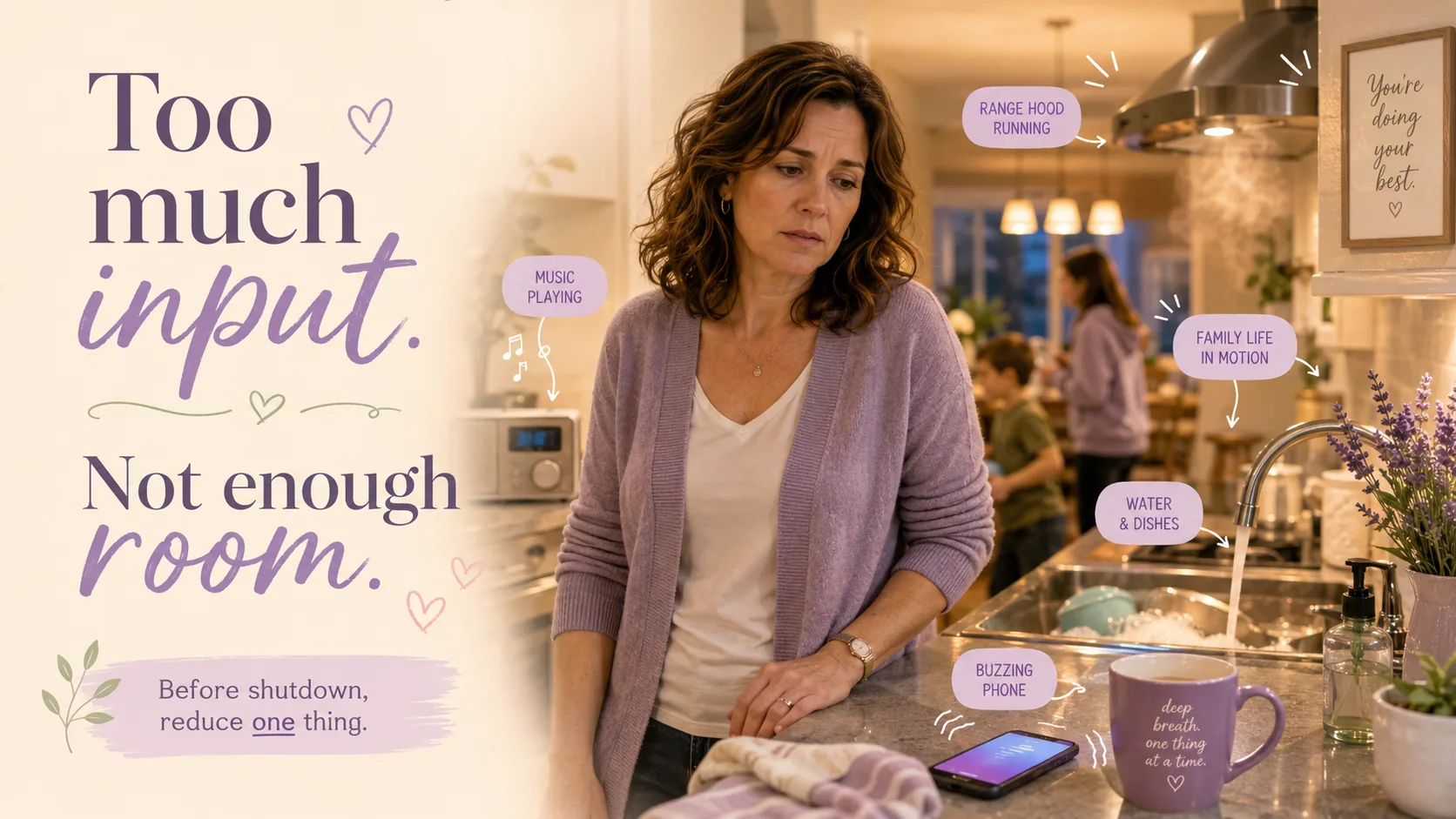
Six in the evening, in my own kitchen. The extractor fan on, the tap running, the radio going, someone asking me what is for dinner, and a phone buzzing on the counter. None of it is loud. Together it stops being separate sounds and becomes one solid wall of noise pressing on the side of my head.
I stood there with a colander in my hand and could not decide what to put down first. Not upset. Not angry. Just completely unable to process one more thing.
For years I thought this meant I was a bad-tempered person who could not cope with normal family life. What it actually meant was that my nervous system had run out of room, and I had no plan for what to do in the minutes before it turned into the flat, useless fog that would take the rest of the evening.
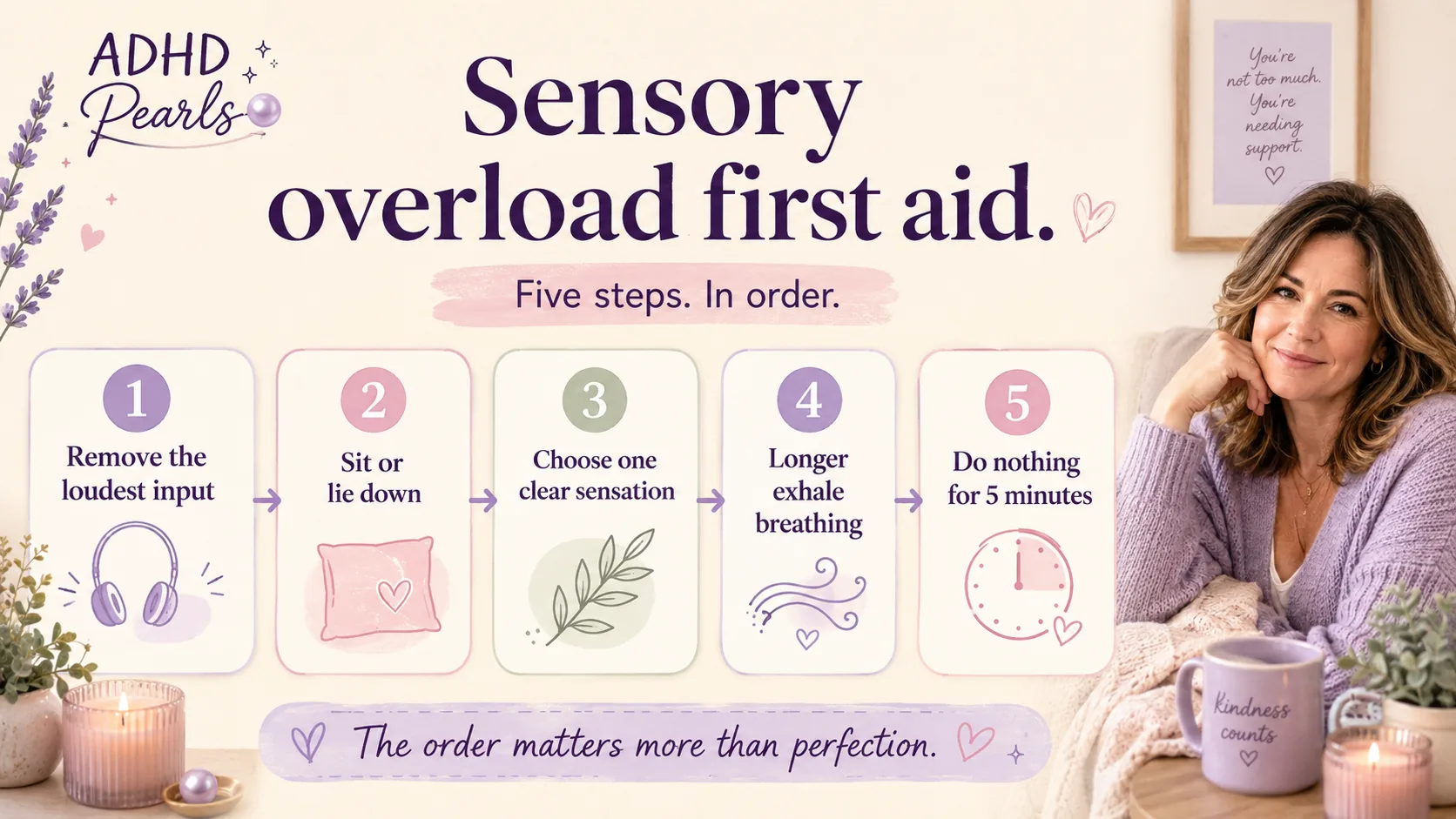
This is the plan I have now. It takes five minutes, the order matters more than the individual steps, and it works best if you start before you are certain you need it.
Quick answer
What do I do when I am overstimulated with ADHD?
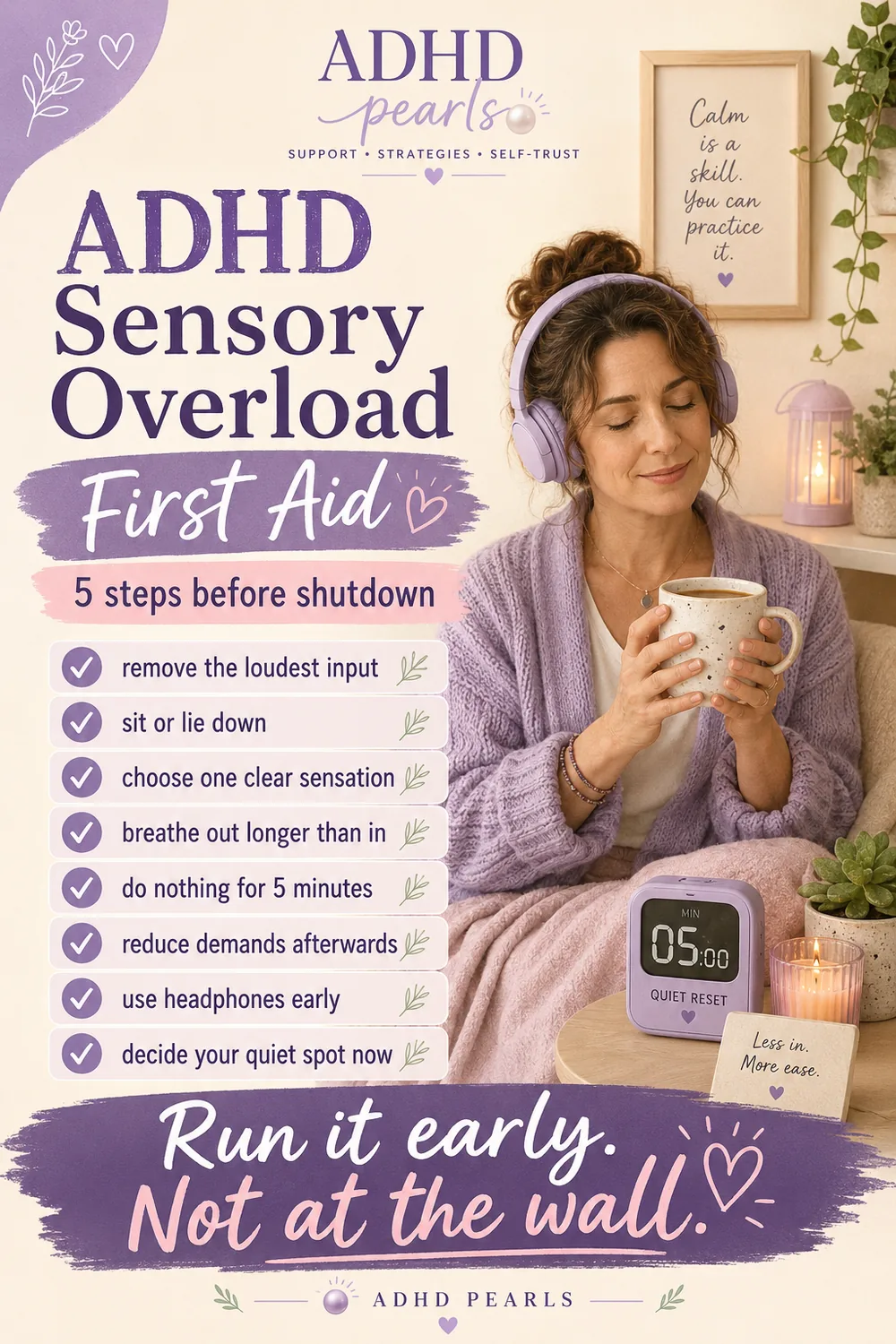
Five steps, in order. Cut the loudest input first — sound before light, light before people. Sit or lie down so your body is supported. Give yourself one clear physical sensation. Breathe with the exhale longer than the inhale. Then stay still longer than feels necessary. The order matters more than any single step.
Key takeaways
📌Run the five steps in order. The order matters more than any individual step.
📌Cut the loudest input first: sound before light, light before people.
📌Overload, shutdown and meltdown are different states and need different responses.
📌Overload can look like a panic attack, but the trigger is sensory input rather than fear.
📌Stay still longer than feels necessary. Coming back too quickly restarts the whole thing.
Nobody in overload reads an article first. So here is the whole thing up front, and the explanations afterwards.
1. Remove the loudest sensory input
Not all of it. The loudest one. Turn off the sound, dim or kill the bright light, or step away from the people - in that order, because sound is usually the input stacking fastest.
The mistake I made for years was trying to fix everything at once and therefore fixing nothing. One input, removed completely, does more than four inputs reduced slightly.
2. Sit or lie down
Stop standing. A sofa, a bed, the floor, the closed lid of the toilet if that is the only door that locks.
Standing costs your body continuous small effort you do not notice until you stop paying it. When I finally sit down I can usually feel the difference in about twenty seconds, which still surprises me every time.
3. Give yourself one clear physical sensation
One, not several. A warm drink held in both hands, a warm shower, warm water over your hands at the sink, or something cool against the back of your neck if you run hot when you are overloaded.
The point is a single, gentle, unmistakable signal that your attention can rest on instead of the chaos. It should be comfortable - nothing sharp, painful or shocking. If a sensation makes you flinch, it is one more thing to process, not a way out.
4. Slow your breathing, with a longer exhale
Four counts in, six counts out. Three to five rounds. That is the whole instruction.
This is the one step with proper evidence behind it. Your heart rate speeds slightly on the inhale and slows on the exhale, and stretching the exhale out leans on that brake. One study found five minutes of slow breathing with a longer exhale measurably increased parasympathetic activity and reduced anxiety in a single session.
Counting also occupies the part of your mind that would otherwise be narrating how badly this is going.
5. Do nothing for five minutes
No phone. No task. No deciding what to do next. This is the step everyone skips, including me, and it is the one that determines whether you come back into the evening or spend it in fog.
Five minutes of nothing feels much longer than it is. Set a timer so you are not also managing the clock.
The protocol works best as a sequence. Reduce input first, then ask your body to come down.
The order matters more than the steps. Remove input, get your body supported, give it one thing to hold, slow the exhale, then stop.
From ADHD Pearls
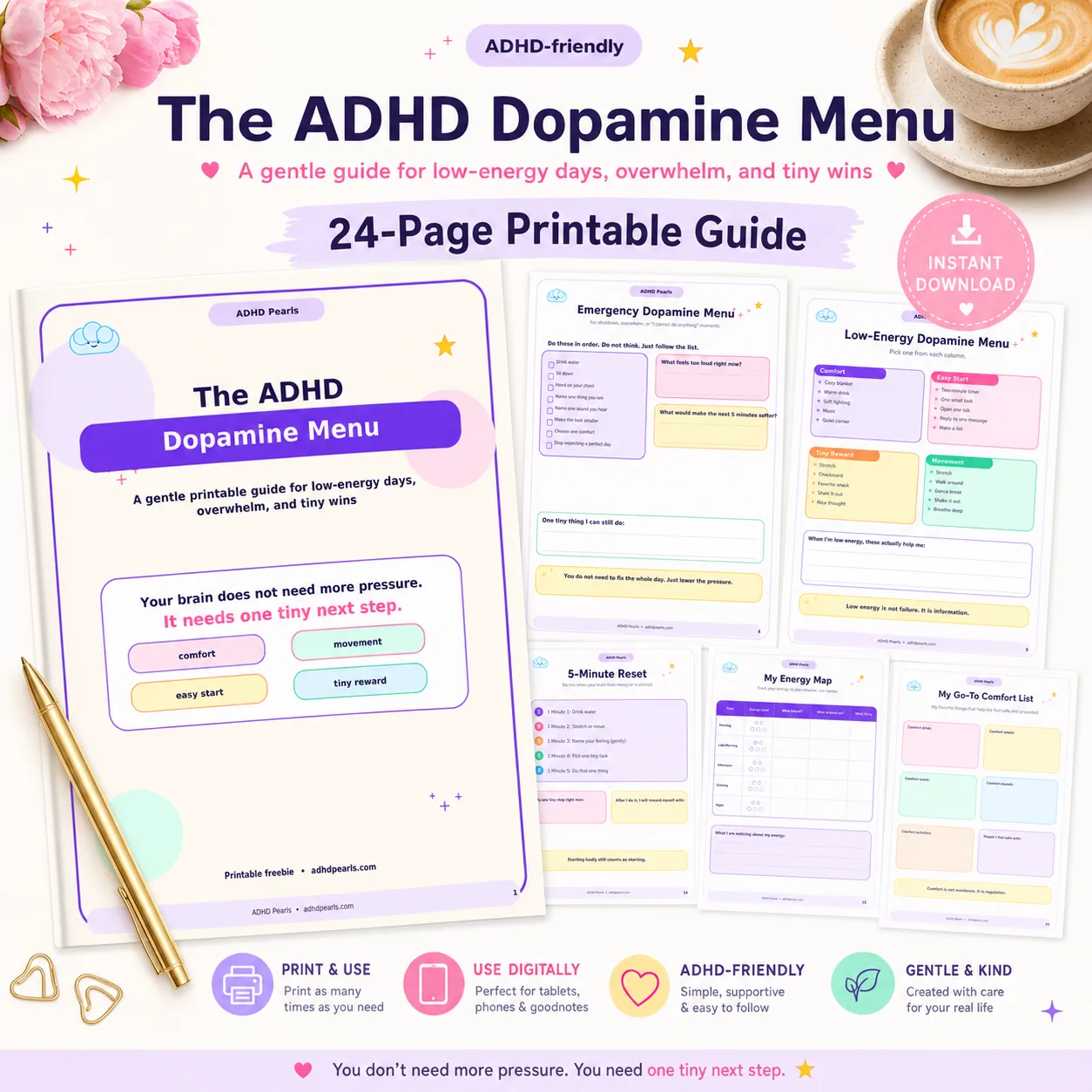
Free Dopamine Menu
24 tiny activities for low-energy, low-capacity days.
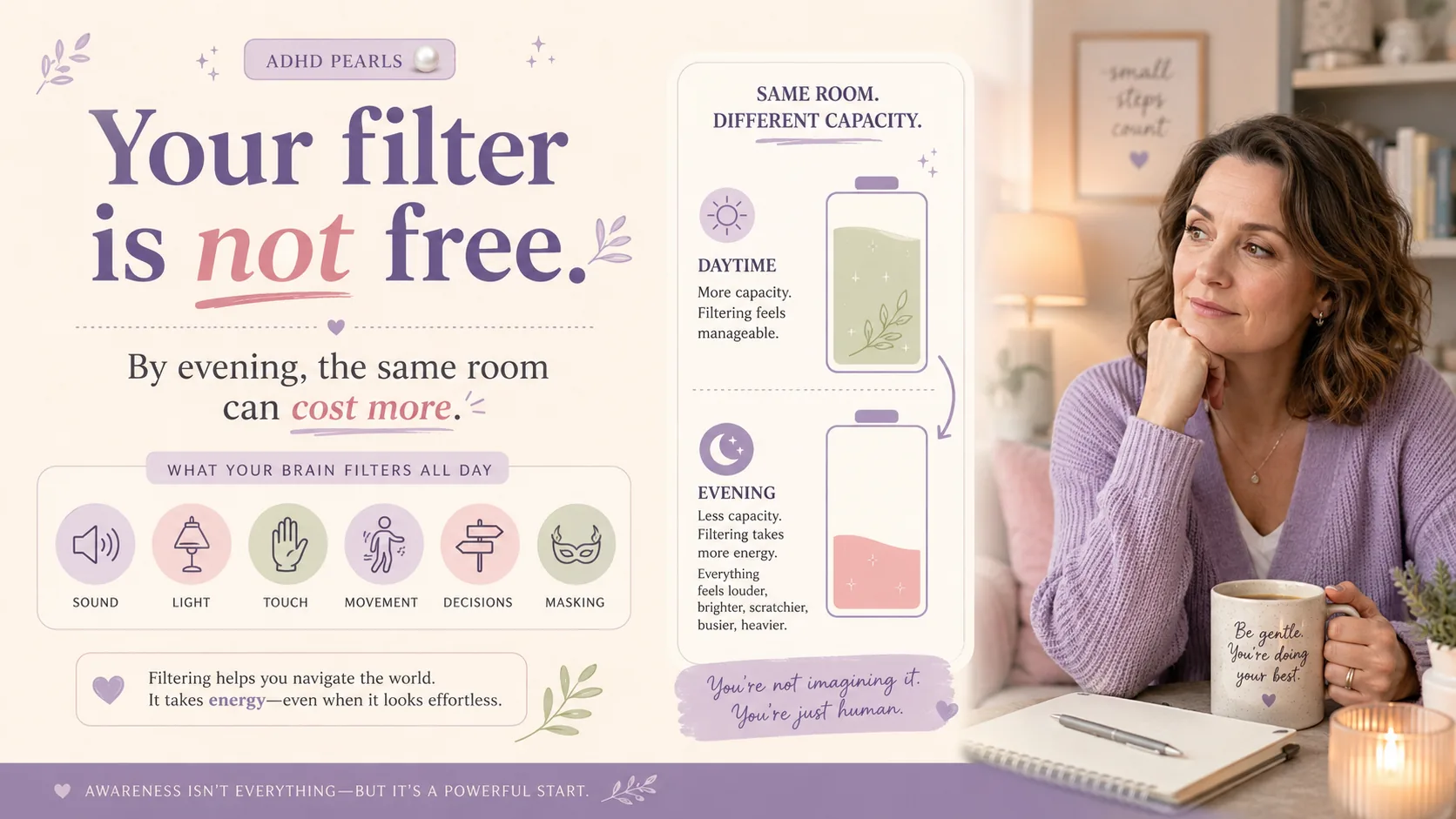
Most brains dim what does not matter. The hum of a fridge fades. A conversation two tables away stays background. That filtering is automatic and free.
With ADHD it is neither automatic nor free. Sound, light, touch and movement arrive closer to full volume, and something in you spends the whole day turning them down manually. It is work, it is invisible, and it is why you can be exhausted after a day in which, on paper, nothing happened.
This is better documented than most people realise. A 2025 meta-analysis in the Journal of the American Academy of Child and Adolescent Psychiatry pooled 30 studies and 5,374 participants and found significantly more severe sensory differences in people with ADHD than in control groups - across sensitivity, avoiding, seeking and low registration alike.
The authors added the part I keep coming back to: current ADHD clinical guidelines do not tell clinicians to assess sensory processing at all, and they argue that should change.
Which explains something a lot of women describe. You get assessed, you get a diagnosis, nobody mentions sensory anything, and you carry on assuming the noise thing is a personality flaw you should have grown out of.
This article is educational and is not medical advice. Sensory overload overlaps with anxiety, panic, migraine, autism and perimenopause, and untangling that is a job for a clinician who can actually assess you. If this is frequent, frightening, or getting worse, please take it to your doctor rather than managing it alone.
Capacity is a budget, not a trait
The same kitchen is fine at ten in the morning and unbearable at six in the evening. Nothing about the kitchen changed. What changed is that by six I have spent the day filtering, masking, deciding and absorbing, and there is nothing left to absorb with.
Once I understood that, I stopped asking why I was suddenly so sensitive and started asking what I had already spent. It is a much more answerable question, and it is the same logic behind planning around energy rather than hours.
The room may not have changed. Your filtering capacity may simply be lower by the end of the day.
Overload, Shutdown, Meltdown
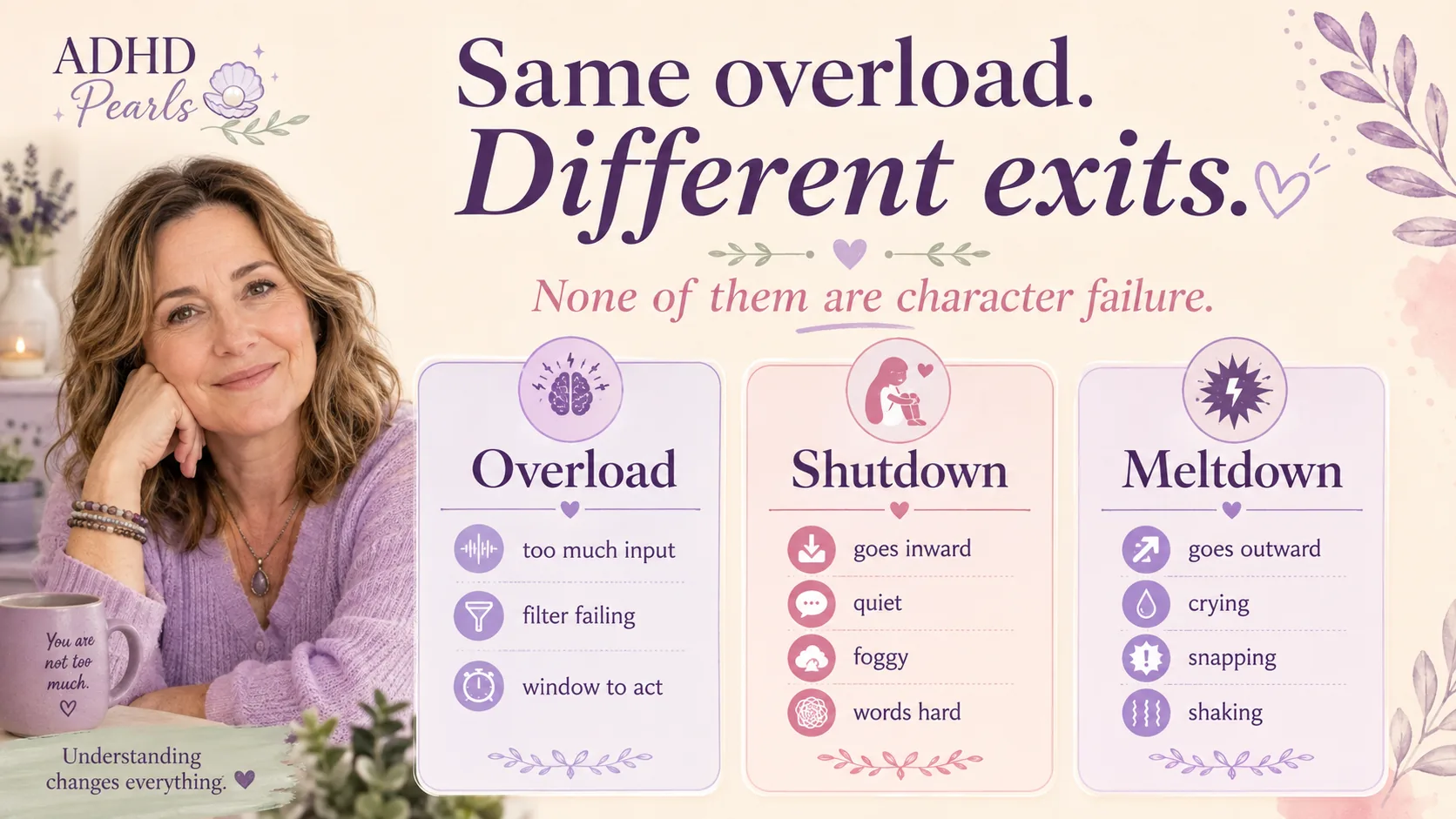
These get used interchangeably and they are not the same thing. Knowing which one is happening tells you what to do.
Overload is the state - too much input, filter failing, everything pressing in. This is the window where the protocol works.
If your overwhelm is not specifically sensory - if it is demands, decisions and mental load rather than noise and light - the same idea sorted by how much capacity you have left will fit better than this protocol.
Shutdown is one exit. Everything turns inward. You go quiet and still, words get hard, and you can look completely fine from the outside while nothing is reaching you. Shutdowns tend to last longer, precisely because there is no visible release.
Meltdown is the other exit. Everything turns outward - crying, snapping, shaking, saying the thing you will apologise for later.
Mine goes to shutdown almost every time, which is part of why it took me so long to recognise. There was nothing dramatic to point at. I just went vague, and everyone including me read it as being tired or in a mood.
Neither exit is a character failure. Both are a nervous system past capacity, choosing a direction. And if the emotional side of this is the part that hits hardest for you, emotional dysregulation in ADHD covers that territory in more depth.
Overload, shutdown, and meltdown are not moral failures. They are different exits from too much input.
Is It Overload or a Panic Attack?
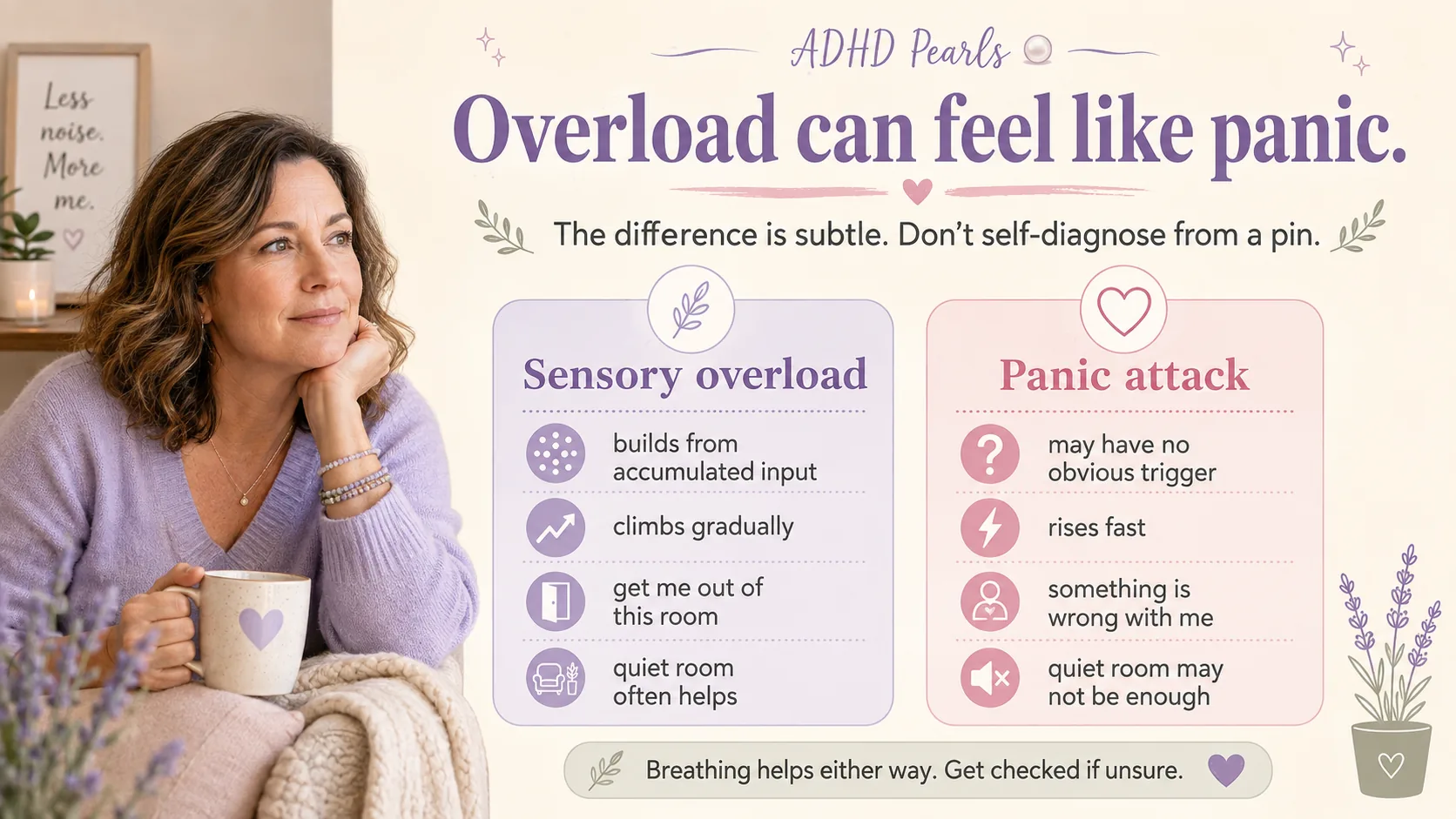
From the inside they are almost identical - heart going, chest tight, a strong need to get out. The differences are real but subtle, and I want to be careful here, because this is exactly the kind of distinction that needs a clinician rather than an article.
Sensory overload
Panic attack
Builds from
Accumulated input - noise, light, touch, people
Often no obvious trigger at all
Shape
Climbs gradually, sometimes over hours
Rises fast, usually peaks within about ten minutes
The fear part
Mostly "get me out of this room"
Often "something is badly wrong with me"
Quiet room helps
Usually yes, fairly quickly
Not reliably
Useful to know: the breathing step is worth doing either way. It is the one part of the protocol that helps both.
If you cannot tell them apart, if it happens often, or if you have any chest symptoms you have not had checked, please see a doctor. This is not a wait-and-see situation and it is not something to solve with a blog article.
Overload and panic can feel similar from the inside. Use grounding tools, and get medical support if symptoms are new, intense, or unclear.
What Helps Afterwards
Here is the part almost nobody warns you about: recovery takes longer than the episode.
Twenty minutes of overload can leave you flat for the rest of the evening. Slow, heavy, faintly stupid, unable to face anything that requires a decision. I used to treat that as evidence that I had wasted the day and should now push harder to make up for it, which reliably made the following day worse.
The flatness is neurological. It is your system recovering, not you being lazy. Treat it the way you would treat the hour after a migraine - reduce demands, expect less, do not schedule anything that needs judgement.
What actually helps in that window is low-stimulation and low-decision. Something familiar rather than something new. And ideally not scrolling, which feels like rest and is in fact more input - a distinction I have written about in fake rest versus real rest.
Say no to one thing that evening. Just one. It is nearly always possible and it nearly always shortens the tail.
One season is worth flagging on its own: December stacks noise, crowds, bright shops and social demand into a single month, which is why so many people meet their worst overload of the year at a family gathering. The Christmas survival strategies cover that specifically.
Making It Happen Less Often
You cannot sensory-proof a life. You can shave the peaks, and small structural changes do more than willpower.
Treat sound as the first lever. Noise-cancelling headphones or filtered earplugs, used early rather than as a rescue. Prevention is much cheaper than recovery.
Never stack inputs voluntarily. No radio while cooking while talking. It sounds obvious written down and I still catch myself doing it most weeks.
Give the evening a lower ceiling. If capacity is lowest at six, that is not the hour to also handle a difficult phone call.
Keep the clothes that do not fight you. Being uncomfortable all day is a background input you stopped noticing - which is the whole argument in why clothes feel wrong some days.
Lower the noise the house itself makes. Visual clutter is input too, and a home that feels too loud is running a tax on you all day.
Run the protocol early. At the first "I cannot take much more of this", not at the wall. Five minutes then saves an evening later.
If this got worse in your forties
A lot of women describe sensitivity ramping up in their forties and assume they are becoming impossible to live with. Falling and fluctuating estrogen in perimenopause affects the same systems that support attention and regulation, and coping strategies that quietly worked for twenty years stop being enough.
It is common and it is worth raising with your doctor rather than absorbing. ADHD burnout in perimenopause goes into what that overlap looks like.
One Tiny Move
Do not wait for the next bad evening to work out where you will go. Decide now.
Pick the room in your house with a door, a light you can turn off and somewhere to sit. That is your spot. Put one thing in it - a blanket, headphones, whatever counts as your one sensation - so that future you does not have to organise anything at the exact moment she cannot organise anything.
That is the entire preparation. The protocol works much better when the room is already decided.
One object worth owning before you need it: filtered earplugs of the conversation kind, which pull the background roar down without muting speech. They are on our list of gifts for adults with ADHD that actually get used, with a note on which model to choose.
Worth separating from its opposite: this protocol is for too much input. When the problem is too little — a boring task your brain will not switch on for — adding sound can genuinely help, and we covered when it does and when it backfires in ADHD and music.
Save this for the next time your nervous system starts saying "too much" and you need a simple first-aid sequence.
Pin this ADHD sensory overload first-aid guide before you need it.
FAQ: ADHD and Sensory Overload
What do I do when I am overstimulated with ADHD?
Run five steps in order. Remove the loudest sensory input first — sound before light, light before people. Sit or lie down so your body is supported. Give yourself one clear physical sensation, like a warm drink or warm hands. Breathe with the exhale longer than the inhale, four counts in and six out, three to five times. Then do nothing at all for five minutes. The order matters more than the individual steps.
Why does ADHD cause sensory overload?
An ADHD brain filters incoming information less efficiently, so sound, light, touch and movement arrive at closer to full volume instead of fading into background. A 2025 meta-analysis of 30 studies and over 5,000 participants found significantly more severe sensory differences in people with ADHD than in controls, across sensitivity, avoiding, seeking and low registration.
What is the difference between an ADHD shutdown and a meltdown?
A shutdown turns inward — you go quiet, still, foggy or non-verbal, and you may seem fine from the outside while nothing is reaching you. A meltdown turns outward, as crying, snapping, shaking or shouting. Both come from the same place, which is a nervous system past its capacity. Shutdowns often last longer because there is no visible release.
How long does it take to recover from sensory overload?
Usually longer than the episode itself, and often a few hours. The flat, heavy, useless feeling afterwards is neurological recovery, not laziness. Planning for it is more useful than being surprised by it every time.
Is sensory overload the same as a panic attack?
No, though they feel similar from the inside. Overload builds from too much input and improves when you reduce input. A panic attack tends to peak within about ten minutes, comes with a strong fear component such as feeling you are dying or losing control, and does not necessarily improve in a quiet room. If you are not sure, or if it happens often, that is worth taking to a doctor rather than working out alone.
Why do I get more overstimulated in the evening?
Because capacity is a budget, not a fixed trait. By evening you have spent the day filtering, masking and deciding, and there is less left to absorb noise with. This is why the same kitchen at 6pm can be unbearable when it was fine at 10am.
Why has my sensitivity got worse in my forties?
Many women report exactly this. Falling and fluctuating estrogen in perimenopause affects the same systems that support attention and regulation, and strategies that used to absorb the noise stop being enough. It is common, it is not you becoming difficult, and it is worth raising with your doctor.
Do noise-cancelling headphones actually help ADHD overload?
For many people they help a great deal, because sound is usually the input that stacks fastest. They work best used early, as prevention, rather than reached for once you are already past your limit. Loop-style filtered earplugs are the lower-profile option if headphones feel too obvious.
How do I explain sensory overload to my family?
Skip the diagnosis conversation in the moment and give them one instruction instead: I need ten minutes with no sound and no questions. Explanations need capacity you do not have mid-overload. Have the longer conversation later, when you can.
One tap makes ADHD Pearls a preferred source in your Google account, so our articles surface higher when you search. No signup, and it brings you straight back to this page.
Before you go
Free Dopamine Menu
24 tiny activities for low-energy, low-capacity days.
For the woman who sets up the perfect system on Sunday and abandons it by Tuesday.
One short letter, every week. Real talk about ADHD, task paralysis, and the tiny wins that actually move the needle for a brain like yours. No shame. No hustle culture.