There was a playlist that worked for about four months. Instrumental, mid-tempo, the same forty minutes on repeat. Put it on, and the tax return that had been sitting there since March suddenly got touched.
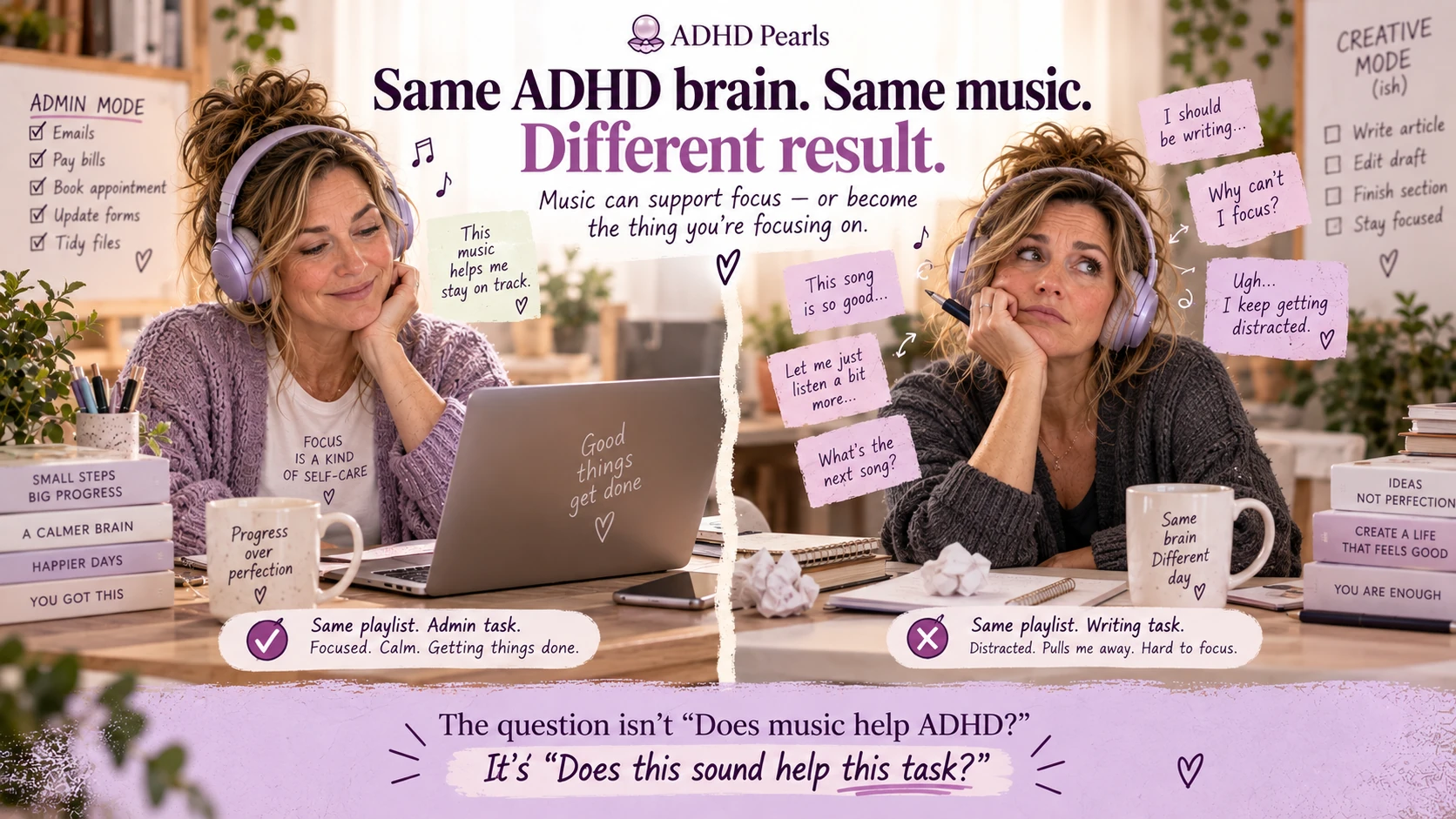
Then one Tuesday we sat down with the same playlist, the same headphones, the same desk — and four hours later there was one paragraph written and a very detailed memory of the chord change at minute six.
Same music. Same brain. Completely different outcome. And the conclusion most of us draw is the wrong one: I must have used it wrong, or I am just worse at this than I was in March.
The research on sound and ADHD is genuinely interesting, and it is a lot less tidy than the internet version. It does not say music is a superpower. It says something more useful: noise helps some ADHD brains on some tasks, measurably hurts others, and the split is not random. 🎧
Quick answer
Does music actually help ADHD focus?
For some people, on some tasks. Moderate background noise appears to improve performance in ADHD by adding stimulation an under-aroused brain is short of. But a 2024 study found no significant effect across a full ADHD sample — the benefit concentrated in people with more inattentive traits. It also depends heavily on the task: the same track that carries you through admin will wreck writing.
Key takeaways
📌Moderate noise can lift ADHD performance, and there is a real mechanism behind it — but it is contested, not settled.
📌It is not universal. Benefit clusters in inattentive profiles; across a whole ADHD sample the effect disappeared.
📌People with ADHD reach for stimulating music exactly when the task is hardest. Neurotypicals do the opposite.
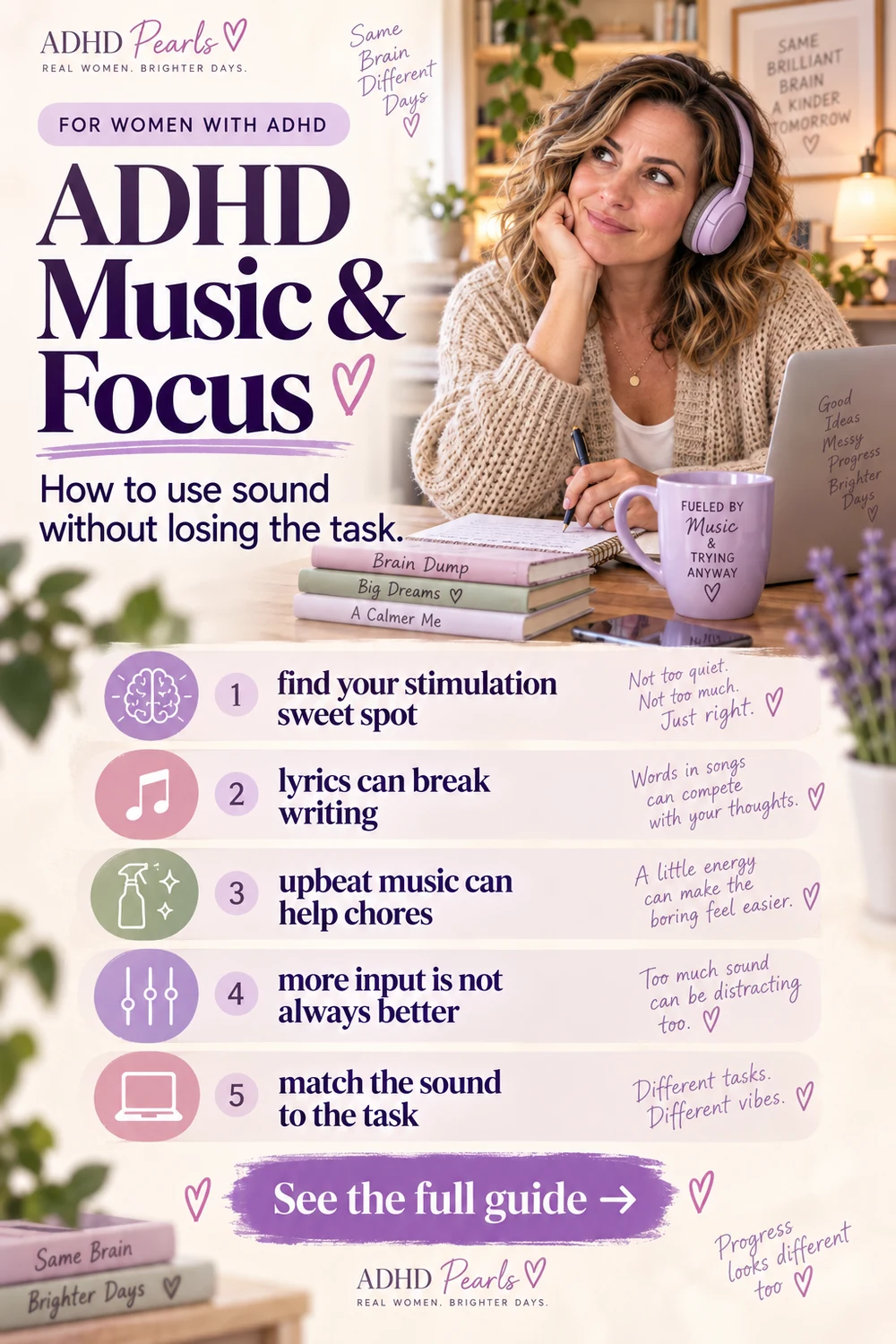
📌Lyrics compete with writing and reading specifically, because both use the same language machinery.
📌If you are choosing tracks, you are not working. Picking is the tell that the music has become the task.
Start with the finding that surprised researchers too. In 2007, Söderlund and colleagues published a paper with the blunt title Listen to the noise: noise is beneficial for cognitive performance in ADHD. Children with attention problems did better on memory tasks with white noise playing. The children without attention problems did worse with the same noise. 🧠
Same room, same noise, opposite results.
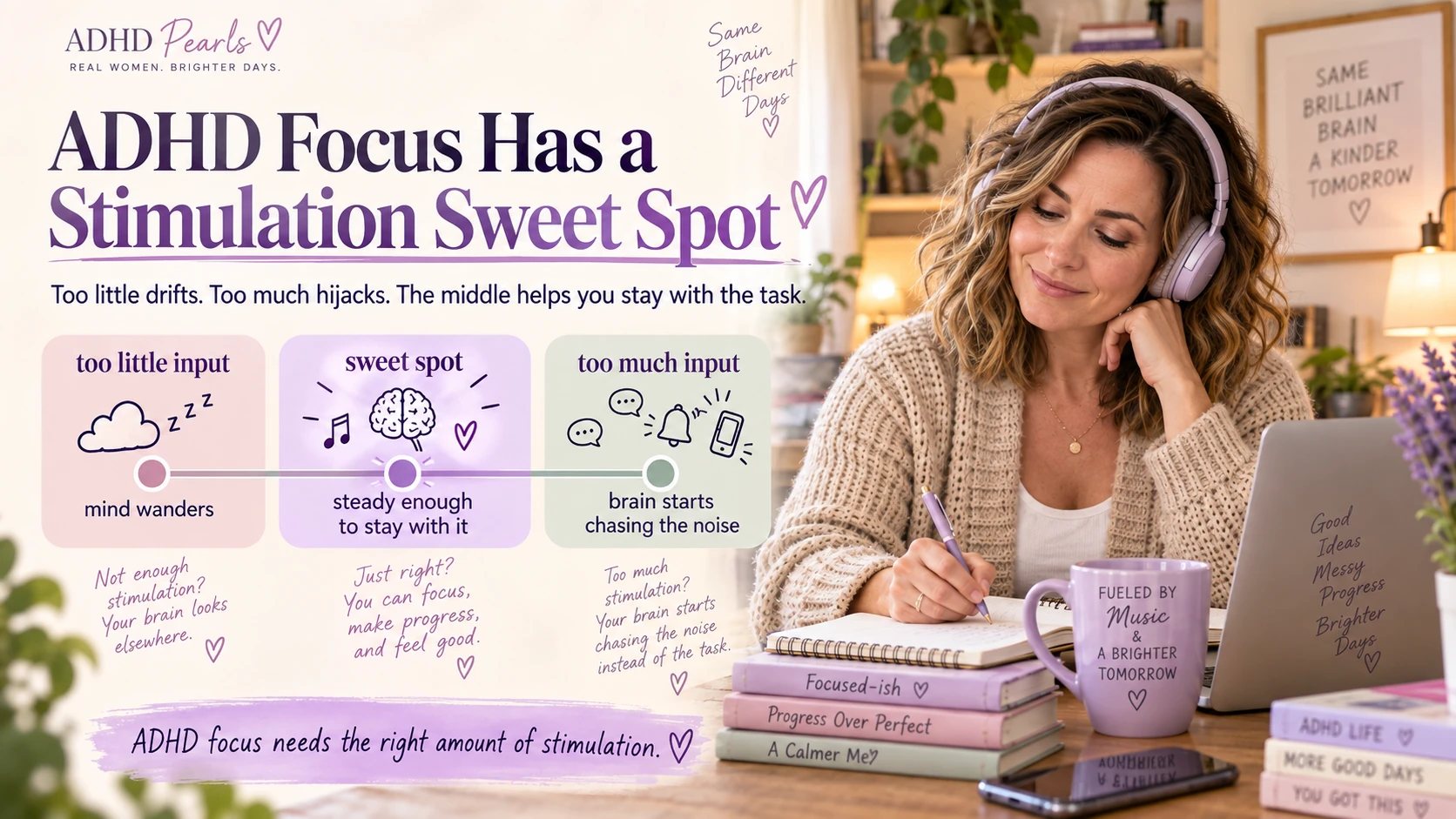
The explanation they proposed is called the Moderate Brain Arousal model, and it borrows an idea from physics called stochastic resonance. In plain terms: some signals are too weak to cross the threshold where your brain registers them. Add a bit of background noise and the weak signal rides on top of it and finally gets through. Too little noise and nothing crosses. Too much and everything is drowned. There is a middle band where it works.
The part that matters for us: where that middle band sits depends on dopamine. A brain with less available dopamine needs more external noise to reach the same place. A brain with plenty needs almost none, which is why your neurotypical colleague finds your playlist unbearable and is not being difficult about it.
You are not adding music because you lack discipline. You are topping up a signal that arrives too quiet.
A 2024 systematic review pooling 13 studies and 335 participants found that white and pink noise did improve cognitive performance in children and young adults with ADHD or significant attention problems. So this is not one odd result from 2007 — it has held up across a body of work.
It is also, honestly, contested. A 2024 paper in Neuropsychologia argued that stochastic resonance may not be the right explanation even if the effect is real. The effect stands up better than the story we tell about it, which is worth knowing before anyone sells you a subscription based on brainwave synchronisation.
The useful level is not the same for everyone. Too little drifts, too much hijacks, and the middle is where the work happens.
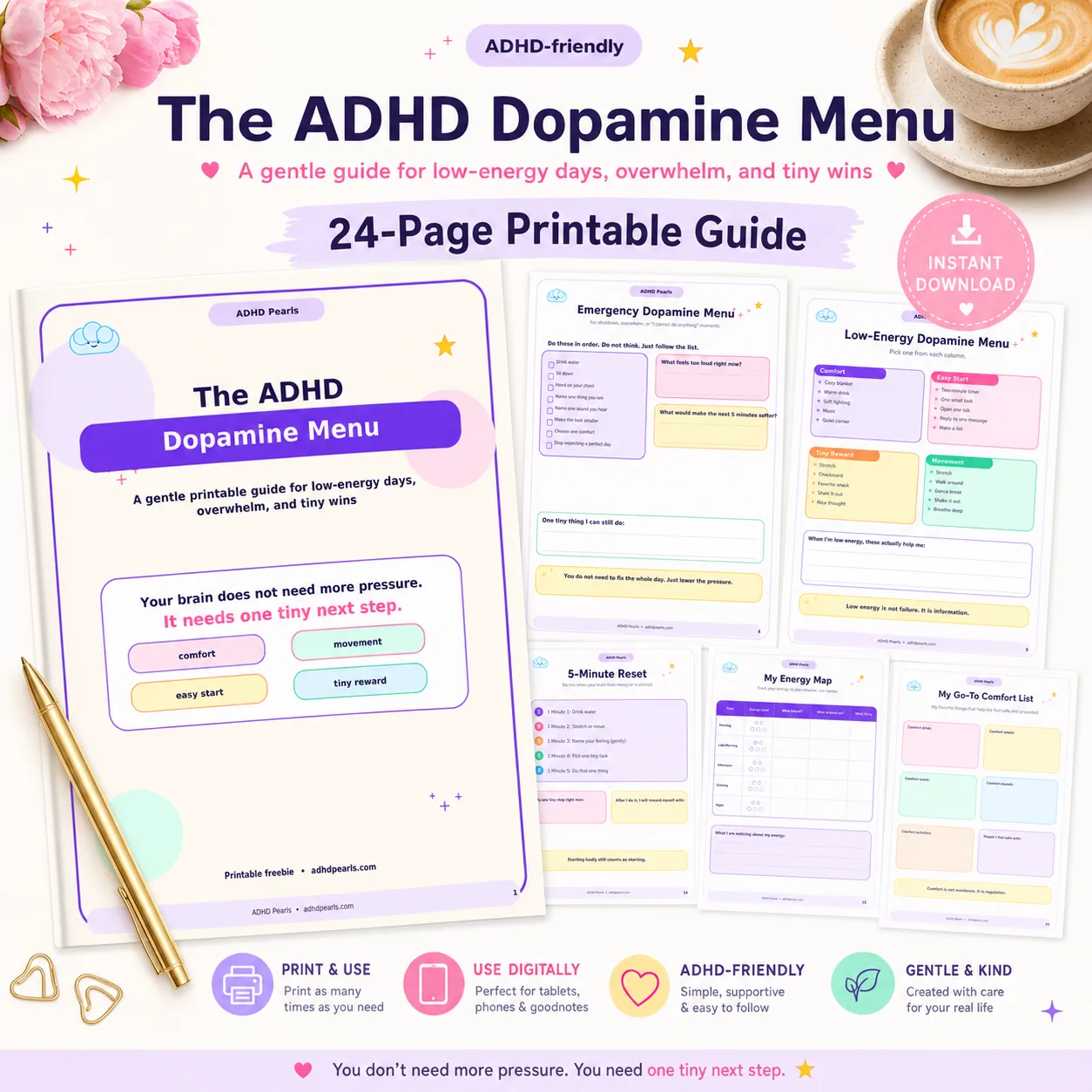
💡 The reason we went looking for any of this: our own low-capacity afternoons used to end with forty minutes of scrolling for the right track and nothing else done — choosing had quietly become the whole activity. What we wanted was a list made in advance, sorted by how much we had left, so the bad day did not require a decision. Nothing like it existed that was not also a productivity system with a streak counter, so we built one. It is a menu, not a plan: twenty-four small options grouped by energy, so the choice is made once and reused. It has not made the bad afternoons good. It has made them shorter, which is a smaller claim and a truer one.
From ADHD Pearls
Free Dopamine Menu
24 tiny activities for low-energy, low-capacity days.
It Does Not Work for Everyone, and the Research Says So Plainly
This is the part the enthusiastic articles leave out, and it is the most useful thing on this page.
A 2024 study asked the question directly in its title: who benefits from noise, and who performs worse? The headline result is uncomfortable. Across the full sample of children with ADHD, there was no significant effect of noise at all. The average washed out.
What was there underneath the average: the children who responded well to noise were the ones with high inattention relative to hyperactivity. For the more hyperactive-presenting children, adding noise did not do the same favour. The researchers' conclusion was that individual differences and symptom profile have to be taken into account rather than applying noise to everyone and hoping.
Two things follow from that, and both are permission rather than instruction.
If music has never worked for you, you are not doing it wrong. You may simply be in the group the average was hiding. That is a real finding, not a consolation prize.
If it works brilliantly for you, that is also real — and it explains why you cannot understand people who need silence, and why they cannot understand you. You are not describing the same nervous system.
Worth saying plainly: these studies are mostly on children and young adults, and mostly on white or pink noise rather than actual music. Applying them to a forty-five-year-old woman with a Spotify playlist is a reasonable inference, not a proven fact. We would rather tell you that than round it up.
The Stimulation Trap 🎧
Here is the finding that reframed the whole topic for us, and it is recent.
In January 2025, researchers surveyed 434 young adults aged 17 to 30 about what they actually listen to, and when. The ADHD-screened group reported listening to background music more than the neurotypical group during studying and during low-demand activities like sport and cleaning. No surprise there.
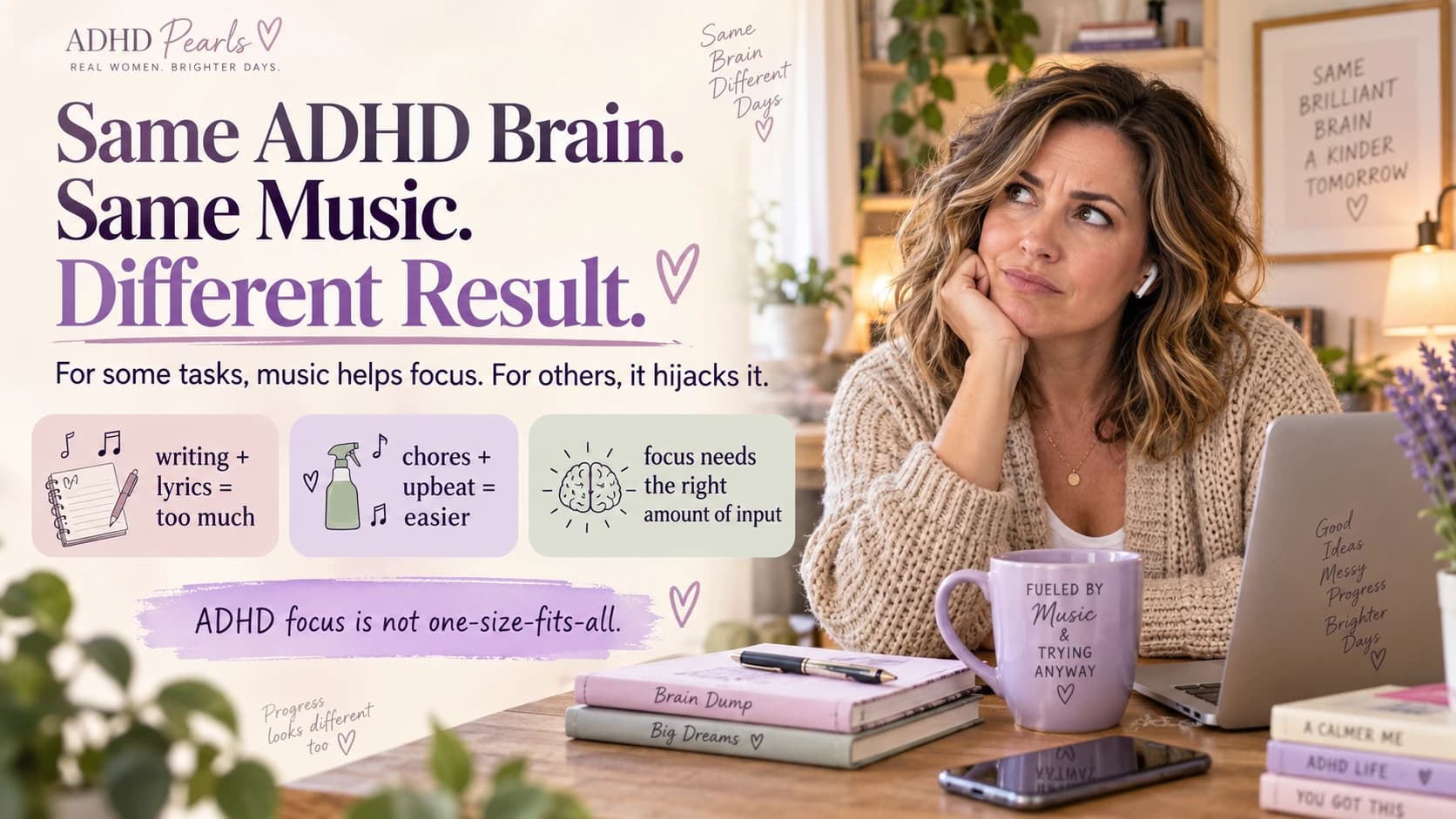
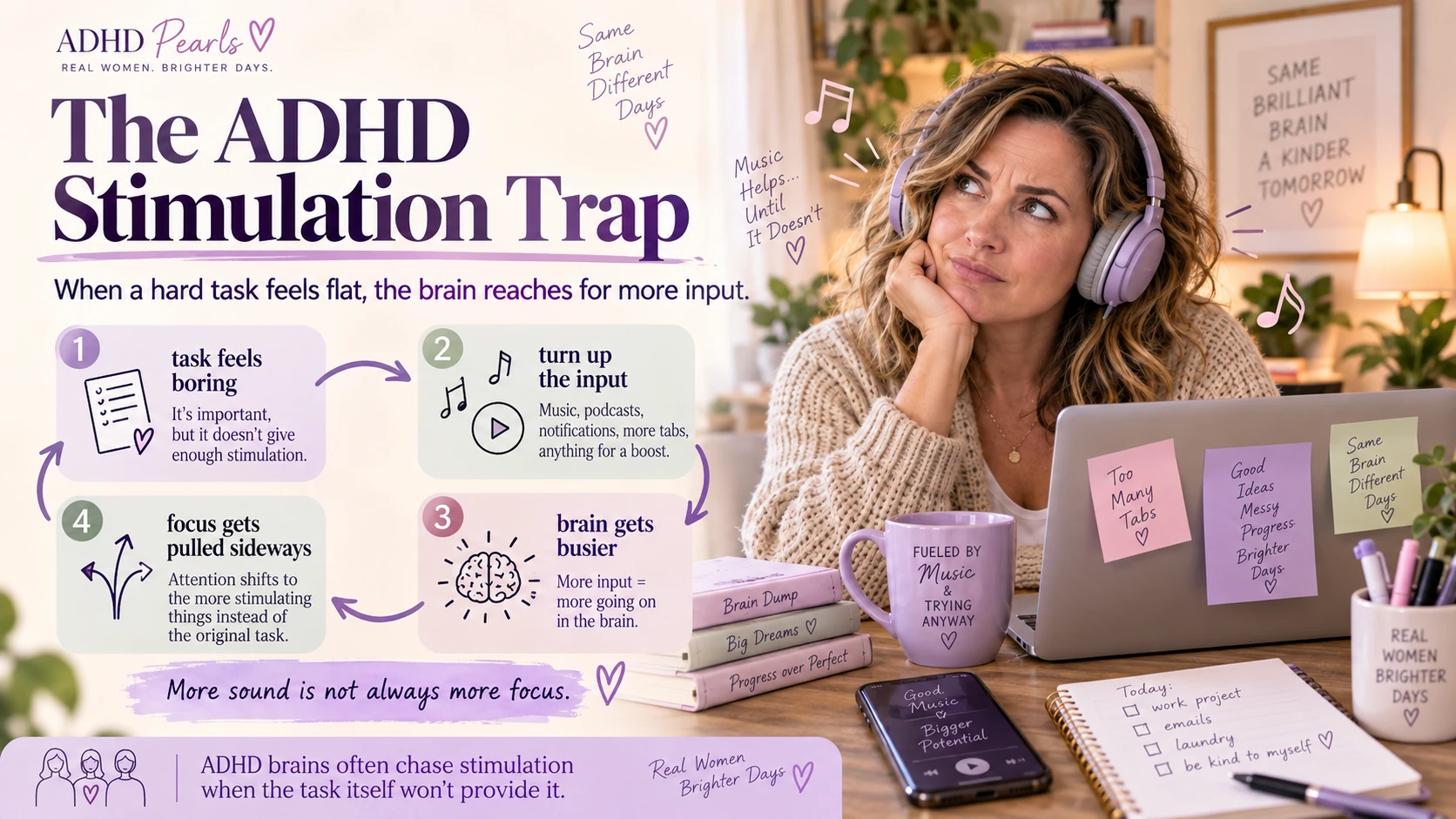
The surprise was the type. People with ADHD reported reaching for stimulating music regardless of how demanding the task was. The neurotypical group did something different: when the task got cognitively heavy, they shifted towards calmer, more familiar music.
Read that again with your own Tuesday in mind. We turn the stimulation up precisely when the task needs the most from us. Everyone else turns it down.
More sound is not always more focus. The loop starts with a flat task, not with a lack of discipline.
And it makes complete sense from the inside. A hard task feels aversive, the aversion needs covering, and something with a beat covers it. The problem is that you have now stacked a demanding task and a demanding soundtrack in the same twenty minutes, and one of them is going to win. Usually not the tax return.
This is the same trade-off that shows up in focus hacks generally — adding interest to a boring task works, right up to the point where the interesting thing becomes the task.
🔋 A simple correction that costs nothing: pick the track for the difficulty of the work, not the difficulty of starting. Use the stimulating thing for the two minutes of getting into the chair, then drop to something duller for the work itself. The hard part is the transition, and the transition is over quickly.
Why Lyrics Break Writing Specifically
Almost every guide says avoid lyrics without saying why, which makes it sound like a preference. It is more specific than that, and knowing the mechanism tells you when the rule does not apply.
Language processing is a limited resource. When you are writing or reading, you are running words through it. Words arriving through your ears go through the same place, whether or not you are paying attention to them — you cannot decide not to process speech in a language you understand. Cognitive psychologists call this the irrelevant speech effect, and it is well documented in general, not just in ADHD.
Which means the rule is narrower and more useful than no lyrics ever:
📌Writing, reading, editing, anything verbal — lyrics compete directly. This is where the rule really holds.
📌Spreadsheets, tidying, sorting, data entry, folding laundry — not verbal, so lyrics cost far less. Sing along if it keeps you there.
📌Lyrics in a language you do not speak — a reasonable middle ground. Your language system has nothing to grab.
So the answer to can I listen to music with words is not no. It is: not while you are using words.
The same playlist, an hour apart. The question was never whether music helps ADHD - it is whether this sound helps this task.
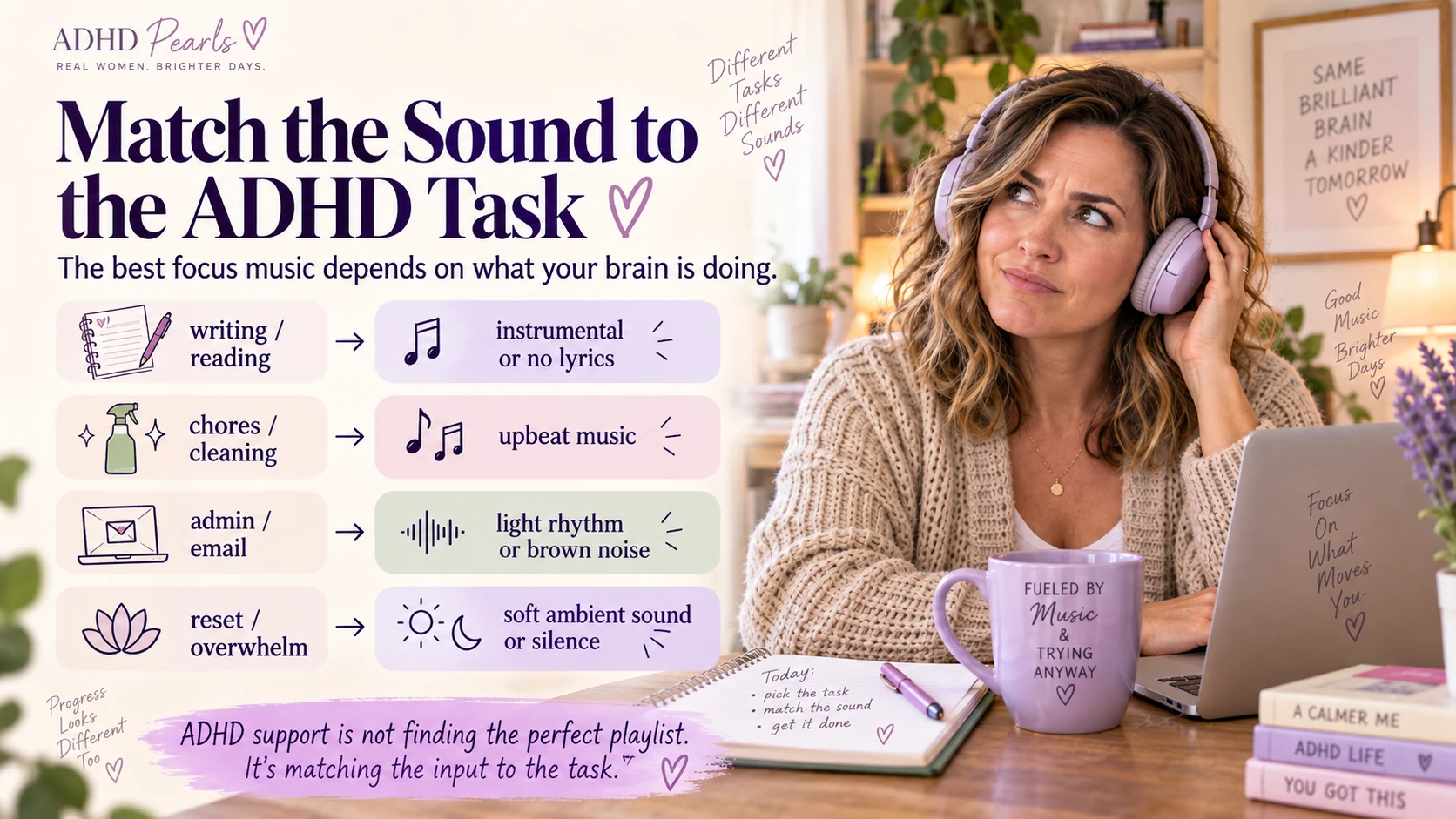
Match the Sound to the Task
Pulling it together into something you can use without thinking about it. 🌀
The task
What usually works
What backfires
Writing or reading
Instrumental, familiar, low variation. Or plain white noise.
Anything with words. Anything new enough to make you listen.
Admin, forms, email
Whatever keeps you in the chair. Lyrics are fine here.
Silence, usually — the dread has nothing to sit under.
Boring physical jobs
The most stimulating thing you own. A podcast counts.
Very little. This is the safest place for loud.
Learning something new
Silence or steady noise. New material is already the stimulation.
Music you love. It will win.
Already overloaded
Less input, not different input. Take the headphones off.
Adding a calming playlist on top. It is still more input.
Not one perfect playlist. A different amount of input depending on what the task is asking for.
That last row is the one people get wrong most often. When you are past your limit, music is not regulation — it is another thing arriving. The protocol for that state is the opposite of this article, and we wrote it up separately in sensory overload first aid.
Is It Working, or Is It Just Nice?
Music is pleasant, which makes it very hard to evaluate honestly. Four tells that it has stopped helping:
1. You are choosing. If you have skipped four tracks in ten minutes, the music is the task now. Choosing is stimulating; that is the whole problem.
2. You can report the music afterwards. Remembering a specific chord change means attention went there. Working music should be slightly boring and largely unremembered.
3. The volume keeps creeping up. Usually a sign you are chasing a hit rather than covering a floor. Studies that find a benefit use moderate noise, not loud.
4. You cannot start without it. Useful most of the time, and worth noticing — a tool you cannot work without has become a condition, and conditions fail on trains, in waiting rooms and in open-plan offices where headphones are not always an option.
The cheap test: work one twenty-minute block with your usual sound and one without, on the same kind of task, and write down what actually got done. Not how it felt. What got done. Feeling is exactly what music alters, so feeling is the one measure you cannot trust here.
One Tiny Move
Do not build a system of playlists. That is a project, and projects are what we are avoiding.
Make one playlist, today, for one kind of task, and never look at it again. Instrumental, long enough that it does not end, dull enough that you would not choose it for a drive. Give it a boring name. Then next time you sit down to write, press play on that and nothing else.
One list, one job, no choosing. The choosing was always the expensive part. 📌
FAQ: ADHD and Music
Does music actually help ADHD focus? For some people on some tasks. Research on moderate background noise shows real improvements in ADHD performance, but a 2024 study found no significant effect across a full ADHD sample — the benefit concentrated in people with more inattentive traits. It also depends on the task: sound that helps with admin often hurts writing.
What is the best type of music for ADHD focus? Instrumental, familiar, repetitive and slightly boring is the safest default, because it adds stimulation without demanding attention. For verbal work, plain white or pink noise often beats music entirely. There is no single best genre — the useful question is whether the sound is interesting enough to notice, because if it is, it will compete.
Why can't I focus with music even though everyone says it helps? Because it genuinely does not help everyone. The 2024 research found the benefit sits mainly with more inattentive presentations, and washed out across the whole sample. If music has never worked for you, that is a plausible profile difference rather than a failure of technique.
Does white noise help ADHD? A 2024 systematic review of 13 studies and 335 participants found white and pink noise improved cognitive performance in children and young adults with ADHD or elevated attention problems. The effect is better established than the explanation for it, and individual responses vary a lot.
Why do lyrics make it harder to concentrate? Because words you hear go through the same language processing you are using to write or read, and you cannot switch that off for a language you understand. It is specific to verbal tasks. For folding laundry or entering data, lyrics cost you very little.
Do binaural beats work for ADHD? The evidence is weak and mixed, and much weaker than the marketing around them. If you enjoy them and they help you settle, there is no harm in using them — but we would not pay a subscription on the strength of the current research.
Why do I need music to do boring tasks? Because boring tasks are under-stimulating, and an ADHD brain is often short of the internal stimulation that makes dull things tolerable. Adding sound tops up the gap. That is a workaround worth using, not a character weakness.
Is it bad to always work with headphones on? Not inherently, but it is worth noticing if you cannot work without them, because that turns a tool into a requirement and requirements fail in the wrong room. Occasionally working without them keeps the option open.
Should I listen to music when I am overwhelmed? Usually not. When you are past your sensory limit, a calming playlist is still additional input. Reducing input works better than swapping it. Music helps with under-stimulation, not over-stimulation, and telling those two states apart is most of the skill.
Save this for the next time your perfect focus playlist quietly becomes the reason you are not focusing.
This article describes published research and lived experience. It is not medical advice, and no playlist treats ADHD. If focus difficulties are affecting your work, health or relationships, that is worth raising with a clinician who understands adult ADHD rather than solving alone.
🧠 And for the afternoons when the problem is not which track — it is that nothing at all feels startable — the free Dopamine Menu is the list we made so that choosing stops being the first hurdle. Twenty-four small options sorted by how much you have left, decided in advance by a version of you who had capacity. It will not fix a bad afternoon. It reliably shortens the part where you stare at the wall deciding, and on those days that is the part that costs the most.
Same brain, different Tuesday. That is allowed. 🎧
Found this helpful? Share it with someone who gets stuck too.
One tap makes ADHD Pearls a preferred source in your Google account, so our articles surface higher when you search. No signup, and it brings you straight back to this page.
Before you go
Free Dopamine Menu
24 tiny activities for low-energy, low-capacity days.
For the woman who sets up the perfect system on Sunday and abandons it by Tuesday.
One short letter, every week. Real talk about ADHD, task paralysis, and the tiny wins that actually move the needle for a brain like yours. No shame. No hustle culture.