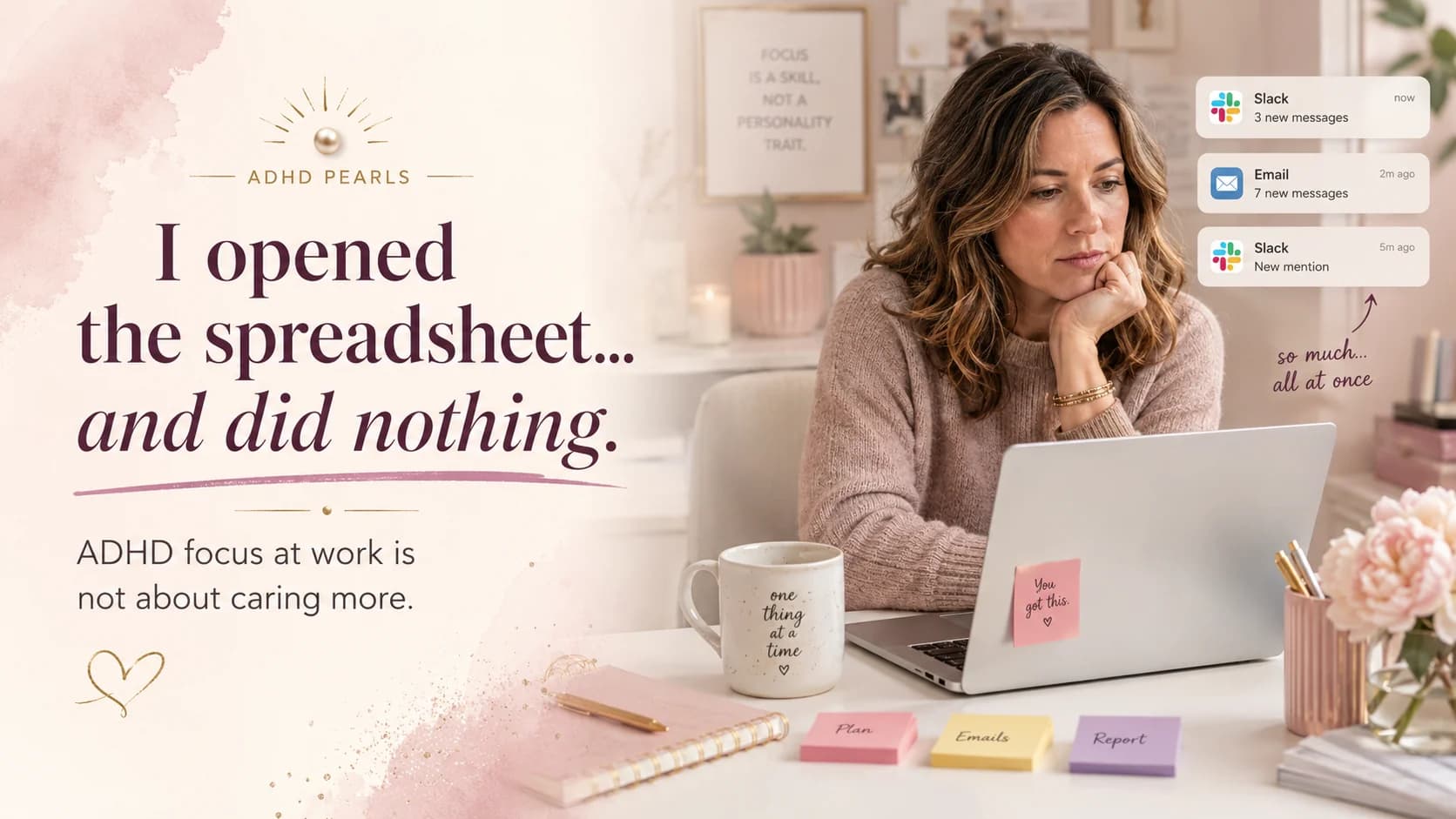
I once sat in front of a spreadsheet for an hour and typed exactly nothing into it.
Not because it was hard. Three columns, some numbers, a formula I'd used a hundred times before. My manager needed it by end of day. I wanted to do it. I opened it at 9am with every intention of finishing by 9:20.
At 10am I had reorganized my desktop icons, read half a Wikipedia article about lighthouses, answered four Slack messages that weren't urgent, and refilled my water bottle twice. The spreadsheet sat there, untouched, judging me quietly.
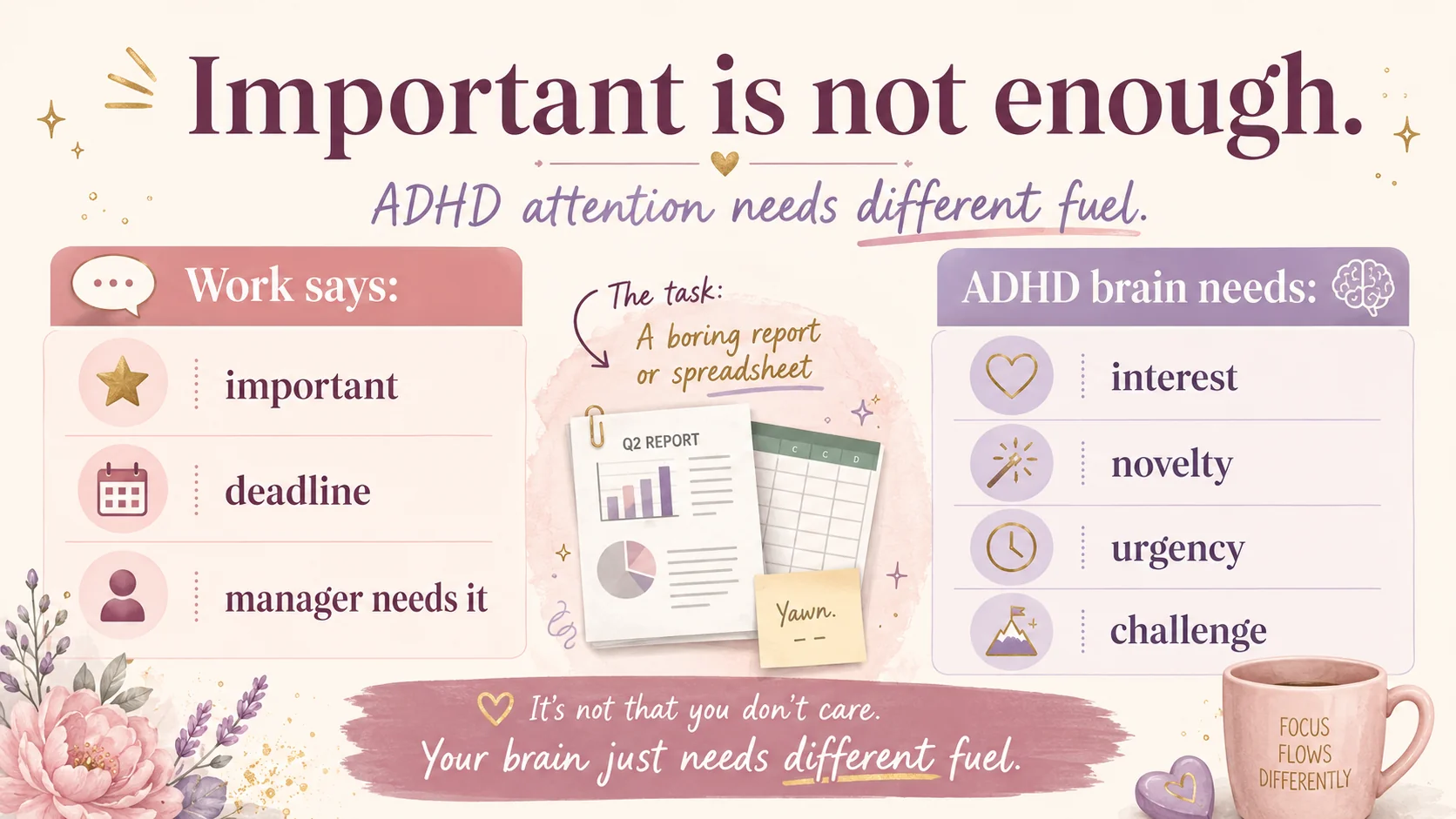
I used to think this meant I didn't care enough about my job. Then I found out what was actually happening: my brain doesn't hand out focus for "important." It hands out focus for interesting, urgent, or new — and a routine spreadsheet at 9am on a Tuesday is none of those things.
This is personal and educational, not medical advice. Focus problems at work can come from ADHD, but also from burnout, depression, anxiety, sleep issues, thyroid problems, or a genuinely bad job fit. If this is seriously affecting your work or wellbeing, a qualified professional can help you sort out what's actually going on.
Quick answer
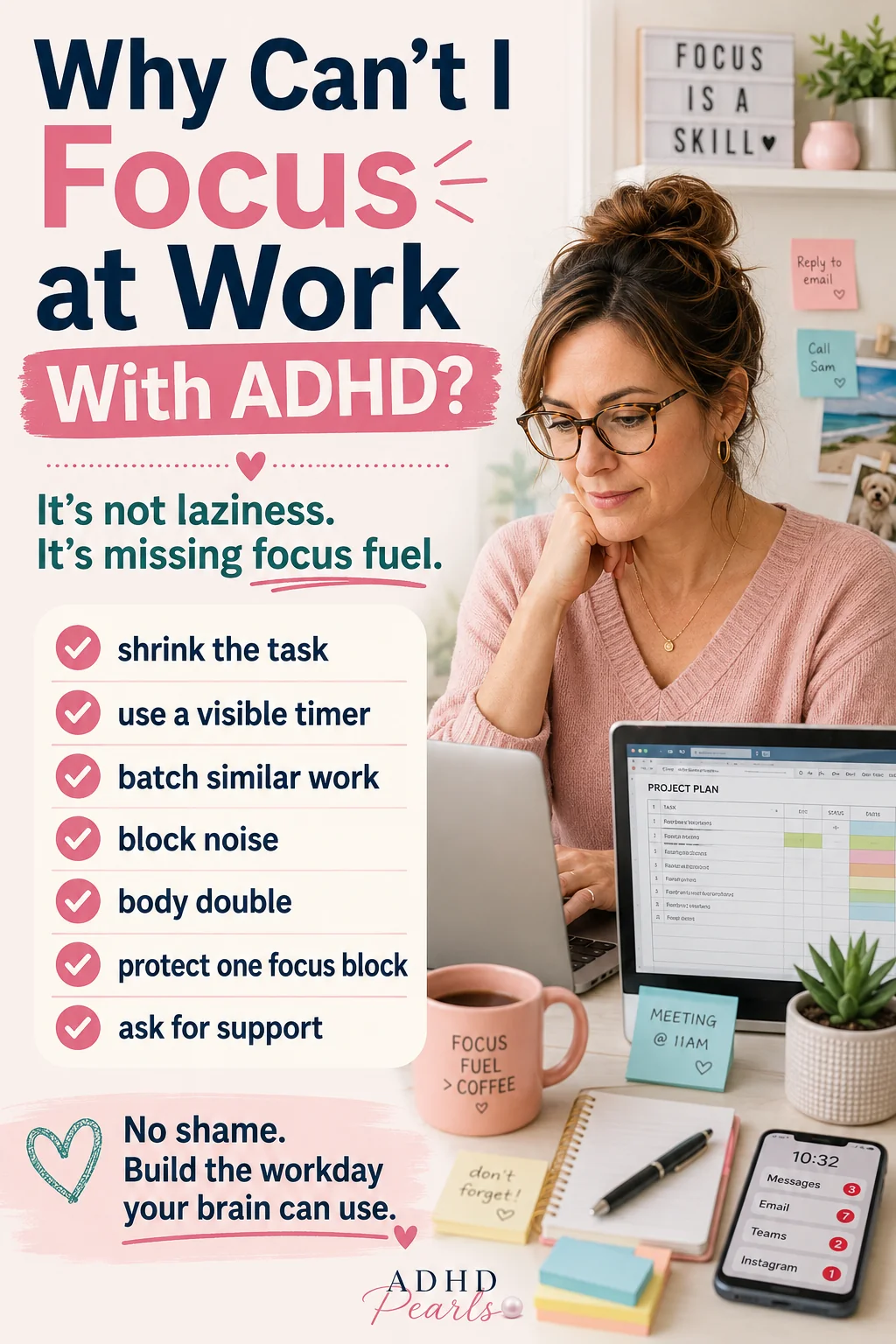
Why can't I focus at work with ADHD?
Because ADHD attention responds to interest, novelty and urgency, not importance or deadlines alone. Routine tasks, open-office noise, back-to-back meetings and constant task-switching all draw from the same limited pool of attention, so your brain checks out even when you genuinely want to focus. Research links this to how the ADHD brain's dopamine reward system works, not to motivation or effort. The fix isn't more willpower — it's adding back whatever the task is missing, whether that's urgency, structure, quiet, or a smaller starting point.
Key takeaways
📌ADHD attention is interest-based, so "important" work doesn't automatically get focus the way urgent or novel work does.
📌Open offices, back-to-back meetings and constant task-switching all quietly drain the same attention budget.
📌Adults with untreated ADHD lose an average of 22 excess days of work performance a year, according to a peer-reviewed U.K. survey.
📌Research has also linked ADHD to more job changes and a real income gap — not because of effort, but because most workplaces aren't built for this kind of attention.
📌Small structural changes — noise control, timers, body doubling, batching similar tasks — help more than trying harder.
📌Workplace accommodations are a legitimate option, not a last resort reserved for "serious" cases.
Most workplaces are built on one assumption: that "important" is enough of a reason to focus. Deadline exists, task matters, therefore brain complies.
An ADHD brain doesn't run on that logic. It runs on interest, novelty, urgency and challenge — the same ingredients that let you hyperfocus on a random Wikipedia rabbit hole for forty minutes but stall out completely on a status report that's due in an hour. Researchers have linked this to differences in the brain's dopamine reward pathway: routine, low-stimulation tasks generate almost no dopamine, so there's nothing pulling your attention toward them, no matter how much they objectively matter.
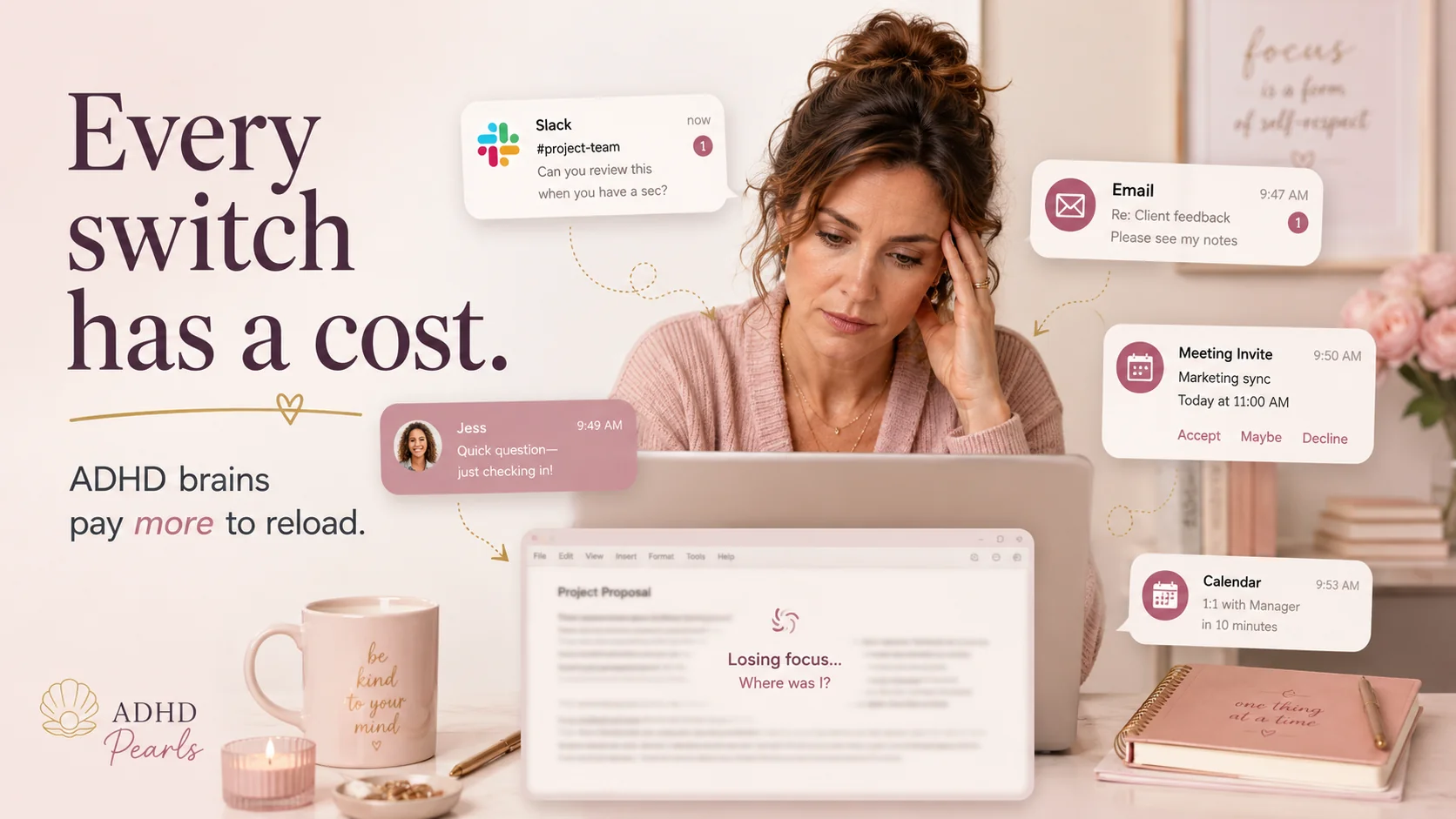
There's a second layer under that: working memory and task-switching. Every time you get pulled off a task — a notification, a coworker stopping by, a meeting invite popping up — your brain has to drop what it was holding and reload it later. That reload isn't free. It costs time and mental effort for anyone, and ADHD brains tend to pay a steeper price for it, because holding a task "in mind" while ignoring competing pulls is exactly the skill that's harder to access.
This isn't about willpower or caring enough. It's a supply problem, not a character problem — the same gap that makes ADHD look like laziness when it isn't.
Nobody warned me that "I care about this job" and "I can make myself focus on this job" were two completely different systems, running on two completely different fuels.
It is not that you do not care. Your brain may need different fuel to start.
The workplace cost of this is measurable, not just a feeling. A U.K. survey published in a peer-reviewed journal found that adults with untreated ADHD lose an average of 22 excess days of work performance a year — a mix of absence, reduced output and lower-quality work. Other research has found employees with ADHD are more likely to change jobs frequently, more likely to be let go, and more likely to quit impulsively than their peers, and that college graduates with ADHD earn several thousand dollars less per year on average. None of that is a verdict on your worth. It's what happens when a workplace built for one kind of attention meets a brain built for another — and it's exactly why the practical fixes below matter, not as a nice-to-have, but as real cost reduction.
From ADHD Pearls
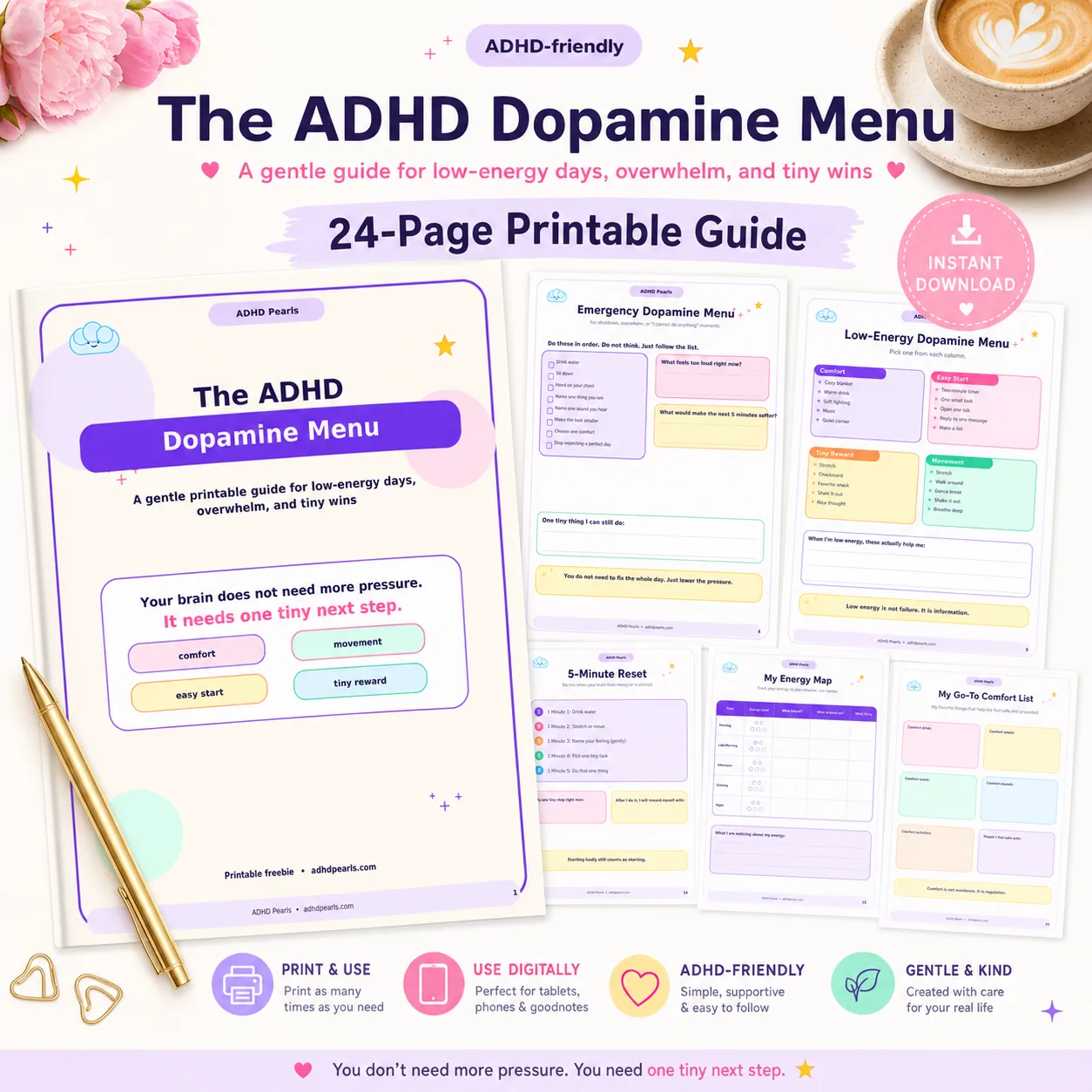
Free Dopamine Menu
24 tiny activities for low-energy, low-capacity days.
Task paralysis at work rarely looks dramatic. It looks like a full inbox and a blinking cursor.
The Boring-But-Important Task
Expense reports. Data entry. That one email you've reread four times without answering. These tasks are low-stimulation and low-reward, so your brain quietly declines to fund them — even while you sit there, technically "at your desk," accomplishing nothing. I have opened the same expense report thirteen times across one week. It took four minutes once I finally did it.
The Open-Plan Office
A phone buzzing two desks over. Someone's keyboard clicks. A conversation you're not part of but can't stop half-listening to. For a brain that already struggles to filter competing stimuli, an open office isn't background noise — it's a constant stream of tiny, competing "look at me" signals, and by 3pm you're not tired from the work, you're tired from filtering.
The Meeting That Could Have Been an Email
Ten minutes in, your mind has already left the room. You're not being rude or checked out on purpose — a low-stimulation, slow-moving meeting is exactly the environment ADHD attention struggles to hold onto, and it takes real, tiring effort to drag it back every few minutes. I have nodded convincingly through an entire status update while mentally replanning my kitchen.
The Constant Task-Switching
Slack message. Email. Back to the report. Someone stops by your desk. Back to the report, except now you've lost the thread completely and have to reread the last paragraph to remember what you were even doing. Every switch has a cost, and ADHD brains pay a bigger one — it's not that you forgot the task, it's that reloading it takes real, measurable time.
Every interruption asks your brain to reload the task. ADHD brains often pay more for that reload.
The Remote-Work Version
Working from home doesn't remove this — it just changes the furniture. The dishwasher that needs unloading is now competing with the report the same way the coworker's phone call used to. Video calls with cameras off invite the mind to wander even faster than in-person meetings, because there's less holding your attention in place.
I used to leave the office most days feeling like I'd run a marathon while sitting perfectly still. Turns out that's a fairly accurate description of what constant task-switching does to an ADHD brain, whether the office is down the hall or in your spare room.
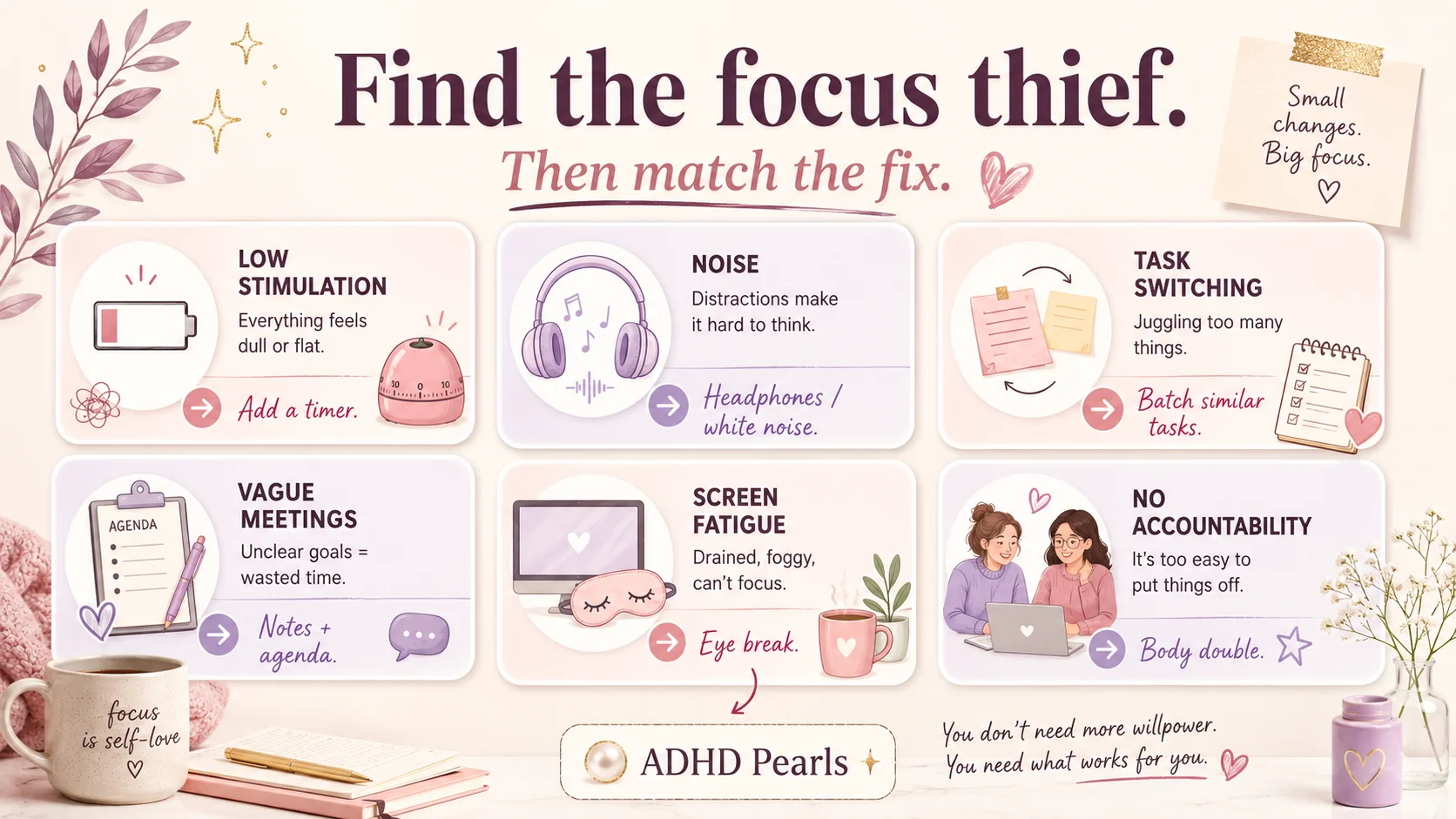
What's Stealing Your Focus at Work
Focus doesn't fail for one reason at work, so the fix depends on what's actually draining it. Find the row that matches your day.
What's draining it
It feels like
What to try
Low stimulation
"I know this matters and I still can't start"
Add urgency with a timer or a borrowed deadline
Environmental noise
"I can't filter anything out"
Noise-blocking headphones, steady background sound, or a quiet room for deep work
Constant switching
"I keep losing my place and starting over"
Batch similar tasks; close notifications during focus blocks
Vague, slow meetings
"My mind left ten minutes ago"
Take notes, ask a question early, request an agenda
Screen fatigue by afternoon
"My eyes are tired and now so is everything else"
Screen breaks every hour, adjusted lighting, blue-light filtering if screens run late into the evening
No accountability
"There's always time later, so I never start"
Body doubling, a coworking session, or telling someone your deadline
The answer is not always more willpower. Find the focus thief, then match the fix.
What Actually Helps You Focus at Work
None of this is about trying harder. It's about giving a workday the ingredients your brain actually runs on.
Shrink the boring task to a two-minute entry point. Not "finish the report" — "open the doc and write one bullet." My spreadsheet finally got done the day I stopped trying to complete it and just committed to typing one single number.
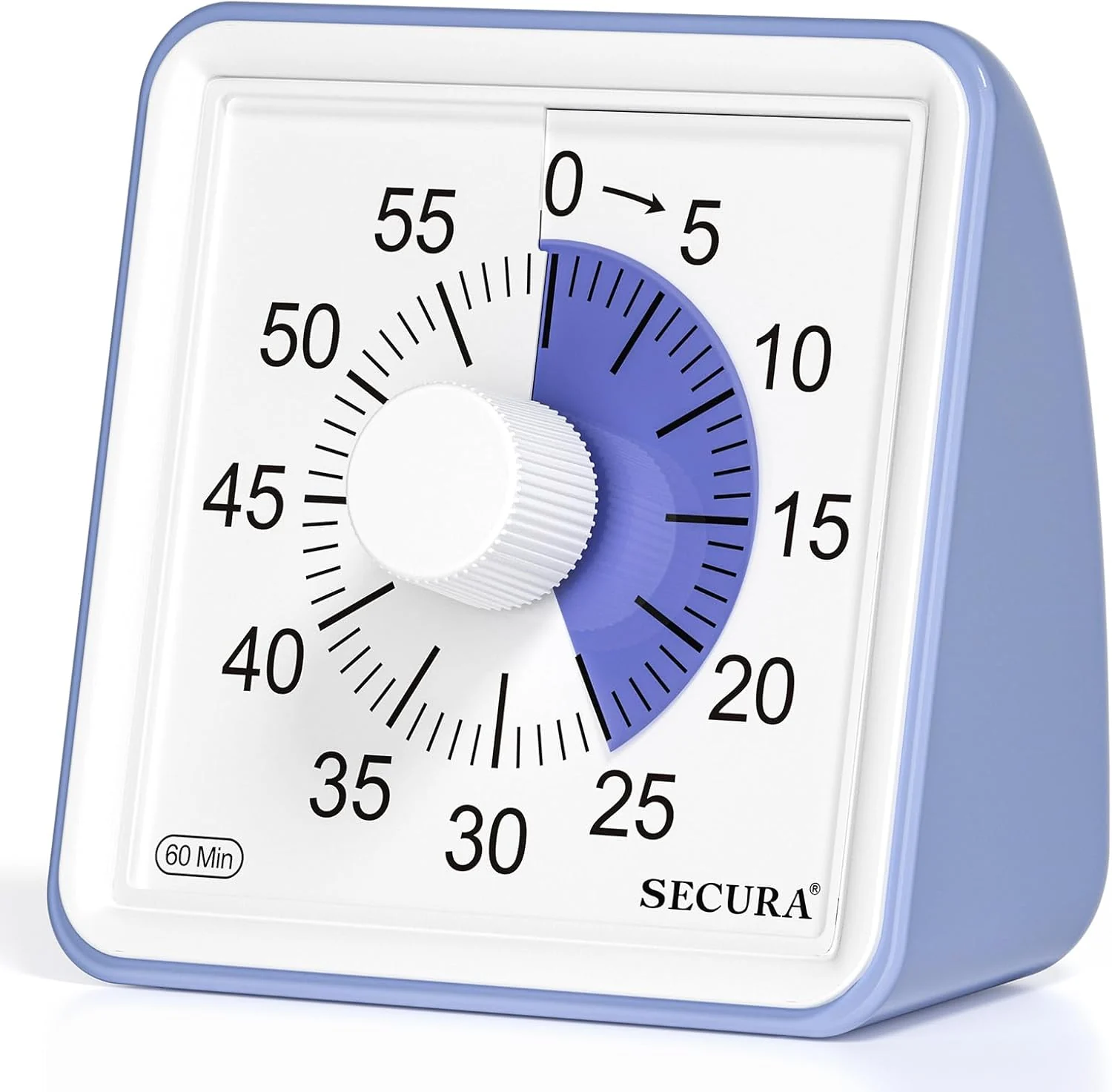
Use a visible timer. Fifteen or twenty-five minutes, then a short break. A countdown creates just enough manufactured urgency to get a boring task moving, and having it physically on the desk works better for me than a phone timer I can swipe away.The visual timer I keep on my desk →Affiliate link — as an Amazon Associate we may earn from qualifying purchases.
Try body doubling. Working alongside someone — in person, on a call, or through a virtual coworking tool — creates soft accountability that pulls your attention back to the task, even if that person is doing something completely different.
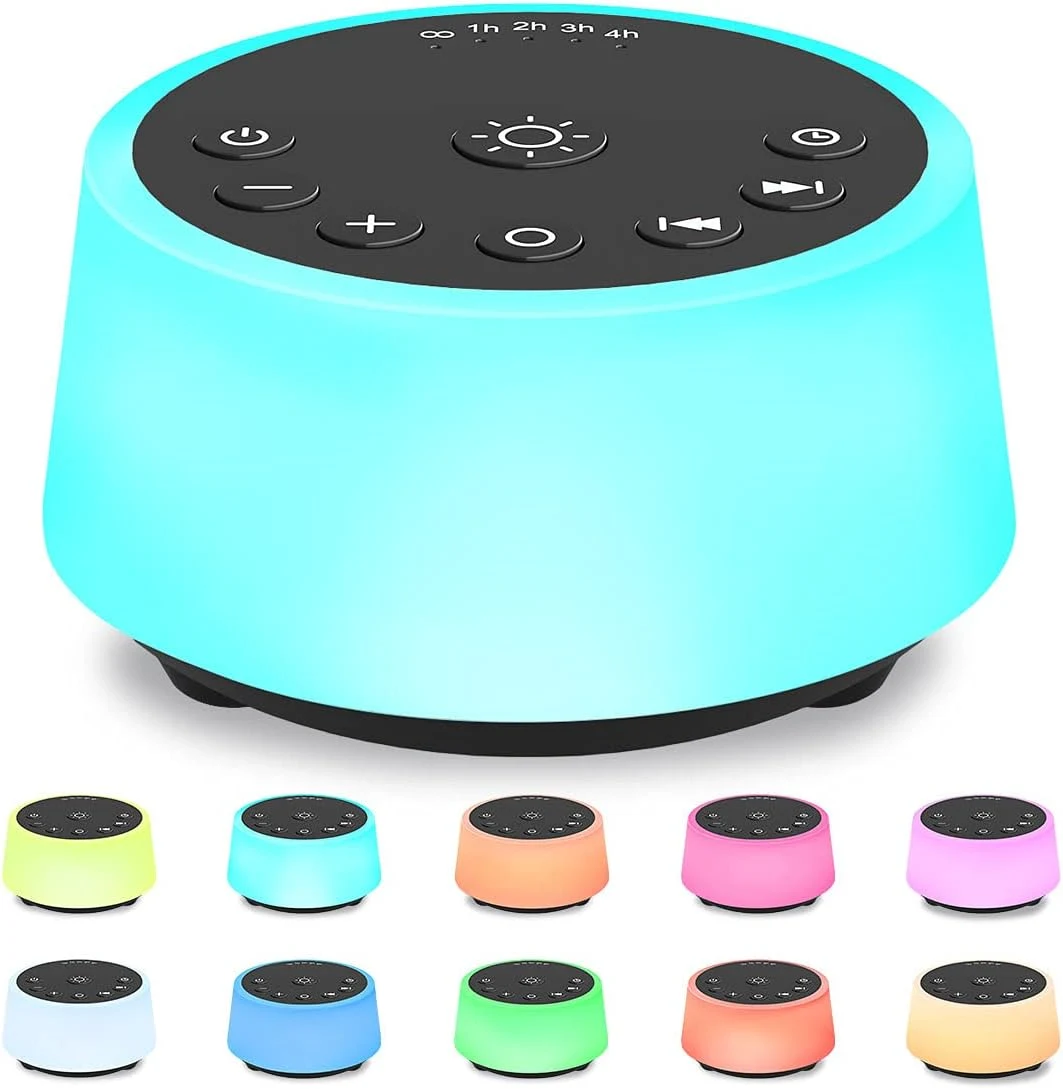
Control the noise, don't just endure it. Noise-blocking headphones or a steady background sound can block the constant "look at me" pull of an open office. Headphones also double as a visual signal to coworkers that you're heads-down.The white noise machine I keep at my desk →Affiliate link — as an Amazon Associate we may earn from qualifying purchases.
Batch the similar stuff. Answer all your emails in one block instead of trickling through the day. Every switch has a cost, and grouping similar tasks means you pay it fewer times.
Protect one block for the hard thing. Book it on your calendar like a meeting, ideally earlier in the day before task-switching has worn down your reserves.
Give your eyes a break before you push through. Afternoon focus crashes are sometimes just screen fatigue wearing a productivity costume. A short away-from-screen break can do what another ten minutes of forcing it won't.
Move between tasks, not just within them. A two-minute walk or stretch between meetings resets a brain that's been idling in low-stimulation mode.
If even opening the file feels impossible some days, our free ADHD stuck reset is built for exactly that moment — one tiny next step, no productivity guilt attached.
Add what the task is missing: urgency, structure, quiet, or a tiny starting point.
When to Talk to Your Employer About Accommodations
I spent years assuming accommodations were for people with "real" disabilities, not someone who just had trouble with spreadsheets. That framing cost me a lot of unnecessary suffering.
If focus problems are a consistent, work-affecting pattern — not just an occasional bad week — it may be worth a conversation with HR or a manager about reasonable adjustments. Depending on where you work and local employment law, that can include things like noise-blocking headphones, a quieter desk, flexible hours, written instructions instead of verbal-only ones, or the option to work from a quiet space for deep-focus tasks. This is general information, not legal advice — workplace accommodation rules vary by country and employer, so it's worth checking what actually applies to your situation.
You don't need a diagnosis in hand to start that conversation informally, though a formal diagnosis can open the door to protected accommodations in many workplaces. A qualified clinician can help you figure out whether ADHD is part of your picture, and what documentation, if any, makes sense for your situation.
This is also where a realistic system matters more than a prettier one — a job that keeps making you feel behind isn't fixed by a nicer planner. That's part of why a planner alone won't fix your routines, and why matching structure to your actual energy — not an idealized 9-to-5 version of you — makes more of a difference than another productivity app ever will.
If headphones are part of how you cope at work, it is worth knowing that the research on sound and ADHD is genuinely split — it helps some people and measurably hurts others, and it depends on the task. We unpacked that in why music helps your ADHD focus some days and ruins it on others.
On the days the tank is just empty — no sleep, no food, genuinely depleted — the honest answer is rest, not another hack. Pushing an exhausted brain harder just adds shame on top of the exhaustion, which is worth remembering on the low-energy days too. On the days there is some fuel but no traction, these focus hacks are the shorter list to try first. And when the distraction is coming from your own clothes rather than the room, that has its own fix in why clothes feel wrong with ADHD.
FAQ: ADHD and Focus at Work
Why can't I focus at work even when I know the task is important?
Because ADHD attention responds to interest, novelty and urgency — not importance on its own. A task can matter deeply and still generate almost no dopamine if it's routine or slow-moving, which is why "just care more" rarely works as a fix.
Is it normal for ADHD to make work harder than school ever was?
For many people, yes. Work often removes the external structure school provided — bells, fixed schedules, constant check-ins — and replaces it with open-ended time and self-directed tasks, which is exactly where ADHD executive function struggles show up most.
Does an open office make ADHD focus worse?
It often does. Open-plan layouts remove the visual and auditory boundaries that help filter distraction, so a brain that already struggles to tune out competing stimuli has more to tune out. Noise-blocking headphones, quiet rooms, and clear "focus time" signals can help offset this.
Why do I zone out in meetings even when I'm trying to pay attention?
Slow-paced, low-interaction meetings are low-stimulation environments, and ADHD attention tends to drift in exactly those conditions. Taking notes, asking an early question, or requesting a clear agenda gives your brain something active to hold onto.
Can task-switching really hurt focus that much?
Yes. Every switch between tasks has a cognitive cost for anyone, and ADHD brains tend to pay a steeper one, since reloading context takes real, measurable effort. Batching similar tasks and limiting notifications during focus blocks reduces how often you pay that cost.
Does ADHD really affect job stability and income, or does it just feel that way?
Research suggests it's a real, measurable pattern, not just a feeling. Studies have linked ADHD to more frequent job changes, higher rates of being let go, and a measurable income gap for college graduates with ADHD compared to peers. That reflects workplace fit and support, not effort or intelligence.
Should I tell my employer I have ADHD?
That's a personal decision with no universal right answer. Some people find that disclosing opens the door to helpful accommodations; others prefer to request specific adjustments (quiet space, written instructions) without naming ADHD directly. A career counselor or ADHD-informed therapist can help you think through what fits your workplace.
What accommodations actually help ADHD focus at work?
Common ones include noise-blocking headphones, a quieter workspace, flexible or adjusted hours, written follow-ups after verbal instructions, and protected blocks of uninterrupted time for deep-focus tasks. What helps varies by role, so it's worth naming your specific sticking points rather than asking for accommodations in the abstract.
Is it ADHD or am I just in the wrong job?
It can be either, or both. A job that's mostly repetitive, low-autonomy, and meeting-heavy will be hard for almost any ADHD brain, regardless of how well-managed the ADHD is. If focus struggles ease dramatically in more stimulating or flexible roles, that's useful information, not proof there was nothing to it.
Save this for the next time your workday feels busy, scattered, and impossible to start.
Pin this ADHD work focus reset for later.
You are not bad at your job. You have a brain that needed a different set of ingredients than the ones a standard workday hands you — and now you have a few more ways to add them back in.
Found this helpful? Share it with someone who gets stuck too.
One tap makes ADHD Pearls a preferred source in your Google account, so our articles surface higher when you search. No signup, and it brings you straight back to this page.
Before you go
Free Dopamine Menu
24 tiny activities for low-energy, low-capacity days.
For the woman who sets up the perfect system on Sunday and abandons it by Tuesday.
One short letter, every week. Real talk about ADHD, task paralysis, and the tiny wins that actually move the needle for a brain like yours. No shame. No hustle culture.