It was beautiful. Cream pages. A proper weekly spread. Little boxes for habits. A notes section in the back. It smelled like the kind of organized life I kept imagining I was about to have.
On day one, I wrote 17 tasks. I used four different pen colors. I created three separate sections — work, home, personal — and blocked every hour from 7am to 9pm. I even wrote a small motivational note to myself in the margin.
By day 3, the planner was already behind. I hadn’t completed everything, so I started writing the same tasks again in the next day’s column. By day 6, I was avoiding opening it. By day 9, it was sitting on my desk making me feel guilty just by existing.
This was before I understood my ADHD planner routine problem. Before my late diagnosis. Before I started building Perlova.
The planner did not fail because I was lazy. It failed because I asked paper to do the job of an ADHD support system.
Quick answer
Why don’t planners work for ADHD?
Because a planner organises information, and ADHD does not fail at information. It affects starting, remembering, prioritising and coming back — the exact things a planner assumes you can already do. A planner is a container, not a support. What works instead is visible and cue-based, rather than written down and then closed in a drawer.
Key takeaways
📌A planner organises information, and ADHD does not fail at information.
📌It assumes you can start, remember, prioritise and come back — the exact things that are hard.
📌The new-planner high is real, and it is not evidence that this system will work.
📌Fresh starts are a trap. They reset the record instead of lowering the difficulty.
📌Build for the version of you having a bad week, not your ideal self on a good Sunday.
The Planner Wasn’t the Problem. The Expectation Was.
A planner is a container. That’s genuinely all it is. It can hold a plan. It cannot make an impossible plan doable.
It cannot adjust when your energy crashes at noon. It cannot shrink a task that feels too big to start. It cannot notice when you’re frozen at your desk and make the first step more obvious. It cannot remove the sting from a day you skipped entirely.
A planner can hold the plan. It cannot make an impossible plan doable.
This sounds obvious written out. But for most of my adult life, I treated a new planner like it was going to do all of those things. Like the right format would somehow fix the part of my brain that struggles with task initiation, working memory, and consistent energy.
It never did. And I spent years assuming the problem was me.
From ADHD Pearls
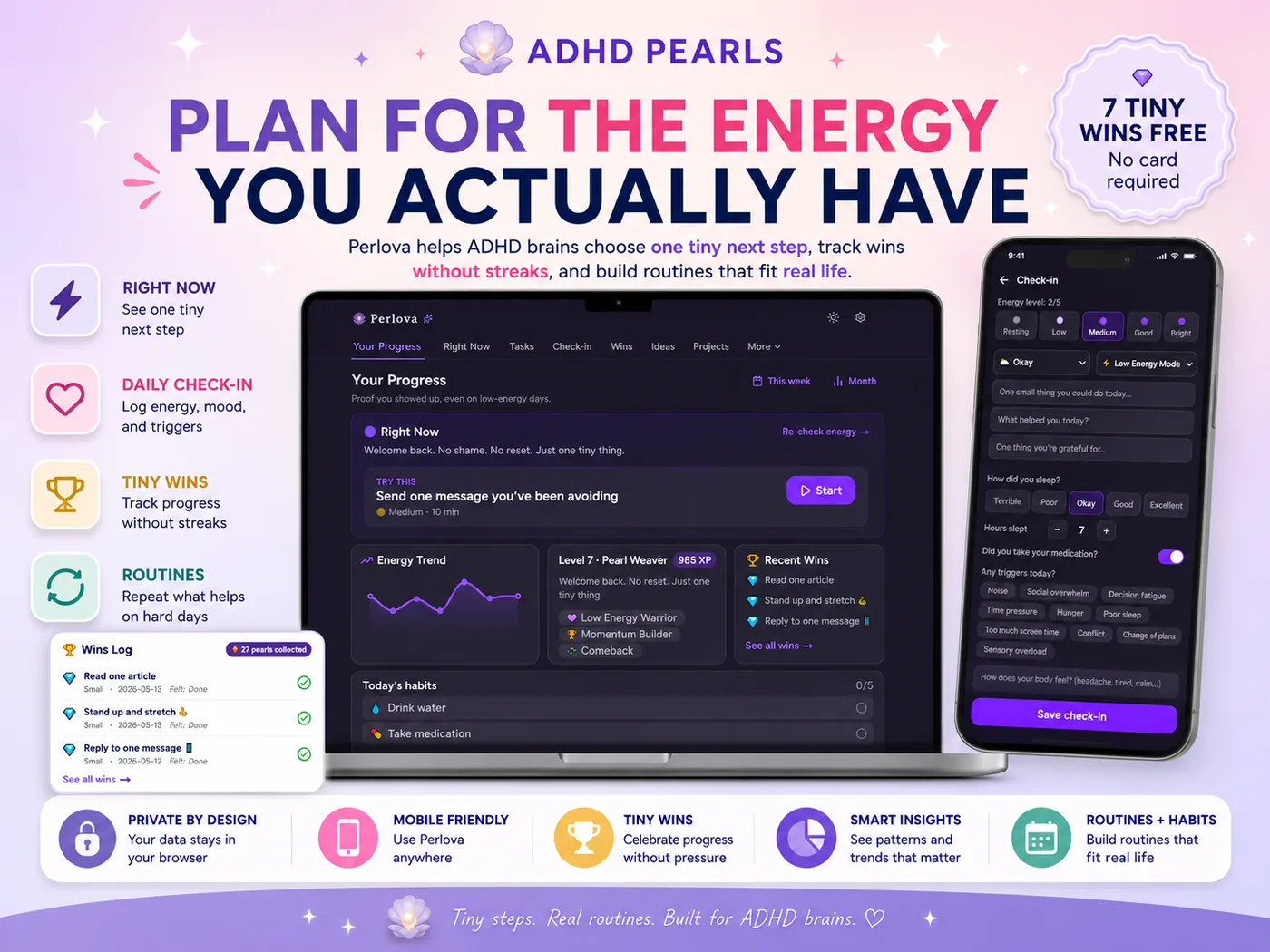
Perlova — plan from the energy you actually have
One doable next step, wins without streaks, and routines that fit real ADHD life. No card, no shame.
There is something genuinely wonderful about a brand new notebook.
Fresh pages feel like a fresh identity. Setting up the system — choosing the pens, designing the habit tracker, filling in the dates — feels like progress. Like you’re already becoming the organized version of yourself just by doing the setup.
That feeling is real. It’s just not the same thing as a system that works.
The setup gave me dopamine. The routine asked for consistency. Those are not the same thing.
ADHD brains are particularly wired for novelty. A new planner is novel. Everything it represents is possible. The problem starts when the novelty fades — usually around day 3 or 4 — and the planner starts asking something different: just do the thing, again, even though it feels the same as yesterday, even though you’re tired, even though one thing already fell off the rails.
That’s where most ADHD planner routines collapse. Not at the beginning. At the return. The hard part isn’t buying the planner. The hard part is coming back after one messy day when the planner already looks like it’s judging you.
The Usual Planner System That Kept Failing Me
I tried everything. Daily pages. Weekly spreads. Habit trackers. Time blocking. Color coding. Sticky notes layered over more sticky notes.
The setup was always around 45 minutes. The list was usually 14 to 18 tasks. Four pen colors minimum — one for work, one for home, one for health, one for things I was already dreading. Three separate lists on a good day.
And then real life happened. Not a catastrophe. Just a morning that didn’t go as planned. One task that felt impossible to start. An interruption that ate two hours. An afternoon where my brain just… wasn’t available.
The list looked manageable in the setup phase. It stopped looking manageable the moment reality arrived.
The planner had been designed for the rested, regulated, ideal version of me. Real me had low energy days. Task initiation problems. A working memory that lost things between walking from one room to another. On those days, staring at the planner didn’t help me start. It just added one more thing to feel bad about.
One missed morning made the whole system feel contaminated. The blank pages started to feel like proof. I repeated this cycle more times than I want to admit.
And every time, I concluded the same thing: I just needed a better planner.
Where ADHD Routines Actually Break
It’s not where most people think. It’s not a motivation problem or a discipline problem. It’s usually one of these:
The routine has too many steps. More than five steps is often too many for an ADHD brain to hold without external scaffolding. The routine looks fine on paper. At 7am, it’s a wall.
The routine depends on a perfect day. If the routine only works when you slept well, started on time, and nothing went sideways, it’s not a real routine. It’s a best-case scenario masquerading as a plan.
The routine has no low-energy version. If there’s no scaled-down version for the days when everything feels heavy, the whole routine collapses the first time you need it most.
The routine asks for too much working memory. When each step requires you to remember what comes next, what you haven’t done yet, and what needs to happen before you can do the next thing — the cognitive load becomes the obstacle.
The first step isn’t visible.ADHD task paralysis often comes down to not being able to locate the beginning. If you can’t see a concrete, physical first action, the whole thing stalls.
The planner becomes another task. Maintaining the system takes its own energy. On low-energy days, even opening the planner feels like a job.
One missed day turns into shame. And shame makes returning feel impossible. This is how a skipped Tuesday becomes a month of avoiding the planner entirely.
The Fresh Start Trap
“Monday I start again.” “New month, new planner.” “New notebook, new me.” “This time I’ll be more disciplined.”
Fresh notebook dopamine is real. A blank page feels like a clean slate. The problem is that ADHD brains can confuse the feeling of starting over with actual support. The high of the reset mimics the feeling of having a system — without the system actually being there.
And the cycle repeats: plan, start, miss a day, experience blank page shame, abandon, buy new planner, repeat.
If the system only works when I’m motivated, rested, emotionally regulated, and caught up, it is not an ADHD system. It is a fantasy.
What Changed When I Stopped Planning Around My Ideal Self
For most of my life, I planned for a version of myself who doesn’t really exist. She wakes up clear. She has consistent energy. She can start things when she decides to start them.
Real me is different. And the shift that mattered — the one that eventually shaped how I built Perlova — was starting to plan for real me.
That meant asking different questions. Not “what should I do today?” but “what can I actually do today?” Not “what does my plan say?” but “what fits my energy right now?” Not “what is the ideal next step?” but “what is the smallest visible next step?” And: “what still counts on a bad day?”
Perlova did not magically turn me into a person with consistent morning routines. It helped me stop building routines that collapsed the first time I had a hard day.
What to Do Instead of Buying Another Planner
The difference isn’t about effort. It’s about whether the system was built for your brain.
Build around energy, not time
Energy-based planning asks a different question first: what capacity do I actually have today? A high-energy version of your plan looks different from a low-energy version. When you have both, you don’t have to abandon the day when the high-energy version becomes impossible.
Make the first step smaller than your shame wants it to be
Not “clean the kitchen.” “Clear one plate.” Not “fix my whole routine.” “Choose one thing for tomorrow.” Not “start the project.” “Open the file.”
The first step should be so small it almost feels stupid. That’s usually the right size. ADHD task initiation breaks down in the gap between deciding and starting — and the smaller the first step, the narrower that gap gets.
Create a bad-day version
If your routine has no bad-day version, it will collapse the first time life gets loud. A bad-day version is the floor. On a hard day, doing the bad-day version means the system survived.
On low-energy days, a free ADHD Dopamine Menu can also help — a pre-made list of tiny, doable options so you don’t have to invent a next step from scratch.
Track tiny wins, not perfect streaks
Streaks punish you for the days that weren’t possible. Tracking tiny wins works differently. Every small thing that happened counts. Over time, they add up to real evidence that you are doing things, even on the weeks your brain insists you aren’t.
Make restarting part of the system
A good ADHD planning system assumes you’ll miss a day, and makes returning easy. Not “I have to catch up before I can move forward.” Just: here’s today. What’s one thing? Go.
Why I Built Perlova Differently
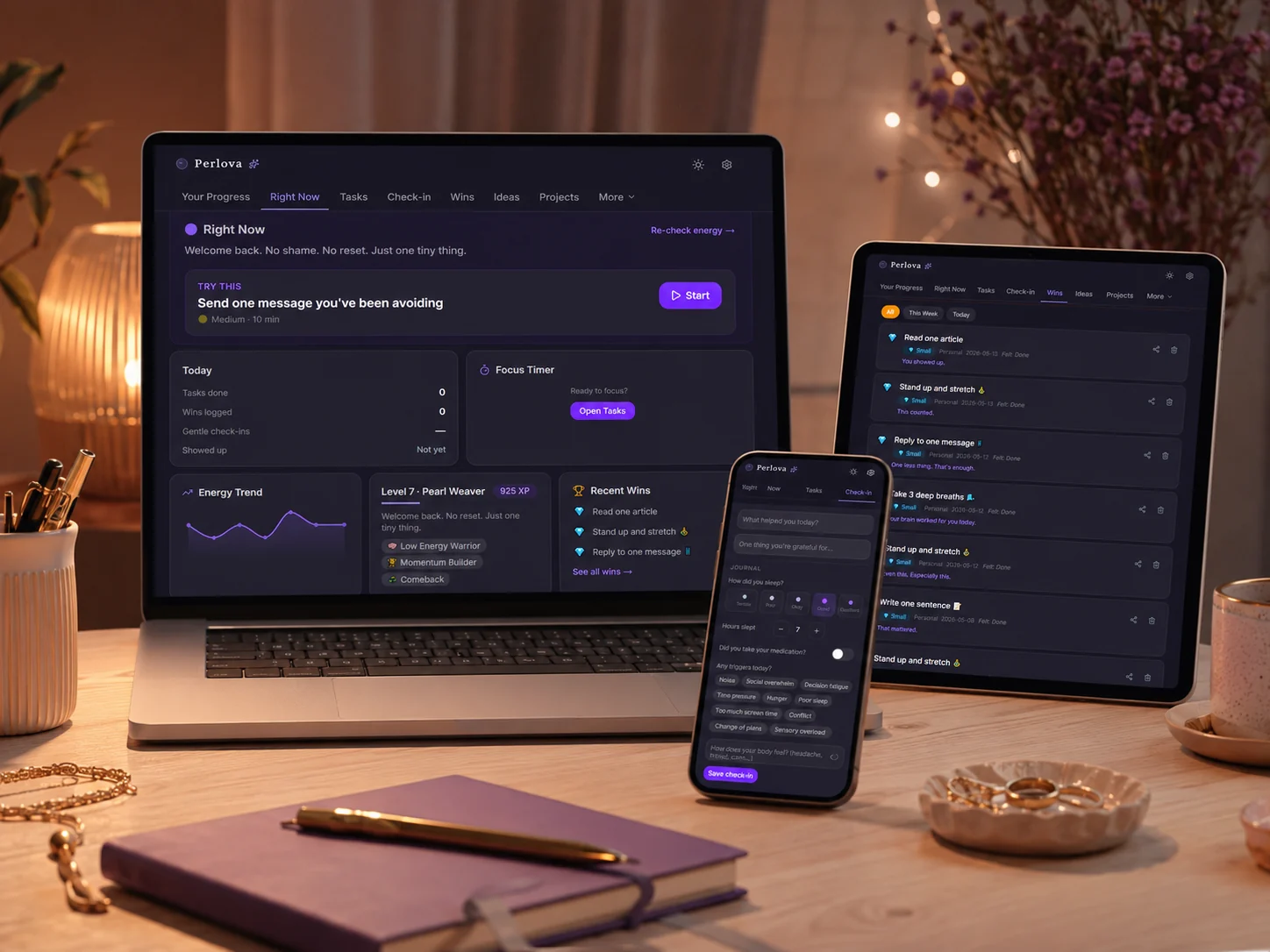
Perlova starts with one question: how’s your energy today? Everything else follows from the answer.
After years of planner guilt — and a late diagnosis that explained a lot — I started building a planning tool that worked the way I actually work.
Perlova asks your energy first. Before showing you a single task, it asks: how are you today? Then it shows only what fits. Not everything on the list. The things that are actually possible right now.
It helps you choose one doable next step. It supports low-energy days. It counts tiny wins. It doesn’t use streaks. And it makes restarting easy — no explanation required, no catching up before you can continue.
Since using the app I built, my organization did not become perfect. But some things shifted slowly. I stopped turning every missed morning into a failed day. I started choosing 1–3 doable things instead of dumping 17 tasks into a list. On low-energy days, I could usually still find one small step that actually fit.
Some weeks were still messy. They were easier to restart.
Perlova did not make me a different person. It made my planning stop arguing with my brain.
What I Put in My Planner Now
I still use paper sometimes. But what goes on the page looks completely different.
I write my energy level first — high, medium, low, crashed. That one thing changes what I plan for the day. Then 1–3 priorities. Not 17. Three things that actually fit today’s energy.
I write the smallest next step — not the task, but the action. Not “finish the report,” but “open the document and write one paragraph.” The visible next step my brain can actually locate when I sit down.
I write a bad-day version. What does this day still count as if everything falls apart by noon? Having that floor means there’s always something to land on.
I note one thing I’m allowed to ignore today. Naming the thing I’m not doing frees up the mental energy I would have spent feeling guilty about it all day.
I track tiny wins at the end. Not just completed tasks — anything that counts. And I include a reset option: what’s the one thing that would make tomorrow easier to start?
A planner can still help. But only when it stops pretending every day is the same.
The ADHD Routine Test
If you’re building or rebuilding an ADHD daily routine, run it through these questions:
Can I do this on a low-energy day? If not, you need a scaled-down version.
Can I restart without shame? If missing one day feels unrecoverable, the system is too fragile.
Does this routine have fewer than five steps? If not, what can be removed or combined?
Is the first step visible? Can you picture exactly what you’d do first? If not, make it more concrete.
Does this depend on me remembering too much? Working memory is limited — every step that requires remembering adds load.
Can a tiny version still count? Is there a bad-day version that still moves things forward?
Does this routine work if I’m interrupted? Real ADHD routines get interrupted constantly. The system should survive that.
Does this system help me return, or does it punish me for leaving? A good ADHD routine makes coming back easy. If returning feels hard, the system is the problem — not you.
A Planner Should Be a Map, Not a Judge
Your planner should not become a courtroom where every blank page testifies against you.
That’s what mine became, over and over, before I understood why. Not because I was failing. Because I was using a tool that wasn’t built for how my brain actually works — and concluding that the gap was a character flaw.
You were not failing because you needed a prettier planner. You needed a system that stopped treating your ADHD brain like a moral problem.
The answer was not more shame. Not more pages. Not more color coding. The answer was a plan small enough to come back to. A routine with a floor. A system that expected the hard days instead of being destroyed by them.
If you want a guided, paper version of exactly that, The No-Shame Reset Workbook is a 74-page ADHD anti-planner workbook built to help you reflect without shame, retire the planners that never fit, and build a softer reset you can actually come back to.
— The ADHD Pearls team
FAQ: ADHD Planner Routines
Why don’t planners work for ADHD?
Planners can organize information, but ADHD affects task initiation, working memory, emotional regulation, energy, and consistency. A normal planner assumes you can start, remember, prioritize, and return without support. For many ADHD brains, those are exactly the things that are hard.
Can a planner help ADHD routines?
Yes — but only if the routine is realistic. ADHD-friendly planning needs smaller steps, low-energy versions, visible cues, and a way to restart without shame.
Why do I keep buying planners and not using them?
A new planner gives a dopamine hit and feels like a fresh start. Once the novelty fades, the system still has to work on tired, distracted, low-energy days. Most normal planners don’t support that — so they get abandoned, and the cycle repeats. This is an ADHD planner problem, not a you problem.
What should an ADHD planner include?
An ADHD-friendly planner should include energy level, 1–3 priorities, tiny next steps, a bad-day version, visible cues, and a way to track small wins.
How do I build ADHD routines that actually stick?
Start smaller than you think. Build around your real energy, not ideal capacity. Create a low-energy version. Make the first step concrete and visible. Expect interruptions. And make restarting part of the system — not a moral reckoning.
How long does it take to build an ADHD routine?
Longer than the popular numbers suggest, and it is rarely a straight line. Rather than counting days, watch whether the routine survives its first bad week. A routine that can be restarted after a gap is working; one that has to be perfect to continue is not.
Is it bad to use paper and an app at the same time?
Not at all, as long as each has one job. Problems start when both hold the same information, because then neither is trusted. Many people keep visible cues on paper and reminders on a phone, which plays to the strengths of each.
What do I do when I fall off the routine completely?
Restart at a smaller size than before, on the same day if possible. The gap is not the damage; treating the gap as proof of failure is. Building a deliberate restart step into the routine makes coming back a step rather than a verdict.
Is Perlova better than a normal planner for ADHD?
Perlova is built differently from a normal planner because it starts with your energy and helps you choose what is actually doable today. It’s not a cure and it won’t fix every hard day — but it was designed to stop the shame spiral that happens when a planner treats every day the same.
Found this helpful? Share it with someone who gets stuck too.
One tap makes ADHD Pearls a preferred source in your Google account, so our articles surface higher when you search. No signup, and it brings you straight back to this page.
Here's why other planners didn't stick
They assume you'll show up the same every day. Perlova starts with how you feel right now.
Other ADHD planners
×Ask you to plan ahead, when your brain isn't there yet
×Assume you have consistent energy every day
×Show you everything you're already behind on
×Fall apart the first time you miss a day
×Require willpower just to open them
Perlova
✓Starts with your energy right now — not a perfect plan
For the woman who sets up the perfect system on Sunday and abandons it by Tuesday.
One short letter, every week. Real talk about ADHD, task paralysis, and the tiny wins that actually move the needle for a brain like yours. No shame. No hustle culture.