I once spent twenty minutes rehearsing a two-line text message.
The text was: “Hey, does Thursday still work for you?”
I wrote it. Deleted it. Wrote it again but with a comma. Deleted that. Considered whether “still” sounded passive-aggressive. Decided it did. Rewrote without “still.” Too blunt. Added an exclamation point. Too eager. Removed it. Sent the original.
Got back “yes!” in thirty seconds.
Spent ten more minutes wondering if the exclamation point was genuine or she was just being polite.
The whole thing ended with me typing “sounds good!” as if I had survived a hostage negotiation.
If you read that and felt something in your chest — keep reading.
ADHD in adult women doesn’t always look like the old stereotype. It doesn’t look like a kid bouncing off walls. It can look like overthinking, quiet exhaustion, starting everything, finishing nothing, and smiling through it all while internally running on fumes.
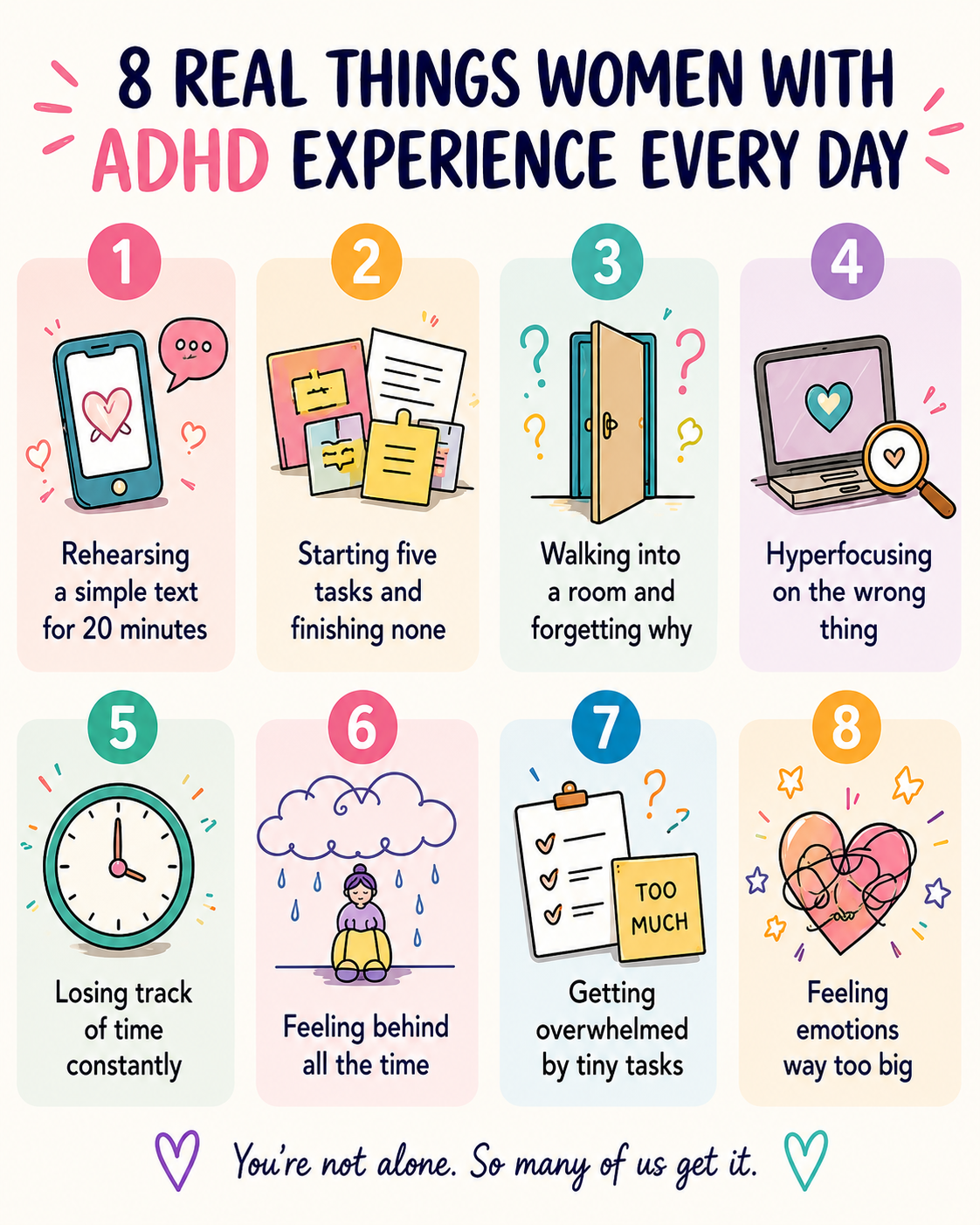
This is what it can actually look like. Eight things. All of them real.
Quick note: This is based on lived experience and ADHD-informed education — not medical advice. If anything here resonates strongly, talking to an ADHD-informed clinician is the best next step.
Quick answer
What does ADHD look like in women day to day?
Less hyperactivity and more overthinking, emotional exhaustion, half-finished tasks, lost time and a permanent sense of being behind. Most of it is invisible because it is masked, which is a large part of why so many women are diagnosed late — and why the daily cost almost never shows up in anyone else’s view of them.
Key takeaways
📌ADHD in women looks less like hyperactivity and more like overthinking and exhaustion.
📌Most of the cost is invisible because it is masked, which is why so many are diagnosed late.
📌Rehearsing a simple text, starting five things, losing hours — none of it is carelessness.
📌The permanent sense of being behind is a symptom, not an accurate assessment of your life.
📌Saying it out loud to one person who understands changes more than most systems do.
I was making elaborate lists I couldn’t follow. I was apologizing constantly for forgetting things. I was people-pleasing my way through every social situation because the fallout of getting something wrong felt unbearable.
I was functional on the outside and quietly overwhelmed on the inside.
I had learned to hide the mess, not solve it.
For years, I thought this was a personality issue. A discipline issue. A “just try harder” issue.
It wasn’t.
Later, I found research confirming that women and girls are often missed because their ADHD tends to look more internalized — more anxiety, more emotional overload, more masking — and less like the hyperactive boy everyone recognizes. A 2020 expert consensus statement led by Dr. Susan Young and colleagues found that ADHD in females is consistently under-recognized across the lifespan because of exactly this.
That made a lot of my life make more sense.
If you spent years looking fine while feeling one missed message away from falling apart — you are in the right place.
Eight everyday ADHD experiences that often look small from the outside — and exhausting from the inside.
From ADHD Pearls
Free Stuck Reset
One tiny move for the moments you know what to do but still can't start.
Here is the thing nobody tells you about ADHD and texting.
It is not about the words.
It is about the seventeen imaginary versions of how the words might land.
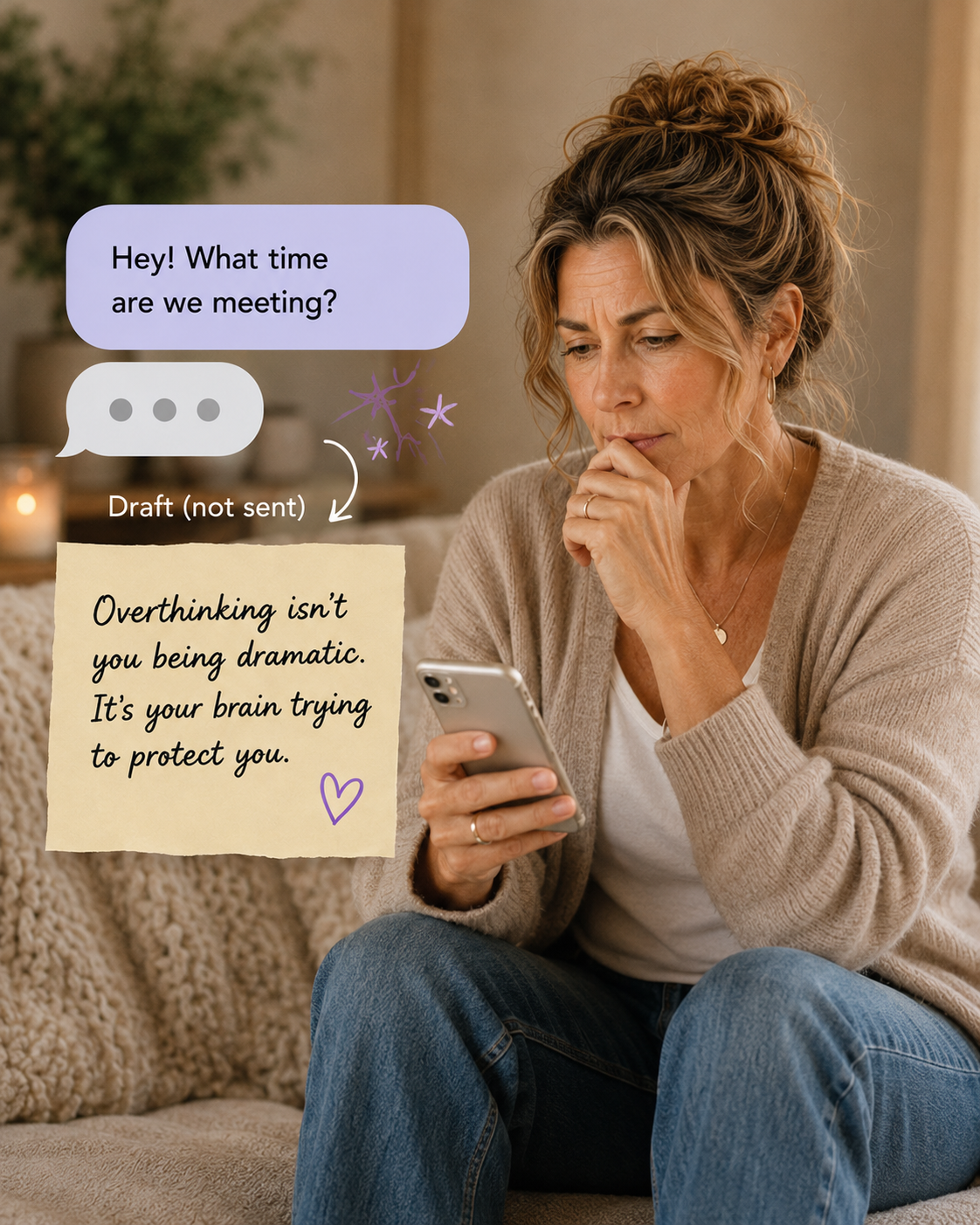
I have sat with a three-word message for twenty minutes while my brain ran full courtroom simulations: Will this sound needy? Too casual? Does the period make it seem passive-aggressive? Should I add an emoji? No, that looks desperate. What if she reads it in a bad mood? What if—
And then I send “sounds good!” and feel mildly victorious, as though I had just defused something.
Reality Check
“Overthinking a text is not you being dramatic. It is your brain trying to prevent a disaster that probably isn’t coming — using information it mostly made up.”
A lot of this connects to something many women with ADHD describe as rejection sensitive dysphoria — the intense, immediate fear of being misread, judged, or disappointing someone.
It is not a formal standalone diagnosis. But the experience is real, and it is exhausting.
Years of accidentally offending people, missing tone cues, sending things that landed wrong — the brain learns to pre-check everything. By the time you are writing a simple reply, you are also managing a lifetime of social feedback.
Sometimes the hard part is not the message. It is the twelve imaginary versions of how it could be received.
If one message can send your brain into a spiral, the free RSD Reset is a tool specifically built for that moment — to help you separate what actually happened from the story your brain constructed around it.
Tiny Reset
Before you reread the message again: ask yourself what the most boring, neutral explanation for the other person’s tone would be. Not the catastrophic one. The boring one. Start there.
2. Starting Five Tasks and Finishing None
I sat down to answer one email.
I noticed the mug on my desk needed to go to the kitchen. I stood up. In the kitchen, I saw the laundry that needed switching. I switched it. Walking back, I checked my phone. A notification reminded me of something I had to look up. I looked it up. That led to a different tab. Then another.
An hour later I was sitting somewhere with seven tabs open, the email still unread, and a vague sense that I had been very busy.
Everything had been touched. Nothing had been finished.
This is not laziness. This is ADHD executive dysfunction — the brain’s difficulty with sequencing, prioritizing, and actually initiating tasks in order.
Dr. Russell Barkley’s decades of research on executive function and adult ADHD describes it as a self-regulation problem, not an intelligence or motivation problem. My brain could see everything that needed doing.
It just couldn’t line things up.
Knowing the task matters and being able to start it are two completely different skills — and ADHD can break the second one while leaving the first fully intact.
Tiny Reset
Stop asking “What should I finish?” Ask instead: “What is the next visible, physical step?” Not a project. Not a category. One thing you can point to with your finger.
3. Walking Into a Room and Forgetting Why
I have walked into a room with the full energy of a woman on a mission.
Stood there.
Waited.
Nothing came.
There is a faint ghost of a purpose somewhere. It felt important thirty seconds ago. Now I am just standing in the kitchen like an abandoned Sims character, waiting for someone to click on me and assign a task.
Reality Check
“Every time this happens I stand very still, as if stillness will help me remember. It does not help. But it feels necessary.”
Working memory is the brain’s ability to hold information in mind long enough to act on it.
For ADHD brains, that thread can drop mid-sentence. It is not stupidity. It is not being scatterbrained in a cute way. It is a working memory traffic jam, and it happens multiple times a day, usually at the most inconvenient moment.
The information is not lost. It just slipped off the counter while you were moving.
Tiny Reset
Go back to where you were when you had the thought. The room you started in. The app you were in. Sometimes the context is the memory.
4. Hyperfocusing on the Wrong Thing
I once researched storage baskets for two hours.
Not casually browsed. Researched. I cross-referenced dimensions. I read reviews. I developed opinions about seagrass versus wicker. I was practically preparing a doctoral thesis on bathroom organization.
The email that would have taken ninety seconds?
Absolutely not. That email sat there for three more days.
Hyperfocus is often described as an ADHD advantage. I’d push back on that framing. It is not something I control. It is attention that locks on — but not always where I need it to. (The crash that follows it gets its own piece: why you hyperfocus for hours and then crash.)
It activates on things that are new, interesting, or emotionally charged. It avoids things that are dull, anxiety-adjacent, or require starting from scratch. The basket research had a clear endpoint and a satisfying decision waiting. The email had dread attached and no obvious beginning.
So my brain chose the baskets. Every time.
Tiny Reset
Before going deeper into whatever you’re currently hyperfocused on, ask: “Is this helping my actual problem, or am I just really comfortable in this tunnel right now?” You don’t have to stop. But naming it helps.
5. Losing Track of Time Constantly
I used to say “I’ll leave in five minutes” and mean it completely.
Then forty minutes would disappear.
Not because I was relaxed. Not because I didn’t care about being late. But because time did this ADHD thing where it turns into soup unless I can actually see it moving.
I have also sat down at 2pm and looked up to find it is 6pm. Not because I was productive. Because time had been doing whatever it wanted while I wasn’t watching.
Researchers have linked ADHD with real differences in time perception — what some describe as living in two states: now and not now. If something isn’t happening in front of me, it barely exists as a planning reality. Tuesday feels abstract until Tuesday is suddenly happening and I’m scrambling.
That helped me stop treating this as a character flaw. It is a perception difference, not a choice.
What actually helps me:
Alarms with labels that say what is actually happening (“LEAVE NOW” not “alarm 3”)
A visual timer I can see from across the room
Buffer time built in by default, because transitions always take longer than I think
One anchor task per day instead of a full schedule I’ll abandon by noon
Reality Check
“Someone once told me to ‘just set a timer.’ I do set timers. I then ignore the timer while fully hearing it because I was mid-thought and starting to feel like I might actually finish something this time.”
6. Feeling Behind All the Time
Not behind on one thing.
Behind on texts I haven’t replied to. Behind on the house. Behind on friendships I keep meaning to tend properly. Behind on the version of myself I was sure I’d have figured out by now.
Just… behind. Permanently, exhaustingly behind.
For a long time, panic was my productivity system. Not because I chose it — but because urgency was one of the only things that could reliably make my brain start.
I wasn’t behind because I didn’t care. I was behind because panic had become my productivity system — and systems built on panic eventually collapse.
Everything that didn’t feel like an emergency got ignored until it became one. And then the cycle of shame started again.
Sari Solden, a therapist who has worked with women with ADHD for decades, writes about the emotional cost of managing undiagnosed ADHD — the accumulated weight of not meeting expectations that seemed effortless for everyone else. Reading her work was the first time I felt like someone understood that the exhaustion wasn’t weakness. It was the cost of running a system that wasn’t built for how my brain works.
Feeling behind is often not really about what is undone.
It is about years of evidence that something is wrong with you — when what was actually wrong was the system you were trying to use.
Write down one thing that actually got done today. Not the list. One thing. That is not a consolation prize. That is real data that your brain is not allowed to ignore.
7. Getting Overwhelmed by Tiny Tasks
The task is: send the email.
Simple. Two minutes. Anyone could do it.
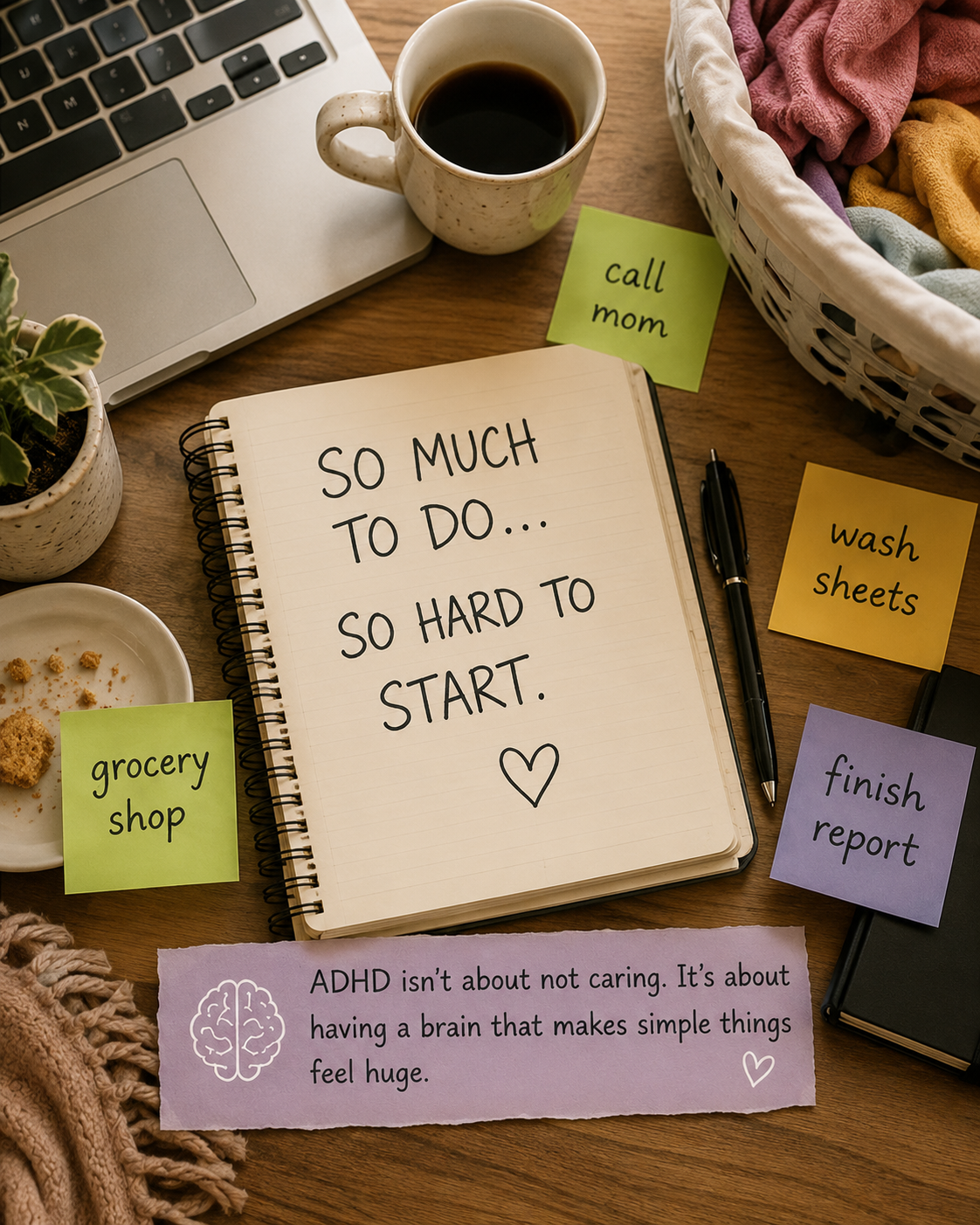
Except “send the email” is not one task.
It is: find the thread. Remember the context. Manage the low-level dread that arrived the moment I opened my inbox. Write something that sounds competent. Reread it because tone is apparently a full-time job. Reread it again. Press send. Spend the next few minutes waiting to see if the reply will require more emotional processing.
By the time it is done, I am mildly exhausted from something that looked effortless.
The task is rarely just the task. ADHD often turns small things into a stack of invisible steps.
The invisible steps are real. The emotional overhead is real. On a high-demand day, the mental load is already at capacity before the “simple” task even begins.
On those days, the Free Dopamine Menu helps me find something small enough to actually start with — without needing to first get my life together. It is 24 pages of low-pressure options organized by energy level. I use it when everything on my actual list feels impossible.
Tiny Reset
Break the task into its actual steps — every single one, including “open laptop” and “find the thread.” Then do only the first step. Not the task. The step.
8. Feeling Emotions Way Too Big
I used to think I was too much.
A plan gets cancelled and the disappointment feels crushing, not mild. A short reply from someone I care about ruins the afternoon. Mild criticism lands like a verdict. And then sometimes — one kind, unexpected message can make me cry because I was so tired of bracing for the other thing.
I spent years apologizing for my emotional reactions. Being told I was “too sensitive.” Learning to perform a smaller version of myself so the feelings were less visible.
The volume knob on feelings can get stuck too high.
That is not a metaphor I made up to be dramatic. Emotional dysregulation — difficulty modulating how intense, fast, and long-lasting emotional responses are — is increasingly recognized as a significant part of ADHD, not a separate issue.
Research by Faraone and colleagues, published in 2019, found emotional dysregulation is present in a large proportion of people with ADHD and contributes meaningfully to how much it affects daily life. Shaw and colleagues, in a 2014 review, noted that emotional impulsivity may actually be one of the most impairing and least talked-about parts of ADHD across the lifespan.
That research did not fix the feelings. But it helped me stop seeing them as a moral failing.
Reality Check
“Big feelings do not mean you are broken. They mean your brain’s emotional regulation system is working differently — and the people around you are probably underestimating how much energy that costs you every single day.”
Tiny Reset
When a feeling arrives that feels too big for the moment: name the size of the actual event, separate from the size of the feeling. “The event was small. The feeling is large. Both of those things are true right now.”
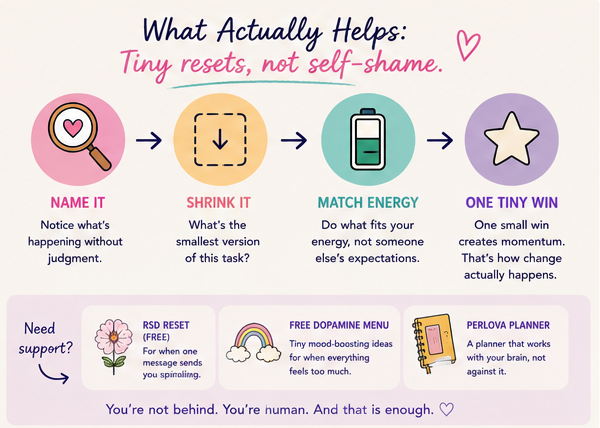
What Actually Helps: Tiny Resets, Not Self-Shame
What helped me was not becoming a new, more organized person.
It was finding smaller doors back in.
The things that made the biggest difference were embarrassingly simple — but only once I stopped trying to fix everything and started trying to make one next step findable.
Tiny resets work because they give your brain a smaller door back in.
The framework I use — and that Perlova is built around — has four parts:
1. Name it. What is actually happening right now? Overwhelm? Freeze? Spiral? Name the state before trying to fix it. This creates a small gap between you and what your brain is doing.
2. Shrink it. Whatever the task is, make it smaller. Not “clean the kitchen.” One surface. One thing you can hold.
3. Match energy. Work with the energy you actually have, not the energy you think you should have. A crashed-day version of a task still counts.
4. Count one tiny win. Not the list. One thing. Out loud, if that helps. It counts. Your brain is allowed to know that.
I built Perlova around this because regular planners kept asking me to be consistent before they helped me get unstuck. They started with what I should do. Perlova starts with what my brain can actually handle today.
It is not a cure. It is a softer question.
A Final Note
You are not lazy.
You are not broken.
You are not too much.
You may have spent years trying to operate a brain that nobody taught you how to support — using systems designed for a different kind of brain — and concluding that the gap was your fault.
It wasn’t.
The shame that comes with undiagnosed or late-diagnosed ADHD in women runs deep because it starts early. You were told you were smart enough to do better. Organized enough if you tried harder. Reliable enough if you really cared. That feedback becomes the voice in your head before the spiral even starts.
Knowing what is actually happening doesn’t fix everything. But it changes the conversation you have with yourself. And sometimes that is the only door that was left unlocked.
A few places to start, when you’re ready:
If one message sends your brain into a spiral: try the free RSD Reset
If everything feels too much and you can’t find a starting point: the Free Dopamine Menu has tiny options that don’t require you to have it together first
If regular planners keep making you feel worse: Perlova was built for exactly that
You don’t have to fix everything today.
You just have to find one smaller door.
This article is for educational and informational purposes only. It is not a substitute for professional diagnosis or treatment. If you think you may have ADHD, please speak with a licensed healthcare provider who is familiar with adult ADHD and its presentation in women.
FAQ: Women With ADHD
What does ADHD look like in women every day?
It often looks less like hyperactivity and more like overthinking, emotional exhaustion, starting things without finishing them, losing track of time, and a persistent feeling of being behind. Many women with ADHD also experience anxiety as a secondary layer — a coping system that developed to manage symptoms they didn’t have a name for yet.
Why are women with ADHD often diagnosed late?
Because for a long time, ADHD research was built around boys. Women and girls tend to present differently — more internalized, more masked, more anxious — and those presentations weren’t recognized as ADHD. A 2020 expert consensus statement confirmed that ADHD in females is consistently under-recognized across the lifespan due to referral bias and symptom differences. Many women are diagnosed in their 30s, 40s, or later — often after a child gets diagnosed first.
Why do women with ADHD feel overwhelmed by small tasks?
Because small tasks are rarely just one thing. They contain invisible steps, emotional overhead, and context-switching costs that non-ADHD brains handle automatically. On a high-demand day, a simple task can genuinely feel beyond reach — not because it is hard, but because the mental capacity needed to start it is already spent.
Is emotional dysregulation part of ADHD?
Yes, and more significantly than most people realize. Research suggests emotional dysregulation is present in a large proportion of people with ADHD and affects relationships, work, and quality of life. It is not always recognized as ADHD-related, which means many women seek support for anxiety or mood issues without the underlying connection being made.
Why do women with ADHD lose track of time?
ADHD affects how the brain perceives time, not just attention. Many people describe it as living in two states: now and not now. Without external cues — visible timers, labeled alarms, physical anchors — time can disappear in both directions. This is a neurological difference, not a scheduling failure.
Why do I rehearse simple messages for so long?
Rehearsing usually comes from a mix of working memory load and sensitivity to how you might be received. Each draft is an attempt to control an outcome you cannot control, and the ADHD brain will happily run that loop indefinitely. It is exhausting and extremely common, and it is not vanity.
Does ADHD get worse with age in women?
Symptoms themselves do not necessarily intensify, but demands often do, and coping systems that worked earlier can stop holding. Hormonal changes during perimenopause may also affect attention, sleep and mood for some women. Many describe their 40s as the point where everything got louder.
Am I just anxious rather than ADHD?
It can be either, and frequently it is both. Anxiety often develops on top of years of undiagnosed ADHD, which is one reason anxiety treatment alone can feel like it only partly lands. Untangling the two is a job for a clinician who is familiar with how ADHD presents in women.
What actually helps women with ADHD?
Smaller systems. Visible cues. Low-energy versions of tasks. A way to restart that doesn’t require shame. The things that tend not to help: planners that assume consistency, advice that starts with willpower, and systems that collapse the first time a bad week happens. What tends to help is building around your actual energy — not the energy you wish you had.
Found this helpful? Share it with someone who gets stuck too.
One tap makes ADHD Pearls a preferred source in your Google account, so our articles surface higher when you search. No signup, and it brings you straight back to this page.
Before you go
Free Stuck Reset
One tiny move for the moments you know what to do but still can't start.
For the woman who sets up the perfect system on Sunday and abandons it by Tuesday.
One short letter, every week. Real talk about ADHD, task paralysis, and the tiny wins that actually move the needle for a brain like yours. No shame. No hustle culture.