A planner. Barely used. The first three weeks filled in, careful handwriting, colour-coded categories. Then nothing. A gap of blank pages, and then one last entry in what looked like a different pen — more tired, less hopeful — that said: “okay starting over, for real this time.”
Then nothing again.
I stood there holding it and felt something I’d felt a hundred times before. Not just disappointment. Something heavier. That specific flavour of shame that says: look at this. Look at what you keep doing. This is proof.
I wasn’t looking at my past. I was weaponizing it against myself.
And I’d been doing it for years.
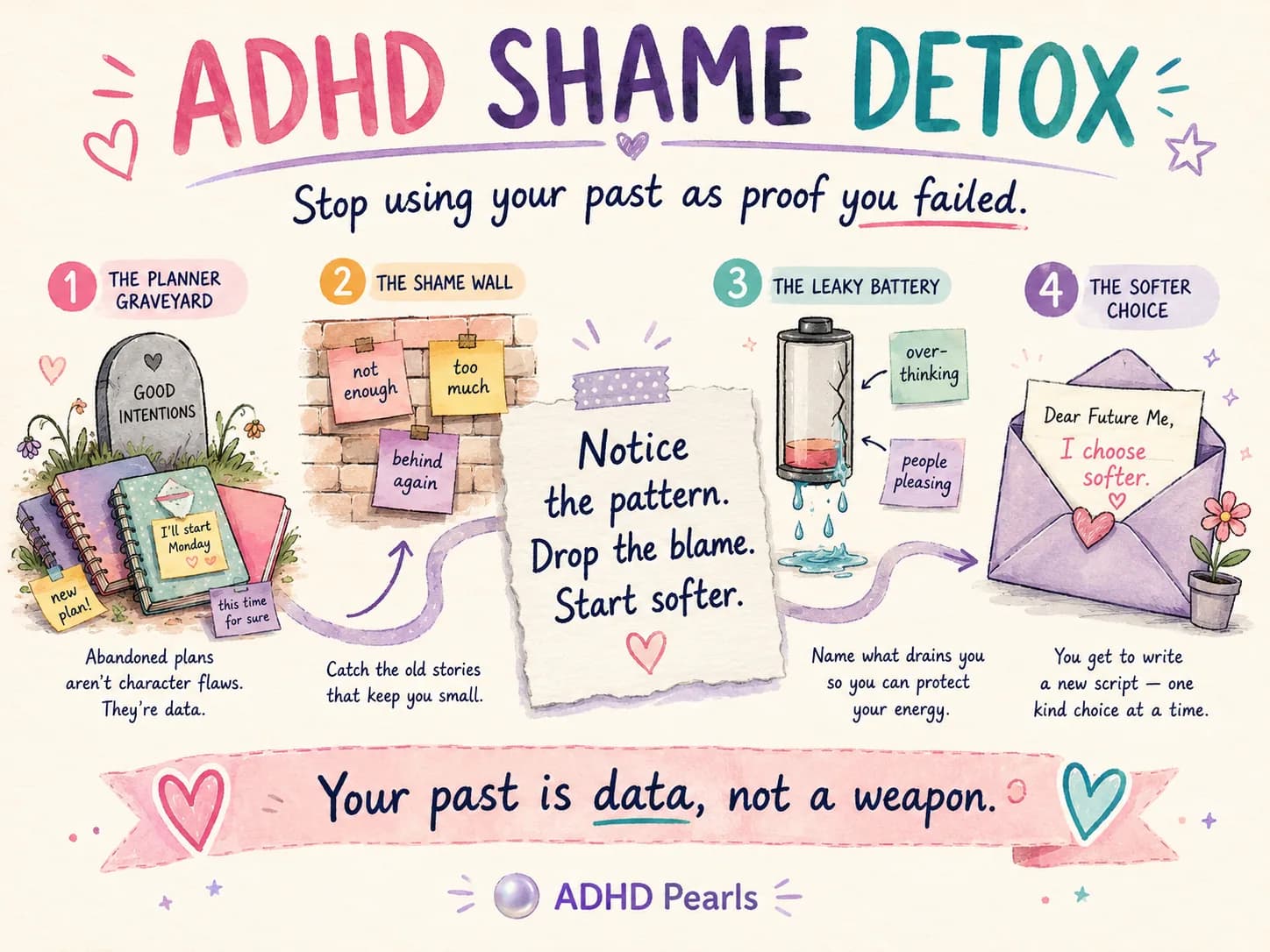
Your past is not evidence. It’s data. There’s a difference.
Quick note: This is written from lived experience and ADHD-informed reflection — not medical advice. If any of this resonates deeply, talking with an ADHD-informed clinician is the best next step.
Quick answer
How do I stop using my past as proof that I failed?
Separate the data from the verdict. Every piece of proof your shame produces — the unused planner, the unanswered message, the routine that collapsed — is a real event attached to the wrong conclusion. The event is data about what did not fit your brain. The verdict about your character was added afterwards, and it can be taken back off.
Key takeaways
📌Separate the data from the verdict. The event was real; the conclusion about your character was added later.
📌The planner graveyard is evidence about fit, not about effort.
📌Shame skips from event to identity fast: not “I forgot that” but “I always forget.”
📌Guilt points at an action and can be resolved. Shame points at you, and cannot.
📌You do not argue shame out of the room. You stop feeding it new evidence.
ADHD shame doesn’t usually arrive with a dramatic moment.
It arrives in the small things.
In the text you meant to reply to three days ago and now feel too embarrassed to answer because too much time has passed and what do you even say. In the meeting you said “I’ll send that over today” and then didn’t, and now the follow-up email is sitting there and opening it feels impossible. In the pile on the kitchen counter that has been there for two weeks and every time you walk past it you think: what is wrong with you.
It’s not one thing. It’s a thousand tiny things that your brain has quietly stitched together into a story.
And the story is: you keep failing. You’ve always kept failing. That’s just who you are.
Reality Check
“The shame isn’t a personality feature. It’s what happens when a brain that works differently is handed systems that weren’t built for it — and then blamed for not fitting inside them.”
What makes ADHD shame different from ordinary guilt is where it goes.
Regular guilt says: I didn’t do that thing. ADHD shame says: I didn’t do that thing, and that means something is fundamentally wrong with me.
It skips from event to identity so fast you barely notice the jump.
One forgotten message becomes: I’m a bad friend. One messy room becomes: I can’t handle life. One missed deadline becomes: I’m failing. Again. Still. Always.
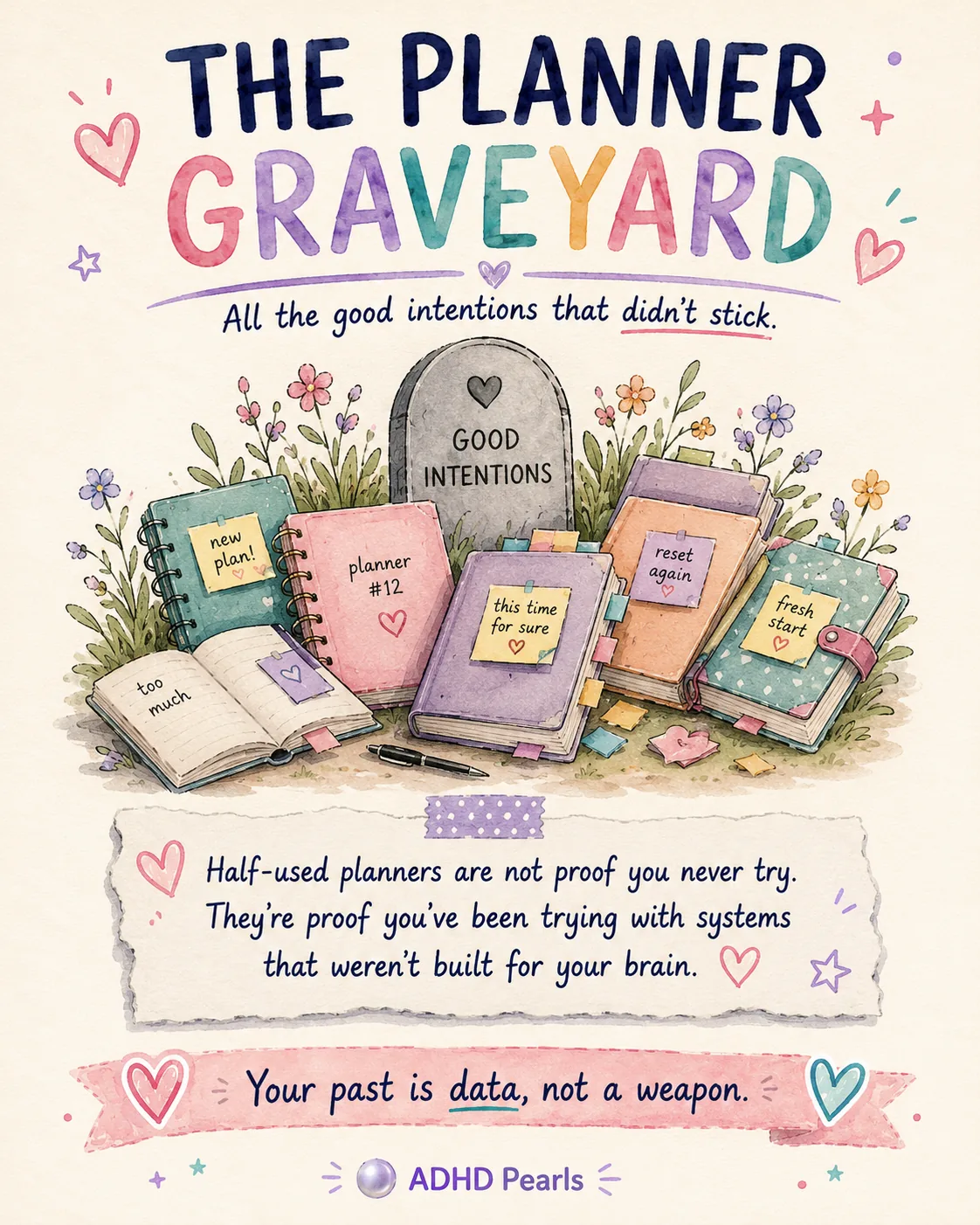
It’s not actually called the planner graveyard, but that’s what it is. There’s a bullet journal that lasted six weeks. A digital system I was absolutely certain would finally be the one. A printed weekly template I made myself, in a colour I liked, laminated, because surely this time the laminating would be the difference.
There’s a habit tracker with seventeen different categories and exactly four days filled in.
There’s a notebook I called my “command centre.”
I used it twice.
Not proof you never try. Proof you’ve been trying with systems that weren’t built for your brain.
For a long time I kept this shelf as evidence against myself.
Look how many times you’ve started. Look how many times you didn’t finish. Look at who you are.
Then I started to see it differently.
Every single one of those systems represents a genuine attempt. Every planner is a moment I thought: maybe this will help. Maybe I can do this differently. Maybe there’s a version of me that functions better.
Half-used planners aren’t proof you never try. They’re proof you’ve been trying with systems that weren’t built for your brain — over and over — and refusing to fully give up.
The planner didn’t fail because you’re broken. It failed because it was designed for a brain that experiences time, energy, and motivation differently than yours does. It assumed consistency you couldn’t guarantee. It assumed willpower as a fuel source. It assumed you’d show up the same way every day.
You didn’t abandon the planner. The planner stopped being designed for you — and you noticed.
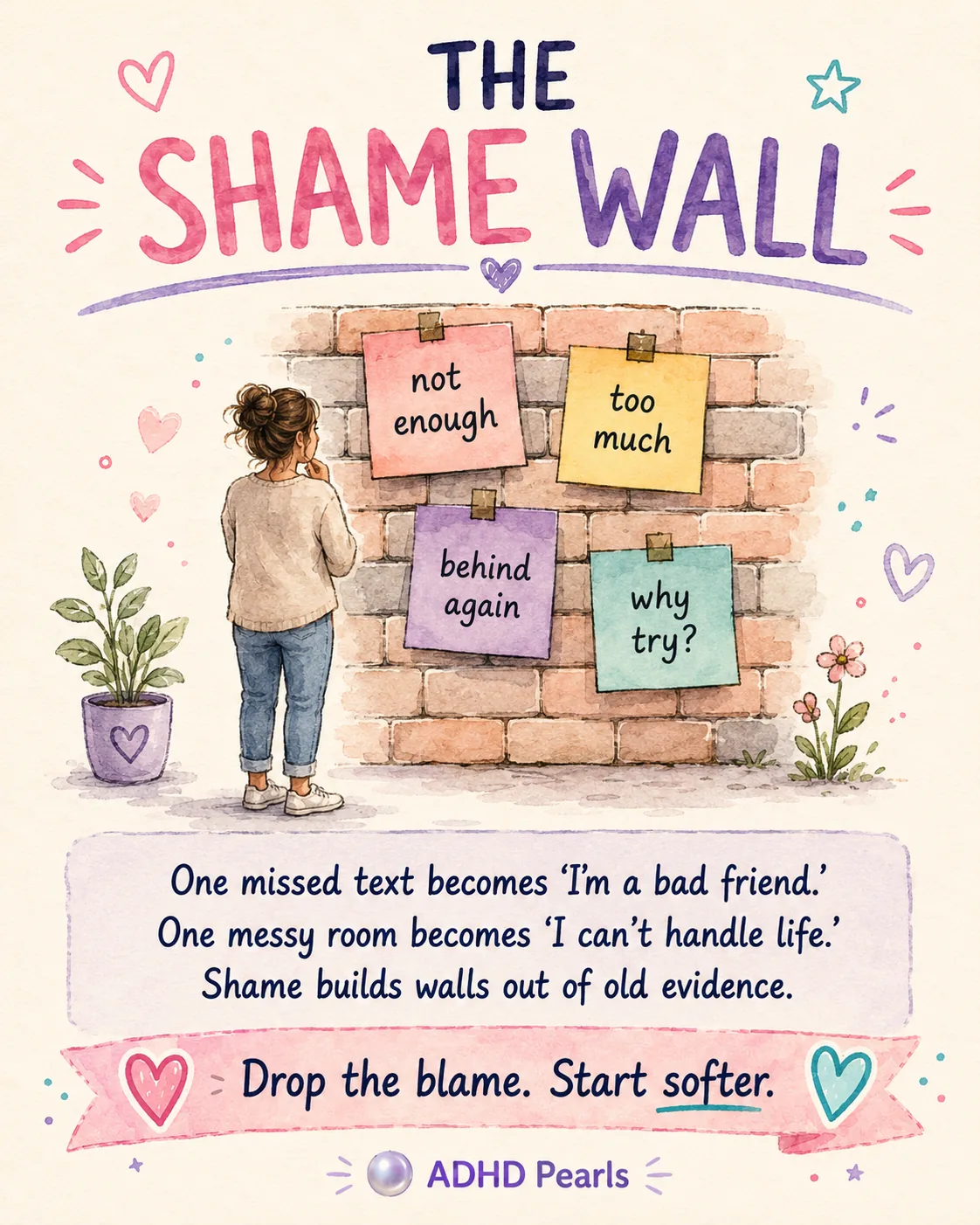
The Shame Wall
Here’s what shame does with evidence.
It collects it. Carefully. Every missed message, every abandoned plan, every moment you froze or forgot or ran out of steam — it files it away. And then, the next time something goes wrong, it pulls out the file and says: see? Here. And here. And here.
This is the shame wall. Built out of your own past, brick by brick, until it starts to feel like a mirror.
The shame wall is built from real moments. It just misreads what those moments mean.
One missed text becomes: I’m a bad friend.
One messy room becomes: I can’t handle my own life.
One abandoned routine becomes: I never change. I never will.
One late task becomes: I’m failing. I’m always failing.
Reality Check
“Shame is a very bad data analyst. It collects the evidence but misreads all of it. Every piece of ‘proof’ it shows you is a real event with the wrong conclusion attached.”
The wall is built from real things. Real moments when you didn’t follow through, when you forgot, when you couldn’t start, when you stopped. Those moments are data.
But data is not the same as a verdict.
A forgotten text is information about what happened that day with that message. It is not a character assessment. A messy room is information about your capacity that week, your energy, what competed for your attention. It is not a summary of who you are.
The shame wall confuses data with identity. And once it does that, every new piece of information goes through the same filter: yes, but that’s because you’re the kind of person who…
That filter is not truth. That filter is a story.
The Leaking Battery
There is something nobody tells you about ADHD energy.
It leaks.
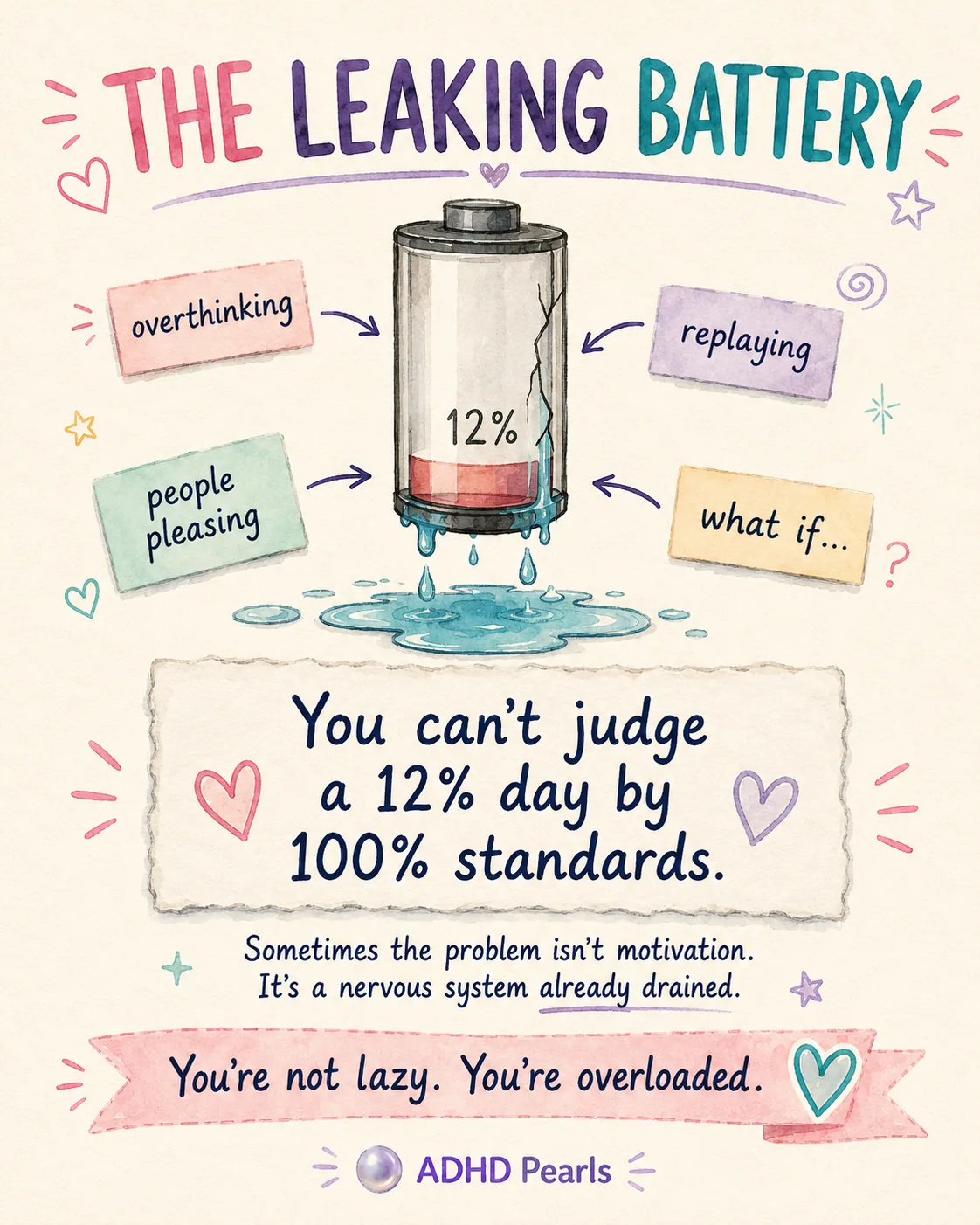
Not just through the obvious things — through the decisions, the transitions, the tasks, the deadlines. It leaks through masking. Through monitoring every conversation to check if you’re being too much or not enough. Through replaying what you said last Tuesday and trying to work out if the other person’s expression meant anything. Through sensory things that shouldn’t cost anything but somehow cost everything. Through the low-level hum of a to-do list that never gets shorter, only longer.
By the time you get to the thing you were supposed to do — the thing that looked simple from the outside — you’re already running on twelve percent.
You can’t judge a 12% day by 100% standards.
You can’t judge a twelve-percent day by hundred-percent standards. It’s not a fair comparison. It’s not even a meaningful one.
ADHD burnout is real. Emotional overwhelm is real. Decision fatigue hits harder and faster when your executive function is already stretched. Overthinking conversations costs more when your brain doesn’t automatically filter the noise.
When the battery is at twelve percent, things that look easy from the outside can be genuinely out of reach. Not because you’re lazy. Not because you don’t care. Because the capacity isn’t there. Not today.
And shame doesn’t account for the battery level. It just sees the outcome and says: you didn’t do it.
Energy-based planning — starting with what your brain can actually handle today, not what it should theoretically be able to handle — changes this. Not by making you more productive. By making the question more honest.
The Blame Filter
ADHD shame has a specific mechanism that makes it so hard to shake.
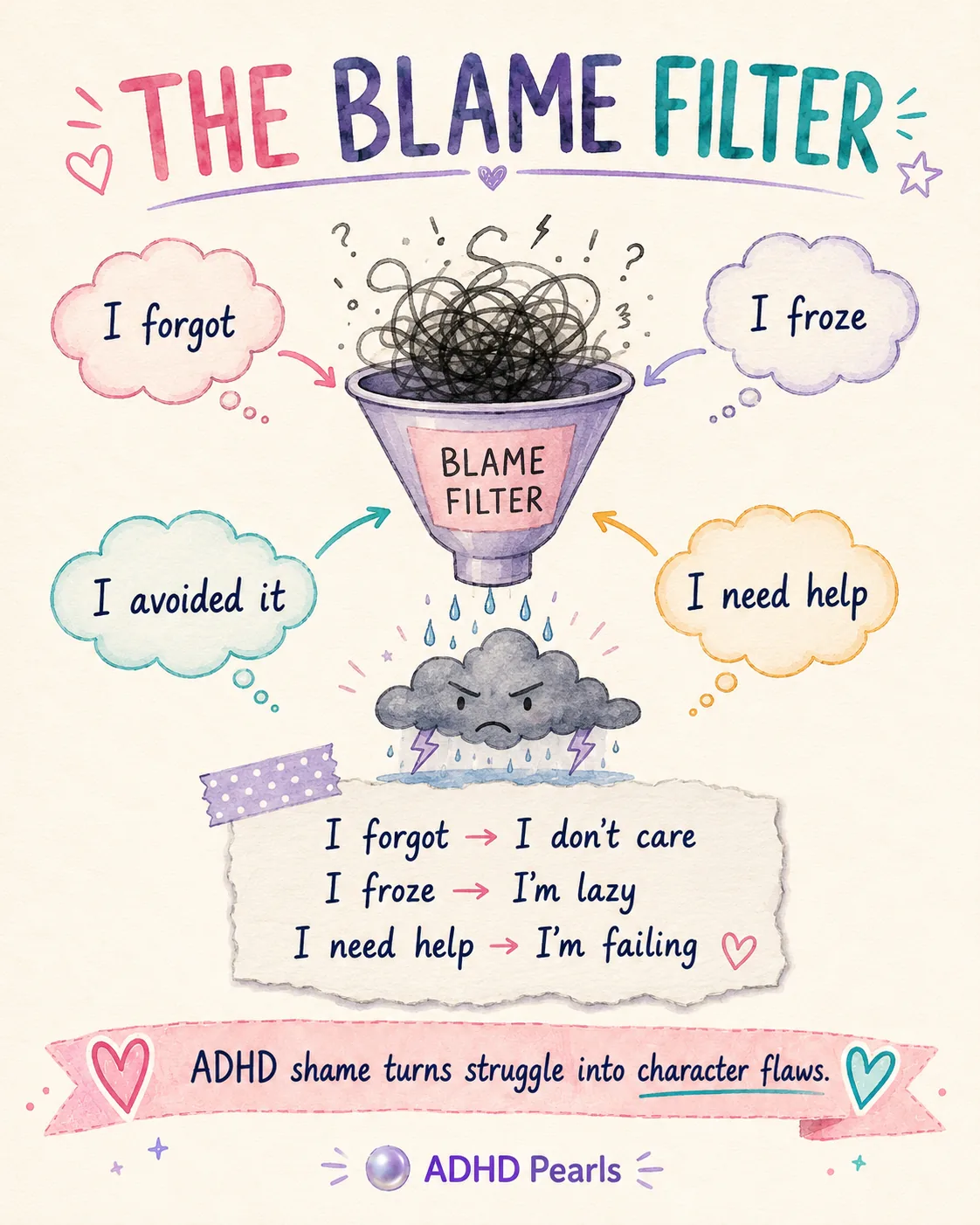
It translates. Automatically. Neutrally stated struggles become character flaws before you even notice the conversion happened.
The blame filter converts information into verdicts. It does this so fast you rarely catch it.
“I forgot” becomes: I don’t care about the people who matter to me.
“I froze” becomes: I’m lazy. I just didn’t want to try.
“I avoided it” becomes: I’m irresponsible. I always leave things too late.
“I need help” becomes: I can’t cope. I’m failing at things that adults are supposed to handle alone.
Every one of those original statements is neutral. It’s just information. A thing that happened.
The blame filter takes neutral information and attaches a moral verdict. And it does it so fast — so automatically — that by the time you’re aware of the thought, you’re already three layers into the story.
The filter has a handful of settings it keeps returning to. If you want them named one by one, with the question that interrupts each, they are here: nine ADHD thought traps.
Reality Check
“For a long time I didn’t even know I was doing this. I thought I was just being honest with myself. I wasn’t being honest. I was being cruel to myself and calling it accountability.”
Accountability and self-blame are not the same thing.
Accountability says: I forgot. What do I want to do about it?
Self-blame says: I forgot. That’s because I’m the kind of person who forgets. Who doesn’t care enough. Who will probably always do this.
One is useful. One just hurts.
Shame doesn’t actually motivate — it freezes. The logic feels sound: if you feel bad enough about something, surely you’ll do it next time. But shame doesn’t activate the part of the brain that starts tasks. It activates the part that wants to hide from the situation entirely.
There’s a distinction that decades of research on shame and guilt has consistently shown: guilt says I did something wrong. Shame says I am wrong. From “I did something wrong” you can take action. From “I am wrong” there is nowhere useful to go — only away from the thing. That’s why the shame spiral doesn’t produce momentum. It produces avoidance dressed up as accountability.
The ADHD Shame Detox Practice
I want to be honest about something first.
This is not a morning routine. It’s not a twelve-step system. It is not something you do perfectly and then have sorted forever.
It is a small repair process. Something you come back to when you notice the spiral starting, or after you’ve already fallen into it. It doesn’t require anything to be working well first.
Not a system. A way back in when the shame spiral has already started.
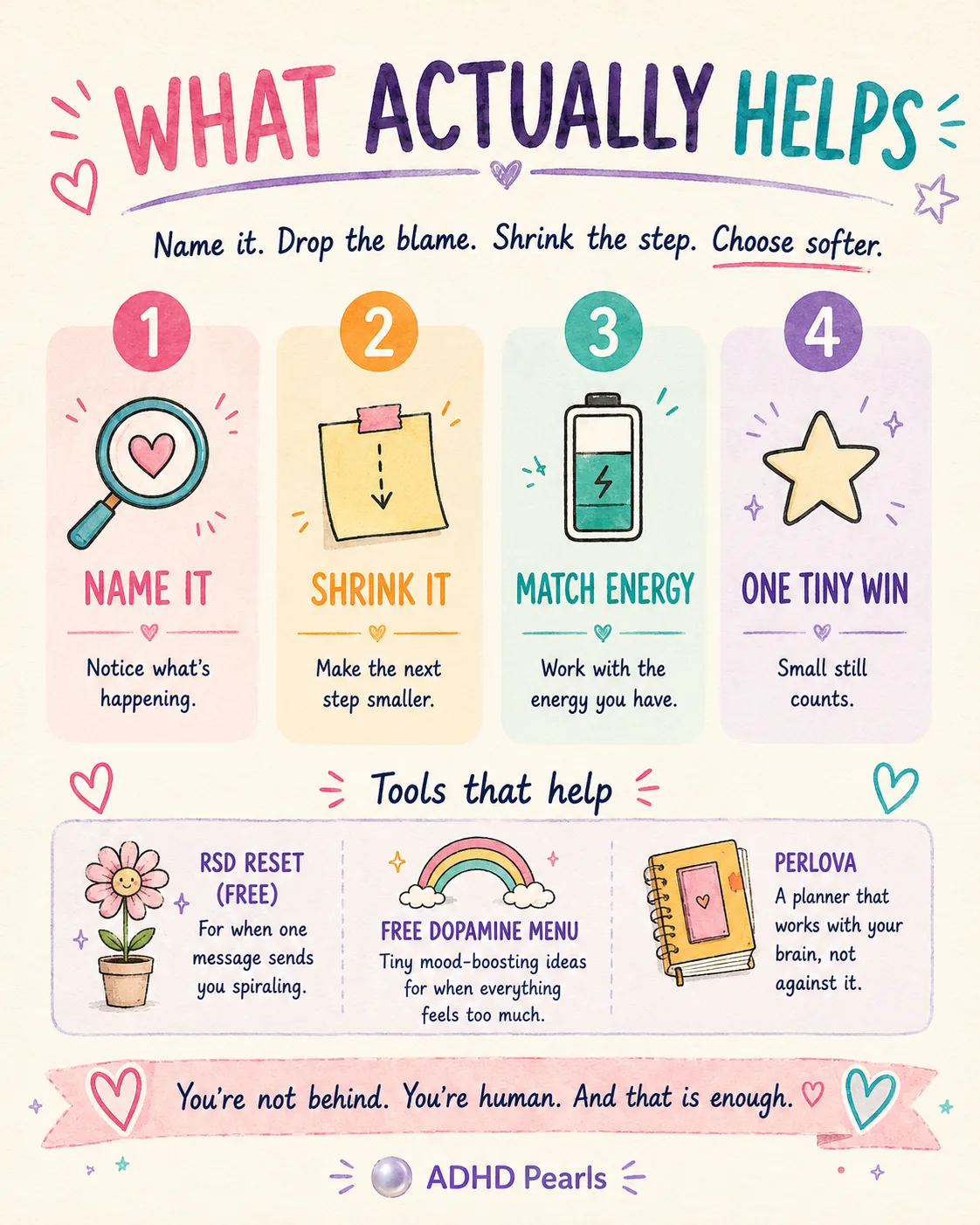
1. Name it.
Before trying to fix anything: what is actually happening right now? Shame spiral? Freeze? Overwhelm? Avoidance? Just naming the state creates a tiny gap between you and it. You are not the spiral. You are noticing a spiral. That distinction matters more than it sounds.
2. Drop the blame.
This is the hardest step. Take the thing you’re ashamed of and strip the verdict off it. Not “I’m so bad at this,” but “that didn’t happen.” Not “I always do this,” but “I didn’t do this today.” You’re not excusing yourself. You’re translating back into neutral.
3. Shrink the step.
Whatever the task is, make it smaller. Not “deal with emails.” Open the inbox. Not “clean the house.” Clear one surface. Not “reply to her.” Open the thread. The smaller the step, the lower the activation energy. This is not cutting corners. This is working with how your brain actually starts.
4. Match your energy.
What is your actual capacity right now? Not what you wish it were. Not what it was last Tuesday. Right now, today, this hour. A twelve-percent version of the task still counts. A slower version still counts. Done with fewer steps because that’s all you have still counts.
5. Count one tiny win.
Not the list. One thing. Something real that happened. Out loud if that helps. Your brain is allowed to know it happened. The shame spiral only counts the things that didn’t happen. The detox starts counting what did.
Right now, before continuing: name one thing that actually happened today. Not a goal. Not something you’re grateful for. Just one real thing that occurred. That counts. Write it down if you need it to feel more real.
A Softer Message to Your Future Self
The shame spiral usually has a voice that sounds very sure of itself.
It sounds like honesty. It sounds like clarity. It sounds like finally seeing yourself as you really are.
It isn’t.
It is a very tired brain that has spent years being handed the wrong tools and blaming itself for the gap. It is a brain that learned, early and repeatedly, that not keeping up meant something was wrong with you — not the system, not the expectation, not the mismatch between how your brain works and how the world asked it to work.
You were not failing. You were trying, constantly, with everything you had, in a framework that was not designed for you.
Your past is not proof you failed. It’s data about what didn’t fit — and what your brain needed instead.
And if the harder question right now is which of your habits were really you and which were armor, that has its own piece: is it my personality or my ADHD?
So this is the letter I would have needed. Maybe it’s the one you need too.
Dear Future Me
You are not starting over because you failed.
You are starting softer because the old way kept hurting you.
The planner you didn’t finish was not a verdict. It was a mismatch. The routine that collapsed was not proof of who you are. It was information about what you needed that you didn’t have yet.
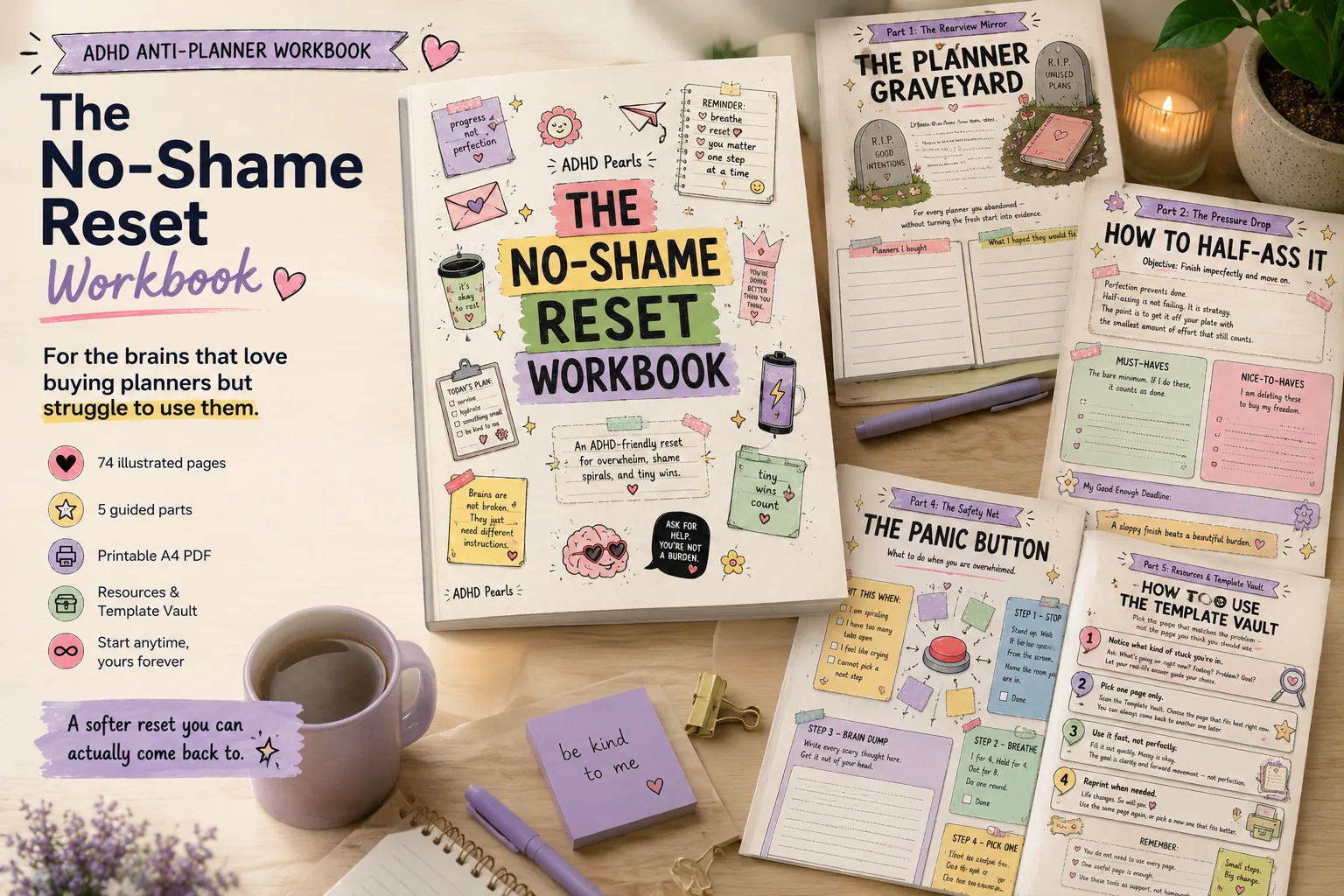
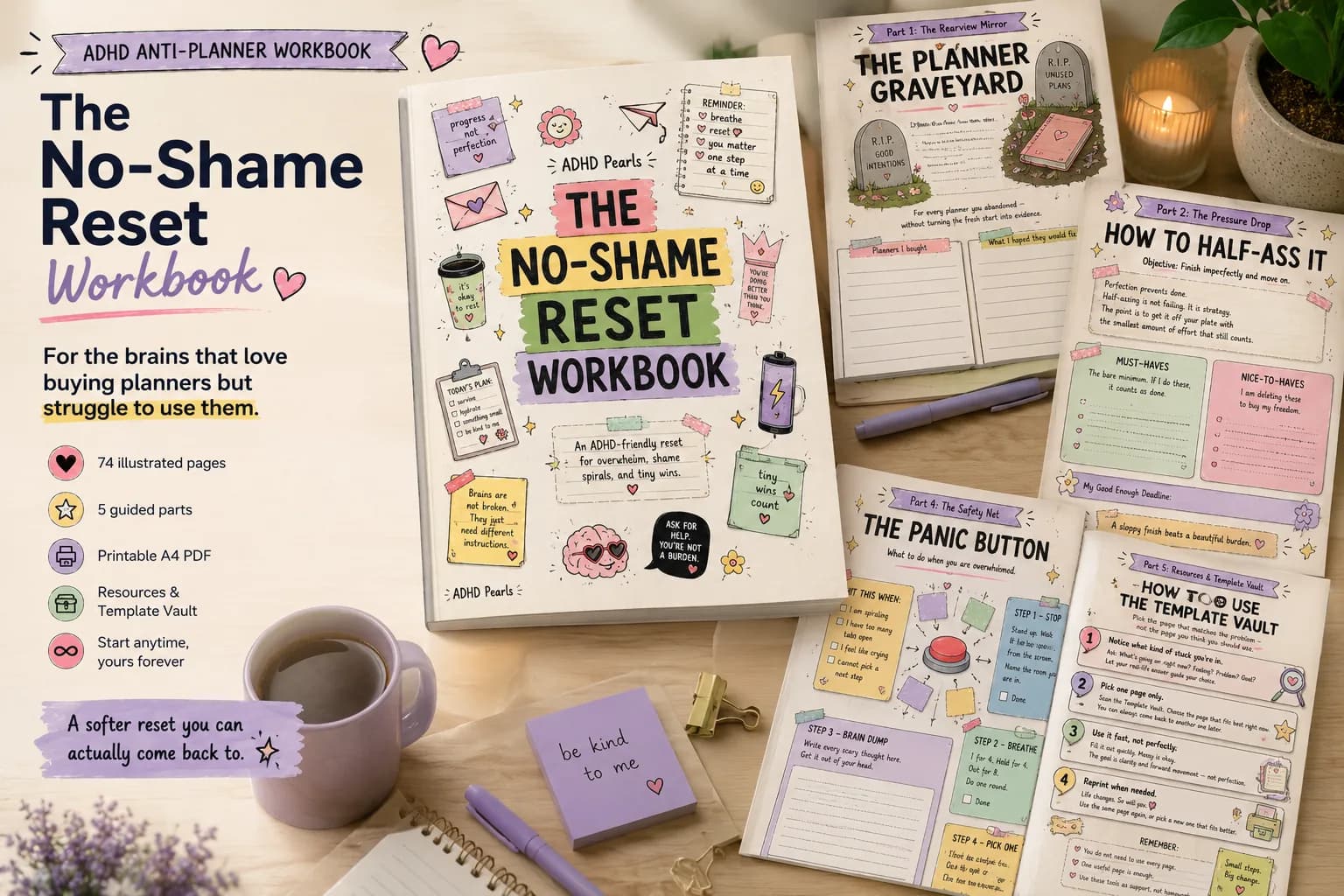
If you want a gentle, structured way to do that on paper, The No-Shame Reset Workbook is an anti-shame ADHD workbook built for turning those “proof I failed” stories back into plain, useful information.
You have been trying. Quietly, persistently, in ways that nobody else saw — trying to function inside structures that were never built for your brain, and feeling the shame of the gap as if the gap was your fault.
It wasn’t.
You don’t have to earn a fresh start. You don’t have to fix everything first, or explain yourself, or wait until you feel ready.
You just have to take one smaller step. And then another. Not because you’ve figured it out — but because starting softer is allowed.
FAQ: ADHD and Shame
What does ADHD shame feel like?
ADHD shame often feels like a constant low hum of not-quite-enough — punctuated by sharper moments when a forgotten task, an unanswered message, or another abandoned system becomes “proof” of something deeper. It tends to skip from event to identity very fast: not “I forgot that,” but “I always forget. That’s who I am.” Unlike ordinary guilt, which points to a specific action, ADHD shame tends to become a story about your character — and that story accumulates quietly over years.
Why do people with ADHD feel guilty over small tasks?
Because small tasks are often not as small as they look. An email might require finding the thread, remembering the context, managing the dread attached to the inbox, writing something that sounds competent, rereading it twice for tone — and all of that before a single word gets typed. When capacity is already depleted by masking, decision fatigue, emotional overwhelm, or sensory load, the gap between “that looks simple” and “I can’t start it” becomes a source of shame. The guilt comes from comparing the perceived difficulty of the task to the actual cost of doing it — and concluding that the gap is a personal failure, not a capacity issue.
How do I stop using my past as proof I failed?
Start by separating data from verdict. Every “proof” your shame offers — the unfinished planner, the missed message, the routine that collapsed — is a real event with the wrong conclusion attached. The event happened. The conclusion (“therefore I am broken”) is a story, not a fact. Practise translating: not “I always do this,” but “this happened today.” Not “this proves who I am,” but “this is information about what didn’t fit.” The ADHD Shame Detox Practice in this article — name it, drop the blame, shrink the step, match your energy, count one tiny win — is a starting framework for that process.
Can energy-based planning help ADHD shame?
Yes — because most ADHD shame is built on the gap between what you thought you could do and what your brain could actually manage that day. Traditional planning assumes consistent energy and willpower. Energy-based planning starts by asking what your brain can realistically handle right now — and builds from there. When the plan matches your actual capacity, you stop setting yourself up for the failure loop that feeds the shame cycle. Perlova was built specifically around this: instead of showing you everything you’re behind on, it asks what one thing is actually doable today.
This article is for educational and informational purposes only. It is not a substitute for professional diagnosis or treatment. If you think you may have ADHD or are experiencing significant shame, anxiety, or depression, please speak with a licensed healthcare provider who is familiar with ADHD in adults.
Why does ADHD shame feel worse than ordinary guilt?
Because guilt is about a thing you did and shame is about what you decide that thing proves. With years of missed deadlines and forgotten plans behind you, the brain has an enormous evidence file to draw on, so a small slip can trigger a verdict on your whole character.
Is ADHD shame the same as low self-esteem?
They overlap but are not identical. Low self-esteem is a steady low opinion of yourself; ADHD shame tends to spike hard around specific failures and then recede. Many late-diagnosed women have both, built on the same decades of evidence.
Why do compliments sometimes make it worse?
Because praise can feel like something you will have to keep paying for. If you know how inconsistent your output actually is, being called reliable can register as a debt rather than a kindness. That reaction is common and does not mean you are ungrateful.
Does therapy help with ADHD shame?
It can, particularly with a therapist who understands ADHD rather than treating the pattern purely as low mood. Approaches that work on self-criticism directly tend to be more useful than ones focused only on organizing skills. A clinician can help you decide what fits.
How long does it take to unlearn this?
Longer than anyone wants to hear, and it is not linear. Most people notice the gap between the slip and the verdict getting slightly longer before they notice the shame getting smaller. That gap is the thing worth watching.
Found this helpful? Share it with someone who gets stuck too.
One tap makes ADHD Pearls a preferred source in your Google account, so our articles surface higher when you search. No signup, and it brings you straight back to this page.
ADHD anti-planner workbook
The No-Shame Reset Workbook
A 74-page printable reset for overwhelm, shame spirals, and the planners you couldn't keep using. Reflect without shame, release what isn't working, and build a softer reset you can actually return to.
For the woman who sets up the perfect system on Sunday and abandons it by Tuesday.
One short letter, every week. Real talk about ADHD, task paralysis, and the tiny wins that actually move the needle for a brain like yours. No shame. No hustle culture.