The first thing I did on the worst week of last winter was put one sock in the laundry basket. Not the pile. One sock, from the floor, into the basket, while the rest of the room stayed exactly as it was.
It sounds like the setup for a joke about low standards. It was actually the first thing I had finished in four days, and something in my chest unclenched about a millimeter. That millimeter is the entire subject of this article.
Quick answer
Why do tiny wins work for ADHD brains?
Because ADHD motivation runs on interest, urgency and reward rather than importance, and a big goal delivers no reward until it is finished - which for many of us is never. A tiny win is small enough to actually complete, and completion is the signal the brain responds to. One finished thing also changes how the day reads, which makes the next thing easier to start.
Key takeaways
📌Big goals pay out only at the end. ADHD brains need a payout much closer to the start.
📌If a task feels slightly embarrassing to write down, it is the right size.
📌A tiny win counts even when it does not lead to anything else.
📌Naming when and where you will do it beats trying to want it more.
📌Tiny wins are not a treatment. They are a way to keep moving while other things get addressed.
Every January I used to write a goal like "get on top of the house." Ambitious, vague, and completely unstartable, which I now understand was the point - a goal that large is emotionally satisfying to write and impossible to be measured against.
The mechanical problem is timing. A big goal delivers its reward at the end. Get on top of the house pays out in approximately March, if ever. Between now and then there is nothing but effort, and effort with no feedback is the exact condition under which an ADHD brain quietly wanders off.
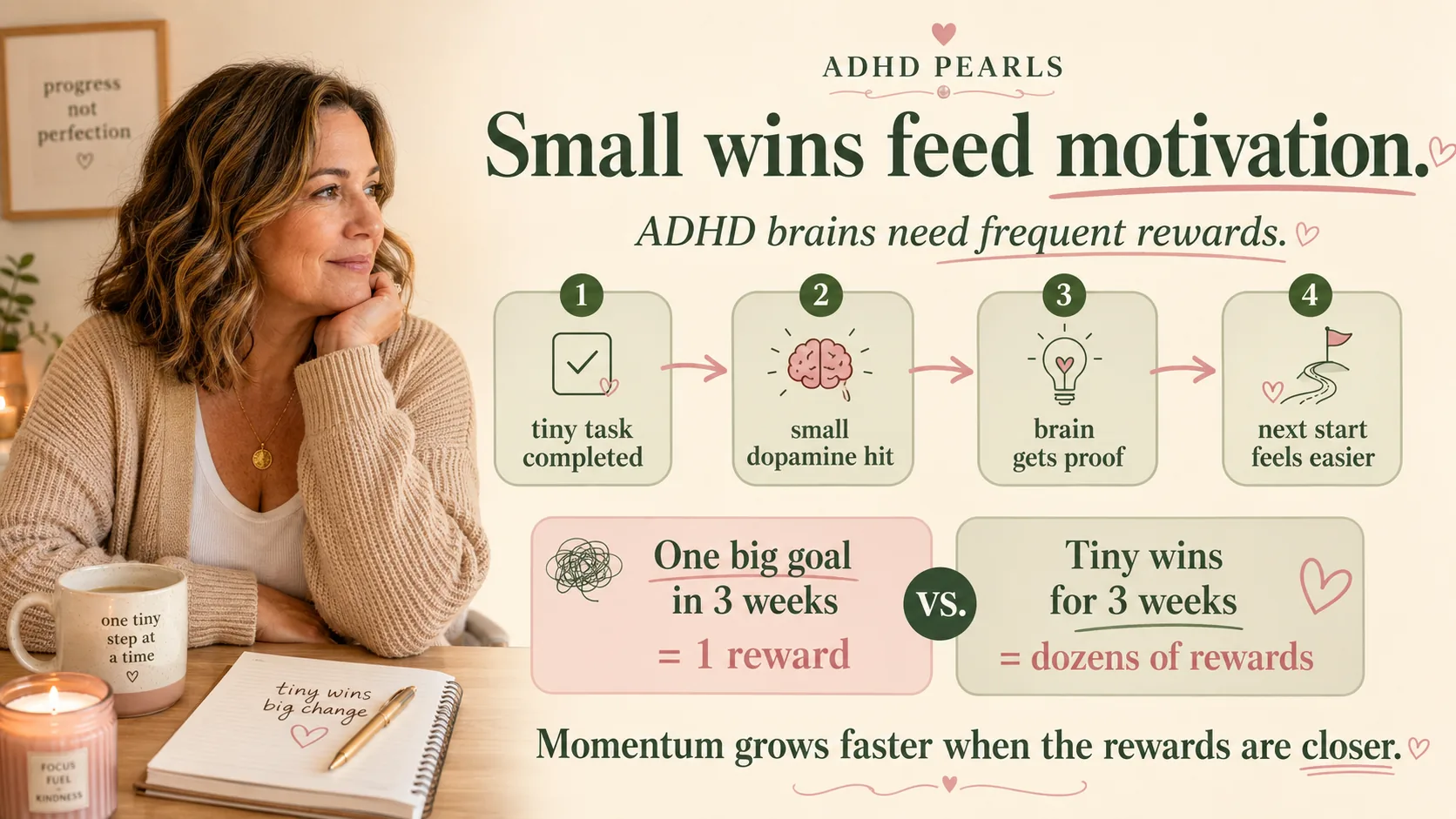
Big goals can feel too far away to activate the brain. Tiny wins give you a place to begin.
There is neurobiology underneath this. A 2009 JAMA study using brain imaging in adults with ADHD found reduced dopamine markers in regions involved in reward and motivation, and the size of that reduction tracked with the severity of inattention. That does not mean anyone is broken or that dopamine explains everything - it is one study in a complicated field. But it fits what the experience feels like: importance alone does not switch the system on. Something has to actually land.
A big goal asks you to run on credit. A tiny win pays cash.
The second problem is what happens when the big goal fails, which it does. It does not fail quietly. It becomes another entry in the file marked evidence that I cannot do this, and that file is heavy enough already. I wrote about dismantling it in the ADHD shame detox, because for a long time my goals were mostly a way of generating fresh proof against myself.
From ADHD Pearls
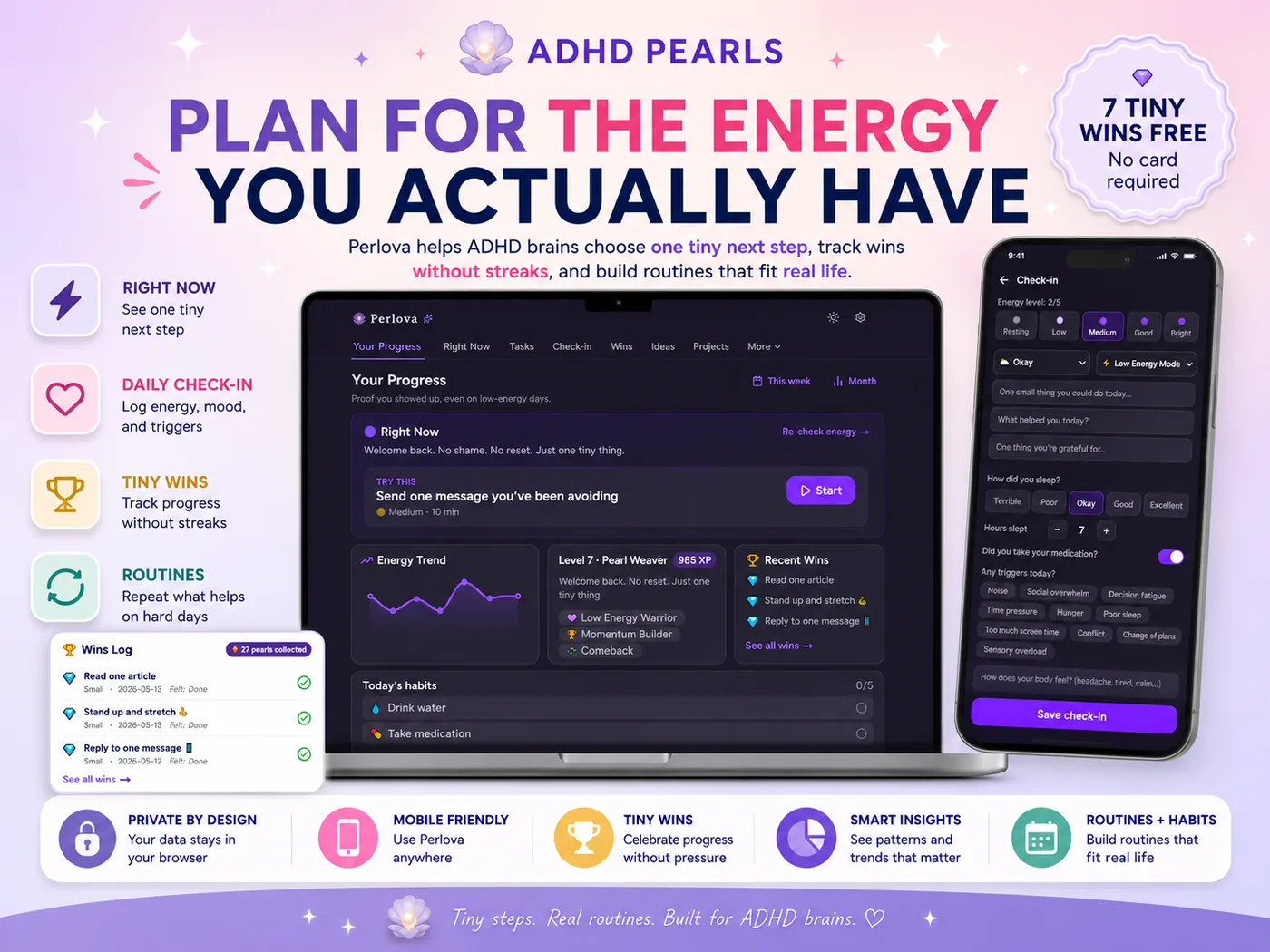
Perlova — plan from the energy you actually have
One doable next step, wins without streaks, and routines that fit real ADHD life. No card, no shame.
Three things, and only one of them is about the task.
It gives you a completion signal
Finishing something registers differently from working on something. This is why you can spend four hours on a project and feel worse than after two minutes of sorting the mail - the mail ended. An ADHD brain that rarely gets to the end of things is a brain that rarely gets that signal, and tiny wins are simply a way of manufacturing it on purpose.
Momentum grows faster when the rewards are closer.
It changes how the day reads
Teresa Amabile and Steven Kramer collected more than 12,000 daily diary entries from people working on creative projects and looked at what separated good days from bad ones. The strongest single factor was not praise, or pressure, or a breakthrough. It was making progress on something that mattered, even in small increments.
That research was done in workplaces, not with ADHD populations, so I hold it loosely. But it names something I recognize: on the days I finish one small thing, I describe the day differently to myself. Not "a write-off." Something more like "slow, but I did the sock."
It lowers the entry cost of the next thing
Momentum is real, though it is oversold. Roughly half the time, putting the pans in the sink turns into doing the dishes. The other half it stays one sock in a basket. Both are fine, and the second one is the reason I insist tiny wins have to count on their own - if they only count when they snowball, you have just rebuilt the big goal in a smaller font.
What Counts as a Tiny Win
The test I use: if writing it down makes you feel slightly ridiculous, it is correctly sized. Not "small enough to be easy." Small enough to be almost silly.
The goal you wrote
The tiny win version
Sort out my finances
Open the banking app and close it again
Deep clean the kitchen
Put the pans in the sink to soak
Answer my emails
Reply to the shortest one with one line
Start exercising again
Put the trainers by the door
Deal with the paperwork
Put every loose page in one box, unsorted
Notice that several of these do not finish the job or even meaningfully advance it. Opening the banking app achieves nothing measurable. What it does is break the seal on a task I had been avoiding for eleven days, and on day twelve the avoidance is the actual obstacle, not the admin.
How to Make a Tiny Win Stick
Say when and where, not just what
"Put the pans in the sink" is a wish. "After I put the kettle on, I will put the pans in the sink" is a plan with a trigger attached.
Psychologists call these implementation intentions, and a meta-analysis covering 94 independent tests found a medium-to-large effect on whether people actually did the thing. The studies were not ADHD-specific, so treat this as a sensible general bet rather than a targeted intervention. It has held up better than anything else I have tried, largely because it moves the decision to a moment when I still have the capacity to make it.
You do not need motivation to start. Starting is often how motivation appears.
Attach it to something that already happens
Your existing routine is scaffolding you do not have to build. Kettle, teeth, school run, closing the laptop - each of those is a reliable cue you already perform without deciding to. Hanging one tiny win off an existing anchor costs far less than inventing a new slot in the day.
Write it down after, not before
This one is slightly perverse and works anyway. A list written in advance becomes a scorecard you will fail. A list written afterward, of things that actually happened, becomes evidence. On bad weeks mine reads like a police log - "8:40, took the bins out" - and it is still more useful than the aspirational version, because it is true.
Do not upgrade it the moment it works
The classic failure mode. One good week of tiny wins and I would immediately promote the system to something ambitious, which promptly collapsed, which I then read as proof that tiny wins do not work. They worked. I fired them for succeeding.
If you want the shortest possible starting list for the days when even this feels like too much, the two-minute hacks for when you cannot start are built for exactly that.
When Tiny Wins Are Not the Answer
I want to be straight about the limits, because this idea gets sold as a cure and it is not one.
If you are running on empty, the answer is capacity, not motivation. On a genuinely depleted day, one tiny win is the whole plan and rest is the rest of it - which is a different problem with a different approach, covered in how to be productive on low-energy ADHD days.
If nothing has felt good for weeks, no amount of small steps will touch that, and it is worth a conversation with a doctor rather than another system. Persistent low mood, exhaustion that does not lift and loss of enjoyment can have a number of causes, several of them treatable.
This article is educational and is not medical advice. Strategies like these can sit alongside professional support, but they are not a treatment for ADHD, depression or burnout, and only a qualified clinician can assess what is going on for you.
FAQ: Tiny Wins and ADHD
What is a tiny win?
A task made small enough that finishing it is realistic even on a bad day - one sock in the basket, one line of an email, the pans in the sink. The defining feature is that it can be completed, not that it makes visible progress. Completion is what the brain responds to.
Why do small steps work better than big goals with ADHD?
Because big goals only pay out at the end, and ADHD motivation tends to respond to interest, urgency and reward rather than importance. A long stretch of effort with no feedback is where attention drifts away. Small steps deliver something the brain registers much closer to the start.
Is there research behind this?
Some, though not a single study that proves the whole idea. Imaging research has found reduced dopamine markers in reward and motivation pathways in adults with ADHD, and diary research in workplaces found that small progress on meaningful work was the strongest driver of good days. Neither was designed to test tiny wins for ADHD specifically.
How small is too small?
There is essentially no floor. If it feels slightly ridiculous to write down, it is probably the right size. The most common mistake is making the first step too big, not too small.
What if the tiny win does not lead to anything else?
Then it was still a tiny win. Roughly half the time one small action turns into more, and half the time it does not. Making them count only when they snowball turns them back into the big goal you were trying to escape.
How do I remember to do them?
Attach each one to something you already do reliably - the kettle, brushing your teeth, closing the laptop - and name the trigger out loud or in writing. Deciding when and where in advance works considerably better than relying on remembering in the moment.
Is this just lowering my standards?
It is lowering the entry requirement, which is different. The standard for the finished job stays where it was. What changes is how much has to happen before you are allowed to begin, and for a brain that struggles with initiation that is usually the binding constraint.
Why do I lose the habit after a good week?
Frequently because the good week gets treated as proof you can handle something bigger, so the system gets upgraded and then collapses. Keeping the steps small when things are going well is the part almost nobody does, including me.
Do tiny wins help with ADHD burnout?
They can keep you moving, but they do not treat it. If exhaustion has become constant, sleep is not restoring you, or nothing feels enjoyable anymore, that needs proper support rather than a smaller to-do list.
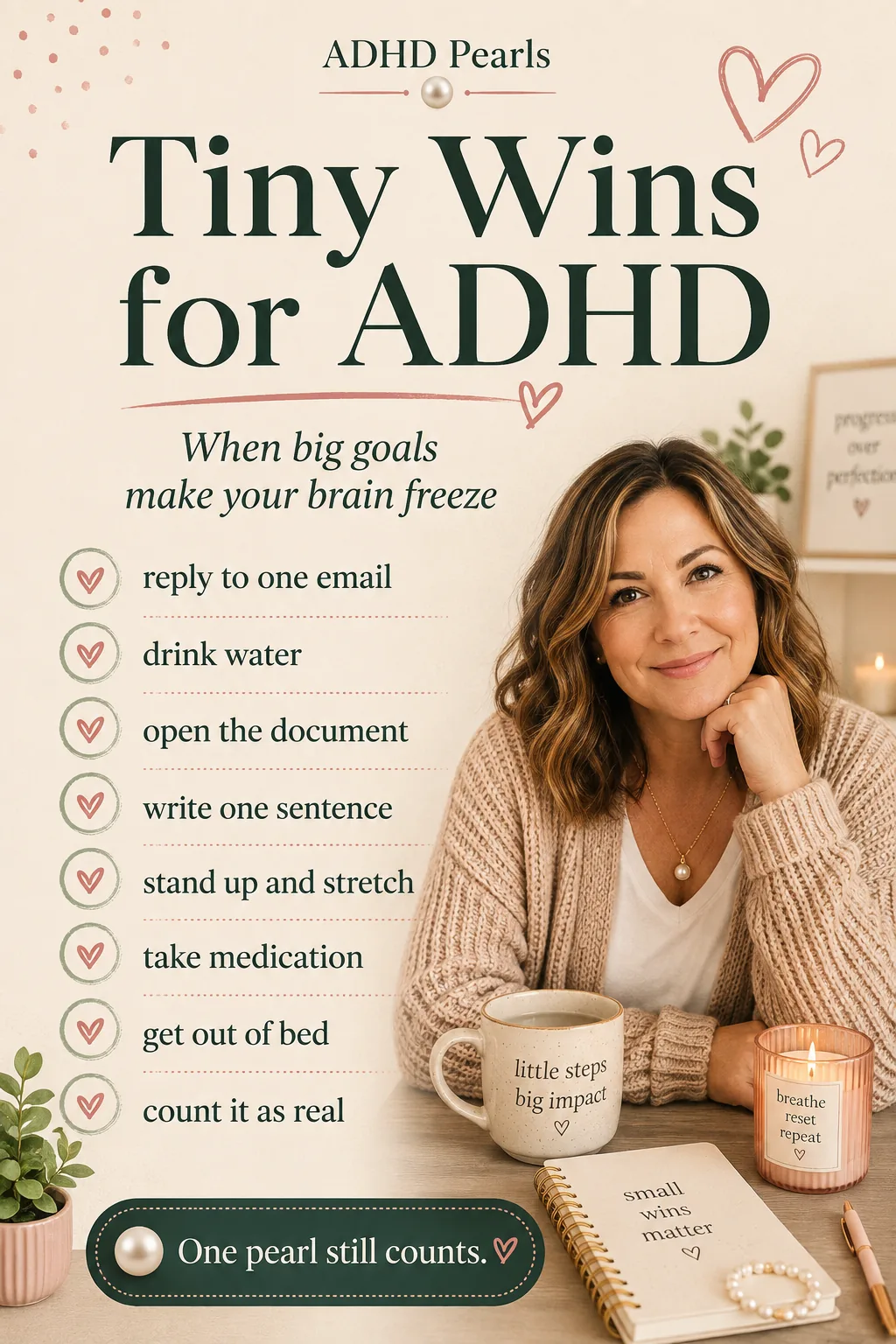
Save this for the next time a big goal makes your brain freeze and you need one tiny place to start.
Pin this tiny wins reset for the next hard ADHD day.
A pearl is not built in one go. It is layer over layer over layer, around something that was originally an irritant, and none of the individual layers look like anything.
You do not need a perfect day. You need one sock.
Found this helpful? Share it with someone who gets stuck too.
One tap makes ADHD Pearls a preferred source in your Google account, so our articles surface higher when you search. No signup, and it brings you straight back to this page.
Here's why other planners didn't stick
They assume you'll show up the same every day. Perlova starts with how you feel right now.
Other ADHD planners
×Ask you to plan ahead, when your brain isn't there yet
×Assume you have consistent energy every day
×Show you everything you're already behind on
×Fall apart the first time you miss a day
×Require willpower just to open them
Perlova
✓Starts with your energy right now — not a perfect plan
For the woman who sets up the perfect system on Sunday and abandons it by Tuesday.
One short letter, every week. Real talk about ADHD, task paralysis, and the tiny wins that actually move the needle for a brain like yours. No shame. No hustle culture.