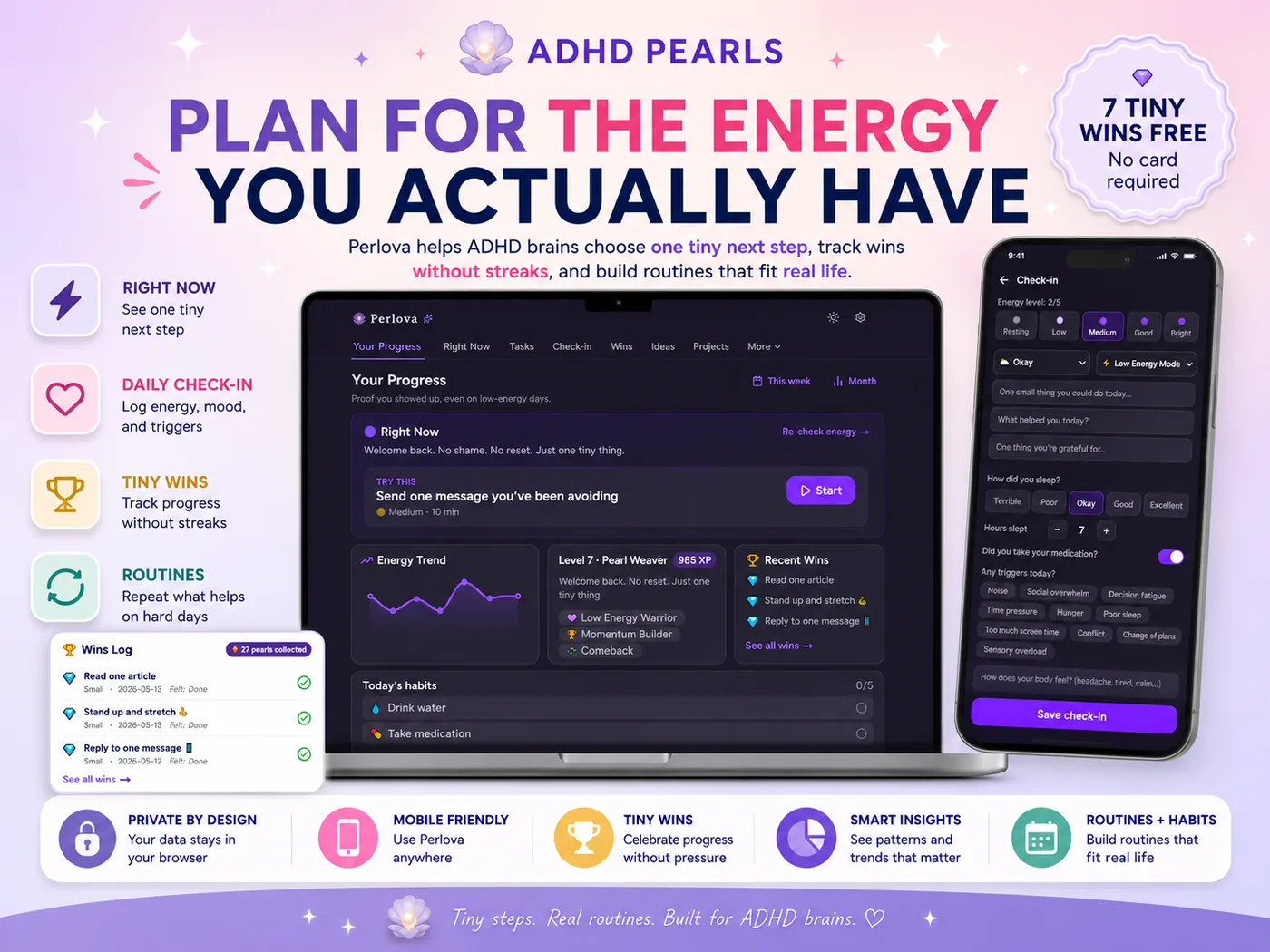
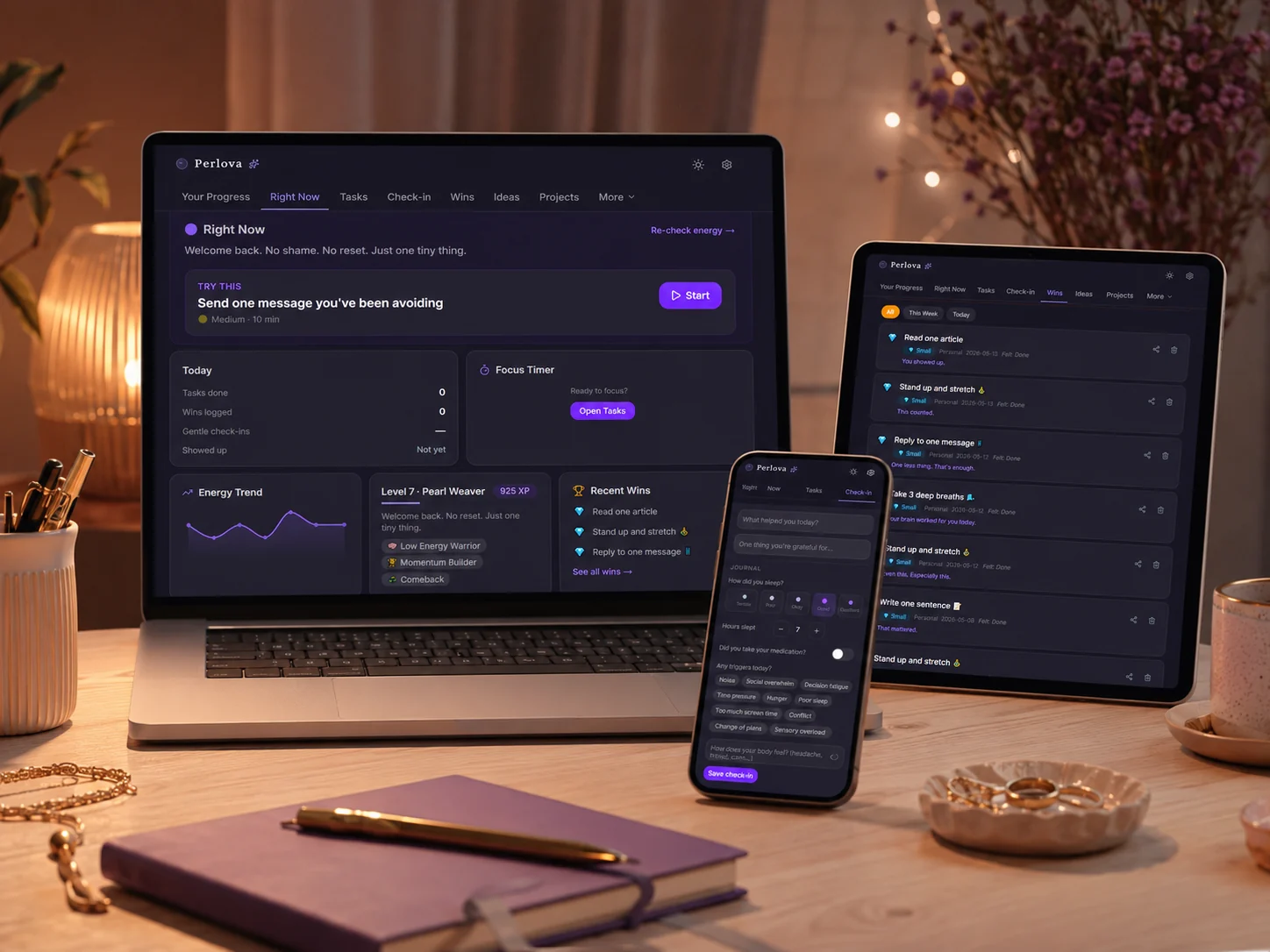
It's 2pm on a Tuesday. Your calendar app politely reminds you that you're supposed to be working on the big project. You open the document. You stare at the cursor. You notice a crumb on your desk and spend 40 seconds deciding whether to clean it before starting. The cursor keeps blinking. You close the laptop.
You've been there. I've been there so many times I stopped being surprised by it.
The thing no one tells you when you get diagnosed with ADHD — or even if you never get a formal diagnosis but you recognize yourself in every description — is that your productivity problem isn't really about time. It's not that you don't know what you're supposed to do. It's not even that you can't do it. It's that the energy to do it is just... not there. And no calendar reminder is going to conjure energy that doesn't exist. What actually works is energy-based planning: matching what you do to what you genuinely have available, instead of what your calendar thinks you should have.

Quick answer
What is energy-based productivity for ADHD?
Planning around the capacity you have today rather than around the clock. You rate your energy, then choose tasks that match it, instead of holding yourself to a schedule written when you felt completely different. The calendar still exists — it just stops being the only input, which is what makes a low-energy day survivable instead of shameful.
Key takeaways
- 📌Plan around the capacity you have today, not the schedule you wrote when you felt different.
- 📌Rate your energy first, then pick the task. A thirty-second check-in is enough.
- 📌The calendar still exists. It just stops being the only input.
- 📌Low-energy days need a shortlist prepared in advance, not improvisation.
- 📌Weekly patterns are real. Once you can see yours, you stop scheduling hard things into your worst slot.
Why Time-Based Planning Fails ADHD Brains
I used to buy a new planner every January. Every single year. Beautiful ones, ugly ones, bullet journals, expensive ones from that one Instagram brand everyone was into. I'd last about 11 days.
Not because I didn't try. I tried desperately. I'd spend hours setting up the system — color-coding, labeling, habit trackers, weekly goals written in my nicest handwriting. The setup felt like productivity. It released just enough dopamine to make me feel like I was getting somewhere. Then February arrived. Or, more accurately, January 12th arrived.
Here's what I've figured out after decades of trying to make conventional planning work on an ADHD brain: time-based planning assumes that Tuesday at 2pm means the same thing every week. That you'll show up to your calendar with roughly the same capacity you had last Tuesday at 2pm. That if you block "deep work" from 9 to 11am, your brain will cooperate.
For most neurotypical people, this is mostly true. Their bad days and good days vary, sure. But the variation is small enough that a calendar remains useful as a guide.
ADHD doesn't work like that.
There's something called time blindness — not just losing track of time, but a fundamentally different experience of how time feels. The future doesn't feel real. "I'll do it in an hour" doesn't register the way it does for someone whose brain naturally anchors to tomorrow. On top of that, executive function is wildly variable: on a good day you can write for three hours without noticing time pass; on a bad day the same task feels like trying to push a car uphill in the rain with your eyes closed.
Then there's the shame spiral. You plan for Tuesday at 2pm. Tuesday at 2pm arrives, and you have the energy of a damp sponge. You don't do the thing. Now you feel guilty. Guilt is exhausting. Now you have even less energy. The list sits there silently judging. By the time you could theoretically start, you've burned through so much cognitive fuel on the loop of shame and avoidance that you're running on empty.
If this sounds familiar, it's not a character flaw. It's ADHD paralysis — the very specific stuck state where you can see what you need to do, you understand the consequences of not doing it, and you still can't make yourself start. Conventional advice (try harder, be more disciplined, stick to your schedule) doesn't fix it because it's treating a regulation problem as if it were a motivation problem.
Time-based planning also ignores something fundamental: capacity isn't fixed. What you can genuinely do at 2pm on Tuesday varies wildly depending on sleep, medication timing, stress, whether you had a difficult conversation that morning, whether the weather changed, whether you're in a hormonal trough you haven't named yet. A system that doesn't account for this isn't just unhelpful for ADHD brains. It's actively harmful, because every day you fall short of the plan is another data point your brain uses to build the case against you.
I spent years building that case. A lot of us do.
What Is Energy-Based Planning
Energy-based planning is a system where you schedule and assign tasks according to your current energy state rather than the time on your clock.
That's the tidy definition. Here's what it actually means.
Instead of looking at your calendar and asking "what should I be doing right now?", you check in with yourself first — how much energy do I actually have right now? Then you look at your task list and ask: what's possible at this energy level?
The shift sounds small. It is not small.
Here's the simplest way I can explain what changed when I started doing this: I stopped fighting myself. For years, I'd look at a low-energy Tuesday afternoon and try to force my way through high-effort tasks. Some days I managed it — pure white-knuckle effort — and I'd feel exhausted and resentful by evening. Most days I failed, and I'd feel like a failure. With energy-based planning, a low-energy Tuesday afternoon is just information. It tells me which tasks are available to me right now. Not which tasks I should be doing, based on some theoretical version of me who slept perfectly and has infinite willpower. Which tasks I can actually do.
There's also something practical about this that didn't hit me until a few months in: I started getting more done. Not because I was pushing harder. Because I stopped wasting energy on the meta-effort of trying to force the wrong task at the wrong moment. The cognitive overhead of trying to initiate a task you don't have the energy for is enormous. You open the document, close it, open it again, check your phone, open it again — and you've spent 45 minutes doing nothing except exhausting yourself. That 45 minutes could have gone toward something you actually had capacity for.
Energy-based planning emerged from disability communities and adapted from concepts in chronic illness self-management — things like spoon theory, which you might have encountered if you've spent time in communities talking about variable-capacity conditions. The core insight is the same: you have a limited, variable amount of capacity each day, and the smart move is to match your output to your available input rather than fighting the gap.
For ADHD specifically, this works because it removes the judgment. There's no "should." There's no "I was supposed to." There's just: what do I have, and what can I do with it?
I want to be honest about one thing, though. Energy-based planning is not a magic fix. It doesn't give you more energy. It doesn't solve executive dysfunction or make hard tasks feel easy. What it does is stop you from wasting energy on the wrong things — and stop you from stacking shame on top of an already depleted brain. It's the difference between working with your biology instead of constantly fighting it.
And for some of us, just having permission to stop fighting it is pretty significant on its own.
The 5-Point Energy Scale
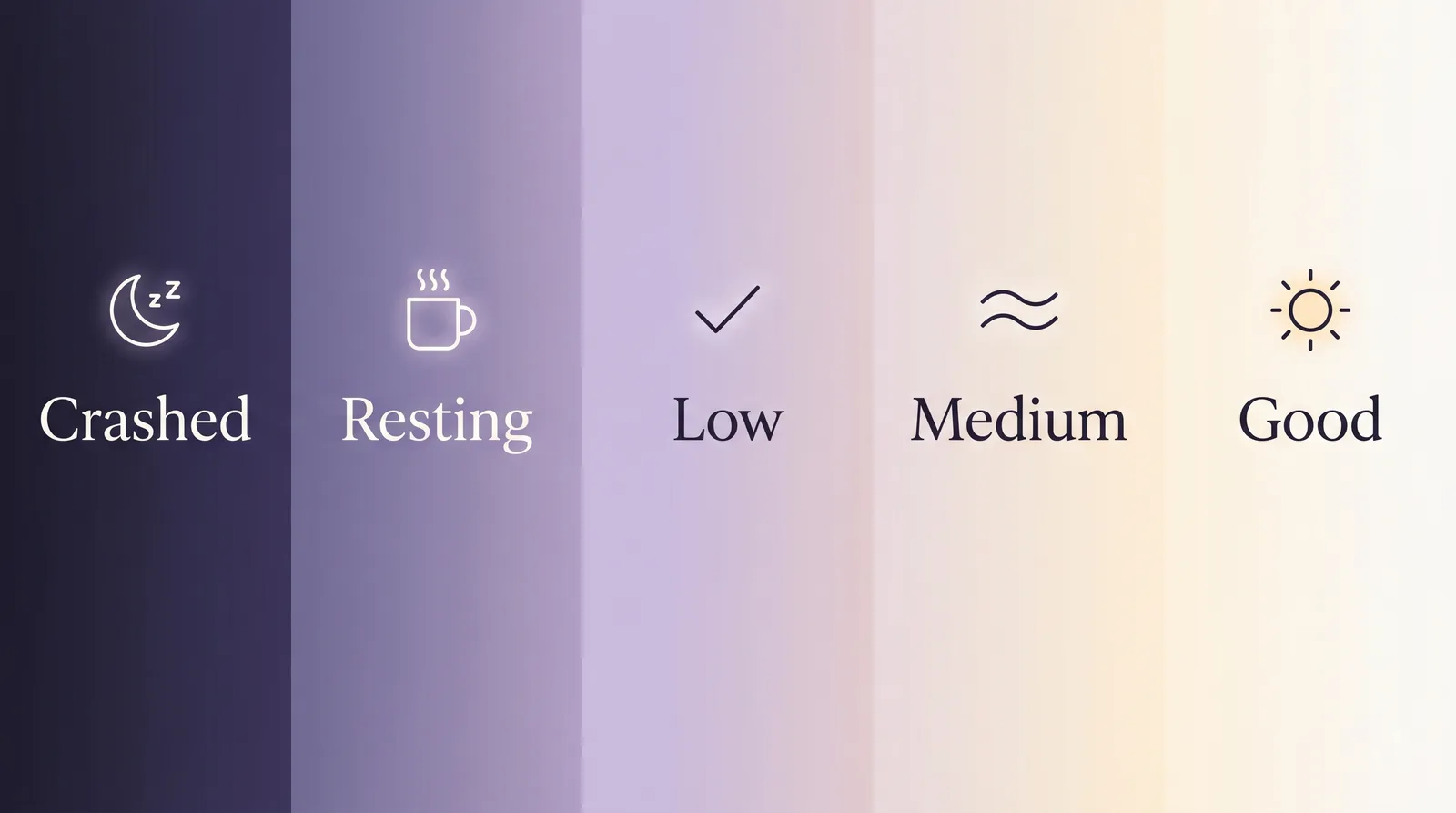
Every energy-based system needs a way to measure energy. Otherwise you're just guessing. I use a 5-point scale because it's simple enough to check in with honestly but granular enough to actually be useful:
- 0 — Crashed. Sleep. Rest. Survival only. The body needs to recover, full stop. This is not a task day.
- 1 — Resting. Functional but barely. Drink water. Send a text if something is genuinely urgent. Do one tiny thing if absolutely necessary. Then rest.
- 2 — Low. Micro-tasks and easy admin. The kind of things that require some cognitive effort but not a lot: sorting emails, responding to a routine message, filing something, updating a list.
- 3 — Medium. Focused work, creative tasks with structure, moderate decision-making. You can access your brain today. It'll take a warm-up, but it's there.
- 4 — Good. Deep work. Hard conversations. Big decisions. Complex creative work. Use these days intentionally, because they're rarer than you think.
The scale seems obvious until you try to use it honestly. That's where most people hit their first wall.
The first week I tried this, I rated myself a 3 every single day. I knew I wasn't a 3. A 3 is an aspirational 3. I was a solid 2 on a good day, maybe a 1.5 on a rough one. But rating myself accurately felt like admitting defeat — like saying "I'm only a 2 today" was a confession of inadequacy rather than a useful piece of information.
Here's what helped me reframe it: the scale isn't a performance review. There's no good or bad score. A 1 day is a 1 day. If you call it a 3 and try to do 3-level work, you'll either fail and feel terrible, or you'll scrape through and be completely depleted by 3pm. Neither of those is the goal.
Calibrating honestly takes practice. For the first two weeks, I'd suggest doing a check-in mid-day and asking yourself: was my estimate accurate? If you consistently rate yourself high and consistently underperform, try going one notch lower than your first instinct. Your brain — especially an ADHD brain — will trend toward optimism. The scale needs your honesty more than your hope.
One more thing: 4 is rarer than you think. If you're rating yourself a 4 every morning, you haven't calibrated yet. A 4 is the kind of day where you sit down at a task and don't look up for two hours. They exist. They're genuinely wonderful. But they're not Tuesday. They're not even most Tuesdays.
The 30-Second Energy Check-In
The most common thing I hear when people first try energy-based planning is: "I keep forgetting to check in." Fair. It's a new habit and it takes a while to stick.
But I also think the check-in gets overcomplicated. People try to do five minutes of journaling, a mood assessment, a sleep quality rating, a stress audit. Then they skip it because it's too much to set up at 8am before coffee.
My check-in takes 30 seconds. Three questions.
One: How is my body? Not "how am I doing?" — that's too big, too existential. Just the body. Rested or tired? Stiff or loose? Headache or not? Hungry or not? This takes about five seconds if you actually pause to notice.
Two: How is my brain? Foggy or clear? Scattered or present? Racing or slow? Five more seconds.
Three: What's my number? Given those two answers, where do I land on 0–4?
That's it. You don't need to write it down at first, though logging it eventually is useful and we'll get to that. You just need the number.
The reason this replaces 20 minutes of planning paralysis is that most of planning paralysis is actually anxiety about the gap between what you can do and what you think you should do. When you know your number, that gap gets named and becomes manageable. You're not avoiding the question of "what should I do today?" You're answering it immediately, based on information you actually have.
I try to do this check-in first thing in the morning, again after lunch, and sometimes in the late afternoon. Once in the morning is the minimum. You'd be surprised how often a morning 2 becomes an afternoon 3, or the reverse. Knowing your number twice gives you twice the information to work with, and it means you can shift gears when the day shifts on you — which it will, because that's just ADHD being ADHD.
Matching Tasks to Your Energy
This is where energy-based planning gets concrete.
First, you need to tag your tasks. Every item in your list gets a label: Micro, Low, Medium, or High. These correspond to the energy required to do them — not necessarily to how important they are. A High task isn't more valuable than a Micro one. It just requires more executive function to access.
To calibrate what this looks like:
Micro tasks (doable even on a 0 or 1): Drink water. Take medication. Reply to a one-line text. Open a document — not write in it, just open it. Add something to a list.
Low tasks (doable on a 2): Reply to a routine email. File something. Do a load of laundry. Review your task list. Update a spreadsheet. Reschedule an appointment. Read an article you've been meaning to get to.
Medium tasks (doable on a 3): Write a first draft. Have a non-urgent phone call. Do research for a project. Give feedback on something. Edit something you've already written. Code a straightforward feature.
High tasks (doable on a 4): Have a hard or emotionally loaded conversation. Make a major decision. Deep creative work with no guardrails. Strategic planning. Anything where you need your full brain online and available.
Once your tasks are tagged, the rule is simple: on a 2-day, you only look at Micro and Low tasks. Not because you're giving up on your Medium and High work — but because those tasks aren't genuinely available to you today. Putting them on today's list just means they sit there undone, silently accumulating dread.
Here's what this looks like in practice. Let's say it's Tuesday. You check in: you slept okay but not great, mild brain fog, a bit stiff. You're a 2. You have 47 unread emails (which, same), a report due Thursday, and three text messages you've been "about to reply to" for four days.
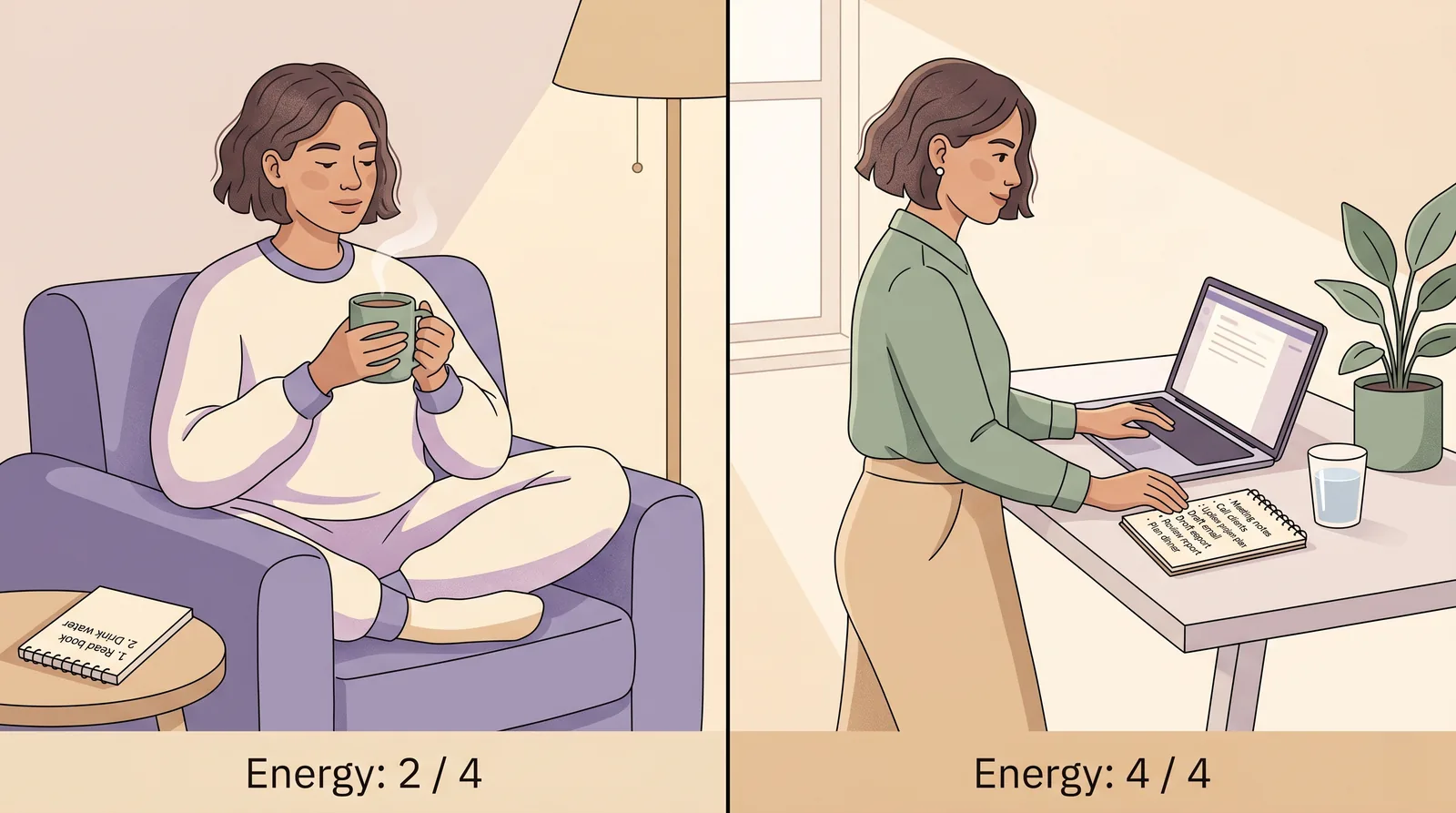
Tuesday at a 2: You look at your Micro and Low list. You reply to the three texts. You file the emails you've already read. You update the outline for the report — not write it, just update the outline, because structuring something you already know is Low. You do one load of laundry. By 2pm you've done six real things and you're not wrecked.
Tuesday at a 4 (different week, different nervous system): You open the report and actually write it. You have the hard conversation with your collaborator you've been putting off. You do the deep thinking you needed to do on that new project. You send the complex proposal you've been avoiding. By 2pm you've done four things, but they're four things that actually moved something significant forward.
Neither version of Tuesday is better. A 2-day handled well is a genuine success. The tiny wins from a well-managed low day compound the same way any wins do — and they're sometimes harder won.
The problem is when we apply 4-day expectations to a 2-day body and feel terrible when we can't deliver. I said earlier that this sounds simple. That's mostly true. But also — it requires genuine honesty about what "level" your tasks actually are. And it requires resisting the urge to peek at your High task list on a low-energy day when you're anxious about something due Friday.
Okay, here's where it gets interesting: the anxiety about Friday's deadline doesn't mean you have more energy. It just means you also have anxiety. Which makes the 2 feel more like a 1.5. The task doesn't get easier by worrying about it on a low-energy day. It gets harder. The worry itself is a task.
7 Low Energy Mode Tactics
Let's spend real time on the low-energy days, because they're the days most productivity advice completely abandons you. "Work when you're most productive" isn't useful advice when your most productive window was three hours ago and you didn't notice it passing.
Here are seven things that actually help. Not because they turn low-energy days into high-energy days, but because they keep you from making a 1 into a 0 — and they let you end the day with something to show for it.
1. The 2-minute floor.
On a low-energy day, any task that takes under 2 minutes gets done immediately, no negotiation. Reply to a text: do it now. File an email: do it now. Refill your water bottle: do it now. These tiny completions build a tiny momentum. They don't require much executive function because they're short enough that the brain's task-avoidance system doesn't fully activate — 2 minutes isn't long enough to dread. You'll be surprised how many things on your list genuinely take under 2 minutes, and how different you feel after clearing them out.
2. Horizontal tasks only.
Context switching — moving between different types of tasks, different projects, different kinds of thinking — is expensive for any brain. For an ADHD brain on a low day, each switch can cost 20–30 minutes of re-orienting time as your brain tries to remember where it was and what it was doing. On low-energy days, pick one category and stay there. All emails in one go. All filing in one go. One project, start to wherever you can get. The efficiency loss from context-switching is real, and today you don't have the budget for it.
3. Lower the bar, then lower it again.
What you thought was a Low task might be a Medium task in disguise. "Reply to emails" sounds Low. "Reply to the difficult email from the person I'm stressed about" is a Medium task, minimum. Be specific. If a task turns out to require more energy than you thought, break it down until there's a piece small enough to be genuine Low. The document doesn't need to be written today. It needs one paragraph today. Sometimes one paragraph is actually one sentence. One sentence is still one sentence more than zero.
4. Remove decisions — use pre-made choices from yesterday-you.
Decision fatigue is real and it hits ADHD brains earlier and harder than most. On low-energy days, rely on decisions you've already made. This is why "tomorrow list" is a useful habit: at the end of a better day, write down the two or three things you want future-you to work on tomorrow. Then future-you — who is having the rough Tuesday — doesn't have to decide. Yesterday-you already decided. You just have to execute. The cognitive difference between "decide what to do and then do it" and "just do the thing that's already decided" is enormous.
5. Body before brain.
When energy is low, your body is usually at least partly responsible. Drink water before checking email. Eat before you try to think. Step outside for five minutes before you open the laptop. I know. This sounds basic. It is basic. But the number of times I've tried to muscle through cognitive work while dehydrated and hypoglycemic is genuinely embarrassing. On the kind of morning where you stare at the coffee maker for 90 seconds before remembering how to use it — that morning, your body needs something before your brain can do anything. Give it that first.
6. The rest-and-return rhythm.
On a low-energy day, 25-minute Pomodoros might be too long. Try 10 minutes on, 10 minutes off. Or even 10 on, 20 off. This sounds counterproductive. It is more productive than 90 minutes of sitting at your desk achieving nothing while burning through your remaining capacity. Short bursts of genuine focus followed by actual rest — not guilt-scrolling, not half-watching something while half-working, actual rest — preserve more total capacity over a day than grinding through exhaustion does.
7. Name the day.
This one sounds silly. It isn't. When you wake up on a low-energy day, say it out loud or write it down: "Today is a 2 day." Name it. Acknowledge it. What gets named gets handled. What doesn't get named becomes an implicit accusation — a vague, persistent sense that you should be doing more, performing better, being a different person. Naming the day removes the accusation. It's a 2 day. That's information. Now you can make choices accordingly, without the background noise of shame adding weight to everything.
Low Energy Mode — the formal approach for days when you're at a 1 or 2 — isn't about giving up. It's about being strategic with a resource that's scarce today. These seven tactics are what that looks like in practice.

Reading Your Weekly Energy Patterns
Here's something most people discover within a few weeks of tracking their energy: the patterns are more predictable than they expected.
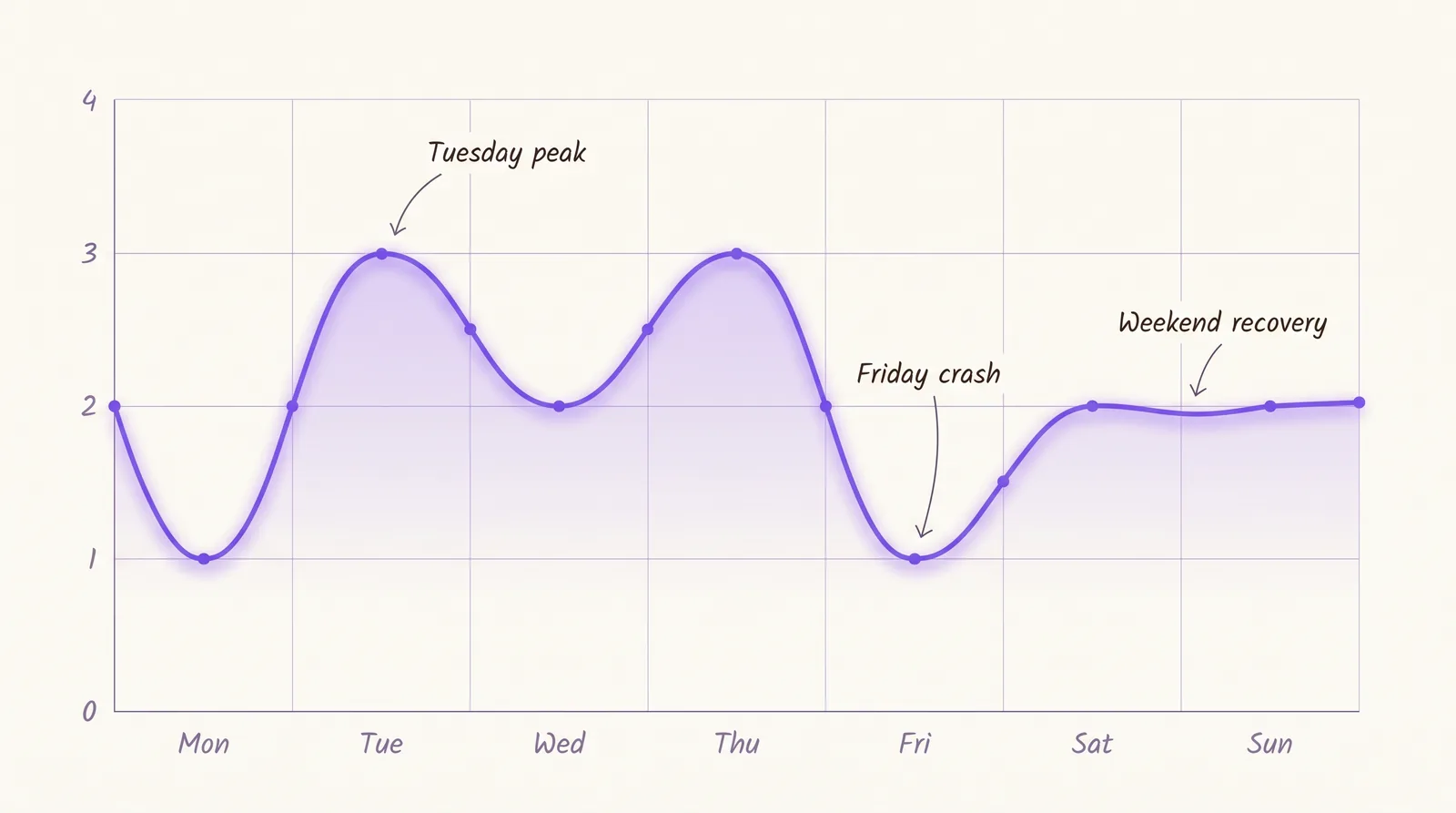
Not perfectly predictable. Not controllable. But patterns exist. Mondays might be consistently rough — the transition from weekend to weekday is hard for ADHD brains, who often have genuine difficulty with mode-switching. Tuesdays might be where the week peaks. Wednesday afternoons could be a dip. Your best creative work might happen between 10am and noon, and after 4pm you're mostly capable of Low tasks and hoping someone else makes dinner.
This is genuinely useful information. Once you have two or three weeks of check-ins logged, you can start reading your own data.
The realization most people have when they do this: you probably have 2 or 3 genuinely good days a week. Not 7. And you've been gaslighting yourself about this your whole life.
That's a strong word and I'm using it intentionally. We internalize the expectation that we should be productive every day, at consistent levels, without significant variation. When we fall short, we explain it with personal failure — I'm lazy, I'm undisciplined, I don't try hard enough, I'm broken. But looking at the actual data, what you see is: a predictable distribution of energy states across the week. On the low days, you were never going to produce at your peak levels no matter how hard you tried. The problem wasn't you. It was the expectation.
There's something weirdly freeing about this. Not because having 3 good days instead of 7 is great news — it isn't, and I'm not going to pretend it is. But because it means you can plan around reality instead of fighting it. You can be strategic.
Practically: use your tracked patterns to schedule your high-stakes work on your historically better days. If Tuesday and Thursday are reliably your 3s and 4s, those are the days for your most important work. Monday and Friday go to the Low and Micro tasks. This isn't giving up on being productive Monday. It's being strategically productive Monday, which means your Low tasks actually get done, and your high-stakes work gets your best energy instead of your worst.
Track your check-ins for 4 weeks. Just 4 weeks. You'll see your patterns. Everyone does. And seeing them — having them written down, visible, real — is different from suspecting them. It changes the conversation you have with yourself from "why can't I do this?" to "ah, this is just what Thursdays look like for me."
Energy is one axis. The other is the clock — and a plan can fit your energy perfectly and still fall apart because nothing was budgeted for the gaps between tasks. That side is in ADHD time management.
5 Common Mistakes When Starting
1. Rating yourself where you wish you were.
Already mentioned in the calibration section, but it bears repeating because it's the most common mistake by a significant margin. Your first instinct on the scale is probably one notch too optimistic. Notice that. Adjust. The goal isn't to perform wellness — it's to have accurate information. An accurate 2 is infinitely more useful than an aspirational 3.
2. Trying to force High tasks on low-energy days.
You know what you need to do. The deadline is coming. The anxiety is real. It feels irresponsible to not at least try. Here's what I'd suggest instead: try the task for 15 minutes. If you're staring at the same sentence and going nowhere, that's information — the task isn't available today. Stop. Come back tomorrow. Fifteen minutes of genuine confirmation is less wasteful than four hours of grinding and ending up in a worse place, with a worse relationship with that task, than when you started.
3. Treating low energy as a problem to solve.
Sometimes low energy isn't something to push through or fix. Sometimes it's the body asking for sleep, food, downtime, or recovery after a hard stretch. If you try to energy-manage your way out of genuine exhaustion, you extend the exhaustion. Rest is sometimes the intervention, not a productivity tactic that failed. This is hard to accept. I still struggle with it. But rest today often means real capacity tomorrow, and grinding today often means crash tomorrow.
4. Not logging.
The whole value of energy-based planning builds on data over time. If you don't log your check-ins — even just a number in a notes app, even just telling Perlova what your level is — you can't see your patterns. Memory is a terrible historian, especially ADHD memory. Two weeks from now you will not accurately remember whether Wednesday mornings are your low point or Thursday afternoons. You'll have a vague feeling. Feelings aren't data. Write it down.
5. Abandoning after one bad week.
A bad week doesn't mean the system doesn't work. Sometimes a bad week is a bad week because of external circumstances — sick kid, poor sleep, elevated stress, medication adjustment, hormonal cycle, just a rough patch. Sometimes it's a calibration issue you can fix. The system is worth at least four solid weeks before you make any real judgment about it. One bad week tells you almost nothing useful. I still forget to do the check-in half the time. I still come back to it. Every time I do, it helps.
How Perlova Automates This
Full disclosure: I built Perlova because I got tired of doing energy-based planning with a paper notebook and a color-coded spreadsheet. The app does the parts I kept forgetting — and the parts that felt like too much friction on a low-energy day to bother with.
Here's what that means practically. Every day when you open Perlova, it asks you one thing: how's your energy? You tap a number. That's your check-in, done. The app then surfaces only the tasks that match your energy level — if you're a 2, you see Micro and Low tasks. Your Medium and High tasks aren't gone, they're just not on today's list. No decision required about what to look at. The system makes that call for you.
As you log your daily check-ins, Perlova builds a weekly pattern view — your personal energy graph over time. After a few weeks, the patterns become visible. You can see your own rhythms in actual data, not just suspicion, and you can start scheduling intentionally around them.
The Low Energy Mode is built in. When you're at a 1 or 2, the interface simplifies: shorter work windows, gentler suggestions, Micro tasks surfaced automatically. No configuration needed — it just responds to your number. On a 4 day, the app gets out of your way and lets you work.
I'm not going to oversell this. Perlova doesn't fix ADHD. It doesn't give you more energy or better executive function or fewer 2-days. What it does is remove the overhead of managing this system yourself, so you can spend that overhead on actually doing things rather than maintaining the system that's supposed to help you do things.
Your first 7 tiny wins are free — no card, no countdown. Try it on a 2-day specifically — that's the real test. See if naming the number and having the app respond to it makes the day feel any more manageable. That's really all I'm asking.
You Don't Need a Perfect Day
Back to 2pm on a Tuesday.
This time, you do the check-in first. Body: a bit tired, mild headache, caffeine wearing off. Brain: foggy but present. Number: 2.
You open your Low list. There are six things on it. You pick the one with the least friction — a task you can actually start without dreading. You do it. Fifteen minutes. Done. You do another one. Then one more.
By 4pm you've done four Low tasks and two Micro. The big project is still there. It'll be there tomorrow, when maybe you're a 3. You've already put it on tomorrow's list, because tomorrow morning is historically your better window, and you know that now because you've been tracking.
The cursor stopped blinking at you like an accusation. The crumb on the desk doesn't matter. You matched today to today, and today was enough.
You don't need to have a perfect day. You just need to match today to today.
FAQ: Energy-Based Planning With ADHD
What is energy-based planning?
It is planning around how much capacity you have today rather than around the clock. You rate your energy, then pick tasks that match that rating, instead of holding yourself to a schedule written when you felt different. The calendar still exists; it just stops being the only input.
How is it different from time blocking?
Time blocking assumes the version of you who shows up at 2pm is the version who wrote the block at 9am. Energy-based planning assumes that person changes, sometimes by the hour, and builds the plan to absorb that. It tends to survive bad days, which is where time blocking usually breaks.
How do I rate my energy without overthinking it?
Use a small scale and a fast check. Notice your body, notice your brain, pick a number, move on. Thirty seconds is enough, and the number does not need to be right - it needs to be roughly honest and available before you choose what to work on.
What if my energy is low every single day?
Then the plan is a low-energy plan, and that is a legitimate way to run a week. It is also worth noticing as information. Persistent low energy can come from sleep problems, thyroid conditions, anemia, depression, medication effects or hormonal change, and those need a doctor rather than a better system.
Does this mean I never do the hard tasks?
No. It means hard tasks go where your capacity actually is, which for most people is a fairly predictable window once they have tracked it for a couple of weeks. Demanding work still happens; it just stops being scheduled into your worst hours by accident.
How long before I see my own patterns?
Usually two to three weeks of rough daily ratings. You are not looking for precision, just repeated shapes - which days sag, which mornings are reliable, what reliably wrecks an afternoon. That is enough to start planning with instead of against.
What if I rate my energy high and then crash?
That happens, and it is not a failure of the method. Adjust the rating and switch lists rather than pushing through on a plan that no longer fits. The whole point is that the plan can be revised mid-day without anything being ruined.
Is this just an excuse to do less?
It usually results in doing more, because fewer tasks get started and abandoned. Matching work to capacity reduces the pile of half-finished things that quietly consumes attention. Doing less on a bad day is also frequently the correct decision rather than an excuse.
Can I use this without an app?
Yes. A number written on paper each morning and two short lists, one for low-capacity days and one for good ones, covers most of the benefit. Apps help with tracking patterns over time, but the method works on a sticky note.
Related reading: