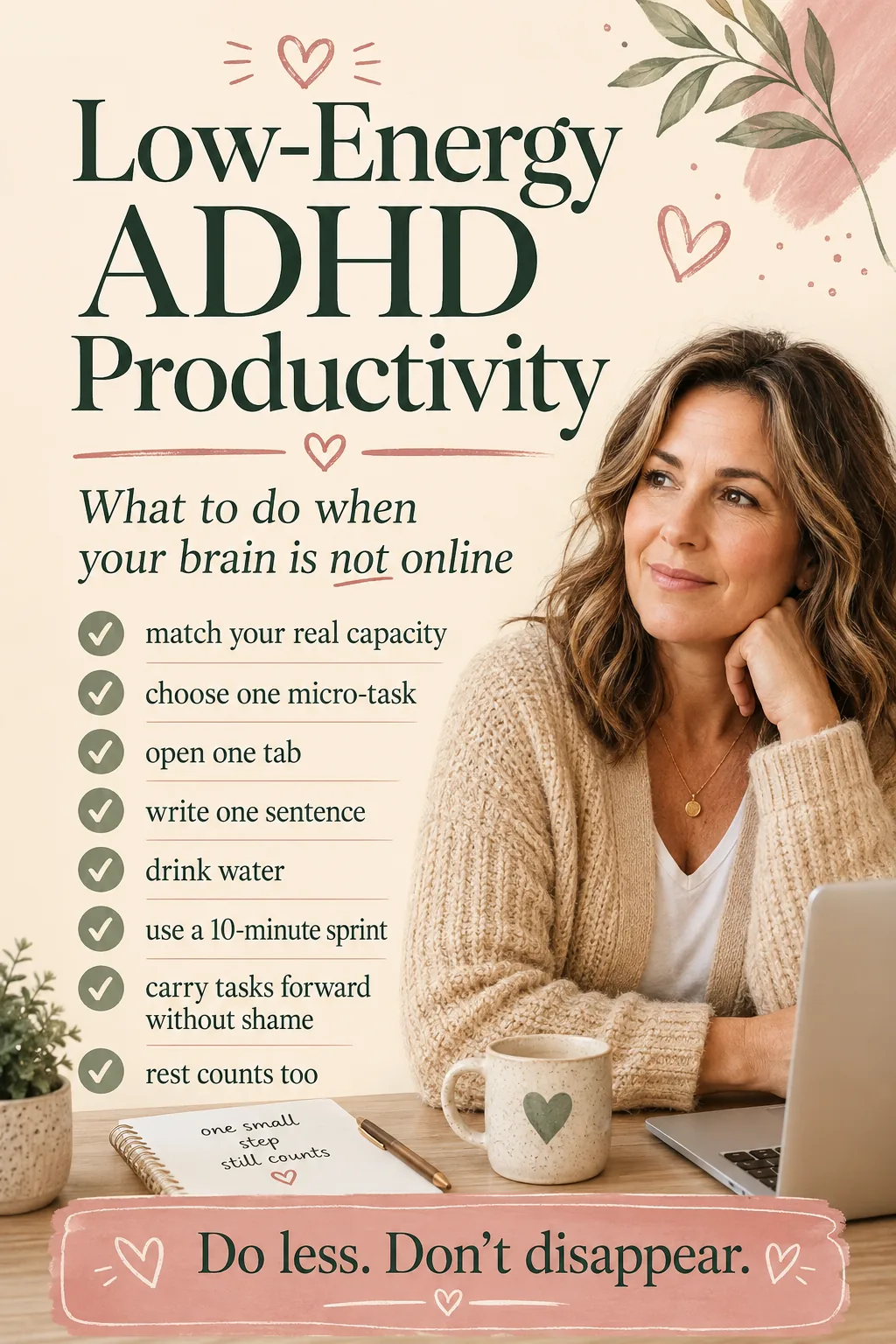
It is 3pm on a Tuesday and I have been standing in front of an open dishwasher long enough that it has stopped beeping at me. I am not sad. I am not procrastinating in the entertaining way, where at least the kitchen drawer gets reorganized. I have simply run out of whatever it is that makes a body unload a dishwasher, and there are still seven hours left in the day.
Low-energy days are not a scheduling problem. They are a capacity problem, and almost all productivity advice is written for people who have capacity and are choosing badly. If you are reading this at roughly 40 percent, this is what works at 40 percent.
Quick answer
How do you get things done on a low-energy day with ADHD?
Match the task to the energy you actually have, not the energy you planned to have. Pick one task that lowers tomorrow's load, shrink it until it feels almost too small to bother with, decide in advance exactly when and where you will do it, then stop when it is done. On a low-energy day, finishing one small thing beats starting three big ones and abandoning all of them.
Key takeaways
📌ADHD fatigue is not laziness with better branding. Running a brain that needs constant workarounds costs energy that nobody else is spending.
📌Plan for the day you are in. A to-do list built for your best self is useless at 40 percent.
📌One finished small thing does more for tomorrow than three abandoned big ones.
📌Deciding when and where in advance helps more than deciding harder.
📌Scrolling is not rest. It costs energy and returns very little of it.
📌If low-energy days have become low-energy months, that is worth raising with a doctor rather than out-planning.
The short version: you are paying for things other people get for free.
The effort nobody can see
Remembering an appointment without a reminder. Starting a task that is not urgent. Not saying the thing. Staying in a conversation when the room is loud. For a lot of brains these are automatic. For an ADHD brain they are each a small act of manual override, and you run several hundred of them before lunch.
None of that shows up on a task list, which is why the exhaustion at the end of it feels unearned. I used to look at a day where I had answered eleven emails and think, that is nothing, why am I wrecked. The eleven emails were not the work. The forty-three attempts to start the eleven emails were the work.
The tiredness is not from what you got done. It is from everything you did to make getting it done possible.
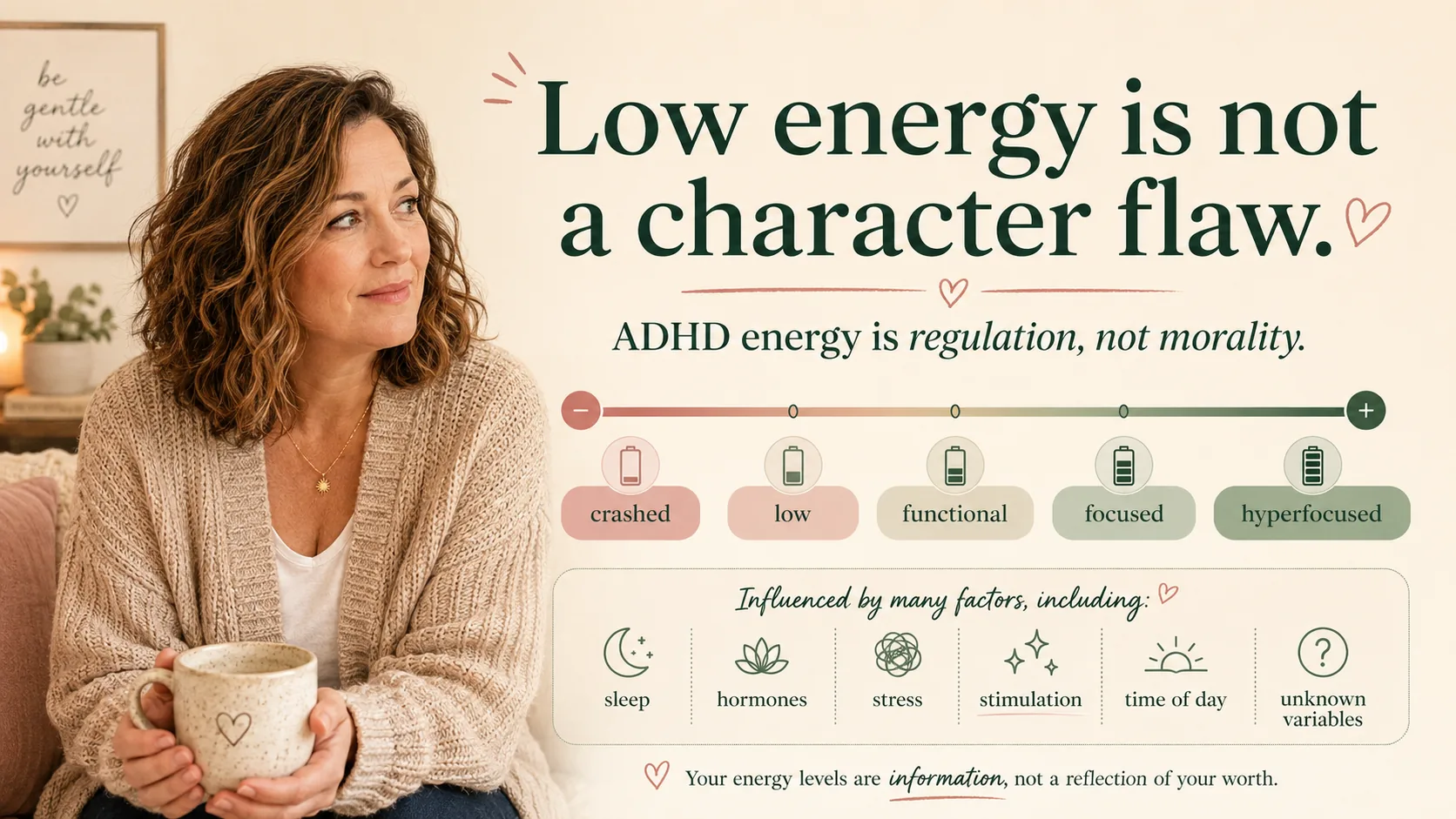
Your energy level is information, not a reflection of your worth.
Sleep that does not put anything back
Then there is the sleep, or the version of it available to you. Insomnia is strikingly common alongside adult ADHD - one clinical study found insomnia disorder in around 44 percent of adult ADHD patients, and reviews put the range of insomnia symptoms much wider, with women affected more often than men. So the recovery mechanism that is supposed to reset you overnight is frequently the thing that is broken.
Which produces a specific and maddening experience: eight hours in bed, zero hours of restoration, and a morning that feels like a continuation rather than a fresh start.
The fatigue itself may be measurable
There is early evidence that this is not purely a story about effort. A 2024 longitudinal study using the ALSPAC birth cohort found that children with high ADHD traits at ages seven and nine were roughly twice as likely to experience chronic disabling fatigue at eighteen, even after accounting for depression. The researchers also found a link with an inflammatory marker measured at nine.
That study followed children into adolescence, not adults into midlife, so it does not settle anything about you specifically. It does suggest the fatigue many of us describe is a real phenomenon being investigated seriously rather than a personality defect we invented.
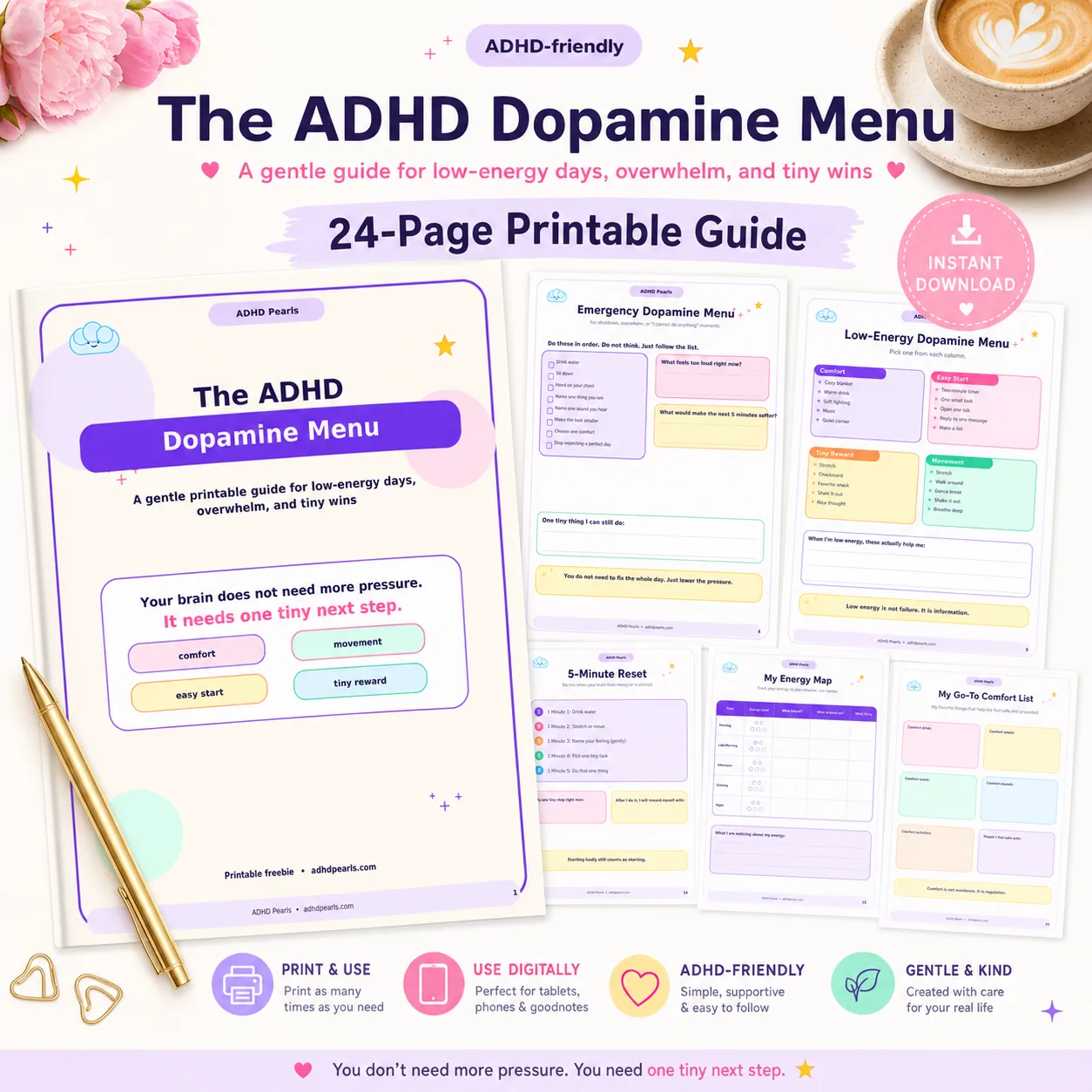
From ADHD Pearls
Free Dopamine Menu
24 tiny activities for low-energy, low-capacity days.
Not every flat day is the same flat day, and they do not respond to the same thing. I needed a way to tell them apart that was more useful than asking myself whether I was being lazy, since the answer to that question is always yes and always wrong.
This is not a diagnostic tool. It will not tell you what is happening. It can help you pick a better response than the default one.
What it feels like
Probably
What helps first
Body is heavy, brain is quiet, you could sleep right now
Low energy
Shrink the day. One task, then stop.
Brain is loud and jumpy, body will not settle, nothing holds
Overstimulation
Less input, not more rest. Dark, quiet, no screen.
You know exactly what to do and cannot make yourself begin
Here is the thing I got wrong for about fifteen years. On a low day I would look at my normal list, feel the gap between that and what I had, and then do nothing at all - because if I could not do the whole list, the list was ruined, and a ruined list is easier to abandon than to edit.
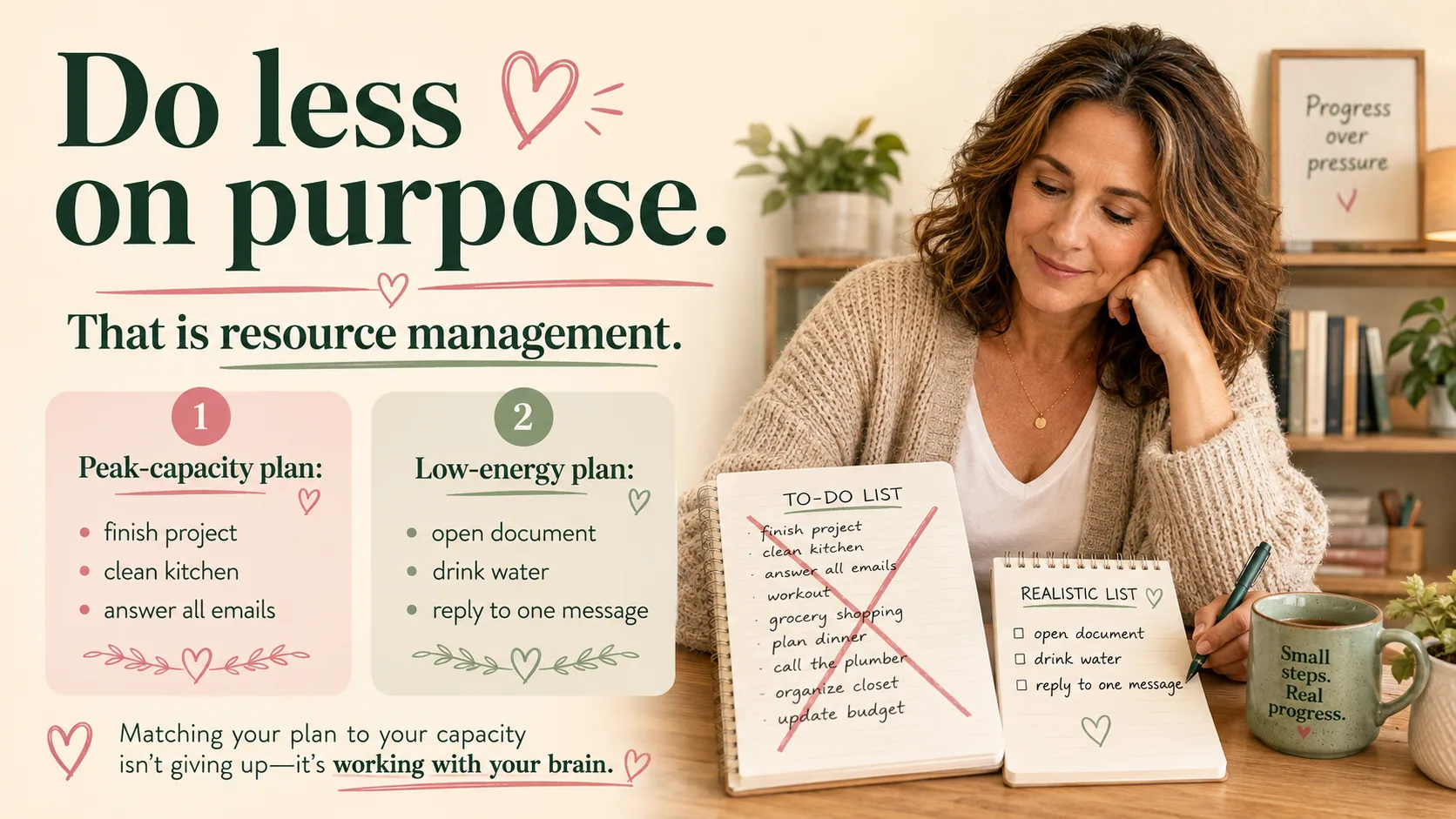
The rule that fixed it is embarrassingly simple. Plan for the capacity you have, not the capacity you meant to have. If today is a 40 percent day, you get 40 percent of a plan. Not a shorter version of the full plan. A different plan entirely, built for a smaller person.
In practice that means one task. Not three small ones, which is just the old list wearing a disguise. One.
This is the whole idea behind energy-based planning: you rate what you actually have, then pick work that fits it, instead of grading yourself against a calendar written by an optimist.
And the one you pick matters. The best low-energy task is the one that makes tomorrow cheaper: the dishes so the kitchen is usable, the load of laundry so there is something to wear, the one email that stops the follow-up email. Not the impressive task. The load-bearing one.
Doing less on purpose is not giving up. It is working with the capacity you actually have.
What Actually Works at 40 Percent
1. Shrink the task until it is almost boring
Not "clean the kitchen." Not even "do the dishes." Try "put the pans in the sink to soak." The test is whether the task sounds too small to be worth doing. If you feel slightly silly writing it down, it is the right size.
Two things happen. The first is that you can actually start, because there is no cliff to climb. The second is that you frequently keep going, though this is a side effect and not the goal. On the days you do the pans and nothing else, the pans were still worth it.
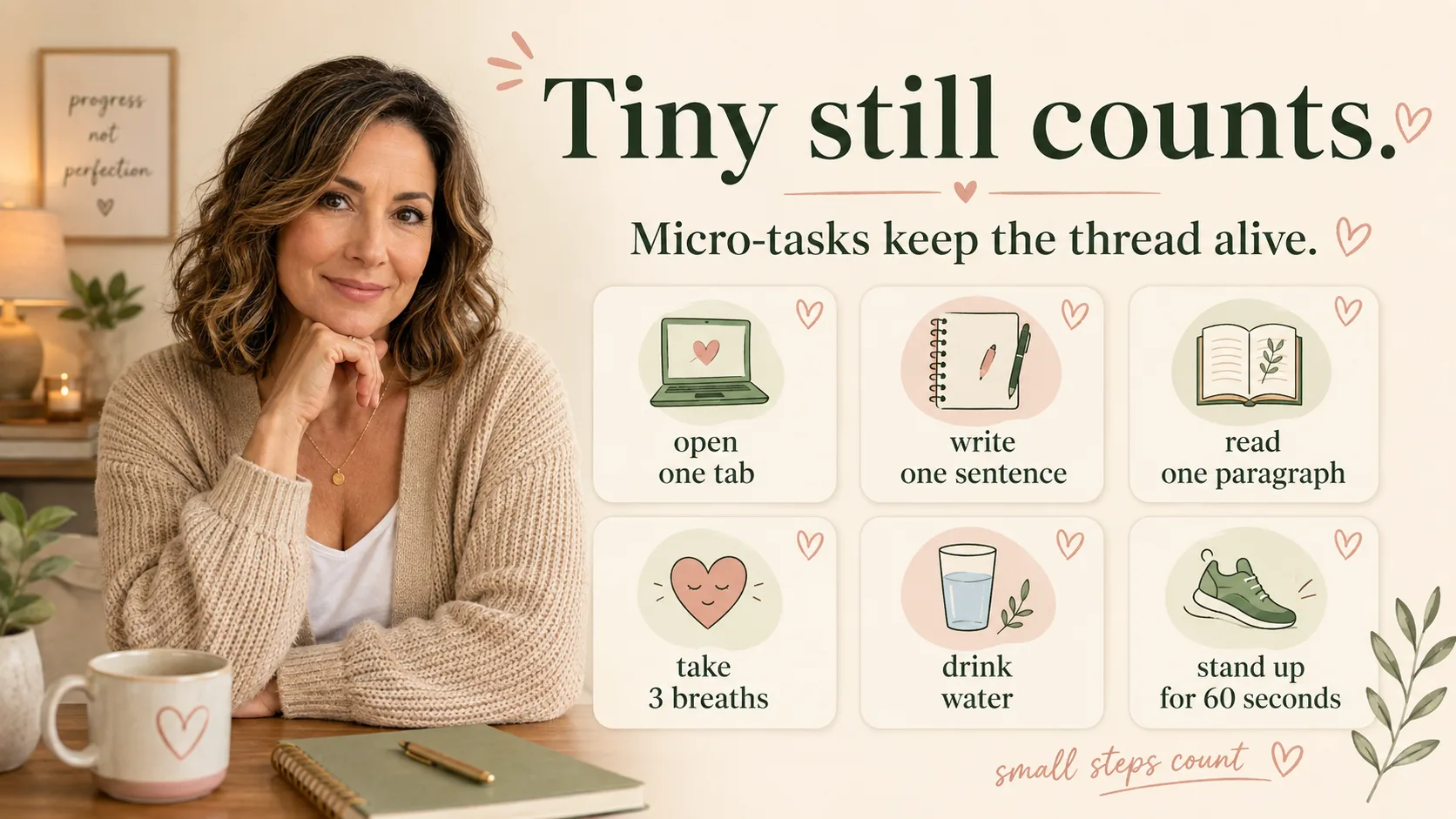
Tiny is not nothing. Micro-tasks keep the thread alive when your capacity is low.
2. Decide when and where before you need to decide anything
A to-do list tells you what. It does not tell you when, where, or what triggers it, which is exactly the information an ADHD brain needs and does not generate on its own at 4pm on a bad day.
The research version of this is called an implementation intention: an if-then plan that names the cue and the action in advance. A meta-analysis of 94 independent tests found a medium-to-large effect on goal attainment. That work was not done on ADHD populations specifically, so treat it as a good general bet rather than a targeted treatment. But "after I put the kettle on, I will put the pans in the sink" has held for me on days when "do the dishes at some point" evaporated on contact.
3. Do one thing that lowers tomorrow's load
Low-energy days compound. The dishes you skip become the sink you cannot face, which becomes the kitchen you avoid, which becomes the takeout order that quietly costs forty dollars. Picking the load-bearing task is not about being productive today. It is about not handing a worse day to the version of you who wakes up tomorrow.
4. Feed yourself something, even badly
I have skipped more meals to low energy than to any diet, and it makes everything else worse. On these days the goal is not a meal. It is calories with minimal decisions - which is a whole category of its own, and why I keep a list of low-energy ADHD meals that require nothing but opening things.
5. Rest properly, which is not scrolling
This is the one I resisted longest. Two hours on my phone felt like rest and left me flatter than before, because a phone is not a break, it is a second job with better graphics. Real rest is either genuine understimulation - lying down, no input, yes it is boring, that is the mechanism - or something absorbing that asks nothing of you. I unpacked the difference in fake rest versus real rest, mostly because I needed to be convinced myself.
Rest is not wasted time when your capacity needs to be restored.
6. Stop when the task is done
The temptation after finishing one thing is to use the momentum for four more things, and then you have spent the reserve you were going to need at 6pm. Finish. Stop. The point of a low-energy day is to get through it without borrowing from the next one.
What Makes a Low-Energy Day Worse
Three reliable ways to turn a slow day into a lost week. All three are versions of the same mistake: reaching for a tool that needs more capacity than you currently have, which is the whole argument in matching the tool to your level of overwhelm.
Rewriting the whole system. Low energy makes the current setup feel like the problem, and building a new one feels productive. It is not. It is the most expensive form of avoidance available, and the new system will be abandoned by Thursday. There is a longer version of this argument in why a planner will not fix your routines.
Adding shame as fuel. Self-criticism is not a stimulant. It reliably makes the next task harder to start, which produces more evidence for the criticism, which is a closed loop with no exit.
Treating rest as something to earn. If rest only becomes available after enough output, you will not rest on the days you most need to.
When Low-Energy Days Stop Being Days
A bad Tuesday is a bad Tuesday. Six weeks of bad Tuesdays is information.
Persistent exhaustion has a long list of possible causes that have nothing to do with planning: thyroid problems, anemia, sleep apnea, depression, perimenopause, medication effects, and plenty more. Several of them are treatable and none of them respond to a better morning routine. If the flatness has stopped lifting, if nothing feels good anymore, or if you are sleeping badly most nights, that is a doctor conversation rather than a productivity one.
For women in their forties there is a particular version of this worth naming, where the energy drop arrives alongside other changes and the old coping systems stop holding at the same time. I wrote about that overlap in ADHD burnout in perimenopause.
This article is educational and is not medical advice or a diagnosis. Ongoing fatigue can have many causes, including conditions unrelated to ADHD, and only a qualified clinician can assess what is going on for you.
If forty percent has quietly become your normal for weeks rather than days, you are probably not having low-energy days any more. That is closer to ADHD burnout, which works differently and does not respond to a better plan.
FAQ: Low-Energy Days With ADHD
Why am I so tired with ADHD when I have not done anything?
Because the effort is invisible rather than absent. Starting tasks, holding information in mind, filtering noise and regulating impulses all take deliberate energy for an ADHD brain where other brains run them automatically. A day with little visible output can still involve hundreds of those small overrides, and the exhaustion afterward is real.
Is ADHD fatigue a real thing?
It is increasingly treated as a real and researchable phenomenon. A 2024 longitudinal study found children with high ADHD traits were about twice as likely to report chronic disabling fatigue in adolescence, independent of depression. That is not the same as proving a mechanism in adults, but it does mean the tiredness people describe is being taken seriously rather than dismissed.
How do I be productive on a low-energy day?
Pick one task, make it smaller than feels reasonable, decide exactly when and where you will do it, and stop once it is finished. Choose the task that reduces tomorrow's load rather than the most impressive one. Three abandoned attempts cost more than one completed small thing.
Is it low energy or task paralysis?
Low energy feels like an empty tank - the body is heavy and you could genuinely sleep. Task paralysis feels like standing at the edge of something with the engine running and no ability to move, often with restlessness underneath. Low energy needs a smaller day; task paralysis needs a smaller first step.
Why does sleep not fix it?
Partly because sleep itself is frequently disrupted. Insomnia symptoms are far more common in adults with ADHD than in the general population, and one clinical study found insomnia disorder in around 44 percent of adult ADHD patients. When the recovery system is unreliable, more hours in bed do not automatically translate into restoration.
Does resting actually help, or am I avoiding?
Rest helps when it is genuinely restful. Scrolling, background television and multitasking keep the brain working while returning very little, which is why you can lose an evening and feel worse. Understimulation or a single absorbing activity tends to restore more than any of those.
Should I push through a low-energy day?
Occasionally, for something that genuinely cannot wait. As a default strategy it tends to borrow from the following day at a bad exchange rate. Pushing through also reliably adds shame when it does not work, which makes the next start harder rather than easier.
Why do low-energy days seem worse in my forties?
Two things often stack. Midlife demands are higher, and hormonal changes during perimenopause can affect sleep, mood and concentration, which may make existing ADHD harder to manage. Many women also find the coping systems built in their thirties stop working around this point. A clinician familiar with both is the right person to help sort it out.
When should I talk to a doctor about being this tired?
If the tiredness is persistent rather than occasional, if it is not improving with rest, if nothing feels enjoyable anymore, or if you are sleeping badly most nights. Thyroid problems, anemia, sleep apnea, depression and medication effects can all produce this picture, and several are straightforward to test for.
Save this for the next day when your brain is not fully online and everything feels harder than it should.
Pin this low-energy ADHD reset for the days when doing less is the realistic plan.
The dishwasher, in case you were wondering, got emptied at 8pm - one rack, badly, while a podcast played. That counted. On a 40 percent day, one rack is the whole job.
Found this helpful? Share it with someone who gets stuck too.
One tap makes ADHD Pearls a preferred source in your Google account, so our articles surface higher when you search. No signup, and it brings you straight back to this page.
Before you go
Free Dopamine Menu
24 tiny activities for low-energy, low-capacity days.
For the woman who sets up the perfect system on Sunday and abandons it by Tuesday.
One short letter, every week. Real talk about ADHD, task paralysis, and the tiny wins that actually move the needle for a brain like yours. No shame. No hustle culture.