This article is personal and educational. It is not medical advice. ADHD, burnout, anxiety, depression, sleep problems, medication issues, and other health factors can all affect motivation, task initiation, and follow-through. If these struggles are disrupting your daily life, it is worth talking with a qualified clinician.
I remember the Sunday it felt like things were finally going to change.
I had found a new app. It looked beautiful — clean boards, color-coded labels, a morning routine section, a weekly review template. I spent two hours setting it up. I made categories. I added priorities. I connected my calendar. I even made a little section called “Wins.”
By Tuesday I had missed one day. By Thursday the app was full of red badges, overdue tasks, and half-finished categories that looked like evidence of a project I had already abandoned.
I did not open it again.
The app did not become a tool. It became another place where I was behind.
This happened with every system I tried — the planner, the bullet journal, the Notion dashboard, the color-coded spreadsheet. Each one felt like hope. Each one became, within a week, a record of everything I had not done.
It was not laziness. It was not a lack of trying. It was that every one of these tools was designed for a brain that was not mine.
Quick answer
Why do productivity apps fail ADHD brains?
Most productivity apps fail ADHD brains because they are built around consistency, future rewards, long task lists, reminders, streaks, and daily follow-through. Those features can help some people, but for ADHD they often add more cognitive load, more shame, and more decisions before the task even starts. ADHD-friendly planning usually needs lower friction, fewer visible tasks, immediate feedback, flexible restarts, energy-based choices, and no punishment for off days.
Key takeaways
📌Most productivity apps assume consistent energy and attention.
📌ADHD brains often need less friction, not more structure.
📌Long task lists can create more paralysis than clarity.
📌Streaks and overdue badges can trigger shame and avoidance.
📌Future rewards often do not feel strong enough to start the task now.
📌ADHD-friendly planning should reduce choices, match energy, and celebrate tiny wins.
📌A good system should help you restart without making you feel behind.
There is a specific kind of hope that comes with a new system. The interface is clean. The categories are empty. Nothing is overdue yet. For a few hours — sometimes a few days — it feels like this time will be different.
That hope is real. It is also, for most ADHD brains, a setup.
The novelty of a new app can create a temporary dopamine hit — the brain engages with something new and interesting. But once the setup phase is over and the real work begins, the same executive function challenges that made planning hard in the first place are still there. The app did not change the brain. It just gave the brain something new to set up.
I spent more time organizing tasks than doing them. I had five labels, three projects, a beautiful dashboard, and a Kanban board I was very proud of. The actual task I needed to do? Still undone.
Sometimes the system becomes more work than the task.
Sometimes the system becomes more work than the task.
From ADHD Pearls
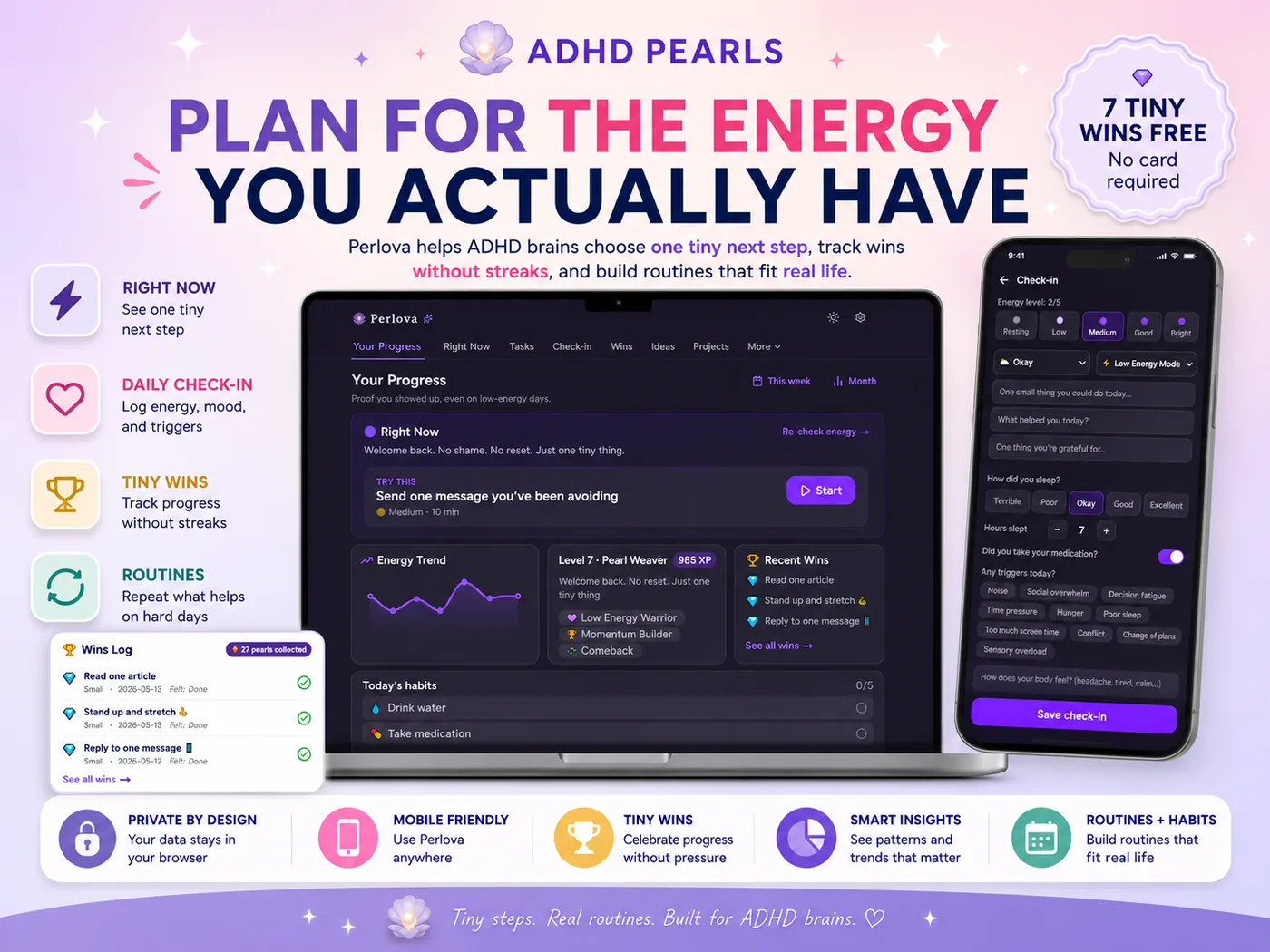
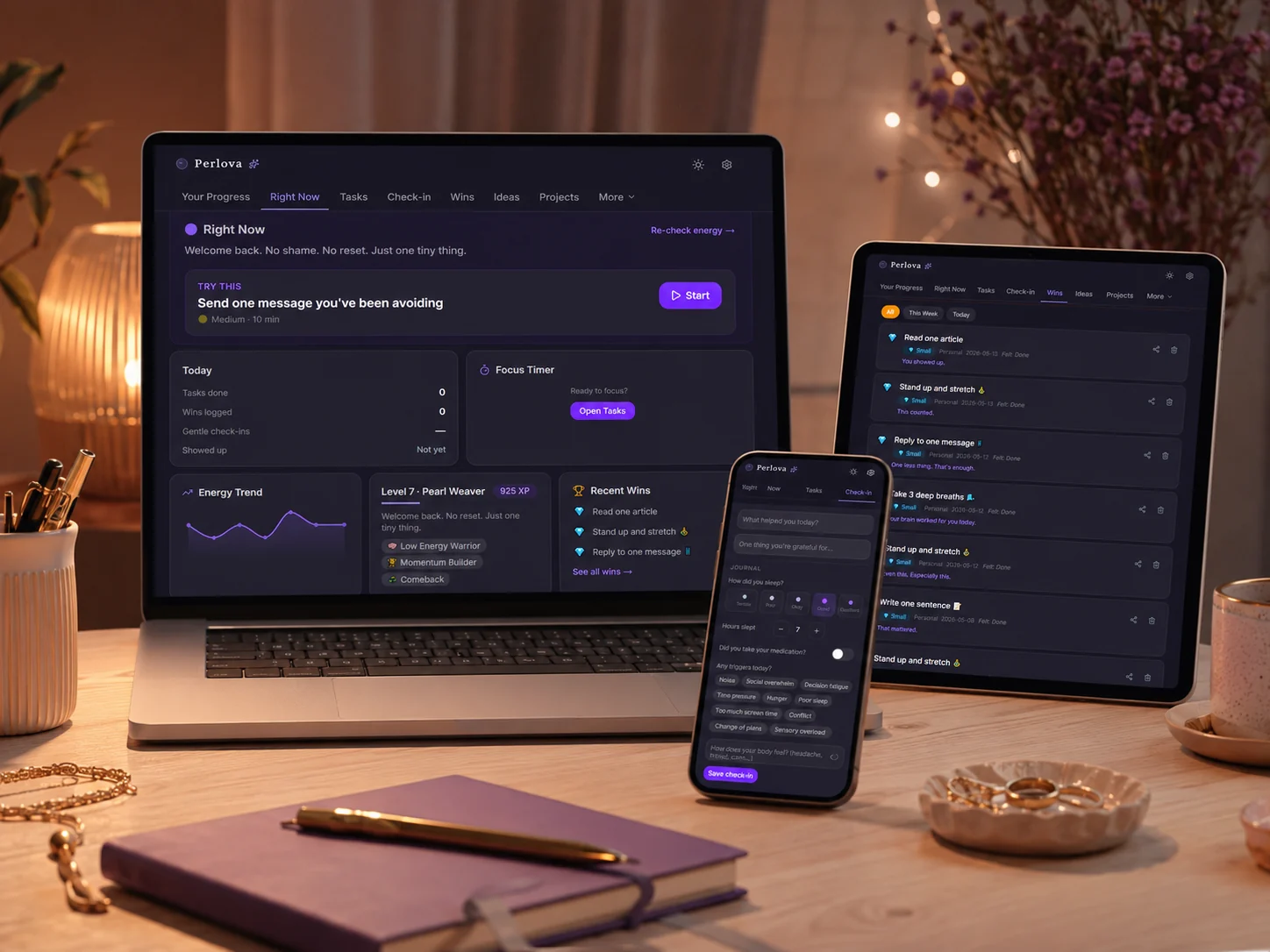
Perlova — plan from the energy you actually have
One doable next step, wins without streaks, and routines that fit real ADHD life. No card, no shame.
Most productivity apps are built around delayed gratification — the idea that organizing now pays off later. The reward lives in the future: a finished project, an empty inbox, a completed quarter.
For many ADHD brains, the future does not feel real the way the present does. Reward processing and motivation are part of the ADHD picture, but they are not the whole story — what matters practically is that future rewards can feel too far away to create action in the moment. The payoff needs to be close enough to feel possible, or the motivation to start simply does not arrive.
This is why tiny wins work better than big goals for many ADHD brains. Not because the wins are small, but because the feedback is immediate. You did the thing. You feel it now. The brain registers: that worked.
For many ADHD brains, immediate feedback and visible progress are more useful than abstract future payoff. An app that celebrates the task you just finished is more motivating than one that shows you how far you still have to go.
Executive dysfunction: when the app adds more steps before the task
Executive dysfunction is one of the core features of ADHD that gets consistently misunderstood. It is not about being disorganized or careless. It is a genuine difficulty with task initiation, prioritization, working memory, and cognitive switching — the neurological machinery that gets you from “I need to do this” to “I am doing this.”
Most productivity apps respond to this with more structure: more tasks, more views, more priority labels, more weekly reviews. But for an ADHD brain already struggling to initiate, more structure often creates more friction. The cognitive load of managing the system can become greater than the cognitive load of the tasks themselves.
I remember opening a task manager one morning with a simple goal: send one email. To do that, I first needed to find the email task in my inbox project, check its priority, see if there were related subtasks, review the notes I had attached, and figure out which label applied.
By the time I had done all that, I had run out of the attention I needed to actually write the email.
The app had added five steps before the task. That is the opposite of helpful.
The system was supposed to reduce the load. Instead it added to it.
The shame spiral: overdue badges, streaks, and broken routines
Here is the thing most productivity app designers do not talk about: for many ADHD brains, the standard app mechanics are not just unhelpful. They actively make things worse.
Miss one day? Streak broken. Behind on your weekly goals? Red badge. Have not opened the app in four days? Forty-seven tasks are now overdue and the app looks like a crime scene.
Every missed day becomes evidence that you are failing. And shame is one of the most powerful task-blockers there is. Shame does not make ADHD brains work harder. It makes them shut down entirely, and then avoid the thing that produced the shame.
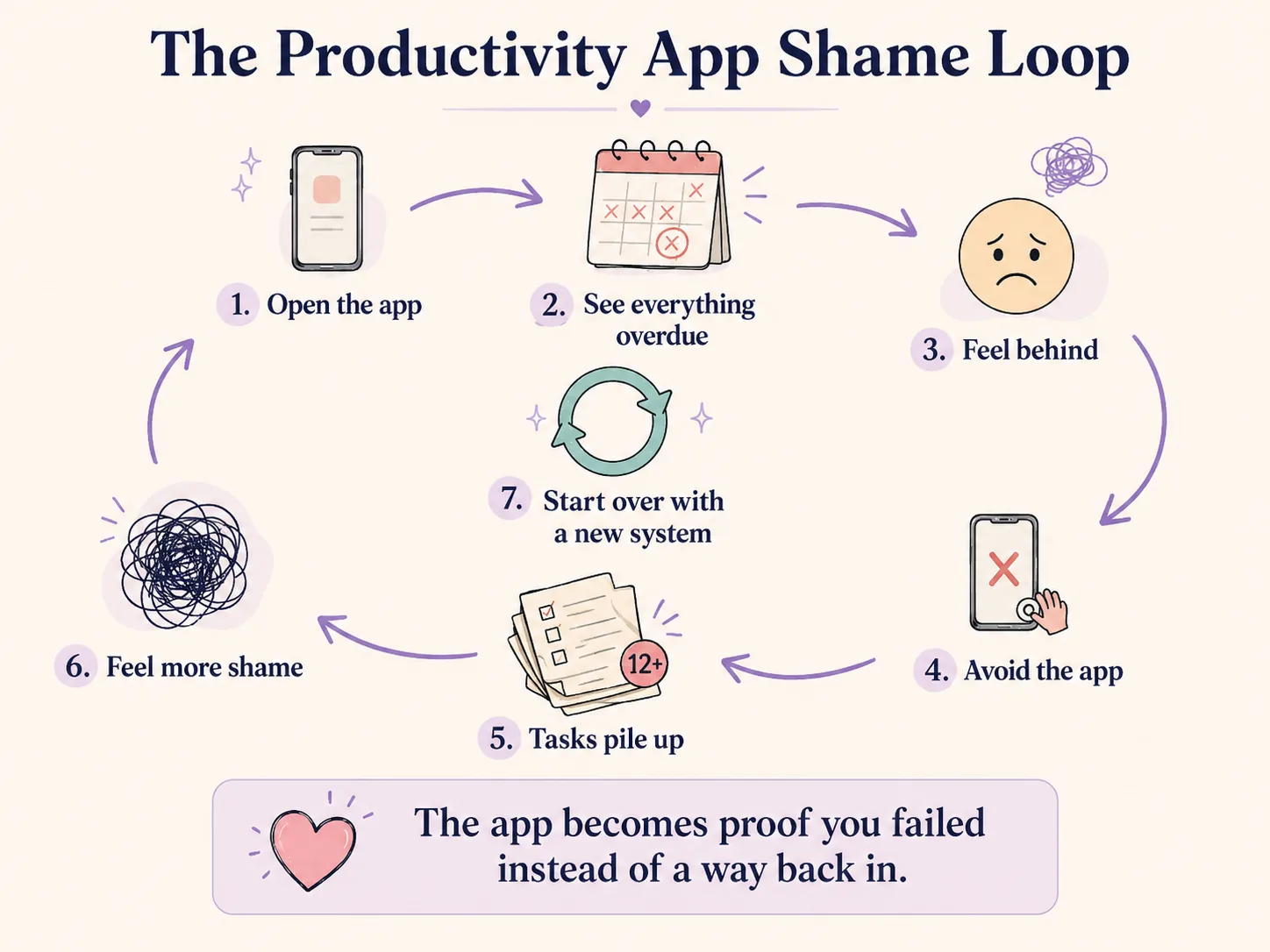
The app becomes proof you failed instead of a way back in.
The app becomes proof you failed instead of a way back in.
The pattern
The Productivity App Shame Loop
The tool was supposed to help. Then it became another place to feel behind.
1
Open the app
↓
2
See everything overdue
↓
3
Feel behind and ashamed
↓
4
Close the app
↓
5
Tasks pile up further
↓
6
Feel more shame
↓
7
Start over with a new system
… and the loop begins again
Why streaks backfire for ADHD
Streaks were designed to build habits through consistency. The idea is that once you do something enough days in a row, it becomes automatic. That promise has a number attached to it, and the number was never 21 days.
For neurotypical brains with reasonably consistent energy and attention, this can work. For ADHD brains, it almost always fails — not because of laziness, but because ADHD does not provide consistent energy, consistent access to executive function, or consistent follow-through. Life intervenes. Bad days happen. Sleep goes wrong. A hard week arrives and the streak breaks.
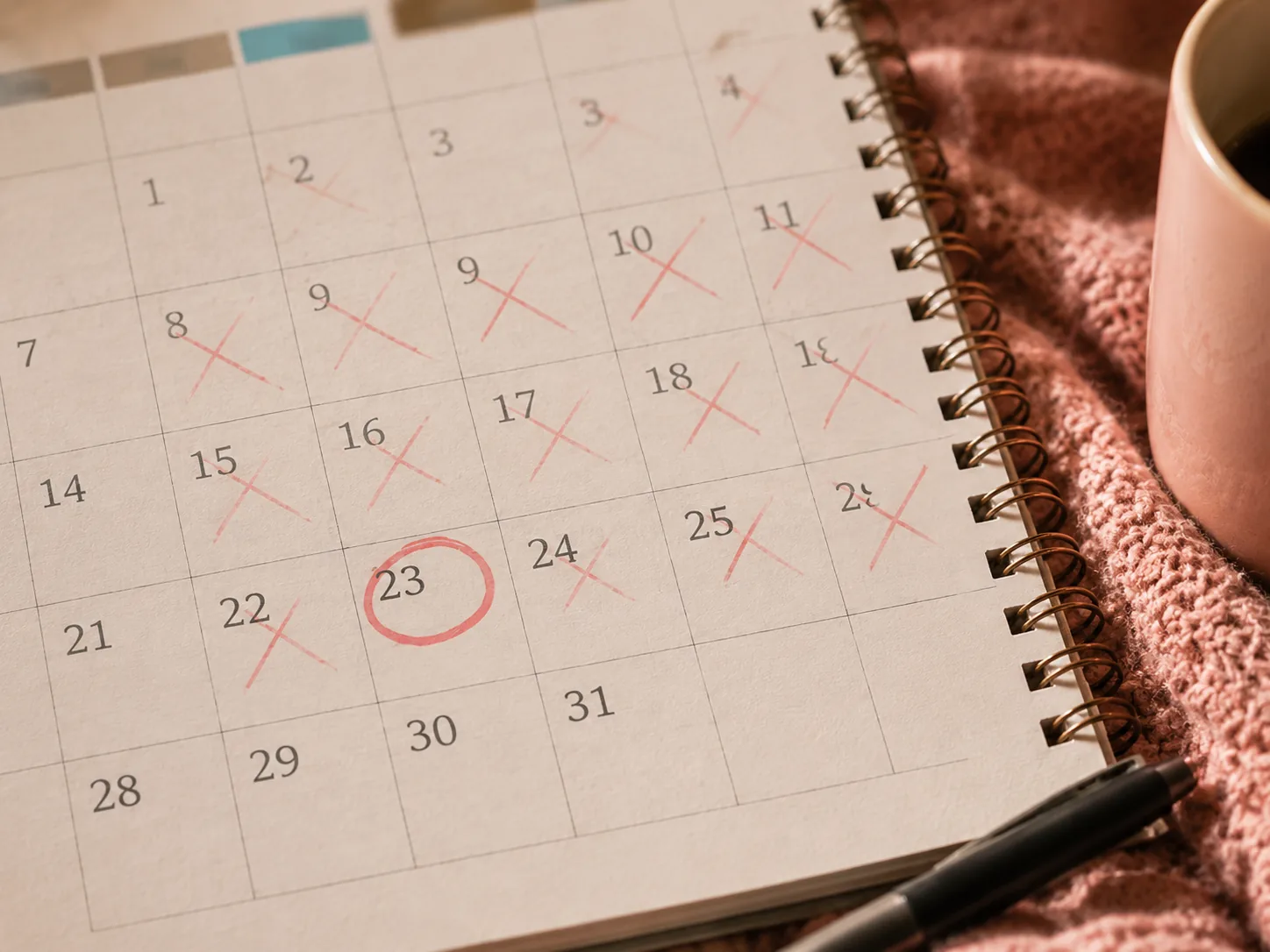
Then the all-or-nothing thinking that often accompanies ADHD kicks in: I ruined it. I may as well start over. The app becomes associated with failure. You stop opening it. Another system abandoned.
One missed day should not turn the whole system into evidence against you.
One missed day should not turn the whole system into evidence against you.
Why classic productivity app features backfire for ADHD
“The feature that looks helpful on paper can become the exact thing that makes the app harder to open.”
Classic app feature
Why it looks helpful
Why it can fail ADHD brains
ADHD-friendlier replacement
Endless to-do list
Keeps everything in one place
Shows too much at once, creates task paralysis
Show only what is doable right now
Daily streaks
Builds consistency
One missed day triggers all-or-nothing shame
Tiny wins without streak pressure
Overdue badges
Reminds you what needs attention
Turns the app into proof you are behind
Gentle restart without punishment
Rigid time blocks
Creates structure
Assumes energy and focus will arrive on schedule
Energy-based planning
Complex tags & projects
Organizes life neatly
Adds maintenance cost before any action
Fewer decisions, simpler categories
Weekly reviews
Keeps the system updated
Becomes another task to avoid
Quick reset instead of full review
Priority labels
Shows what matters most
Requires decisions when already overwhelmed
One next step
Habit chains
Turns routines into automatic behavior
One disruption can collapse the whole chain
Flexible restart points
What ADHD brains actually need instead
I did not need an app that showed me my whole life. I needed one that helped me find the next possible move.
What actually works for most ADHD brains is almost the opposite of what most apps offer.
Low friction. Getting started is the hardest part. The path from “open app” to “doing a task” needs to be as short as possible. Every extra click, every decision, every view to scroll through is another place to lose momentum before the task begins.
Fewer visible choices. Seeing forty tasks at once does not help ADHD brains choose. It creates paralysis. Seeing three tasks you can actually do right now is more useful than a comprehensive list of everything you should theoretically accomplish.
Energy-matched tasks. On a low-energy day, seeing a list of high-effort tasks is not just demotivating — it is actively counterproductive. A system that adapts to how you feel right now, rather than how you felt on Sunday when you made the plan, is far more likely to result in something actually done. This is the core of energy-based planning.
Immediate feedback. Small wins need to feel good now, not eventually. Every completed task — no matter how small — deserves immediate acknowledgment. Not someday. Now. ADHD-friendly planning needs wins you can feel in the moment.
No shame for off days.When old ADHD strategies stop working, it is often because they relied on shame and urgency to create motion. A good system should meet you where you are on a hard day, not remind you how far behind you are.
Flexible restarts. A good ADHD system should help you restart without making you feel like you ruined everything. The moment a missed day erases all sense of progress, the system has failed. Restart should feel like a new beginning, not a confession.
One next step. Not a roadmap. Not a full plan. Just one thing you could do right now. When everything feels equally impossible, having a pre-decided single action removes the decision cost entirely.
If starting feels completely impossible on a hard day, the free Stuck Reset tool gives you one tiny next move without requiring you to choose it yourself. And if you need pre-made options for low-capacity moments, a dopamine menu means you do not have to invent a next step from scratch.
Less friction. Fewer decisions. One possible next step.
What an ADHD-friendly productivity app should do differently
If most productivity apps made you feel behind, the problem may not be you. It may be the design.
An ADHD-friendly productivity system should:
Ask about your energy before showing the plan. Not every task is available every day. The system should start with where you are, not where it assumes you should be.
Show fewer tasks, not more. Only what is actually doable right now. Everything else can wait.
Help you choose one next step. Not prioritize a whole list. Just: what is the one thing?
Allow imperfect days without punishment. Missing a day should not turn into a shame session. The app should make coming back feel easy.
Avoid streak shame entirely. Or make streaks optional and low-stakes.
Make restarting easier than abandoning. The moment returning feels harder than quitting, the system has lost.
Celebrate tiny wins immediately. Not at the end of the week. Right now.
Reduce decision load, not increase it. Fewer labels, fewer categories, fewer settings to configure.
Offer low-energy options. What can this person do on a 30% capacity day? That is the question a good system should answer.
This is not a list of nice-to-haves. For ADHD brains, these are the difference between a system that gets used and a system that becomes another place to feel behind.
ADHD-friendly planning needs wins you can feel now, not someday.
FAQ: productivity apps and ADHD brains
Why do productivity apps fail ADHD brains?
Most productivity apps are built around consistency, future rewards, long task lists, reminders, streaks, and daily follow-through. For ADHD brains, these features often add more cognitive load, more shame, and more decisions before the task even starts. ADHD-friendly planning usually needs lower friction, fewer visible tasks, immediate feedback, flexible restarts, energy-based choices, and no punishment for off days.
Are productivity apps bad for ADHD?
Not inherently. The problem is that most mainstream productivity apps are designed for neurotypical patterns of motivation and consistency. They can work if the design reduces friction and avoids shame-based mechanics. The key is finding tools that adapt to your energy and help you restart easily, rather than tools that reward streaks and punish inconsistency.
Why do ADHD people abandon planners and apps?
Usually because the maintenance cost of the system becomes higher than the benefit. Many ADHD people set up beautifully organized apps and abandon them after missing one day — because the overdue tasks, broken streaks, and red badges make opening the app feel worse than not using it. A system that punishes imperfect use is not sustainable for ADHD brains.
Why do streaks backfire for ADHD?
Streaks require consistent energy and follow-through that ADHD brains cannot reliably provide. When a streak breaks, the all-or-nothing thinking that often accompanies ADHD can take over: “I ruined it, so what’s the point.” The app becomes associated with failure and gets abandoned. Flexible restart options work better than streak mechanics for most ADHD brains.
Why do long to-do lists make ADHD worse?
Long task lists create decision paralysis. When an ADHD brain sees forty tasks at once, the cognitive load of choosing where to start can be greater than the effort of any individual task. Seeing too many overdue or undone items can also trigger shame and avoidance. Showing only what is actually doable right now tends to work better.
What should an ADHD productivity app do differently?
An ADHD-friendly productivity app should reduce friction rather than add it, ask about energy before showing tasks, show only what is doable right now, allow imperfect days without punishment, make restarting easy, celebrate tiny wins immediately, and avoid streak shame. The system should be easier to return to than to abandon.
What is energy-based planning?
Energy-based planning means matching tasks to your actual capacity right now, rather than your calendar or an idealized schedule. Instead of assigning tasks to specific time blocks, you check your current energy level and see only tasks that are realistic for that state. It reduces the gap between what you plan and what you can actually do on a given day.
Do ADHD brains need reminders?
Some reminders can help, but type and timing matter. Generic daily reminders that appear regardless of energy or context often become background noise. Reminders that are specific, low-friction, and tied to context tend to be more effective. Too many reminders can also add to the cognitive load of managing the system itself.
How can I restart after falling behind?
Lower the bar for re-entry. You do not need to catch up on everything you missed. You need one small next step. Moving overdue tasks without guilt, choosing one thing to do right now, and treating today as a fresh start rather than a continuation of failure are all useful. A good system should make restarting feel possible, not shameful.
What helps when I cannot start any task?
When starting feels impossible, reducing the decision is often more effective than increasing motivation. Pre-made options like a dopamine menu, a physical change of state, naming that you are stuck, or using the free Stuck Reset tool can all help. The goal is not to force the task but to lower the activation barrier enough that movement becomes possible.
Sources I leaned on while writing this
CHADD. Executive Function Skills and ADHD. chadd.org. Overview of how executive function difficulties, including task initiation and planning, affect people with ADHD.
Cleveland Clinic. Executive Dysfunction. my.clevelandclinic.org. Clinical overview of executive dysfunction, including how it affects task initiation, planning, and follow-through.
ADDA. ADHD Paralysis. add.org. Overview of ADHD-related paralysis, avoidance, and the practical approaches that can help from the Attention Deficit Disorder Association.
Barkley RA. Taking Charge of Adult ADHD. Guilford Press. Foundational work on how executive function deficits — including task initiation, time management, and motivation — drive adult ADHD behavior.
One tap makes ADHD Pearls a preferred source in your Google account, so our articles surface higher when you search. No signup, and it brings you straight back to this page.
Here's why other planners didn't stick
They assume you'll show up the same every day. Perlova starts with how you feel right now.
Other ADHD planners
×Ask you to plan ahead, when your brain isn't there yet
×Assume you have consistent energy every day
×Show you everything you're already behind on
×Fall apart the first time you miss a day
×Require willpower just to open them
Perlova
✓Starts with your energy right now — not a perfect plan
For the woman who sets up the perfect system on Sunday and abandons it by Tuesday.
One short letter, every week. Real talk about ADHD, task paralysis, and the tiny wins that actually move the needle for a brain like yours. No shame. No hustle culture.