This article is personal and educational. It is not medical advice. ADHD, perimenopause, depression, anxiety, thyroid issues, sleep disorders, anemia, medication side effects, and other health conditions can overlap. Please get proper medical guidance if your symptoms are affecting daily life.
I was putting in earrings in front of the mirror, looking like a woman who had it together, while privately wondering why every trick that used to save me had stopped working.
The face looking back was fine. Presentable. Reliable. The version people expected.
But inside, I was running calculations. How much energy would today cost. How many things I’d already agreed to. How much caffeine I’d need to get through the afternoon. Whether the panic would arrive soon enough to actually make me move, or whether it would arrive too late — after the collapse.
I thought about the planner on my desk. Third one this year. I’d set it up on Sunday, color-coded and hopeful. It was Wednesday and I hadn’t opened it since Monday.
Deadline pressure used to create motion. New planners used to feel like a real fresh start. Caffeine used to buy a few more hours. Saying yes used to keep things calm. Starting over every Monday used to feel like proof I was still trying.
But now those strategies cost more than they gave back.
That was the confusing part. They had worked. I had evidence. Thirty-seven years of evidence. And now, standing in front of that mirror, they were quietly failing me. And I didn’t know why yet.
Quick answer
Why do ADHD strategies stop working after 45?
Many old ADHD coping tools were never sustainable in the first place. Urgency, shame, masking, people-pleasing, caffeine, overplanning, and last-minute panic can create short-term motion, but they drain the nervous system. In midlife and perimenopause, sleep disruption, hormonal changes, life load, and reduced recovery time may make those expensive strategies harder to maintain. The problem may not be discipline. It may be capacity.
Key takeaways
📌ADHD strategies can stop working when they rely on urgency, shame, or panic.
📌Many “high-functioning” systems are actually expensive compensation in disguise.
📌Perimenopause and midlife can make old coping strategies harder to sustain.
📌If your planner stopped working, it does not automatically mean you failed.
📌Masking, people-pleasing, and overplanning can quietly feed burnout.
📌Gentler systems usually need less friction, fewer decisions, and more honest capacity.
📌The goal is not to return to your old pace. The goal is to build a system that doesn’t keep breaking you.
The old strategies were not fake — they were expensive
Here’s what I need you to hear first: they worked. The urgency worked. The shame worked. The caffeine, the planner resets, the people-pleasing, the masking — all of it worked. I have evidence across three decades.
That was the problem.
They worked just well enough to hide how much they were costing me.
I remember the particular feeling of a deadline arriving. The way the pressure would flip something in my brain and suddenly I was moving. Productive. Capable. Words coming out in the right order, tasks completing, the version of myself I wanted to be all the time showing up at the last possible moment. I called it discipline. I called it finally getting serious. I kept calling it discipline because calling it survival felt too honest.
I remember buying planners. Properly buying them — standing in the stationery aisle, running my hand across the covers, choosing the one that felt like a promise. A new system. A new version of me who would actually follow through. The relief lasted about two days. Then I avoided the planner because it already had failed entries in it, which made it feel contaminated, which meant I needed a new one.
I remember saying yes to things because no required an explanation. Explaining felt harder than doing the thing. I was reliable. I was competent. I was building resentment I didn’t have language for yet.
I remember using caffeine like a bridge over exhaustion. Not because I was thriving — because I was borrowing from tomorrow to pay for today.
And I remember starting over every Monday. New list. New resolve. New version of myself. By Thursday I was in the same place I’d started, and the only thing that had changed was that I had one more Monday reset behind me.
The old system did work. That was the problem. It worked just well enough to hide how much it was costing me.
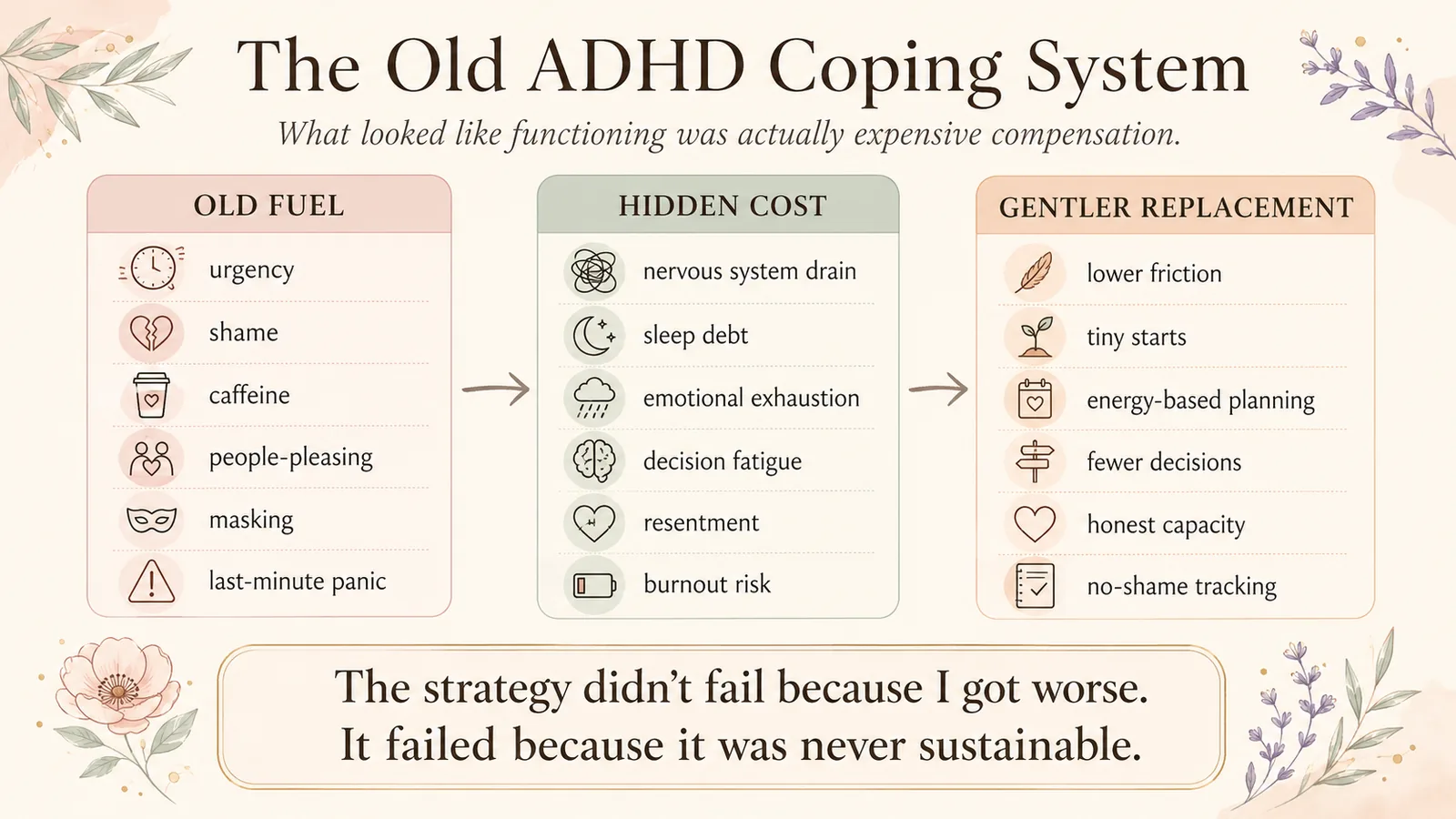
Urgency created motion. Shame created compliance. Caffeine created temporary alertness. Masking kept other people comfortable. People-pleasing kept conflict at bay. Overplanning created the illusion of control. Starting over every Monday created temporary hope.
But the invoice was always coming. Nervous system drain. Sleep debt. Emotional exhaustion. Resentment. Decision fatigue. The slow collapse when life load increased and there was nothing left in reserve.
What looked like functioning was actually expensive compensation.
From ADHD Pearls
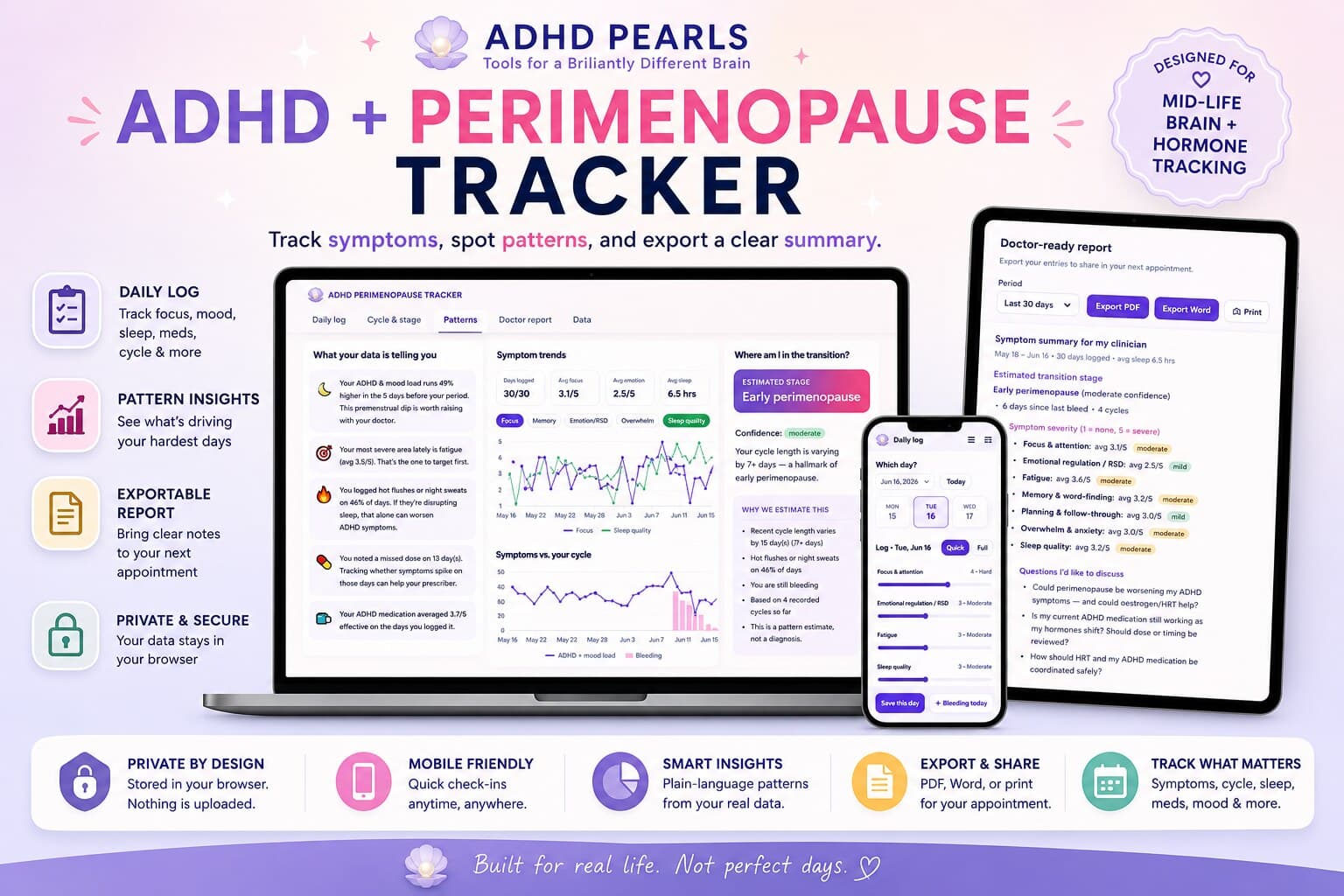
Is it ADHD, perimenopause, or both? See if there’s a pattern.
The ADHD Perimenopause Tracker logs your symptoms, sleep, meds and cycle together, estimates your transition stage, decodes your patterns, and builds a doctor-ready report — plus two printable workbooks.
Opens in a new tab — this article stays where it is.
7 free days, counted only on the days you log — just your email, no card. Then $27 once. Educational tracking tool, not a diagnosis.
The ADHD coping strategies that stopped working after 45
Each one had a moment where it turned on me. Not dramatically — there was no single crash. It was more like the interest rate on an old loan quietly going up until the payments weren’t manageable anymore.
Urgency stopped creating motion
I used to wait for the pressure to get loud enough, and then I moved. The deadline would arrive, something would flip, and I’d produce. People called me good under pressure. I was. The problem was I couldn’t start without it.
At some point — not a specific day, but a general drift — urgency started producing panic instead of motion. The same pressure that used to generate a reliable sprint started generating a kind of paralysis. I’d feel the deadline, feel the fear, and then freeze rather than move.
Urgency was never motivation. It was emergency fuel. There’s a difference, and the difference gets louder as capacity decreases.
What helped instead: starting smaller before the crisis point. Not a full plan — one tiny visible thing I could touch before the deadline was close enough to terrify me.
Shame stopped working as fuel
I had an inner voice that was very good at this. What is wrong with you. Normal people can do this. Why can’t you just… And it worked, sometimes. The shame would get loud enough that I’d move just to make it stop.
But the aftermath got uglier over time. The compliance came with a cost — a particular kind of exhaustion that wasn’t just physical. A slow erosion of trust in myself. The shame made me do the thing, but it also made me feel like the kind of person who could only be moved by shame.
Shame can produce compliance. It destroys trust. Eventually, for me, it started producing shutdown instead of movement — as if my brain had learned that the shame was coming regardless, so there was no point in moving toward it.
What helped instead: neutral accountability. Writing the task without commentary. No inner critic, no stake attached to self-worth. Just: the thing that needs to happen.
Planner resets became another task
I would buy the planner. Set it up carefully — sections, stickers, color for each category. Feel genuinely hopeful. The hope lasted roughly two days, sometimes three if the planner was particularly nice.
Then I’d miss a day. Then the planner would sit there with a gap in it, and looking at the gap felt worse than not opening it. So I’d stop opening it. Then it would need to be restarted from scratch, which would feel like a whole project, which I’d do next Monday.
The planner was not the problem. The maintenance cost was. Any system that requires daily consistency and perfect re-entry after a miss is not built for an ADHD brain.
What helped instead: systems that survive imperfect use. A sticky note with one task is more useful than a beautiful planner I can’t face opening.
The problem was not that I did not try. I had evidence everywhere.
Masking got too heavy
I got very good at this. Earrings in, collar straight, smile ready. The version of me that answered questions smoothly, tracked conversations correctly, appeared to be tracking conversations correctly even when I was three beats behind and working hard to catch up.
The mask didn’t fall off. It got too heavy to hold.
The recovery time got longer. After a meeting where I’d been fully masked for two hours, I’d need a kind of silence that looked like being antisocial. After social events, I’d need to lie down in a way that confused people who had seen me doing fine five minutes ago.
Masking hides distress from other people while making it louder inside. It is not a neutral act. It costs something every time, and that cost doesn’t stop accumulating just because nobody can see it.
What helped instead: being honest about capacity limits. Small, quiet honesty. I’m running low today. I need to leave by 4. I’m better in writing than in person.
People-pleasing became a burnout machine
Saying yes was faster than saying no. No required an explanation, and explaining required energy I rarely had spare. So I said yes. Often. To things I didn’t want to do, couldn’t realistically do, and would privately resent doing.
Being reliable became another way of never resting.
The invisible load got very heavy. And because I’d said yes to all of it, I felt I had no one to blame but myself, which made it harder to talk about, which meant I carried it alone.
What helped instead: a slower yes. Not a permanent no, just a pause. Let me check what I have on that week. Even if I always said yes in the end, the pause meant I was making a choice rather than a reflex.
Being reliable became another way of staying overloaded.
Caffeine and adrenaline stopped being a system
Coffee used to buy me a few more hours. Two cups and I could usually get through the afternoon. The crash came later, but later felt manageable.
At some point the bridge got shorter. More coffee, same crash, earlier. Or the coffee would create a kind of anxious alertness rather than functional focus — wired and still not able to start anything. That combination was new, and confusing, and not useful.
Temporary stimulation is not sustainable capacity. It never was — I just had more buffer before. When the buffer shrank, the gap between what I was consuming and what I was actually producing became much more visible.
What helped instead: energy-aware planning. Working with my actual alertness pattern rather than trying to extend or override it with caffeine.
Starting over every Monday became the pattern
There is a particular dopamine hit in a fresh start. New week, clean page, everything feels possible on Sunday evening. I was very good at Sunday evening. Less good at Wednesday morning when the plan had already unraveled and I couldn’t figure out how to re-enter it.
Starting over every Monday was not a strategy. It was a symptom.
If a system collapses every week, the problem is the system. Not the person. The system was too expensive to maintain, and starting over was cheaper than fixing it, so starting over became the habit.
What helped instead: restarting small, not from zero. Not rebuilding the whole plan. Just: what is one thing I can still do today.
A new notebook is not a new nervous system.
Old ADHD strategy vs gentler replacement
I needed to stop asking “why can’t I make this work anymore?” and start asking “what was this strategy actually costing me?”
Old strategy
Why it used to work
Hidden cost
Gentler replacement
Urgency
Created last-minute motion
Panic, pressure, crash
Smaller starts before crisis mode
Shame
Forced compliance
Exhaustion and self-distrust
Neutral accountability
Overplanning
Made life feel controllable
Maintenance became another task
Low-friction planning
Masking
Kept other people comfortable
Emotional drain and invisibility
Honest capacity limits
People-pleasing
Avoided conflict
Overcommitment and resentment
Slower yes, cleaner no
Caffeine & adrenaline
Created short-term stimulation
Sleep debt and nervous system drain
Energy-aware planning
Monday resets
Gave a fresh-start dopamine hit
Repeating collapse cycle
Restart small, not from zero
Why perimenopause and midlife can expose the cost
I used to recover from a hard week by sleeping in on Saturday, making a new list, and forcing momentum on Monday. It was imperfect, but it worked. There was enough buffer to absorb the damage from a bad week and come back roughly functional the next.
Then recovery started taking longer. Sleep became less predictable — I’d lie awake at 2am for no particular reason and wake up feeling like I’d only been asleep for an hour. The list on Monday morning looked exactly the same as the one I’d abandoned on Friday. And the life load — work, family, the invisible administration of being an adult — hadn’t decreased.
The old compensation system had less room to hide.
Perimenopause may not create the ADHD chaos for every woman. But for some women, changes in sleep, energy, mood, attention, and hormonal patterns can make old coping strategies harder to sustain. Research suggests estrogen may influence brain systems involved in attention, mood, and dopamine-related signaling. When those systems are already under ADHD pressure and then face hormonal fluctuation on top, the margin for compensation can shrink significantly.
Midlife often brings more demands, not fewer. Careers often peak in complexity. Families need more, not less. Aging parents arrive in the picture. The strategies that worked when life was smaller and sleep was reliable may simply not have the same effect when both of those have changed.
This is not a character failure. It is a capacity problem.
The part nobody tells you: some ADHD strategies are not supports. They are survival tools with a delayed invoice.
What I use now instead
The replacement was not becoming more disciplined. It was reducing friction.
I stopped trying to rebuild my whole life every Monday. Instead, I started asking one question: what would still be possible on a 40% capacity day?
That reframe changed almost everything. A system that only works on my best day is not a system. It is a performance. I needed something that still worked when my brain was running on fumes.
I make the first step smaller. Not “do the thing” — “open the document.” Not “clean the kitchen” — “put one thing away.” The entry point has to be small enough that even a tired, low-capacity brain can access it.
I plan from energy, not fantasy. I stopped making plans based on the version of me who sleeps well and has no commitments. I started making plans based on what today actually looks like.
I stopped making systems that require daily perfection. If the system breaks when I miss a day, the system is too fragile. Good systems for ADHD brains survive imperfect use.
I use fewer decisions. Pre-decided is better than re-decided. A dopamine menu of pre-chosen options for low-capacity days means I don’t have to generate options from nothing when my brain can’t generate anything.
I let “good enough” count. The task touched for ten minutes is not a failure. It is forward movement. I started counting it.
I track tiny wins without streak pressure. A note that says “did the thing today” has no streak to break. It is just a record that I showed up.
I treat capacity as data, not a character flaw. On days I can’t do the thing, I note what made it hard. That is information, not evidence of failure.
What helped was not a better hustle system. It was a lighter one.
My new system does not ask me to become a different person before breakfast.
What to try when your old ADHD systems stop working
You do not need a system that works only on your best day. You need one that still works when your brain is running on fumes.
Choose one must-do instead of rewriting your whole life.
Replace “finish the task” with “touch the task for two minutes.”
Move one task out of your head and into one visible place.
Delay one non-urgent yes.
Remove one step from a routine that keeps collapsing.
Stop restarting the whole system every Monday.
Ask: “What would this look like at 40% capacity?”
Track what actually helps instead of what should help.
Tiny reality check: if a system only works when you are panicked, it is not a sustainable system.
FAQ: Why ADHD strategies stop working after 45
Why do ADHD strategies stop working after 45?
Many ADHD coping strategies relied on urgency, shame, adrenaline, masking, or overplanning rather than sustainable systems. These approaches can create short-term motion but drain the nervous system over time. In midlife, hormonal changes, sleep disruption, increased life load, and reduced recovery time may make those expensive strategies harder to sustain. The problem may not be discipline. It may be capacity.
Can perimenopause make ADHD coping strategies less effective?
Yes — for some women, it can. Perimenopause may affect sleep, mood, energy, attention, and hormonal patterns that previously helped support ADHD compensation. Strategies that depended on urgency, caffeine, or adrenaline may become less reliable when the body has less buffer. This is worth discussing with a qualified clinician if your functioning is significantly affected.
Why did my planner stop working for my ADHD?
Most planners require daily maintenance, consistent energy, and a willingness to restart after a miss. ADHD brains often struggle with all three. When a planner becomes another task to maintain rather than a tool that reduces load, it can feel like failure rather than support. The problem is usually the maintenance cost, not your work ethic.
Is masking an ADHD coping strategy?
Yes. Masking is the effort of appearing neurotypical — suppressing ADHD symptoms, mimicking others’ behavior, and performing competence. It can be effective in the short term but carries a significant energy cost. Many women with ADHD mask heavily without realizing it. In midlife, when overall capacity decreases, the cost of masking can become harder to absorb.
Why does urgency stop helping ADHD?
Urgency works for ADHD brains by creating a pressure-linked “go” signal — a deadline makes starting possible. But urgency is emergency fuel, not sustainable motivation. Over time, especially as hormonal changes and life load increase, urgency can tip from creating motion to creating panic and shutdown.
Why does shame feel like motivation for ADHD?
Shame can produce compliance in the short term. The internal pressure of “what is wrong with me?” can force action when nothing else will. But shame also depletes self-trust and emotional reserves. Shame-driven productivity tends to be unstable and erodes wellbeing over time. It may work until it doesn’t, and the “doesn’t” tends to arrive without much warning.
What should I use instead of panic-based productivity?
Smaller starts before the crisis point, single-step clarity, and energy-aware planning tend to work better long-term than urgency-driven systems. Tools that work on a low-capacity day are more useful than perfect systems that collapse under stress.
How do I build a gentler ADHD system?
Start by reducing friction rather than adding more structure. Use systems that survive imperfect use — one visible next step rather than a full weekly plan, tracking actual wins rather than maintaining streaks, and planning from realistic energy rather than optimistic capacity.
Can old ADHD coping strategies cause burnout?
Yes — for some women, they can contribute to it. Strategies that rely on urgency, shame, overplanning, masking, people-pleasing, and adrenaline create a slow nervous system drain. Over years, especially as life demands increase and recovery time decreases, this can accumulate into full burnout.
When should I get professional support?
Seek support from a qualified clinician if your functioning is significantly affected — work, relationships, parenting, daily safety, or finances. Also consider it if mood changes feel new or intense, sleep problems are chronic, you suspect ADHD but have never been assessed, or your symptoms are being dismissed. If ADHD and perimenopause are both possible, you may benefit from a clinician familiar with both.
Sources I leaned on while writing this
CHADD. Women and Girls with ADHD. chadd.org. Overview of how ADHD may present differently in women, including the particular challenges of late diagnosis and hormonal transitions.
Rucklidge JJ. “Gender differences in attention-deficit/hyperactivity disorder.”Psychiatric Clinics of North America, 2010. Peer-reviewed overview of how ADHD presents differently in women, including masking, compensation strategies, and the particular cost of late or missed diagnosis.
A final note
I kept calling it discipline because calling it survival felt too honest.
The strategies were real. The effort was real. The fact that they eventually stopped working is not evidence that I was doing it wrong. It is evidence that they were built for a younger version of me with more buffer, more adrenaline, and less honest self-knowledge.
I did not lose my work ethic. I lost the ability to keep paying for everything with adrenaline.
That is not a failure. That is information.
When capacity changes, the old rules stop applying. That is not a character defect. That is just what happens when the conditions change and the system was never built to handle it honestly.
The goal is not to return to the old pace. The goal is to build something that does not keep breaking you.
One tap makes ADHD Pearls a preferred source in your Google account, so our articles surface higher when you search. No signup, and it brings you straight back to this page.
Before you go
Stop trying to hold the pattern in your head.
Log symptoms, sleep, medication and cycle day in one place, then let it line the days up for you and build a report you can hand to a clinician. Made for perimenopause — the daily cycle logging works at any age.
For the woman who sets up the perfect system on Sunday and abandons it by Tuesday.
One short letter, every week. Real talk about ADHD, task paralysis, and the tiny wins that actually move the needle for a brain like yours. No shame. No hustle culture.