I did not notice it all at once. That would have been too clean.
First it was the emails. I’d open them, read them, understand them, feel the pull to respond — and then nothing. The tab would close itself somehow. An hour later I’d open it again, as if this time would be different. It wasn’t different.
Then it was the words. Mid-sentence, I would reach for a word I’d known my whole life — a simple noun, a name, a verb — and it would just be gone. Not slow. Gone. I started trailing off more. Saying “the thing” for everything.
Then the decisions. I’d stand in the supermarket aisle holding two identical items for too long, aware that I needed to choose one, aware that choosing one should take three seconds, aware that it was now taking three minutes.
Then the planner. I kept buying new ones, convinced that the right system would fix whatever this was. I’d set it up, colour everything in, feel briefly hopeful — and then avoid it by day three. Every time.
I didn’t suddenly become lazy at 45. I didn’t develop a new character flaw. My old coping system stopped covering the cost.
It took me a long time to find the words for it. ADHD symptoms getting worse in perimenopause. I didn’t know that was the question until I had most of the pieces.
Quick answer
Why can ADHD feel worse in perimenopause?
Research suggests hormonal changes during perimenopause may affect sleep, mood, memory, attention, energy, and dopamine-related systems — the same systems ADHD brains already find hard to manage. Perimenopause does not cause ADHD. But for some women, it can amplify existing symptoms significantly and make old coping strategies stop working. If you were masking ADHD for decades on urgency, adrenaline, and over-preparation, midlife may be where the bill comes due.
Key takeaways
📌Perimenopause does not cause ADHD.
📌For some women, it can make existing ADHD symptoms significantly harder to manage.
📌Brain fog, emotional crashes, sleep disruption, task paralysis, and broken routines can all overlap.
📌If the pattern existed before midlife, ADHD may already have been part of the picture.
📌If symptoms worsened with sleep changes, cycle changes, or hormonal shifts, perimenopause may be amplifying them.
📌The problem may not be motivation. It may be capacity.
📌Track patterns and talk to a qualified clinician if symptoms are affecting daily life.
A note before we start: This is personal and educational — not medical advice. ADHD, perimenopause, depression, anxiety, thyroid issues, sleep disorders, anemia, medication side effects, and other health conditions can overlap significantly. If your symptoms are affecting daily life, please get proper medical guidance from a clinician who knows both.
I want to be specific about what it felt like. Because “ADHD got worse” does not capture it.
I would open my laptop to do a task I understood. A task I had done many times before. And I would just… sit there. Not distracted by something else. Not avoiding it consciously. Just staring at the screen in a way that felt like waiting for a machine to boot, except the machine was my brain and it was taking much longer than it used to.
I rewrote the same paragraph six times without improving it. I answered a one-line email in four drafts. I made a list of three things and felt immediately overwhelmed by the list.
The urgency trick — the one that had carried me through decades of deadlines — stopped working reliably. And when I tried to force urgency, I got panic instead of momentum. My nervous system had apparently stopped distinguishing between “do this now” and “crisis.”
I was not doing less because I cared less. I was doing less because the cost of every tiny thing had gone up.
More effort. Less output. A gap between the two that kept widening.
I thought I was losing discipline. I was losing capacity. Those are not the same thing, but they feel identical from the inside.
From ADHD Pearls
Is it ADHD, perimenopause, or both? See if there’s a pattern.
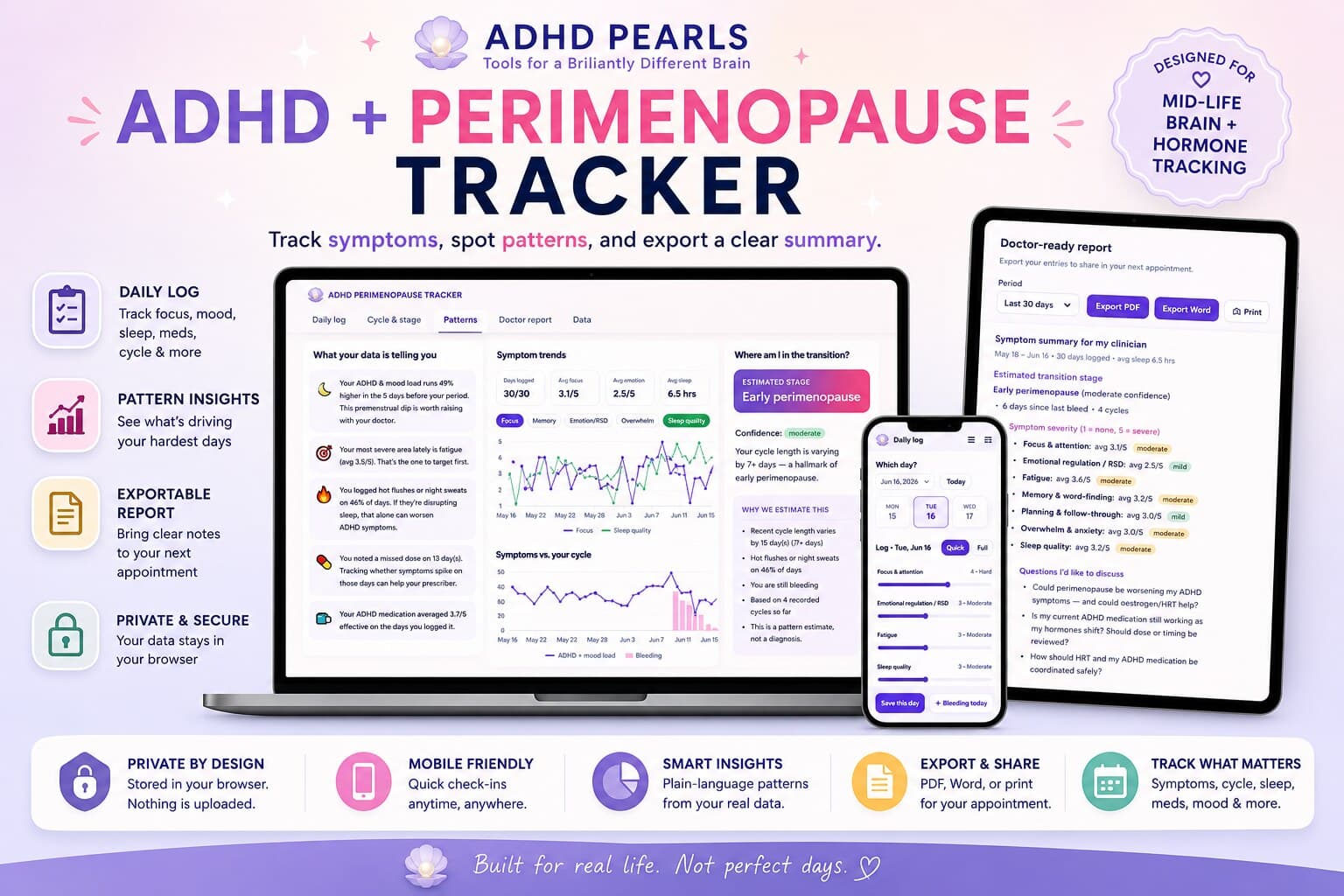
The ADHD Perimenopause Tracker logs your symptoms, sleep, meds and cycle together, estimates your transition stage, decodes your patterns, and builds a doctor-ready report — plus two printable workbooks.
Opens in a new tab — this article stays where it is.
7 free days, counted only on the days you log — just your email, no card. Then $27 once. Educational tracking tool, not a diagnosis.
What Actually Changed in My ADHD Symptoms
Looking back now, I can see the shifts. At the time, they arrived slowly enough that I explained each one away.
I came here to focus. My brain had other plans.
Brain fog felt sharper and scarier. The ADHD brain fog I’d had my whole life was familiar — I knew how to navigate it, mostly. This was different. Words gone mid-sentence. Conversations I couldn’t hold the thread of. Thoughts that dissolved before I could finish them. It frightened me in a way the old fog never had.
Task initiation got harder. I could still make a plan. That was never the problem. The problem was that the plan no longer created motion. I could see exactly what needed doing and still not be able to make myself start it.
Emotional regulation became more fragile. The reactions were faster and the recovery was slower. Small things that would have annoyed me before now floored me. Not dramatically — quietly. A flatness after. A heaviness that sat on the rest of the day.
Sleep stopped repairing the damage. I had always slept imperfectly. But I’d usually wake up functional. The new version of bad sleep wiped out the entire next day in a way that felt new and unfair.
Masking became harder to maintain. I had been performing competence for so long I barely noticed I was doing it. In my 40s, the performance started costing more. I’d come home from normal interactions and need an hour of nothing just to recover from the effort of seeming fine.
Brain fog felt sharper and less predictable
Task initiation failed even on simple, familiar tasks
Emotional reactions got faster and recovery got slower
Sleep disruption started wrecking entire days, not just mornings
Old routines collapsed after two or three days instead of holding
Masking became expensive in a way it hadn’t been before
Output dropped even as effort increased
Each one of these I had an explanation for at the time. Stress. Bad week. Needed to try harder. It was only looking at the pattern across months that I saw what was actually happening.
Why Perimenopause Can Make ADHD Feel Louder
Here is the science part, but in normal human language.
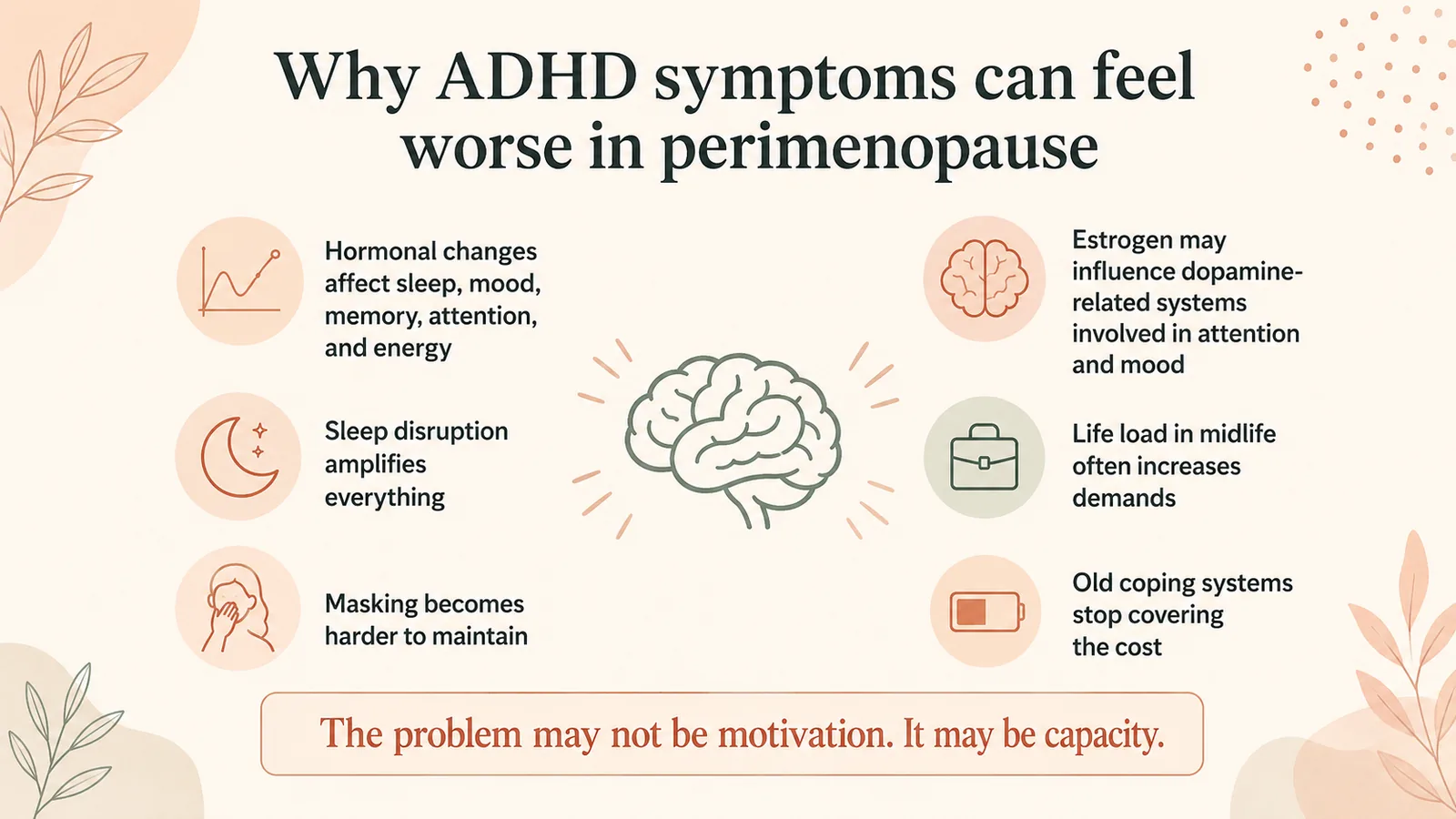
Research suggests that hormonal changes during perimenopause may affect sleep, mood, memory, attention, and energy — and may influence dopamine-related systems involved in how the brain regulates attention and emotion. ADHD is already connected with these same systems. So for some women, when estrogen starts fluctuating and declining, the brain’s ability to manage attention, regulation, and cognitive load may be affected in ways that are already harder for an ADHD brain.
A 2025 systematic review found evidence suggesting a relationship between ADHD symptoms and sex hormones in females across the lifespan. A population-based cohort study published the same year found that women with ADHD reported significantly more severe perimenopausal symptoms than women without ADHD — with 54% of women with ADHD reporting severe perimenopausal experiences, compared to 30% of women without.
Sleep disruption amplifies all of it. Poor sleep worsens attention, emotional regulation, memory, and task initiation in any brain. For an ADHD brain that already struggles in these areas, losing quality sleep can turn a manageable day into an unmanageable one.
And then there is life load. Your 40s often coincide with peak responsibility — career pressure, children, aging parents, relationships, health questions. The cognitive and emotional demands go up exactly when capacity may be going down.
The part nobody tells you: perimenopause may not create the ADHD chaos. It may remove the scaffolding that was hiding it.
If you had ADHD and were compensating with systems that worked because you were younger, slept better, had fewer demands, and could run on urgency — all of those advantages can quietly disappear in perimenopause. The scaffolding comes down. The gaps become visible.
This is not a failure. It is a change in conditions. A brain that was barely managing under old conditions may struggle under new ones. That is information, not indictment.
The problem may not be motivation. It may be capacity.
ADHD Before 45 vs ADHD During Perimenopause
I needed a way to see what had actually changed. Not because a table can diagnose you — it can’t. But because patterns are harder to dismiss when you stop carrying them only in your head.
Area
Before perimenopause
During perimenopause
Focus
Distracted, but urgency could still create motion
Urgency stopped working or turned into panic instead of momentum
Memory
Forgetful but usually recoverable with systems
Word-finding gaps, missed conversations, “why did I come in here?” moments felt new and alarming
Task starting
Procrastination until deadline pressure kicked in
Task paralysis even on simple or familiar tasks with no deadline pressure available
Emotions
Intense reactions, but masking could smooth them over
Faster emotional spikes, slower recovery, and masking cost much more
Routines
Systems worked if I forced them hard enough and consistently enough
Systems collapsed after a few days and felt impossible to restart
Energy
Tired but functional on adrenaline and caffeine
Low battery became the default — adrenaline less available or less reliable
Sleep
Poor sleep made things harder but manageable
One bad night could wreck the entire next day — no recovery buffer
This is not a diagnostic table. It will not tell you what you have. But it may help you see that something real shifted — and that the shift has a name.
Still functioning. Just with less capacity than before.
The Coping Strategies That Stopped Working
These were not bad strategies. That’s the part that’s hard to sit with. They worked. That was the problem. They worked just well enough to hide how much they were costing me — and what they were costing me on was something I was running out of.
Urgency. Waiting until the last minute to create artificial pressure. Worked for years. Started producing panic instead of focus.
Over-preparing. Spending three times longer than needed on everything so nothing could surprise me. Exhausting but effective. Became unsustainable as capacity dropped.
People-pleasing. Saying yes to keep friction low and avoid confrontation. Works until it doesn’t, and then it collapses under the weight of what you promised.
Masking. Performing competence and ease regardless of the internal chaos. The performance got harder and the recovery got longer.
Planner resets. Buying a new system, setting it up with hope, avoiding it within days. Repeat. The setup felt like progress. It was not.
Shame as fuel. Using self-criticism and the fear of being found out to drive action. This one is particularly corrosive and particularly common in late-diagnosed ADHD women.
Caffeine and adrenaline. Running on stimulation instead of genuine capacity. Worked at 30. Created anxiety instead of energy at 45.
If your planner worked at 35 and feels useless at 45, you may not need more discipline. You may need a different system.
If you have spent decades running on these strategies, you are not failing when they stop working. You are in a changed set of conditions. And changed conditions require changed approaches.
If you are still trying to work out whether what you are experiencing is ADHD, perimenopause, or both, the first article in this series — Is It ADHD or Perimenopause? — may help you ask the right questions.
What Helped Me Stop Blaming Myself
The first useful thing was accepting that something had actually changed. Not that I was failing. That the conditions had changed and my old approaches were not built for the new conditions.
Sometimes the reset is not productivity. It is getting out of the noise.
Then the practical things. Annoyingly boring practical things.
I stopped treating “try harder” as a strategy. It had never been a strategy. It was just a threat I made to myself. The brain does not respond to threats. It responds to lower friction.
I started tracking patterns instead of trusting memory. A simple notes app. Date, what happened, how I felt, where I was in my cycle. After a few months I could see things I would never have noticed otherwise.
I planned from energy, not fantasy. What could my brain actually do today? Not what should it theoretically be able to do. What was actually available?
I took sleep seriously as a non-negotiable. Not a luxury. Not something to optimize later. Sleep disruption was amplifying every other symptom, and treating it as optional was making everything worse.
I talked to a clinician instead of trying to DIY everything. I brought notes. I was specific. I asked about both the ADHD piece and the hormonal piece. I had to raise both myself — neither was offered unprompted.
I lowered the friction in my systems. Fewer steps. Shorter lists. Smaller asks. Tasks that could be started in thirty seconds, not thirty minutes of preparation.
My brain did not need more pressure. It needed less friction. Those are not the same thing, and confusing them cost me years.
None of this was glamorous. None of it felt like progress in the moment. But over time, the patterns shifted — and I stopped spending most of my energy blaming myself for conditions I hadn’t understood.
What to Track Before You Assume You’re Failing
You do not need a perfect spreadsheet. You need enough evidence to stop gaslighting yourself.
Sleep quality — how long, how broken, and how you feel the next day
Cycle timing — where you are in your cycle when symptoms spike
Hot flashes or night sweats — if present and how disruptive
Brain fog — when it is worst, what makes it better
Task paralysis episodes — how long, which tasks, what time of day
Emotional crashes — triggers, severity, recovery time
Caffeine response — if it has changed or feels different
Medication consistency — if relevant, whether effectiveness has changed
Days when routines collapse — what was different about those days
Days when symptoms unexpectedly improve — what was different about those too
A simple notes app, a plain text file, or even a paper notebook works. Write the date. Write three things you noticed. That is enough.
When you bring this information to a clinician, you are no longer going in with “I feel like things are worse.” You are going in with evidence. That changes the conversation.
The kind of tired sleep does not always fix.
FAQ: Why ADHD Symptoms Can Get Worse in Perimenopause
Can ADHD symptoms get worse in perimenopause?
Yes — for many women, they can. Research suggests hormonal changes during perimenopause may affect sleep, mood, memory, attention, energy, and dopamine-related systems. Because ADHD already involves attention regulation and dopamine-related processes, some women find their symptoms become significantly harder to manage during this transition. A 2025 population-based cohort study found that women with ADHD reported significantly more severe perimenopausal experiences than women without ADHD.
Does perimenopause cause ADHD?
No. Perimenopause cannot cause ADHD. ADHD is a neurodevelopmental condition typically present from early life, even if never diagnosed. What perimenopause can do is make previously manageable ADHD symptoms much harder to cope with — especially if you were compensating with strategies that relied on urgency, adrenaline, or hormonal support that no longer holds.
Why does ADHD feel worse in your 40s?
Several things may converge. Hormonal changes from perimenopause may affect dopamine-related systems ADHD brains already rely on. Life demands often peak. Sleep quality often declines. And the coping strategies built over decades — urgency, over-preparation, masking — may stop being sustainable. The result is a brain that was barely managing under old conditions struggling significantly under new ones.
What ADHD symptoms can worsen in perimenopause?
Many women report worsening brain fog, difficulty starting tasks, word-finding problems, emotional crashes, irritability, disrupted sleep, and the collapse of routines that used to work. Masking — the effort of appearing neurotypical — can also become harder to sustain as hormonal changes reduce overall cognitive capacity.
Is ADHD brain fog different from perimenopause brain fog?
They can overlap significantly. ADHD brain fog tends to have been present in some form since childhood or early adulthood, even if explained away. Perimenopause brain fog often appears or worsens noticeably in the 40s, linked with sleep disruption or hormonal changes. Many women experience both at once, making the fog feel deeper and less predictable than either alone.
Can sleep disruption make ADHD worse?
Yes — significantly. Poor sleep worsens attention, emotional regulation, memory, and task initiation in any brain. For ADHD brains that already struggle in these areas, perimenopause-related sleep disruption can amplify every symptom. This means that for some women, a large part of worsening ADHD in midlife may be driven by sleep changes.
Can ADHD medication feel less consistent during perimenopause?
Some women report this. Medication that worked reliably before may feel less predictable or effective. This may relate to hormonal effects on the same neurotransmitter systems medication targets, as well as changes in sleep and baseline capacity. If this is happening, mention it to your prescribing clinician — they may be able to adjust your approach.
Can HRT help ADHD symptoms?
For some women, hormone replacement therapy may help with perimenopause-related symptoms — brain fog, mood instability, sleep disruption — which can in turn make ADHD easier to manage. HRT is not a treatment for ADHD itself, and individual responses vary. If you are in perimenopause and your ADHD symptoms have worsened significantly, it is worth discussing both ADHD-specific support and hormonal options with a qualified clinician.
What should I track before talking to a doctor?
Track sleep quality, cycle timing, the timing of brain fog and emotional crashes, task paralysis episodes, hot flashes or night sweats, and any changes in caffeine response. Also note when symptoms unexpectedly improve. You do not need a perfect system — a simple notes app with dates is enough. The more specific you can be, the more useful the conversation with your clinician will be.
When should I seek professional help?
Talk to a qualified clinician if symptoms are affecting work, relationships, parenting, finances, or daily safety — or if they feel new, severe, or rapidly worsening. Also seek support if sleep problems are becoming chronic, mood swings feel unfamiliar or intense, you suspect ADHD but have never been assessed, or your current provider dismisses your symptoms. You may need both an ADHD-informed clinician and a menopause specialist — and you may have to ask for both yourself.
Osianlis E, Thomas EHX, Jenkins LM, Gurvich C. “ADHD and Sex Hormones in Females: A Systematic Review.”Journal of Attention Disorders, 2025. Systematic review of evidence for relationships between ADHD symptoms and sex hormones across female reproductive stages.
You are not falling apart. You are not suddenly bad at your life.
You are a brain that was always wired differently, trying to run old strategies on new conditions, at a life stage that nobody prepared you for. That is genuinely hard. The fact that you are trying to understand it — rather than just accepting the blame — is already something.
You might need different support now than you needed at 35. That is not regression. That is responding honestly to changed conditions.
This article is personal and educational. It is not medical advice. ADHD, perimenopause, depression, anxiety, thyroid issues, sleep disorders, anemia, medication side effects, and other health conditions can overlap. Please get proper medical guidance if your symptoms are affecting daily life.
Found this helpful? Share it with someone who gets stuck too.
One tap makes ADHD Pearls a preferred source in your Google account, so our articles surface higher when you search. No signup, and it brings you straight back to this page.
Before you go
Stop trying to hold the pattern in your head.
Log symptoms, sleep, medication and cycle day in one place, then let it line the days up for you and build a report you can hand to a clinician. Made for perimenopause — the daily cycle logging works at any age.
For the woman who sets up the perfect system on Sunday and abandons it by Tuesday.
One short letter, every week. Real talk about ADHD, task paralysis, and the tiny wins that actually move the needle for a brain like yours. No shame. No hustle culture.