It wasn’t a complicated email. It wasn’t from anyone frightening. It was a three-line message that needed a four-line response, and I had been “about to reply” to it for four days.
Every time I opened it, the same thing happened. I read it. I understood it. I felt the familiar pull of needing to respond. And then my brain just… slid off. I’d close the tab. Open something else. Come back an hour later and open the email again, as if this time would be different.
That was the sixth time.
I sat there and felt something shift. Not frustration exactly. Something closer to fear. Because this wasn’t new tiredness. This wasn’t a bad week. This had been happening for months — a slow leak in my ability to start things, hold things together, trust my own brain. Something had changed. And I didn’t know if it was my ADHD getting worse, or something else entirely happening inside my body.
It took me a long time to find the right words for it. ADHD or perimenopause? For a while, I didn’t even know that was the question.
Quick answer
Can perimenopause make ADHD worse?
Yes — for many women, it can. Research suggests estrogen may influence dopamine-related systems involved in attention and mood. When estrogen fluctuates during perimenopause, ADHD symptoms — focus, memory, emotional regulation, impulse control — can become significantly harder to manage. You’re not imagining the overlap. It’s worth taking seriously.
Key takeaways
📌Perimenopause does not cause ADHD.
📌It can make existing ADHD symptoms significantly harder to manage.
📌Brain fog, memory slips, emotional crashes, sleep problems, and task paralysis can overlap between the two.
📌If these patterns existed before midlife, ADHD may be part of the picture.
📌If symptoms worsened with cycle changes, sleep disruption, or hormonal shifts, perimenopause may be amplifying them.
📌Track patterns and talk to a qualified clinician if symptoms are affecting daily life.
A note before we start: This is personal and educational — not medical advice. ADHD, perimenopause, depression, anxiety, thyroid issues, sleep disorders, anemia, medication side effects, and other health conditions can overlap significantly. If your symptoms are affecting daily life, please get proper medical guidance from a clinician who knows both.
For years I had a system. It wasn’t a pretty system. It wasn’t the kind of system you’d show anyone. But it worked — in the way that things built on caffeine, adrenaline, and sheer panic can technically work for a very long time.
I knew I had ADHD. I’d been diagnosed late — the way a lot of women are, in our 30s or 40s, after decades of being told we were bright but scattered, sensitive but dramatic, capable but somehow always almost-but-not-quite.
I’d made peace with my brain in the rough, pragmatic way ADHD women do. I had my workarounds. My backup plans. My 47 tabs of “just in case.” I was, on paper, managing.
And then, somewhere in my early 40s, the workarounds stopped working.
Not all at once. Gradually. Like a battery being drained faster than it charges, and you only notice when you go to do something and there’s less there than you expected.
I opened that email six times and couldn’t reply. And instead of explaining it away as a bad week, I finally asked the question I should have asked months earlier: what is actually happening to my brain right now?
From ADHD Pearls
Is it ADHD, perimenopause, or both? See if there’s a pattern.
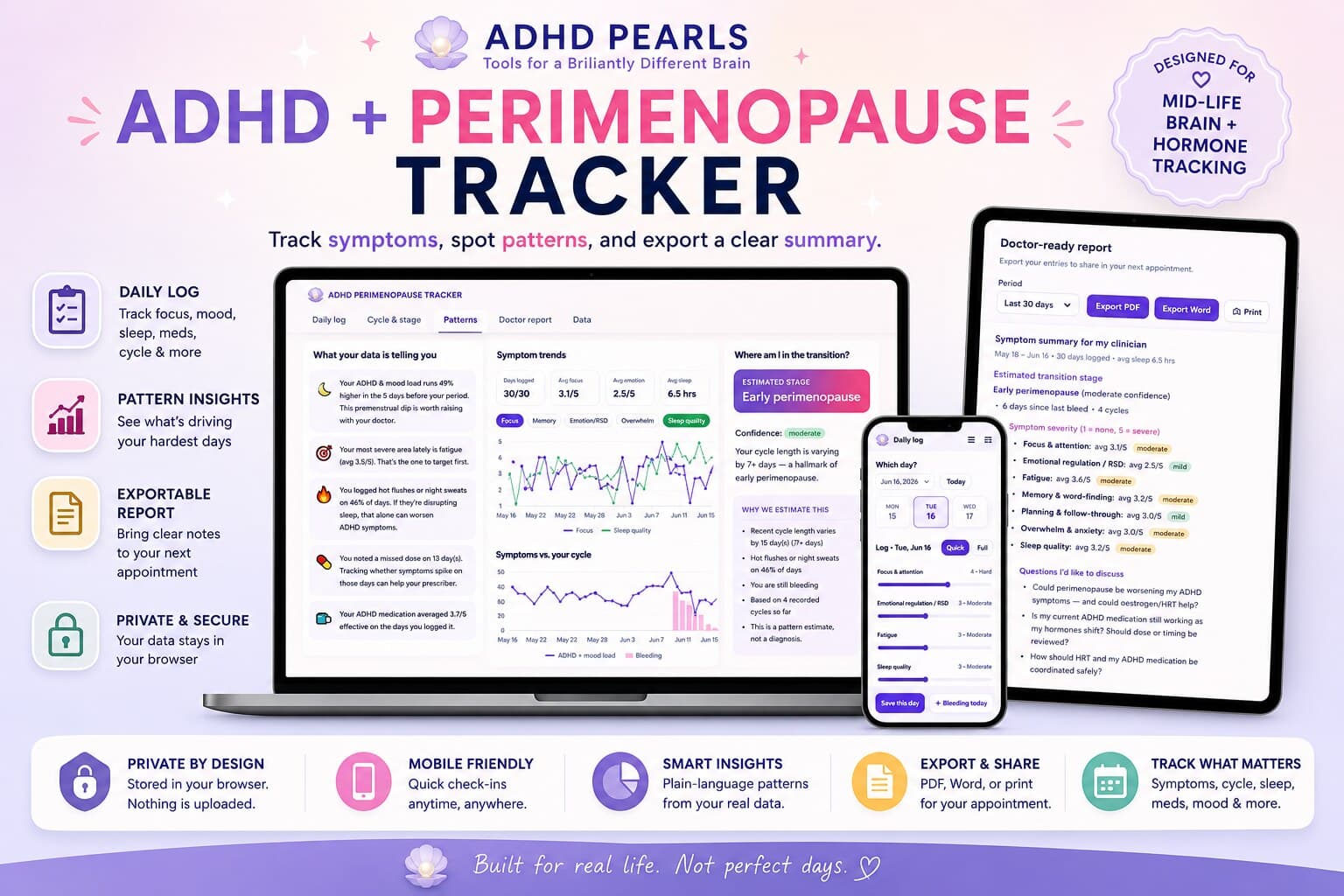
The ADHD Perimenopause Tracker logs your symptoms, sleep, meds and cycle together, estimates your transition stage, decodes your patterns, and builds a doctor-ready report — plus two printable workbooks.
Opens in a new tab — this article stays where it is.
7 free days, counted only on the days you log — just your email, no card. Then $27 once. Educational tracking tool, not a diagnosis.
What Everyone Kept Calling It
Before I had the right framework, I had a lot of wrong ones. Here’s the list I cycled through:
Stress. You’re doing too much. Not sleeping enough. Of course your brain is foggy.
Burnout. The world has been a lot. Everyone is exhausted. Rest more. Slow down.
Anxiety. Possibly. But anxiety about what, specifically? The anxiety felt like a symptom, not a cause. My brain was misfiring and I was anxious about the misfiring. Not the same thing.
Depression. Maybe. There was a flatness to some days that hadn’t been there before. But it didn’t feel like depression in the way depression had felt before. It felt like capacity loss — like someone had turned the dial down on my ability to function, and I couldn’t find the dial.
Nobody mentioned perimenopause. I didn’t mention it either, because I didn’t know it was relevant. My cycles were still fairly regular. I wasn’t having hot flashes. I didn’t know that perimenopause can start years before any of the obvious signs — and that the brain symptoms often come first.
Why ADHD and Perimenopause Get Confused
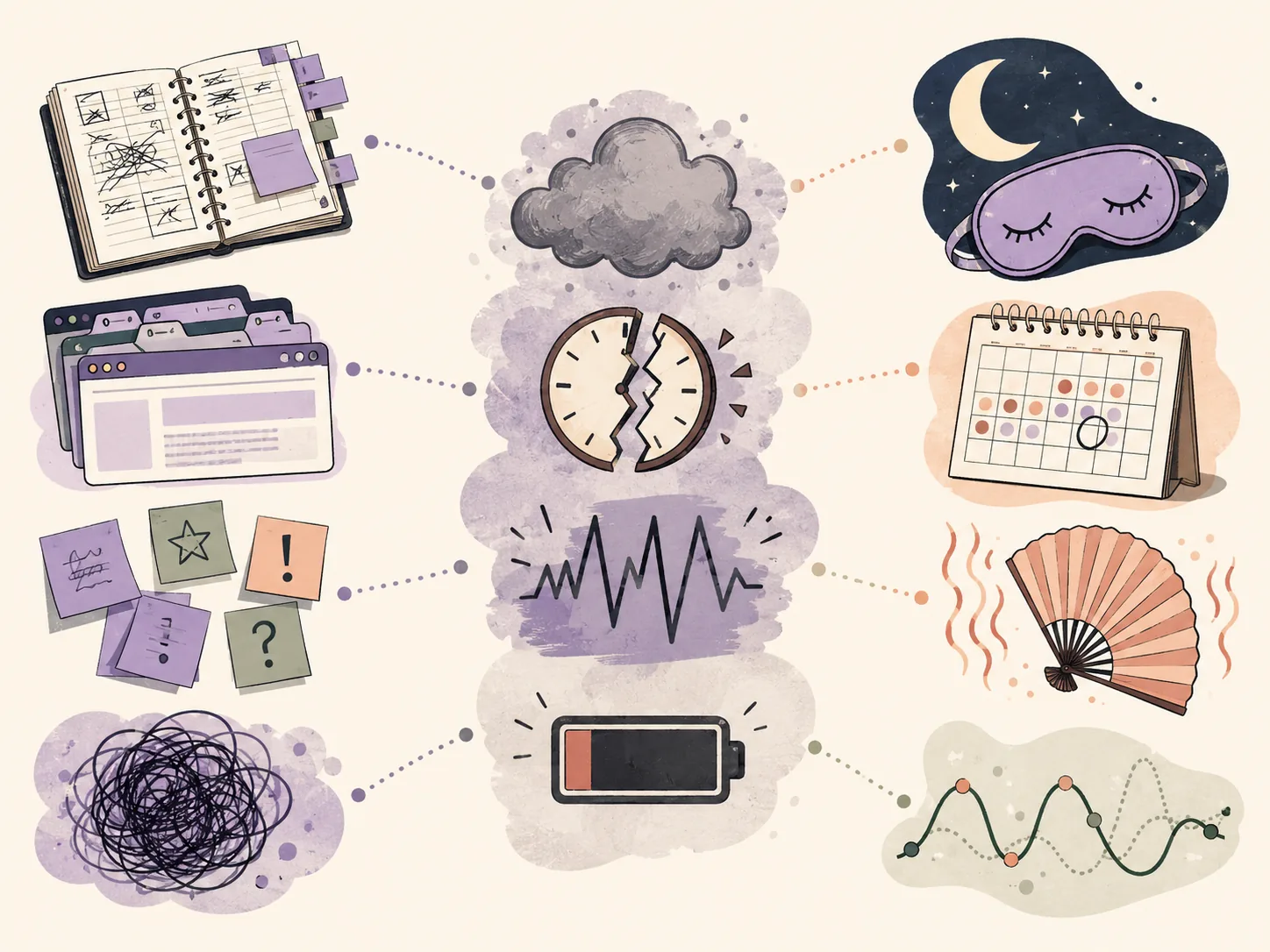
This is where things get annoying: ADHD and perimenopause can wear the same outfit. Both can show up as:
•Brain fog and can’t-start-anything days
•Emotional spikes that seem out of proportion
•Sleep that doesn’t fix the tired
•Capacity that runs out before midday
•Forgetfulness that feels new and alarming
•Routines that collapse for no obvious reason
When you try to explain it, everything sounds like everything else.
Here’s the science part, in normal human language: research suggests estrogen may influence dopamine-related systems involved in attention and mood — the same systems central to ADHD. For some women, when estrogen fluctuates during perimenopause, that support appears to thin out, and symptoms like focus, emotional regulation, and task-starting become significantly harder to manage. This is an active area of research, and individual responses vary.
So if you have ADHD and you’re entering perimenopause, you may be dealing with your existing ADHD and losing some of the hormonal support that was quietly helping you cope. That combination can feel like a collapse. It is not a character failing. It is a lot happening at once.
Some women don’t have a diagnosed ADHD but start experiencing what looks like classic ADHD symptoms in their 40s — brain fog, task paralysis, emotional crashes, broken routines. This can be perimenopause acting on a brain that was always wired differently but managed to compensate. It can also be ADHD that was always there but masked by structure, adrenaline, or hormonal support that no longer exists.
Either way, the result looks similar from the inside. Which makes figuring out what’s happening genuinely difficult.
The system that held everything together for years — and then quietly stopped.
When My Old Systems Stopped Working
The planner I’d used for two years. Gone — not lost, I could see it sitting on the desk. But every time I opened it, I felt nothing. No orientation. No clarity. Just a page of tasks that my brain refused to engage with.
The routines I’d carefully built. Dismantled. Not by any dramatic event — just quietly eroded over a few months until I looked up one day and realized I’d stopped doing the things that kept me functional.
This is something I hear from women with ADHD in midlife over and over: the old scaffolding stops holding. The systems that required enormous effort to maintain in the first place suddenly require more than you have.
The part nobody tells you: sometimes perimenopause does not create the chaos. Sometimes it removes the coping system that was hiding the chaos.
If your planner stopped working, if your routines have collapsed, if the strategies that held your life together suddenly feel useless — that might not mean you’ve failed. It might mean the conditions changed, and your strategies haven’t caught up yet.
Standing in a doorway, holding something, having no idea why you walked in.
The Brain Fog That Felt Different
I’ve had ADHD brain fog my whole life. I know what it feels like — the difficulty switching between tasks, the thought that evaporates mid-sentence, the awareness that I could access the information if I could just… get to it.
The brain fog that arrived in my early 40s felt adjacent to that, but different.
There was a new quality to it. Words I’d always known suddenly weren’t there when I reached for them. Names of people I’d known for years. Simple nouns. I’d be mid-sentence and the word would just be… gone. Not slow to come. Gone.
There were mornings where the fog felt physical. Heavy. Like my brain was running through something thicker than air. I noticed, eventually, that it tracked with sleep — and with where I was in my cycle.
ADHD brain fog tends to be fairly consistent — present in some form most of the time, varying with sleep and stimulation and stress. Perimenopause brain fog can be more cyclical, more sudden, more tied to hormonal fluctuations. For many women, both are happening at once, which makes the fog feel deeper and less predictable than either alone.
Not all of this is one thing. Not all of it is the other. A lot of it is both at once.
ADHD vs Perimenopause: The Difference That Helped Me
I needed something less mystical than “listen to your body” and less useless than “reduce stress.” I needed a way to separate old patterns from new ones.
This is not a diagnostic table. It will not tell you what you have. But it can help you ask better questions.
New or worse cognitive fog in midlife, often linked with sleep disruption or hormonal changes
Yes
Forgetfulness
Losing keys, missing deadlines, forgetting tasks since youth or early adulthood
New word-finding problems, name recall issues, “why did I come in here?” moments
Yes
Emotional crashes
Long history of intense reactions, rejection sensitivity, shame spirals
New mood swings, irritability, anxiety, or tearfulness in midlife
Yes
Task paralysis
Knowing what to do but being unable to start — often lifelong
Fatigue and poor sleep making normal tasks harder than they used to be
Yes
Broken routines
Systems have always needed enormous effort to maintain
Old systems stop working during hormonal transition
Very likely
Timing
Patterns existed before 40, even if you explained them away
Symptoms appear or worsen noticeably during perimenopause
Often overlaps
The question is not always “Is this ADHD or perimenopause?” For many women, the real question is: Was ADHD always there — and perimenopause made it impossible to ignore?
The Three Questions I Wish I Had Asked Sooner
I spent a long time trying to work out what was wrong with me before I started asking better questions. These are the three that helped the most.
Was this pattern there before 40? Think back. Not to whether you coped — many of us coped, in the way you can cope with a broken leg if you really have to. Think about whether the pattern was there: the difficulty starting things, the emotional intensity, the need for systems that other people didn’t seem to need. If yes, that’s useful information about what you’re working with.
Did it get worse around your cycle, or when your sleep changed? If symptoms track with hormonal shifts — worse in the week before your period, worse during perimenopause, worse after poor sleep — that points toward a hormonal element worth exploring alongside the ADHD piece.
Am I in ADHD burnout, or is this a hormonal transition? ADHD burnout and perimenopause can look nearly identical from the inside. Both involve exhaustion that doesn’t shift with rest, loss of coping capacity, and a sense that systems that used to work have stopped. The difference matters, but the starting point is the same: you need less demand and more support, not more pressure and more plans. If you would rather take this to a doctor than keep guessing at it, what to track before your appointment lays out exactly what to write down.
The kind of tired that sleep does not fix.
What This Looked Like in Real Life
Real life looked less like “executive dysfunction” and more like:
•Opening the same email six times and still not answering it
•Standing in the kitchen holding something, having no idea why I walked in
•Buying another planner, then avoiding it by day three
•Snapping at a tiny noise and then drowning in guilt about it
•Scrolling because choosing what to do next felt genuinely impossible
•Ending the day with nothing dramatic done and still feeling completely destroyed
By early evening, I had nothing left. Not the ordinary nothing-left of a full day — something deeper. A flatness that sat on everything. The smallest interruptions felt enormous. The part of me that used to rally for a second wind was just… not there.
Tiny reality check: if you were ‘high-functioning’ only because you were running on fear, caffeine, shame, and 47 backup systems — that was not functioning. That was survival with good branding.
I had been masking and compensating for a long time. And the hormonal shift of perimenopause removed the last reserves I was using to do it. When capacity drops, everything that relied on that capacity drops with it.
This is what ADHD shame in midlife often looks like: not dramatic failure, but the quiet erosion of the coping strategies you built before you knew what you were coping with. And if the pattern was monthly long before it became unpredictable, that has its own name - premenstrual exacerbation.
What Actually Helped Me Stop Spiraling
What helped was boring. Annoyingly boring.
•Tracking patterns, not vibes — a simple notes app, date and symptoms, nothing fancy
•Planning from energy, not fantasy — what can my brain actually do today, not what should it theoretically do
•Reducing friction everywhere I could find it — fewer decisions, shorter lists, lower bars
•Taking sleep seriously as a non-negotiable, not a luxury to optimize later
•Bringing written notes to appointments instead of hoping I’d remember everything under pressure
•Treating ADHD and hormones as two possible pieces, not one neat answer
The first thing, really, was naming it. Not diagnosing it perfectly — just accepting that something real was happening that had a real cause, and that I wasn’t just failing at being a person.
The tracking piece mattered more than I expected. Over a few months I could see patterns — which symptoms tracked with sleep, which tracked with my cycle, which were there regardless. That information was useful when I finally talked to a clinician.
What I know now: when an ADHD brain loses capacity, ‘try harder’ becomes terrible advice. You do not need more pressure. You need less friction.
Getting proper clinical support — for my ADHD, and separately for the hormonal piece — mattered too. And I had to ask for both. Nobody offered either unprompted.
When to Talk to a Doctor
⚠️ Talk to a qualified clinician if any of the following apply:
→Symptoms feel new, severe, or rapidly worsening
→Brain fog is affecting work, driving, parenting, money, or relationships
→Sleep problems are becoming chronic
→Mood swings feel intense or unfamiliar
→Anxiety or depression symptoms are increasing
→You suspect ADHD but have never been assessed
→Perimenopause explains some symptoms but not the whole pattern
→You feel dismissed by your current provider
You may need more than one kind of support: a menopause-informed clinician for hormonal symptoms, and an ADHD-informed clinician for assessment, medication questions, or executive function support.
Before the appointment, write down: when symptoms started or got noticeably worse, how things have changed compared to a few years ago, whether symptoms track with your cycle or your sleep, any new physical changes such as night sweats, joint pain, or cycle changes, and what you’ve already tried that hasn’t helped.
If your doctor dismisses you, you are entitled to a second opinion. Seek out a specialist in ADHD in women, or a menopause specialist who takes cognitive symptoms seriously. You know your brain. If something has changed, keep looking for someone who will help you understand why.
FAQ: ADHD or Perimenopause?
Can perimenopause make ADHD worse?
Yes — for many women, it can. Research suggests estrogen may influence dopamine-related systems involved in attention and mood. When estrogen fluctuates during perimenopause, ADHD symptoms — focus, memory, emotional regulation, impulse control — can become significantly harder to manage. You’re not imagining the overlap.
Can perimenopause cause ADHD?
No. Perimenopause cannot cause ADHD. ADHD is a neurodevelopmental condition that is typically present from early life, even if it was never diagnosed. What perimenopause can do is make previously manageable ADHD symptoms much harder to cope with — often because the coping strategies that worked before stop working as hormonal changes reduce your brain’s baseline capacity.
How do I know if it is ADHD or perimenopause brain fog?
The most useful question is: when did this start? ADHD brain fog tends to have been present in some form since childhood or early adulthood, even if you explained it away. Perimenopause brain fog typically appears or worsens noticeably in your 40s, often alongside other symptoms like sleep changes or cycle changes. Many women have both at once. A clinician who knows both conditions is the best person to help you untangle it.
Why do ADHD symptoms get worse in your 40s?
Several things may converge: hormonal changes from perimenopause can reduce estrogen’s apparent buffering effect on dopamine; life responsibilities often peak (career, family, aging parents); and the coping strategies built over decades — often based on adrenaline, fear, and masking — start running out. The brain that functioned, just barely, under old conditions may struggle more under new ones.
Does estrogen affect ADHD symptoms?
Research suggests it may. Some studies indicate estrogen may influence dopamine- and norepinephrine-related systems involved in attention and mood — the same systems affected by ADHD. When estrogen levels drop during perimenopause or the luteal phase of the cycle, some women find ADHD symptoms harder to manage. Individual responses vary. Worth discussing with a clinician who understands both.
Can HRT help ADHD symptoms?
For some women, hormone replacement therapy may help with perimenopause-related cognitive symptoms — brain fog, mood instability, sleep problems — which can in turn make ADHD feel more manageable. HRT is not a treatment for ADHD itself, and responses vary. If you are in perimenopause and your ADHD symptoms have worsened significantly, it is worth discussing both ADHD-specific support and hormonal evaluation with a qualified clinician.
Can ADHD medication feel less consistent during perimenopause?
Some women report this — that medication that worked well before seems less effective or less predictable. This may relate to hormonal effects on the same neurotransmitter systems medication targets. If this is happening to you, mention it to your prescribing clinician. They may be able to help.
What kind of doctor should I see?
Ideally, someone who understands both ADHD and hormonal health. In practice, you may need two clinicians: an ADHD specialist and a menopause specialist or gynecologist with an interest in women’s hormonal health. Raise both topics with each of them. Many will not ask on their own.
What should I track before an appointment?
When symptoms are worse (time of day, time of month, after sleep changes), what specifically changed versus a few years ago, how your menstrual cycle has changed if it has, and any new physical symptoms. A simple notes app works. The more specific you can be, the easier it is for a clinician to help you.
What if my doctor dismisses me?
That happens. If a doctor dismisses your symptoms without proper evaluation, you are entitled to a second opinion. Seeking a specialist in ADHD in women, or a menopause specialist, can make a significant difference. You know your brain. If something has changed and nobody is helping you understand why, keep looking for someone who will.
A Final Note
You are not broken. You are not lazy. You are not falling apart in some way that is your fault.
You are a brain that was always wired differently, navigating a hormonal transition that nobody talked to you about, at a life stage that asks more of you than it probably should. That’s a lot. The fact that you’re here, reading this, trying to understand what’s happening — that already matters.
Getting proper support — from clinicians who take both ADHD and perimenopause seriously — is not a last resort. It’s a reasonable next step for a brain under real pressure.
This article is personal and educational. It is not medical advice. ADHD, perimenopause, depression, anxiety, thyroid issues, sleep disorders, anemia, medication side effects, and other health conditions can overlap. Please get proper medical guidance if your symptoms are affecting daily life.
Found this helpful? Share it with someone who gets stuck too.
One tap makes ADHD Pearls a preferred source in your Google account, so our articles surface higher when you search. No signup, and it brings you straight back to this page.
Before you go
Stop trying to hold the pattern in your head.
Log symptoms, sleep, medication and cycle day in one place, then let it line the days up for you and build a report you can hand to a clinician. Made for perimenopause — the daily cycle logging works at any age.
For the woman who sets up the perfect system on Sunday and abandons it by Tuesday.
One short letter, every week. Real talk about ADHD, task paralysis, and the tiny wins that actually move the needle for a brain like yours. No shame. No hustle culture.