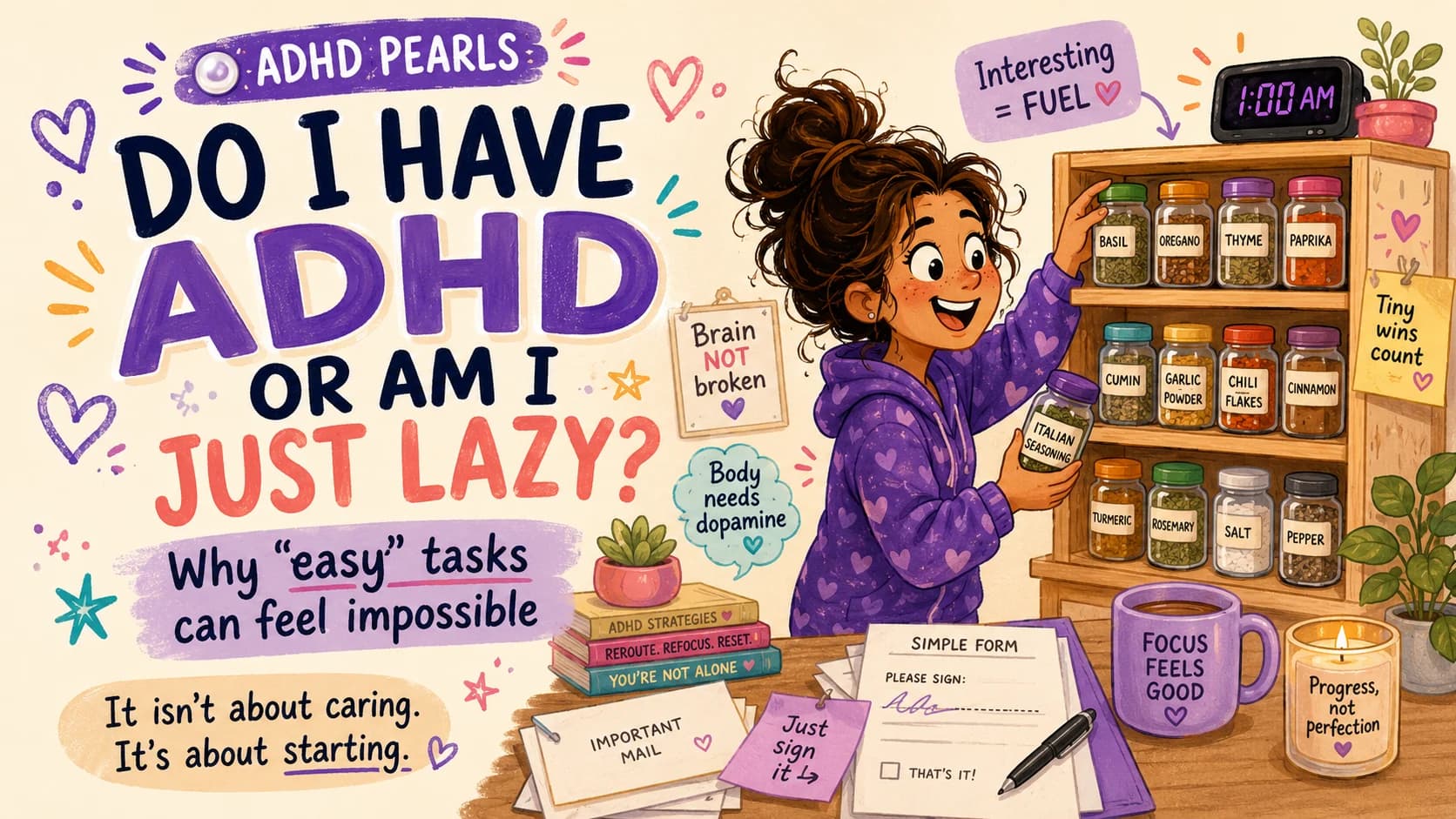
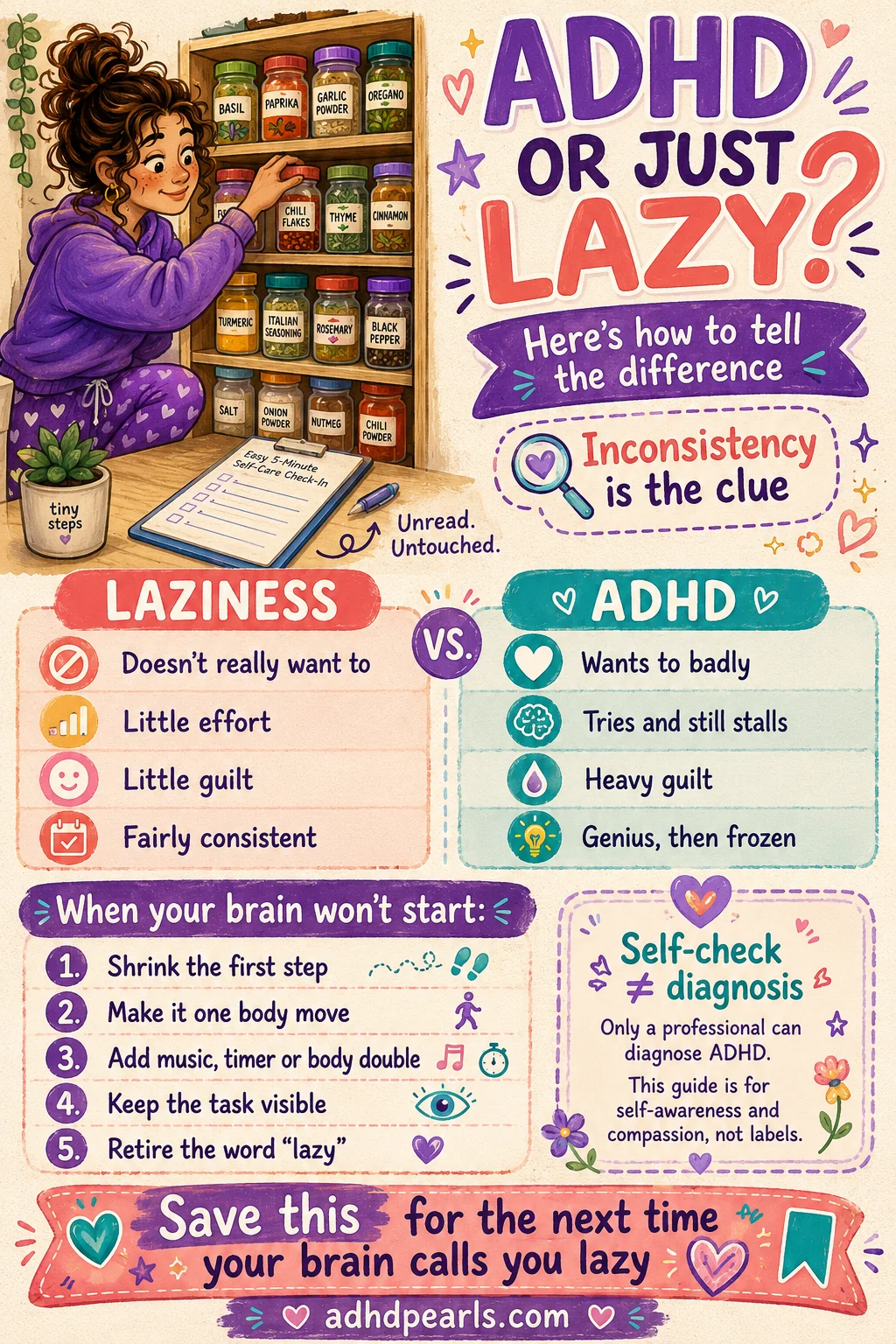
I once reorganized my entire spice rack, alphabetically, at 1am. The same week, a single form sat on my counter for eleven days because I could not make myself pick up a pen and sign it.
If I were lazy, both of those would be lazy. But one of them happened with a burst of unstoppable energy and the other one made me feel like the paper was radioactive. That is the thing nobody tells you about the "am I just lazy" question: lazy is consistent. This isn't.
For years I called myself lazy and disorganized because it was the only word I had. It turns out it was the wrong word.
This article is educational and personal, not medical advice or a diagnosis. Only a qualified clinician can diagnose ADHD, and things like anxiety, depression, thyroid problems, burnout and sleep deprivation can look almost identical. If this resonates, please bring it to a professional.
Quick answer
Do I have ADHD or am I just lazy?
Laziness is choosing not to do something and feeling fine about it. What people call ADHD "laziness" is wanting to do the thing, trying to start, still not being able to, and then drowning in guilt. That gap between intention and action isn't a character flaw - it's executive dysfunction plus a dopamine-based motivation system that won't switch on for boring tasks. If you genuinely care and still can't start, "lazy" was never the right word. An article can't diagnose you, but that pattern is worth taking to a clinician.
Key takeaways
📌Laziness is choosing not to and feeling fine about it. This is wanting to, trying, and still not starting.
📌The gap between intention and action is executive dysfunction, not character.
📌Guilt is the tell. Genuinely lazy people do not lie awake about the thing they did not do.
📌Easy tasks can be the hardest, because there is no urgency to borrow from.
📌Women reach for “lazy” first because it is the explanation they were handed for decades.
Why Can't I Do Simple Things I Actually Want to Do?
Because in ADHD, motivation doesn't run on importance - it runs on brain chemistry. Specifically, dopamine.
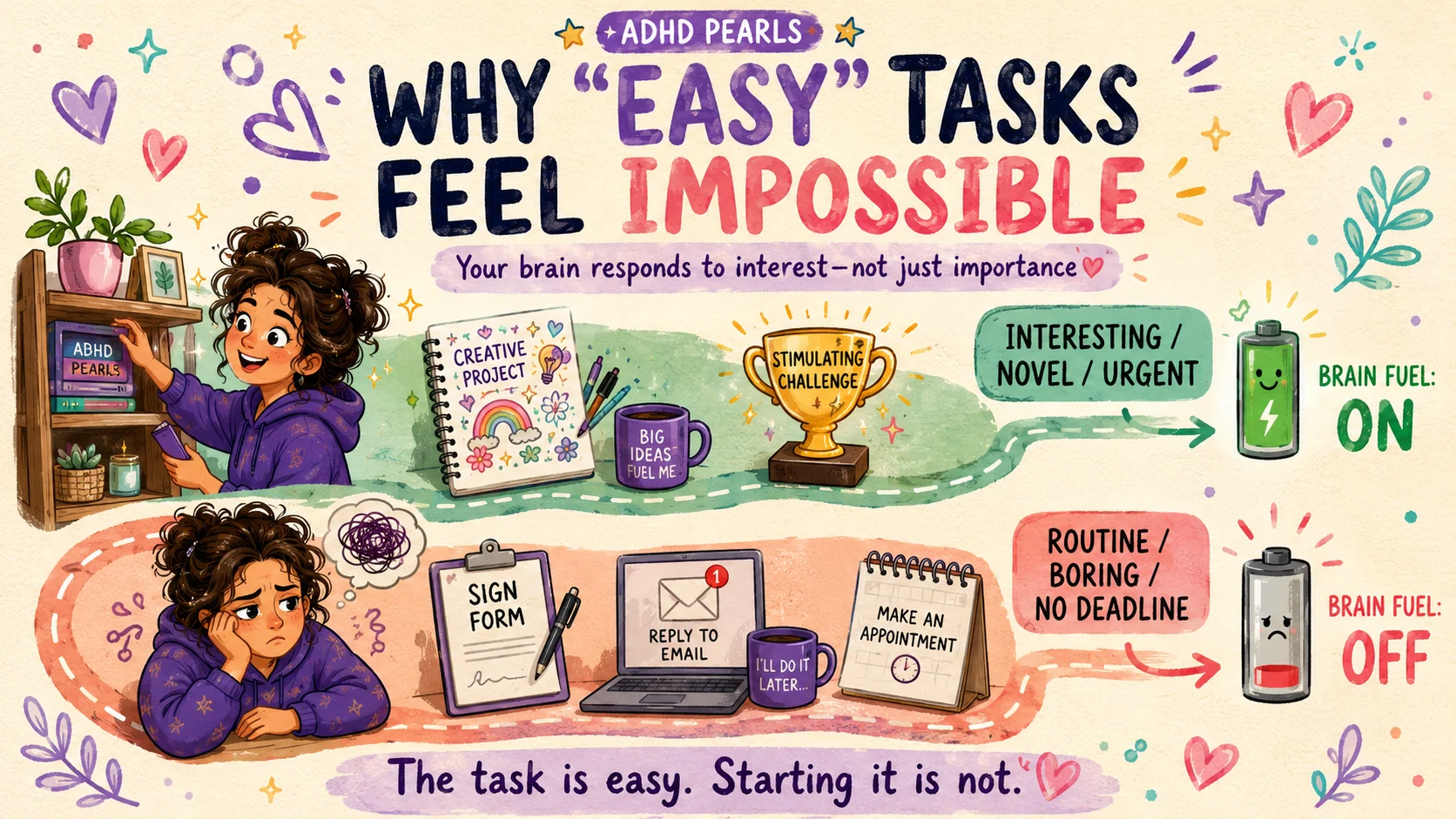
The ADHD brain has differences in its dopamine reward pathway, and researchers have linked that directly to the motivation problems people with ADHD describe. Interesting, novel, urgent or genuinely challenging tasks produce dopamine on their own, so your brain lights up and you can go. Boring, routine, low-stakes tasks produce almost no dopamine, so they rely entirely on executive function to get started - and executive function is exactly the system ADHD makes unreliable.
So the spice rack at 1am was novel and interesting. The form was boring and had no deadline. To an outsider, signing a form is "easier" than reorganizing a cupboard. To an ADHD brain, the form is harder, because there's no dopamine to push you into it.
I wasn't lazy about the things that mattered. My brain just couldn't tell the difference between "important" and "interesting" - and it only handed me fuel for one of them.
This is why the classic ADHD experience is doing the "hard" thing effortlessly and freezing on the "easy" one. Lazy doesn't work like that. Lazy is comfortable. This is frustrating, confusing, and usually soaked in shame.
An ADHD brain can activate for interest, novelty or urgency while stalling on a simpler task that provides no immediate stimulation.
From ADHD Pearls
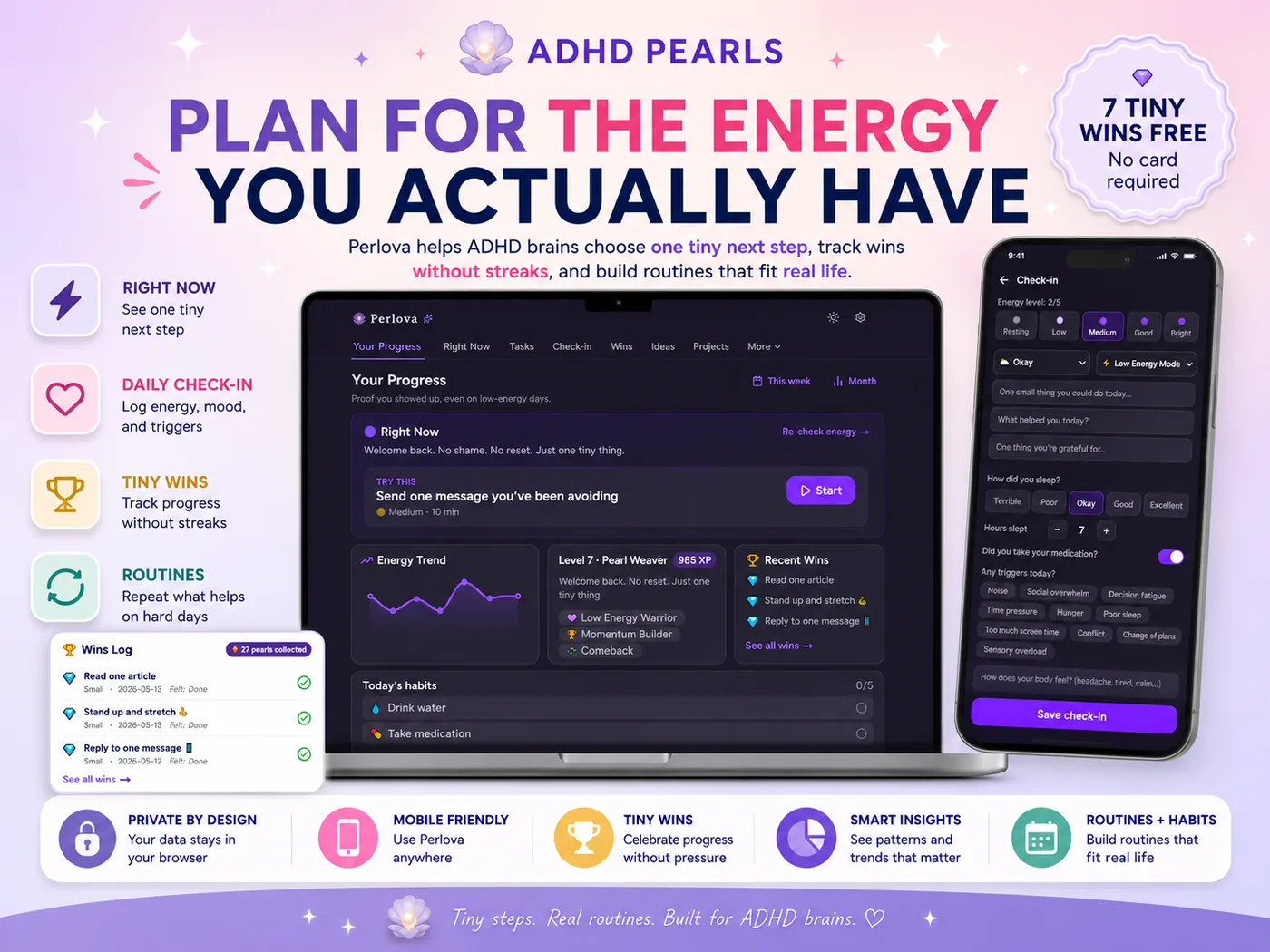
Perlova — plan from the energy you actually have
One doable next step, wins without streaks, and routines that fit real ADHD life. No card, no shame.
What's the Real Difference Between ADHD and Laziness?
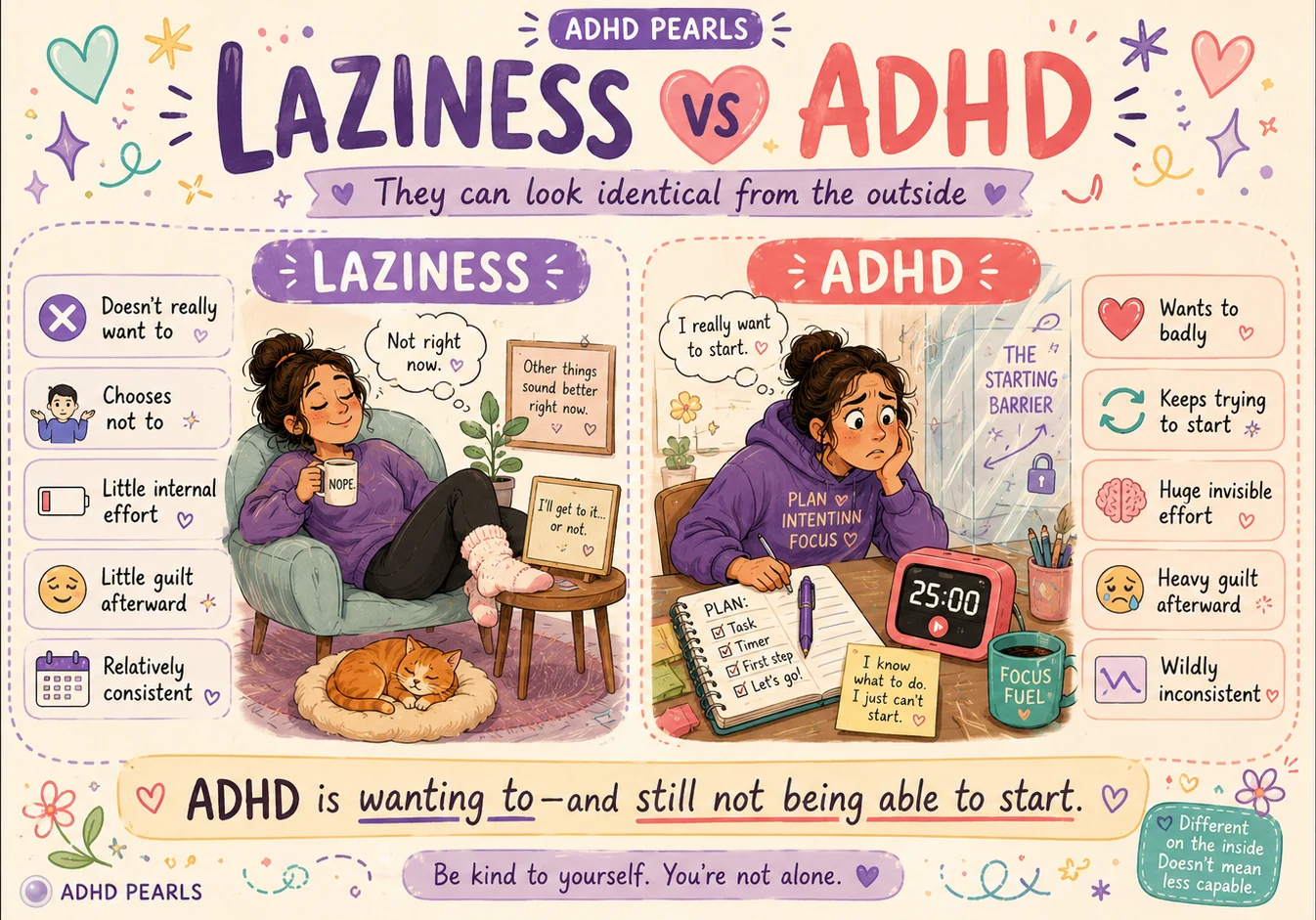
The cleanest tell is the emotional aftermath. Laziness doesn't hurt. ADHD "laziness" hurts constantly, because you wanted to do it and couldn't, and now you're judging yourself for a brain glitch you didn't choose.
Here's how they actually separate out:
Laziness
ADHD
The wanting
You don't really want to, and that's fine by you
You badly want to and still can't start
Effort
No effort spent, no distress
Huge internal effort, and it still stalls
Guilt afterward
Little to none
Heavy shame, self-blame, "what's wrong with me"
Consistency
Steadily unbothered across the board
Wildly inconsistent - genius one hour, frozen the next
Since when
Comes and goes with mood or circumstance
A lifelong pattern, there since childhood
The critical difference is intention: ADHD often means wanting to act, repeatedly trying to start and still becoming blocked.
If you read that and your stomach dropped at the "wants to and can't, then feels awful" row, that reaction is data. Truly lazy people do not lie awake feeling guilty about the dishes.
Why Does Starting Feel Like Hitting a Wall?
Because task initiation is its own executive function, and it's one of the first to break down in ADHD. It's not the doing that's hard - it's the starting.
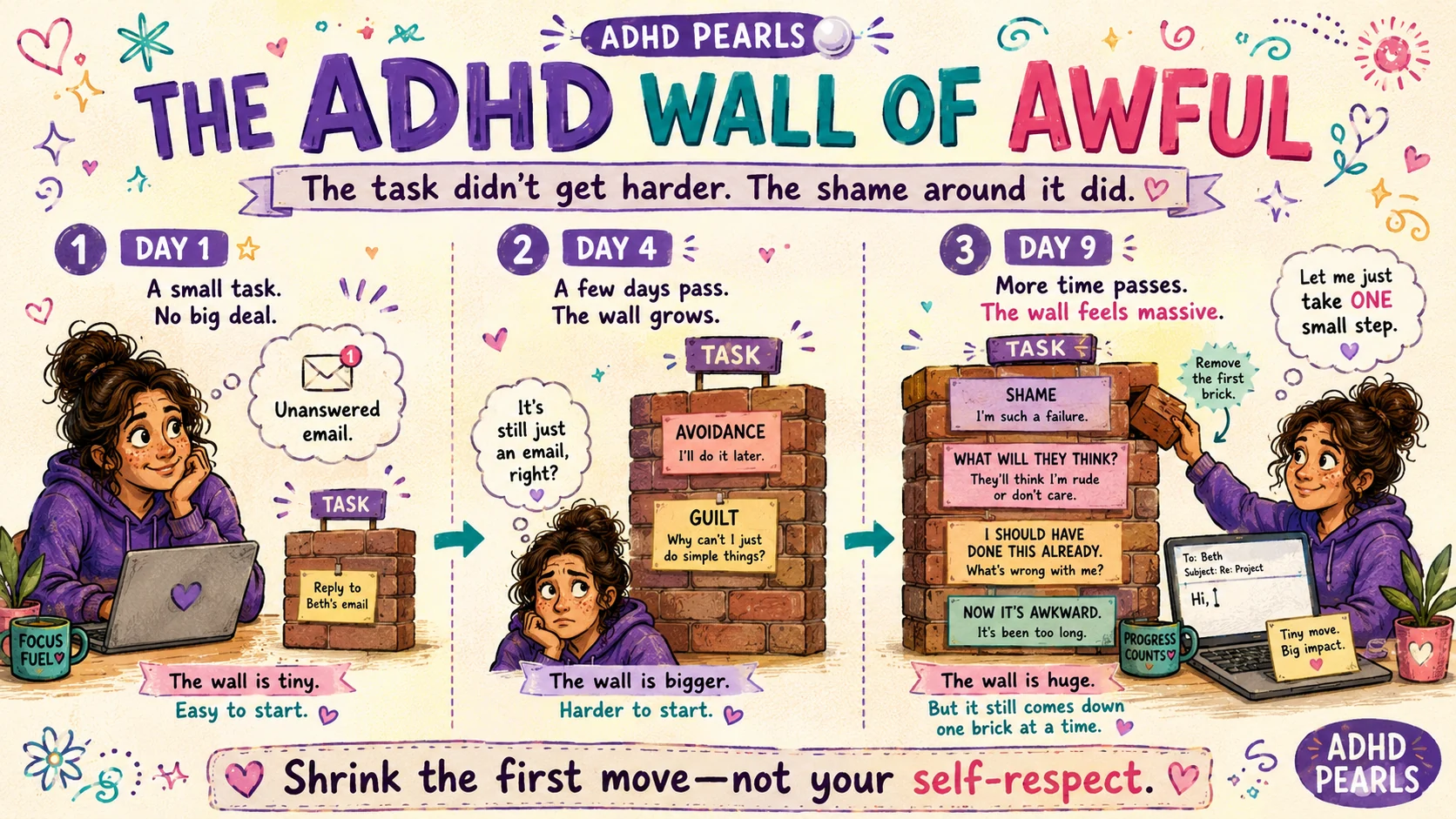
People in the ADHD community call it the "wall of awful": an invisible barrier that gets taller every time you avoid a task. The email you didn't answer on day one is a small wall. By day nine it's enormous, because now it carries the shame of nine days of not answering, and the bigger the wall, the harder it is to climb - which makes you avoid it more. It's a loop, not a personality.
The original task may stay small while avoidance and shame build a much larger barrier around starting it.
This is also why "just do it" advice bounces off. The problem was never the fifteen minutes of work. It's the enormous activation energy to begin those fifteen minutes. Once you're moving, you're usually fine - sometimes annoyingly fine, wondering why you waited eleven days. If starting is your wall, our free ADHD stuck reset is built for exactly that moment, and there's more on this in why task paralysis isn't laziness.
Am I Just Messy, or Is This Executive Dysfunction?
"Disorganized" is usually executive dysfunction wearing a costume. Organization isn't a personality trait or a moral value - it's a set of brain skills: holding things in working memory, prioritizing, sequencing steps, keeping track of time, and switching between tasks without losing the thread. ADHD makes those skills patchy.
So the piles, the lost keys, the forty open browser tabs, the "I'll put it here for now" that becomes permanent - those aren't a sign you don't care. They're a sign your brain's filing system runs differently. Add object permanence trouble (out of sight really does mean out of mind for ADHD brains) and clutter isn't laziness, it's a memory strategy that got out of hand.
The proof that it isn't a values problem: most women who think they're "just messy" have one or two areas of their life that are immaculate. The thing they hyperfocused on. You can't be globally lazy and locally perfect. That inconsistency is the ADHD fingerprint. If you want the deeper reason the usual tools keep letting these brains down, read why productivity apps fail ADHD brains.
Why Do So Many Women Assume They're Just Lazy?
Because women were handed the "lazy" label instead of the diagnosis. ADHD research was built around hyperactive boys, so quiet, inattentive, daydreaming girls didn't match the picture. Instead of "she might have ADHD," we got "she's bright but she doesn't apply herself" and "she just needs to try harder."
Women also tend to have the inattentive presentation - forgetfulness, distraction, disorganization, emotional intensity - without the obvious hyperactivity that gets a kid noticed. And many became expert maskers, building exhausting systems of lists and double-checks to look like they had it together. Masking works so well that nobody, including you, sees the struggle underneath. So the only explanation left for the parts that kept slipping was: I must be lazy.
That's also why so many women aren't identified until their 30s or 40s, often when hormones, life load or burnout finally overwhelm the coping systems that were holding it all up. If your old strategies recently stopped working, that's a real pattern, not a moral decline. There's a fuller self-check in how do I know if I have ADHD. And if you keep circling back to why nobody caught it when you were nine, that has its own answer in why your ADHD got missed until now.
Okay, So What Do I Actually Do About It?
First, retire the word lazy. It's not just unkind - it's inaccurate, and it sends you toward the wrong fixes (more discipline) instead of the ones that work (less friction).
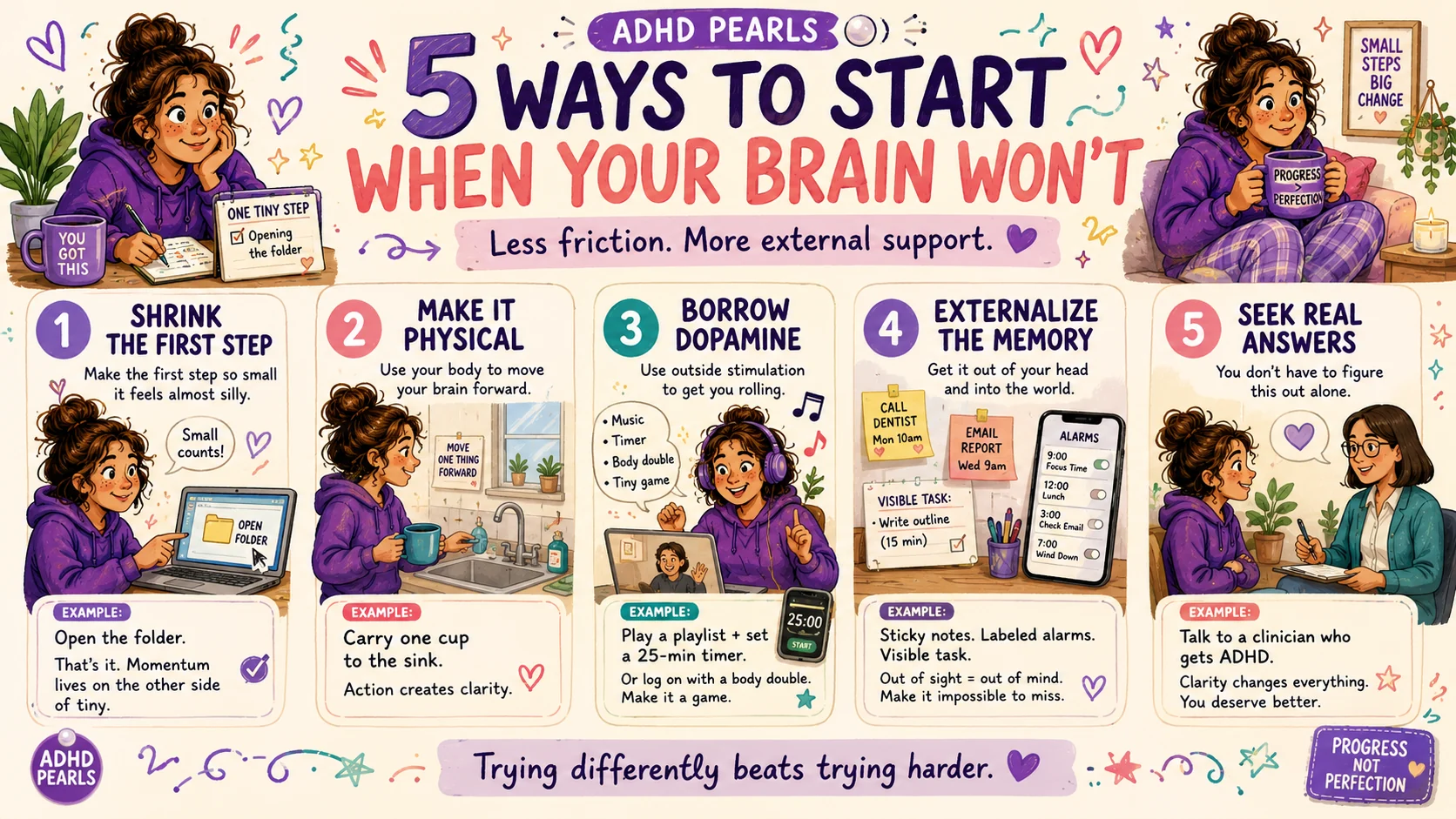
Then try the things that actually help an ADHD brain start:
Shrink the first step until it's almost silly. Not "do taxes" - "open the folder." Not "clean kitchen" - "carry one cup to the sink." The win is starting, not finishing.
Make it a body action, not a decision. Executive function stalls on choices. Reduce the task to one physical move you don't have to think about.
Borrow dopamine. Music, a timer, a body-double (a friend on video doing their own thing) or making it a tiny game can add the stimulation your brain needs. A dopamine menu gives you options ready in advance.
Build external structure. Visual reminders, things left in sight, alarms with labels. If out of sight is out of mind, keep it in sight.
Talk to a professional. If this has been lifelong and it's affecting your work, relationships or wellbeing, an assessment is worth it. Diagnosis often brings relief and access to strategies and, if appropriate, treatment.
Starting becomes easier when the first move is smaller and the brain receives external structure, stimulation and support.
None of that is "trying harder." It's trying differently, with the brain you actually have.
Save this ADHD versus laziness guide for the next time your brain calls you lazy.
You are not a lazy person who can't get it together. You may be a person whose brain runs on a different fuel system, who has been white-knuckling it without the manual. That's a very different problem - and a much more solvable one.
FAQ: ADHD or Laziness
Is it ADHD or am I just lazy?
Laziness is not wanting to do something and feeling okay about it. ADHD is wanting to, trying to start, still not managing it, and then feeling guilty and confused. If you care and still can't act - especially if that's been true your whole life - "lazy" is almost certainly the wrong word, though only a clinician can confirm ADHD.
Why can I focus on some things but not others if I have ADHD?
Because the ADHD brain is interest-based, not importance-based. Interesting, novel or urgent tasks produce their own dopamine, so you can focus or even hyperfocus. Boring or routine tasks produce little dopamine and depend on executive function, which ADHD impairs - so they feel impossible even when they matter more.
Can ADHD make you look lazy and disorganized?
Yes, and it very often does. Unfinished tasks, clutter, lateness and forgotten plans look like not caring from the outside, but they're usually executive dysfunction - trouble with starting, memory, time and organization - rather than a lack of effort or values.
Why is starting tasks so hard with ADHD?
Task initiation is its own executive function, and it's one of the weakest in ADHD. The barrier is the activation energy to begin, not the work itself. Avoidance adds shame, which makes the task feel even bigger - the "wall of awful." Shrinking the first step to something tiny and physical is the reliable way in.
Is being disorganized a sign of ADHD?
It can be, especially alongside other lifelong signs like time blindness, forgetfulness, distractibility and emotional intensity. Disorganization on its own isn't proof of ADHD - lots of things cause it - but persistent, since-childhood disorganization that resists every system you try is worth exploring with a professional.
How is ADHD different from just procrastinating?
Everyone procrastinates sometimes. ADHD procrastination is chronic, happens even on things you care about, is driven by a brain that can't self-activate for low-dopamine tasks, and comes wrapped in shame. It's less "I'll do it later because I'd rather relax" and more "I want to do this now and physically cannot make myself start."
Can you have ADHD and still be successful at some things?
Absolutely. Many people with ADHD are brilliant in the areas that engage them and struggle badly in the ones that don't. That very inconsistency - excelling here, stalling there - is more consistent with ADHD than with laziness, which tends to be uniform.
What should I do if I think it's ADHD, not laziness?
Stop using "lazy" as your explanation, start using low-friction strategies (tiny first steps, body-doubling, external reminders), and if the pattern is lifelong and disruptive, book an assessment with a qualified clinician. A diagnosis can bring both relief and real tools.
And if you are not frozen so much as busy doing everything except the thing, that is a different mechanism — ADHD procrastination and the last-minute pattern covers why only the deadline works.
One tap makes ADHD Pearls a preferred source in your Google account, so our articles surface higher when you search. No signup, and it brings you straight back to this page.
Here's why other planners didn't stick
They assume you'll show up the same every day. Perlova starts with how you feel right now.
Other ADHD planners
×Ask you to plan ahead, when your brain isn't there yet
×Assume you have consistent energy every day
×Show you everything you're already behind on
×Fall apart the first time you miss a day
×Require willpower just to open them
Perlova
✓Starts with your energy right now — not a perfect plan
For the woman who sets up the perfect system on Sunday and abandons it by Tuesday.
One short letter, every week. Real talk about ADHD, task paralysis, and the tiny wins that actually move the needle for a brain like yours. No shame. No hustle culture.