The first thing I said when someone finally used the word ADHD about me was: but I was a good student.
I had built an entire case against myself. Good grades, no detentions, nobody ever called my parents in. If I had ADHD, surely one of the roughly forty adults employed to notice children would have noticed. So the only remaining explanation was the one I had been carrying since I was about nine - that I was just lazier and more chaotic than everyone else, and hiding it well.
It took me an embarrassingly long time to understand that I was not too subtle, too clever or too well behaved to have ADHD. I was exactly the kind of child nobody was looking for.
Quick answer
Why did my ADHD get missed until now?
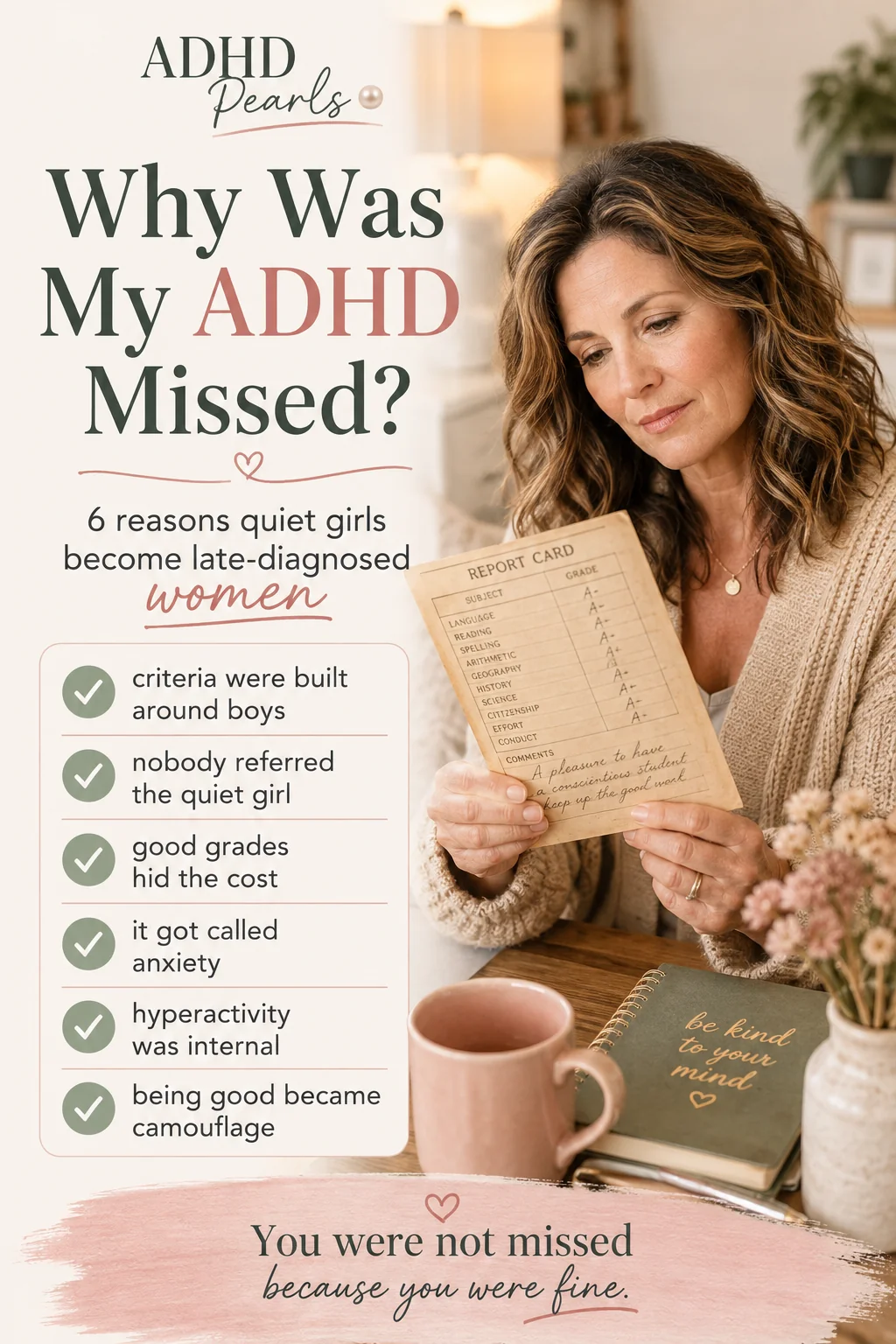
Because the diagnostic picture was built around hyperactive boys, and girls who are quiet, anxious or high-achieving do not get referred. Most women with ADHD were not disruptive, so nobody flagged them; many compensated well enough that the difficulty stayed invisible; and the symptoms that did show - worry, tearfulness, disorganisation - were often labelled anxiety, sensitivity or laziness instead. Boys are diagnosed at roughly three to four times the rate of girls in clinical settings, but by adulthood the gap almost closes. The girls were always there. They just were not being seen.
Key takeaways
📌The diagnostic picture was built around hyperactive boys. Quiet, anxious or high-achieving girls were not referred.
📌Doing well at school measures output, not what producing that output cost you.
📌It often surfaces when the scaffolding drops — a baby, a promotion, perimenopause.
📌The grief is real and rarely warned about. You are mourning support that existed and never reached you.
📌Rereading your history accurately is more useful than rereading it kindly.
The clinical picture of ADHD was assembled largely from hyperactive boys in classrooms - the child who cannot stay in his seat, who blurts, who gets sent out. If your version was drifting off mid-sentence while looking directly at the teacher, you did not match the template. You were not less affected. You were less inconvenient.
2. Nobody refers a quiet girl
Referral is the gate, and someone has to open it. A 2020 expert consensus statement on females with ADHD is blunt about this: the large male-to-female diagnosis gap is due at least in part to lack of recognition and referral bias, because most girls with ADHD do not have the externalising behaviour that gets adults' attention.
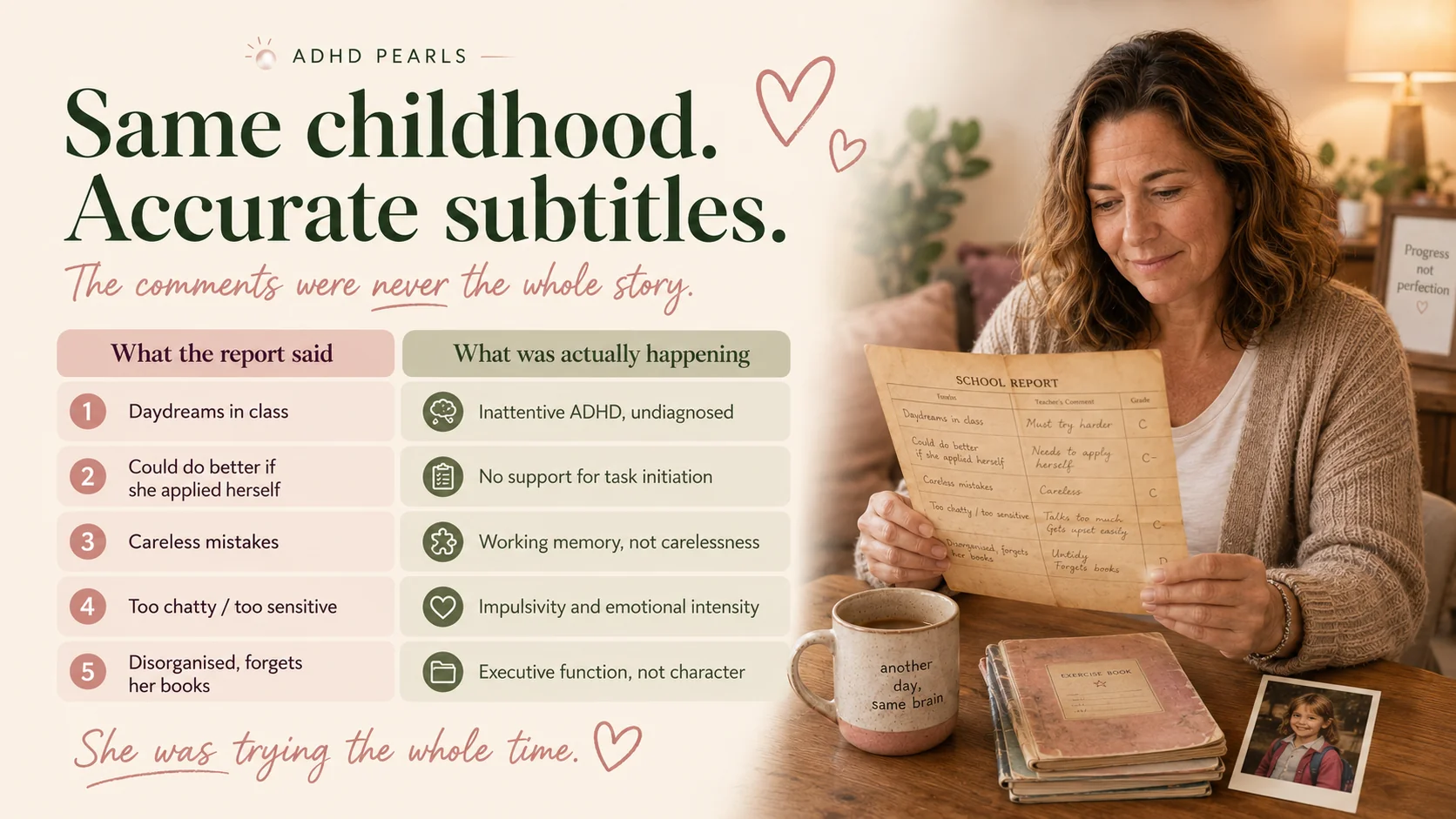
The same statement warns that school reports are unreliable for assessing girls, since teachers often missed subtler hyperactive-impulsive signs and commented instead on daydreaming or a lack of effort. Which is how you end up as an adult, holding a report card that says could do better if she applied herself and treating it as evidence for the prosecution.
The problem was not that there were no signs. The problem was that people were trained to look for a different kind of child.
3. You compensated, and it worked - for a while
This is the one that fools everyone, including you. Masking and compensating are more common in girls, and they push diagnosis back by years or decades. Panic-fuelled all-nighters that produced good marks. Being the funny one so nobody noticed you had lost the thread. Systems held together by fear of getting it wrong.
The output looked fine. The cost was invisible, because the cost was internal - and you had nothing to compare it to, so you assumed everyone found it this hard.
When the result looks fine, nobody asks what it cost to produce it.
4. It got called anxiety, or depression, or hormones
Women with ADHD frequently arrive in the mental health system through the anxiety and depression door, because those are what shows on the surface, and often what genuinely developed on top of years of undiagnosed struggle. Treating the anxiety is not wrong. It is just incomplete - and when the treatment only half works, the conclusion is usually that you are difficult rather than that something is missing.
The first label may have named part of the pain. It may not have named the whole pattern.
5. Your hyperactivity was on the inside
Plenty of women with ADHD are hyperactive. It just never looked like climbing the furniture. It looked like a brain that will not stop narrating at 2am, talking too fast when excited, three unfinished projects, an inability to sit through a film without your phone. Internal restlessness is not visible from across a classroom, so it does not get counted.
6. Being good was the entire strategy
Girls tend to be socialised early and thoroughly into not being a problem. If your survival strategy was to be helpful, pleasant and low-maintenance, you were also, without meaning to, running excellent camouflage. The better you were at it, the less likely anyone was to look underneath - and the more crushing it felt when you slipped, which is often where rejection sensitivity gets its grip.
From ADHD Pearls
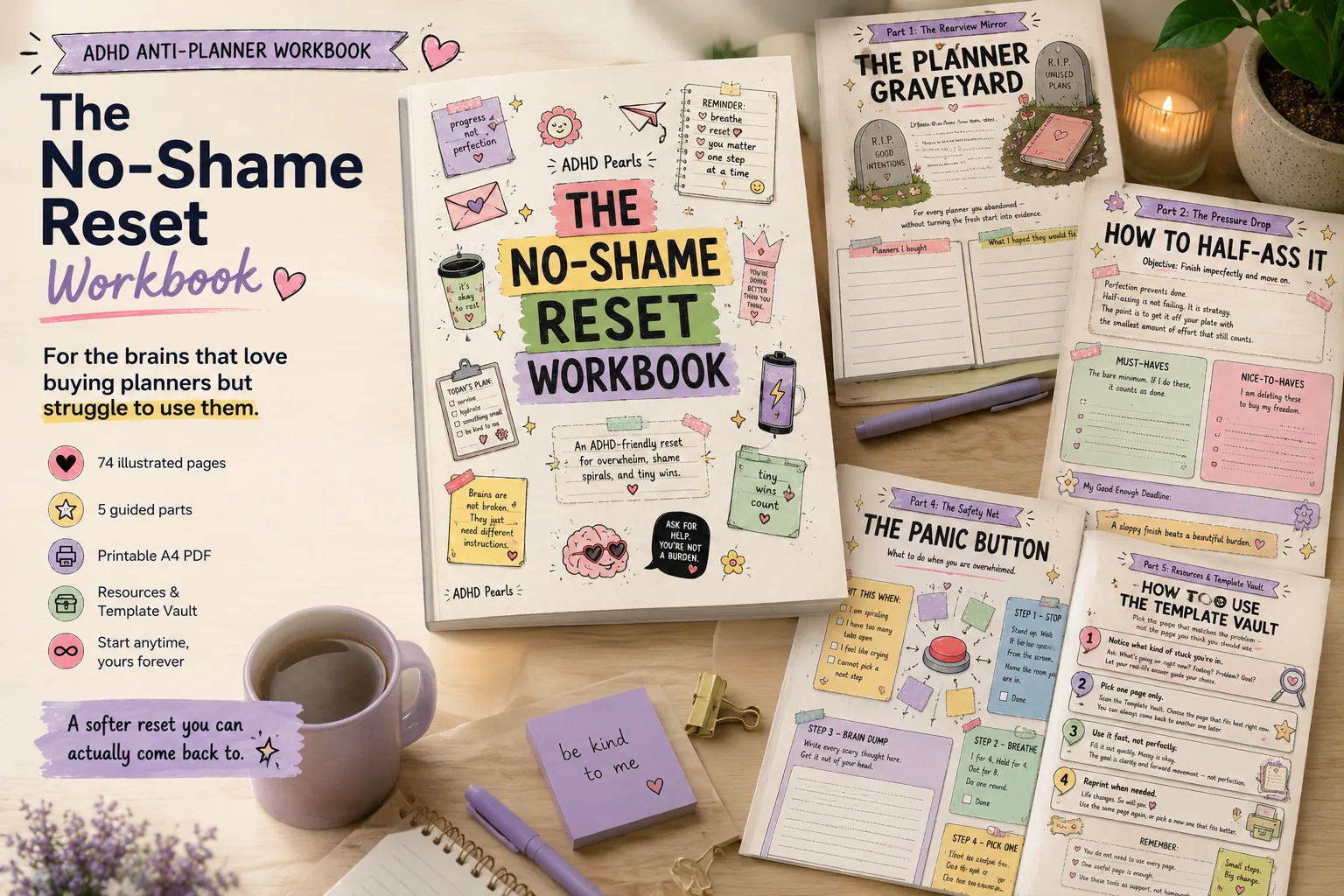
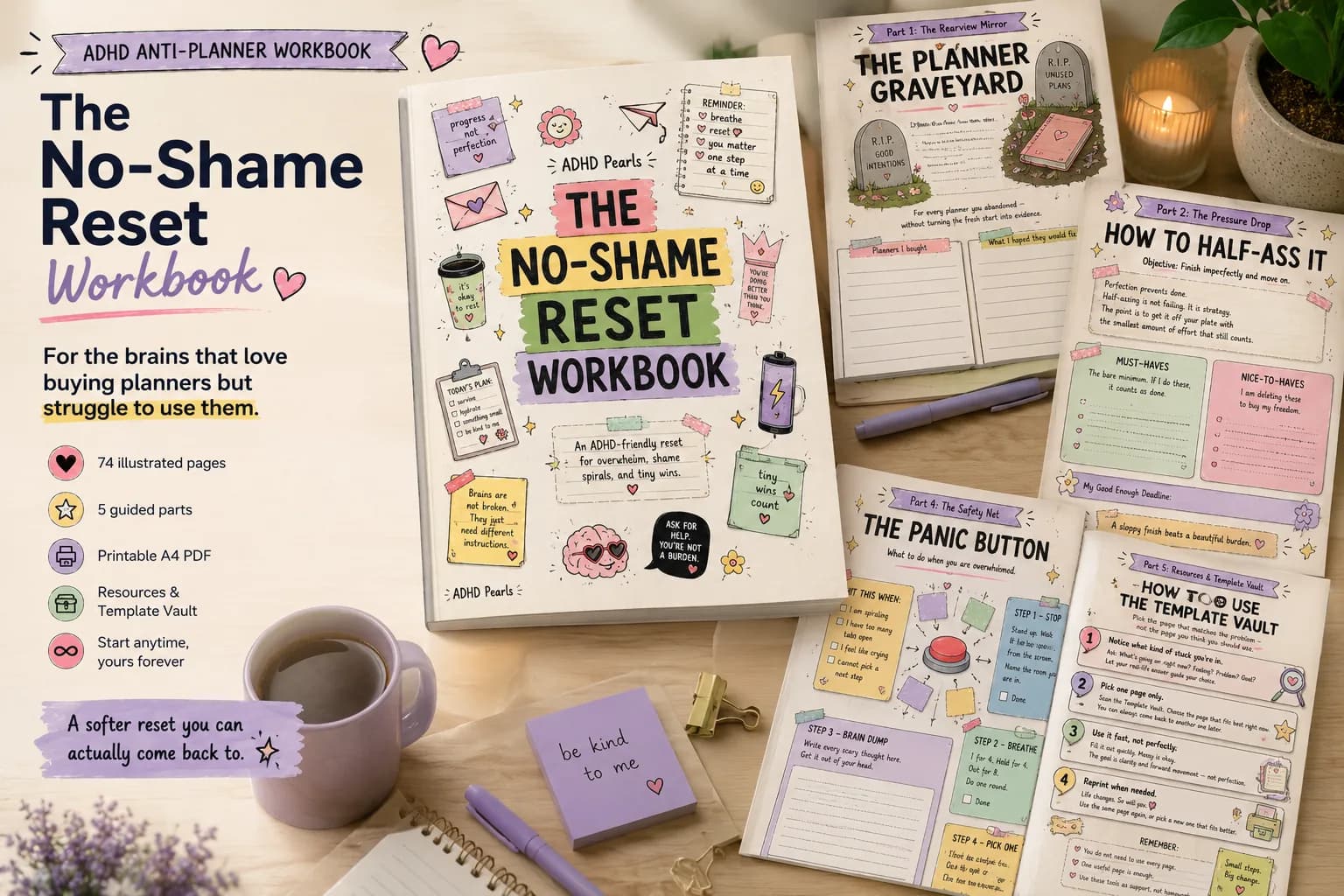
The No-Shame Reset Workbook
74 pages to reflect without shame, release what isn't working, and build a softer reset you can actually return to.
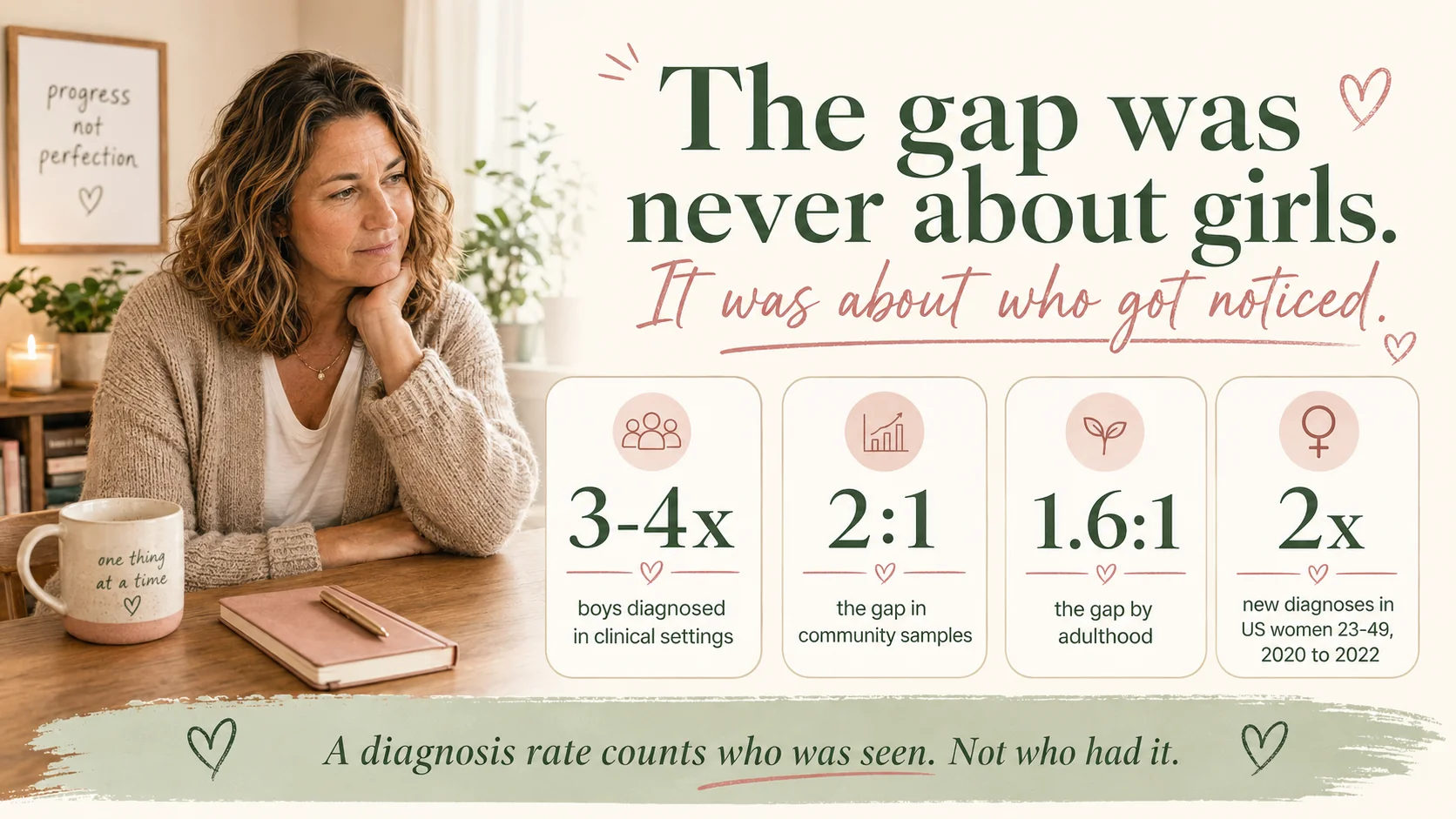
The gap is not evidence that ADHD is a boys' condition. It is evidence of a referral funnel.
In clinical settings, boys are diagnosed at roughly three to four times the rate of girls. In community samples - where researchers go looking rather than waiting for a referral - it narrows to around two to one. By adulthood, when people refer themselves, it is closer to even.
A diagnosis rate measures how many people were noticed. It does not measure how many people had it.
And the catching-up is happening now: new ADHD diagnoses among American women aged 23 to 49 roughly doubled between 2020 and 2022. If you have the uncanny sense that everyone your age suddenly has ADHD, that is what you are watching - not a trend, but a backlog.
The ratio never described reality. It described who was being noticed.
Why Did It Surface Now?
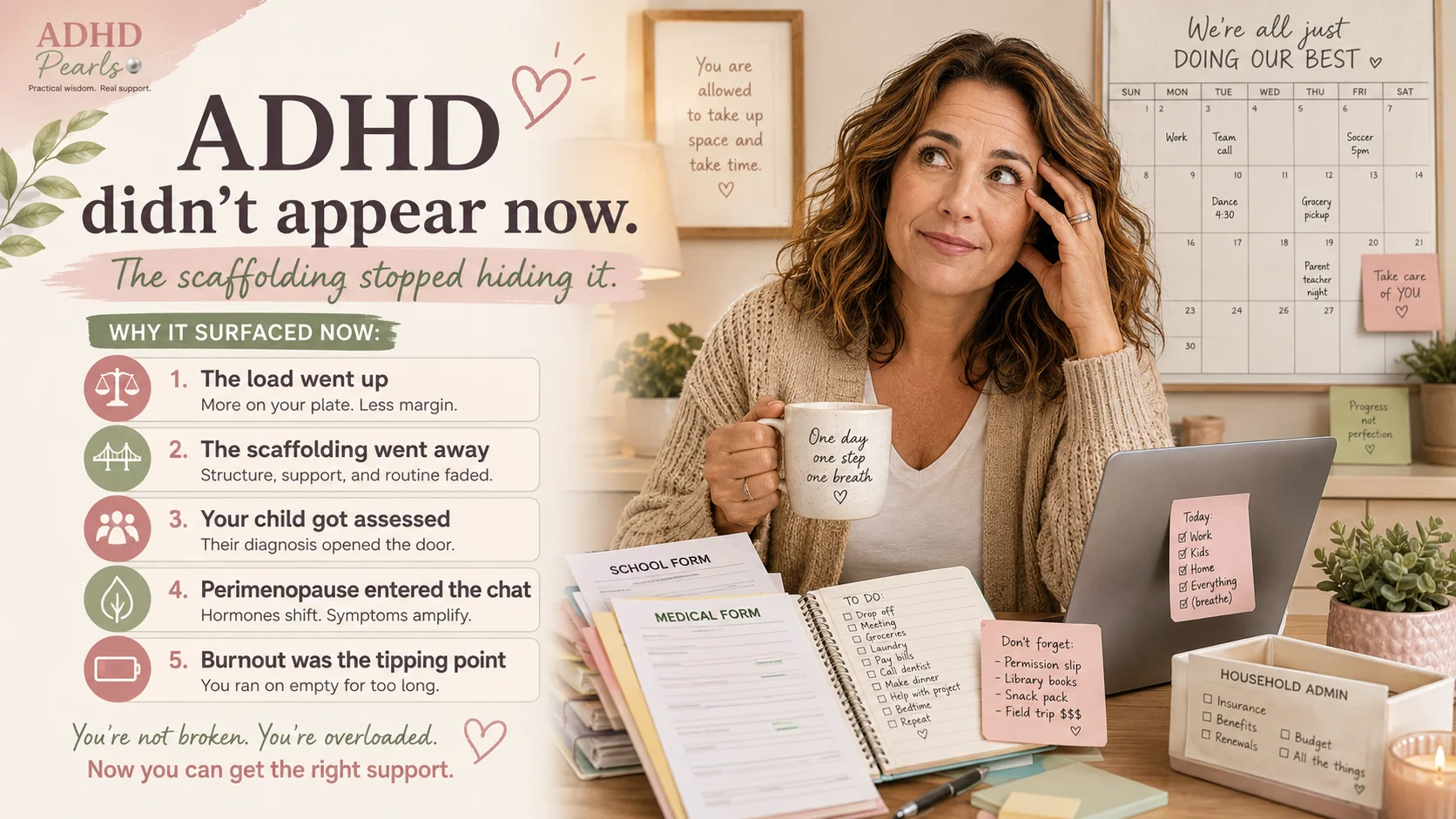
Compensation is not free. It works until the demands exceed what it can absorb, and then it stops working rather suddenly - which is why so many women arrive at this question in their late thirties and forties rather than at nineteen.
The usual tipping points:
The load went up. Children, a promotion, a house, ageing parents, all the invisible admin. More balls, same hands.
The scaffolding went away. School and university impose structure. Adult life hands you a blank calendar and calls it freedom.
Your child got assessed. Sitting in that appointment, recognising every single question. A remarkably common route in.
You burned out. When there is no spare capacity left, masking is the first thing to go.
None of these caused ADHD. They removed the conditions that were hiding it.
ADHD did not appear out of nowhere. The support structures that hid it may have stopped working.
The Grief Nobody Warns You About
Everyone talks about the relief. Fewer people mention what arrives about a fortnight later.
Relief comes first: there is a reason, and the reason is not that I am a bad person. Then, often, grief - for the child who was trying so hard, for the version of your life that might have existed with support, for the years spent apologising for something that had a name the whole time. Then anger, usually at the systems and adults who did not look properly.
All of it is normal and clinically well documented. It is not ingratitude, and it does not mean you are dwelling. You are updating twenty or thirty years of self-narrative, which is a substantial administrative task even for a brain that likes admin.
What helped me was letting the anger be about the system rather than about individual people who mostly did not know. And letting the grief be short and real rather than tidy - it does pass, and what it leaves behind is usually a much kinder read on your own past. If the self-blame layer is thick, the ADHD shame detox is written specifically for that.
Rereading Your Own History
The most useful thing a late diagnosis gives you is not a treatment plan. It is subtitles for scenes you have been misreading for decades.
Same childhood. Accurate subtitles.
Try it with three specific memories rather than your whole life at once. The school report. The job you left without being able to explain why. The friendship that quietly ended after you forgot something important.
Then ask what mechanism was actually running: working memory, task initiation, time blindness, emotional dysregulation, sensory overload. Not to excuse anything - to describe it accurately for the first time. Accurate is a lot easier to work with than I am just like this.
What Actually Helps Now
Whether or not you have a formal diagnosis yet, the useful moves are similar:
Get it named properly. If you are still at the suspecting stage, the gentle self-check for women is a reasonable first step, and a qualified clinician is the only route to an actual assessment.
Stop grading yourself against a system that was not looking at you. Your school reports were not neutral instruments.
Externalise instead of remembering. Alarms, visible lists, one landing spot for objects. Every system that survives is one that does not depend on your memory being reliable that day.
Plan around capacity, not intention.Energy-based planning holds up better than a timetable built for a version of you that does not exist.
Have one small move ready for the frozen days. The free Stuck Reset exists for exactly that.
Tell one person. Being witnessed does a surprising amount of the work here.
This article is educational and is not a diagnosis. Difficulty with attention, memory and organisation can also come from anxiety, depression, trauma, sleep problems, thyroid conditions or hormonal change, and only a qualified clinician can assess what is going on for you.
FAQ: Late ADHD Diagnosis in Women
Why was my ADHD missed as a child?
Most likely because you were not disruptive. The diagnostic picture was built largely around hyperactive boys, and referral depends on an adult noticing a problem. Expert consensus on females with ADHD points to lack of recognition and referral bias as major drivers of the diagnosis gap, with school reports often commenting on daydreaming or effort rather than flagging anything.
Can you have ADHD if you did well at school?
Yes. Good grades often reflect compensation - deadline panic, high effort, fear of getting it wrong - rather than an absence of difficulty. Academic results measure output, not how much it cost you to produce it, and many women with ADHD only hit the wall when the structure of school disappears.
Why are more women being diagnosed now?
Partly better awareness of how ADHD presents in girls and women, partly women recognising themselves in other people's descriptions and referring themselves. New diagnoses among American women aged 23 to 49 roughly doubled between 2020 and 2022, which looks like a backlog being cleared rather than a sudden increase in ADHD.
Is it common to be diagnosed with anxiety or depression first?
Very. Anxiety and depression are what tends to be visible, and they frequently develop genuinely on top of years of undiagnosed ADHD. Treatment that only partly works is a common sign that something underneath has been missed.
Can ADHD show up later in life?
ADHD is a neurodevelopmental condition, so the traits were there in childhood even if nobody noticed them. What changes later is the demand: more responsibility, less external structure, and hormonal shifts in perimenopause can all overwhelm coping strategies that used to hold.
Why do I feel grief after finding out?
Because you are rereading decades of your own history at once. Relief is usually followed by grief for the child who was trying so hard and anger at the systems that missed her. It is a documented and normal part of late diagnosis, not a sign you are dwelling on it.
Does a late diagnosis actually change anything?
It changes the explanation, which changes what you try. Instead of aiming to be more disciplined, you can build external structure, ask for specific adjustments, and stop using your past as evidence of character failure. Whether you go on to pursue treatment is a separate decision to make with a clinician.
What if I cannot get assessed right now?
Assessment matters, and waiting lists and costs are real. In the meantime, nothing stops you using ADHD-shaped strategies - external reminders, capacity-based planning, smaller first steps. They help regardless of what is eventually written on a form.
Am I making this up because it is everywhere online?
Recognising yourself in accurate descriptions is how most late diagnoses start, and it is worth checking properly rather than dismissing. The rest of the picture matters too: ADHD traits are lifelong, present in more than one setting, and cause real impairment, which is exactly what an assessment is designed to establish.
Save this if you keep wondering how ADHD could have been missed for so long.
Pin this reminder: you were not missed because you were fine.
You were not missed because you were fine. You were missed because you were quiet, and because the people looking had been given a picture of someone else.
One tap makes ADHD Pearls a preferred source in your Google account, so our articles surface higher when you search. No signup, and it brings you straight back to this page.
ADHD anti-planner workbook
The No-Shame Reset Workbook
A 74-page printable reset for overwhelm, shame spirals, and the planners you couldn't keep using. Reflect without shame, release what isn't working, and build a softer reset you can actually return to.
For the woman who sets up the perfect system on Sunday and abandons it by Tuesday.
One short letter, every week. Real talk about ADHD, task paralysis, and the tiny wins that actually move the needle for a brain like yours. No shame. No hustle culture.