I once told my husband I would be ready in five minutes. I believed it completely. Forty-one minutes later I came downstairs and found him by the door with his coat on, doing the face.
I had not been ignoring him. I had been in the bathroom, then answering one message, then finding the other shoe, and somewhere in the middle of all that, forty minutes evaporated without leaving a receipt.
For most of my life I filed that under rude, or scatty, or proof that a better planner would fix me. It is none of those things. It has a name - time blindness - and once you understand what your brain is actually doing with time, you can stop trying to feel your way through the day and start building a scaffold instead.
Quick answer
Why do I lose track of time with ADHD?
Because ADHD affects how your brain tracks and estimates time, not how much you care. Time perception leans on working memory and sustained attention - the two things ADHD hits hardest - so instead of a running sense of the hours passing, your brain works in two tenses: now and not now. That is why five minutes becomes forty, and why an hour on your phone feels like ten minutes. It is not a discipline problem and trying harder will not fix it, but it responds very well to putting time outside your head: an analog clock, a visual timer, two alarms instead of one, and time estimates you measured once instead of guessed.
Key takeaways
📌Time blindness is about tracking and estimating time, not about how much you care.
📌Time perception leans on working memory and sustained attention, the two things ADHD hits hardest.
📌The brain works in now and not-now, which is why next week and next month feel identical.
📌Looking at a clock does not fix it. Reading the time is not the same as feeling it pass.
📌Make time external and visible: analogue faces, visual timers, alarms for the start rather than the deadline.
Time blindness is a consistent difficulty sensing how much time has passed, how long something will take, and how far away a future event really is. It is not about caring less. It is about missing the internal running clock that most people never have to think about.
Two honest notes before we go further. Time blindness is not a formal diagnosis, and you will not find it in the DSM-5. It is a descriptive term the ADHD community adopted because it names something clinicians and researchers do study seriously under the drier label of time perception.
The clearest description I have found is that the ADHD brain works in two tenses: now and not now. Now is the thing in front of you, in high definition. Not now is everything else - the meeting in twenty minutes and the tax deadline in March feel roughly the same distance away, which is to say vaguely far, until suddenly they are on fire.
For many ADHD brains, time does not feel like a smooth timeline. It often feels like now or not now.
Once I had that framing, half my life reorganised itself. The reason I could not start a task at 2pm when something was booked for 4pm was not laziness. My brain had put the whole afternoon into now, and it refused to spend it. That is close cousin territory to ADHD waiting mode, where one appointment quietly eats the entire day.
From ADHD Pearls
Perlova — plan from the energy you actually have
One doable next step, wins without streaks, and routines that fit real ADHD life. No card, no shame.
Because tracking time is not one skill. It is several, and they run on exactly the machinery ADHD affects.
Time-keeping runs on working memory
Russell Barkley's model of ADHD makes the chain explicit: weaker inhibition degrades working memory, and degraded working memory degrades your sense of time - because holding a running clock in your head means keeping a representation of it alive while eleven other things compete for the same space. Lose the thread for a second and the count restarts from nowhere.
This is why I can be in the shower with a genuine intention to be quick, and emerge into a different hour. Nothing distracted me in an obvious way. The counting just quietly stopped.
Timing may be a core dimension of ADHD, not a side effect
A 2023 review of a decade of adult ADHD research points to Sonuga-Barke's triple-pathway model, which adds timing to the two better-known pathways of cognitive control and reward processing. In that framing, altered time perception sits alongside impulsivity and delay aversion as a defining feature of the condition rather than a consequence of being disorganised.
The same review is refreshingly honest that the adult evidence base is thin and the findings are mixed - some studies show clear deficits in time estimation and reproduction, others do not, partly because everyone measures it differently. So: real, studied, and still being argued about. That is a more useful truth than a confident headline.
Dopamine, and the brain regions that keep the beat
Interval timing - the sense of seconds and minutes elapsing - involves the prefrontal cortex, the basal ganglia and the cerebellum, and it is sensitive to dopamine signalling. ADHD involves differences in that same dopamine system, which is one reason time can run fast, slow, or apparently not at all depending on how interesting the thing in front of you is.
If your brain cannot measure time accurately, more shame will not fix it. Better measurement tools will.
Time blindness is not a discipline problem. It is a measurement problem - and measurement problems get solved with instruments, not willpower.
What Does ADHD Time Blindness Actually Look Like?
It rarely announces itself as a time problem. It shows up as a personality flaw, which is why so many of us reach adulthood convinced we are simply unreliable.
You are chronically late, or so anxiously early that you sit in the car for twenty-five minutes.
Every task takes two to three times longer than you predicted, and you are surprised every single time.
You cannot start something small because there is an appointment in three hours.
Hours vanish into a phone, a game, a rabbit hole, or a genuinely productive hyperfocus you cannot stop.
Deadlines feel imaginary until roughly twelve hours before, when they become the only thing in the universe.
You forget people, plans and objects the moment they are not in front of you - the time cousin of ADHD object permanence.
Someone asks when you last did something and you say a few weeks. It was eight months ago.
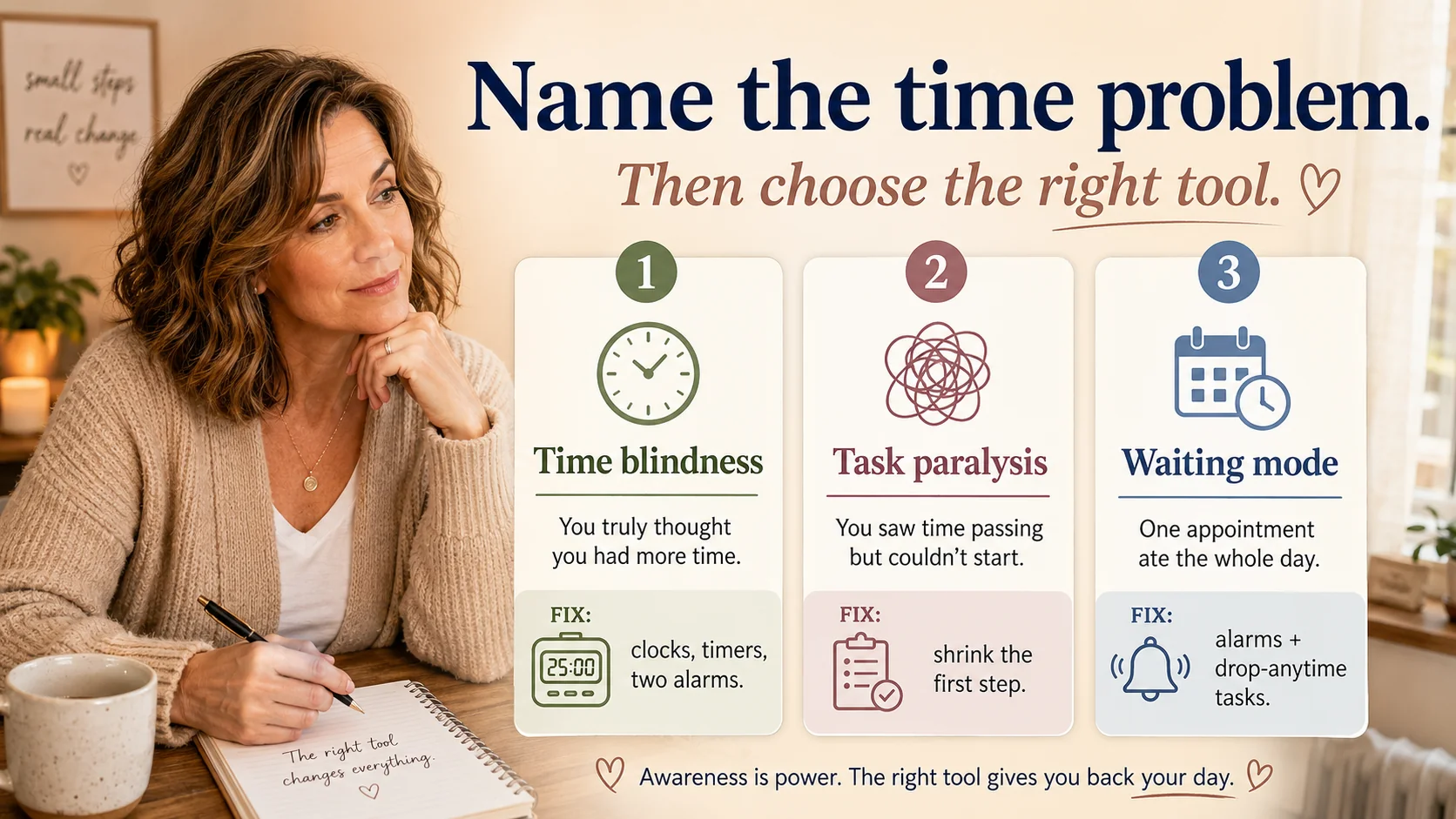
Being late is the symptom people notice, but lateness has at least three different ADHD causes, and they need different fixes. This is the bit that took me years to untangle:
What is happening
How you can tell
What actually helps
Time blindness
You were busy and genuinely believed you had more time. No dread involved.
External clocks, timers, two alarms, measured estimates.
Task paralysis
You knew the time. You watched it pass. You could not make your body start.
Shrink the first step until it is almost silly - see task paralysis.
Waiting mode
You did nothing all morning because of one thing in the afternoon.
Hand the clock-watching to alarms and pick drop-anytime tasks.
Being late or stuck does not always come from the same problem. Naming the pattern helps you choose the right tool.
Most of us run all three in the same week. Naming which one is happening today decides which tool you reach for, and stops you applying a motivation fix to a measurement problem.
Why Doesn't Just Looking at the Clock Work?
Because a digital clock gives you a number, and a number is not a feeling of duration. 2:41pm tells me nothing about whether I have enough time to unload the dishwasher before I leave. I look at it, I register it, and it slides straight off.
An analog face works differently. The hand is physically moving through an arc, so time looks like something being spent rather than a fact being reported. Same information, entirely different message to a brain that thinks in pictures.
There is also a specific trap worth naming: the activities where time disappears fastest are usually the ones with no natural edges. Showers, phones, games, tidying one drawer, a research spiral at 11pm. Nothing in them signals that a chunk has gone. That is also the machinery behind revenge bedtime procrastination - it is not a decision to stay up, it is the absence of a signal that time is passing.
I now keep a timer running in the bathroom, which sounds absurd until you consider that it has saved me from being late to more things than any planner I have ever bought.
How Do I Stop Losing Track of Time With ADHD? (8 Things That Help)
You are not going to grow an internal clock. The strategies that work all do the same thing: they move time out of your head and into the room, where your brain can actually see it.
The goal is not to magically grow a perfect internal clock. The goal is to put time where your brain can see it.
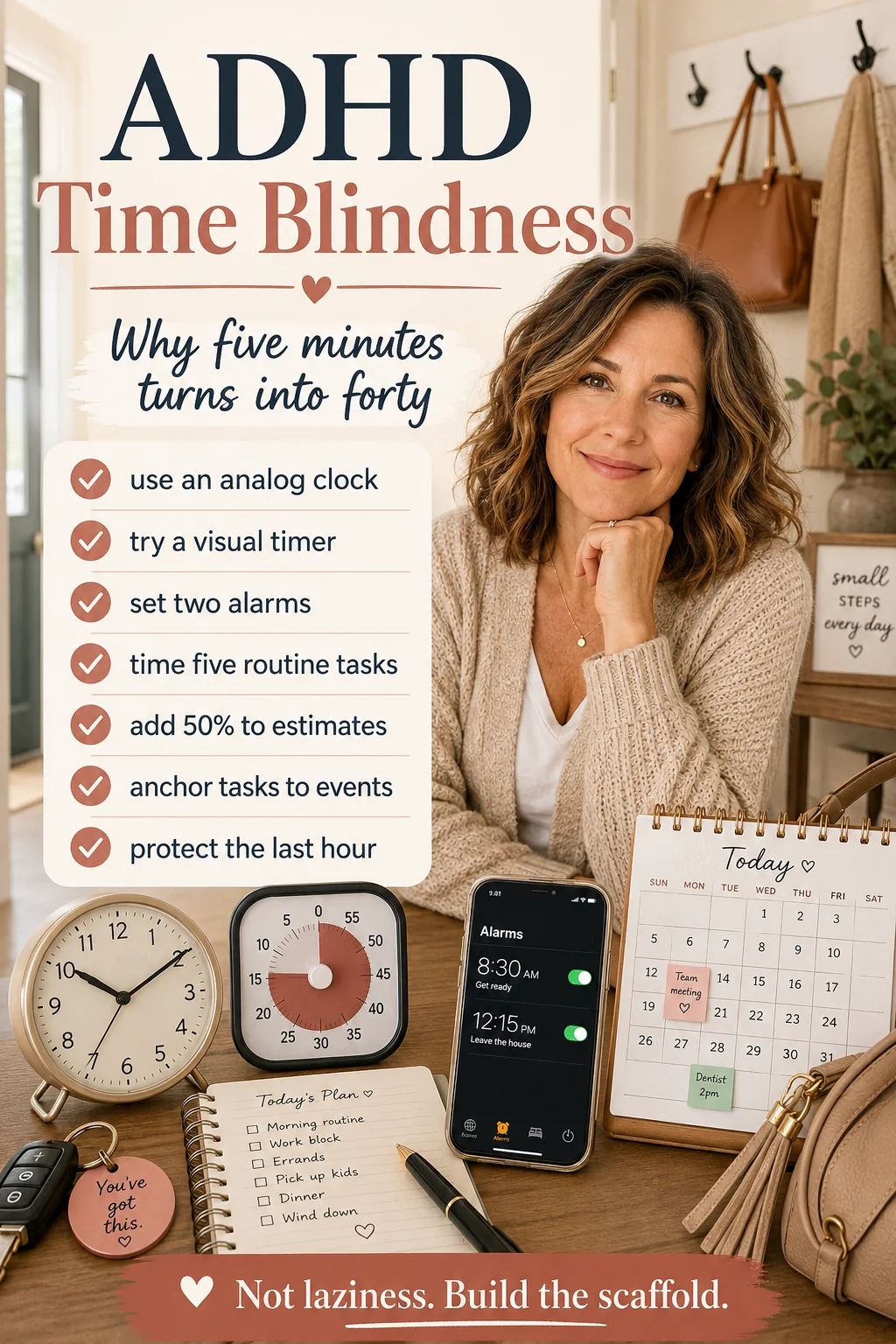
1. Put an analog clock where you actually stand
Not one clock in the hall. Clocks in the rooms where time goes missing: the bathroom, the kitchen, wherever you work. The point is to make checking the time require zero effort, because effortful checking does not happen when you are absorbed.
2. Use a visual timer for the sinkholes
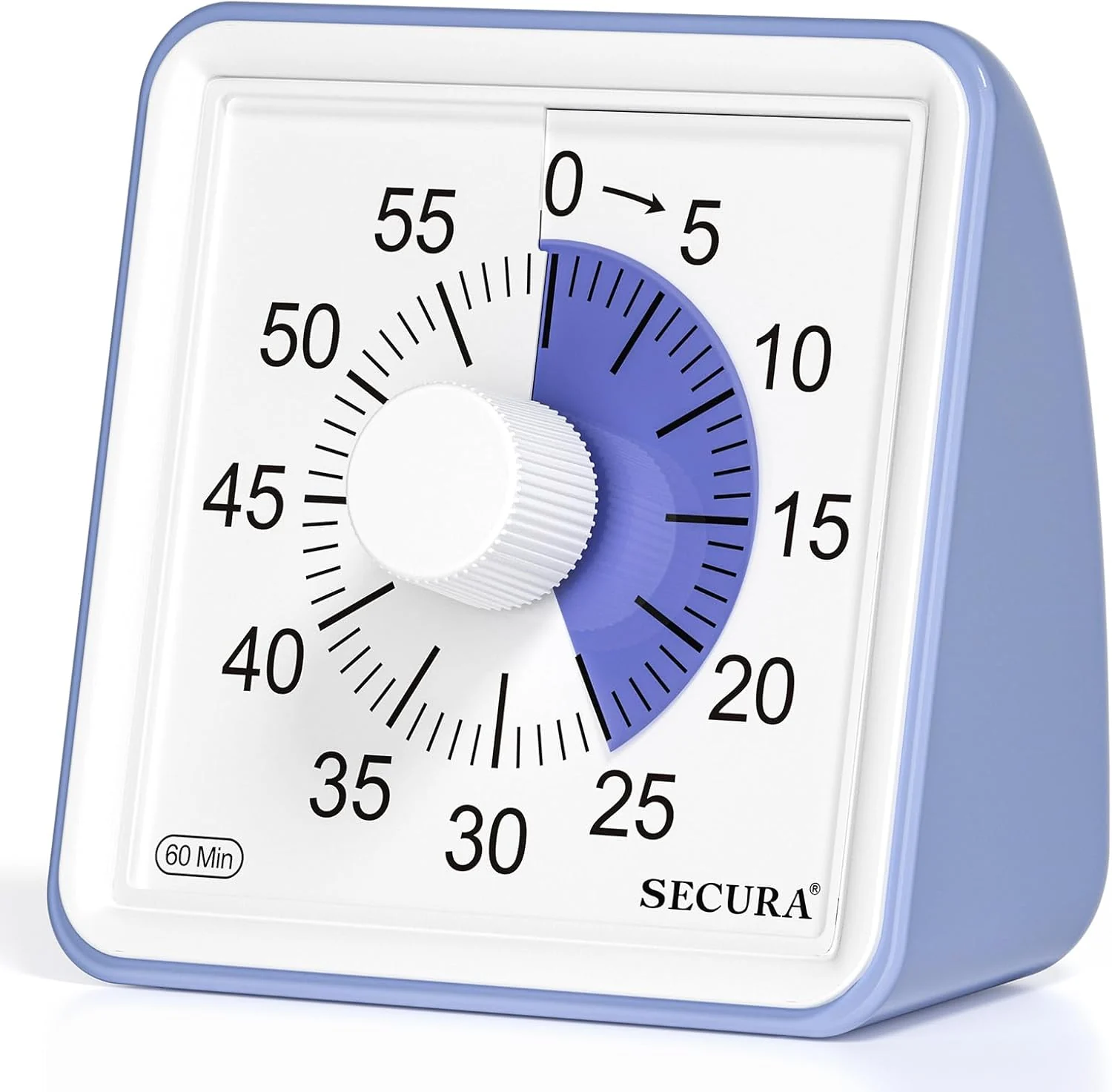
A visual timer with a coloured disk that shrinks as the minutes go turns twenty minutes into something you can see leaving. Clinicians recommend them constantly for a reason. Point one at the two or three activities that reliably swallow you - for me it is the shower and anything that involves a screen and the word quickly.
One alarm for the time you need to leave is useless, because at that moment you are still in a towel. Set the first one for when you need to start getting ready and the second for when you need to be out of the door. Label them properly. My phone says start moving and leave now, and both of them have saved my week.
4. Measure five tasks once, then stop guessing
Spend one week timing the five things you do most often: shower and dress, the school run, a food shop, the weekly report, the commute. Write the real numbers on a card. Your estimates are not going to improve, but you can borrow data from a past version of yourself who used a stopwatch.
Mine were humbling. Getting out of the house is a twenty-five minute job, not a ten minute one, and it has been twenty-five minutes for my entire adult life.
5. Add 50 percent and stop negotiating
Whatever number your brain offers, add half again. Twenty minutes becomes thirty. An hour becomes ninety minutes. This is a crude fix and it works, because ADHD time estimates are wrong in a consistent direction: too short, nearly always.
6. Anchor tasks to events, not to numbers
At 9:15 I will do the emails is a plan for someone with a functioning internal clock. After I put the coffee down I will do the emails is a plan for you. Events are visible; abstract minutes are not. Habit stacking works for ADHD brains precisely because it does not depend on noticing a moment arriving.
7. Protect the last hour before you leave
The single rule that changed my lateness the most: nothing new gets started inside the hour before I have to be somewhere. Not one email, not one cupboard, not one quick thing. That hour is for existing tasks and getting ready only, because I have proven a hundred times that I cannot be trusted to estimate a quick thing under time pressure.
8. Borrow someone else's clock
Body doubling - working alongside another person, in the room or on a video call - helps with starting and, crucially, with stopping. Some of that is accountability, but a lot of it is simply having a second nervous system in the room that notices the hour changing. If you use a service like Focusmate, the session length does the time-keeping for you.
One tiny move for today
Pick the one activity that eats the most time this week - shower, phone, one drawer - and put a timer on it. Just that one. You are not building a system today, you are collecting one piece of evidence about where your hours are actually going.
If the problem is less about the clock and more about not being able to start at all, the free Stuck Reset gives you one small move instead of a list, and these two-minute hacks for when you cannot start are the gentlest place to begin. If your days keep collapsing regardless of how well you plan them, energy-based planning tends to hold better than a timetable.
Knowing why time slips is one half. The other is a day built around it — gaps between tasks, doubled estimates, an alarm for leaving rather than for arriving. That is the practical side, in ADHD time management strategies.
How Do I Explain Time Blindness to My Partner or My Boss?
Carefully, and without turning it into a shield. This is the part I got wrong for years, in both directions - first hiding it, then over-explaining it.
What works is short, concrete, and paired with the fix. Something like: My brain does not track time well, which is why I am late even when I care. I am not asking you to accept it - I have started setting two alarms and leaving fifteen minutes of buffer, and I would rather you tell me when I get it wrong than quietly resent me.
At work, keep it operational rather than diagnostic. Ask for meeting reminders fifteen minutes ahead, deadlines with a date rather than soon, and written summaries after verbal briefings. None of that requires disclosing anything you do not want to disclose, and it fixes the thing that was actually going wrong. If focus at work is its own battle, this is why concentrating at work is so hard with ADHD.
One nuance clinicians are firm about, and I have come to agree with: time blindness explains the difficulty, it does not excuse the impact. You are not at fault for how your brain measures time, and you are still the person responsible for building the workarounds. Holding both of those at once is the whole skill.
And if being told you are late lands like a physical blow rather than a piece of feedback, that is worth knowing about too - see why rejection sensitivity hits ADHD women so hard. The shame that follows chronic lateness is often heavier than the lateness itself, and it is the part that makes people give up on trying new systems.
This article is educational and is not medical advice. Time blindness is not a diagnosis, and difficulty with time can also come from anxiety, depression, sleep deprivation, perimenopause or other conditions. If it is affecting your work, your relationships or your safety, talk with a qualified clinician who can look at the whole picture.
FAQ: ADHD and Time Blindness
What is ADHD time blindness?
Time blindness is a consistent difficulty sensing how much time has passed, estimating how long a task will take, and judging how far away a future event is. It is a widely used description rather than a clinical diagnosis, and it maps onto what researchers study as time perception in ADHD.
Why do I lose track of time with ADHD?
Because keeping track of time depends on working memory and sustained attention, and ADHD affects both. Without a reliable internal clock running in the background, your brain defaults to two tenses - now and not now - so anything that is not immediately in front of you loses its shape, including the hour you are currently spending.
Is time blindness a real diagnosis?
No. It is not listed in the DSM-5 and it is not something you can be formally diagnosed with. The underlying difficulty is real and studied - a 2023 review of adult ADHD research describes time perception as impaired in adult ADHD, while being clear that the evidence base is still small and the findings are mixed.
Is time blindness the same as being lazy or rude?
No. Lateness caused by time blindness usually comes with genuine surprise, not indifference - you believed you had more time and you were wrong. That said, the impact on other people is still real, so the useful response is not self-blame but visible workarounds: alarms, buffers and measured estimates.
Why do I always underestimate how long things take?
ADHD time estimates tend to be wrong in one direction, consistently too short, partly because you remember the task and not the friction around it - finding the keys, the transition, the interruption. Timing five routine tasks once and then adding 50 percent to future estimates fixes more of this than trying to guess better.
Why does time disappear in the shower or on my phone?
Those activities have no natural edges and nothing in them signals that time is passing, so there is no cue to interrupt the flow. It is the same mechanism behind losing an evening to scrolling. A visual timer or an alarm placed on exactly those activities is more effective than any amount of intention.
How do I explain time blindness to my partner or my boss?
Keep it short, concrete and paired with the fix: say that your brain does not track time reliably, that it is not about caring less, and name the specific thing you are doing about it. At work, ask for practical adjustments such as fifteen-minute meeting reminders and dated deadlines rather than explaining the neurology.
Does ADHD medication help with time blindness?
For some people, medication improves attention and task initiation enough that time feels less slippery, but it does not install an internal clock. Most people who find medication helpful still rely on external structure - clocks, timers, alarms and buffers - alongside it. Any medication decision belongs with a qualified clinician.
Do neurotypical people have time blindness too?
Everyone loses track of time occasionally, especially when absorbed or exhausted. The difference with ADHD is frequency and consequence: it happens most days, across most contexts, and it produces real costs at work and in relationships. Difficulty with time can also come from anxiety, depression, poor sleep or hormonal shifts, which is worth ruling in or out.
What is the fastest thing I can do today?
Set two alarms for your next commitment - one for when to start getting ready, one for when to walk out of the door - and put a clock in the room where you lose the most time. It is a five-minute setup and it addresses the specific moment where most days go wrong.
Save this for the next time five minutes somehow turns into forty.
Pin this ADHD time blindness reset for later.
You are not going to think your way into a better sense of time. But you can put instruments around yourself until the day stops surprising you quite so often - and if you want to see how your brain handles the clock compared to other ADHD brains, the This or That game has a whole spectrum for exactly that.
One tap makes ADHD Pearls a preferred source in your Google account, so our articles surface higher when you search. No signup, and it brings you straight back to this page.
Here's why other planners didn't stick
They assume you'll show up the same every day. Perlova starts with how you feel right now.
Other ADHD planners
×Ask you to plan ahead, when your brain isn't there yet
×Assume you have consistent energy every day
×Show you everything you're already behind on
×Fall apart the first time you miss a day
×Require willpower just to open them
Perlova
✓Starts with your energy right now — not a perfect plan
For the woman who sets up the perfect system on Sunday and abandons it by Tuesday.
One short letter, every week. Real talk about ADHD, task paralysis, and the tiny wins that actually move the needle for a brain like yours. No shame. No hustle culture.