For years I thought the problem was that I didn't want it badly enough.
The task was right there. I knew exactly what to do. I had decided to do it. And I still sat there, watching myself not move, while the clock did that thing where an hour disappears and you have nothing to show for it.
Here's what finally helped: I stopped trying to want it more. I started making the first step so small it was almost embarrassing. Not "do the taxes." Not "clean the kitchen." Two minutes of one tiny thing — and then I was allowed to stop.
These are the eight two-minute hacks I actually use. Not theory. The ones I reach for on the days my brain refuses to start.
This article is personal and educational. It is not medical advice. ADHD task paralysis can overlap with burnout, anxiety, depression, sleep problems, and medication issues. If being stuck is affecting your daily life, it is worth talking with a qualified clinician.
Quick answer
How do you start a task when you have ADHD?
Shrink the first step until it takes two minutes or less. ADHD makes task initiation hard, not effort, so the fix is lowering the barrier instead of forcing motivation. Empty your head onto paper, open the setup instead of the task, set a visible timer, or pick a step from a pre-made list. Starting almost always carries you further than the two minutes you promised.
Key takeaways
📌The problem usually isn't motivation. It's task initiation — the gap between deciding and doing.
📌Lowering the first step works better than raising the pressure.
📌Two minutes counts. Starting is the hard part, not continuing.
📌Make time visible, do a bad version on purpose, or borrow someone else's focus.
📌When deciding is the thing that freezes you, pick from a menu instead of inventing a step.
Most mornings my brain has twelve tabs open before my feet hit the floor. Reply to that email. Did I sign the form. The dishes. That thing I forgot to say. And I can't start any of it, because all of it is running at once.
I used to think I was overwhelmed by the work. I wasn't. I was overwhelmed by holding it all in my head at the same time.
The two-minute version: Grab paper, set a timer for two minutes, and write down every single thought — no order, no neatness, no judgment. You're not making a plan. You're emptying the channel.
Once the swirl is on the page, my working memory has room to actually pick one thing. The page holds it so my brain doesn't have to.
Two minutes of mess on paper clears the static so you can pick one thing.
From ADHD Pearls
Free Stuck Reset
One tiny move for the moments you know what to do but still can't start.
If I tell myself "do the taxes," I will not do the taxes. The size of it slams a door shut before I've even sat down.
So I lie to myself, gently. I say: two minutes. That's all. After two minutes I'm officially allowed to stop and walk away, no guilt.
The two-minute version: Pick the task you're avoiding and commit to exactly two minutes of it. Set a timer. When it goes off, you can quit with a clear conscience.
Most of the time I don't quit. Starting was the wall. Once I'm over it, continuing is easy. And on the days I do stop at two minutes? That was still two minutes more than the zero I'd have done otherwise.
Two minutes feels doable in a way that the whole task never will.
3. Start the Setup, Not the Task
The laundry isn't the problem. Picking up the basket is the problem. The email isn't the problem. Opening the laptop is the problem.
My brain treats "do the project" as one giant boulder. But it can usually access "open the tab" even on a frozen day.
The two-minute version: Don't start the task. Start the setup. Open the document. Put the thing on your desk. Fill the water bottle. Lay out the one tool you need — and only that.
Setup is low-stakes, so the door stays open. And once everything's ready and sitting in front of me, not doing it somehow becomes harder than just beginning.
Sometimes everything is ready except the part of the brain that begins.
4. Make Time Visible With a Five-Minute Timer
"In a minute" is my most honest lie. When I say it, I mean it completely. Then the minute becomes an hour and I never felt it pass.
My brain runs on two settings: now, and not now. The future doesn't feel real, so a task scheduled for "later" basically doesn't exist yet.
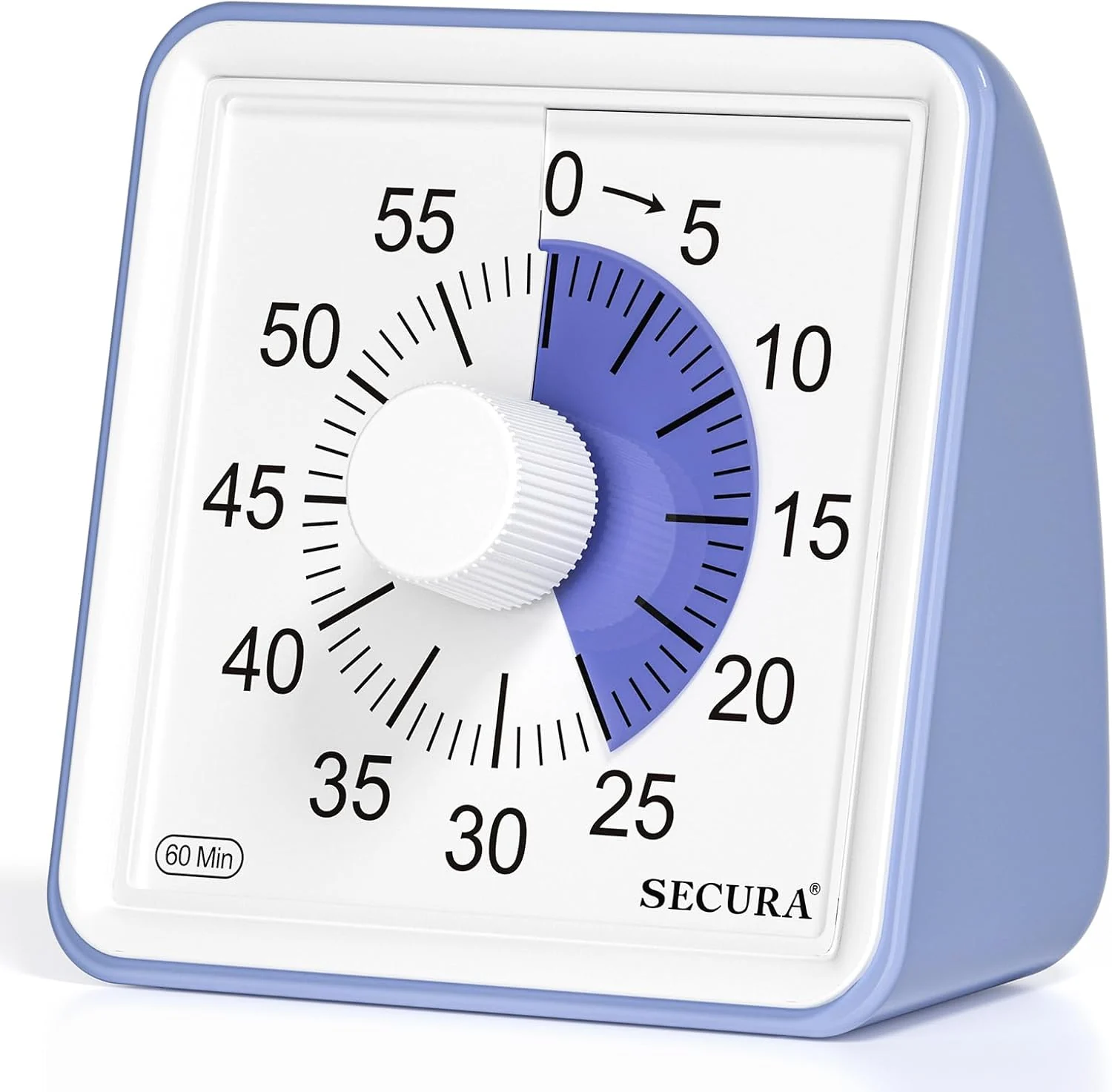
The two-minute version: The moment you catch yourself saying "in a minute," set a visible timer — five minutes, on the counter, where you can see it counting down.
The timer doesn't give me more time. It makes time exist. Suddenly the task is something happening now, and now is the only tense my brain takes seriously.
The visible countdown timer I keep on my desk →Affiliate link — as an Amazon Associate we may earn from qualifying purchases.A countdown you can see turns a vague 'later' into a real 'now.'
5. Borrow Someone Else's Brain (Body Doubling)
I can stare at a task for an hour alone. Put one other person in the room — or on a video call doing their own thing — and I start instantly. It makes no logical sense and it works every time.
That's body doubling. The other person isn't helping me. They're just there. And somehow their presence flips the switch mine can't find on its own.
The two-minute version: Text a friend "I'm doing dishes for the next 20 minutes, you too?" Join a focus room. Or video-call someone and both work in silence.
You're not asking for help. You're borrowing the part of someone else's brain that starts things — until yours catches up.
If this is the one on the list that lands for you, there is a full guide to ADHD body doubling — including the versions that work when there is nobody available to ask.
These are starting hacks. If your problem is more that nothing moves until the deadline is tomorrow, the procrastination strategies are the better fit.
No one around right now? Sort the Chaos is a calm ADHD game with a built-in two-minute body double — play one short round, then let Perlova stay on screen while you start your tiny task.
You don't need help. You need someone in the room while you start.
6. Give Yourself Permission to Do It Badly
A lot of my freezing isn't avoidance. It's perfectionism wearing a trench coat. If I can't do it well, some part of me would rather not do it at all.
The problem is that "do it well" and "start at all" get tangled together, and the bar gets so high I can't reach the first rung.
The two-minute version: Decide, out loud, that you're going to do the worst possible version. The ugliest sentence. The sloppiest five minutes. On purpose.
A bad version can be fixed. A blank page can't. Lowering the quality bar is often the only way I get the activation bar low enough to step over.
A bad version can be fixed later. A blank page can't.
My brain never needed more pressure to start. It needed less distance to the first step.
7. Change Your Body Before You Change Your Task
When I'm truly stuck, sitting there harder doesn't work. My body is in freeze, and you can't think your way out of a body that's frozen.
So I stopped trying to fix my mind first. I move my body, and my brain tends to follow.
The two-minute version: Stand up. Drink a full glass of water. Open a window. Ten jumping jacks, a quick walk to the mailbox, a song you move to — anything that shifts your physical state for two minutes.
It sounds too simple to count. But changing my state is often the thing that unlocks starting, after twenty minutes of willpower did nothing — especially on low-energy days.
You can't think your way out of a frozen body. Move first.
8. Pick From a Menu Instead of Inventing a Step
On my worst days, the task isn't the task. The task is deciding what to do — and deciding is exactly the thing my brain can't do when it's overloaded.
Every "what should I even start with?" is one more decision stacked on an already maxed-out system. So I stopped asking myself to decide.
The two-minute version: Keep a short, pre-made list of tiny starting moves. When you're frozen, don't think — just pick the top one off the list and do it.
When choosing feels impossible, a ready-made menu removes the hardest part. This is the whole idea behind the free Stuck Reset tool — it hands you one tiny move so you don't have to invent one. And if the deeper issue is that a planner keeps failing you, it's worth knowing why that happens.
When deciding is the thing that freezes you, let a list decide.
At a glance
The 8 two-minute hacks
The hack
What it unblocks
Your 2-minute move
Brain dump
Overloaded working memory
Write every thought down for two minutes
Two-minute rule
The activation barrier
Commit to two minutes, then you may stop
Start the setup
Task initiation
Open the doc or lay out one tool only
Visible timer
Time blindness
Set a countdown you can actually see
Body doubling
Starting alone feels impossible
Work beside someone, in person or on video
Do it badly
Perfectionism freeze
Do the ugliest version on purpose
Change your state
A body stuck in freeze
Stand, drink water, move for two minutes
Pick from a menu
Decision overload
Choose the top item off a pre-made list
FAQ: Two-Minute ADHD Hacks
What is the fastest way to start a task with ADHD?
Shrink the first step until it takes two minutes or less. ADHD brains struggle with task initiation, not effort, so the goal is to lower the barrier instead of raising motivation. Open the document, write one messy sentence, or set a visible timer. Starting almost always carries you further than you planned.
Why can't I start tasks even when I want to?
Because wanting and starting use different brain systems. ADHD affects task initiation — the step between deciding and doing — so you can fully intend to start and still feel frozen. This is executive dysfunction, not laziness or a lack of discipline.
Is ADHD task paralysis the same as laziness?
No. Laziness is choosing not to do something you are capable of doing. ADHD task paralysis is wanting to start, knowing it matters, and still being unable to move. They can look identical from the outside but feel completely different inside — task paralysis is tied to executive dysfunction, not effort or motivation.
Do two-minute hacks actually work for ADHD?
For many people, yes — but not because two minutes is enough time. They work because they remove the activation barrier. Once you are moving, your brain often keeps going. And on the days it doesn't, two minutes was still more than zero, which matters more than it sounds.
How long does ADHD task paralysis last?
It varies. An episode can last minutes, hours, or on a hard day most of a day. There is no fixed length, because it depends on the task’s emotional load, your energy, sleep, and stress levels. These hacks are meant to shorten an episode by lowering the first step, not to predict how long it would otherwise last.
What is body doubling and why does it help ADHD?
Body doubling means doing a task alongside another person, in the room or on a video call. The other person's presence provides gentle external accountability and helps your brain shift into action. Many people with ADHD find they can start instantly with a body double when starting alone feels impossible.
Why does setting a timer help me start?
Because ADHD brains often experience time as now or not-now, which makes future tasks feel unreal. A visible timer turns an abstract future task into something happening right now. That small shift can be enough to make starting feel possible.
What is the best timer for ADHD?
The best timer is one that makes time visible. Many people with ADHD do better with a visual countdown — a dial or bar you can watch shrinking — than with numbers on a screen, because it turns abstract time into something concrete you can see. A phone countdown works too; the key is that it is visible while it counts down.
When should I get professional help for task paralysis?
If being unable to start is regularly affecting your work, relationships, finances, or daily life — and small strategies aren't making a real difference — it's worth talking with a qualified clinician. Task paralysis can overlap with burnout, anxiety, depression, and sleep problems, so a proper assessment can help clarify what you're dealing with.
Sources I leaned on while writing this
CHADD. Executive Function Skills and ADHD. chadd.org. Overview of how executive function difficulties, including task initiation, affect people with ADHD.
ADDA. ADHD Paralysis. add.org. Overview of ADHD-related paralysis, its causes, and practical ways to get unstuck.
Cleveland Clinic. Executive Dysfunction. my.clevelandclinic.org. Clinical overview of executive dysfunction, including task initiation and planning difficulty.
Barkley RA. Taking Charge of Adult ADHD. Guilford Press. Foundational work on how executive function deficits — including task initiation and time blindness — drive adult ADHD behavior.
None of these are about trying harder. Every one of them is about needing less distance to the first step.
You're not lazy, and you don't need more discipline. You need a smaller place to start. Pick one hack from this list. Do the two minutes. That's the whole job today.
One tap makes ADHD Pearls a preferred source in your Google account, so our articles surface higher when you search. No signup, and it brings you straight back to this page.
Before you go
Free Stuck Reset
One tiny move for the moments you know what to do but still can't start.
For the woman who sets up the perfect system on Sunday and abandons it by Tuesday.
One short letter, every week. Real talk about ADHD, task paralysis, and the tiny wins that actually move the needle for a brain like yours. No shame. No hustle culture.