I once left for a 10am appointment at 9:20 for a twenty-minute drive, and arrived at 10:08.
Nothing dramatic happened. I could not find my other shoe, so I went to look, and on the way I noticed the recycling, and while I was near the kitchen I put the milk away, and then I could not find my keys, which turned out to be in the coat I had already put on. Forty-eight minutes to leave a house I was standing in, dressed, with my bag by the door.
For years I filed this under "I need to leave earlier". I have since left much earlier, many times, and still arrived late — because the problem was never the departure time. It was that leaving is not one action, and I had budgeted for it as though it were.
That is what this article is about. Not why you cannot feel time passing — time blindness covers that, and it is real. This is about the part that happens even when you do know what time it is: the plan is fine, the day still collapses, and you cannot point at where it went.
Quick answer
Why is time management so hard with ADHD?
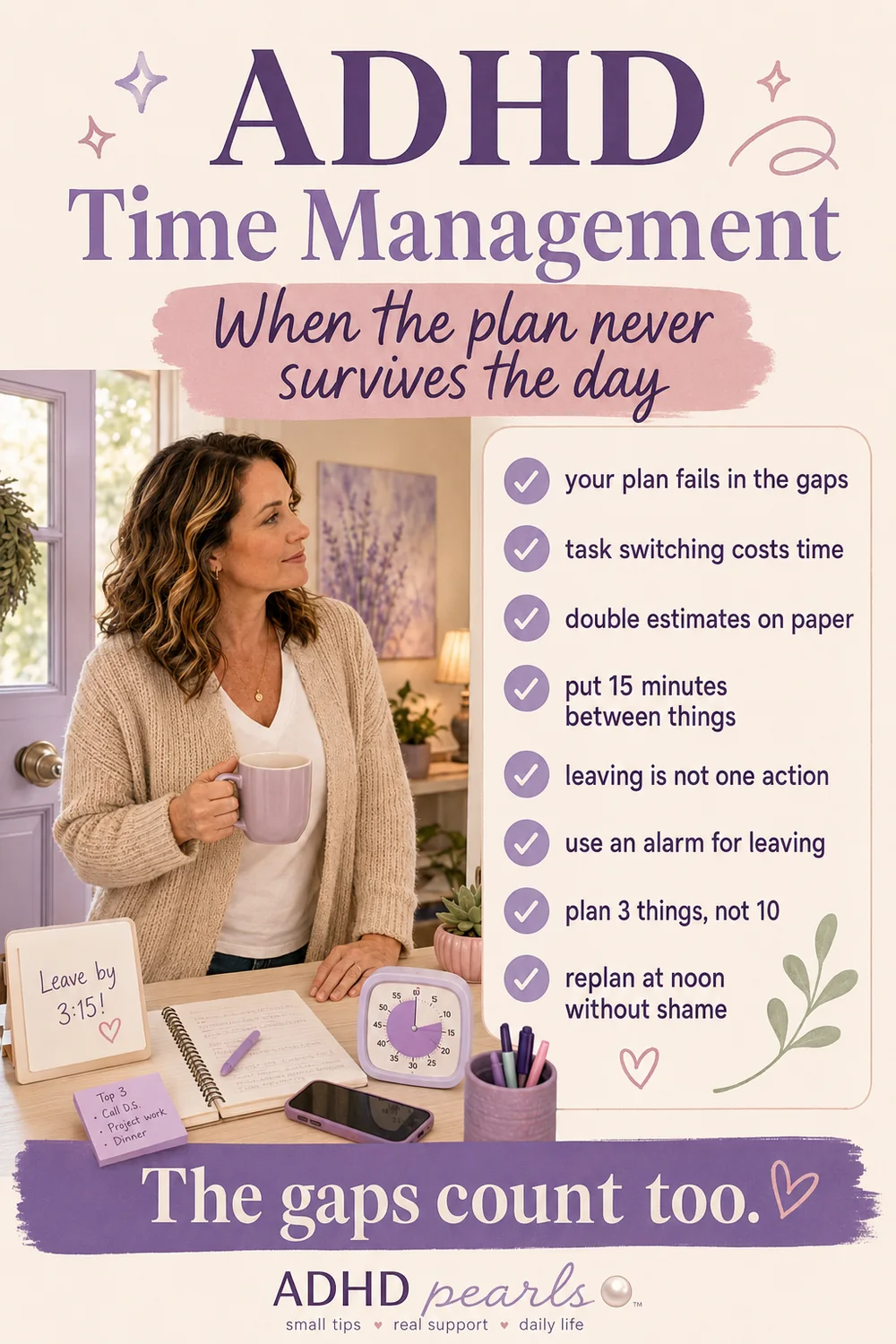
Because plans budget for tasks, and an ADHD day is spent in the seams between them. Switching costs more than most schedules allow, so a day that looks reasonable on paper has run out of room by mid-morning. Budget the transitions, put time somewhere you can see it, and double your estimates rather than hoping.
Key takeaways
📌Plans budget for tasks; an ADHD day is spent in the seams between them.
📌Your estimate is not optimism — forward-looking time estimates run systematically short.
📌You can be late even when you leave early, because leaving is itself a series of small starts.
📌Put time somewhere you can see it. A phone timer lives inside the device that eats the time.
📌A plan that survives contact has fewer items and more gaps than feels reasonable when you write it.
Look at how a normal plan is built. Nine to ten, emails. Ten to eleven, the report. Eleven, the call. Every block is a task, and the blocks touch each other.
Now look at what your day actually contains. Emails, then the six minutes of standing up and not yet starting the report. The report, then the four minutes of realising the call is soon and not being able to start anything else. Between every two tasks there is a seam, and the seams are where the day goes.
This is not a moral failing or a focus problem. Task switching costs everyone something, but the cost is measurably larger in ADHD — the difficulty is specifically in shutting down the previous task before the next one can start. Your brain does not close a tab when you tell it to. It leaves it running in the background, and the next thing starts slower because of it.
You did not run out of time during the tasks. You ran out of it in the gaps between them, which nobody put on the plan.
So a schedule with no gaps is not an efficient schedule. It is a schedule that has already overspent before you have done anything, and the first task that runs long takes the whole row down with it.
A plan with no gaps is not efficient. It is already overspent before the day starts.
From ADHD Pearls
Perlova — plan from the energy you actually have
One doable next step, wins without streaks, and routines that fit real ADHD life. No card, no shame.
The second structural problem: the numbers you put on the plan are wrong before you start.
A 2023 review of a decade of research on time perception in adult ADHD found consistent differences in estimating, reproducing and producing time intervals, alongside a broader body of work showing that people with ADHD tend to overestimate their own performance while underestimating how long tasks will take.
Notice the direction. It is not that the estimates are noisy in both directions. Forward-looking guesses come out short, reliably. So the plan is not slightly optimistic — it is systematically wrong in one direction, and it is wrong in the same direction every time.
Once I accepted that, doubling my estimate stopped feeling like pessimism and started feeling like arithmetic. I no longer think "that will take twenty minutes". I think "I will guess twenty, so put forty, because my twenty has never once been twenty."
This is educational and personal, not medical advice. If losing time is affecting your work, your money or your relationships in a way that is getting worse rather than staying flat, that is worth raising with a professional rather than solving with a better calendar.
Doubling the estimate is not pessimism. It is calibration for a brain that consistently guesses short.
Why You Are Late Even When You Leave Early
Here is the thing nobody tells you: most ADHD lateness is spent inside the house.
Leaving looks like one item on the plan. It is actually a chain of small starts — find shoes, pack bag, locate keys, turn off lights, take the thing you must not forget, close the door. Each one is a separate initiation, and initiation is the executive function most reliably taxed in ADHD. Six small starts in ten minutes is six chances to get diverted by the recycling.
Which reframes the whole problem. I do not need to leave earlier. I need leaving to contain fewer starts.
Three things that changed this for me more than any amount of extra buffer:
Everything that leaves with me lives in one place by the door. Not "usually there" — always there, including the thing I will need tomorrow, put there tonight.
I get fully ready first, then wait. Shoes on, coat on, bag in hand, standing in the hall doing nothing for six minutes. It feels absurd. It works, because the dangerous minutes are the ones where I am ready-ish and still moving around the house.
The alarm is for leaving, not for the appointment. An alarm at the time you should walk out, not at the time the thing starts. Obvious in writing, and I did it the wrong way round for about fifteen years.
Most ADHD lateness is not the drive. It is the chain of small starts before the door.
17 Strategies That Actually Stick
Grouped by the problem they solve, because a strategy aimed at the wrong part of the day is exactly how you end up believing nothing works.
Make time visible
1. Put a clock in every room you lose time in. Analogue, on the wall, in your eyeline. Checking your phone for the time is how twenty minutes disappears, because the phone answers the question and then asks you six of its own.
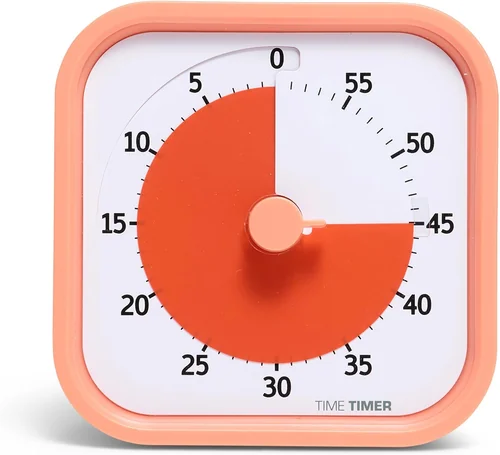
2. Use a countdown you can see, not one you have to read. A shrinking disc gives you the information at a glance; digits require you to do sums about time, which is the thing your brain is worst at.
3. Time one task honestly, once. Actually measure the thing you always underestimate. Mine was "quickly reply to that email" — a consistent twenty-two minutes, every time, for a task I had been budgeting five for. One measurement fixed years of bad arithmetic.
4. Say the time out loud when you start something. "It is twenty past two." It sounds silly and it plants a marker, so that when you resurface you have something to measure against rather than a vague sense that a while has passed.
Budget the seams
5. Put fifteen minutes between everything. Not because the tasks need it — because the switching does. This single change did more for my days than every planner I have ever bought.
6. Halve the list, then halve the halves. Whatever number of things feels reasonable for today, it is roughly double what will fit once the seams are counted. Four things is a full day. Three is a realistic one.
7. Never schedule anything for immediately after something that can overrun. Meetings, phone calls, anything involving other people. Those are the blocks that push, and everything behind them falls.
8. Batch by type, not by priority. All the calls together, all the admin together. Each change of category is a fresh switching cost, so five emails in a row is cheaper than five emails spread through the day, even though the total work is identical.
9. Leave things visibly unfinished. Stop mid-sentence, mid-form, mid-anything. Restarting from an open document is barely a transition; restarting from a blank screen is a full one.
Protect the plan from the day
10. Decide tomorrow's first action tonight. Not the day's priorities — the literal first thing, written down. Mornings are the worst possible time to be making decisions, and this removes the biggest one.
11. Pick one thing that makes the day count. If everything else falls apart and that one is done, the day was fine. This is the strategy that has kept the most days from feeling like failures.
12. Put an interruption in the middle of long stretches. An alarm at 3pm with nothing attached to it. Losing an afternoon requires an uninterrupted afternoon, and the interruption does not need to be clever — it only needs to arrive.
13. Write the estimate next to the task, then double it. Seeing "30 min (so: 60)" on paper is what makes the doubling stick. Doing the doubling in your head does not survive the moment you are actually planning.
14. Get it out of your head onto paper first. An unwritten list feels bigger than it is and takes attention all day. Emptying it is not organising, it is stopping the loop.
For the days it goes wrong anyway
15. Replan at noon, without a post-mortem. The plan is dead by eleven often enough that it is worth having a scheduled moment to make a new one. Two minutes, no analysis of why the morning went the way it did.
16. Move things rather than dropping them. The instinct after a lost morning is to abandon the whole day and start fresh tomorrow. Moving one task to 4pm keeps the day alive; the fresh-start reflex is what turns a bad morning into a lost week — the same trap as in buying another planner.
17. Count what you did, not what you did not. At the end of a scattered day I can usually list six real things if I make myself, and my instinct was reporting zero. That gap is not modesty, it is bad measurement, and it makes tomorrow harder for no reason.
Pick two. Genuinely two. Seventeen strategies is a list, and implementing a list is its own project you will not have time for.
Building a Day That Survives Contact
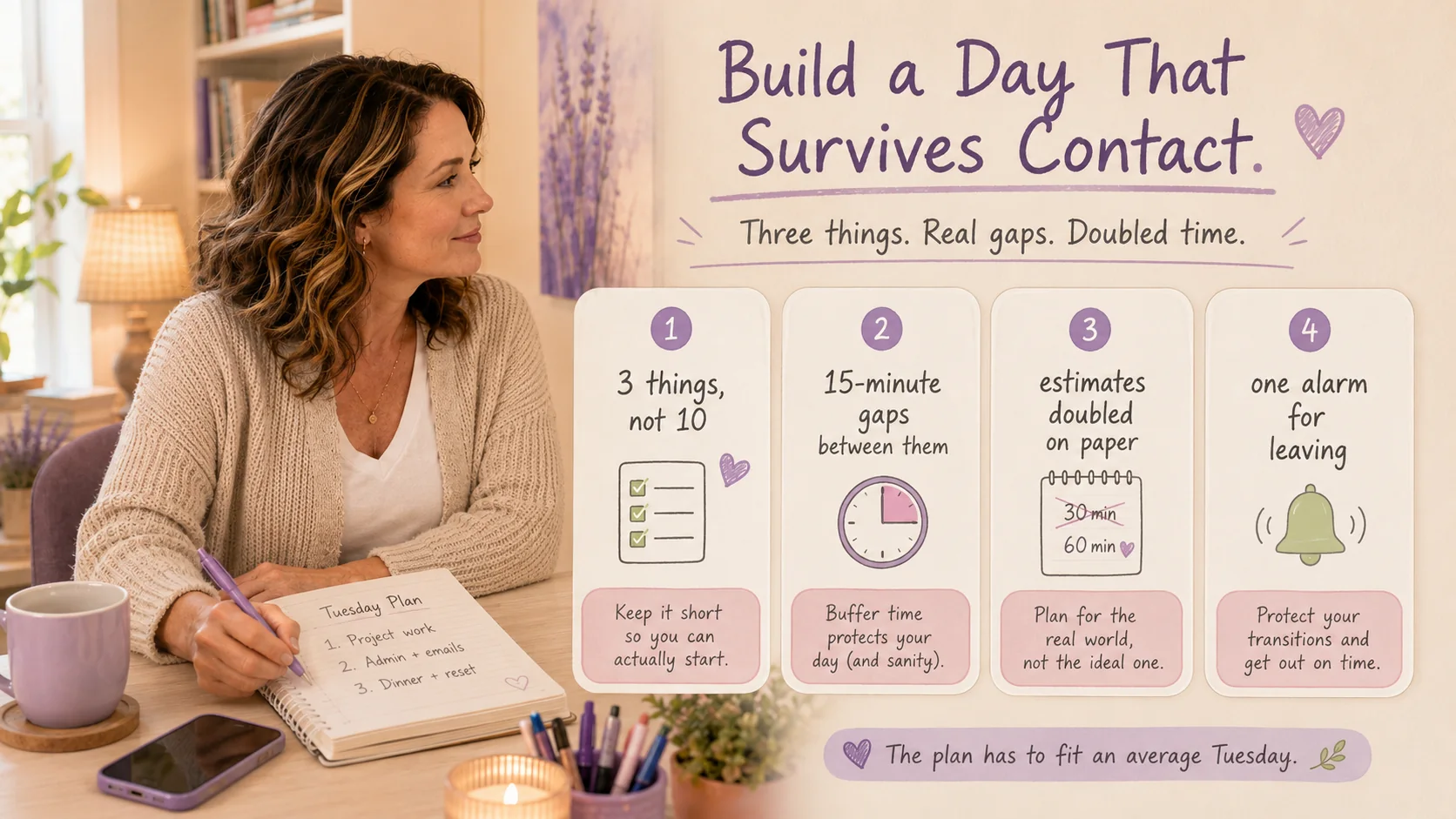
If you want the shortest possible version, it is four lines:
Three things, not ten. Written down the night before.
A gap between each one. Fifteen minutes, non-negotiable, doing nothing in particular.
Estimates doubled on paper. Not in your head, where the doubling evaporates.
One alarm for leaving, set to when you walk out, not when it starts.
That is the whole system I actually use. Everything else in this article is a refinement of those four, and on bad weeks I only manage the first two.
If even three things is too many today, the honest move is not a better schedule — it is planning for the capacity you actually have, which is a different question from planning for the hours.
A useful plan has to fit an average Tuesday, not the imaginary version of you with perfect energy and no interruptions.
What Makes It Worse
Planning in fifteen-minute increments. The finer the plan, the faster it breaks, and the more clearly it documents your failure by 10am.
Building the schedule for your best self. The plan has to work on an average Tuesday, not on the version of you who slept well and has no interruptions.
Rebuilding the whole system after a bad week. A new system is the most convincing way to avoid the current one for another fortnight.
Keeping the running order in your head. Held plans get heavier, vaguer and more anxious by the hour. Written plans just sit there.
Treating a lost morning as evidence. It is data about the plan, not about you — and if it happens most days, the plan is the thing to change.
One Tiny Move
Tonight, before you stop, write down the single first action of tomorrow. Not the priorities. The first physical thing: open the document, put the washing on, send the one message.
Then set one alarm for the time you need to leave for whatever tomorrow's first fixed point is — not the time it starts.
Two lines and one alarm. That is the smallest version of this whole article, and it is the part that survives on the days nothing else does.
Save this for the next time your plan looks fine on paper but collapses before lunch.
Pin this ADHD time management guide for the next time the calendar looks reasonable but the day does not survive contact.
FAQ: ADHD and Time Management
Why is time management so hard with ADHD?
Because most plans budget for tasks and nothing else, while the expensive part of an ADHD day is the transitions between them. Switching tasks costs an ADHD brain measurably more than it costs other people — there is a delay shutting down the previous task and starting the next — so a schedule with no gaps is already over budget before the day begins.
Why do I always underestimate how long things take?
It is a documented pattern rather than optimism. Research on time perception in adult ADHD finds consistent differences in estimating, reproducing and producing intervals, and the estimating error runs in one direction: forwards-looking guesses come out short. Which is why doubling your estimate is not pessimism, it is calibration.
Why am I late even when I leave early?
Because leaving is not one action, it is six or seven small starts — shoes, bag, keys, lights, phone, door — and each one is its own initiation. The time you allowed covered the journey, not the assembling. Most ADHD lateness is spent inside the house, not on the road.
Does time blocking work for ADHD?
It works if you block the gaps as well as the work, and fails if you fill the day edge to edge. A block that assumes you move instantly from one thing to the next is a plan for someone else’s brain. Try scheduling four things and calling the day full.
What is the best time management method for ADHD?
There is no single one, and any article promising otherwise is selling something. What tends to survive is a small set of habits: make time visible, halve the number of things on the day, add a real gap between them, and decide the first action of tomorrow before you stop today.
How do I stop losing whole afternoons?
Put an external interruption in the middle of one. An alarm, a timer you can see, a scheduled call. Losing three hours needs an uninterrupted three hours to happen in, and the interruption does not have to be clever — it only has to arrive.
Should I use a paper planner or an app for ADHD?
Whichever one you will actually look at, which is usually the one that is already open or already visible. The failure mode is not choosing the wrong tool, it is choosing a tool you have to remember to check — and remembering to check is the exact thing that is unreliable.
Why does my schedule fall apart by 11am?
Usually because the morning was planned as though nothing would overrun and nothing would need a gap. One task running twenty minutes long is not a problem in itself; it becomes one when every later block was touching the one before it, so a single overrun knocks the whole row down.
Is ADHD time management something I can improve?
The underlying time perception does not change much, but the systems around it can carry a surprising amount. The improvement usually comes from building outside your head — visible clocks, alarms, buffers, fewer commitments — rather than from trying harder to feel time accurately.
One tap makes ADHD Pearls a preferred source in your Google account, so our articles surface higher when you search. No signup, and it brings you straight back to this page.
Here's why other planners didn't stick
They assume you'll show up the same every day. Perlova starts with how you feel right now.
Other ADHD planners
×Ask you to plan ahead, when your brain isn't there yet
×Assume you have consistent energy every day
×Show you everything you're already behind on
×Fall apart the first time you miss a day
×Require willpower just to open them
Perlova
✓Starts with your energy right now — not a perfect plan
For the woman who sets up the perfect system on Sunday and abandons it by Tuesday.
One short letter, every week. Real talk about ADHD, task paralysis, and the tiny wins that actually move the needle for a brain like yours. No shame. No hustle culture.