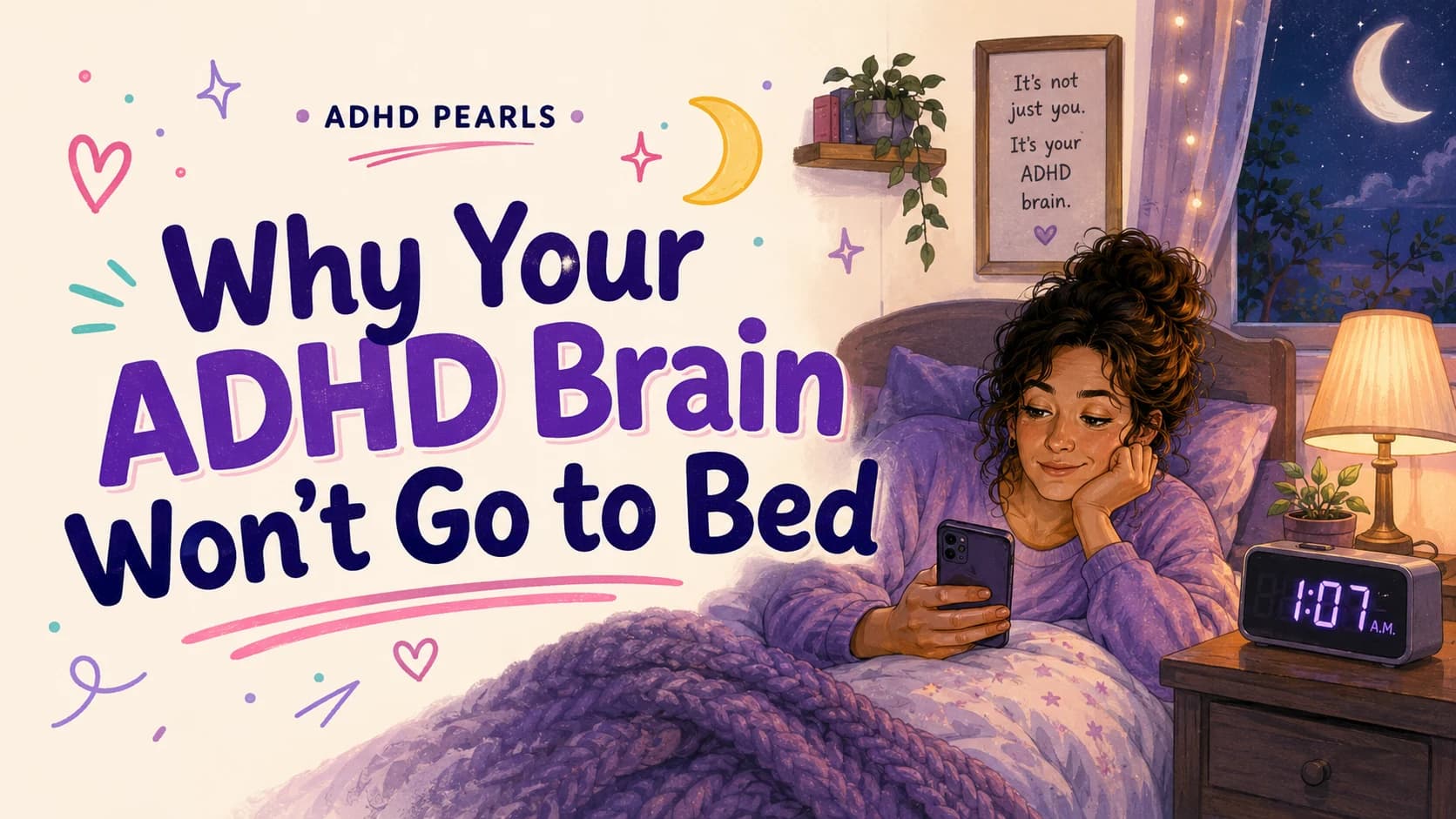
It's 1 a.m. I have to be up in six hours. I am genuinely exhausted. And I am still awake — scrolling, watching, reading — because this quiet hour is the only part of the day that has felt like mine.
For years I thought this was just a bad habit, or proof I had no discipline. Then I learned it has a name: revenge bedtime procrastination — delaying sleep to claw back the leisure or calm you didn't get during the day. And it shows up a lot with ADHD, for reasons that have nothing to do with willpower.
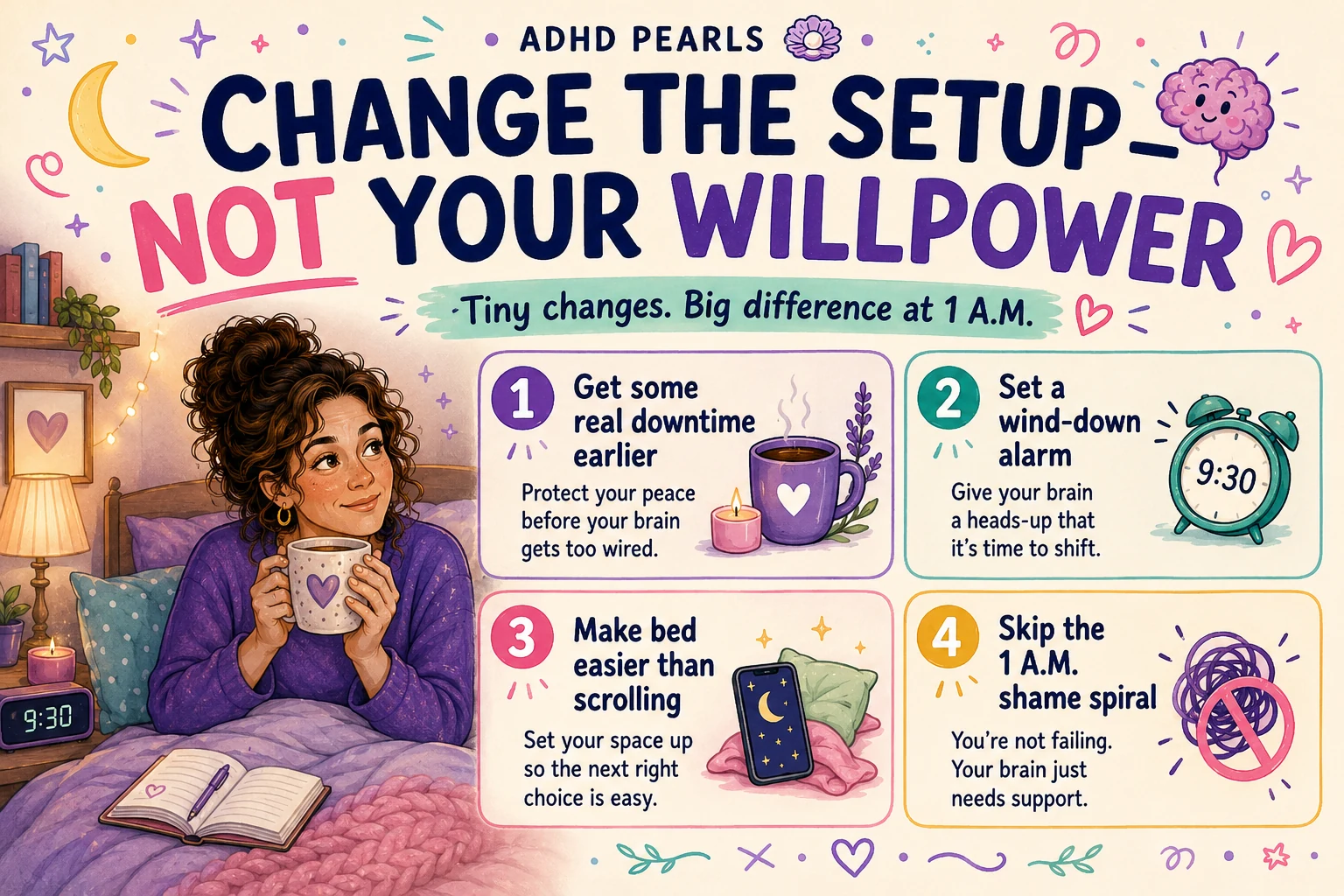
These are the seven things that actually helped me go to bed — not by trying harder, but by changing the setup so my tired brain didn't have to win an argument at midnight.
This article is personal and educational. It is not medical advice. Sleep problems can overlap with ADHD, anxiety, depression, hormonal changes, and other conditions. If your sleep is affecting your daily life, it is worth talking with a qualified clinician.
Quick answer
Why won't my ADHD brain let me go to bed, even when I'm exhausted?
Because late night is often the only calm, unclaimed time you get — and a tired ADHD brain reaches for easy dopamine and struggles to switch from something fun to something boring like getting ready for bed. It's a self-regulation difference, not a discipline problem. The fix is changing the setup: get real downtime earlier, add friction to staying up, set a wind-down alarm, and make going to bed easier than staying awake.
One important distinction: not every late ADHD bedtime is revenge bedtime procrastination. Sometimes time blindness or hyperfocus makes the evening disappear with no conscious choice at all. Revenge bedtime procrastination is the more intentional version — when you know you could sleep, but staying awake feels like the only way to reclaim time that belongs to you.
Key takeaways
📌Revenge bedtime procrastination is choosing to stay up for leisure or quiet — not the same as insomnia.
📌ADHD traits — dopamine-seeking, time blindness, hard task-switching — push bedtime later.
📌The night feels like the only time that's yours, so your brain protects it.
📌Change the setup, not your willpower: friction, external cues, an interesting wind-down.
📌Shame keeps the cycle going. Self-compassion gets you to bed faster than self-criticism.
Staying up late gives you a short burst of freedom, but it borrows energy from the next day. Bedtime procrastination — the voluntary postponement of sleep — has been linked in research to shorter sleep and more daytime fatigue.
With less sleep, focusing, switching tasks, regulating emotions, and resisting easy dopamine all get harder. That makes the next day feel more demanding — which leaves you craving even more unclaimed time the following night. The loop becomes: depleted day, stolen night, exhausted morning, repeat. Naming the loop is the first step out of it.
From ADHD Pearls
ADHD Morning + Night Cards
36 printable micro-step cards for hard ADHD mornings and hard ADHD nights — one clear next step, no full routine required.
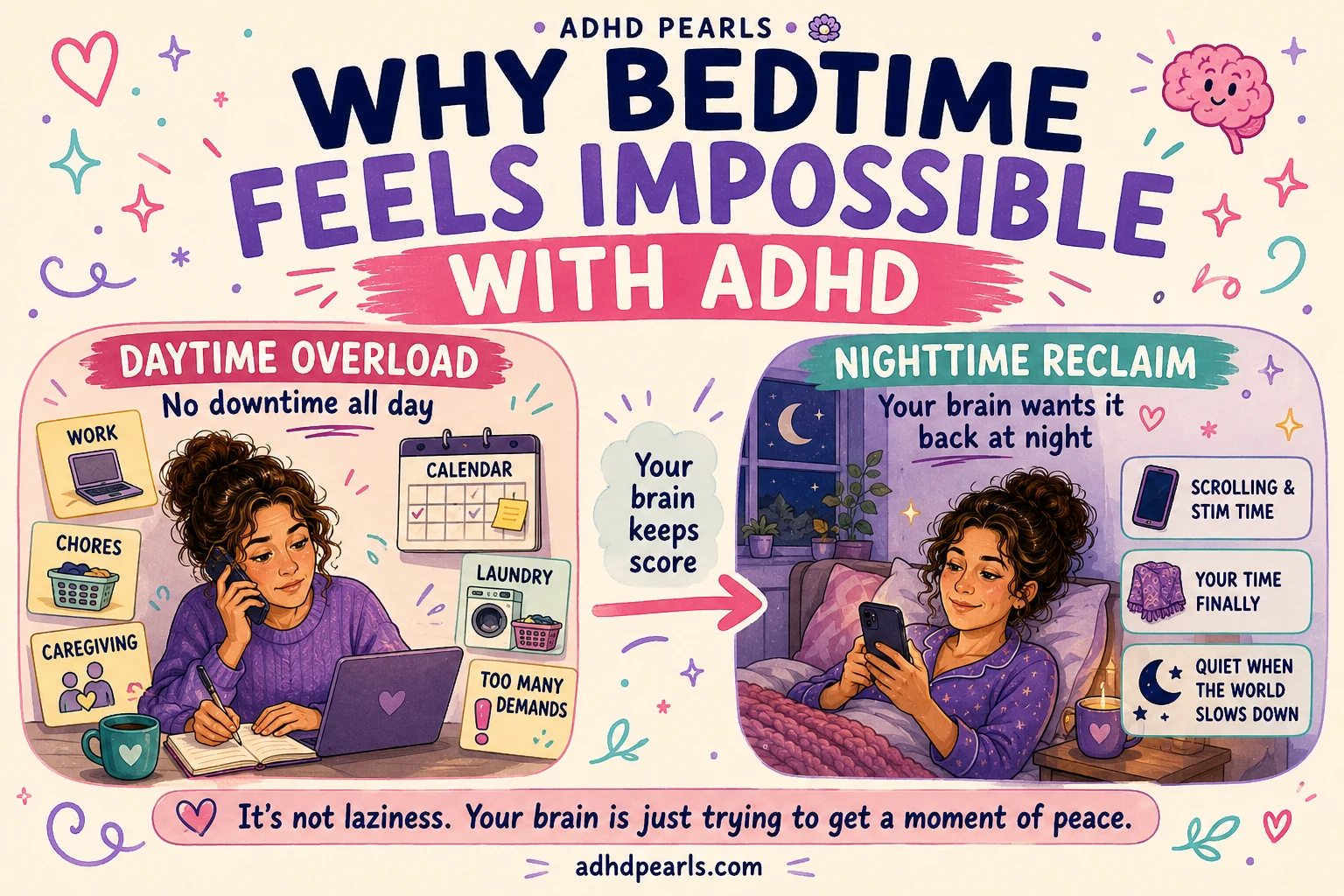
Here's the part that surprised me: revenge bedtime procrastination is rarely about the screen. It's about the revenge. If your whole day was work, caregiving, and other people's needs, your brain will demand its share back — and night is the only window left.
So the most effective fix happens during the day, not at bedtime. When I get even a small pocket of genuine, chosen pleasure earlier, the desperate 1 a.m. grab for "my time" gets much quieter.
A free ADHD dopamine menu is perfect for this — a little list of small, satisfying things you can actually reach for in the daylight.
Tonight's tiny move: Pick one small thing you enjoy and do it on purpose before dinner, so the day isn't all output.
2. Make Staying Up Harder Than Going to Bed
Willpower loses to a comfy couch and an open phone every single time. What works is changing the math so staying up takes more effort than going to bed.
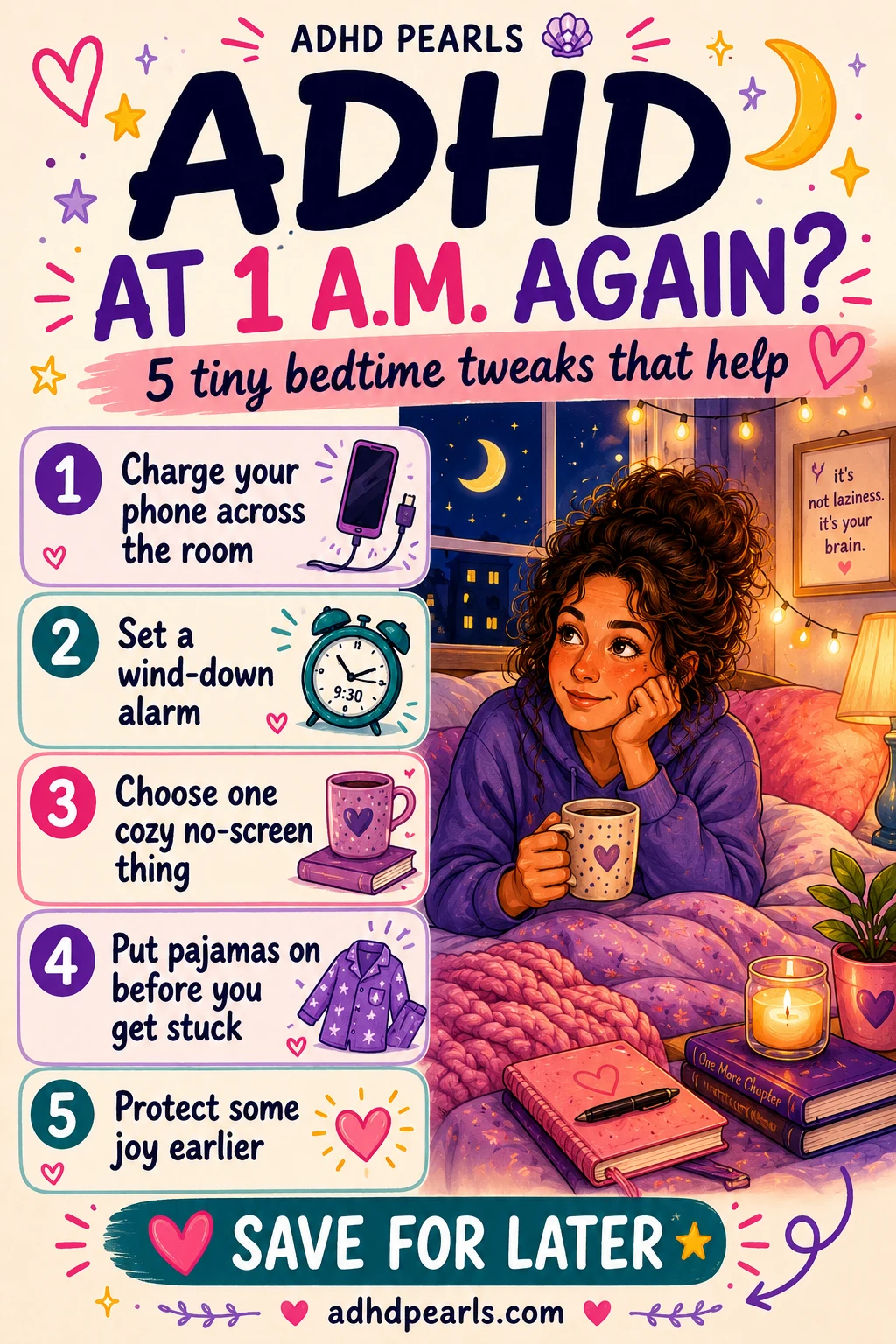
The biggest one for me: I charge my phone across the room, not next to the bed. When the dopamine machine is out of arm's reach, "one more video" suddenly requires standing up — and that tiny bit of friction is often enough.
On the other side, make bed the path of least resistance: pajamas already out, water by the bed, lights low. When going to bed is the easy option, you do it more.
Tonight's tiny move: Put your charger somewhere you'd have to stand up to reach it.
3. Set an Alarm for the Wind-Down, Not the Bedtime
Most of us set an alarm to wake up. Almost no one sets one to start going to bed — and for an ADHD brain with time blindness, that's the gap where whole evenings vanish. You look up and it's somehow already midnight.
An external cue fixes what your internal clock can't. Set an alarm an hour before you want to be asleep, labeled "start winding down" — not "go to bed now," which is too big a jump.
If you tend to swipe the first one away, set a gentle backup thirty minutes later. You're not trying to obey a rule; you're giving your brain a visible signal that time is real.
It was never about being tired enough. It was that nobody had told my brain the night had ended.
Tonight's tiny move: Set one "start winding down" alarm for an hour before your ideal sleep time.
4. Make Winding Down Interesting, Not Boring
Standard sleep advice — dim the lights, lie still, breathe — can feel unbearable to an understimulated ADHD brain. Boredom is not relaxing for us; it's uncomfortable. So we reach for the phone to escape it, and we're up another hour.
The trick is to make winding down something your brain actually wants to do. A warm shower, an audiobook or a familiar podcast, gentle stretching, a cozy low-stakes activity that occupies just enough of your mind without lighting it up.
Tonight's tiny move: Choose one genuinely pleasant wind-down activity in advance, so you're not deciding at the moment you're most tempted to scroll.
5. Build a Bridge Out of the Screen
Going straight from a stimulating screen to a dark, silent room is a brutal task-switch — exactly the kind ADHD brains struggle with most. And if you've slipped into hyperfocus, the night can disappear entirely while you "just finish" one more thing.
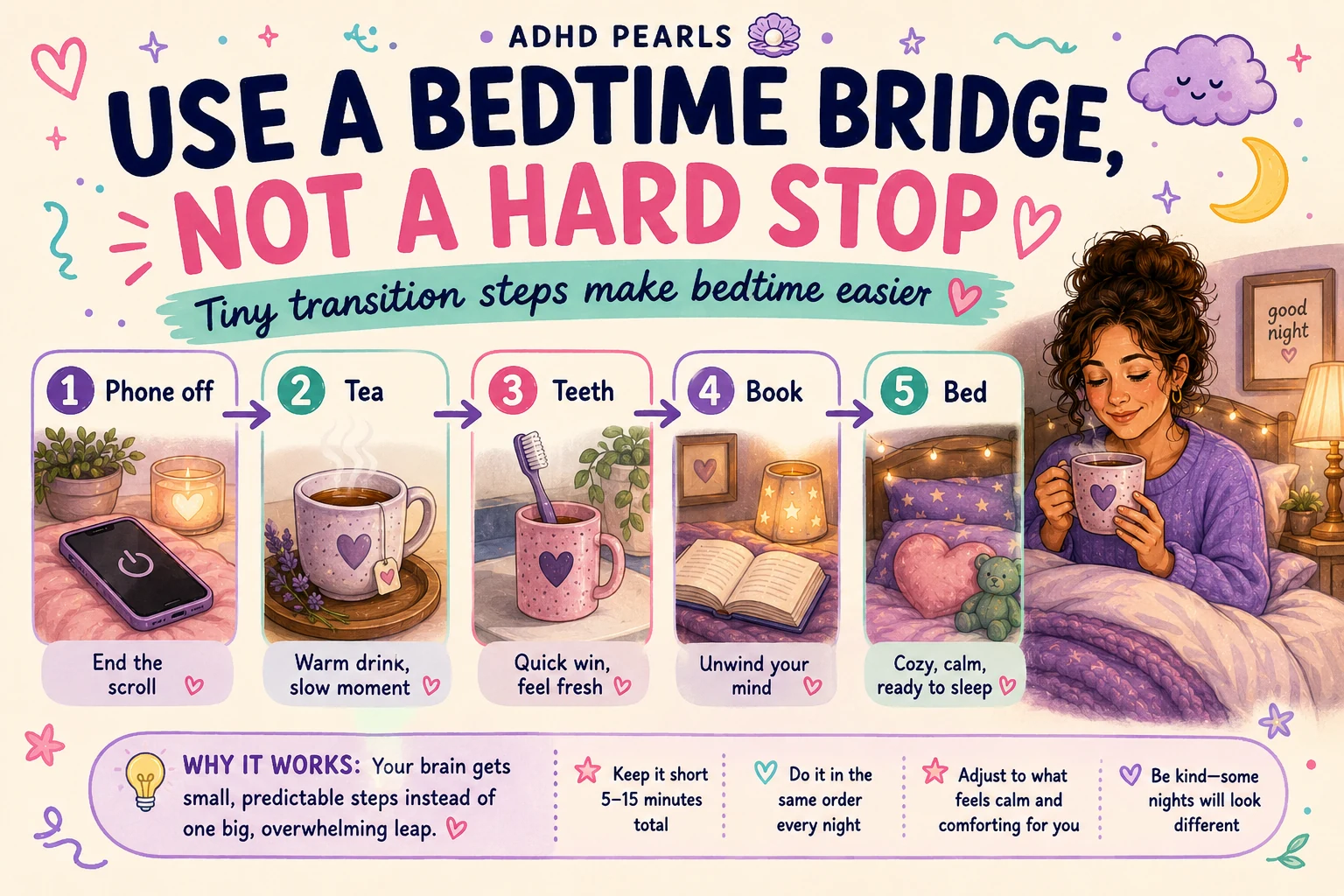
A transition ritual builds a bridge so the jump is smaller. The same few steps every night — tea, teeth, a couple of pages of a real book — tell your brain we're moving from one mode to another, instead of slamming on the brakes.
It doesn't have to be elegant. It has to be the same, so your brain can follow it half-asleep. If you can't pick where to begin, the free Stuck Reset can hand you one tiny first move.
Tonight's tiny move: Decide on the very first step of your bridge — just the first one — and do only that.
6. Anchor Your Wake Time, Not Just Your Bedtime
Bedtimes are slippery; wake times are sturdier. When you keep a roughly consistent wake time — even after a late night, even on weekends — your body slowly starts to get tired at a more predictable hour, which makes the next night's bedtime less of a fight.
Getting daylight soon after waking helps anchor that rhythm too. None of this is about rigid perfection; it's about giving a wandering internal clock one steady point to orbit.
Tonight's tiny move: Pick a realistic wake time you can keep most days, and open the curtains as soon as you're up.
7. Stop Punishing Yourself at Midnight
Here's the quiet trap: lying there at 1 a.m. calling yourself lazy and broken doesn't get you to sleep faster. It floods you with stress, which wakes you up more — and the shame spiral becomes its own reason to stay up and avoid the feeling.
The nights I actually got to bed sooner were the ones where I said something kinder: of course you wanted some time for yourself today — you barely got any. Let's get a bit more tomorrow, in the daylight.
This isn't a soft extra. Self-criticism tends to raise stress, which can make winding down harder; responding with a little curiosity and self-compassion may make it easier to interrupt the loop and start your wind-down. You're not failing at sleep. You're a tired person who needed a little life back. That's human.
Tonight's tiny move: When you notice you're up too late, skip the lecture. One kind sentence, then your first bridge step.
At a glance
The 7 fixes
The fix
What it targets
Tonight's tiny move
Daytime pleasure
The "revenge" need
Do one enjoyable thing before dinner
Add friction
Easy late-night dopamine
Charge your phone across the room
Wind-down alarm
Time blindness
Alarm one hour before sleep
Interesting wind-down
Boredom intolerance
Pick a pleasant wind-down in advance
Transition bridge
Hard task-switching
Do just the first step of a ritual
Anchor the morning
A drifting body clock
Keep a steady wake time + daylight
Drop the shame
Stress that keeps you awake
One kind sentence, then bed
FAQ: ADHD Revenge Bedtime Procrastination
Is revenge bedtime procrastination a sign of ADHD?
Not on its own — plenty of people without ADHD do it too. But it is very common with ADHD, because traits like dopamine-seeking, time blindness, trouble switching tasks, and difficulty winding down all push bedtime later. If you regularly delay sleep even when you're exhausted, it can be one of many signs worth discussing with a qualified clinician.
Why do I stay up late even when I'm exhausted?
Usually because the late-night hours are the only time that finally feels calm and yours, and a tired brain reaches for easy dopamine — your phone, a show, one more video. For ADHD brains, stepping away from something stimulating to do something boring like getting ready for bed is exactly the kind of task-switch that feels almost impossible. It's a self-regulation difference, not a willpower failure.
How do I stop revenge bedtime procrastination?
Stop relying on willpower and change the setup instead. Get some real downtime during the day so night isn't your only window, add friction to staying up (charge your phone across the room), set an alarm for when to start winding down rather than for bedtime itself, and make the wind-down genuinely pleasant. Small system changes work far better than promising yourself you'll just go to bed earlier.
Is revenge bedtime procrastination the same as insomnia?
No. Insomnia is wanting to sleep and being unable to. Revenge bedtime procrastination is being able to sleep but choosing to stay awake for leisure or quiet you didn't get during the day. They can overlap and feed each other, but they're different problems with different fixes — which is one reason a proper assessment helps if your sleep is suffering.
Why do women seem to get revenge bedtime procrastination more?
Research suggests women and students report it most, and one likely reason is that late evening is often the first moment with no demands from work, caregiving, or others. For many women, especially those with ADHD, the night becomes the only unclaimed time — so the brain protects it, even at the cost of sleep.
Does ADHD make it hard to fall asleep or hard to go to bed?
Often both, but they're separate. Many ADHD brains struggle to wind down and switch off at night, and separately struggle to disengage and head to bed in the first place. This article is about the second one — the choice to stay up — but the two frequently travel together.
When should I talk to a doctor about my sleep?
If short changes aren't helping and poor sleep is affecting your mood, focus, health, or daily life, it's worth talking with a qualified clinician. Sleep problems can overlap with ADHD, anxiety, depression, hormonal shifts, and other conditions, so a proper assessment can help you figure out what's actually going on.
What is a realistic bedtime to aim for?
One you can hit on an average night rather than a good one, which is usually later than the ideal you have in mind. A bedtime you meet five nights a week beats a better one you meet twice and then abandon.
Does giving myself free time earlier in the day help?
For a lot of people it does, because the late-night refusal is often about reclaiming time the day took. Even a short protected gap in the afternoon or early evening can reduce how much you need to take back at midnight.
Sleep Foundation. Revenge Bedtime Procrastination. sleepfoundation.org. General overview of the behavior, who it affects, and sleep-hygiene strategies.
None of this is about forcing yourself to be tired enough. It's about giving your brain a little of its life back in the daylight, and a softer, shorter path to bed at night.
You're not lazy and you don't lack discipline. You're a tired person who needed an hour that felt like yours. Pick one fix from this list and try it tonight. That's the whole job.
One tap makes ADHD Pearls a preferred source in your Google account, so our articles surface higher when you search. No signup, and it brings you straight back to this page.
Before you go
ADHD Morning + Night Cards
36 printable micro-step cards for hard ADHD mornings and hard ADHD nights — one clear next step, no full routine required.
For the woman who sets up the perfect system on Sunday and abandons it by Tuesday.
One short letter, every week. Real talk about ADHD, task paralysis, and the tiny wins that actually move the needle for a brain like yours. No shame. No hustle culture.