I sat down at ten on a Saturday morning to “quickly” sort the family photos into albums. When I looked up it was 4:40 p.m. I had not eaten. I urgently needed the bathroom. My neck made a noise like a stepped-on twig. And I had beautifully organized 1,900 photos of one holiday in 2014.
Then I lay down on the sofa and could not get up. Not tired exactly. Unplugged. The dinner I had planned turned into toast, the laundry stayed in the machine, and I spent the evening feeling vaguely ashamed of a day that had, technically, been extremely productive.
If that pattern sounds familiar, you are not imagining the whiplash. Hyperfocus and the crash after it are two halves of the same thing, and once you see how they connect, you can stop treating the crash as a character flaw.
Quick answer
Why do I hyperfocus for hours and then crash?
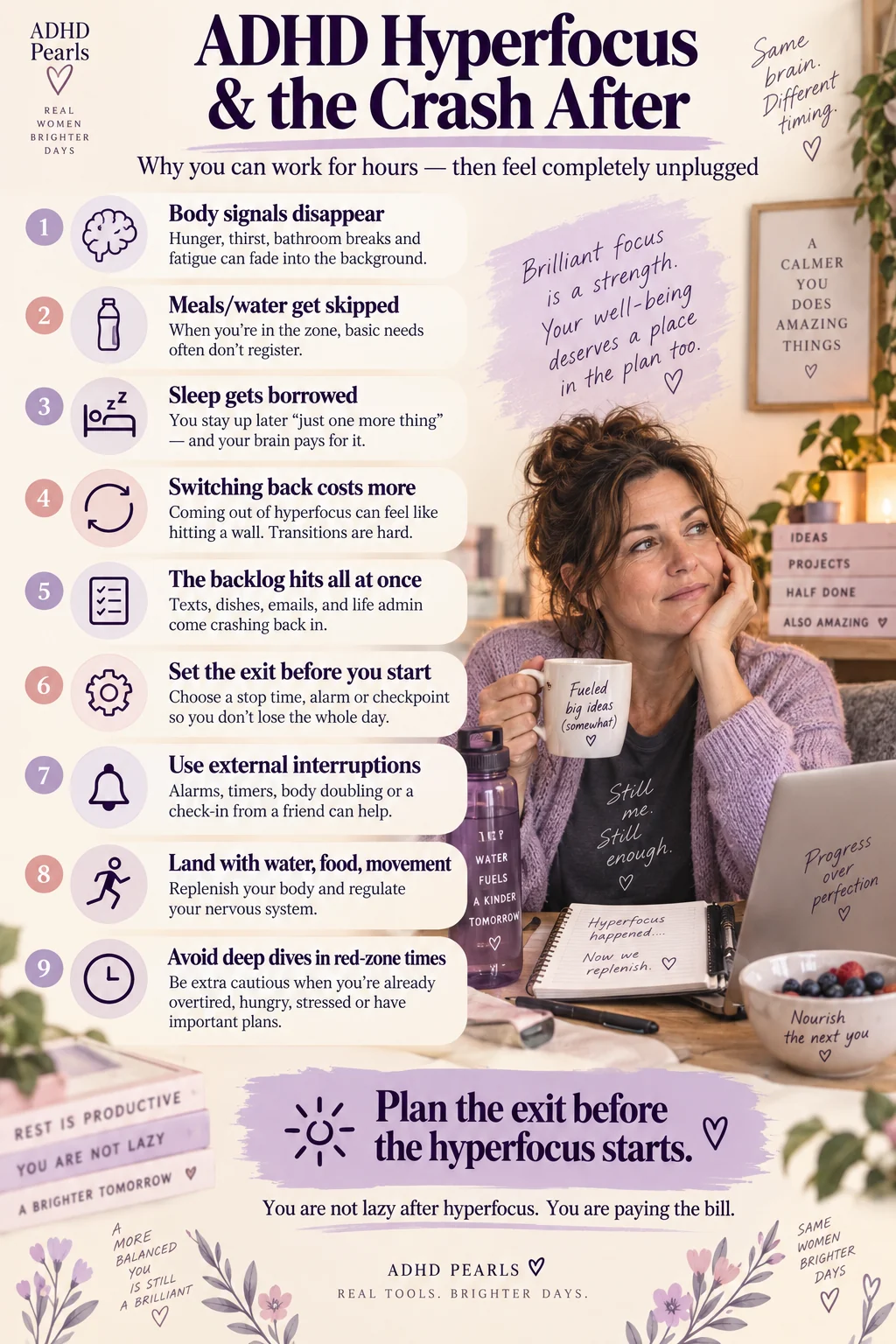
Hyperfocus locks attention onto something engaging so completely that hunger, thirst, movement and time stop registering. When it ends, the skipped signals arrive all at once, along with the effort of switching back to ordinary life. The crash is usually the bill for those hours, not laziness, and planning the exit before you start softens it.
Key takeaways
📌Hyperfocus is not in the official ADHD criteria, but adults with more ADHD traits consistently report it more often.
📌Researchers disagree about whether hyperfocus is the same as flow; one 2024 study found it looked more like getting stuck than like chosen absorption.
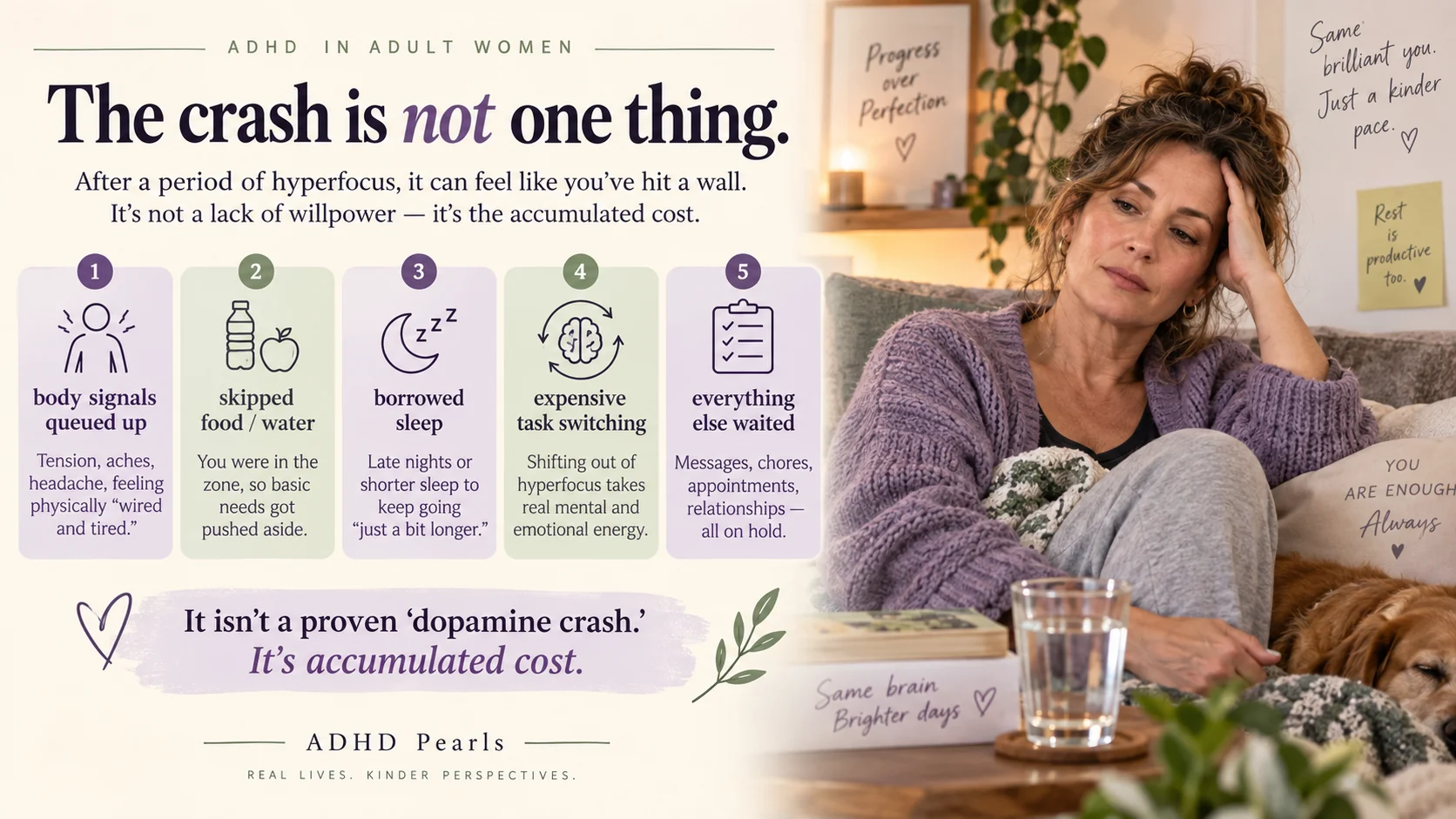
📌The crash has ordinary ingredients: skipped food, water and movement, lost sleep, and the cost of switching back to everything that waited.
📌You rarely stop hyperfocus from the inside. The exit has to be set up before you go in.
📌Deciding where hyperfocus is allowed, and where it is not, protects your evenings far more than trying to have less of it.
Hyperfocus is a state of intense, narrow attention on something engaging, so strong that everything else fades out: the clock, the room, your own body. A review in Psychological Research proposed four features: the task is engaging, attention is intense and sustained, things outside the task stop registering, and performance on the task often improves.
Here is the strange part. Hyperfocus is not in the official diagnostic criteria for ADHD, which are mostly a list of attention problems. Yet adults with ADHD describe it constantly. When researchers built a questionnaire for it and tested it on more than 600 adults, people with more ADHD symptoms reported hyperfocus more often, at school or work, in hobbies and on screens. A newer version of the same questionnaire, tested on 347 adults, found a moderate link with ADHD traits.
So it is not that ADHD brains cannot focus. It is that focus is steered by interest rather than by importance, and when something is interesting enough, the brakes do not engage at all. The photos of 2014 were interesting. The laundry was not. My brain made that call without consulting me.
The bit I used to struggle with most was not the hyperfocus. It was the flat hour afterward, when I had nothing left and reached for my phone because it was the only thing that required zero decisions. I went looking for something that would help me pick a gentler refill in that moment, and every list I found was either a productivity plan or “take a bath,” which, on a crash day, might as well be “climb a hill.”
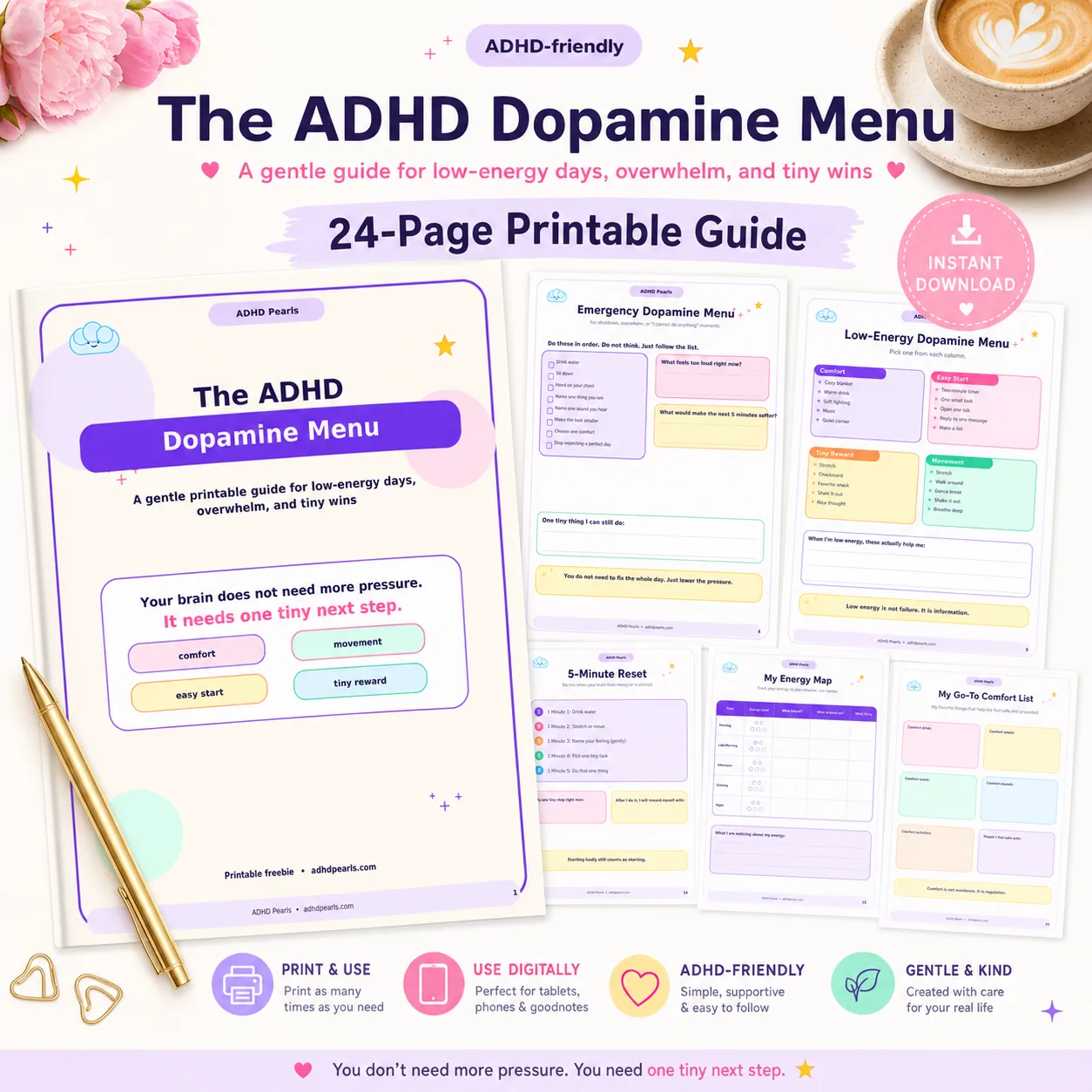
So we made a Dopamine Menu: a short list of tiny, low-effort things sorted by how much energy they cost, so the choice is already made when your brain is not available to make it. It does not stop the crash. It did mean that more of my crash evenings ended with a cup of tea and a podcast instead of three hours of a stranger restoring a rusty knife.
From ADHD Pearls
Free Dopamine Menu
24 tiny activities for low-energy, low-capacity days.
You will often see this explained online as a “dopamine crash.” That makes a tidy story, but as far as I can find, no study has measured a dopamine drop after hyperfocus. What we can say is less dramatic and more useful: the crash is built from ordinary costs that hyperfocus quietly ran up while you were not looking.
The crash does not need a dramatic neurochemical explanation to be real. Several ordinary costs can arrive at the same time.
1. Your body sent the bill late
During hyperfocus, signals like hunger, thirst, needing the bathroom or a stiff back often do not get through, because attention is entirely somewhere else. They did not stop happening. They queued. When you surface, all of them arrive together, along with the low blood sugar of a skipped lunch. We wrote about how hunger signals can go missing with ADHD, and hyperfocus is one of the main times that happens.
2. You probably borrowed from sleep
A lot of hyperfocus happens at night, when the house is quiet and nobody interrupts. That is lovely until 2 a.m. The crash the next afternoon is often simply sleep debt wearing a different hat.
3. Switching back costs more than switching in
Getting into hyperfocus was effortless; something pulled you. Getting back into ordinary tasks is the opposite. You have to restart cold, with no pull at all, and that re-entry is exactly the kind of transition ADHD brains find expensive.
4. Everything else waited for you
While you were absorbed, the messages, the dishes and the dinner question did not go anywhere. Surfacing means meeting all of them at once, slightly guilty, slightly hungry, with low battery. No wonder the sofa wins.
5. The world feels grey after something vivid
This one is harder to measure but easy to recognize. After hours of something deeply engaging, ordinary life can feel flat by comparison, and that flatness can read as sadness or exhaustion. It usually passes once the body is looked after.
If the crashes have stopped being occasional and become your normal weekly rhythm, with no recovery in between, that is worth looking at as ADHD burnout rather than as hyperfocus alone.
Is Hyperfocus a Superpower? Not Exactly
Hyperfocus gets described as the ADHD superpower so often that admitting it costs you feels ungrateful. I would rather be accurate.
Researchers do not fully agree on what hyperfocus is. The Psychological Research review argued it is essentially the same thing as flow, the deep, rewarding absorption athletes and artists describe. But a 2024 study of 215 university students found that hyperfocus questions clustered with perseveration, meaning difficulty disengaging, and actually pulled slightly away from flow. That study was small and relied on self-reported ADHD, so it is not the final word. It is still a useful warning against treating hyperfocus as purely a gift.
Hyperfocus is not attention I steer. It is attention that locks on, and it does not always lock onto what I needed.
The honest version is that hyperfocus is powerful and unsteerable. On a good day it lands on the report due tomorrow and I look brilliant. On another day it lands on researching the history of the spork while the report waits. We wrote about that second version in the things women with ADHD rarely say out loud, and it is one of the most recognized parts of that article.
Hyperfocus You Chose vs Hyperfocus That Took You
I stopped asking whether hyperfocus is good or bad. A better question turned out to be: did I choose this one, or did it take me? The same state can be either, depending on the setup around it.
The same intense focus can feel completely different depending on whether the exit, food, water and surrounding time were planned before it began.
Sign
Hyperfocus you chose
Hyperfocus that took you
How it started
You knew you were going in and roughly for how long
“I’ll just check one thing”
What it landed on
Something you wanted or needed to do
Whatever happened to be interesting at that moment
Your body
Water and food were within reach
You surfaced starving, thirsty and stiff
Stopping
An exit was set up before you started
Something outside you finally broke the spell
Afterward
Tired but satisfied
Crashed, behind and a bit ashamed
Notice that most of the right-hand column is not about the hyperfocus itself. It is about what was missing around it. That is good news, because the setup is the part you can change.
How to Get Out of Hyperfocus (Set the Exit Before You Go In) ⏰
A behavioral psychologist at Cleveland Clinic put it plainly: hyperfocus is not something you can manage internally. I tested this extensively by telling myself “just until eleven” and then discovering it was 1:15. The willpower that would stop you is the very thing hyperfocus switches off. So the exit has to live outside your head, and it has to be in place before you start.
The most useful stop signal is usually one you arranged before your attention narrowed.
•Put the alarm across the room. An alarm you can silence without moving gets silenced without thinking. One that makes you stand up breaks the spell physically.
•Label the alarm with what comes next. Not “stop.” Write “Eat something, then pick up Leo at 3:15.” A reason gets you out of the chair; a beep gets snoozed.
•Leave a bookmark sentence. Before you stop, write one line about exactly what you would do next. Half my resistance to stopping was the fear of losing the thread. The bookmark keeps it.
•Use a when-then. “When I finish this section, then I eat lunch.” A natural stopping point is easier to obey than a time.
•Recruit a human. Ask someone in the house to knock at a set time, or tell a friend you will text them at four. People are harder to snooze than phones.
My best version so far is unglamorous: a kitchen timer on the windowsill, a sticky note on it saying what comes next, and a sentence typed at the bottom of whatever I am working on. It is not elegant. It has rescued a lot of school pickups.
How to Land the Crash (Instead of Falling Into It)
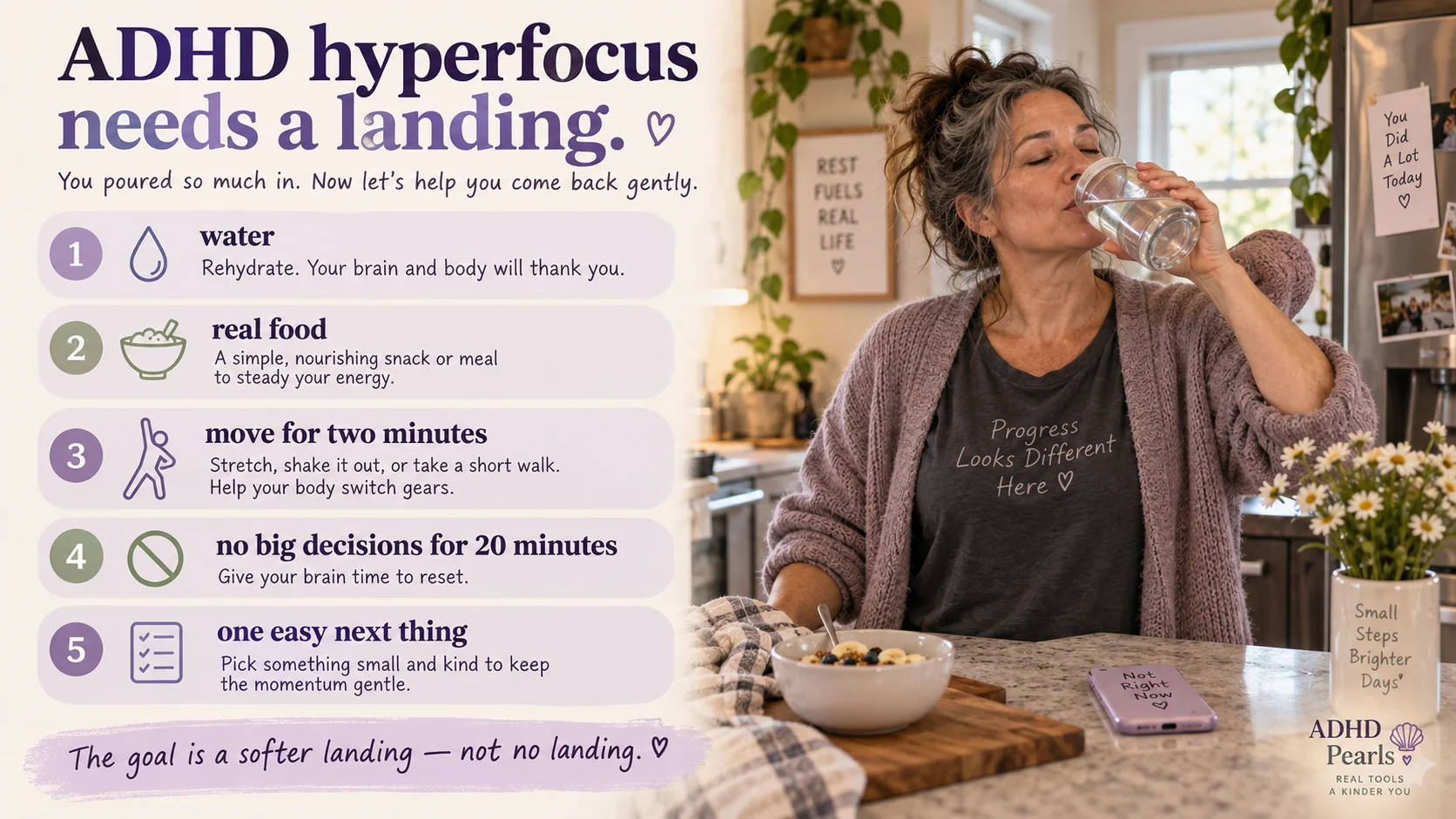
Even with a good exit, some crash is normal. The goal is a softer landing, not no landing. When you surface, try this order before you look at your messages or the to-do list:
Do the body-level things first. The inbox, dinner decisions and backlog can wait twenty minutes.
•Drink a full glass of water. It is the fastest thing that helps, and it takes ten seconds.
•Eat something real, even small. A handful of nuts and a piece of cheese counts. The crash is often partly a skipped meal.
•Move for two minutes. Bathroom, stretch your neck, step outside. Your body has been a statue for hours.
•Make no big decisions for twenty minutes. This is not the moment to tackle the inbox or decide dinner for the week.
•Pick one small next thing. Not the whole backlog. One thing that is easy to finish.
And if you are going to rest, make it the kind that actually refills you. Scrolling after a crash feels like rest and usually is not, which we unpacked in fake rest vs real rest.
The other part of landing is planning around it. I no longer book anything demanding for the two hours after a deliberate deep-work session. That one change made my Saturdays dramatically less dramatic.
Decide Where Hyperfocus Is Allowed
You probably cannot make hyperfocus happen less. You can decide where it is welcome. I think of it as zones:
•Green zone: open time with nothing important afterward, like a Saturday morning with no plans until evening. Go in. Enjoy it.
•Amber zone: work time. Useful hyperfocus lives here, but only with an exit set up.
•Red zone: the hour before an appointment and anything after about 9 p.m. Starting something fascinating here is how you miss the dentist and lose a night of sleep.
In the red zone, I avoid opening the things that most reliably capture me: new hobby research, spreadsheets I enjoy, and anything with a rabbit hole attached. If you lose evenings this way, time blindness is probably working alongside the hyperfocus, and the two are worth tackling together.
The flip side is learning to invite hyperfocus onto the work that matters, by making boring tasks more interesting, urgent or novel. That is the whole point of these ADHD focus hacks.
This article is personal and educational. It is not medical advice. Persistent exhaustion, low mood, sleep problems or appetite changes can have many causes, including depression, thyroid issues and medication side effects. If crashes are affecting your daily life, please talk to a qualified clinician.
One Tiny Move
Before your next deep dive, do two things: put a glass of water and a snack within reach, and set one alarm across the room labeled with what comes next.
That is it. You are not trying to tame hyperfocus. You are just packing a lunch for the trip.
Save this for the next time you look up and it is somehow 4:40.
FAQ: ADHD Hyperfocus and the Crash After
What is hyperfocus in ADHD?
Hyperfocus is a state of intense, narrow attention on something engaging, so absorbing that time, surroundings and body signals fade out. Many adults with ADHD describe it, even though it is not part of the official diagnostic criteria. It tends to be triggered by interest, novelty or urgency rather than by importance.
Is hyperfocus a sign of ADHD?
Hyperfocus on its own is not a sign of ADHD, because most people experience it occasionally. Research does show that adults with more ADHD traits report it more often. It is one piece of a bigger pattern, and only a qualified clinician can assess ADHD.
Why do I crash after hyperfocusing?
Usually because hyperfocus postpones your body's needs, often eats into sleep, and leaves you switching cold back into tasks that have no pull. All of those costs arrive together when you surface. The popular idea of a “dopamine crash” has not been measured in research, so it is better to treat the crash as ordinary costs you can plan for.
Is hyperfocus the same as flow?
Researchers disagree. One major review argued hyperfocus and flow are essentially the same state described in different fields. A 2024 study found hyperfocus questions looked more like perseveration, meaning trouble disengaging, than like flow. A practical difference: flow usually feels chosen, while hyperfocus often feels like it took you.
How do I get out of hyperfocus?
Set up the exit before you start, because willpower tends to switch off during hyperfocus. Put an alarm across the room labeled with what comes next, leave a bookmark sentence so stopping does not mean losing the thread, use a when-then rule, or ask a person to interrupt you at a set time.
Is hyperfocus a good thing?
It can be both. When it lands on something you need to do and is set up with an exit, it can be very productive. When it lands on whatever is interesting and runs through meals or sleep, it carries real costs. It is better thought of as powerful but hard to steer than as a superpower.
Why can I hyperfocus on hobbies but not on work?
ADHD attention tends to follow interest, novelty, challenge and urgency rather than importance. A hobby offers those automatically, while routine work usually does not. Making work more novel, more urgent or more social can help attention land there more often.
Can you hyperfocus on a person?
Many people with ADHD describe intense early focus on a new friendship, relationship or crush that later fades. It is not formally researched in the same way, but it follows the same interest-driven pattern. Knowing that can make the later shift feel less like a betrayal and more like a change in novelty.
Does everyone hyperfocus?
Most people experience absorbing focus sometimes. What adults with ADHD often describe is that it happens more often, is harder to steer, and is harder to leave, with bigger consequences for meals, sleep and plans.
Sources I leaned on while writing this
Ashinoff, B. K., & Abu-Akel, A. (2021).Hyperfocus: the forgotten frontier of attention.Psychological Research, 85(1), 1–19. Review proposing four defining features of hyperfocus, noting it is absent from ADHD diagnostic criteria, and arguing it overlaps with flow.
Hupfeld, K. E., Abagis, T. R., & Shah, P. (2019).Living “in the zone”: hyperfocus in adult ADHD.ADHD Attention Deficit and Hyperactivity Disorders. Two samples totaling 623 adults; those with more ADHD symptoms reported hyperfocus more often across school, hobbies and screen time.
Ayers-Glassey, S., & MacIntyre, P. D. (2024).Investigating emotion dysregulation and the characteristics of ADHD hyperfocus (Simply Psychology summary). Psychology of Consciousness: Theory, Research, and Practice, 11(2), 234–251. 215 undergraduates, 29 with self-reported ADHD; hyperfocus items grouped with perseveration rather than flow. Small sample, self-report.
Cleveland Clinic (2022).Understanding hyperfocus and ADHD. Interview with behavioral psychologist Michael Manos on the downsides of hyperfocus and why external supports work better than willpower.
I still lose the occasional Saturday. Last month it was a deep investigation into which houseplants are safe for cats, and we do not have a cat.
The difference now is mostly the landing. The water is already on the desk, and when I surface, the Dopamine Menu is stuck on the fridge, so the next choice is already made: tea, a podcast, five minutes outside. It does not make me any better at stopping. It just means the crash ends at the kettle instead of at the bottom of my phone, and that turned out to be most of what I needed.
Found this helpful? Share it with someone who gets stuck too.
One tap makes ADHD Pearls a preferred source in your Google account, so our articles surface higher when you search. No signup, and it brings you straight back to this page.
Before you go
Free Dopamine Menu
24 tiny activities for low-energy, low-capacity days.
For the woman who sets up the perfect system on Sunday and abandons it by Tuesday.
One short letter, every week. Real talk about ADHD, task paralysis, and the tiny wins that actually move the needle for a brain like yours. No shame. No hustle culture.