It was 11:40 p.m. and I was supposed to be asleep. Instead I was on Pinterest, staring at two brain scans side by side. The “normal brain” glowed in calm blues and greens. The “ADHD brain” looked like a firework that had been dropped in a paint shop.
I saved it immediately. Finally, I thought. Proof. It was never laziness. My brain is literally a different color.
Then I did the most ADHD thing possible and spent the next two hours trying to find out where that picture came from. The answer was less satisfying, and much more interesting. An ADHD brain really is different from a neurotypical one. Just not in the way the pins show, and the real version is kinder to us than the rainbow one.
Quick answer
What is the difference between an ADHD brain and a normal brain?
On average, ADHD brains show small differences in how some regions develop, how attention networks switch on and off, and how the reward system responds. The differences are subtle, overlap heavily with everyone else, and are clearest in children. No brain scan can diagnose ADHD; it is still diagnosed from how your life actually goes.
Key takeaways
📌Large brain-imaging studies do find differences in ADHD, but they are small averages, not a visible signature in any one person's brain.
📌Parts of the cortex mature about three years later in children with ADHD, following the same pattern, just on a later schedule.
📌Research links ADHD to differences in the brain's reward pathway, which helps explain why interest starts you and importance often doesn't.
📌The colorful “ADHD brain vs normal brain” scans on Pinterest are not a diagnostic test, and no scan is approved to diagnose ADHD.
📌Most of this research was done mainly on boys, which is one reason it can feel so far from a late-diagnosed woman's daily life.
Yes. But “different” in brain research means “different on average across thousands of people,” not “you could spot it on one scan.” Here are the differences that have held up in large studies, in plain language.
1. A few regions are slightly smaller, mostly in childhood
The biggest study so far pooled brain scans from 3,242 people across 23 research sites. Children with ADHD had slightly smaller volumes in several deep brain regions, including areas involved in reward, emotion and memory.
The key word is slightly. The differences were small, and in adults none of them stayed statistically significant. A smaller average says nothing about intelligence, and it does not mean any single ADHD brain is smaller than any single non-ADHD brain.
2. Parts of the brain mature on a later schedule
A long-term study scanned 446 children and teenagers, most of them more than once. In the ADHD group, the outer layer of the brain reached its peak thickness at about 10.5 years, compared with 7.5 years in the comparison group. The frontal areas involved in planning and attention lagged most.
The part I keep coming back to: the pattern of development was normal. It just ran later. And the motor areas were the one place that matured faster, which the researchers suggested might relate to fidgeting. When I read that, I thought about every school report that said “can't sit still” and felt oddly vindicated on behalf of nine-year-old me.
3. The “daydream network” doesn't switch off as easily
Your brain has a network that is busy when you are not focused on anything in particular: daydreaming, replaying, planning dinner during a meeting. Normally it quiets down when you start a task. Several studies, including a small one in adults diagnosed as children, suggest that in ADHD this network and the “get to work” network can stay switched on at the same time.
That matches the lived version almost too well. I sit down to answer one email and my brain is simultaneously answering it, rehearsing an argument from 2019 and wondering whether ducks have knees.
4. The reward system responds differently
A brain-imaging study of 53 adults with ADHD and 44 without found differences in dopamine markers along the brain's reward pathway, and those differences were linked to how severe inattention was. The lead researcher described it as a disruption in interest.
This is the one that rearranged my self-image. It is not that you don't care about the important thing. It is that your brain pays out less for doing it, while anything new, urgent or interesting pays out immediately. That is why a boring form can feel physically impossible and a new hobby can swallow a whole Saturday.
Knowing that did not make my Tuesday afternoons any easier on its own. What I needed was something to reach for in the exact minute my brain refused the important thing, and every list I found was either “just break it into steps” or “take a bubble bath,” which is not useful at 3 p.m. at a desk.
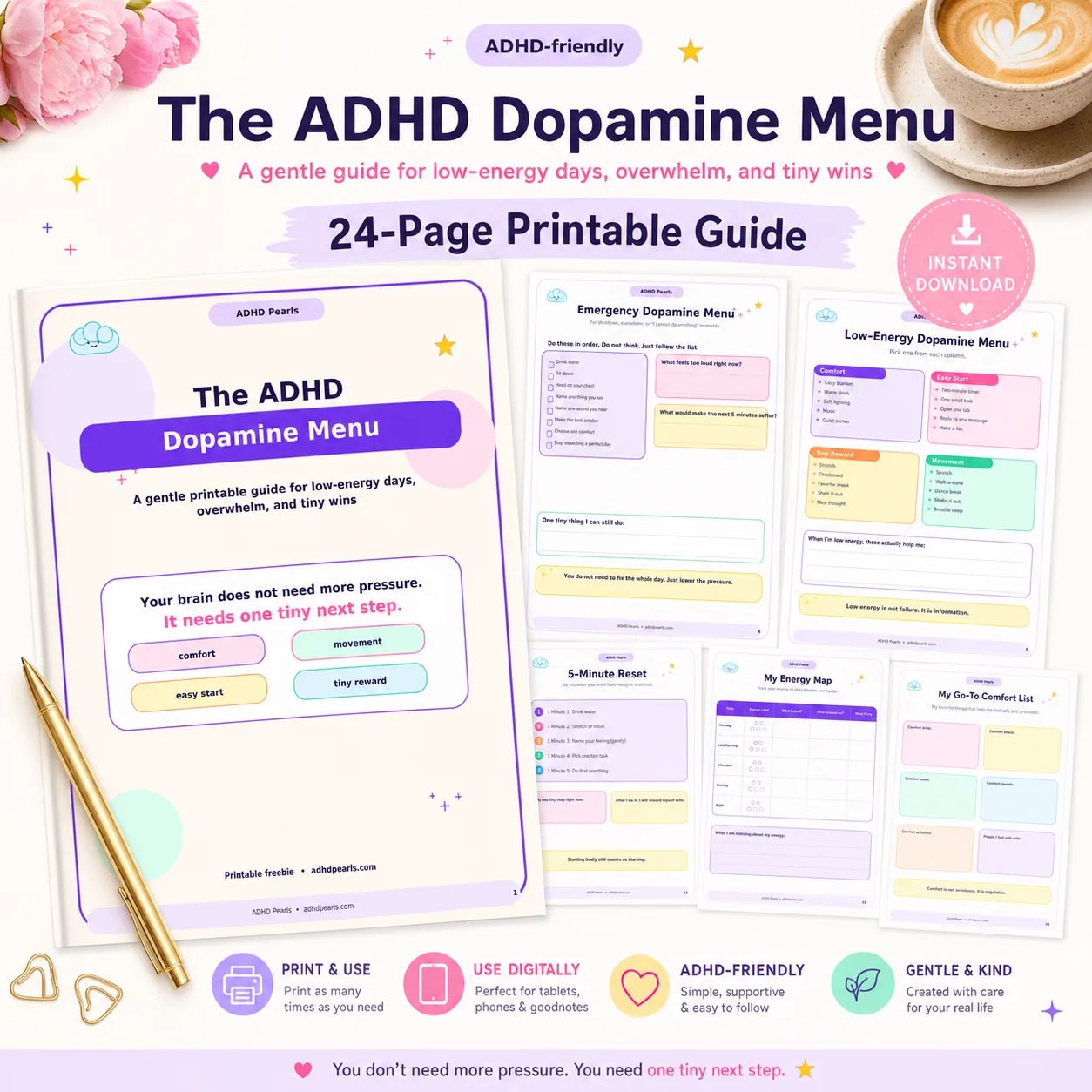
So we put together a Dopamine Menu: small, quick things sorted by how much energy they cost, so you can top up a little interest without disappearing into your phone. It has not changed my reward pathway, obviously. It has changed how many of my stuck afternoons end with the form actually filled in.
From ADHD Pearls
Free Dopamine Menu
24 tiny activities for low-energy, low-capacity days.
What the “ADHD Brain vs Normal Brain” Pins Get Wrong 🔍
I still love a good pin. But a few of the most popular ones teach the wrong lesson.
•The rainbow scans. Many of the colorful side-by-side images trace back to brain-imaging work from around 1990, in small groups, that later studies did not reproduce as a simple overall pattern. A single colored image of one brain was never meant to show what “the ADHD brain” looks like.
•“ADHD brains don't have enough dopamine.” The research points to differences in how the dopamine and reward systems work, not a tank that is simply low. That is why “just get more dopamine” advice so often misses.
•“Smaller brain.” The size differences are small averages, clearest in children, and unrelated to intelligence.
•“Broken brain” or “superpower brain.” Both are stories. The science describes a brain that develops and prioritizes differently, with real costs in a world built for a different schedule.
One of the most shared images I found even comes with a caption joking that scientists changed the colors of normal scans. When a joke and a fact look identical on a pin, the pin is not the place to learn neuroscience.
I didn't need my brain to be a different color. I needed someone to explain why the boring thing felt like lifting a car.
Why Most of This Was Studied in Boys 👩
Here is a detail that rarely makes it onto a pin. In that large study of 3,242 brains, about two thirds of the participants were male, and most of the clearest differences showed up in children.
That means the “ADHD brain” in most research is, on average, a young boy's brain. A woman diagnosed at 38 or 46 was usually not the person these studies were designed around.
It also explains something I found strangely comforting. The adult differences in these studies were much smaller. Yet adults with ADHD still struggle, sometimes more, because life gets more demanding exactly as the scaffolding of school disappears. If you have ever wondered why your ADHD got missed for decades, this piece on late diagnosis goes into the other reasons.
ADHD Brain vs Neurotypical Brain in Everyday Life 🔄
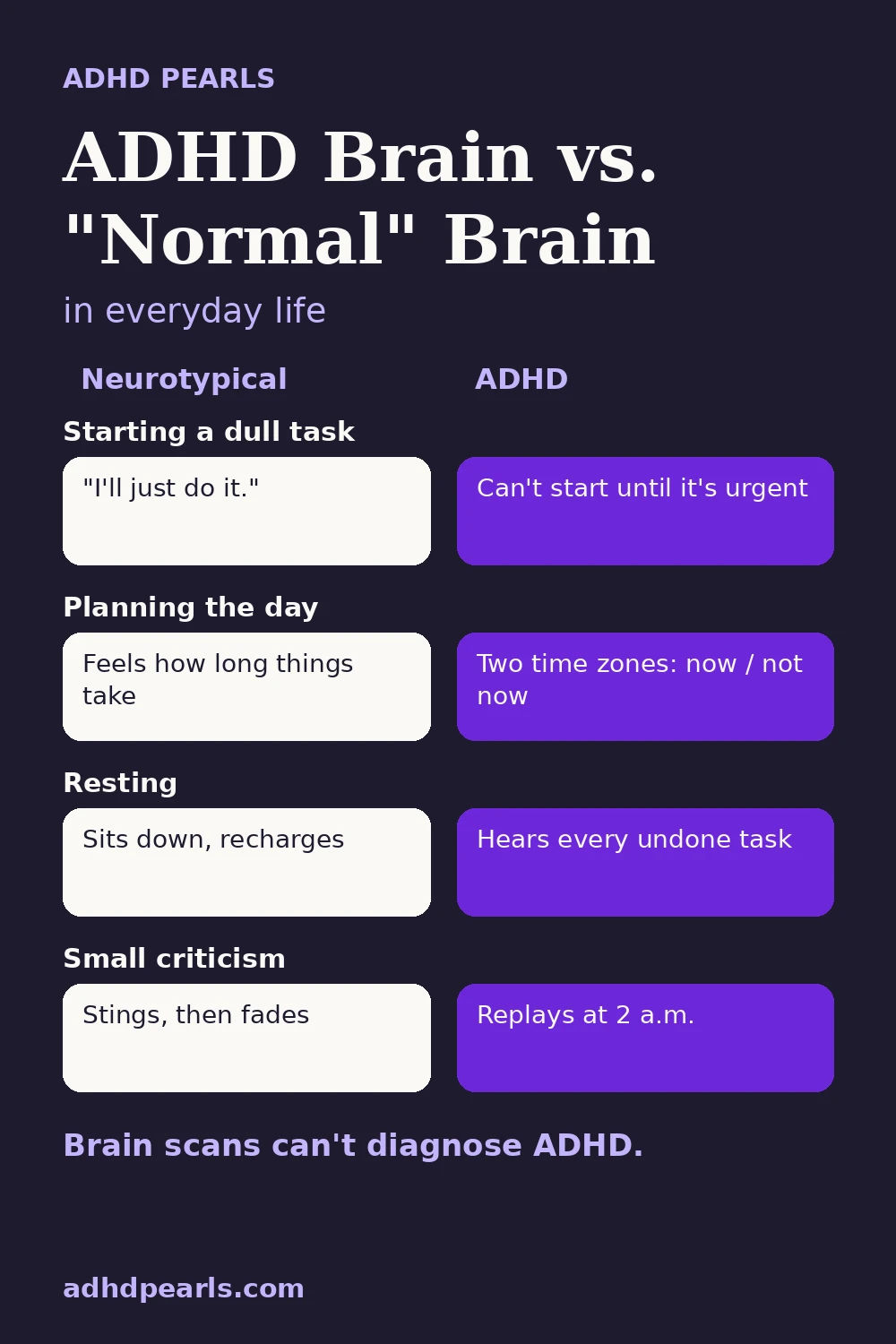
The scans are abstract. The everyday version is not. These are patterns many people with ADHD describe, set next to what a neurotypical brain tends to do. Not every person on either side fits every row, and that is the point: it is a tendency, not a rule.
Moment
Neurotypical brain often
ADHD brain often
Starting a dull task
“I don't feel like it, but I'll do it.”
Knows exactly what to do and still can't start until it becomes urgent or interesting
Planning the day
Feels roughly how long things take
Has two time zones: “now” and “not now”
Something interesting
Enjoys it, stops when it's time
Disappears into it and surfaces hungry four hours later
Resting
Sits down and recharges
Sits down and hears a list of everything undone
A small criticism
Stings, then fades
Lands at full volume and replays at 2 a.m.
Things out of sight
Stay on the mental to-do list
Stop existing until they reappear with a jolt of guilt
Each of those rows has its own article on this site, because each one deserves more than a cell in a table:
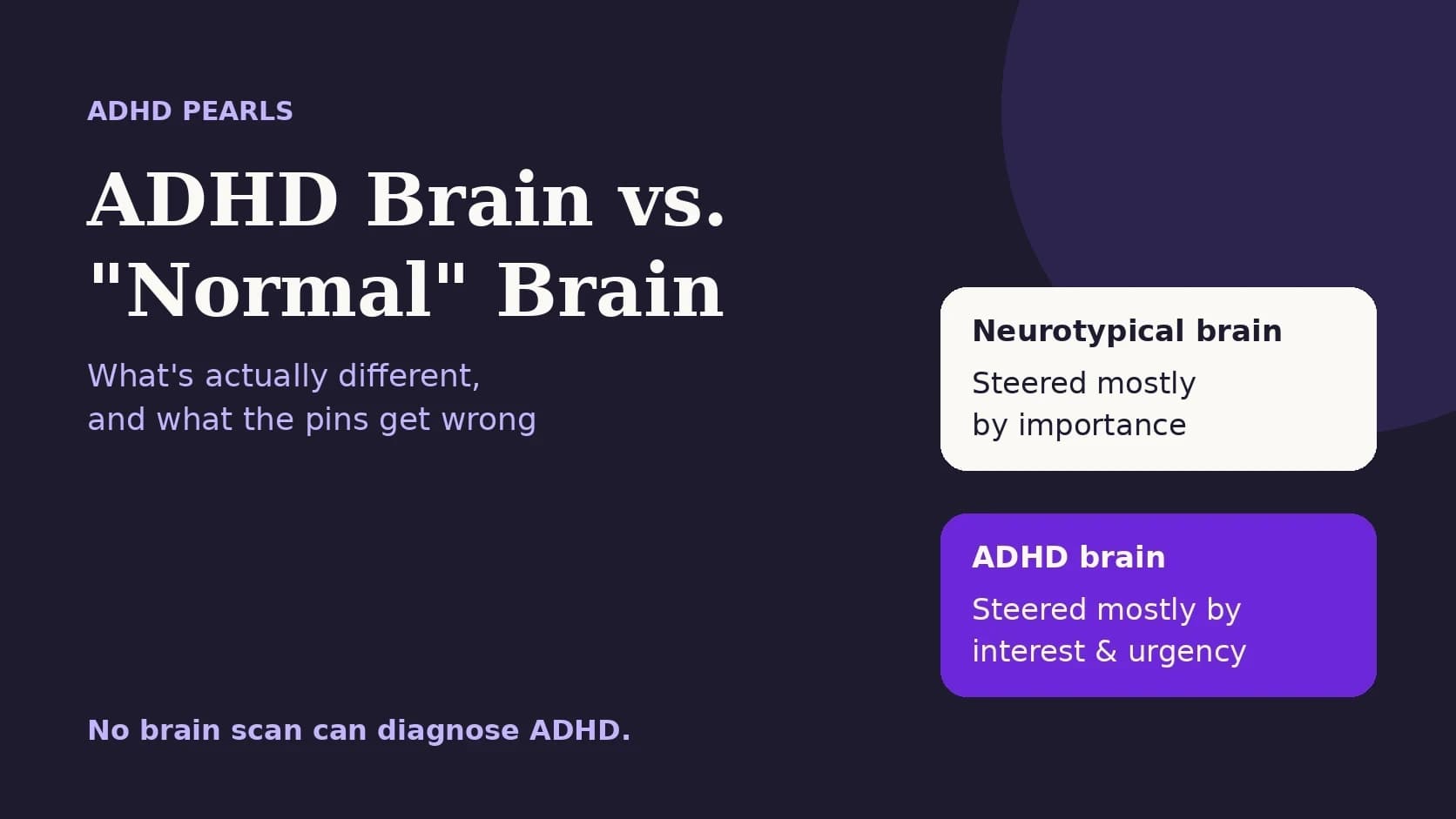
The way I explain it to friends now: a neurotypical brain is steered mostly by importance. An ADHD brain is steered mostly by interest, urgency and novelty. Same destination list, very different steering wheel. You may have seen this called the “interest-based nervous system.” It is a useful phrase from clinical practice, but it is a description, not something brain research has formally tested.
Can a Brain Scan Tell If I Have ADHD? 🩺
No. This is the most common question these pins create, so let's be direct about it.
Major medical bodies, including the American Academy of Pediatrics and the American Academy of Child and Adolescent Psychiatry, do not recommend brain scans to diagnose ADHD. Even the researcher behind the brain-maturation study said brain imaging is not ready to be used as a diagnostic tool. Some private clinics sell scans as part of an ADHD assessment, often for a lot of money. A scan might add a picture. It cannot give you the answer.
ADHD is diagnosed by a qualified clinician from your history, your current symptoms, and how much they affect your life, usually going back to childhood. If you are wondering whether that might be you, our gentle self-check for women is a good first step before an appointment.
This article is personal and educational. It is not medical advice. Attention, memory and motivation problems can have many causes, including sleep problems, anxiety, depression, thyroid issues, hormonal changes and medication side effects. If these difficulties are affecting your daily life, please talk to a qualified clinician.
Is “Normal Brain” Even the Right Phrase?
People search for “normal brain,” so I used it in the title. But research suggests ADHD traits sit on a spectrum across the whole population. In one large study of children in the general population, the same brain measures linked to ADHD were also linked to everyday attention problems in kids without a diagnosis.
That is why many people prefer “neurotypical,” meaning a brain that develops and works in the most common way, rather than “normal,” which quietly implies the other kind is broken. An ADHD brain is not a faulty version of a normal one. It is a common variation that the world is mostly not designed for.
One Tiny Move
Next time a task refuses to start, try saying the true version out loud: “This isn't laziness. My brain isn't getting paid for this one.”
Then add one small bit of interest: a timer, a song, a person nearby, a ridiculous reward. You are not fixing your brain. You are tipping the scales enough to begin.
FAQ: ADHD Brain vs Normal Brain
What is the difference between an ADHD brain and a normal brain?
On average, people with ADHD show small differences in how some brain regions develop, how attention networks switch on and off, and how the reward system responds. These differences are subtle, overlap a lot with people without ADHD, and are clearest in children. They describe groups, not any one person's brain.
Can a brain scan show ADHD?
No. Major medical organizations do not recommend brain scans to diagnose ADHD, and no scan can confirm or rule it out in one person. ADHD is diagnosed by a qualified clinician based on your history, current symptoms and how they affect your life.
Is the ADHD brain smaller?
Large studies have found slightly smaller average volumes in some brain regions in children with ADHD. The differences are small, mostly disappear in adults, and have nothing to do with intelligence. They do not mean any individual ADHD brain is smaller than any individual non-ADHD brain.
Do ADHD brains have less dopamine?
It is more accurate to say the dopamine and reward systems work differently. Research has linked ADHD to differences in dopamine markers along the brain's reward pathway, and those differences were related to inattention. That helps explain why interest and urgency get you going more reliably than importance.
Does the ADHD brain catch up?
Some parts of it appear to mature later rather than differently. One long-term study found the cortex peaked in thickness about three years later in children with ADHD, following a normal pattern. Many adults still have ADHD, though, so catching up in brain structure does not always mean the daily difficulties disappear.
Are the colorful ADHD brain scans on Pinterest real?
Many are real images taken out of context, often from small early studies that later research did not reproduce as a simple overall pattern. Some are jokes or edited images. None of them can show what a typical ADHD brain looks like, and none are a diagnostic test.
What does neurotypical mean?
Neurotypical describes a brain that develops and functions in the most common way. Many people prefer it to normal because it does not imply that ADHD or other neurodivergent brains are broken versions of a correct one.
Why do women with ADHD often not recognize themselves in brain research?
Much of the brain research on ADHD was done mostly with boys and children. In one of the largest studies, about two thirds of participants were male. Women diagnosed later in life were rarely the people these studies were designed around, so the research can feel far from their daily experience.
Volkow, N. D., et al. (2009).Evaluating dopamine reward pathway in ADHD (HealthDay summary). JAMA. 53 adults with ADHD and 44 without; differences in dopamine markers in the reward pathway were linked to inattention.
Zametkin, A. J., et al. (1990) and follow-ups.What FDG-PET studies show (summary). New England Journal of Medicine. The early PET study behind many colorful scan images: 25 adults, about 8% lower overall brain metabolism; a 1993 study in teenagers found no overall difference.
ADDitude.How ADHD is diagnosed: brain scans. Notes that the American Academy of Pediatrics does not recommend SPECT or qEEG for ADHD and that the American Academy of Child and Adolescent Psychiatry calls ADHD a clinical diagnosis.
I still have the rainbow pin saved, by the way. It now lives on a board called “things I believed at midnight.”
What stuck with me was the reward part: my brain gets paid less for the important thing. So on stuck afternoons I don't argue with it anymore. I open the Dopamine Menu we made, pick the smallest thing on the low-energy list, and use it to buy myself the first five minutes. It doesn't change the wiring. It just gets the form filled in, which, some weeks, is the whole victory.
Found this helpful? Share it with someone who gets stuck too.
One tap makes ADHD Pearls a preferred source in your Google account, so our articles surface higher when you search. No signup, and it brings you straight back to this page.
Before you go
Free Dopamine Menu
24 tiny activities for low-energy, low-capacity days.
For the woman who sets up the perfect system on Sunday and abandons it by Tuesday.
One short letter, every week. Real talk about ADHD, task paralysis, and the tiny wins that actually move the needle for a brain like yours. No shame. No hustle culture.