I once spent an entire Saturday not sending a birthday card. The card was written. The stamp was on. The envelope was sealed, addressed, and sitting next to my keys, which I walked past eleven times. I know it was eleven because by the ninth I was counting, like a sports commentator of my own failure.
I did not forget it. I did not not care. I just could not make my body do the last forty-second step. That gap between knowing and doing has a name now: task paralysis. And it turns out it is not only an ADHD thing, which matters more than I expected.
This article is personal and educational. It is not medical advice. ADHD, depression, anxiety, autism, burnout, sleep problems, thyroid issues, hormonal changes and other health conditions can overlap. Please get proper medical guidance if your symptoms are affecting daily life.
Quick answer
What is task paralysis?
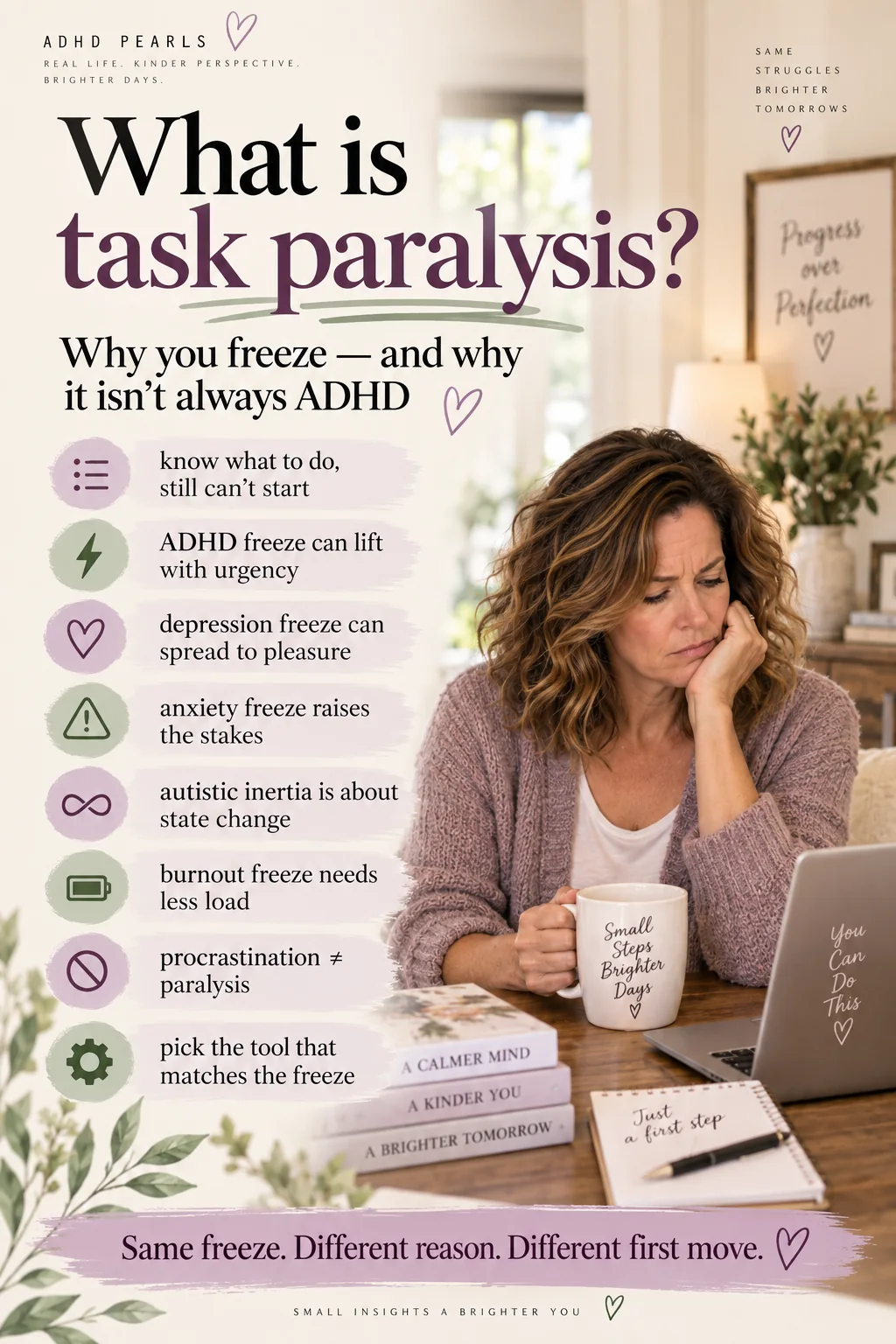
Task paralysis is knowing what you need to do, wanting to do it, and still being unable to start. It is not a diagnosis or a lack of willpower. It shows up in ADHD, but also in depression, anxiety, autism and burnout, and the fix works best when it matches the reason you froze.
Key takeaways
📌Task paralysis is a freeze between intention and action, not a character flaw or a medical diagnosis.
📌The same freeze can come from five different places: ADHD, depression, anxiety, autistic inertia or burnout.
📌ADHD freezes tend to lift with urgency or interest; depression freezes tend to spread to things you normally enjoy.
📌A trick that fails is often a trick aimed at the wrong freeze, not proof that you are beyond help.
📌If the freeze lasts most days for two weeks or more, that is worth a conversation with a doctor.
Task paralysis is a freeze in the space between deciding to do something and actually starting it. You know the task. You often know how long it will take. You may even want it done badly. And still, nothing happens.
It is not a clinical term. You will not find it in a diagnostic manual. It is the name people started using because “I am being weird about the dishwasher again” did not quite cover it. Clinicians tend to describe the same thing as trouble with task initiation, motivation or overwhelm.
From the inside, it usually looks something like this:
•Sitting with the email open, cursor blinking, for twenty minutes
•Not starting the important thing, and not starting anything else either, because the important thing is “next”
•Feeling physically heavy or wired when you think about the task
•Scrolling your phone while narrating, in your head, exactly what you should be doing instead
•Doing it instantly the moment someone else is in the room, or the deadline is tonight
That last one is the cruelest part. Because you can do it under the right conditions, everyone, including you, concludes you could do it any time and simply chose not to. That is where the shame comes in, and shame is a terrible starting motor. 🧊
If you want the ADHD-specific version of what is going on in the brain during a freeze, it is covered in the reset I use when I lose hours to one task. This article is about the bigger question first: what kind of freeze is this?
For a long time I treated every freeze the same way, with a stern internal voice and a to-do list in a nicer font. When I went looking for something that would help in the actual moment, most of what I found was either a productivity system that assumed I could already start, or a pep talk. Neither one touched the forty seconds I was stuck in.
So we built a small free tool for exactly that moment: you name the task (or do not), it offers one reset matched to how you are stuck, and it ends by asking whether you touched the task, not whether you finished it. It has not made me a person who posts birthday cards on the day. It did get the card to the mailbox by Tuesday.
From ADHD Pearls
Free Stuck Reset
One tiny move for the moments you know what to do but still can't start.
No. Task paralysis is a common ADHD experience, but it is not exclusive to ADHD. Depression, anxiety, perfectionism, autism and burnout can all produce a freeze that looks almost identical from the outside.
This matters for a very practical reason. The fix that works depends on what is causing the freeze. A timer and a dopamine hit can get an ADHD brain moving. The same timer, aimed at a depressed brain that cannot feel reward right now, is just a loud reminder that you are still on the sofa.
I found this out the slow way. One winter, every trick that normally got me going stopped working at once. Music, body doubling, the two-minute rule, all of it. I assumed my ADHD had “gotten worse.” It had not. I was also depressed, and I was trying to fix a flat tire by refueling the car.
A trick that stops working is not always proof you are beyond help. Sometimes it is proof you are using the right tool on the wrong freeze.
Many people carry more than one of these at once. ADHD and anxiety are frequent companions, and many late-diagnosed women were treated for depression or anxiety for years before anyone mentioned ADHD. So think of the categories below as ingredients, not boxes.
The Five Kinds of Freeze
The freeze can look almost identical from the outside. The useful intervention depends on what is driving it.
This is not a diagnostic table. It will not tell you what you have. But it can help you notice which freeze tends to be yours, and ask better questions if you talk to someone about it.
Kind of freeze
What it often feels like
What tends to unlock it
ADHD
The task feels flat and gray; you can do it instantly if it becomes urgent, novel or social
Borrowed urgency, interest or company: a timer, a body double, making it a game
Depression
Heavy, slowed down; the freeze spreads to things you normally enjoy
Very small, body-first steps, lower expectations, and professional support
Anxiety or perfectionism
Wired, dreading; starting feels like being judged
Shrinking the stakes: a deliberately bad first draft, a private version first
Autistic inertia
Stuck in the current state; hard to start, stop or switch, even for good things
External prompts, predictable routines, a gentle transition ritual
Burnout or low capacity
Empty; the tank is gone after months of running above capacity
Fewer tasks, real rest, and dropping the plan to the energy you actually have
1. The ADHD freeze: the task that will not light up 🧠
My ADHD freeze has a specific texture. The task is not scary. It is just gray. Filling in a form feels like trying to push a shopping cart with one wheel locked. And then my sister calls to say the form is due tomorrow, and suddenly I can do it in eleven minutes flat.
That pattern, stuck on boring and fine on urgent, is the ADHD signature. Research suggests the dopamine-related reward system may work differently in ADHD. One brain-imaging study of adults with ADHD who had never taken medication found differences in the reward pathway, and those differences were linked to lower scores on a measure of motivation.
In plain terms: the “this is worth doing” signal may arrive too quietly for tasks that are important but not interesting. Urgency, novelty and other people turn the volume up. That is why they work, and why willpower mostly does not.
2. The depression freeze: the empty tank 😴
The depressed version felt completely different once I knew to look. It was not “this is boring.” It was “everything is far away and heavy, including the things I like.” I stopped replying to the group chat. I stopped reading. The birthday card and the fun novel were equally impossible.
The US National Institute of Mental Health lists fatigue, feeling slowed down, loss of interest in things you used to enjoy, and difficulty making decisions among the symptoms of depression. Any of those can look like task paralysis. The difference is reach: a depression freeze tends to spread to pleasure, too.
3. The anxiety and perfectionism freeze: starting feels like a test
This one is sneaky, because it often attaches to the things you care about most. I can load a dishwasher without a flicker. The newsletter I actually want to write? I will reorganize my entire spice drawer first. Alphabetically. Then by cuisine, because alphabetical felt shallow.
A large meta-analysis found that perfectionistic concerns, the worry about mistakes and other people’s judgment, are linked with more procrastination, while simply having high standards is not. It is not the ambition that freezes you. It is the fear of what the first attempt will say about you.
4. Autistic inertia: stuck in the current state
In one study, 32 autistic adults described in focus groups a difficulty starting, stopping and changing activities that did not feel under their conscious control. It affected enjoyable activities too, not just unpleasant ones. What helped most was outside input: another person, a deadline, a routine.
The key difference: autistic inertia is often about changing state, not about a specific task. It can be as hard to stop reading and go to bed as it is to stop lying down and start the laundry. Some people have both inertia and ADHD, and the two can stack.
5. The burnout freeze: no capacity left 🔋
The last kind is the one I see most often in women in midlife. You were the person who held everything together. Then, gradually, the systems stopped catching things. Work, kids, parents, hormones, the invisible admin. The freeze is not a mystery. It is a bill for years of running above capacity.
No trick fixes this one, because the problem is not starting. The problem is that there is nothing left to start with. The honest response is subtraction, and planning from the energy you actually have rather than the energy you used to have. If you are in your 40s and it arrived alongside hormonal changes, ADHD burnout in perimenopause is written for exactly that season.
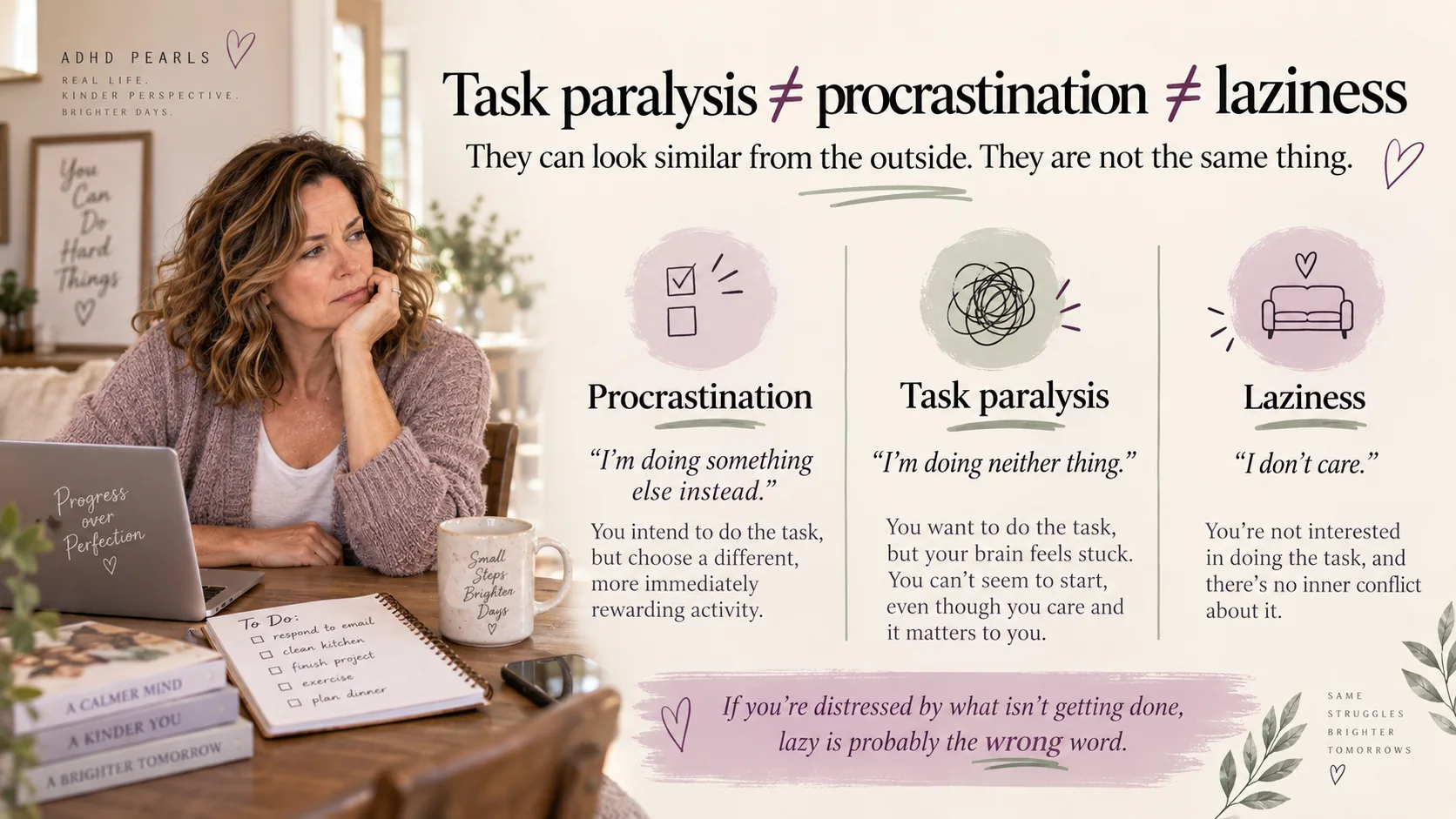
Task Paralysis vs Procrastination vs Laziness
These three get used interchangeably, and only one of them is an insult.
Distress matters. Caring deeply about the unfinished task is not the same thing as being unbothered by it.
•Procrastination is usually putting a task off by doing something else, often to escape a bad feeling. The laundry gets folded instead of the tax return.
•Task paralysis is often not doing the task or anything else. You are stuck in the doorway, unable to go through and unable to leave.
•Laziness implies you do not care. Most people reading an article about task paralysis care so much it hurts.
When I am stuck now, I ask myself four quick questions before I reach for any trick. It takes about thirty seconds, which is less time than I used to spend staring at the envelope. 📋
These questions are for choosing a more useful first move, not for diagnosing yourself.
•If this were due in one hour, could I do it? If yes, that leans toward the ADHD interest-and-urgency freeze.
•Can I still enjoy things I normally enjoy? If no, and it has been weeks, that leans toward depression and is worth taking seriously.
•What happens if I picture doing it badly? If the thought brings relief, perfectionism was holding the door shut.
•Is it this task, or is it any change at all? If stopping the current thing is just as hard as starting a new one, that sounds more like inertia.
And a fifth that is less a question than a gut check: am I tired in a way that sleep does not fix? If so, the answer is probably fewer tasks, not better starting techniques.
None of this is a diagnosis. It is a way to pick a better first move. I still get it wrong. Last month I spent a whole morning deploying body doubling, timers and a playlist on a task I was simply afraid of. The moment I admitted that, I wrote a terrible first paragraph, and the rest came out in an hour.
What Helps, Matched to the Freeze
The general principle underneath all of these: you are not trying to finish the task. You are trying to touch it. A touched task is much easier to continue than an untouched one is to begin.
A touched task is usually easier to continue than an untouched task is to begin.
•For the depression freeze: body first, task second. Stand up, drink water, open the curtain. Shrink the goal until it is almost insulting, and tell someone how you are doing.
•For the anxiety freeze: lower the stakes on purpose. Write the worst possible first line. Make a private draft nobody will ever see.
•For inertia: outsource the switch. An alarm with a specific instruction, a routine that always follows the same order, a person who says “okay, now.”
•For burnout: cross something off without doing it. Deciding not to do a task is a legitimate way to finish it.
My one tiny move for today, whichever freeze you are in: name the task out loud, then do only the first physical action. Not “do the taxes.” Open the folder. That is the whole assignment. 🌀
For the bigger picture, all of our writing on this lives in the task paralysis guide.
Same freeze from the outside. Five different reasons on the inside.
When to Talk to Someone 🩺
Task paralysis on its own is not an emergency. But it can be a signal worth listening to. It may be time to talk to a doctor or mental health professional if:
•The freeze is affecting your job, your bills or your relationships
•It lasts most of the day, nearly every day, for two weeks or more
•You have stopped enjoying things you used to enjoy
•Tricks that used to work have all stopped working at the same time
You do not need to know which freeze it is before you ask for help. Figuring that out is part of what the help is for. It can be useful to bring notes: when it happens, what unlocks it, and whether it spreads to things you like.
If you are ever having thoughts of harming yourself, please contact a crisis line or emergency services right away. In the US, you can call or text 988.
FAQ: Task Paralysis
What is task paralysis? Task paralysis is the experience of knowing what you need to do, wanting to do it, and still being unable to start. It is not a medical diagnosis or a physical paralysis. It is an everyday name for a freeze between intention and action that shows up in ADHD and in several other conditions.
Is task paralysis a symptom of ADHD? It is not an official diagnostic symptom, but it is one of the most common things adults with ADHD describe. It is usually explained through difficulties with starting tasks, motivation and emotional overwhelm. Research suggests differences in dopamine-related reward signaling may make low-interest tasks especially hard to begin.
Can you have task paralysis without ADHD? Yes. Depression, anxiety and perfectionism, autistic inertia, burnout and plain exhaustion can all produce the same freeze. The experience looks similar from the outside, but the reason underneath can be different, which is why the same trick does not work for everyone.
Is task paralysis a sign of depression? It can be. Depression commonly brings low energy, a feeling of being slowed down and trouble making decisions, which can look like task paralysis. A useful difference: in depression the freeze often spreads to things you normally enjoy, and it lasts most days for two weeks or more. That pattern is worth raising with a doctor.
What is the difference between task paralysis and procrastination? Procrastination usually means putting a task off while doing something else, often to avoid a bad feeling. Task paralysis often means not being able to do the task or anything else, stuck in between. The two overlap a lot, and many people move from one into the other on the same afternoon.
Is task paralysis the same as autistic inertia? They overlap but are not identical. Autistic inertia, as described by autistic adults in research, is difficulty starting, stopping and switching activities, including enjoyable ones. It is often about changing state rather than about a specific task. Some people experience both, especially if they are autistic and have ADHD.
Why do I freeze on things I actually want to do? Wanting a task does not always make starting it easier. Caring a lot can raise the stakes, so the first step feels like a test. And if a task has several unclear steps, your brain may not find a clear place to begin. Making the first step tiny and specific often helps more than wanting it harder.
How do you get out of task paralysis quickly? Pick one physical move that takes under two minutes, like opening the document or putting one dish in the sink, and stop there if you need to. Changing your body state, having someone nearby, or writing the swirl of thoughts down can also help. The aim is to touch the task, not to finish it.
When should I see a doctor about task paralysis? If the freeze is affecting work, bills or relationships, if it lasts most days for two weeks or more, or if you have stopped enjoying things you used to enjoy, it is worth talking to a doctor or mental health professional. If you ever have thoughts of harming yourself, contact a crisis line or emergency services right away.
National Institute of Mental Health.Depression. nimh.nih.gov. Source for the symptoms of fatigue, feeling slowed down, loss of interest and difficulty making decisions, and the two-week threshold.
Child Mind Institute.What is ADHD paralysis? childmind.org. A clinician-reviewed explainer noting that ADHD paralysis is not an official symptom and describing how overwhelm and anxiety feed into it.
I still have freezes. Last week it was a two-line email to my dentist, which sat in drafts for four days while I wrote an entire article about why people freeze. The irony was not lost on me. It just did not help.
What changed is that I stopped treating every freeze as a verdict on my character, and started asking which kind it was. When I looked for something that would help in that exact moment, everything I found wanted me to plan my week first, which is a strange thing to ask of someone who cannot open an email.
So we made the Stuck Reset small on purpose: one question about where you are stuck, one matched reset, and a check-in that counts touching the task as a win. It will not diagnose you, and it cannot do anything about burnout except gently suggest you do less. But the dentist email went out on day five, and I am choosing to count that.
Found this helpful? Share it with someone who gets stuck too.
One tap makes ADHD Pearls a preferred source in your Google account, so our articles surface higher when you search. No signup, and it brings you straight back to this page.
Before you go
Free Stuck Reset
One tiny move for the moments you know what to do but still can't start.
For the woman who sets up the perfect system on Sunday and abandons it by Tuesday.
One short letter, every week. Real talk about ADHD, task paralysis, and the tiny wins that actually move the needle for a brain like yours. No shame. No hustle culture.