For most of my twenties, my diagnosis was depression, and my treatment was a rotating cast of antidepressants. Some helped my mood a little. None of them fixed the thing where I couldn't start a task to save my life, or focus on anything that wasn't on fire.
Nobody asked why a supposedly depressed person could still hyperfocus for six hours on a hobby but couldn't answer one email. The flatness was real - but so was the part of me that lit up for the right things. That part didn't fit the story.
It took years to learn that a lot of my "depression" was an undiagnosed ADHD brain running on empty, plus the low mood that grows when you spend a decade feeling like you're failing. If you're stuck on the same question, here's how the two differ - and why they're so easy to mix up.
Quick answer
Is it ADHD or depression?
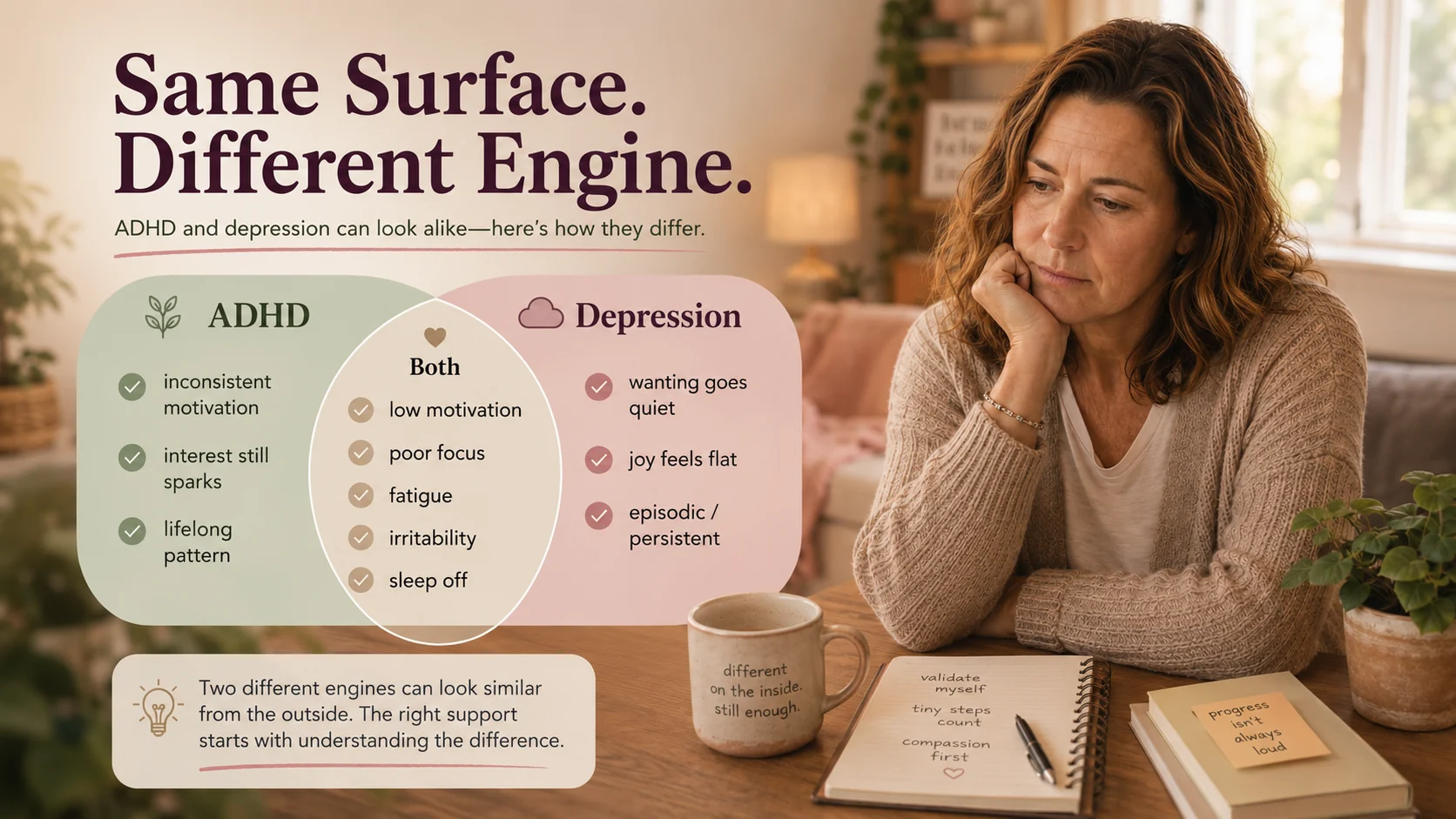
They overlap heavily - both bring low motivation, poor focus, fatigue and irritability - so they're easy to confuse. The clearest difference is interest: ADHD leaves you unable to focus even on things you want to do, while depression drains the wanting itself and flattens even things you used to love. ADHD is lifelong and inconsistent; depression usually comes in episodes. Often it's both, and only a professional can tell for sure.
Key takeaways
📌Both bring low motivation, poor focus, fatigue and irritability, so they are easy to confuse.
📌The clearest difference is interest: ADHD cannot focus on what you want, depression drains the wanting.
📌If something genuinely exciting still lands, that points away from depression.
📌They frequently coexist, and untreated ADHD is itself a route into depression.
📌Women are often treated for the depression and never assessed for what caused it.
This is educational, not a diagnosis. ADHD, depression, anxiety, thyroid issues, perimenopause and burnout can all look similar and often coexist. If low mood is affecting your life - and especially if you're having thoughts of harming yourself - please reach out to a qualified professional or a crisis line. You deserve real support, not just a blog post.
Why Do ADHD and Depression Feel So Similar?
On the surface they wear almost the same outfit. Trouble concentrating. Low motivation. Fatigue. Irritability. Disorganization. Sleep that's off. From the outside - and honestly from the inside - "I can't focus, I can't start anything, I'm exhausted, nothing's getting done" describes both.
That's exactly why they get confused so often, and why so many people (me included) get handed the depression label first. The symptoms genuinely overlap, so if you only look at the surface, they're near-identical twins.
I remember a GP appointment where I listed it all out - I'm exhausted, I can't concentrate, I can't get anything done, I feel like I'm drowning - and watched her write "low mood" before I'd even finished the sentence. She wasn't wrong that something was off. She just reached for the most familiar label, the same way I would have. Everything I described genuinely lives in both columns.
And the confusing part is that I was low. That's the trap: the ADHD was quietly manufacturing situations - the late bills, the disappointed friends, the projects abandoned at 80% - that any reasonable person would feel low about. So the depression was real and the ADHD was real, and untangling which came first took me the better part of a decade.
But underneath, they're driven by different engines - and that difference is the thing that finally helped me tell them apart.
I wasn't a person with no motivation. I was a person whose motivation only worked on the wrong things - which is a very different problem.
ADHD and depression can look similar from the outside, but the "why" underneath may be different.
From ADHD Pearls
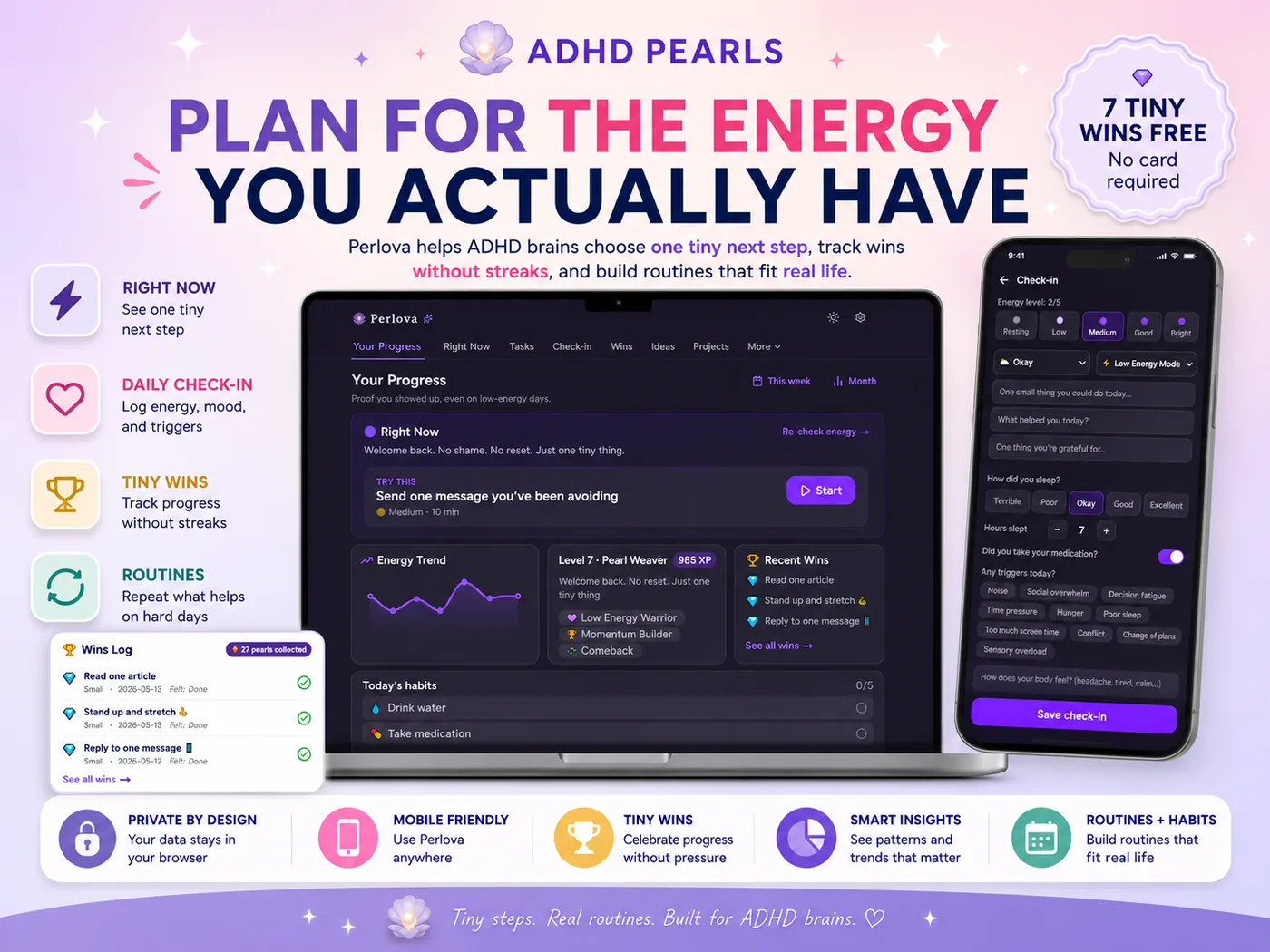
Perlova — plan from the energy you actually have
One doable next step, wins without streaks, and routines that fit real ADHD life. No card, no shame.
Three things helped me actually separate them: motivation, timeline, and the shape of the low mood.
Motivation and interest. This is the big one. ADHD motivation is inconsistent, not absent - you can't focus on the boring thing, but a novel, urgent, or genuinely interesting thing can still switch you on completely. Depression tends to drain the wanting across the board, so even things that should feel good stop feeling like anything.
Here's how it showed up for me: on the same afternoon I "couldn't" open a spreadsheet I'd been avoiding for a week, I could - and did - spend four hours researching a random rabbit hole about deep-sea creatures with total, effortless focus. A genuinely depressed brain doesn't usually hand you four hours of joyful hyperfocus on request. Mine did, constantly, just never on the thing I was supposed to be doing.
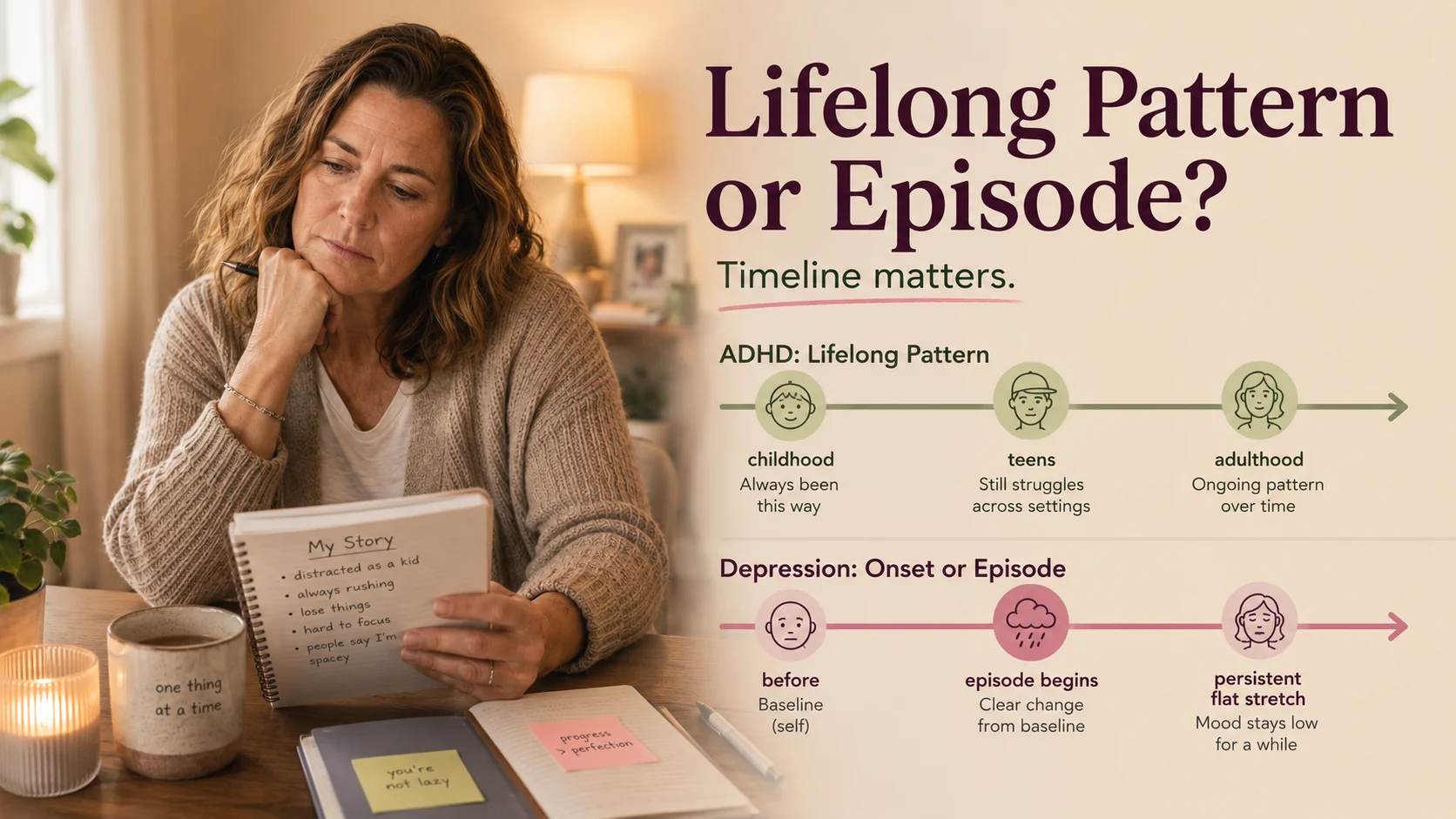
Timeline. ADHD is lifelong and there on your good days too - the focus and follow-through struggles trace back to childhood. Depression usually has an onset or arrives in episodes: a stretch where the lights dimmed, often with a before-and-after you can point to.
When I actually looked back, my "symptoms" had no before. The forgetting, the lateness, the half-finished everything - it was all there at nine years old, on every school report that said "so much potential, if only she'd apply herself." There was no year the lights went out, because for me they'd always flickered. That lifelong-and-consistent shape is one of the clearest ADHD tells, and it's the thing a depression story could never quite explain.
The shape of the mood. ADHD low mood is frequently reactive - it spikes after a specific setback, rejection, or failure, and it lifts when things go well. Depression tends to be more pervasive and persistent, hanging around regardless of what's happening. If the flatness doesn't budge even on a genuinely good day, that leans toward depression.
My low mood had a very specific rhythm to it: it would crash hard the afternoon I missed a deadline or misread a friend's short text, and then lift almost completely when something went right. It tracked events. Real depression, the times I've had it layered on top, felt different - a flat grey that stayed put even on a sunny day when nothing had gone wrong at all. Learning to feel that difference in my own body was more useful than any checklist.
Timeline matters. ADHD often shows a lifelong pattern, while depression may appear as a clearer change from baseline.
The "Can You Still Enjoy Things?" Test
Here's the single question that cut through it for me: can you still enjoy the things you love?
With ADHD, the fun stuff still works. Your favorite show, a hobby, a deep-dive rabbit hole, plans with the right person - those still light you up. It's the boring, effortful, "important" tasks that feel impossible. The problem is doing, not feeling.
With depression, the joy itself goes quiet. The things that used to bring pleasure go grey and flat too - a symptom clinicians call anhedonia. It's not that you can't make yourself do them; it's that they stopped feeling good at all.
The moment it clicked for me was almost silly. I was lying on the floor convinced I was "too depressed to function," and then a friend texted about a last-minute concert - and I was up, dressed, and out the door in fifteen minutes, buzzing. I remember thinking: that is not how depression works. A brain with no dopamine left doesn't sprint toward a concert. Mine had plenty of dopamine; it just refused to release any of it for laundry, admin, or anything without a hook.
It's a clue, not a verdict. But when I finally asked myself honestly - and realized I still lit up for the interesting things, I just couldn't make myself do the dull ones - a lot of the picture clicked into place. That "can't start" freeze, by the way, is the same one I unpack in task paralysis that looks like laziness.
This is only a clue, not a diagnosis, but noticing whether joy still sparks can help you understand the pattern.
Can You Have Both ADHD and Depression?
Absolutely - and it's common. The two coexist a lot, and here's the part that mattered most to me: untreated ADHD can quietly grow a depression on top of itself.
Spend years missing deadlines, forgetting things you care about, being called lazy or too much, and constantly feeling behind - and low mood is a completely reasonable response to that. This is sometimes called secondary depression: it isn't a separate storm that blew in, it's the weather created by an unmanaged brain and a lot of accumulated shame. If that self-blame sounds familiar, the ADHD shame detox is written for exactly it.
Why does the distinction matter if it can be both? Because treating only the depression, when ADHD is the root, is treating the effect and not the cause - which is why antidepressants alone so often feel like they half-work.
I lived the half-working version for years. The antidepressants took the sharpest edge off the despair, which mattered - but I'd still sit down to work and hit the same invisible wall, still forget the same things, still end each week feeling like I'd failed at being a functional adult. And every one of those failures fed the low mood right back. It was a loop: the ADHD created the mess, the mess created the shame, the shame looked exactly like depression, and the depression treatment never touched the ADHD underneath.
Sometimes the answer is not either-or. Treating only one layer may miss what is really happening.
Why Women Get Told It's "Just Depression"
If you're a woman who got the depression diagnosis first, you are in enormous company. Major depression is one of the most common misdiagnoses for women who actually have ADHD.
It happens because women's ADHD is usually quiet - inattention, overwhelm, emotional intensity, and bone-deep exhaustion rather than the hyperactive-boy picture everyone pictures. Those internal symptoms read as depression. Layer on decades of diagnostic bias and the fact that the low self-worth from unmanaged ADHD is genuinely real, and depression becomes the label that sticks while the ADHD underneath goes unnoticed for years. It's the same masking story behind being told it's "just anxiety".
For most of those years I was praised for how "well" I was coping, which is its own quiet trap - I was masking hard, holding it together in public and falling apart in private, and the effort of that mask is exhausting in a way that also looks like depression. Nobody sees the frantic swan-legs under the water. They just see a capable woman who's a bit down, hand her a prescription for the down part, and send her back out to keep paddling.
How Do I Figure Out Which One It Is?
You don't have to solve this alone in your own head - and honestly, you can't, because the two overlap too much and can travel together. But you can walk in with a clearer picture.
Before an appointment, notice the pattern over time, not a single bad week. Ask whether the focus and motivation problems are lifelong and present even when you're not low (leans ADHD), or whether they mostly showed up with a stretch of persistent flatness (leans depression). Ask whether interesting things still spark - or whether everything has gone grey. Then bring that to a professional who can look at your history and sort ADHD, depression, or both. If you're still wondering about the ADHD side specifically, start with how to know if you have ADHD.
When I finally went in with the ADHD question, I didn't bring a vague "I think something's wrong." I brought specifics: the school reports, the twenty-year pattern of the same struggles, the fact that I could hyperfocus but not initiate, and the observation that my worst moods always had a trigger and always lifted. Concrete beats a feeling in that room. It gave the clinician something to actually work with, and it stopped the appointment from defaulting, once again, to "sounds like depression, let's try another SSRI."
The tiny move: before you close this, write one honest line - do the things you love still light you up, or has everything gone flat? You don't need the answer or the diagnosis today. You just need one true observation to bring to someone who can help you sort the rest.
Pin this as a clue, not a diagnosis.
FAQ: ADHD or Depression
Is it ADHD or depression?
They overlap a lot - both bring low motivation, trouble concentrating, fatigue and irritability - so they're genuinely easy to confuse. The clearest difference is motivation and interest: ADHD makes you unable to focus even on things you want to do, while depression tends to drain the wanting itself, flattening even the things you used to love. ADHD is also lifelong and inconsistent, while depression usually comes in episodes. Only a professional can tell for sure, and it can be both.
Can you have both ADHD and depression?
Very often, yes - they coexist frequently, and untreated ADHD can lead to depression over time. Years of missed deadlines, feeling behind, and being called lazy wear down your self-esteem, and depression can grow on top of that. Studies suggest a large share of people with ADHD also experience depression, so "both" is a common and valid answer.
How do I tell ADHD apart from depression?
Look at motivation, timeline and mood. ADHD focus problems are lifelong and present even on good days, and your interest still switches on for novel or urgent things; depression usually has an onset or comes in episodes and flattens interest across the board. ADHD low mood is often reactive - triggered by a specific setback and lifting when things go well - while depression tends to be more pervasive and persistent.
Why do I feel flat and unmotivated - is it ADHD or depression?
Both can cause it, so the useful question is what the flatness responds to. With ADHD, a boring task feels impossible but something interesting or urgent can still light you up, and the low mood usually tracks specific frustrations. With depression, the flatness is more constant and even previously enjoyable things stop feeling good. If nothing - not even the fun stuff - brings any spark, that leans more toward depression and is worth getting checked.
Can ADHD cause depression?
It can contribute to it. Living for years with an undiagnosed brain - constant catch-up, repeated "failures", and harsh self-judgment - is a reasonable thing to become depressed about. This is sometimes called secondary depression: it grows on top of unmanaged ADHD rather than existing on its own, and addressing the ADHD can sometimes lift both.
Why do women with ADHD get diagnosed with depression instead?
Because women's ADHD is often quiet - inattention, overwhelm, emotional dysregulation and exhaustion rather than obvious hyperactivity - and those look a lot like depression. Add decades of diagnostic bias and the fact that the low self-esteem from unmanaged ADHD is real, and depression becomes the label that gets written down while the ADHD underneath goes unseen for years.
Does the "can you still enjoy things" test help?
It's a useful clue, not a diagnosis. If your favorite things still reliably light you up - you just can't make yourself do the boring stuff - that leans more ADHD. If the things you used to love have gone grey and flat too, that loss of pleasure (called anhedonia) leans more toward depression. Either way, a professional should confirm it.
Can antidepressants help ADHD?
They may ease depression symptoms, but they don't treat core ADHD, so if the focus and follow-through problems remain after your mood improves, that gap is worth raising. When depression is sitting on top of undiagnosed ADHD, treating only the depression can feel like it half-works. Any medication decision should be made with a qualified clinician who can look at the whole picture.
Should I see someone if I'm not sure?
Yes, especially if low mood, low energy or focus problems are affecting your work, relationships or wellbeing. You don't need to have it figured out first - sorting ADHD, depression, or both is exactly the clinician's job. Bring your history and your questions; that's more than enough to start.
One tap makes ADHD Pearls a preferred source in your Google account, so our articles surface higher when you search. No signup, and it brings you straight back to this page.
Here's why other planners didn't stick
They assume you'll show up the same every day. Perlova starts with how you feel right now.
Other ADHD planners
×Ask you to plan ahead, when your brain isn't there yet
×Assume you have consistent energy every day
×Show you everything you're already behind on
×Fall apart the first time you miss a day
×Require willpower just to open them
Perlova
✓Starts with your energy right now — not a perfect plan
For the woman who sets up the perfect system on Sunday and abandons it by Tuesday.
One short letter, every week. Real talk about ADHD, task paralysis, and the tiny wins that actually move the needle for a brain like yours. No shame. No hustle culture.