For most of my twenties, I had a folder of coping strategies for anxiety. Breathing apps, worry journals, the works. They helped a little, and also not at all, because I was treating the smoke and never once looking at the fire.
The thing nobody asked me was why my brain was loud in the first place. Everyone assumed anxiety. It took years to realize a lot of my "anxiety" was an undiagnosed ADHD brain running hot, and the worry was the thing sitting on top.
If you're stuck on the same question, here's the honest version: they overlap a lot, they often travel together, and only a professional can truly tell them apart. But there are real differences, and knowing them changes what you go looking for.
This is educational, not a diagnosis. ADHD, anxiety, depression, thyroid issues, trauma and perimenopause can all look similar and often coexist. If any of this is affecting your life, please bring it to a qualified professional.
Quick answer
Is it ADHD or anxiety?
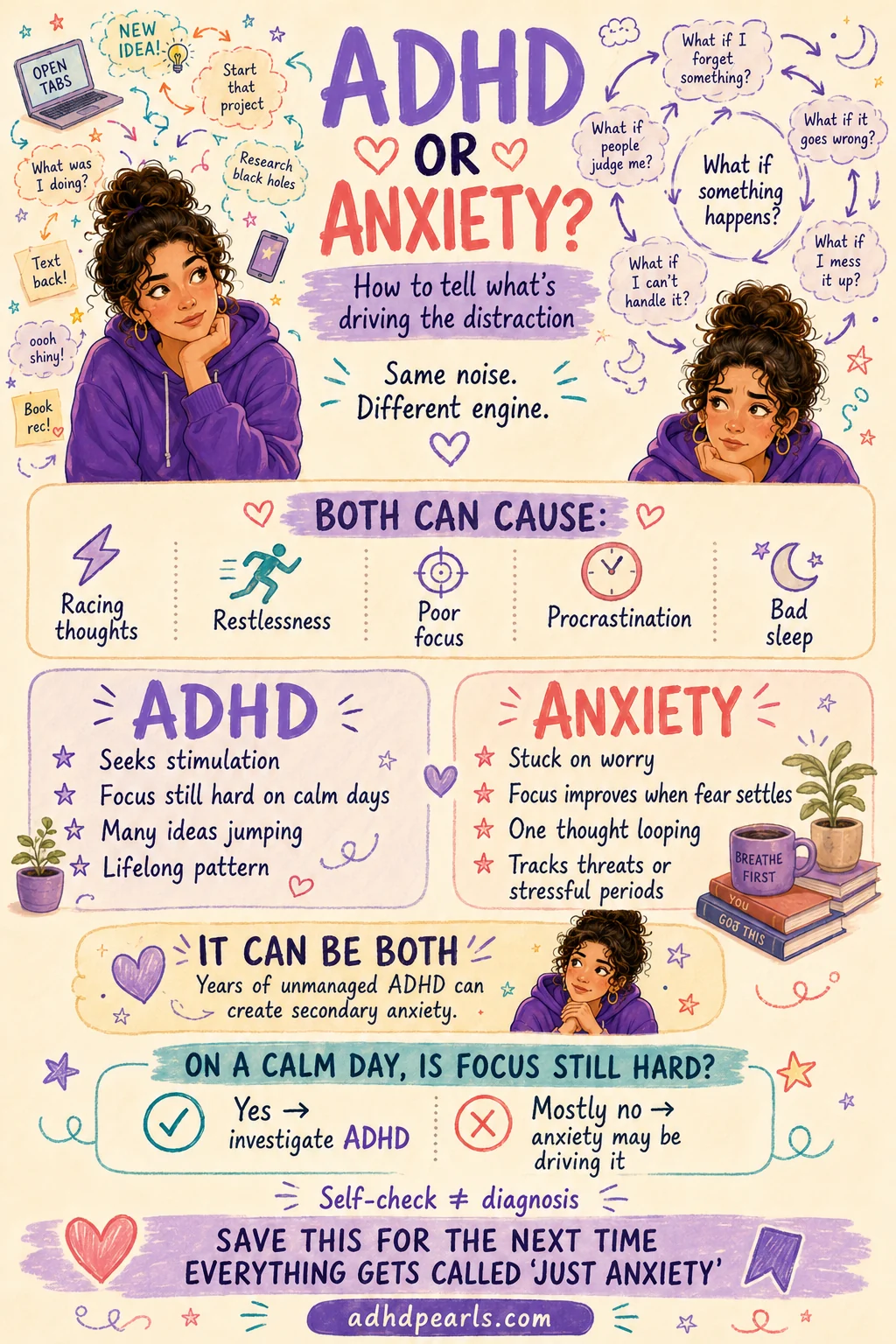
They overlap a lot - both bring racing thoughts, restlessness, trouble focusing and bad sleep - so they're easy to confuse. The clearest difference is what's driving it: ADHD inattention is a brain reaching for something more stimulating, while anxiety inattention is a brain stuck on worry. ADHD struggles to focus even when you're calm; anxiety mostly derails focus when fear kicks in. ADHD is lifelong and everywhere, while anxiety tends to track specific threats. You can absolutely have both - many women do - so a clinician is the one who can sort it out.
Key takeaways
📌Both bring racing thoughts, restlessness, poor focus and bad sleep. The overlap is genuine.
📌The difference is the driver: ADHD reaches for stimulation, anxiety is pushed by threat.
📌They commonly coexist, and anxiety is often a coping layer built on top of undiagnosed ADHD.
📌Women are disproportionately told it is “just anxiety” and treated for the layer rather than the cause.
📌Track when it started and in which situations. That history is what a clinician actually needs.
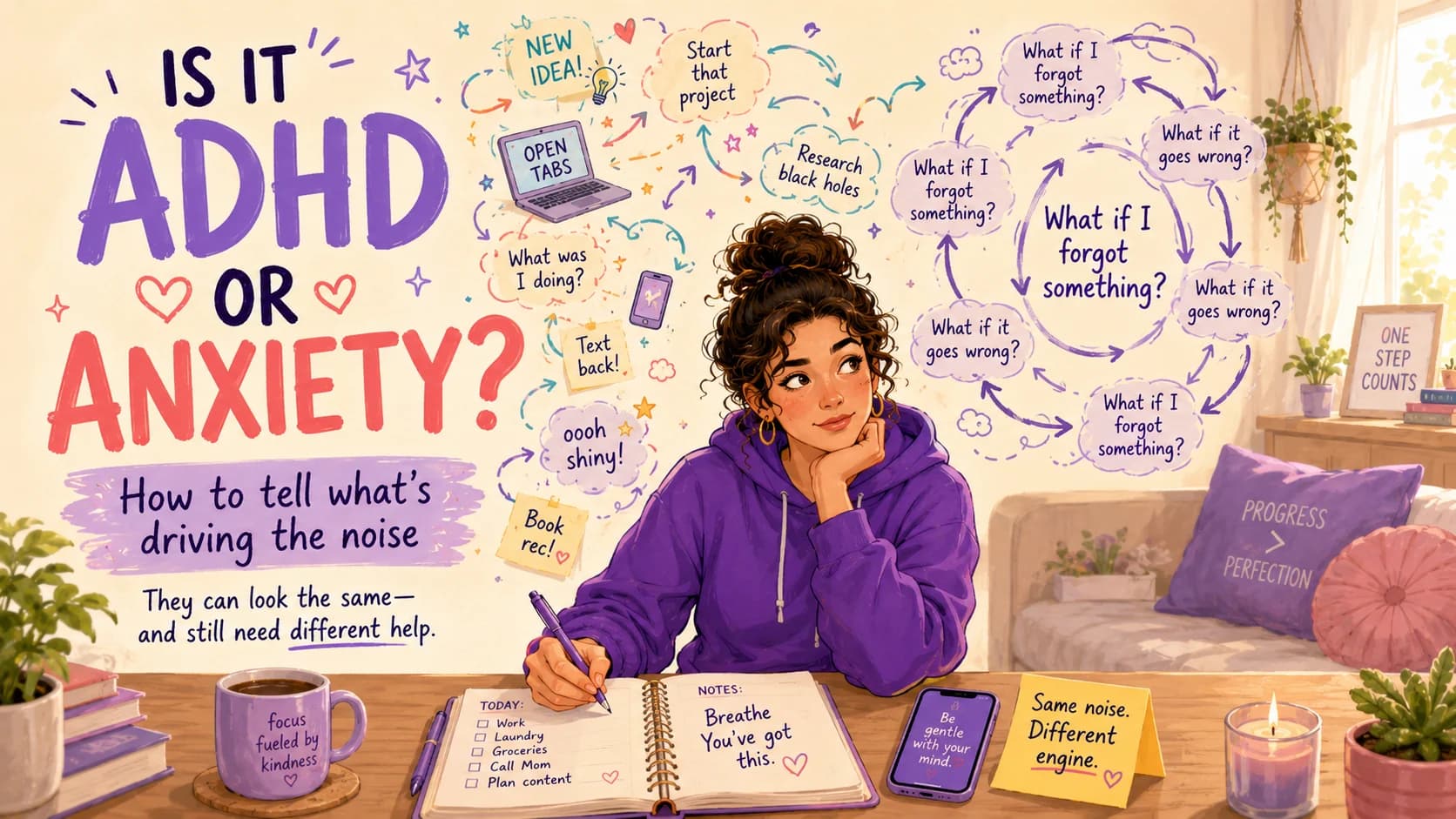
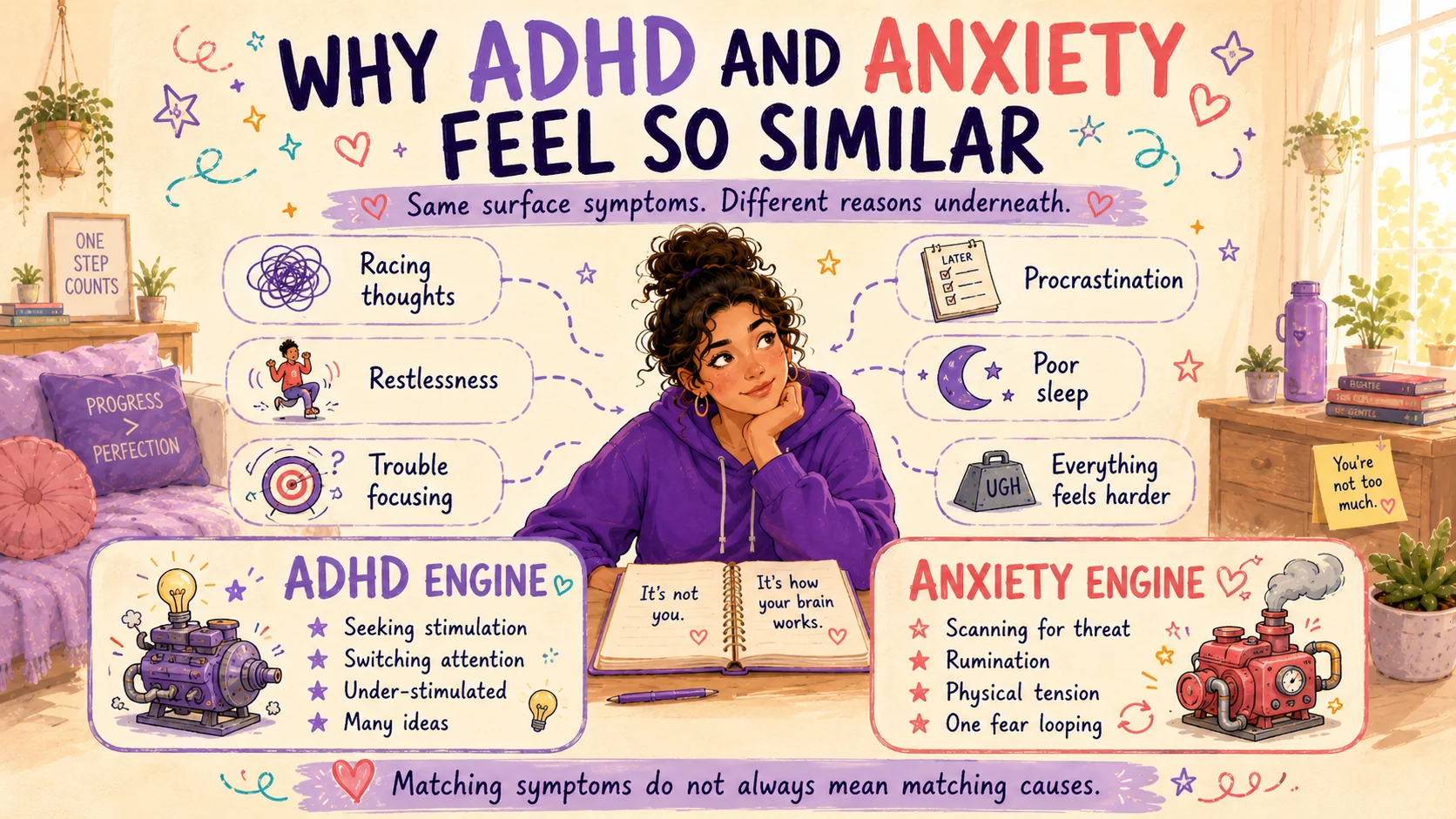
Because they share an overlap zone: racing thoughts, restlessness, trouble concentrating, procrastination, poor sleep, and that low hum of "why is everything so much effort." From the inside, a noisy ADHD brain and an anxious brain can feel almost identical - mentally loud, physically restless, and frustrated with yourself.
That's exactly why they get mixed up, and why so many people get handed the anxiety label first. Anxiety is the more familiar word, and the surface symptoms match. But matching symptoms don't mean matching causes.
I wasn't an anxious person who couldn't focus. I was an unfocused brain that got anxious about not being able to focus.
ADHD and anxiety can create similar surface symptoms even when the underlying attention and threat systems work differently.
From ADHD Pearls
Perlova — plan from the energy you actually have
One doable next step, wins without streaks, and routines that fit real ADHD life. No card, no shame.
What's the Real Difference Between ADHD and Anxiety?
The clearest tell is the engine underneath the symptom. Same restlessness, different reason.
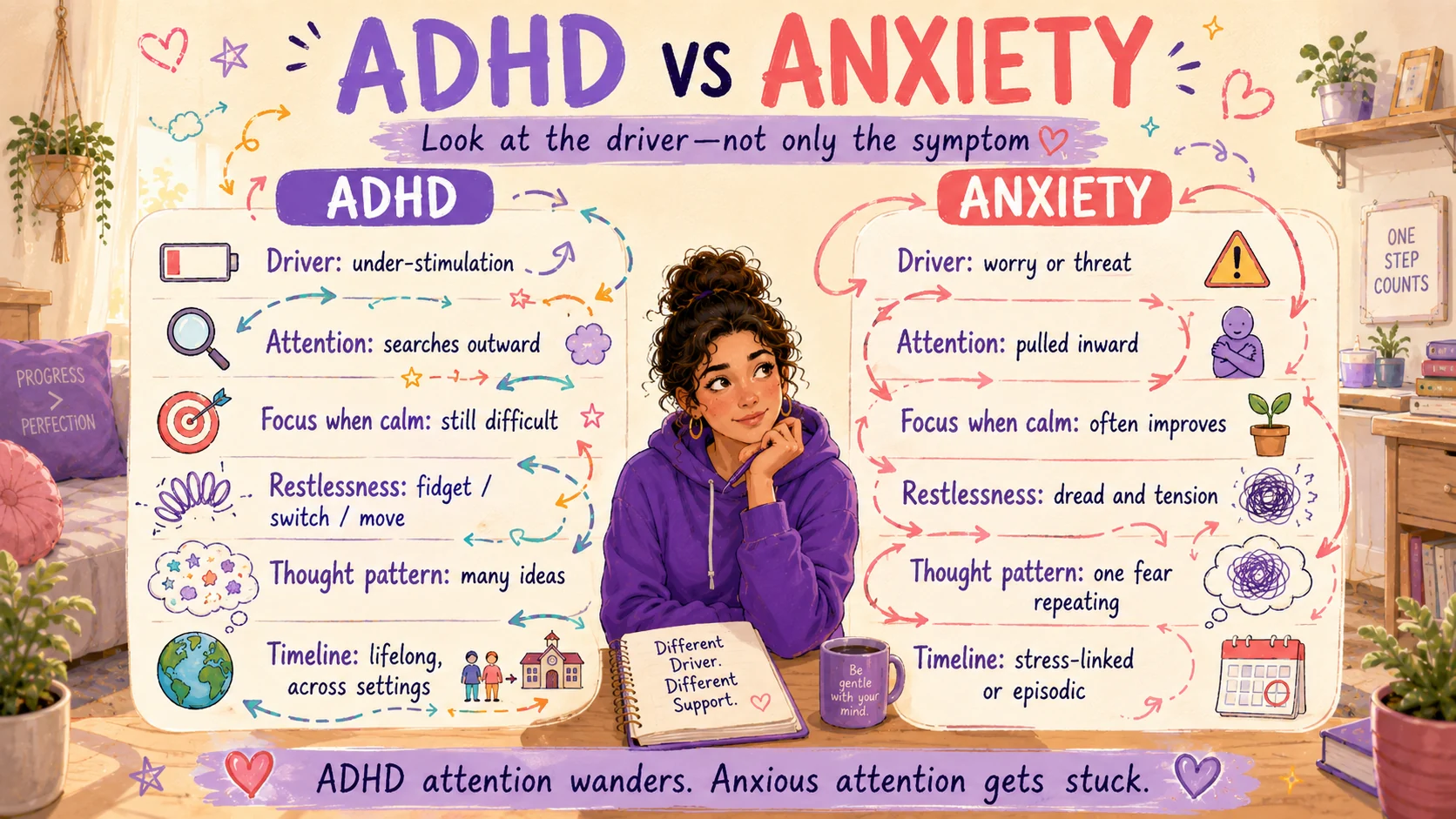
With ADHD, your attention wanders because your brain is under-stimulated and hunting for something more interesting. With anxiety, your attention wanders because your brain is over-stimulated and stuck on a worry. One is reaching outward for stimulation; the other is spiralling inward on a threat.
A few practical ways they separate out:
ADHD
Anxiety
What drives it
Under-stimulation, seeking interest
Worry, fear, rumination
Focus when calm
Still hard - even relaxed, boring tasks slip
Usually fine once the worry settles
The restlessness
Needs to move, fidget, switch tasks
Tied to dread and physical tension
Since when
Lifelong, since childhood, everywhere
Often tracks specific stressors or periods
Racing thoughts are…
Lots of ideas, jumping between topics
The same fear, looping
ADHD attention tends to search outward for stimulation, while anxious attention becomes captured by worry or perceived threat.
If your focus is a problem even on calm, low-stakes days - not just when you're stressed about something specific - that points more toward ADHD. If the trouble shows up mainly when worry takes over and eases when the worry does, that leans anxiety. It's a similar untangling to telling ADHD apart from plain laziness: look at the driver, not just the surface.
Can You Have Both ADHD and Anxiety?
Yes - and it's extremely common. The National Comorbidity Survey Replication found that about 47% of adults with ADHD also have an anxiety disorder, far above the general population. So "ADHD or anxiety?" is often the wrong question. The real one is "ADHD, anxiety, or both - and which is driving which?"
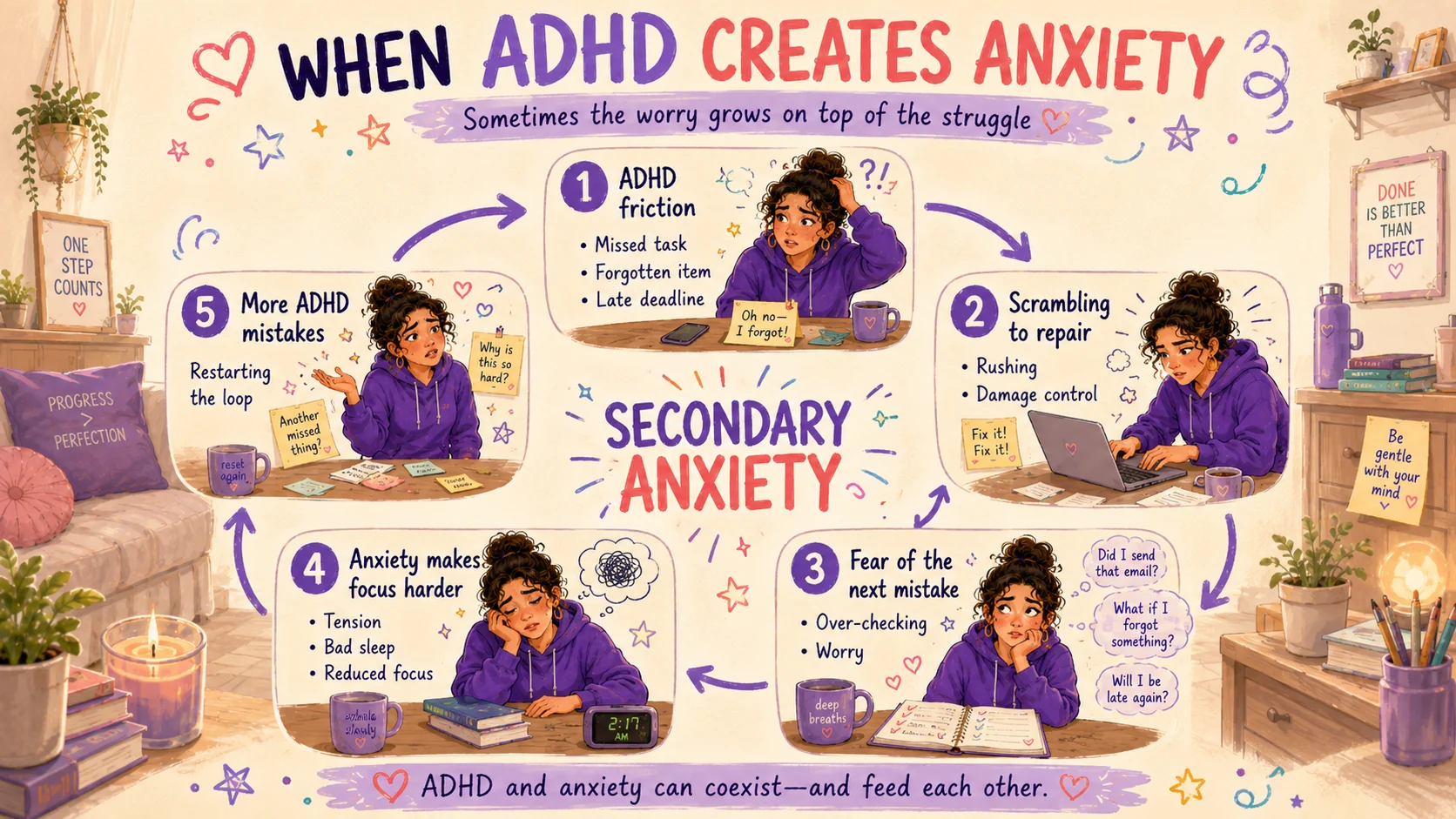
There's also a specific pattern worth knowing: secondary anxiety. When you spend years missing deadlines, forgetting things and scrambling to cover for a brain nobody explained to you, anxiety is a completely reasonable response. The worry isn't the root problem - it grew on top of an unmanaged ADHD brain. Treat only the anxiety and you're bailing water without patching the hole.
Repeated ADHD friction can create secondary anxiety, and the resulting worry can make attention and follow-through even harder.
Why Do Women Get Told It's "Just Anxiety"?
Because women's ADHD tends to be internal, and internal looks like anxiety from the outside. Instead of visible hyperactivity, it shows up as overthinking, forgetfulness, overwhelm, and emotional intensity - and emotional dysregulation, a core ADHD trait, is very easily read as anxiety.
Add decades of masking - the lists, the over-preparing, the double-checking to look like you have it together - and the ADHD stays hidden while the exhaustion and worry show. So a lot of women get an anxiety diagnosis, get treated for anxiety, and quietly wonder why it never fully lands. If that's you, you're in very good company - more on that in the real things women with ADHD experience every day and how to know if you have ADHD. Being treated for anxiety for years while the ADHD goes unnamed is one of the most common routes to a late diagnosis - why ADHD gets missed in women covers how that happens.
How Do I Figure Out Which One It Is?
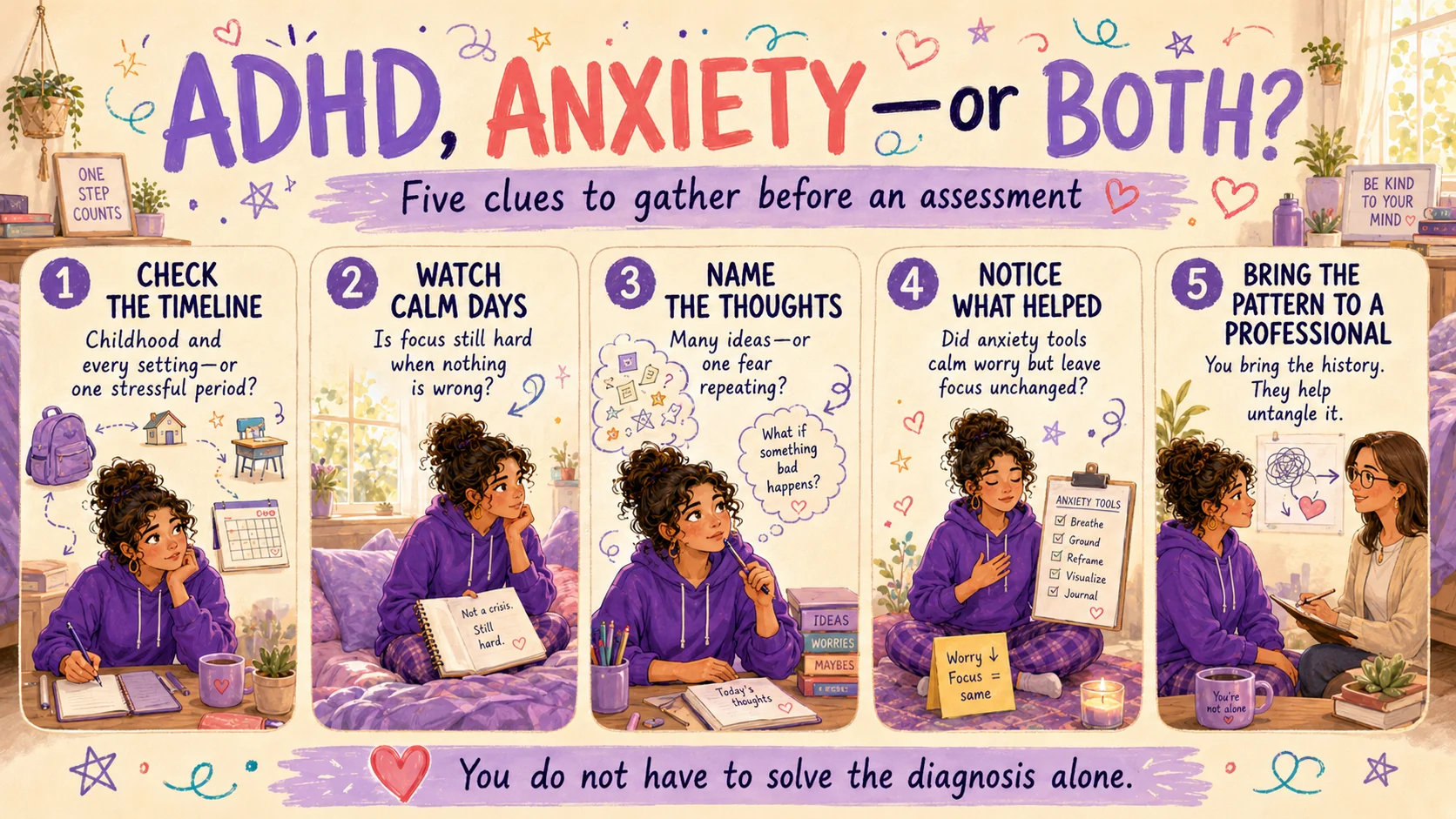
You don't have to solve it alone or tonight. But you can gather useful evidence before you talk to someone:
Check the timeline. Has the focus and restlessness been there since childhood, across every setting - or did it start with a stressful period? Lifelong and everywhere leans ADHD.
Watch calm days. On a genuinely low-stress day, is focus still hard? ADHD doesn't take days off; anxiety often eases when the threat does.
Name the thoughts. Are they many different ideas pulling you around (ADHD), or one fear on a loop (anxiety)?
Notice what treatment helped. If anxiety tools helped a little but never fixed the focus, that gap is worth mentioning.
Bring it to a professional. A good assessment looks for patterns over time, not just today's symptoms, and can untangle ADHD, anxiety, or both - and treat the right thing.
Patterns across time, calm days and previous treatment can give a clinician better evidence than one difficult week.
Getting the label right isn't about box-ticking. It changes the plan - and often, finally, what actually works.
Save this ADHD-versus-anxiety guide for the next time everything gets called just anxiety.
You're not too anxious, too much, or too broken. You might just have a brain that was described with the wrong word for a long time. That's a very fixable kind of wrong.
FAQ: ADHD or Anxiety
Is it ADHD or anxiety?
They share symptoms - racing thoughts, restlessness, trouble focusing, poor sleep - but differ in what drives them. ADHD inattention comes from a brain seeking stimulation; anxiety inattention comes from worry. ADHD is also lifelong and present even on calm days, while anxiety tends to track specific stressors. Only a clinician can confirm which (or both) you have.
Can ADHD be mistaken for anxiety?
Very often, especially in women. Emotional intensity, overwhelm and mental restlessness from ADHD look a lot like anxiety, so many women are diagnosed and treated for anxiety while the underlying ADHD goes unnoticed for years.
How do I know if I have ADHD, anxiety, or both?
Look at the pattern over time, not a single symptom. Ask whether the focus problems are lifelong and present even when you're relaxed (leans ADHD), or mostly appear with worry and ease when it passes (leans anxiety). Because roughly half of adults with ADHD also have anxiety, "both" is a common answer - a professional assessment can tell them apart.
Does ADHD cause anxiety?
It can contribute to it. Years of struggling with a brain nobody explained - missed deadlines, forgotten plans, constant catch-up - is a reasonable thing to become anxious about. This is sometimes called secondary anxiety: the worry grows on top of unmanaged ADHD rather than existing on its own.
What's the main difference between ADHD and anxiety?
The engine underneath. ADHD attention wanders toward something more stimulating; anxious attention gets stuck on a fear. A useful test: on a calm, low-stakes day, is focus still hard? If yes, that points more to ADHD than to anxiety.
Why do women with ADHD get diagnosed with anxiety instead?
Women's ADHD is often internal - overthinking, forgetfulness, overwhelm, emotional dysregulation - rather than visible hyperactivity, and those internal symptoms read as anxiety. Masking hides the ADHD while the worry and exhaustion show, so anxiety becomes the label that sticks.
Can anxiety medication help ADHD?
It may ease anxiety symptoms but it does not treat ADHD itself. If anxiety treatment helps a bit but the focus and follow-through problems remain, that gap is worth raising with a professional, because the ADHD may need its own approach. Always discuss medication decisions with a qualified clinician.
Should I see someone if I'm not sure?
Yes, if it's affecting your work, relationships, sleep or wellbeing. You don't need to have it figured out first - that's the clinician's job. Bringing your history and your questions is more than enough to start.
One tap makes ADHD Pearls a preferred source in your Google account, so our articles surface higher when you search. No signup, and it brings you straight back to this page.
Here's why other planners didn't stick
They assume you'll show up the same every day. Perlova starts with how you feel right now.
Other ADHD planners
×Ask you to plan ahead, when your brain isn't there yet
×Assume you have consistent energy every day
×Show you everything you're already behind on
×Fall apart the first time you miss a day
×Require willpower just to open them
Perlova
✓Starts with your energy right now — not a perfect plan
For the woman who sets up the perfect system on Sunday and abandons it by Tuesday.
One short letter, every week. Real talk about ADHD, task paralysis, and the tiny wins that actually move the needle for a brain like yours. No shame. No hustle culture.