For about twenty years, I thought I was just a disorganized person who needed to try harder.
I had the planners. So many planners. I had the color-coded calendar, the productivity podcasts, the 6am routine I started roughly four hundred times. And I was still losing my keys, missing the dentist, crying in the car because I could not understand why everyone else seemed to be running their life on the normal setting and I was running mine on hard mode with the volume up.
Nobody ever said the word ADHD to me. I was a girl who got decent grades and apologized a lot. I did not fit the picture.
If you have landed on this article, some part of you is already asking the question. So let's look at it gently, together.
This article is personal and educational. It is not medical advice or a diagnosis. Only a qualified clinician can diagnose ADHD, and conditions like anxiety, depression, thyroid issues, sleep problems and perimenopause can look similar. If this resonates, please bring it to a professional.
Quick answer
How do I know if I have ADHD?
You can't confirm it from an article - only a clinician can diagnose ADHD. But the strongest signals are a lifelong pattern (not a recent one) of trouble with focus, organization, time and emotions that follows you everywhere, that you've been quietly compensating for, and that feels like effort failing rather than not trying. If several of these have been true since childhood, it's worth a professional assessment - and it's never too late.
Key takeaways
🧠ADHD in women is often inattentive and masked - quiet and internal, easily mistaken for anxiety or stress.
📌An estimated 50 to 75 percent of women with ADHD are undiagnosed.
🌀Versus stress: stress is temporary; ADHD is lifelong and follows you everywhere.
🔋Versus laziness: you want to do it and feel awful that you can't - that's executive dysfunction, not character.
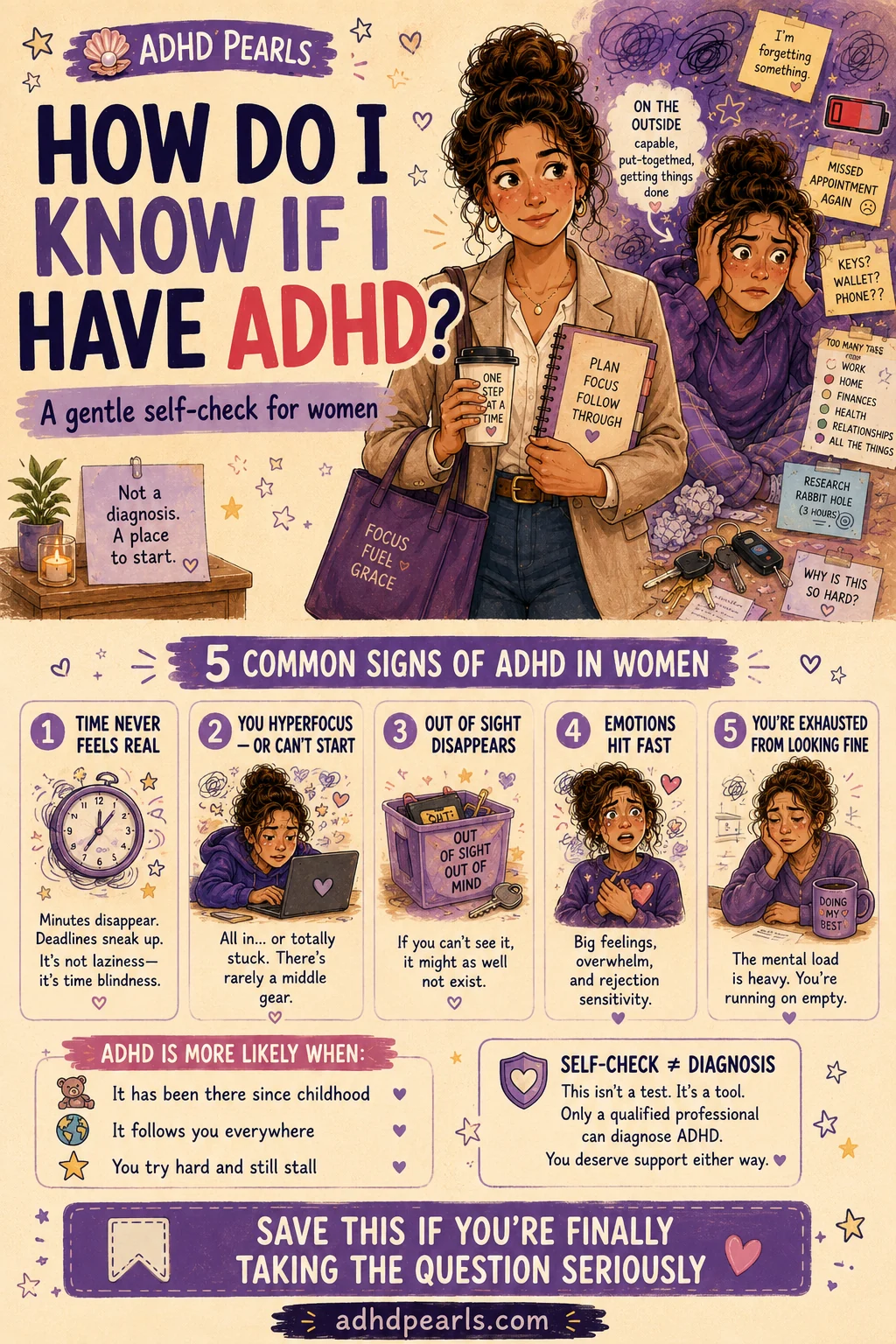
🩺A self-check is a starting point, not a diagnosis. Only a clinician can confirm it.
Not like the hyperactive boy bouncing off the walls. That stereotype is exactly why so many of us got missed.
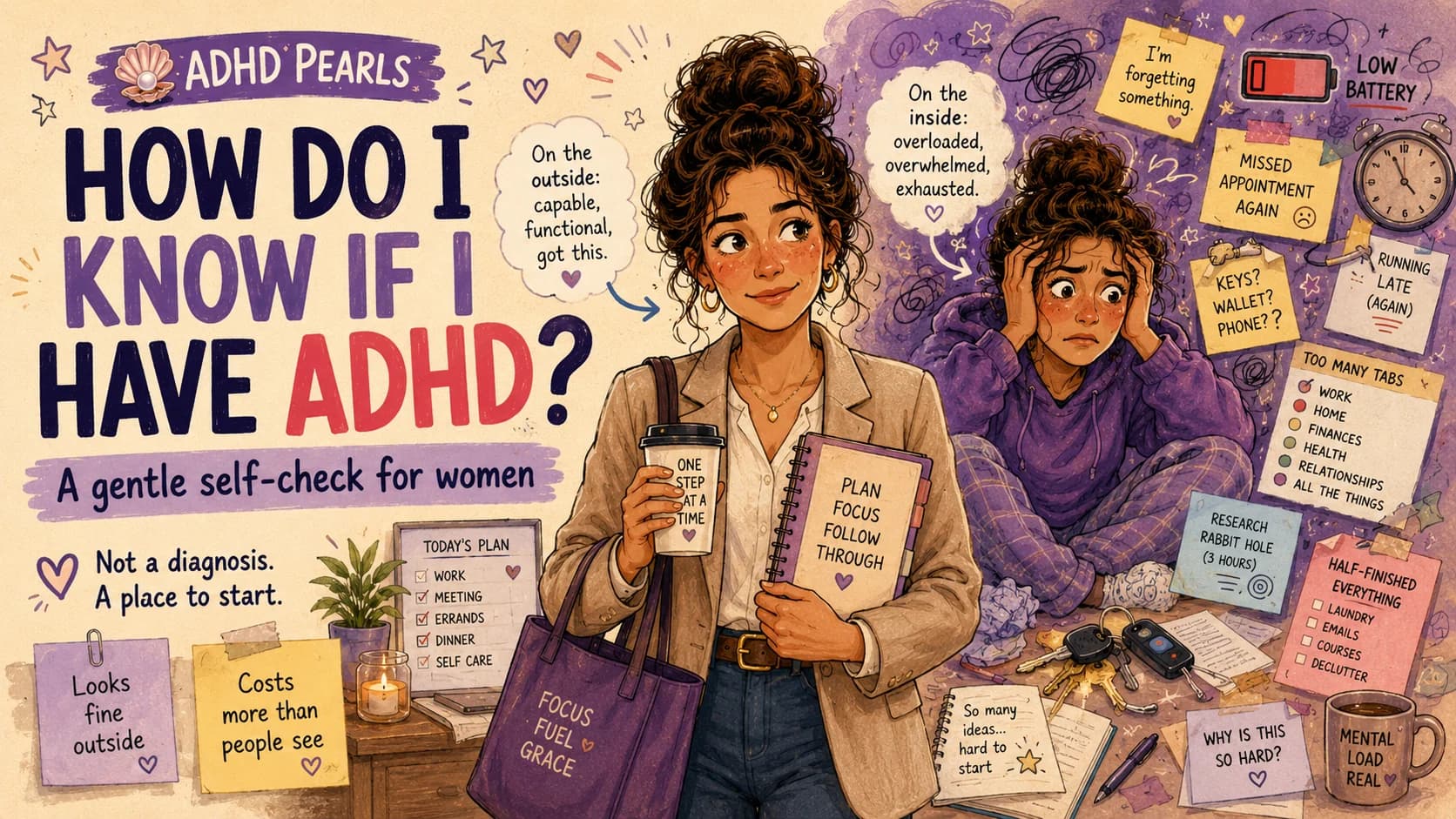
In women, ADHD is usually quieter and more internal. The hyperactivity, if it's there at all, lives in your head - a brain that will not stop, a constant background hum of "I'm forgetting something." It often hides behind anxiety, perfectionism, and a truly heroic amount of effort spent looking like you have it together.
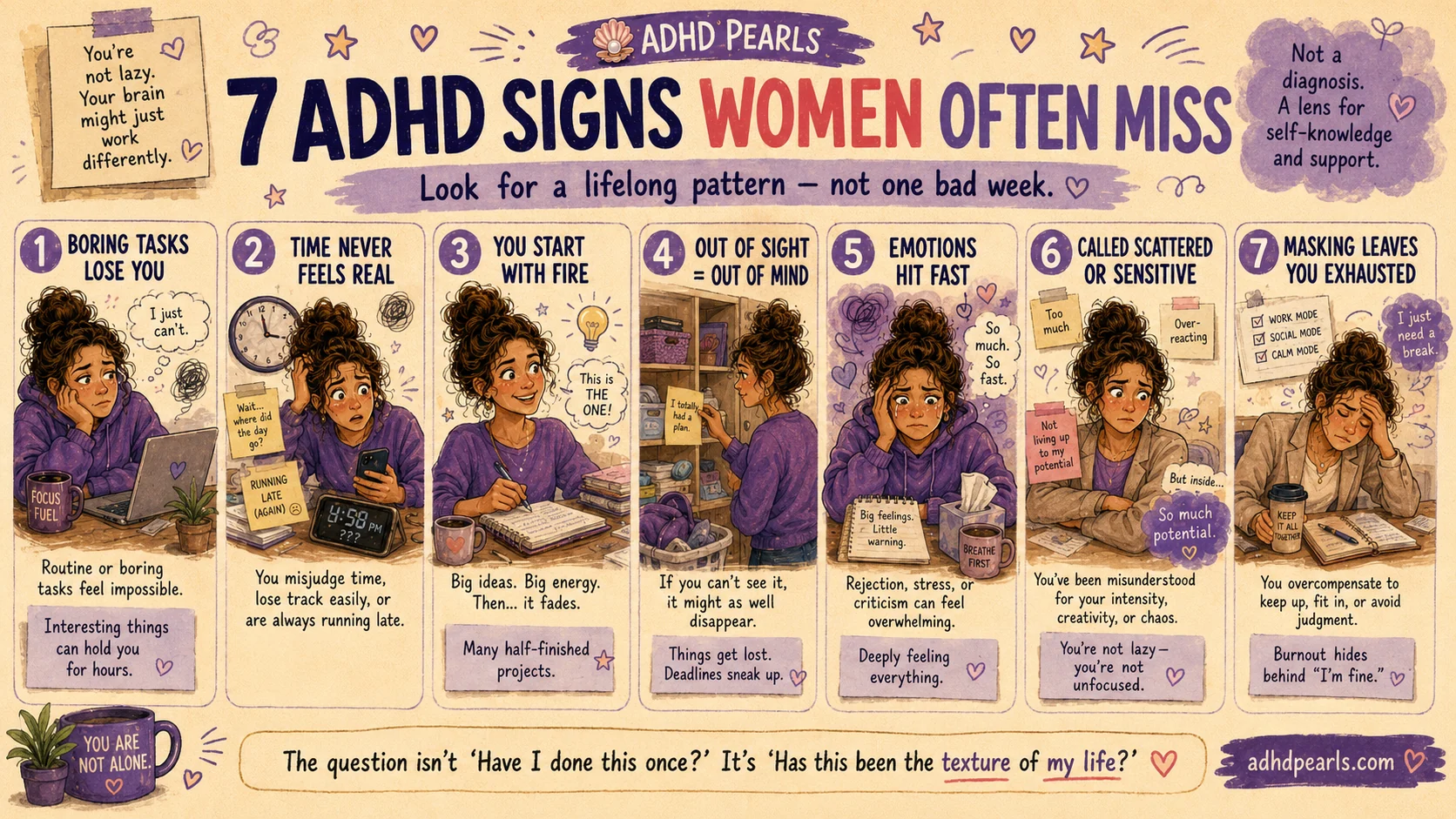
Here's a gentle self-check. Read these slowly. The question isn't "have I done one of these once" - everyone has. It's "has this been the texture of my whole life, across every setting?"
You lose focus on boring or detailed things, then hyperfocus so hard on something interesting that you forget to eat.
You're chronically late, or anxiously early, because time doesn't feel real until it's right on top of you.
You start projects with a burst of fire and abandon a graveyard of half-finished ones.
You forget appointments, replies, and birthdays - not because you don't care, but because out of sight is genuinely out of mind.
Your emotions arrive fast and big, and rejection or criticism can wreck your whole day.
You've been called sensitive, scattered, dramatic, or "so much potential if you'd just apply yourself."
You're exhausted in a way that doesn't match your life, because masking is a full-time unpaid job.
The useful question is not whether one sign happened once, but whether the pattern has followed you throughout your life.
If you read that list and felt a little exposed - or a little teary - you're not alone, and you're not broken. You might just be running a brain nobody handed you the manual for. Many women describe this exact moment in the small daily experiences of ADHD. (If you are reading this about someone else rather than yourself, the signs to look for in a partner is the better starting point.)
I wasn't failing at being organized. I was succeeding, quietly and exhaustingly, at hiding that I couldn't be.
From ADHD Pearls
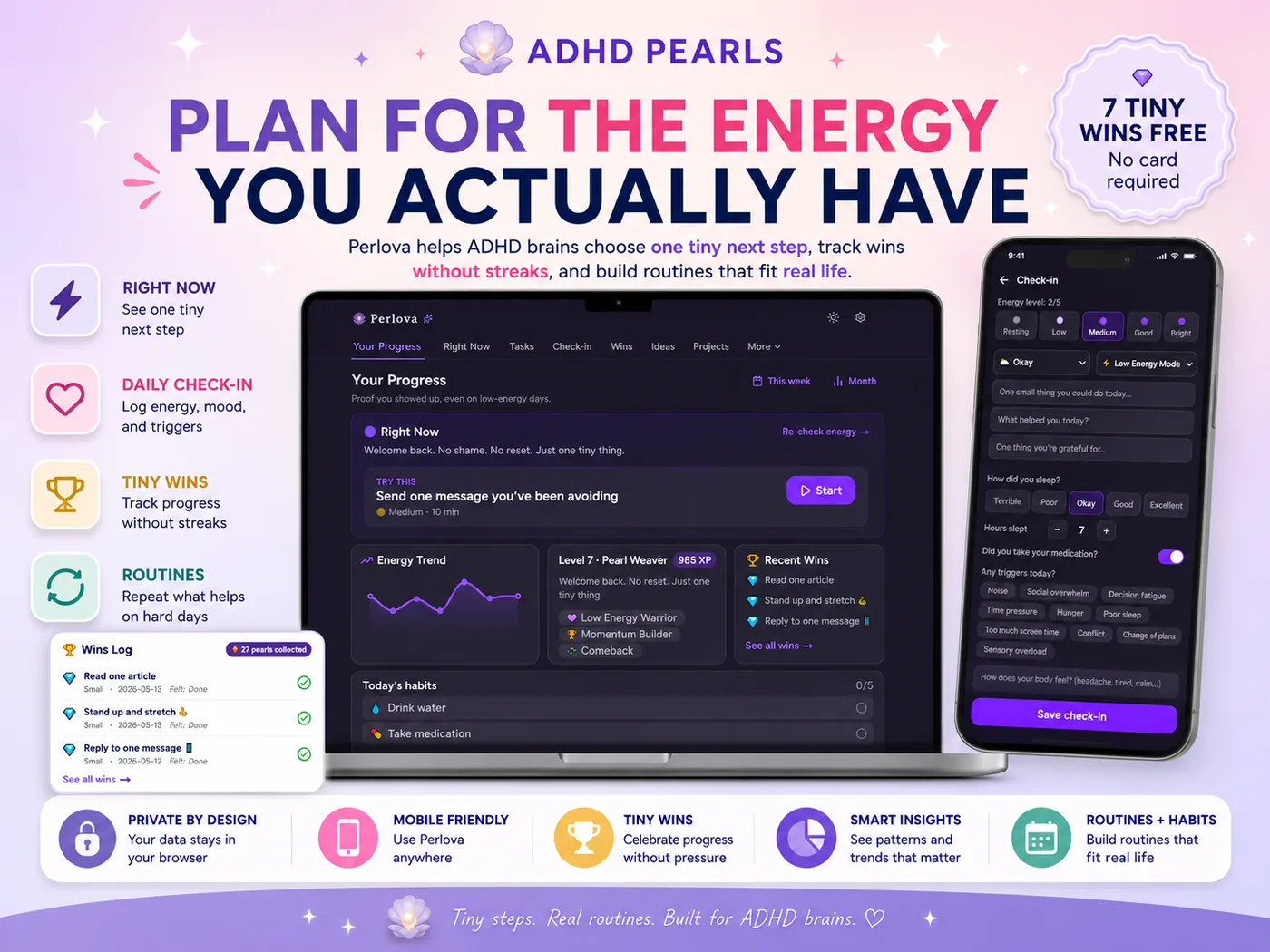
Perlova — plan from the energy you actually have
One doable next step, wins without streaks, and routines that fit real ADHD life. No card, no shame.
This is the question that kept me stuck for years, because honestly, who isn't stressed and busy?
The cleanest way to tell them apart is the timeline. Stress is a response to a situation - it ramps up under pressure and eases when the pressure lifts. If your focus and overwhelm melt away on a quiet holiday and only roar back when real life restarts, stress is the more likely driver.
ADHD doesn't take the holiday. It's a lifelong, brain-based pattern that travels with you into the calm weeks too. The forgetfulness, the time blindness, the half-finished projects - they're there whether your life is hard right now or easy.
So the question to sit with isn't "am I struggling lately?" It's "has this been true since I was a kid, even in the good, low-stress stretches?" That single reframe is often the whole answer.
Is It ADHD, or Am I Just Lazy?
I want to gently take this one apart, because I carried "lazy" like a name tag for most of my life.
Here's the actual difference. Laziness is not wanting to do the thing, choosing not to, and feeling basically fine about it. There's no inner war. There's no guilt at 2am.
ADHD is the opposite. You want to do the thing. You care, sometimes desperately. You try. And you still can't make yourself start, or finish, and then you lie awake feeling like garbage about it. That gap - between what you intend and what your brain will actually let you do - has a name. It's executive dysfunction, and it's a difference in the brain's self-management system, not a flaw in your work ethic.
People who are genuinely lazy do not spend hours researching whether they have ADHD at midnight. The fact that you're here, trying to understand yourself, is itself a clue. There's more on this in why task paralysis isn't laziness.
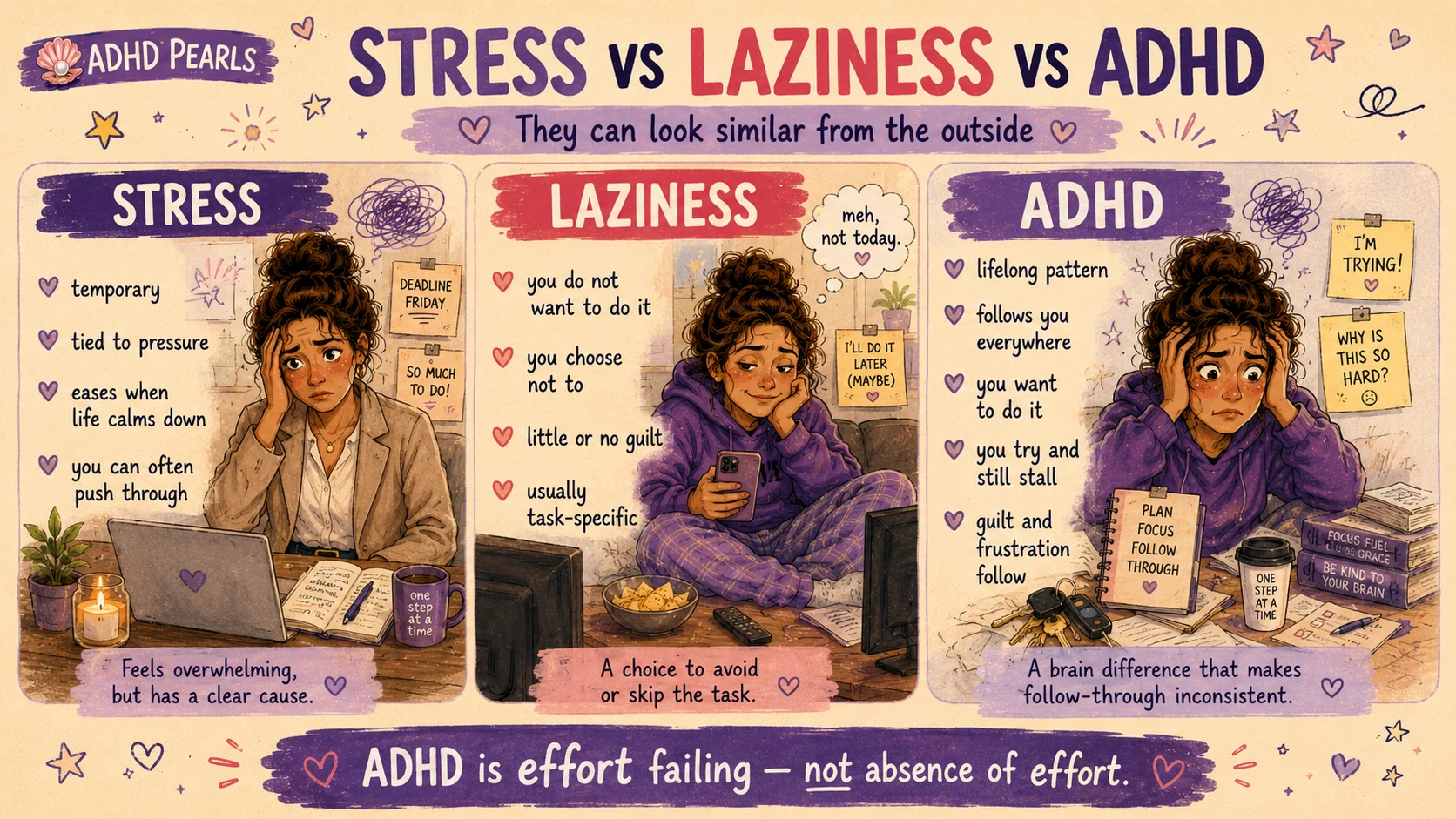
Here's the same idea in one view:
Stress
Laziness
ADHD
How long
Temporary, tied to a situation
Comes and goes by choice
Lifelong, since childhood
Where it shows up
Eases when life calms down
Only on tasks you don't care about
Everywhere, even the calm times
Effort and guilt
You can usually push through
No real effort, no guilt
You try hard, stall anyway, feel awful
Stress usually has a temporary cause; ADHD is a lifelong gap between intention and consistent follow-through.
Why Do So Many Women Miss It for Decades?
Because the whole system was built to miss us. Early ADHD research focused on hyperactive boys, so the official picture - and the diagnostic checklist - was shaped around how it shows up in them. Quiet, inattentive, daydreaming girls slipped straight through.
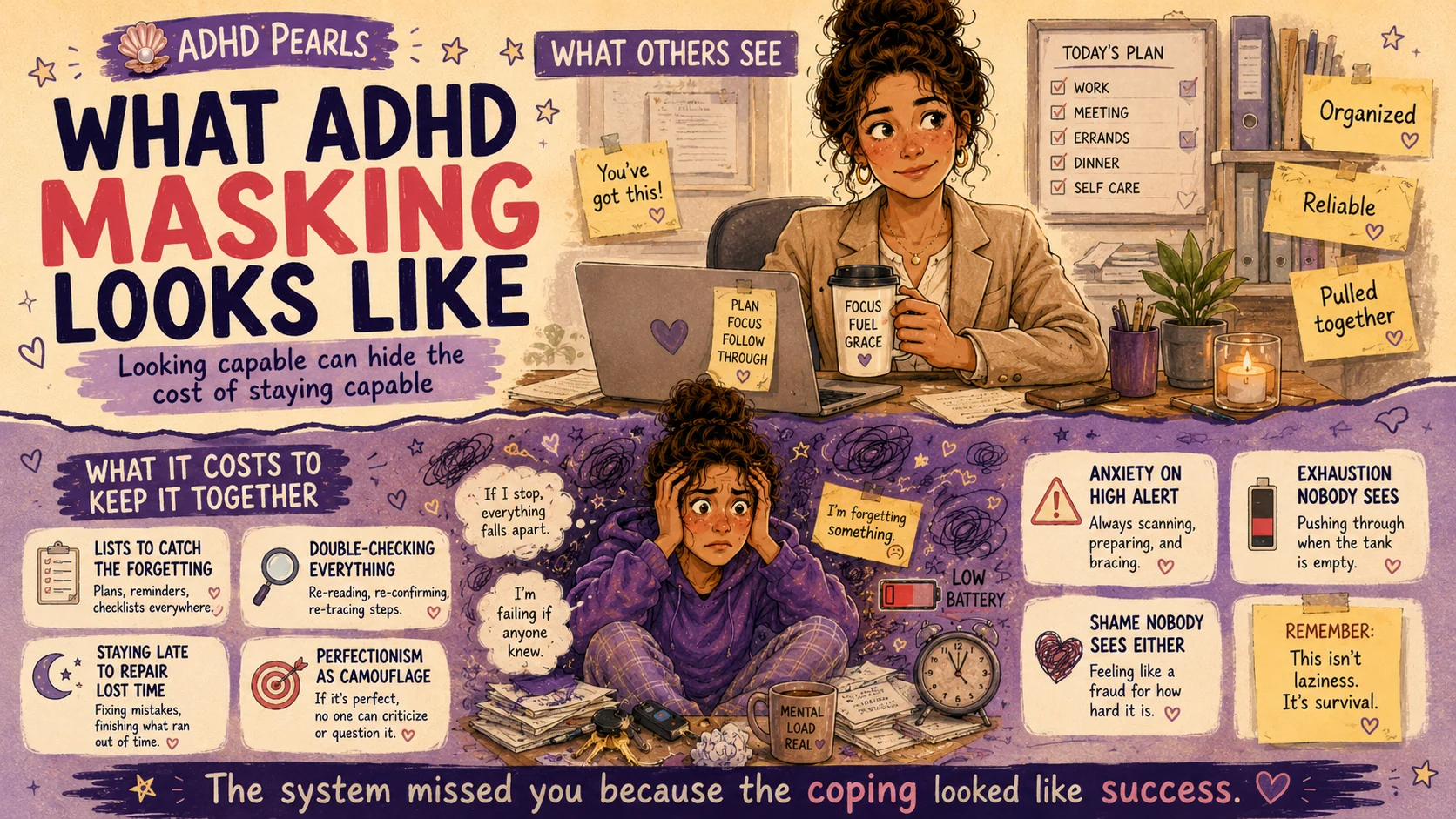
Then there's masking: the constant, often unconscious work of covering the symptoms so you look organized and fine. The lists to catch the forgetting. The double-checking. The staying late to make up for the hours you lost to a brain that wandered off. Masking works, which is exactly the problem - it works so well that nobody, including you, sees the struggle underneath.
Masking can look like success from the outside while requiring anxiety, perfectionism and constant repair underneath.
So women get told they're anxious, or hormonal, or too sensitive. Many aren't identified until their 30s or 40s, often when life load, hormones, or burnout finally overwhelm the coping systems that were holding everything together. If your old systems recently stopped working, that's a real and common pattern - more on it in why your strategies stopped working. And if the question underneath all of this is how nobody spotted it sooner, why ADHD gets missed in girls and women answers that one directly.
None of that lost time was your fault. The map was wrong, not you.
What Do I Do If This Sounds Like Me?
First: breathe. You don't have to overhaul your life tonight. Recognizing the pattern is the whole first step, and you just took it.
It is also worth knowing what the other side looks like, because it surprises people: relief first, and then a stretch where the old shame carries on regardless. That is normal, and it is not a sign the answer was wrong.
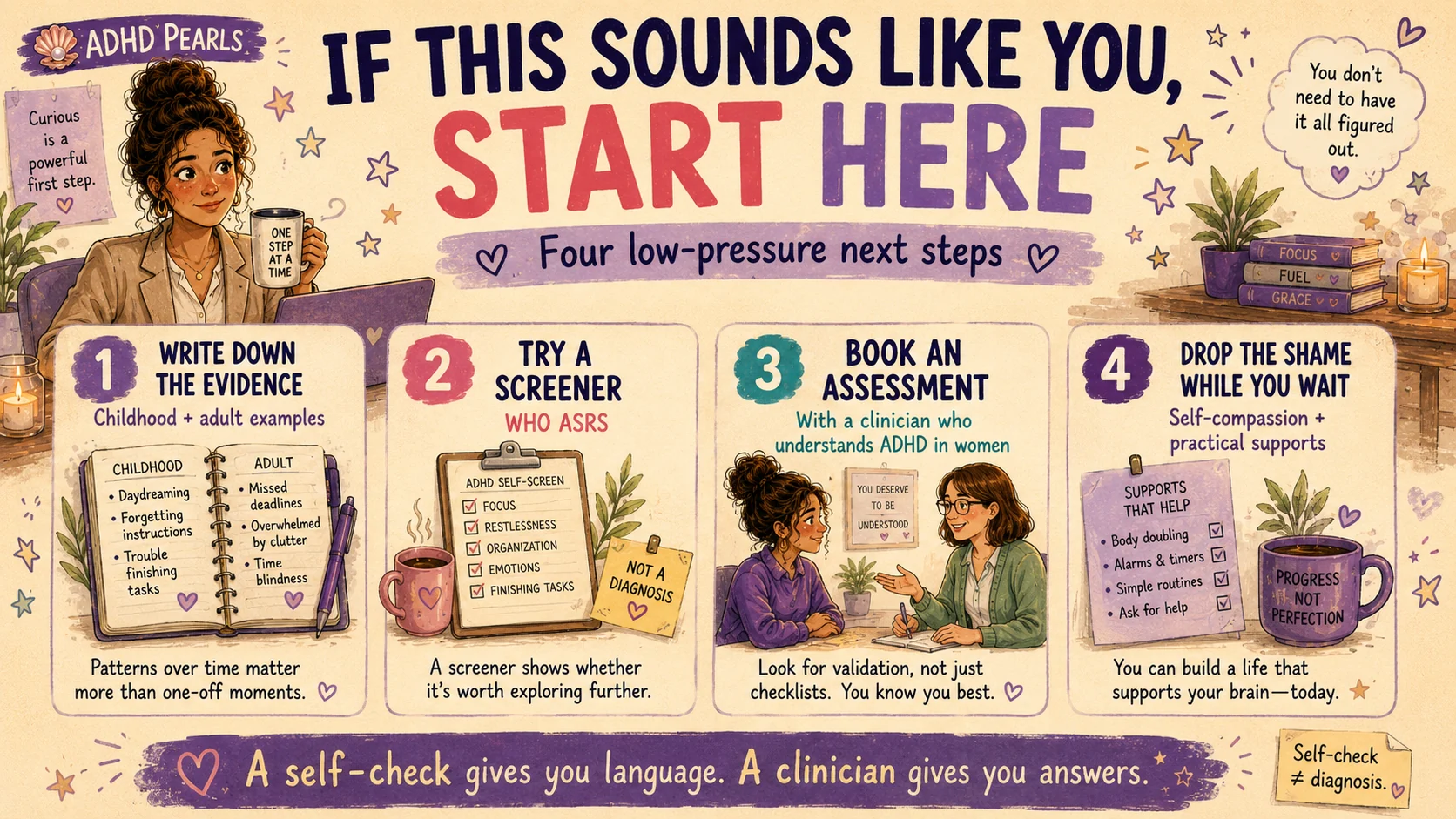
Here's a gentle, low-pressure path from here:
Write down your evidence. Jot the moments from this article that felt like being seen - and examples from childhood, not just now. This is what a clinician will actually ask about.
Try a free screener. A self-test like the WHO ASRS or our own quick ADHD quiz can't diagnose you, but it gives you language and a starting point.
Book an assessment. Talk to your doctor, or a psychologist or psychiatrist who understands adult ADHD in women. Bring your notes so you're taken seriously.
Put down the shame while you wait. You don't need a diagnosis to start being kinder to yourself. The ADHD shame detox is a soft place to begin.
A self-check can give you language and direction, but only a qualified clinician can provide a diagnosis.
And whatever the assessment says, you're allowed to use the strategies that help a brain like this. On the days you can't even start, the free ADHD Stuck Reset is there.
FAQ: How to Know If You Have ADHD
How do I know if I have ADHD as a woman?
You cannot confirm it from an article - only a qualified clinician can diagnose ADHD. But the strongest signals are a lifelong pattern of trouble with focus, organization, time and emotions that follows you across every part of life, that you have been quietly compensating for, and that feels like effort failing rather than not trying. If several of those have been true since childhood, a professional assessment is worth it.
Can I have ADHD without being hyperactive?
Yes. Many women have the inattentive presentation, which looks like daydreaming, forgetfulness, disorganization, mental restlessness and emotional sensitivity rather than visible hyperactivity. Because the old stereotype was a hyperactive boy, quieter inattentive ADHD in women was missed for decades.
Is it ADHD or anxiety?
They overlap and often coexist, which is part of why ADHD in women gets misread as anxiety. A rough tell: anxiety-attention is the brain trapped by worry and over-stimulated, while ADHD-attention is an under-stimulated brain scanning for something more interesting. If restlessness and distraction have been there your whole life, not just during stressful periods, ADHD is worth exploring. A clinician can help untangle it.
Is it ADHD or just stress?
Stress is usually temporary and situational - it eases on holiday or after a deadline passes, then returns with the pressure. ADHD is lifelong and follows you everywhere, including the calm times. If your symptoms disappear when life slows down, stress is more likely; if they travel with you regardless, ADHD may be the root.
Can you have ADHD and not know until adulthood?
Very much so. It is estimated that 50 to 75 percent of women with ADHD are undiagnosed, and many are not identified until their 20s, 30s, 40s or later. Masking, inattentive symptoms and being told they were just sensitive or scattered kept it hidden. Late diagnosis is common and still genuinely helpful.
Do I have ADHD or am I just lazy?
Laziness is not wanting to do the task and feeling fine about skipping it. ADHD is wanting to do it, trying, and still hitting a wall - then feeling guilt and frustration that you could not. That gap between intention and action is executive dysfunction, a brain-based difference, not a character flaw.
How do I get tested for ADHD as an adult?
Start with your doctor or a psychologist or psychiatrist experienced in adult ADHD, ideally someone who understands how it presents in women. There is no single test - assessment usually involves questionnaires, your history since childhood, and ruling out overlapping conditions. Free screeners like the WHO ASRS can be a useful conversation starter, but they are not a diagnosis.
Is it worth getting an ADHD diagnosis later in life?
For many women, yes. Research on late-diagnosed women describes the experience as revelatory - their lives finally making sense, with relief and improved self-esteem after years of internalized criticism. A diagnosis can open the door to support, strategies and self-compassion, whatever you decide about medication.
Save this gentle ADHD self-check for when you are ready to take the question seriously.
You're Allowed to Take the Question Seriously
For most of my life, I treated "maybe it's ADHD" like a thought I wasn't allowed to have - too dramatic, too convenient, too much. Naming it didn't make me more broken. It made twenty confusing years finally make sense.
You don't need permission, and you're not being dramatic. You're a woman paying close attention to her own life. Wherever the answer lands, that's a good and brave place to start.
One tap makes ADHD Pearls a preferred source in your Google account, so our articles surface higher when you search. No signup, and it brings you straight back to this page.
Here's why other planners didn't stick
They assume you'll show up the same every day. Perlova starts with how you feel right now.
Other ADHD planners
×Ask you to plan ahead, when your brain isn't there yet
×Assume you have consistent energy every day
×Show you everything you're already behind on
×Fall apart the first time you miss a day
×Require willpower just to open them
Perlova
✓Starts with your energy right now — not a perfect plan
For the woman who sets up the perfect system on Sunday and abandons it by Tuesday.
One short letter, every week. Real talk about ADHD, task paralysis, and the tiny wins that actually move the needle for a brain like yours. No shame. No hustle culture.