For a long time I had a private list of grievances: the forgotten plans, the "I'll do it in a minute" that became next week, the way a conversation could lose their attention halfway through a sentence. I'd decided it meant they didn't care enough to try.
Then I started learning about ADHD - for my own reasons - and half my grievance list turned out to be a symptom list. Not an excuse. An explanation. And explanations are the thing that let you actually fix a pattern instead of just resenting it.
If you're quietly wondering "does my partner have ADHD," here's what to look for, why it isn't about caring, and how to raise it without starting a fight.
Quick answer
Does my partner have ADHD?
Maybe - signs include zoning out mid-conversation, chronic lateness, forgetting tasks and promises, unfinished projects, impulsivity, and fast, big emotions, often leaving you carrying most of the mental load. A cluster of these, present since childhood and across every area of life, is worth exploring - but only a professional can diagnose it. The most useful shift is realizing these behaviors usually mean "my brain struggles with this," not "I don't care about you."
Key takeaways
📌Look for a cluster present since childhood and across settings, not one or two traits.
📌Zoning out, lateness, forgotten promises and unfinished projects are not indifference.
📌The parent-child dynamic and the nag-withdraw loop damage the relationship faster than the symptoms do.
📌Raise it outside a conflict, and describe patterns rather than delivering a diagnosis.
📌You cannot make someone get assessed. You can decide what you need either way.
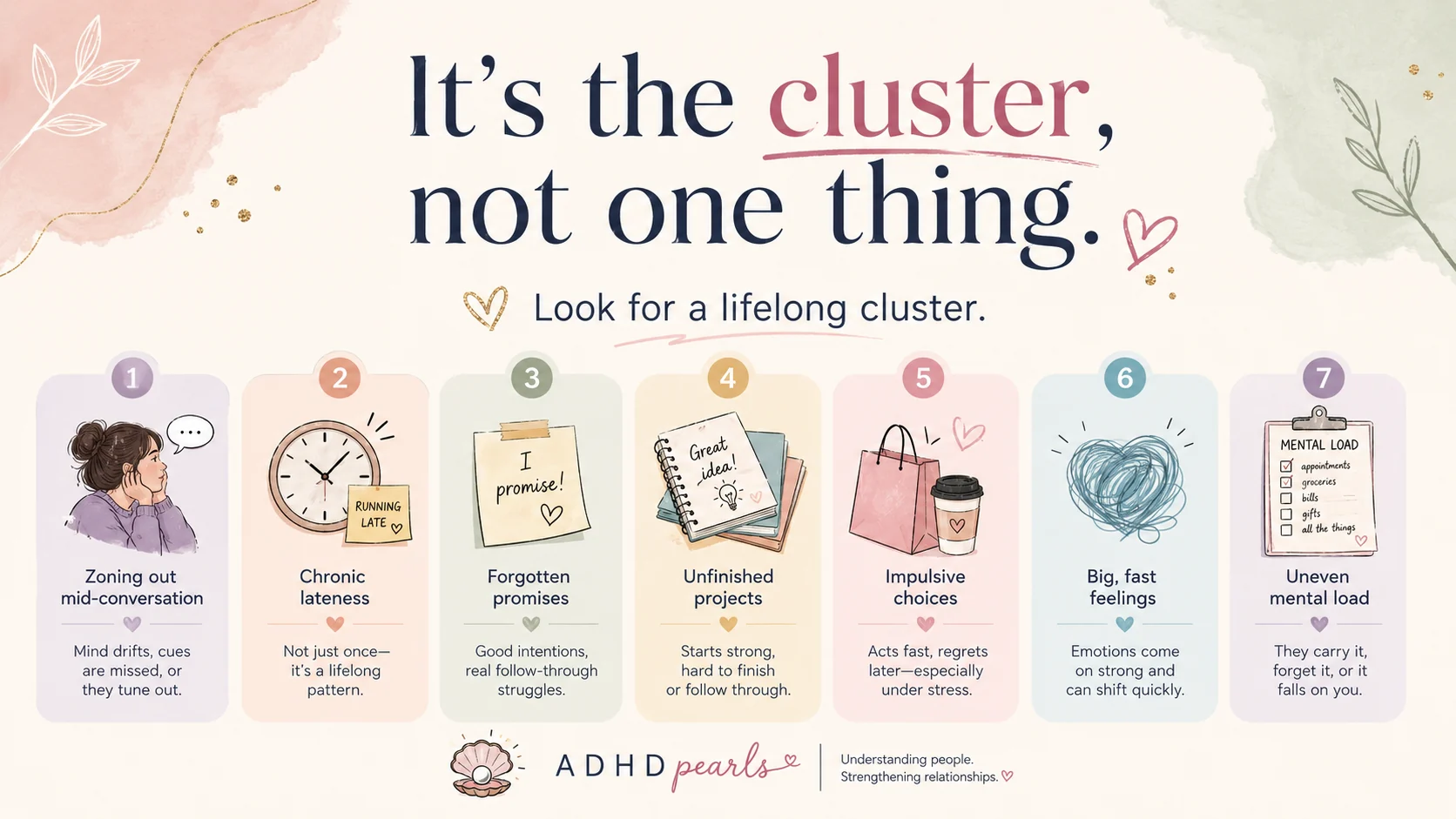
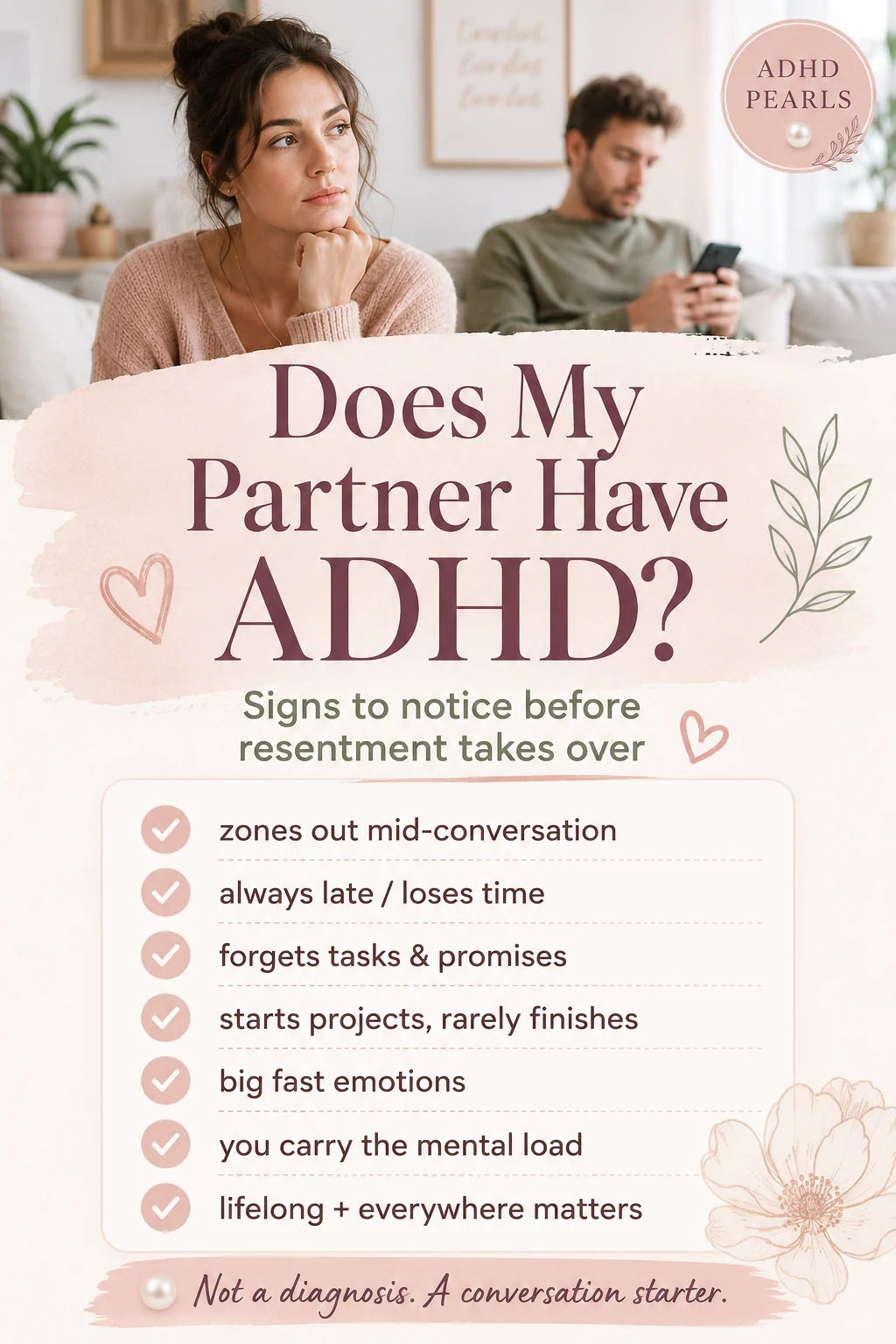
No single one of these means anything on its own - we all lose our keys. It's the cluster, present since childhood and showing up everywhere (not just with you), that's worth noticing:
They drift mid-conversation. Eyes glaze, they miss what you said, or change the subject - even about things they care about.
Time doesn't behave. Chronically late, underestimating how long anything takes, "five more minutes" that is never five minutes.
Forgotten tasks and promises. Sincere in the moment, gone by evening. The bin, the call, the thing they swore they'd handle.
Projects started, not finished. Enthusiasm at the start, a graveyard of half-done things later.
Impulsivity. Sudden purchases, blurted words, plans changed on a whim.
Big, fast feelings. Reactions that spike quickly and land hard - often rejection sensitivity.
You carry the mental load. You're the one remembering, planning, and following up for two.
Reading that list, I recognized my person immediately - and, uncomfortably, a fair bit of myself. Which is common: ADHD is heritable and under-recognized, so a lot of couples turn out to be two differently-wired brains, not one "normal" and one "difficult."
One missed task means very little. A lifelong cluster across many situations tells a different story.
From ADHD Pearls
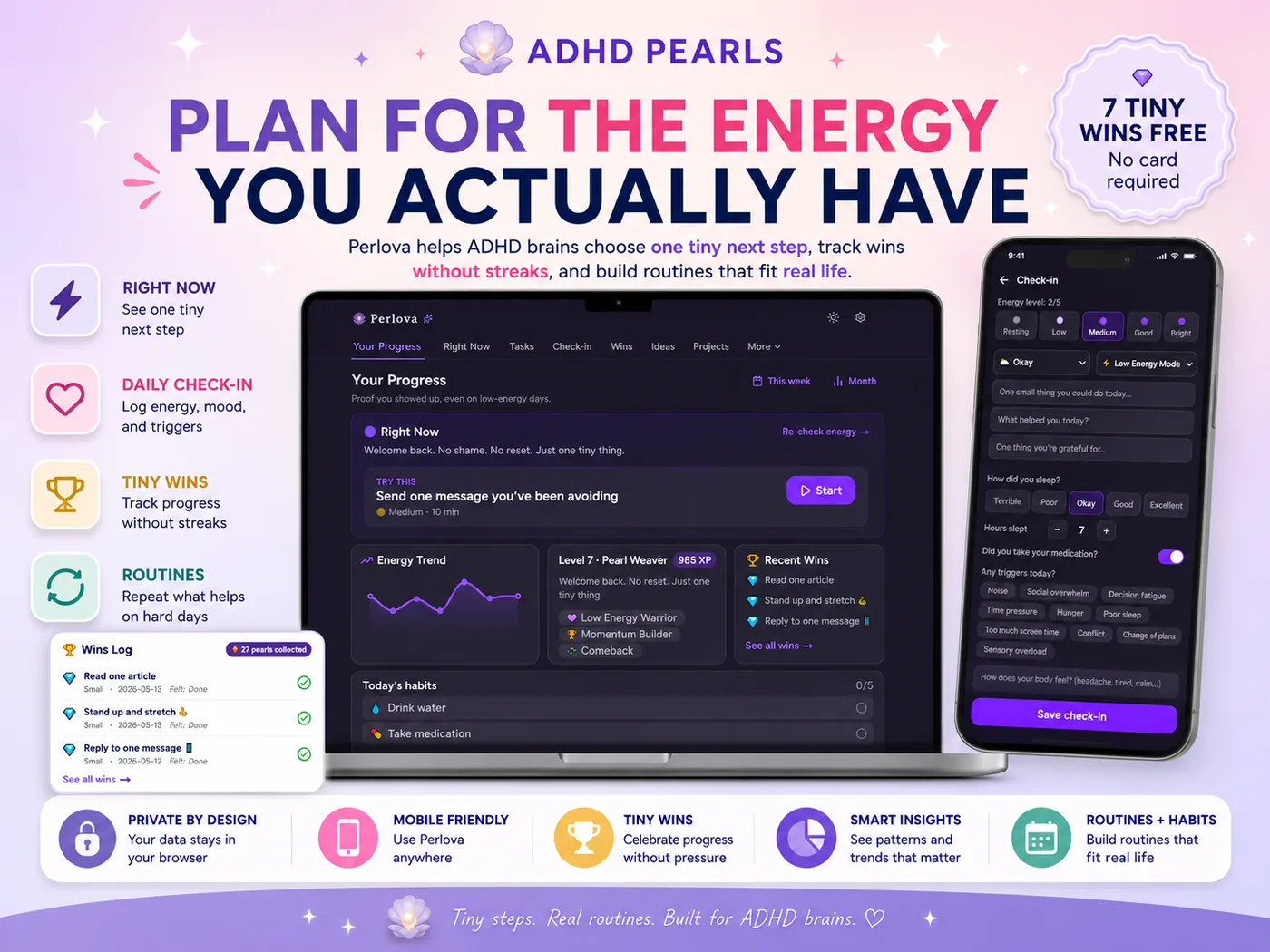
Perlova — plan from the energy you actually have
One doable next step, wins without streaks, and routines that fit real ADHD life. No card, no shame.
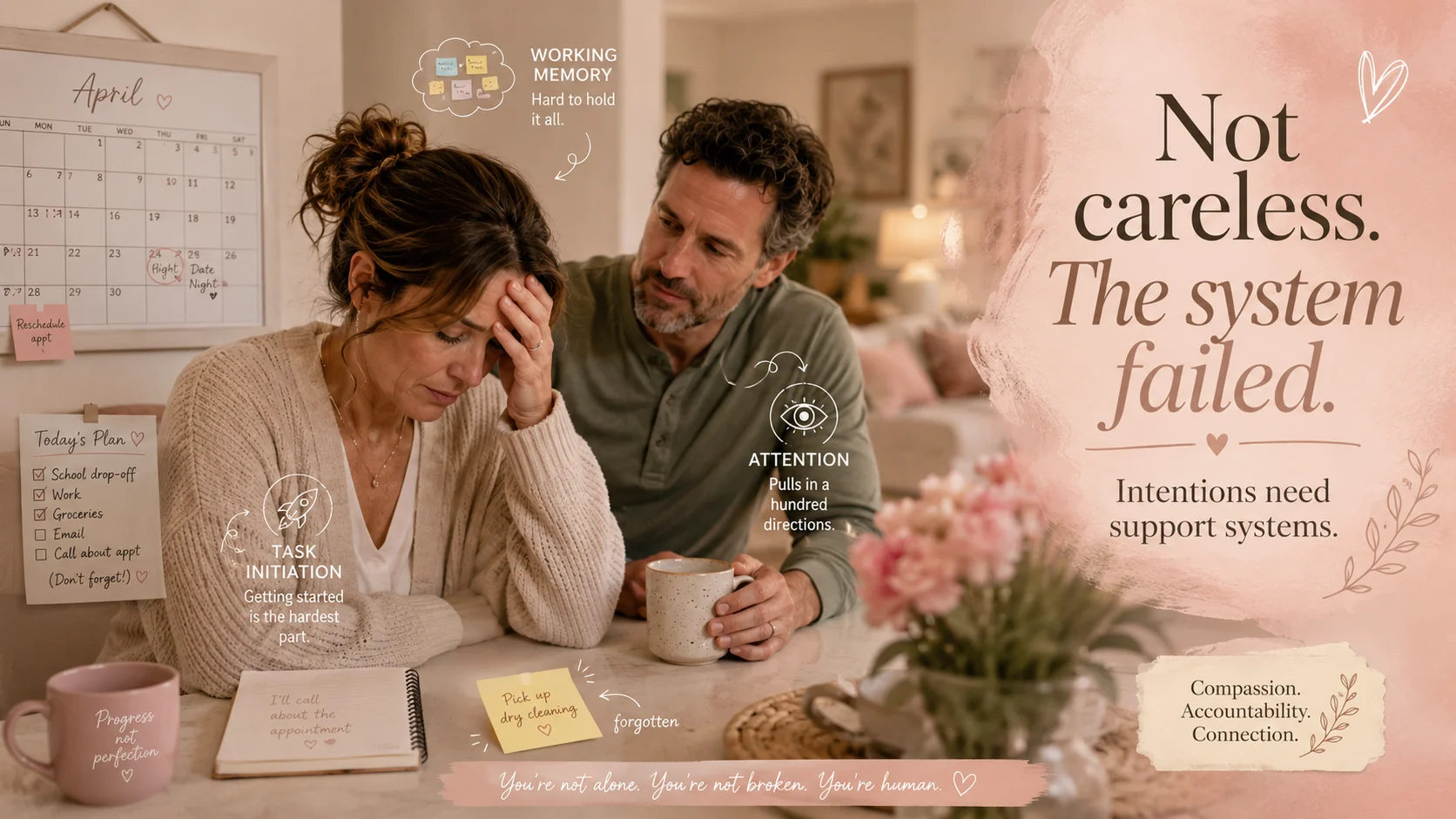
This is the reframe that changed my whole relationship: the behaviors that read as "careless" or "selfish" are usually about the machinery that turns good intentions into actions - working memory, task initiation, and attention - not about how much they love you.
A promise can be completely sincere and still evaporate, because the reminder never stuck. Their attention can wander mid-sentence while they genuinely adore you, because attention in an ADHD brain doesn't ask for permission. The boring task doesn't get done not out of disrespect, but because "boring and invisible" is the exact thing an ADHD brain can't make itself start - the same freeze behind life-admin paralysis.
None of that erases the impact on you. Feeling unheard or unsupported is real and it matters. But knowing the cause changes the fix: you stop trying to make someone care more (they already do) and start changing the systems that keep failing.
They weren't choosing the phone over me a hundred times a day. Their brain kept wandering off, and I'd been reading it as a verdict on our marriage.
The impact is real, but the explanation is often neurological and systemic, not a lack of love or care.
The Parent-Child Dynamic (and the Nag-Withdraw Loop)
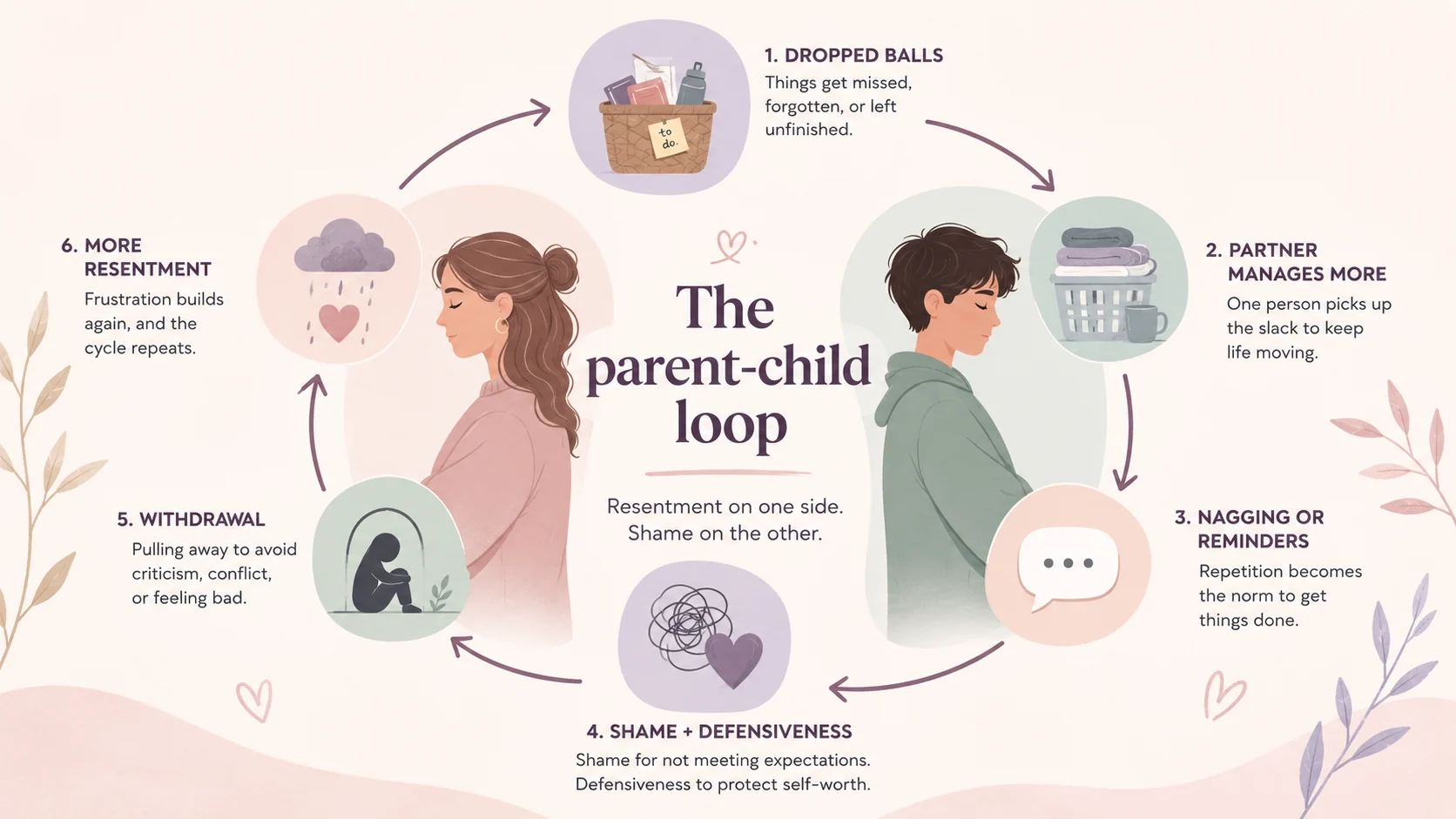
Here's the trap almost every ADHD-touched relationship falls into. One person keeps dropping balls, so the other starts catching all of them - managing the calendar, the bills, the reminders, the everything. And slowly they stop feeling like a partner and start feeling like a parent.
Then it loops: the managing partner nags (understandably - they're exhausted), the ADHD partner feels criticized and incompetent, so they withdraw or get defensive, so less gets done, so there's more to manage. Resentment on one side, shame on the other. I have been on both ends of this loop and neither is fun.
The crucial reframe: this is a dynamic created by unmanaged symptoms, not proof that one of you is lazy and the other is controlling. Naming it out loud - "we've fallen into a parent-child thing, and I hate it too" - is often the first crack of light. It's the pattern I watched quietly wear down a marriage in how undiagnosed ADHD can affect a marriage.
This cycle hurts both people: resentment grows on one side while shame grows on the other.
How to Bring It Up Without a Fight
Telling someone "I think you have ADHD" can land like an accusation if you're not careful. Here's what actually helps.
Pick a calm moment, not a flashpoint. Never mid-argument, never right after a forgotten thing. Set aside a low-stakes time, away from distractions.
Lead with curiosity and relief, not a label. Frame it as "I read something that might explain why X is so hard for you, and it might actually help" - not "you have a disorder." You're offering a possible key, not a diagnosis.
Use "I feel," not "you always." "I feel alone with the planning" opens a door; "you never remember anything" slams it. The goal is to describe the impact without putting them on trial.
Make it clear you're on their team. This isn't ammunition, it's an invitation. And then - the hard part - you let it be their choice. You can plant the seed; you can't force the assessment.
Curiosity lowers defensiveness. Labels used as weapons raise it.
What If They Won't Get Assessed?
Sometimes you share it all perfectly and they still aren't ready. That's genuinely hard, and it's also their call to make - pushing usually just creates more defensiveness.
So focus on what you can change. External systems - a shared calendar, a whiteboard, reminder apps - can shift the mental load off you without needing anyone to be diagnosed first. Kinder communication helps regardless. And your own support, boundaries, and rest matter, whether or not they ever pursue it. Sometimes a partner comes around later, on their own timeline, once it feels like relief instead of an accusation. If you're now wondering about your own brain too, that's worth honoring - start with how to know if you have ADHD.
This is educational and personal, not a diagnosis. These traits overlap with anxiety, depression, trauma, autism, sleep issues and ordinary stress, and only a qualified professional can assess for ADHD. If your relationship feels unsafe, or you're dealing with abuse rather than executive-function struggles, please reach out to a professional or a local support service - ADHD explains a lot, but it never excuses harm.
The tiny move: instead of adding one more thing to your resentment list this week, jot down whether the pattern is lifelong and everywhere, or only with you. That one distinction tells you a lot - and it turns "why won't they just try" into a question you can actually explore together, gently, when the moment is right.
Pin this as a conversation starter, not a diagnosis.
FAQ: Partners and ADHD
What are the signs my partner has ADHD?
Common signs include zoning out mid-conversation, chronic lateness and time blindness, forgetting tasks and promises, unfinished projects, impulsive spending or decisions, and big, fast emotional reactions. In a relationship it often shows up as one partner carrying most of the mental load. None of this is a diagnosis - lots of things can look like ADHD - but a cluster of these, lifelong and across settings, is worth exploring with a professional.
Can you have ADHD and not know it as an adult?
Absolutely - it's incredibly common, especially in people who were bright, coped, or didn't fit the hyperactive-kid stereotype. Many adults only recognize their ADHD when a child, partner, or burnout forces the question. Not knowing doesn't mean it isn't there; it usually means they got good at masking or blaming themselves.
Why does my partner never follow through or forget things?
For an ADHD brain, follow-through relies on working memory, task initiation, and interest - all of which run unreliably. So a promise made sincerely can genuinely evaporate, and boring or invisible tasks stall out. It usually isn't a lack of love or respect; it's a wiring difference in the systems that turn intentions into actions.
Is my partner ignoring me or is it ADHD?
It can absolutely be ADHD. Difficulty sustaining attention means an ADHD partner can drift mid-sentence even when they care deeply about you - the attention wanders without their permission. That said, feeling unheard is real and worth naming. The goal isn't to excuse it, but to understand the cause so you can fix the pattern instead of blaming character.
How do I bring up ADHD with my partner without them getting defensive?
Pick a calm, low-stakes moment, lead with curiosity rather than accusation, and use "I feel" statements instead of "you always." Frame it as something that might explain a struggle and offer relief, not a label or a flaw. Share what you noticed gently, and make clear you're on their team - then leave the decision to look into it with them.
Does ADHD cause the parent-child dynamic in relationships?
It's one of the most common patterns. When one partner keeps forgetting or not finishing, the other slides into managing everything, then resents it - and the ADHD partner feels nagged and shuts down. It's a cycle created by unmanaged symptoms, not by either person being bad. Naming it as a dynamic (not a character flaw) is the first step to breaking it.
Can a relationship survive undiagnosed ADHD?
Yes - many do, and often improve a lot once ADHD is named and both people stop blaming character. Understanding the mechanism, sharing the mental load with external systems, and getting support (assessment, treatment, sometimes couples work) can shift things significantly. What tends to hurt most is not the ADHD itself, but years of misreading it as not caring.
Should my partner get an ADHD diagnosis?
If these traits are affecting their life, work, or your relationship, an assessment is worth it - a diagnosis can bring relief, self-understanding, and access to strategies and treatment. A GP or mental health professional is a good starting point. It's genuinely helpful for many adults, but it has to be their choice, made when they're ready.
What if my partner won't get assessed?
You can share what you notice and why you think it might help, but you can't force it - pushing usually creates defensiveness. Focus on what you can change: external systems that share the load, kinder communication, and your own support or boundaries. Sometimes a partner comes around later, on their own timeline, when it feels safe rather than like an accusation.
One tap makes ADHD Pearls a preferred source in your Google account, so our articles surface higher when you search. No signup, and it brings you straight back to this page.
Here's why other planners didn't stick
They assume you'll show up the same every day. Perlova starts with how you feel right now.
Other ADHD planners
×Ask you to plan ahead, when your brain isn't there yet
×Assume you have consistent energy every day
×Show you everything you're already behind on
×Fall apart the first time you miss a day
×Require willpower just to open them
Perlova
✓Starts with your energy right now — not a perfect plan
For the woman who sets up the perfect system on Sunday and abandons it by Tuesday.
One short letter, every week. Real talk about ADHD, task paralysis, and the tiny wins that actually move the needle for a brain like yours. No shame. No hustle culture.