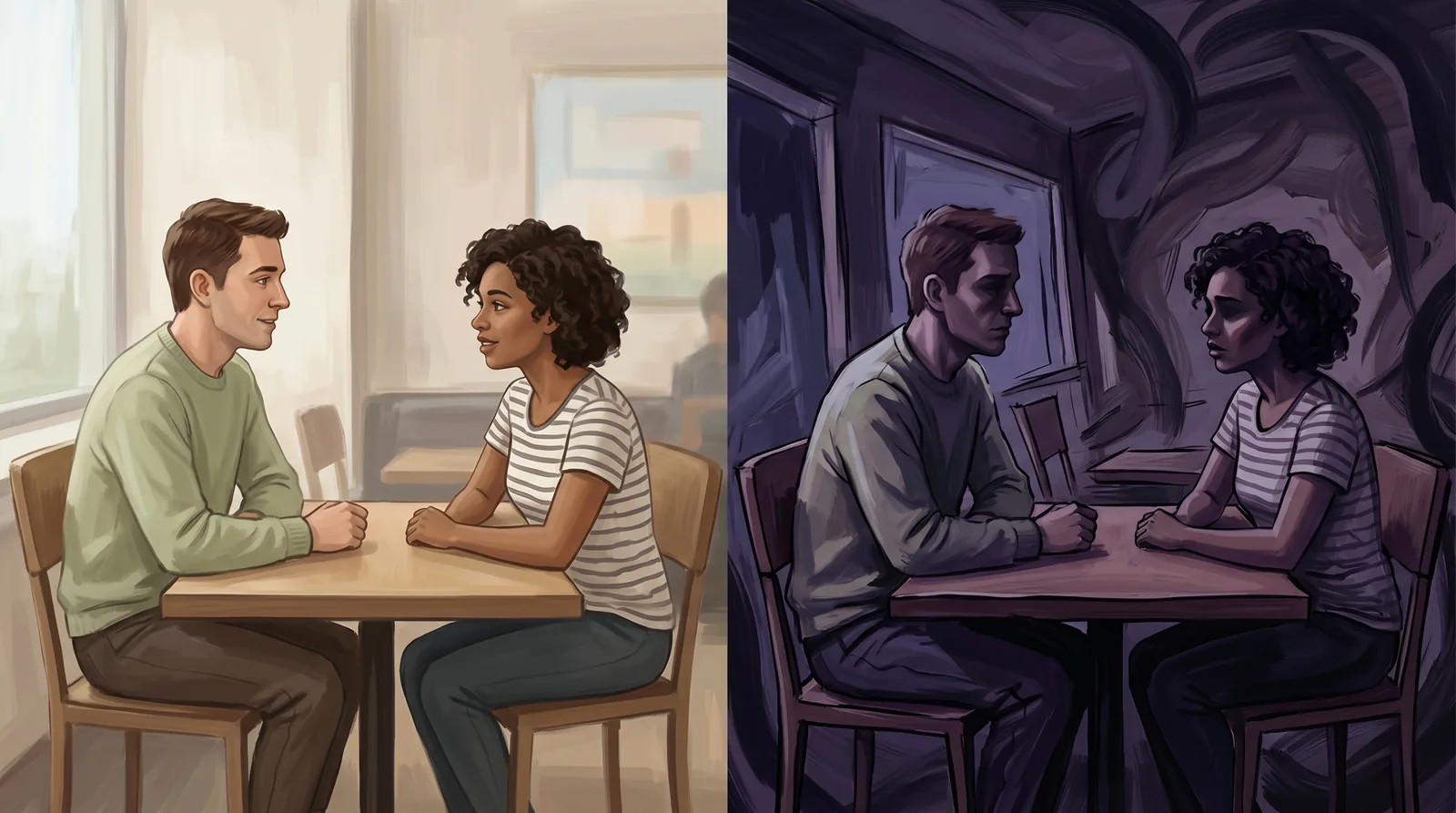
A coworker walked past my desk without saying good morning.
That’s it.
That’s the whole event.
For the next four hours, I convinced myself she hated me. That I had done something wrong. That I was being discussed in a meeting I was not invited to. That I should probably start updating my resume.
My chest was tight. I could not focus. I replayed every interaction from the past week, searching for the thing I had done wrong.
At lunch, she mentioned she had just been running late.
That was it.
I had been doing this for as long as I could remember, with no name for it — until, years later, I heard a clinician say:
“That sounds like rejection sensitive dysphoria.”
Finally.
A name for the thing that had cost me friendships, sleep, and a truly alarming number of hours spent reading between lines that had nothing written on them.
Quick answer
Why does a small social slight ruin my whole day?
That is rejection sensitive dysphoria: an intense, fast emotional response to perceived rejection or criticism, common in ADHD. It is not insecurity and it is not overreacting. The reaction arrives before reasoning does, and its size is a fact about the response rather than the event — which is why a colleague not saying good morning is genuinely enough.
Key takeaways
📌RSD is an intense, fast response to perceived rejection. The reaction arrives before reasoning does.
📌Its size is a fact about the response, not the event. A missed “good morning” is genuinely enough.
📌It is not insecurity or overreacting, and it is increasingly recognised as part of ADHD emotional regulation.
📌Naming it in the moment shortens it. “This is RSD” is a surprisingly effective interruption.
📌Wait before acting on the story. The urge to fix, apologise or withdraw is part of the spike.
Quick note: This article is based on lived experience and ADHD-informed education. It is not medical advice or a diagnosis. If rejection sensitivity is affecting your relationships, work, or safety, talk to a licensed mental health professional.
There are moments that, to anyone watching, would look completely unremarkable.
A manager walks past without making eye contact. A text goes unanswered for two hours. Someone in a meeting doesn’t laugh at your joke. A friend takes a day to reply.
For most people, these moments register briefly and dissolve. The brain notes them, assigns them low significance, and moves on.
For many people with ADHD, the brain does something different. It flags the moment. Escalates it. Begins building a case. Within seconds — not minutes — the emotional system has already reached a verdict, before rational thought has had a chance to weigh in.
That sudden, overwhelming wave of pain triggered by perceived rejection — often from something small, often without clear evidence — is what many describe when they talk about rejection sensitive dysphoria, or RSD.
It does not feel like sensitivity. In the moment, it feels like truth.
The gap between what actually happened and what your brain decided happened — that’s RSD in ADHD
From ADHD Pearls
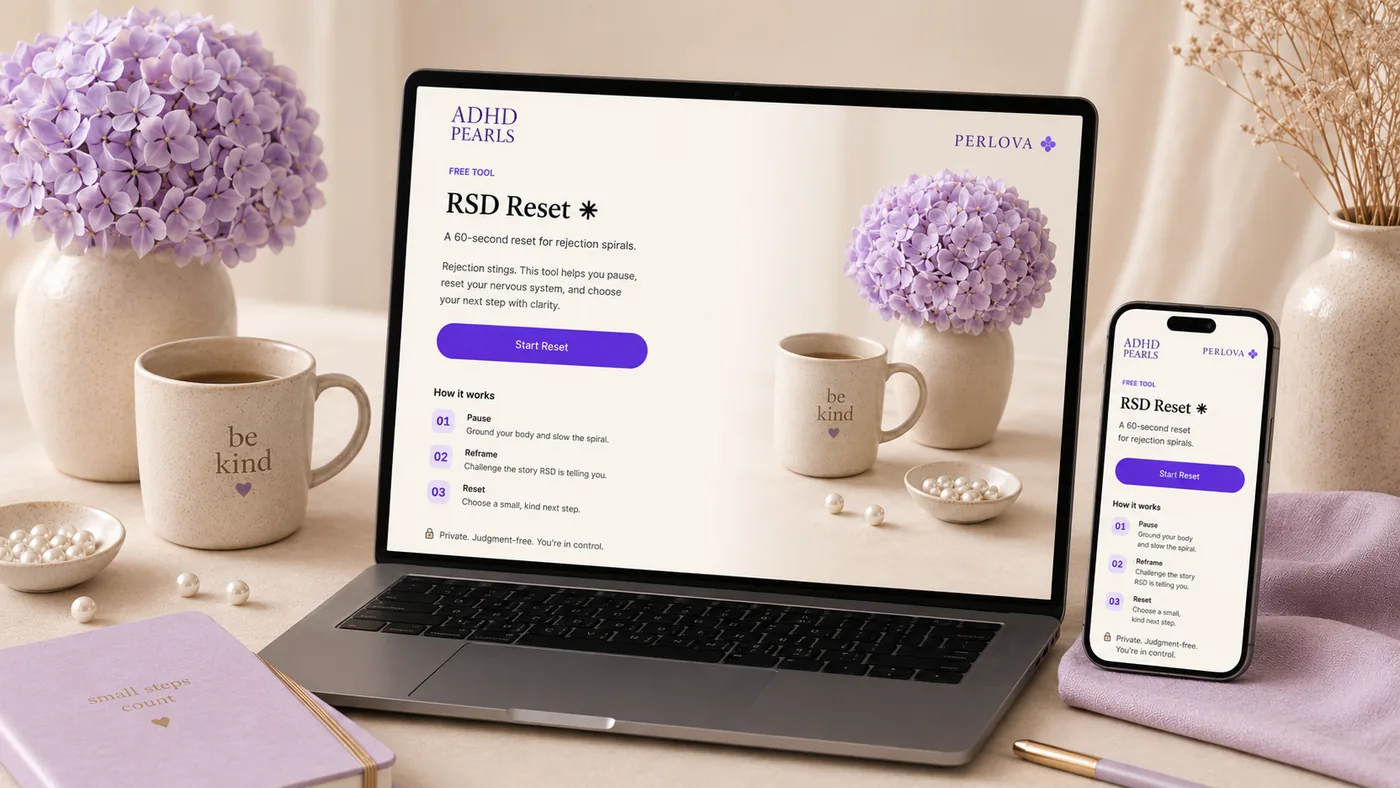
Free RSD Reset
When one message or moment sends your nervous system sideways.
RSD stands for rejection sensitive dysphoria. “Dysphoria” means intense emotional discomfort — and that word is deliberate. This is not mild hurt feelings. It is a sudden, overwhelming pain response triggered by the perception — real or imagined — of being rejected, criticized, or failing to meet someone’s expectations.
The key word is perception. You do not have to actually be rejected. A delayed text reply, an email with a clipped tone, a friend who does not laugh at your joke — these can trigger the same emotional response as actual rejection.
Dr. William Dodson, a psychiatrist who has written extensively about RSD for ADDitude Magazine, describes it as one of the most impairing aspects of ADHD that nobody talks about. The pain is real. The intensity is real. And the speed at which it arrives — often within seconds — is unlike what most people experience.
RSD is not a standalone diagnosis in the DSM. It describes a pattern of emotional response that falls within ADHD-related emotional dysregulation — which is increasingly recognized as a core feature of ADHD, not just a side effect. Researchers like Dr. Russell Barkley have argued that emotional impulsivity and difficulty regulating emotional responses are central to how ADHD works, not peripheral.
If you have been told your whole life that you are “too sensitive,” “too emotional,” or that you “take things too personally” — there may be a neurological reason for that. Not a character flaw. Neurochemistry.
RSD vs. Normal Sensitivity
Everyone gets hurt by rejection. Everyone has felt the sting of criticism, the anxious wait after a vulnerable message, the ache of being left out.
RSD is different in three specific ways.
Speed
The pain arrives instantly, before rational thought can intervene. One moment you are fine. The next, someone’s tone of voice has sent you into a spiral so complete it feels like the original feeling was always there. You do not drift into it — you are suddenly, completely inside it.
Intensity
Many people with RSD describe the emotional pain as unbearable — not metaphorically. It can feel physical. A punch to the chest. Grief. It is disproportionate to the triggering event in a way you can see clearly in retrospect but cannot feel in the moment.
Duration
RSD can linger for hours or days. The brain replays the triggering event, looking for what went wrong, looking for confirmation, trying to fix something that may not even exist.
Normal emotional sensitivity responds to evidence. RSD does not — at least not while it is active. You can know, intellectually, that you are misreading a situation. The feeling does not care what you know.
The moment between sending a message and waiting for a reply — ADHD brains know this place too well
How RSD Shows Up in Real Life
RSD does not just show up in dramatic moments. It shows up in the ordinary texture of a Tuesday.
At Work
Your manager gives constructive feedback on a project. For most people, this is information. For someone with RSD, it may feel like total failure — like being told you are not good enough at a fundamental level. Some people respond by shutting down. Others over-explain and apologize repeatedly. Others go home and spend the evening convinced they are about to be fired.
In Friendships
A friend cancels plans last-minute. Logically, you know life happens. But the RSD interpretation is immediate and absolute: they do not want to see you. Something has shifted. You spend the next 48 hours anxiously monitoring the friendship for more evidence of what you have already decided is true.
That last move — collecting evidence for a verdict already reached — has a name, and so do the eight other shapes this takes. They are set out in the ADHD thought traps, with the question that interrupts each one.
In Creative Work
You share something you made. Someone responds with mild enthusiasm instead of the reaction you hoped for. The piece that felt alive and good moments ago now feels embarrassing. The RSD interpretation: they were being polite. It is bad. You should stop making things.
The exhausting part is that you can know this is happening — can watch yourself doing it — and still not be able to stop it. If this pattern sounds familiar alongside other experiences like task paralysis or low-energy crashes, the ADHD connection is worth exploring with a professional. The text-message version of this - a one-word reply that ruins an afternoon - gets its own piece in why short texts trigger rejection sensitivity.
Why ADHD Brains May Experience Rejection So Intensely
The leading explanation involves dopamine and norepinephrine — the same neurotransmitters that are dysregulated in ADHD.
ADHD brains may have more difficulty regulating emotional responses, not just attention. The prefrontal cortex — which handles impulse control and emotional regulation — can be less effective at moderating intense reactions. So when a rejection signal arrives, the emotional response may fire fast and hard, with less of the usual filtering.
There is also the weight of accumulated experience. Many people with ADHD — especially those diagnosed later in life — have spent years receiving feedback that they are too much, too messy, too unreliable, too forgetful. When rejection sensitivity meets that history, the emotional reaction does not just respond to the current moment. It responds to every moment like it that came before.
It is not overreacting — it is a brain that learned to brace for impact before impact was confirmed
This is why RSD can look like anxiety or depression from the outside. The behaviors are similar. But the root may be different — and so the support needs to be different too.
What Actually Helps With RSD
The things that helped me were not the things most people suggest.
“Just remind yourself it is not personal” does not work when your brain is mid-spiral. “Take a deep breath” helps with regular anxiety. RSD is not regular anxiety.
Here is what actually made a difference — and what many people with ADHD describe finding useful.
Name It in the Moment
When the RSD spike hits, try saying — out loud or in writing — “This is RSD. My brain is reading rejection. I do not know yet if that reading is accurate.” It does not stop the feeling. But it creates a small separation between the feeling and the story the feeling is telling you.
Delay the Response
If RSD hits when you are about to reply to a message or send an email, wait. Not forever — just long enough for the acute phase to pass. Messages sent in the middle of an RSD spike rarely land the way you intend.
Anchor Yourself in Evidence
Keep a note somewhere — your phone, a notebook — called “things that were actually fine.” Real evidence of relationships that are solid, work that has been valued, moments where your brain predicted catastrophe and nothing happened. During a spiral, you cannot generate this from memory. But you can read it.
Tell Safe People in Advance
The friends and colleagues who know about your RSD can handle you asking “are we okay?” without alarm. Giving them context in advance changes the entire dynamic. You do not have to manage it alone.
Get Support From an ADHD-Informed Professional
For many people, ADHD medication meaningfully reduces the intensity of RSD episodes — not eliminating them, but turning the volume down. Therapy with someone who understands emotional dysregulation in ADHD, particularly DBT (dialectical behavior therapy), can also help build regulation skills over time. Talk to a licensed professional about what might make sense for you.
Build a System That Does Not Constantly Make You Feel Behind
RSD spirals are significantly worse on days when you are already overwhelmed, already feeling inadequate. Building a way of working that does not punish low-energy days reduces the overall emotional load. It is part of why energy-based planning matters more than it might seem at first.
FAQ: RSD and ADHD
Is RSD only found in people with ADHD?
No. Patterns of rejection sensitivity have been described in other conditions, including PTSD, depression, and borderline personality disorder. But it is particularly prevalent in ADHD and increasingly recognized as part of how ADHD affects emotional regulation. If you experience intense rejection sensitivity alongside other ADHD symptoms, it is worth exploring with a professional.
Is RSD the same as being overly sensitive?
“Overly sensitive” implies a character flaw that can be corrected with more willpower. RSD describes a neurological response pattern rooted in how some ADHD brains regulate emotion. The intensity is real and cannot be willed away. That said, with the right support, many people find it becomes more manageable over time.
Does therapy help with RSD?
Therapy can help — particularly with a therapist familiar with ADHD and emotional dysregulation. DBT has specific skills for emotion regulation that many people with RSD find useful. General CBT is less effective on its own for RSD because the core challenge is the speed and intensity of the reaction, not just the thought patterns around it.
What is the difference between RSD and anxiety?
Anxiety tends to be anticipatory — it is about what might happen. RSD is reactive — it is about what just happened, or what you have interpreted as having happened. They often coexist, which is part of why RSD can be mistaken for an anxiety disorder. Treatment approaches differ, which is why getting the right support matters.
Can children have RSD?
Yes. Patterns consistent with RSD often appear in childhood — sometimes before a formal ADHD diagnosis. Children may avoid trying new things, quit at the first sign of difficulty, or become extremely distressed by peer conflict in ways that seem disproportionate. If this sounds like a child in your life, it may be worth discussing with their pediatrician or a child psychologist.
Is RSD an official diagnosis?
No. Rejection sensitive dysphoria is not listed in the DSM-5 and has no standardized diagnostic criteria, so a clinician cannot formally diagnose it. What is well documented is emotional dysregulation in ADHD, and RSD is best understood as a widely used descriptive term for one intense form of it. The experience is real even though the label is informal.
How long does an RSD episode usually last?
It varies enormously. The initial hit is often described as almost instant, and the come-down can take anything from twenty minutes to a couple of days depending on how tired you are and who was involved. Sleep, hunger and hormonal shifts all tend to lengthen it.
Why does it hurt most with the people I am closest to?
Because those are the relationships with the most to lose. The brain treats a flicker of distance from someone important as a much bigger signal than the same flicker from a stranger. It is not a sign the relationship is fragile - it is a sign it matters.
What can someone say to help when I am in the middle of it?
Short, concrete reassurance tends to land better than reasoning. Something like "nothing is wrong between us, I was just busy" gives the brain a fact to hold on to. Being asked to explain why you feel that way usually makes it worse in the moment.
You Are Not Too Sensitive
On harder days — when RSD has hit and the whole brain feels like it needs a reset — the ADHD Stuck Reset tool is a free place to start.
You are not too sensitive.
Your brain learned to brace for impact before impact was confirmed. That is not weakness — it is adaptation. And it is something that can shift, slowly, when you finally have a name for it.
Found this helpful? Share it with someone who gets stuck too.
One tap makes ADHD Pearls a preferred source in your Google account, so our articles surface higher when you search. No signup, and it brings you straight back to this page.
Before you go
Free RSD Reset
When one message or moment sends your nervous system sideways.
For the woman who sets up the perfect system on Sunday and abandons it by Tuesday.
One short letter, every week. Real talk about ADHD, task paralysis, and the tiny wins that actually move the needle for a brain like yours. No shame. No hustle culture.