I once avoided one phone call for so long it started to feel like a haunted object in my life.
It sat there. In my notes app. On a sticky note on my desk. In the back of my throat every time I tried to relax on a Sunday afternoon.
And the worst part?
I cared. I cared about the appointment. I cared about the bill. I cared about fixing the problem.
I just could not make my body pick up the phone.
If any version of that sounds familiar — the bill you know about but cannot open, the form that’s been sitting on your desk for six weeks, the email you’ve mentally replied to fourteen times — this article is for you. Not to fix you. Just to explain what’s actually happening. Because it is not what most people think.
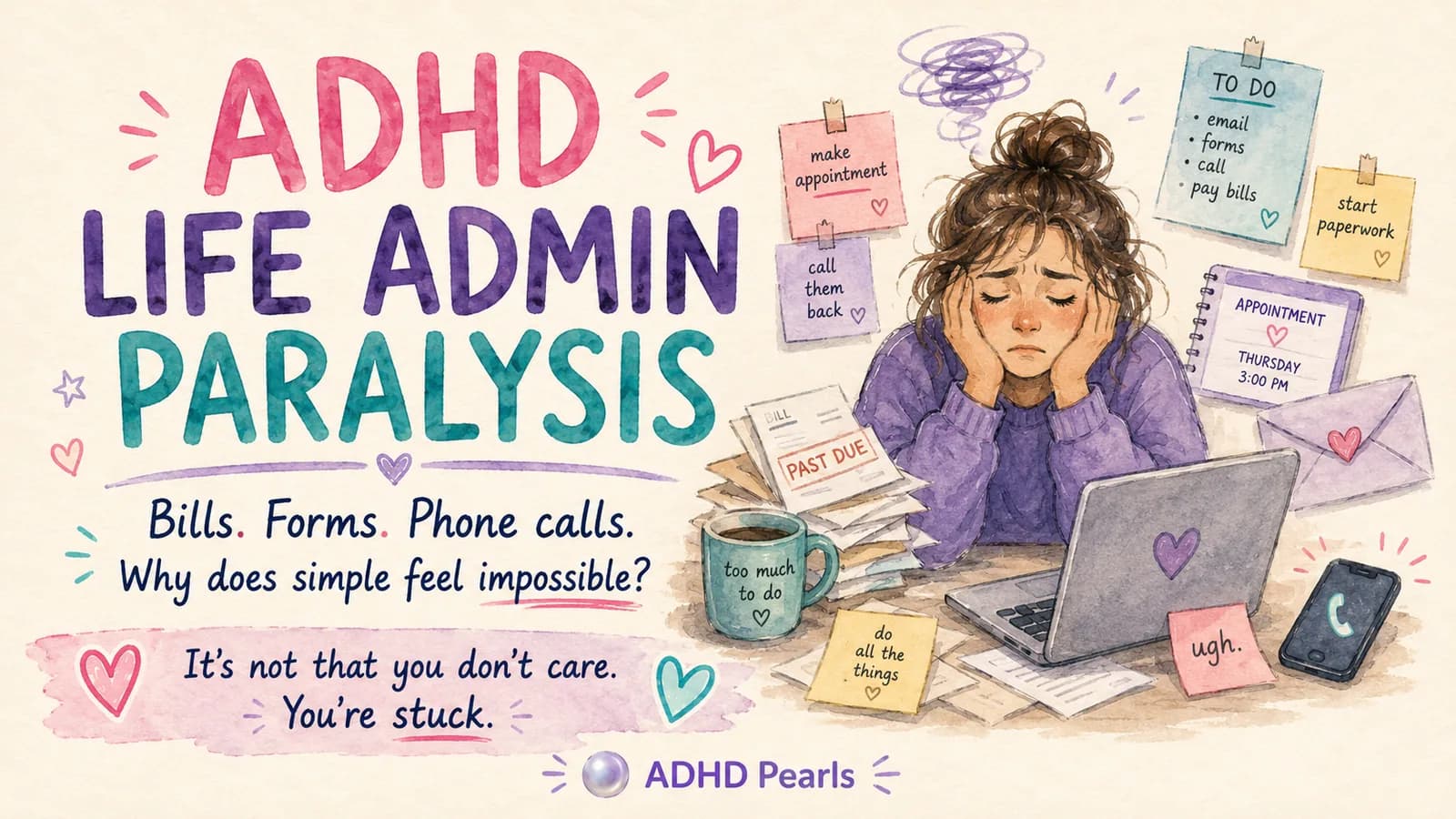
Life admin paralysis is not forgetting. It is remembering constantly, and somehow still being unable to start.
Quick answer: What is ADHD life admin paralysis?
ADHD life admin paralysis is when everyday administrative tasks — bills, forms, phone calls, appointments, emails, insurance, returns, paperwork, documents — feel impossible to start, even when they matter. It is not laziness. It usually happens when one “simple” task hides too many decisions, emotional pressure, uncertainty, shame, and invisible steps.
Quick answer
Why do bills, forms and phone calls feel impossible with ADHD?
Because life admin is never one task. A single bill hides finding the login, recovering the context, tolerating the dread, and deciding when it counts as done — and every one of those steps needs the executive functions ADHD taxes most. It is not laziness, and the cost is real: late fees on money that was there the whole time.
Key takeaways
📌Life admin is never one task. A single bill hides five separate executive demands.
📌The dread is about the sequence, not the difficulty. Nothing in it is actually hard.
📌Phone calls are their own category, because they cannot be paused, drafted or edited.
📌The pile grows because every untouched item adds context you then have to recover.
📌Late fees on money you already had is the ADHD tax in its purest form.
What ADHD Life Admin Paralysis Actually Feels Like
It is not “I forgot.”
That is the part that is hardest to explain to people who do not have ADHD. Life admin paralysis is not forgetting the bill exists. It is remembering it constantly — while doing dishes, while trying to sleep, while watching something you cannot even follow because the bill is there in the background — and somehow still not being able to do it.
It looks like:
An unopened letter on the counter that you walk past every single day.
A form you half-filled three weeks ago and never submitted.
An appointment you keep meaning to book and somehow never do.
An email you have mentally answered fourteen times but never typed.
A phone call that has started to feel like a boss fight.
A document you need to upload that you simply cannot bring yourself to face.
A password reset that turns into a twenty-minute emotional event.
“Life admin paralysis” is not an official clinical diagnosis. It is a useful phrase for what happens when ADHD task paralysis — the freeze that makes starting feel impossible — lands specifically on the practical adult responsibilities that keep life functioning. The bills. The forms. The calls. The appointments. The paperwork that quietly multiplies when you are not looking.
Life admin paralysis is not “I forgot.” It is “I remember constantly, and somehow still cannot do it.” That distinction matters more than most people realise.
If you have been caught in that loop, you might also recognise the particular shame that comes with it. Because these tasks feel like they should be easy. They are things that other people seem to just do. Which is its own whole thing — and if that shame spiral feels familiar, the ADHD Shame Detox article goes into exactly that pattern and how to start unwinding it.
I spent a long time thinking my whole problem was that I could not start. It was partly that. The other part was that every piece of admin I did manage to start went straight back into my head afterwards, where it sat waiting to become a surprise. Nothing I tried held it — the notes app filled up, the reminders got dismissed, and the paper pile quietly grew a second paper pile.
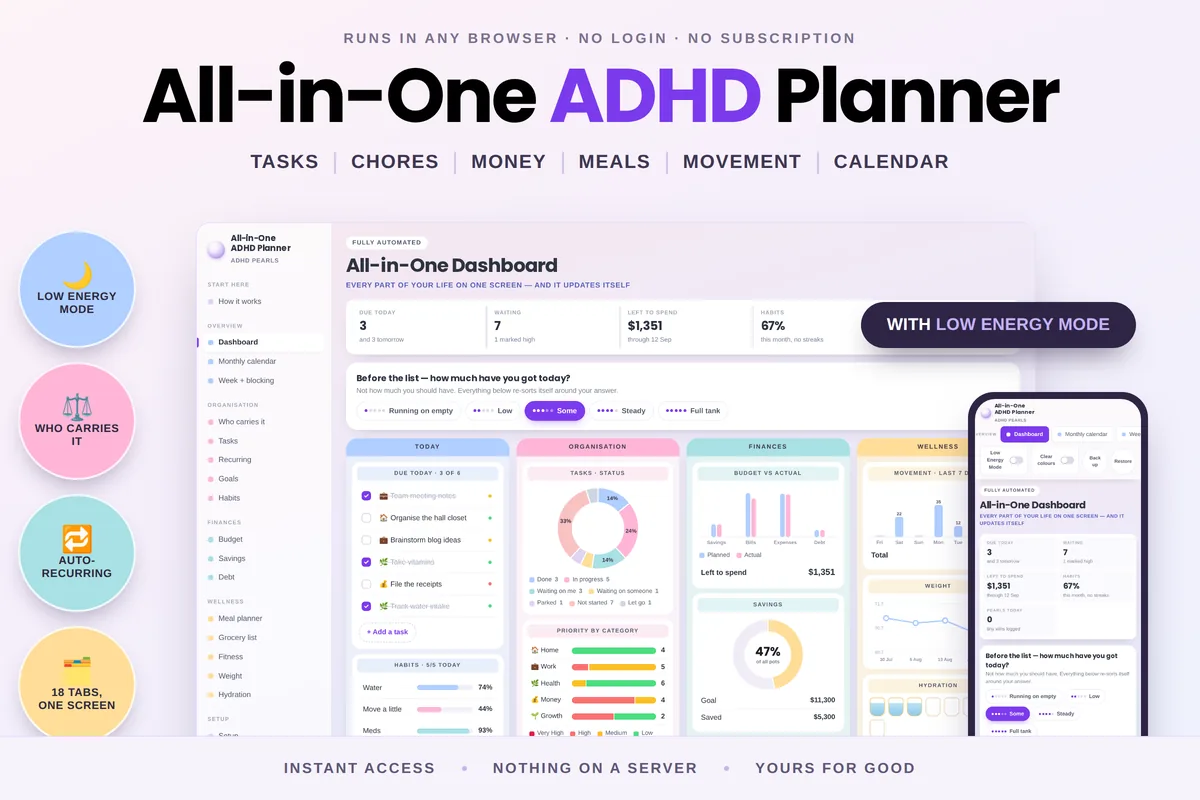
So we ended up building somewhere for it to go instead: bills that carry their own due dates and tick off as you pay them, and repeating jobs you describe once. It did not make phone calls any easier. It did stop the same three of them living rent-free in my head.
From ADHD Pearls
All-in-One ADHD Planner
Eighteen tabs that fill each other in. Say a repeating chore once and the schedule builds itself, and one tab shows who in the house actually carries what.
Opens in a new tab — this article stays where it is.
5 free days, counted only when you use it — just your email, no card. Then $27 once, private to your browser, no login, no subscription.
Why Simple Admin Is Not Simple for ADHD Brains
Here is the thing nobody says out loud: “pay the bill” is not one task.
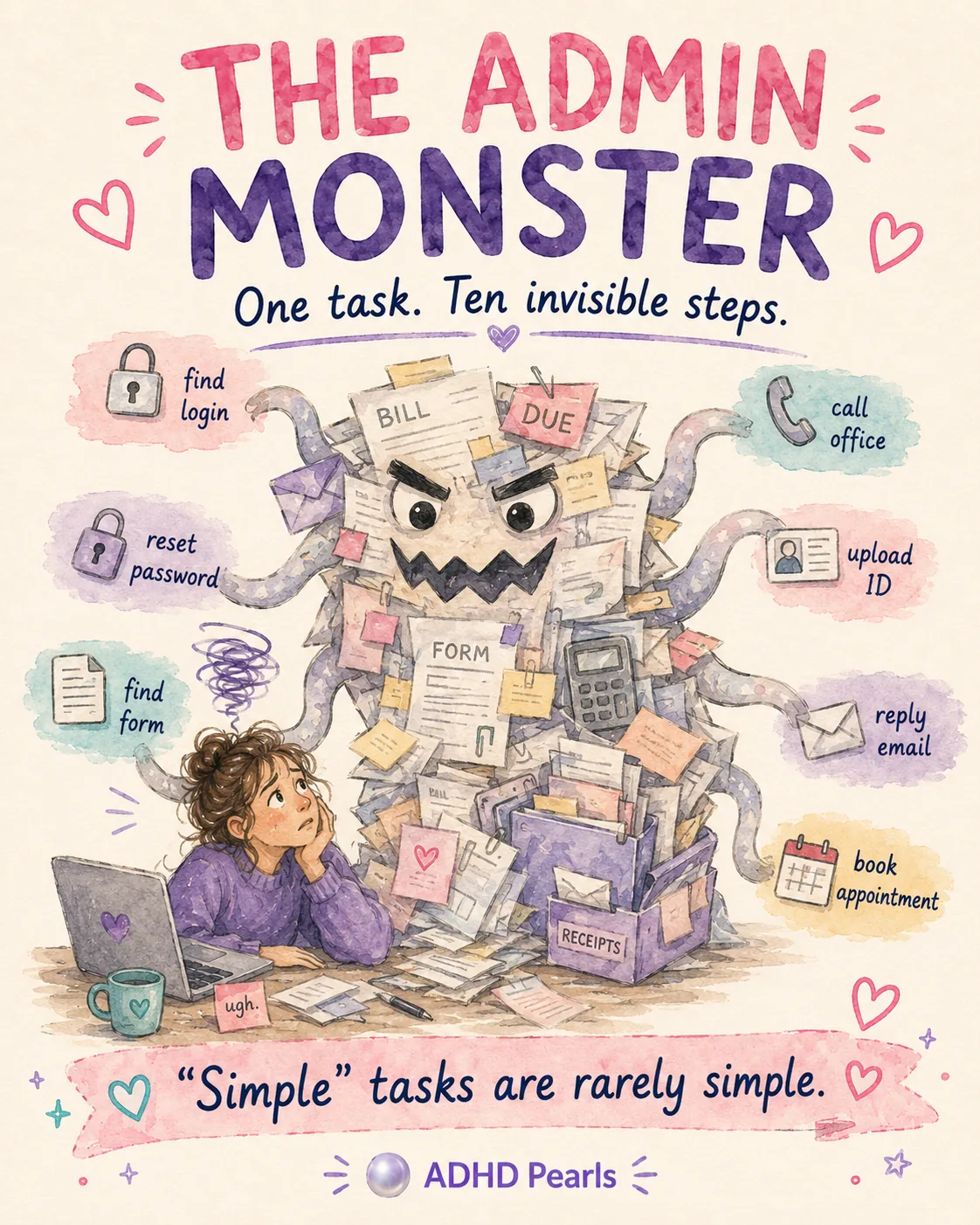
From the outside it looks like one step. From inside an ADHD brain trying to actually do it, it can look like this:
The task is small. The hidden steps are not.
Find the bill (which might mean finding the email, the app, or the letter you have not opened).
Remember the login (or accept that you do not remember it).
Do the password reset (which involves finding the right email account, waiting for the link, clicking it before it expires, choosing a new password you will somehow remember).
Open the account and look at the balance.
Understand what the letter or bill is actually asking.
Decide what to pay, or what to do, or whether there is a problem.
Handle the emotional reaction if the news is bad.
Figure out what the next step is even after you pay.
Not spiral if something goes wrong.
That is not one task. That is a project. And the ADHD brain, which already struggles with task initiation, working memory, and emotional regulation, has to do all of that just to get to the part where it does “the simple thing.”
One task. Many invisible steps. No wonder the brain stalls.
This is what makes life admin so particularly exhausting with ADHD. It is not that the tasks are hard the way learning a skill is hard. It is that each one contains a branching series of smaller tasks, decisions, and emotional loads that are invisible to everyone except the person carrying them.
That invisibility has a name and a shape, and it is worth knowing: the mental load has four stages, and ADHD makes two of them much more expensive than the other two.
And when the task involves something that already carries weight — money, health, relationships, deadlines — the emotional temperature of each step goes up too.
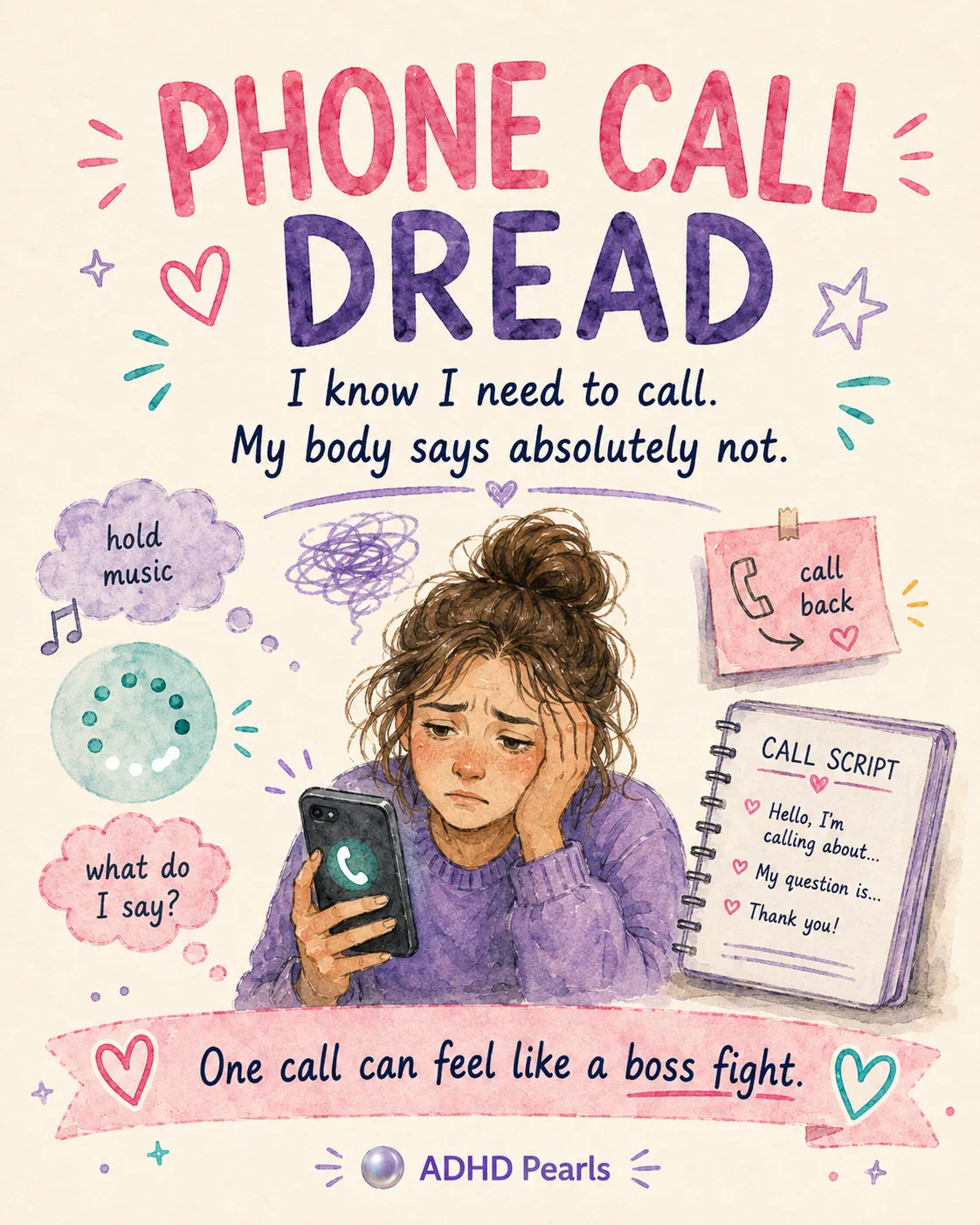
The Phone Call Dread Loop
A phone call is not just a phone call when you have ADHD.
I do not avoid calls because I think they are unimportant. I avoid them because my brain turns one call into a courtroom, a pop quiz, and a customer service maze at the same time.
There is no visual script. You cannot see the person. You cannot pause to think. You do not know what they will ask. You do not know if you will have the right answer ready. You do not know how long it will take or what they will redirect you to or what account number you should have memorised before calling.
And then there is the fear that the call will create another task. That you will hang up and there will be something else to do, something else to track, something else to remember. When working memory is already stretched, that is not a small fear.
So the call does not get made. And then tomorrow it is slightly heavier. And six weeks later, it is the haunted object.
The longer the call waits, the heavier it gets. That weight is not drama. It is a real neurological load.
I do not avoid calls because I think they are unimportant. I avoid them because my brain turns one call into a courtroom, a pop quiz, and a customer service maze at the same time.
The dread loop is not irrational. It is a reasonable response to a task that genuinely contains a lot of uncertainty and executive function demands all at once. Understanding that does not fix it immediately, but it does change the question from “why am I so bad at this?” to “what would make this less hard?” That is a much more useful question.
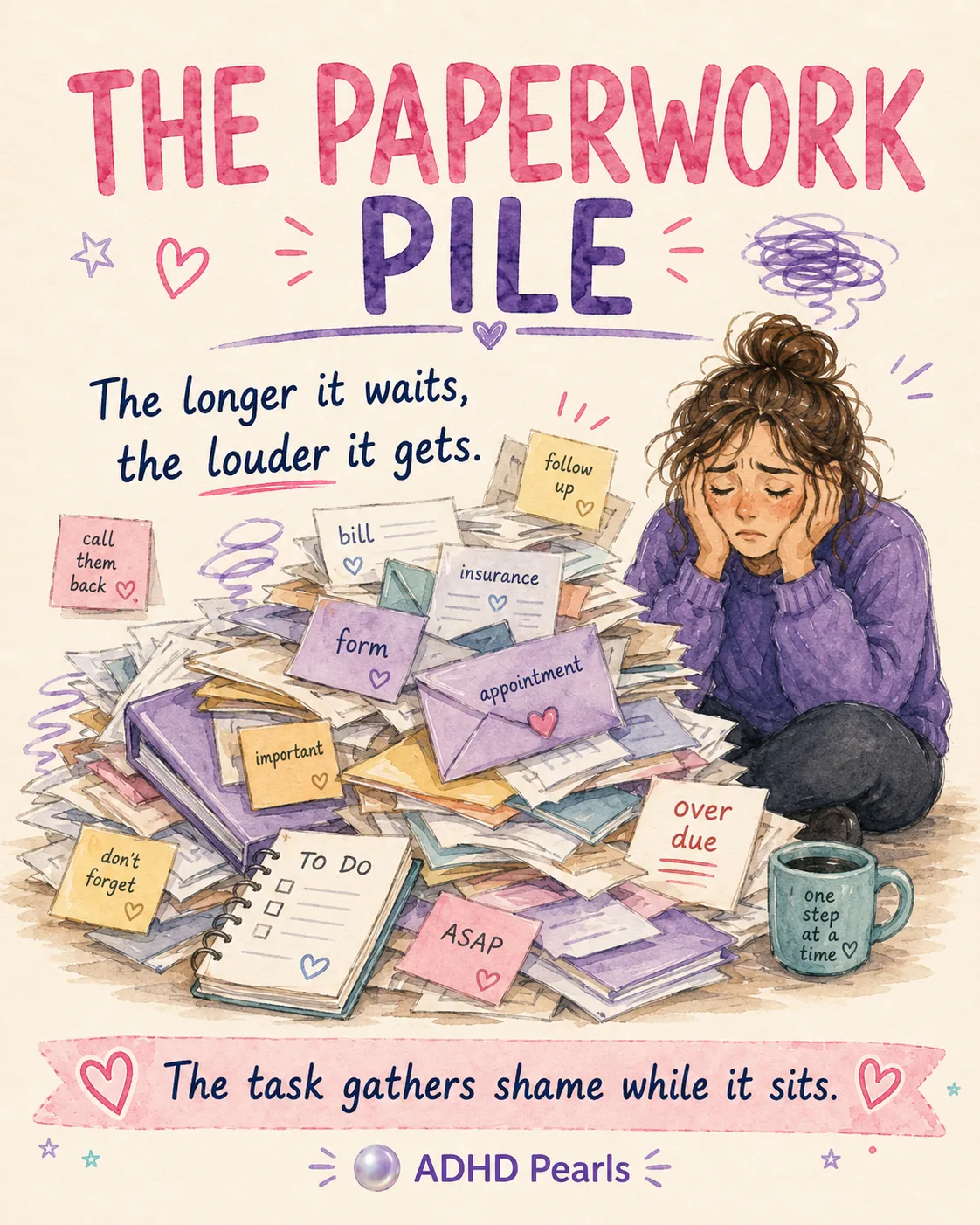
The Paperwork Pile Effect
Paperwork gets louder the longer it waits.
One unopened letter becomes three. One late payment becomes a shame spiral. One insurance email becomes a whole emotional event. One form with a deadline you missed becomes a story about what kind of person you are.
The task does not just sit there. It gathers shame.
The pile does not grow in silence. It grows in weight.
Shame is the thing that makes starting hardest. Because now the task is not just “fill in this form.” It is “fill in this form that you were supposed to do weeks ago, that you have been avoiding, that now has a consequence attached to it, and that is further proof of a pattern you already feel terrible about.”
This is why “just do it now so it does not pile up” is advice that does not quite land. It assumes the pile is a time management problem. It is often an emotional weight problem. Each item in the pile carries not just the task itself, but all the times you tried to start it and could not, all the moments you remembered it and felt bad, all the small evidence your brain is collecting against you.
The Am I Lazy Spiral
Am I lazy, or is this ADHD task paralysis?
Lazy usually does not come with panic. Or guilt. Or mentally rehearsing the task six hundred times. Or lying awake thinking about it.
That is not peace. That is stuck.
Lazy might sound like: “I do not really care about this and I am honestly fine with not doing it.”
ADHD paralysis often feels like: “I care so much about this that my nervous system has completely locked up around it.”
The caring is the thing that makes it so disorienting. You care about your bills. You care about your health. You care about being a functional adult who replies to emails and books appointments and sorts out insurance. And you cannot do it. And the gap between caring and doing — that is the paralysis. It is not what lazy looks like. Lazy does not spend six weeks being haunted by a sticky note.
If this pattern is chronic — if it keeps showing up across different areas of life, keeps interfering with things that matter to you, keeps producing this specific cycle of remembering and freezing and shaming and trying again — it may be worth speaking with an ADHD-informed clinician. Not to get a label, but to get a map. Our article on ADHD task paralysis vs laziness goes deeper on exactly this question if you want to sit with it a bit more. And if the tasks you avoid hardest are the ones that matter most to you, experiential avoidance explains that particular twist. For the specific case of bills you can afford and still do not pay, there is a separate piece on the payment window.
Why Procrastination Hits Differently With ADHD
This is not just a quirky personality thing. There is real research behind the stuck feeling.
A study published in the Journal of Attention Disorders linked ADHD symptoms directly to procrastination through specific executive function skills: time management, organisation and problem-solving, motivation, and emotion regulation. In other words, the stuck feeling is not random. It lives right where ADHD already makes life harder.
The ADHD paralysis framework from ADDA and the Cleveland Clinic overview of executive dysfunction both point to the same thing: this is a neurological pattern, not a motivation deficit. You are not choosing to be stuck. Your brain is doing something specific that makes starting feel genuinely difficult in a way that willpower alone cannot override.
The Appointment That Steals the Whole Day
If I have an appointment at 3 PM, apparently my brain believes the entire day is legally unavailable.
I cannot relax, because the appointment is coming. I cannot start anything serious, because what if I get absorbed and miss it. I keep checking the time. I run small useless tasks in the gap. And then somehow it is 2:45 and I have done almost nothing, and the appointment takes forty minutes, and the day is just gone.
Many ADHDers describe this experience as “waiting mode” — a phrase that captures something real even if it is not a formal clinical term. The brain, which already struggles with time perception, seems to treat the upcoming event as an anchor point. Everything before it becomes uncertain ground. You cannot fully commit to anything else because the thing is coming, even if it is hours away.
It is not laziness in the morning. It is the appointment already having taken up residence in your cognitive space from the moment you woke up.
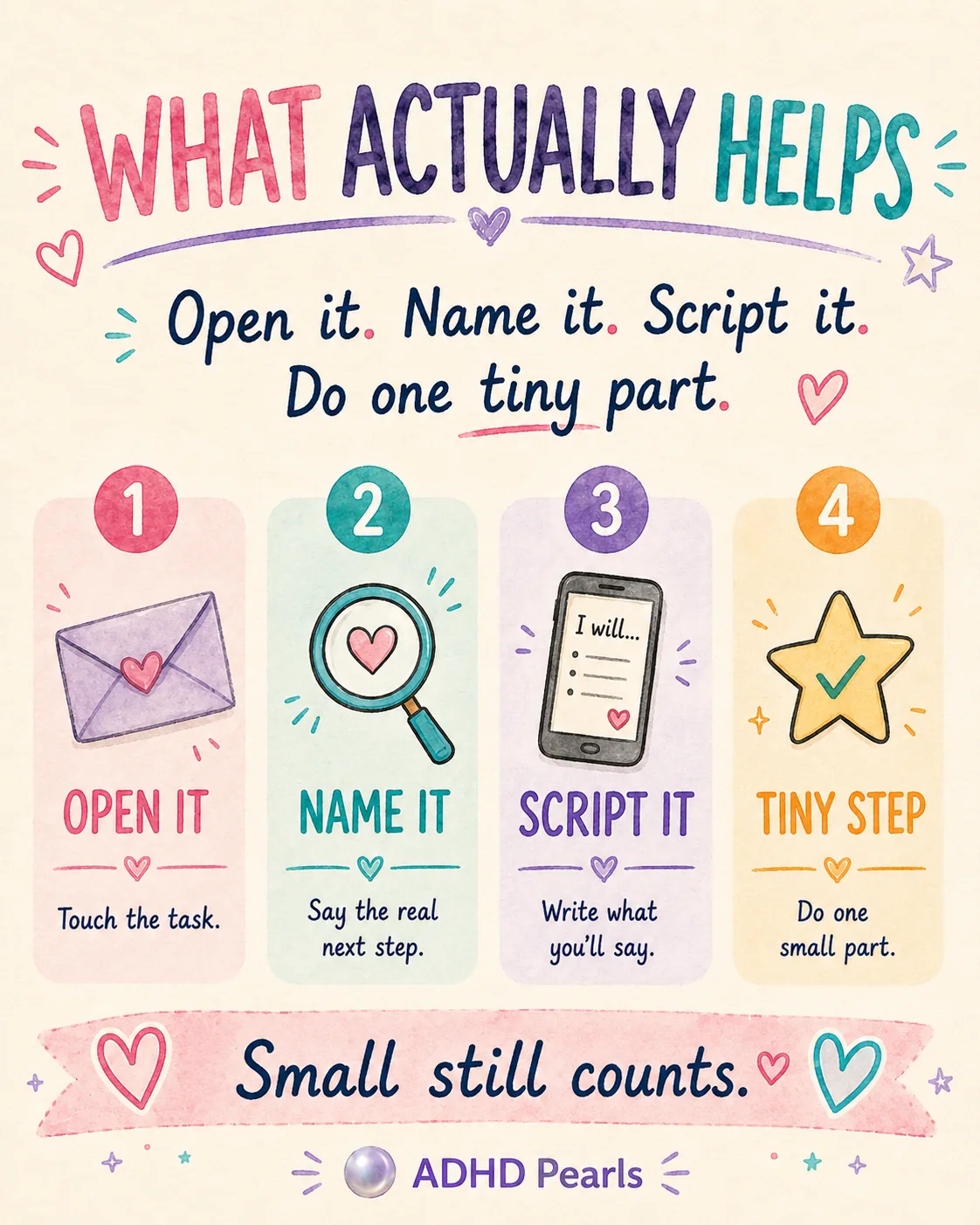
What Actually Helps When Life Admin Feels Impossible
“Break it down” is technically correct and also completely useless as advice if it is all someone says. Here is what that actually means in practice, applied specifically to life admin.
1. Name the admin monster.
Not “deal with insurance.” Say: “I need to open the insurance email.” Not “sort out the bills.” Say: “I need to find the electricity bill reference number.” The vaguer the task, the harder the start. Name the actual next visible thing.
2. Find the real first step.
Not “book the appointment.” The real first step is: find the phone number. That is it. That is today’s task if needed. Find the number and write it down somewhere visible. You can make the call tomorrow.
3. Lower the emotional temperature.
Tea. Pajamas. A comfort show in the background. A timer that gives you an exit. Sitting on the floor if that somehow feels safer. Doing it imperfectly on purpose. The task does not need to happen in optimal conditions. It needs to happen in conditions you can actually tolerate.
If the emotional temperature is very high, the Stuck Reset tool is a three-minute way to interrupt the freeze before you try to tackle the admin.
4. Script the scary part.
For phone calls, have something written before you dial. You do not need a full script. You need the first sentence and a few fallback lines:
“Hi, I am calling because I need help with…”
“Can you tell me what information you need from me?”
“Can you repeat that slowly so I can write it down?”
“Can I call back if I need to find that information?”
Having those lines written somewhere takes away the pop-quiz feeling. You are not walking in unarmed.
5. Make the task embarrassingly small.
Open the letter. Find the document. Put the paper on the desk. Write the first sentence. Open the app. That counts. Not because everything is fixed, but because the freeze got interrupted — and interrupting the freeze is the actual job when you are in paralysis.
6. Count the tiny win.
Not because the admin is done. Because you touched it. Because your brain learned, once more, that touching it will not destroy you. That is data your nervous system needs.
The goal is not to finish the whole admin monster. The goal is to interrupt the freeze.
For the days when the freeze is particularly strong, the ADHD Dopamine Menu is a free tool that can help you find a smaller door in — a task sized for a low-battery brain that still moves something forward.
A Tiny Life Admin Reset You Can Try Today
This is not a productivity system. It is a five-minute interrupt for when the pile feels impossible.
The 5-minute admin reset:
Pick one admin task you are avoiding. Just one.
Write the actual next tiny step — not the whole task, just the first visible thing.
Remove one decision from it. (Find the number in advance. Have the app already open.)
Set a 5-minute timer.
Stop when the timer ends, even if it is not done.
Count it as a win, because you touched the task.
The goal is not to finish the whole admin monster. The goal is to teach your brain that touching it will not kill you.
The one-step rule
You do not have to finish it today. You just have to touch it. Open the letter. Find the number. Write the first word. That is enough for right now. The freeze gets smaller each time you interrupt it.
Where the Admin Goes After You Start It
Everything above is about starting. That is the hard half, and it is the half nobody talks about kindly.
But life admin has a second half that catches people out: it does not stay done. The bill you finally paid comes again next month. The form you submitted generates a letter that needs a reply. The appointment you booked needs another one in six months. You did not fail to finish it — it was never the kind of task that finishes.
So the question after “how do I start this” is “where does it live now, so it does not arrive as a surprise.” For some people that is a wall calendar. For others it is a shared reminder with a partner. What matters is that it lives somewhere outside your head, because the inside of your head is where admin goes to turn into dread.
Pick one recurring thing — the one that has ambushed you twice already — and give it a home this week. Not all of them. One.
FAQ: ADHD Life Admin Paralysis
What is ADHD life admin paralysis?
ADHD life admin paralysis is when everyday administrative tasks — bills, forms, appointments, phone calls, emails — feel impossible to start, even when they matter. It is not laziness. It happens when one “simple” task hides too many decisions, emotional weight, uncertainty, shame, and invisible steps.
Is ADHD task paralysis the same as laziness?
No. Laziness usually means not caring and feeling fine about it. ADHD task paralysis comes with stress, guilt, constant mental rehearsal, and a nervous system that has locked up — even when you care deeply. If you are lying awake thinking about the bill you cannot make yourself open, that is not laziness.
Why do phone calls feel so hard with ADHD?
Phone calls combine everything ADHD finds difficult: uncertainty, no visual script, rapid processing, memory demands, social pressure, and the possibility of a new task at the end. There is no pause button. You cannot re-read what they said. And you cannot see their face. For a brain that already struggles with all of that, one call can feel like three tasks at once.
Why do bills and paperwork pile up with ADHD?
Because each item in the pile carries not just the task, but the shame of all the times you tried and could not start. The longer a bill or form waits, the heavier it gets — not just as a task, but as evidence of something you already feel bad about. The pile does not just need sorting. It needs some of the shame removed first.
How do I break ADHD life admin paralysis?
Start smaller than feels reasonable. Not “do the admin” — open the letter. Not “call them” — find the phone number. Not “sort the finances” — open the app. Set a 5-minute timer and stop when it ends even if nothing is finished. The goal is to interrupt the freeze, not complete the task. Each time you touch it, it gets a little less impossible.
This article is for education and personal support, not medical advice. If ADHD symptoms are affecting your daily life — including your ability to manage bills, appointments, and paperwork — consider speaking with an ADHD-informed clinician who can help you understand what is happening and what support is available.
Why is it worse with letters that are not even urgent?
Because urgency is one of the few things that reliably overrides the freeze. A non-urgent letter offers no external pressure, so starting has to come entirely from you, which is exactly the part ADHD makes hard. Unimportant admin often sits longest for this reason.
What do I do about the pile I have already avoided for months?
Do not sort it. Put everything into one box, unopened, then handle three items a day from that box. Sorting is a second task disguised as preparation, and it is usually where the whole attempt collapses.
Does body doubling help with life admin?
For a lot of people, yes. Having someone else present, in person or on a call, supplies external structure and makes the task feel less like it is happening in a vacuum. They do not need to help or even pay attention.
When is it worth paying someone else to do it?
When the cost of continuing to avoid it is higher than the fee, which with tax deadlines, penalties or unclaimed refunds it frequently is. Outsourcing a task you have failed to start for six months is a reasonable decision, not a moral failure.
If you take one thing from this: the freeze is not a character flaw, and starting is a skill you can practise. Do the one-item version. Open the letter, write the first sentence, and stop there.
The part I could never fix by practising was what happened afterwards. Admin does not finish — it comes back on its own schedule, whether or not I remember it exists. So the version we built is the one that remembers instead of me: due dates that sit on the bills, and repeating jobs that redraw themselves. Not a cure for the dread. Just somewhere for the paperwork to live that is not my head at 2am.
Found this helpful? Share it with someone who gets stuck too.
One tap makes ADHD Pearls a preferred source in your Google account, so our articles surface higher when you search. No signup, and it brings you straight back to this page.
Before you go
All-in-One ADHD Planner
Eighteen tabs that fill each other in. Say a repeating chore once and the schedule builds itself, and one tab shows who in the house actually carries what.
For the woman who sets up the perfect system on Sunday and abandons it by Tuesday.
One short letter, every week. Real talk about ADHD, task paralysis, and the tiny wins that actually move the needle for a brain like yours. No shame. No hustle culture.