I once sat at a kitchen table with a form in front of me for three hours. Not doing the form. Not doing anything else either. Just sitting there, aware that it needed eleven minutes of my life, unable to spend them.
My sister came over to borrow a charger. She sat down at the other end of the table and started scrolling on her phone. I filled in the form. It took nine minutes.
She did not help me. She did not know what I was doing. She was not even looking at me. And still, something in my brain that had been jammed all afternoon quietly unstuck itself the moment there was another person in the room.
That is body doubling. It is one of the few ADHD strategies I have never had to force myself to keep using, and it is also the one I understood the least - right up until I could not find anyone to do it with.
Quick answer
What is body doubling, and why does it work for ADHD?
Body doubling means doing a task while another person is present, in the room or on a call, who is not helping you and usually not even talking to you. Their presence is what makes starting possible. It appears to work by supplying accountability and gentle structure at the moment of transition — which is exactly where ADHD tasks stall.
Key takeaways
📌The other person is not helping and usually not talking. Their presence is the entire mechanism.
📌It works at the transition, which is exactly where ADHD tasks stall.
📌Nobody available? A video call, a recording, or a busy café can stand in.
📌You do not have to explain ADHD to ask. “Can you sit here while I do this” is enough.
📌It backfires when the other person starts supervising, or when the task needs real silence.
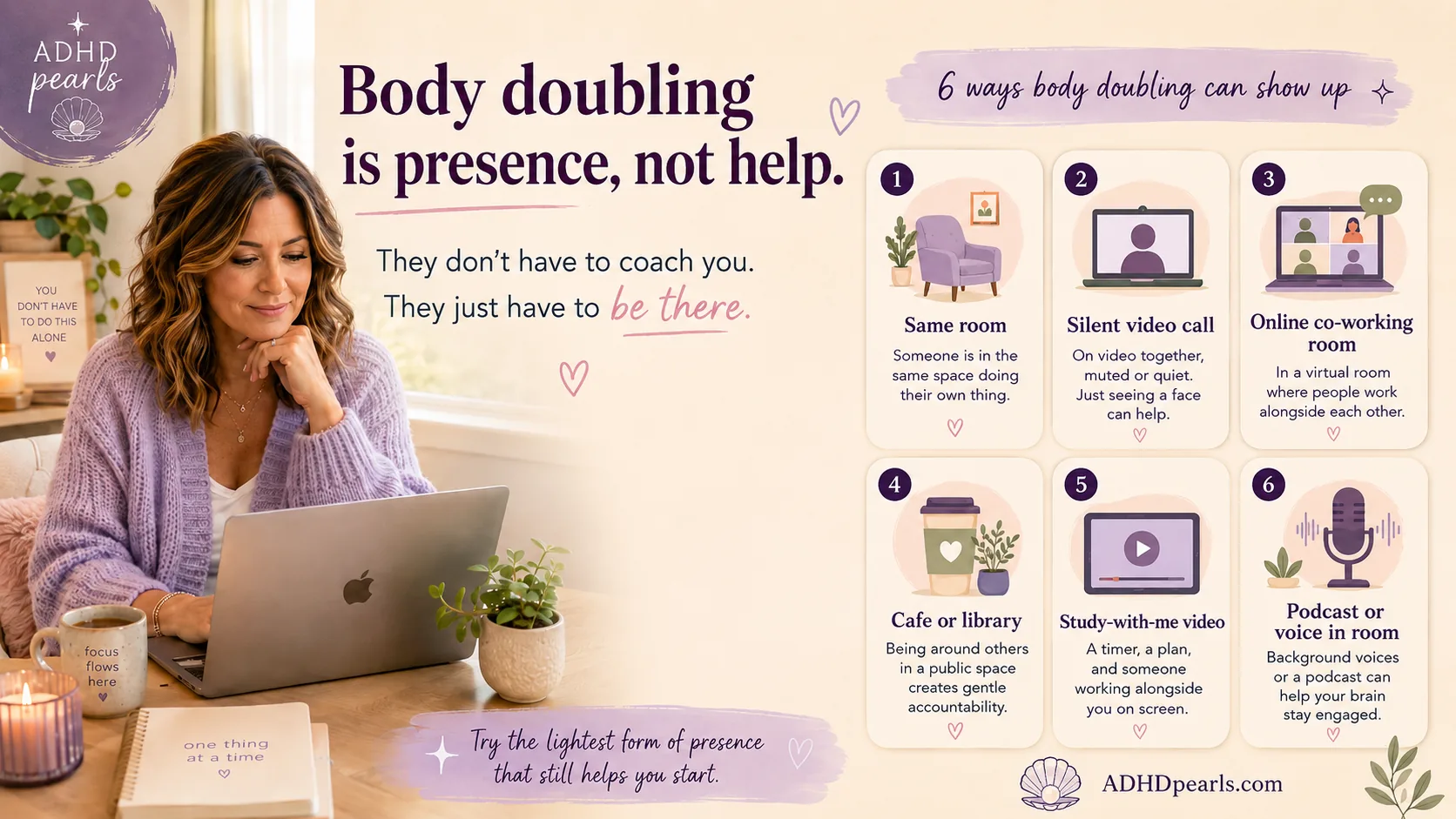
Body doubling means doing a task while somebody else is present. That is the whole thing. They are not coaching you, not checking your work, usually not talking to you at all. They are doing their own task, or scrolling, or reading, and their presence is the entire intervention.
The clearest definition comes from the people who use it. Researchers at UC Santa Cruz surveyed 220 neurodivergent adults and let the community define the term itself: using the presence of others to start, stay focused on, or accomplish a task. The body double can be in the room or remote, live or recorded, a close friend or a complete stranger.
Two findings from that survey stopped me cold.
The first: 75 percent of the people surveyed said they use body doubling - but only 57 percent had heard the phrase. Nearly a quarter of them learned the term while filling in the survey. The average person had been doing it for around four years and had known what it was called for about one and a half.
The second: 186 of the 220 said they were more likely to finish a task when another person was present.
So this is not a technique most of us adopted. It is a technique most of us invented independently, used quietly for years, and felt slightly embarrassed about - until somebody gave it a name. I had been doing my worst admin at my mother's kitchen table since my twenties. I thought it was because her coffee was better.
Most of us did not learn body doubling. We stumbled into it, kept doing it, and assumed it was a personal quirk rather than a strategy.
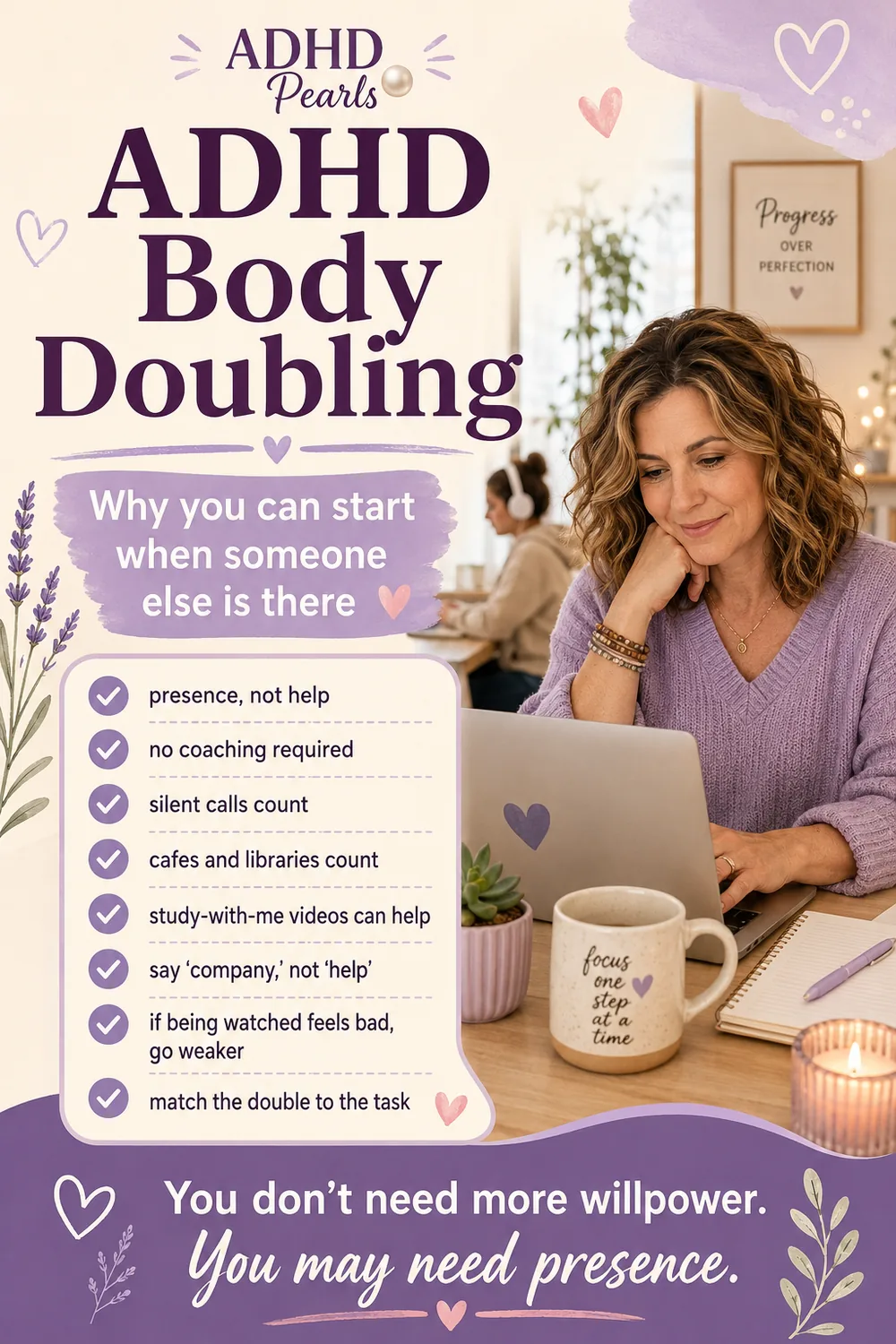
Body doubling does not require advice or supervision. Often, the useful part is simply shared presence.
From ADHD Pearls
Free Stuck Reset
One tiny move for the moments you know what to do but still can't start.
Nobody can tell you definitively why it works, and I want to be straight about that before I give you the explanations that ring true.
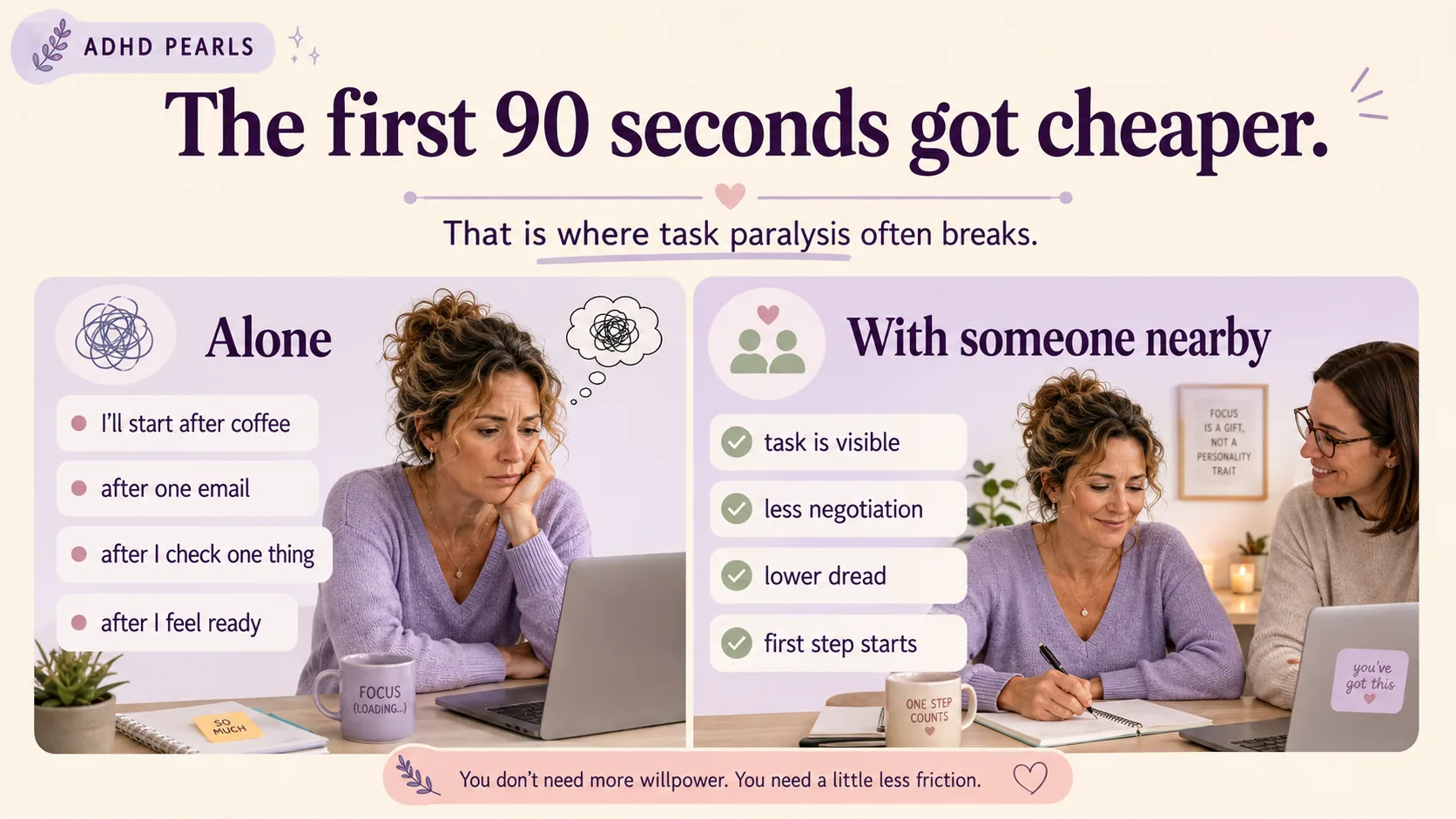
The mechanisms people report most often are companionship, mild accountability, and a visible reminder to stay on task. There is something about another person being there that converts a private negotiation into a semi-public one. Alone, I can renegotiate with myself endlessly - I will start after this coffee, after this email, after I check one thing. With someone in the room, that internal court closes. There is no one to argue with.
What I notice in myself is that body doubling does almost nothing for my concentration and almost everything for my task paralysis. Once I have started, I am fine. The person could leave. It is the first ninety seconds that were impossible, and their presence is what makes those ninety seconds cheap.
For many ADHD brains, the hardest part is not the whole task. It is the first ninety seconds.
It also seems to lower the emotional temperature of the task. A lot of what looks like procrastination is really avoiding how the task makes you feel - the dread, the anticipated shame, the memory of the last time you got it wrong. Company dilutes that. It is harder to spiral about a form when someone is sitting nearby humming.
The honest bit about the evidence
Body doubling is a community invention, not a laboratory finding, and the research has not caught up. Survey work documents that it is widespread and experienced as useful. But as of 2025, a review by researchers designing body doubling systems noted that no peer-reviewed controlled trials have demonstrated a conclusive effect in adults with ADHD, and the small experimental studies that exist have come back mixed - one with ADHD participants found no significant effect, even though participants perceived the body double as motivating.
This is not a reason to skip it. It is a reason to treat it as a tool you test on yourself rather than a prescription you have failed if it does not work. Nothing here is medical advice, and body doubling is not a treatment for ADHD.
I find the gap between the lived experience and the evidence genuinely interesting rather than discrediting. Plenty of things people do to manage ADHD - timers, external reminders, working in a cafe - are under-studied because they are unglamorous and hard to fund. The absence of a trial is not proof of absence.
How to Body Double When There Is Nobody
Here is the problem with a strategy that requires another human being: it requires another human being.
For about two years I told myself body doubling did not work for me. What was actually happening was that it worked extremely well and I could almost never access it. My friends had jobs. My family was three hours away. The days I most needed someone at the table were, reliably, the days I was alone in the house with a laptop and a rising sense of doom.
The survey data suggests this is the normal experience rather than my personal failure. Participants described exactly this bottleneck - people who were too chatty, people who were not available, and the courage it took to ask at all. One participant said they frequently did not get out of bed and eat breakfast until a body double was available.
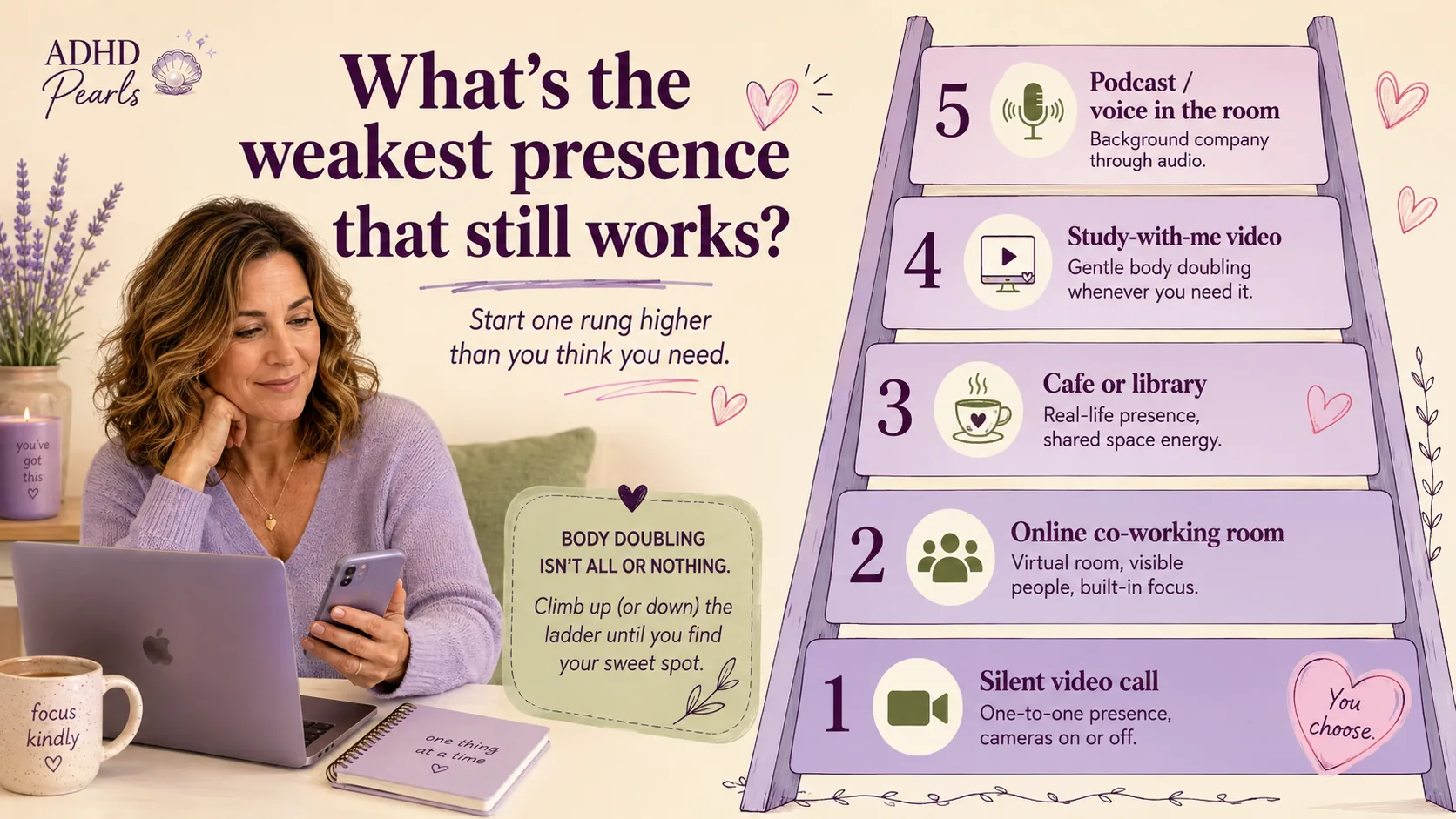
So the useful question is not who can I ask. It is what is the weakest form of presence that still works on me. Here is the ladder, from strongest to weakest signal.
1. A silent video call
The closest substitute for a person in the room. You call a friend, you both say what you are doing, and then you shut up and work with the call still running. Cameras on if you can stand it, off if you cannot.
The rule that makes it work is agreeing up front that you are not there to talk. Without that rule you get a lovely catch-up and no laundry. I say the sentence out loud now: I am going to be boring for forty minutes.
2. An online co-working room
Platforms like Focusmate, Flow Club and Caveday pair you with a stranger for a timed session - you state your goal, you both work quietly, you report back at the end. Study rooms on Discord and StudyStream do a looser version, often running around the clock, where you drop in muted and work alongside whoever is there.
A stranger is better than a friend for this, which surprised me. There is no social obligation, no catching up, and no history. Twenty percent of the surveyed group body doubled with strangers online.
3. A public place where nobody knows you
The library and the cafe. Fifty-seven of the surveyed participants used public spaces, and one described it perfectly as body doubling without them knowing.
This is my highest-yield version for anything involving forms or money. Something about being visible to strangers who have zero expectations of me makes it almost impossible to open a new tab and disappear. I do bills in a cafe now. It costs me a coffee and saves me a fortnight of dread about bills I meant to pay and did not.
4. A recorded or live video
Study-with-me and clean-with-me videos, long-format, often several hours. Seventeen survey participants used YouTube videos and fourteen used livestreams as their double.
This is the weakest signal and the most available one - it works at 6am and at midnight and requires nothing from anyone. In my experience it holds up well for physical tasks and poorly for anything that needs real thought. It is more than enough to get me through the kitchen. It is not enough to get me through a difficult email.
5. A voice in the room
A podcast, a phone call on speaker while you fold, a radio show with actual conversation. Not music - music is background, and my brain treats it as furniture. It has to be people talking.
This is the version I reach for most often because it costs nothing and requires no planning, and it is the same trick that shows up as a cleaning hack in almost every ADHD list you will read.
Start one rung higher than you think you need. When I am truly stuck, a podcast does not touch it and a live person does. When I am mildly avoidant, a podcast is plenty and calling a friend would be overkill.
Body doubling is not all or nothing. You can move up or down the ladder until the level of presence fits the day.
How to Ask Without Explaining ADHD
This is the part that stopped me for years, and I suspect it stops a lot of women who were diagnosed late and are still working out how much to disclose to whom.
I used to think asking meant explaining. That I would have to say something like: I have ADHD and I struggle to initiate tasks, so I need you to sit here. Which is true, and which is also a lot to hand someone when you just want to do your taxes.
You do not need to name it. You need a normal-sounding invitation:
Want to do a co-working hour? We each do our own thing, no talking.
I work better with someone around - can I call you while I do this and we both stay quiet?
I have got an admin pile I have been avoiding. Fancy sitting in the same room being productive?
Two things I learned the slow way. First, most people enjoy this - working alongside someone is mildly pleasant for almost everybody, so you are offering something rather than asking for a favour. Second, the framing matters more than the words. If you present it as help, they will try to help, and then they will talk, and then you will have had a nice afternoon and done nothing.
Say company, not help. The word does a surprising amount of work.
When Body Doubling Backfires
It does not work for everyone, and the ways it fails are predictable enough to design around.
The double becomes the distraction. The most common failure and the easiest to fix. A chatty friend is not a body double, they are a social event with a laptop nearby. Choose the least interesting person available, or a stranger, or a recording.
Being watched raises anxiety instead of lowering it. Research on this is clear that social presence cuts both ways - if you already carry a fear of being judged, having someone observe you can raise the pressure to perform and push you further into avoidance. If a live call makes your chest tight, you have not failed at body doubling. You have found out that you need a weaker version. Camera off, audio only, or a recorded video where nobody can see you at all.
The scheduling costs more than the task. If arranging the session takes more executive function than the job itself, the strategy has eaten its own benefit. This is why I keep the low-effort rungs of the ladder available - a video I can start in four seconds beats a session I have to coordinate.
It works so well you stop being able to work alone. Worth naming honestly. If you can only function with a double, that is not a moral problem, but it is a fragile setup. I try to keep one or two tasks a week that I start by myself, mostly so I know I still can.
Which Version Fits Which Task
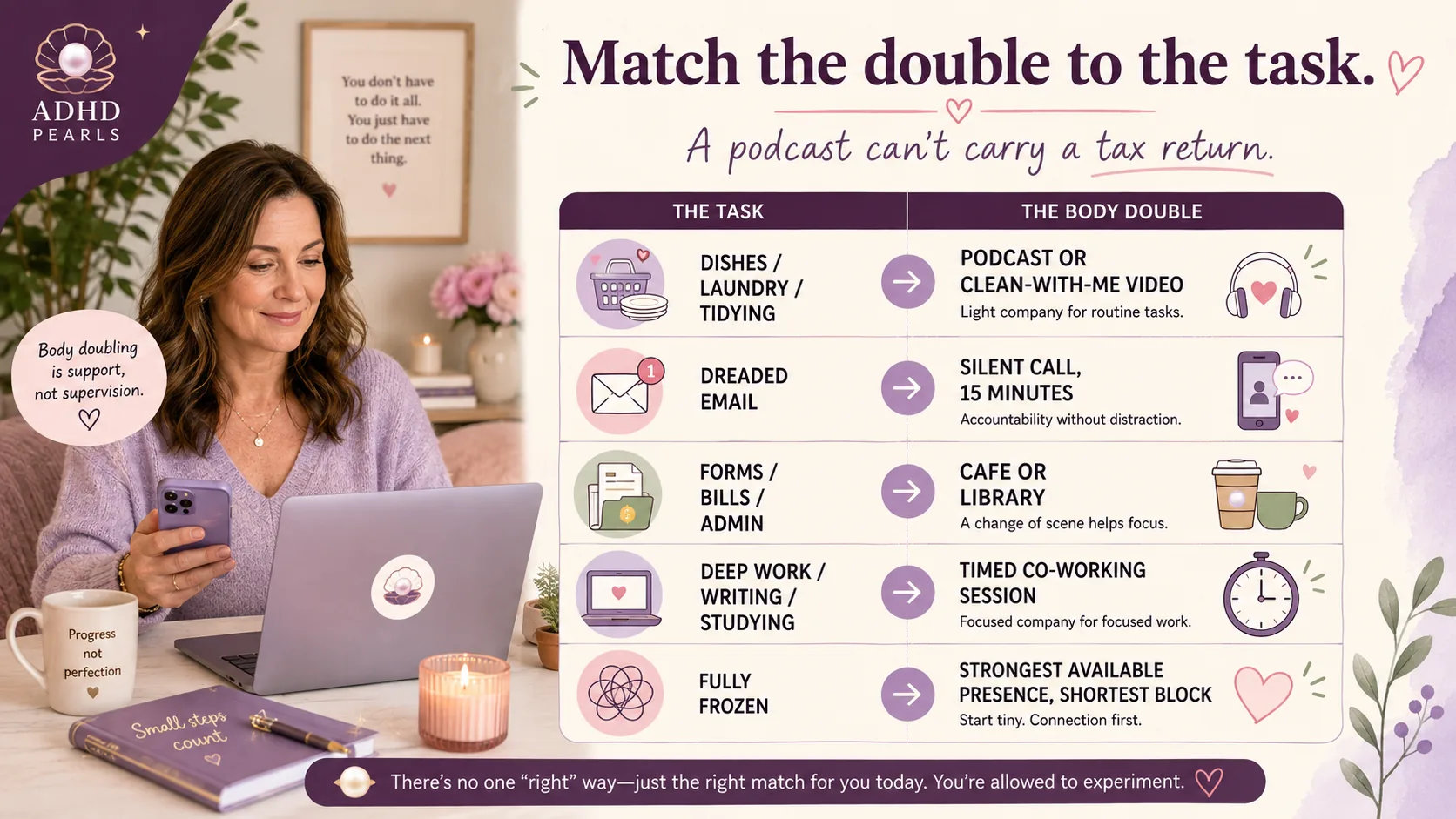
The mistake I made for a long time was using one form of body doubling for everything and concluding it was unreliable. It is not unreliable. It is that a podcast cannot carry a tax return and a Focusmate session is wasted on folding towels.
The task
What is hard about it
Version that fits
Dishes, laundry, tidying
Boring, not difficult
Podcast or clean-with-me video
Email you have avoided for a week
Emotionally loaded, short
Silent call with a friend, 15 minutes
Forms, bills, admin pile
Dread plus decisions
Cafe or library, out of the house
Deep work, writing, studying
Needs sustained attention
Timed co-working session, cameras off
The thing you cannot even name
Fully frozen
Strongest available presence, shortest possible block
If you work in an office and the problem is that focus evaporates the moment you sit down, the co-working version translates directly - it is one of the few things that has reliably helped me concentrate at work without white-knuckling it.
And if there is genuinely nobody, at any hour, in any format: Sort the Chaos is a small calm game with a two-minute body double built into it. Play one round, leave it on screen, start your tiny thing. It is the lightest rung on the ladder and some days it is the only one I can reach.
The right body double depends on the task. A light cue may work for dishes, but a dreaded admin task may need stronger presence.
One Tiny Move
Pick the single task that has been sitting on you longest. Open a study-with-me video, any length, and press play. Do not schedule anything, do not text anyone, do not decide whether body doubling is your strategy.
Give it four minutes. If nothing shifts, you have lost four minutes and learned you need a stronger rung. If something does shift - and for three quarters of neurodivergent people surveyed, something does - you have just found the version you can reach at 11pm on a Tuesday when there is nobody left to ask.
For the days when even that feels like too much, the two-minute starting hacks are the shorter menu.
Save this for the next time you are stuck on a task and need company, not pressure.
Pin this ADHD body doubling guide for the next time starting feels impossible alone.
FAQ: ADHD and Body Doubling
What is body doubling in ADHD?
Body doubling means doing a task while another person is present, either in the room or on a call. They are not helping you and usually not even talking to you — they are just there, doing their own thing. In a survey of 220 neurodivergent people, the community defined it as using the presence of others to start, stay focused on, or finish a task.
Why does body doubling work for ADHD?
The most common explanations are companionship, mild social accountability, and having a visible reminder that you are supposed to be doing something. For many people the effect is on starting rather than on concentration — the task stops feeling like a private negotiation you can quietly lose, so the first step gets easier.
Can you body double alone?
Yes, and most people who rely on it end up doing some version of this. Options include a silent video call, an online co-working room with strangers, a cafe or library, a long study-with-me video, or a livestream. In the 220-person survey, 81 participants body doubled online and 31 used recorded or live media rather than a real partner.
Do study-with-me videos count as body doubling?
For a lot of people, yes. Seventeen participants in the survey used YouTube videos and fourteen used livestreams as their body double. It is a weaker signal than a live person, so it tends to work better for physical or repetitive tasks than for work that needs deep thought.
Is body doubling scientifically proven?
Not yet, and it is worth being honest about that. The strategy came from the ADHD community rather than from a lab. Survey research documents that it is widely used and widely experienced as helpful, but as of 2025 there are no peer-reviewed controlled trials showing a conclusive effect in adults with ADHD, and small experimental studies have had mixed results. That does not mean it will not work for you — it means the evidence base is thin, not that the experience is imaginary.
What if body doubling makes me anxious instead of focused?
That is a documented reaction, not a personal failure. Being observed can raise anxiety about performing or making mistakes, which can push you further into avoidance. If a live person feels like surveillance, move down the intensity scale — audio only, camera off, a recorded video, or a public place where nobody is looking at you specifically.
How do I ask someone to body double without explaining ADHD?
Do not use the term. Say some version of: I work better with company — want to be on a call while we each do our own thing? Most people find working alongside someone mildly pleasant, so it lands as an invitation rather than a request for help.
How long should a body doubling session be?
Shorter than you think. Twenty-five to fifty minutes is the standard length on most co-working platforms, and it is long enough to get past the starting problem without turning into an endurance test. If you are dreading the task, book fifteen minutes — the point is to make starting cheap.
Does body doubling work for chores, or only for desk work?
It works well for chores, and often better. Dishes, laundry, tidying and admin are exactly the low-stimulation tasks that stall an ADHD brain, and they do not require the concentration a talking companion would interrupt. Many people who cannot body double through work calls can absolutely clean through one.
One tap makes ADHD Pearls a preferred source in your Google account, so our articles surface higher when you search. No signup, and it brings you straight back to this page.
Before you go
Free Stuck Reset
One tiny move for the moments you know what to do but still can't start.
For the woman who sets up the perfect system on Sunday and abandons it by Tuesday.
One short letter, every week. Real talk about ADHD, task paralysis, and the tiny wins that actually move the needle for a brain like yours. No shame. No hustle culture.