The notification arrived at 11.40pm: your payment is overdue. I sat up, opened the banking app, and paid it in about forty seconds. The money had been sitting there the entire time. It had been sitting there when the bill arrived, and every one of the nineteen days since.
I did not have a money problem that month. I had a problem with a specific eleven-second task that never once happened at a moment when I was capable of doing it.
Quick answer
Why do I pay bills late when I have the money?
Because paying a bill is not a money task, it is a timing task, and timing is the part ADHD makes hard. A deadline three weeks away does not register as real, an unopened envelope stops existing the moment you set it down, and the longer it sits the more emotional weight it collects. Having the funds does not help if nothing puts the task in front of you on a day you can act on it.
Key takeaways
📌Late bills are usually a timing failure, not a money failure or a character one.
📌Research finds adults with ADHD score lower specifically on noticing that a bill has arrived.
📌Autopay removes the decision, which is the part that keeps failing - but it is not right for every bill.
📌One fixed bill day a month beats twelve separate intentions to deal with it later.
📌Unopened post is avoidance, not laziness, and it gets heavier the longer it sits.
📌If your income is irregular, autopay needs a different setup rather than being written off.
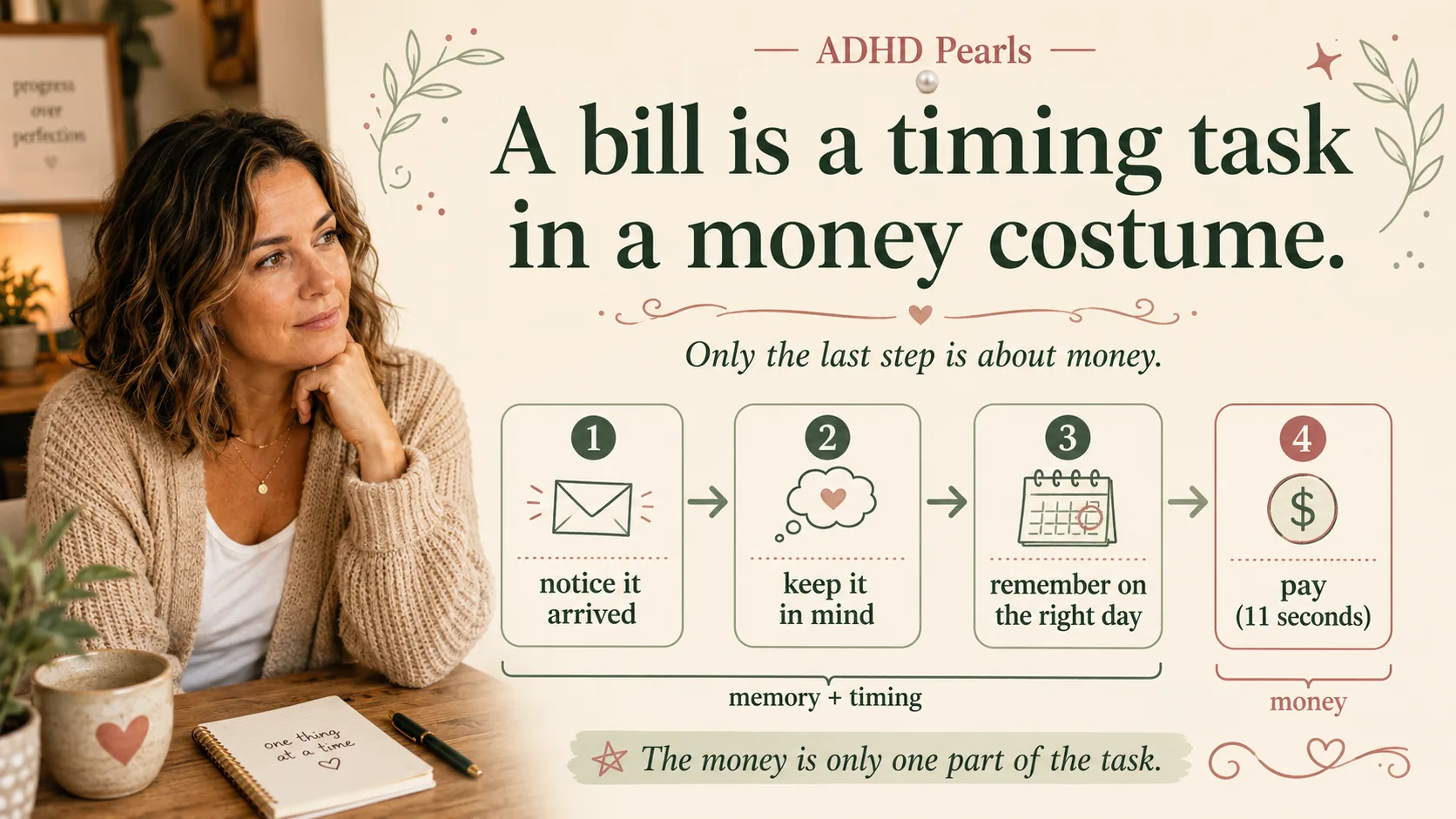
Look at what actually has to happen. Notice the bill exists. Hold that fact for up to a month. Recall it on a day when you are near a device, awake, and not mid-something-else. Then perform an action that takes under a minute.
Only the last step involves money. Everything before it is memory and timing, which is precisely where ADHD costs you.
Only the final step is about money. The three before it are where ADHD breaks the chain.
This is not a metaphor. A 2023 study using the Financial Competence Assessment Inventory compared 45 adults with ADHD against 47 without, and found the ADHD group scored significantly lower on awareness of the arrival of bills - not on understanding money, on noticing that something had turned up needing payment. It is a small study, so hold it loosely. But it measured the exact thing that keeps happening.
You did not forget how much you owed. You forgot that today was a day.
Three weeks away is not a real deadline
ADHD tends to run on two settings: now, and not now. A due date twenty-one days out lands squarely in not now, and stays there until it converts, usually overnight, into a crisis.
Nothing changes on day nineteen. There was no warning at day ten. That is time blindness doing its work on your finances rather than on your calendar.
The envelope stops existing
Then there is the physical version. Post arrives, gets set down somewhere sensible, and is instantly gone - the same out of sight, out of mind mechanism that loses food in a fridge drawer. An unopened envelope is not a reminder. It is a hidden object with a countdown attached.
And then it gets heavy
Here is the part that turns a small task into a months-long one. On day one it is an envelope. On day thirty it is an envelope plus everything you now feel about not having opened it. The task did not grow. The dread around it did, and dread is not something you can pay with.
Which is why "just open your post" fails so reliably as advice. By the time someone says it, the post is not the problem. The pile is the whole shape of life admin paralysis.
From ADHD Pearls
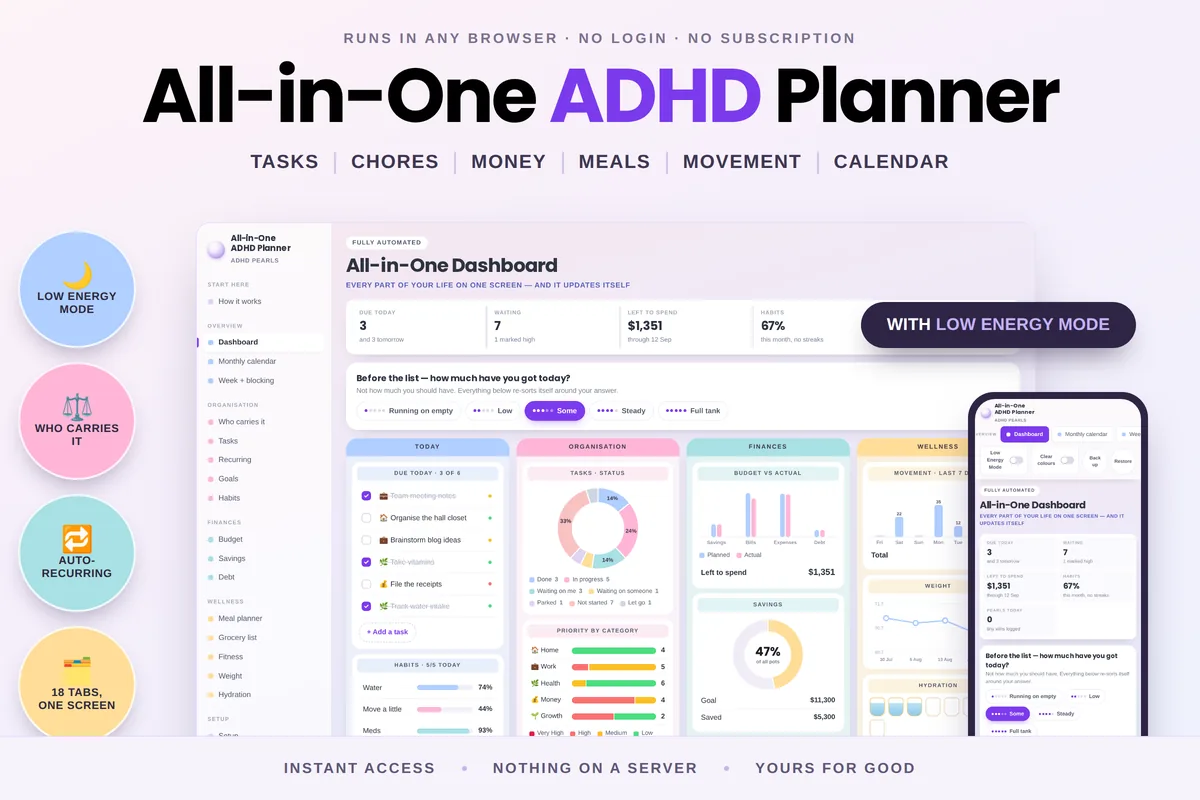
All-in-One ADHD Planner
Eighteen tabs that fill each other in. Say a repeating chore once and the schedule builds itself, and one tab shows who in the house actually carries what.
Opens in a new tab — this article stays where it is.
5 free days, counted only when you use it — just your email, no card. Then $27 once, private to your browser, no login, no subscription.
What Late Actually Costs
Two things worth knowing, both about the size of this rather than the shame of it.
First, it is measurable and it compounds. Late fees, reconnection charges, interest, and eventually a credit file that quietly makes everything else more expensive. None of it reflects your income. All of it reflects timing.
Second, and more relevant to who is reading this: a 2026 study in BMC Psychiatry found ADHD symptoms were significantly associated with debt, and the association was stronger in women. Other research on adults with ADHD reports more financial problems overall than matched controls - debts, exceeding credit limits, difficulty building any reserve.
These are associations across groups, not a prediction about you. But if you have been treating this as a private personal failing, it is worth knowing it has been studied, has a pattern, and has a mechanism. The mechanism is not carelessness about money. Related, and quieter, is everything covered in the ADHD tax.
What to Put on Autopay, and What Not To
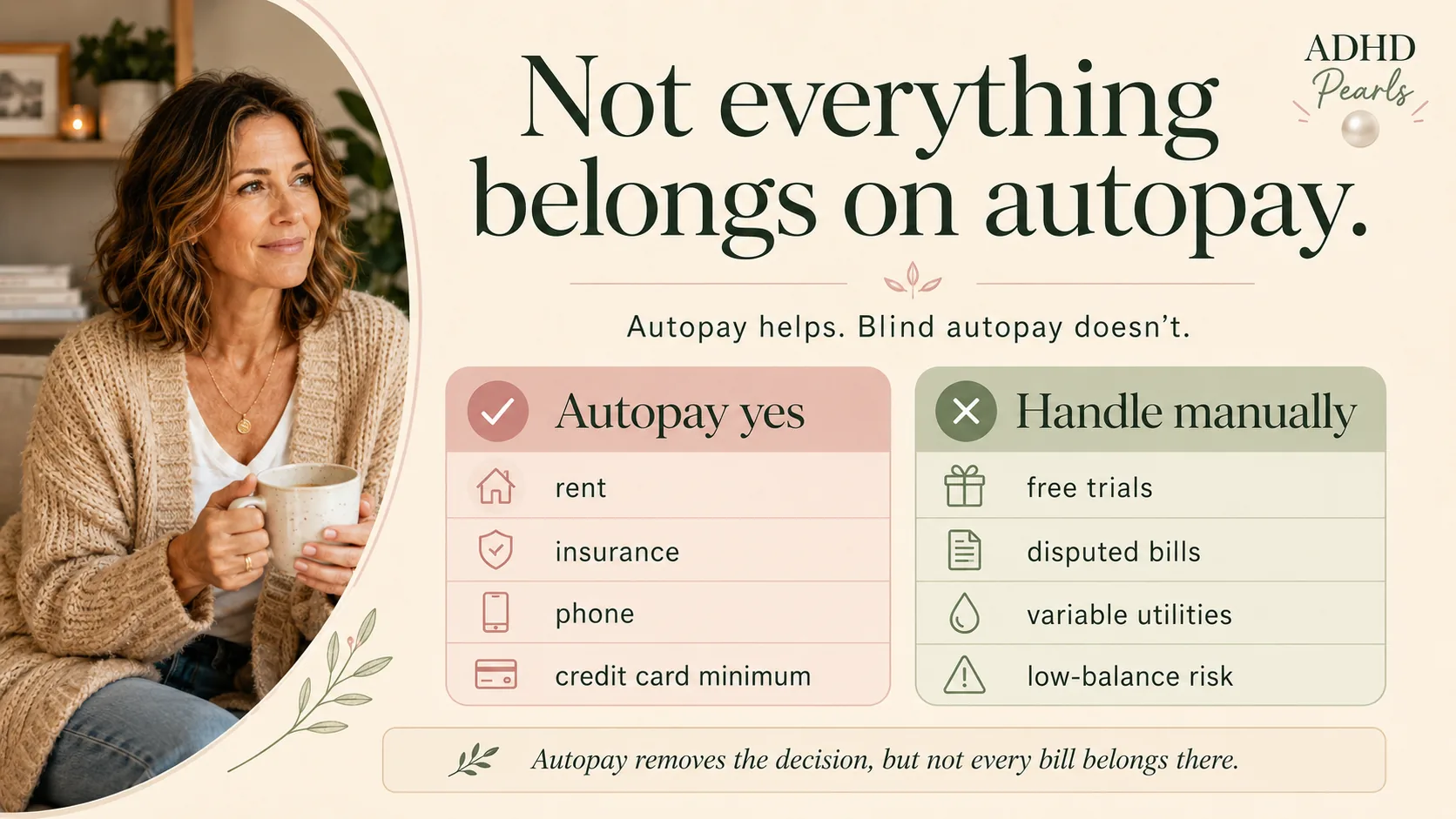
Autopay does one useful thing: it removes the decision, and the decision is the part that keeps failing. Set once, works every month, requires nothing from you on any particular day.
It is not right for everything, and most advice glosses over that. A payment that leaves automatically on a day your balance happens to be low can cost you an overdraft charge, which is a worse outcome than the late fee you were avoiding.
Type of bill
Autopay?
Why
Same amount, same date - rent, insurance, phone
Yes
Nothing to check. Predictable enough that automation has no downside.
Credit card
Minimum only
Protects you from a missed-payment mark. Pay more on top manually when you can.
Variable amount - energy, water
Usually, with a glance
Automate it, but read the amount once a month. Rates rise quietly.
Free trials and subscriptions
No
Automating something invisible is how it renews for four years. Handle these separately.
Anything you are disputing
No
Money is much harder to get back than to withhold.
Autopay removes the decision, which is the part that keeps failing. It is still not right for every bill.
This is general information about systems, not financial advice, and it is not tailored to your circumstances. Whether autopay suits you depends on your balance, your bank's overdraft terms and your income pattern. If money is genuinely tight, free debt advice services exist in most countries and using one is a sensible move, not an admission of anything.
The Bill Day: 20 Minutes, Once a Month
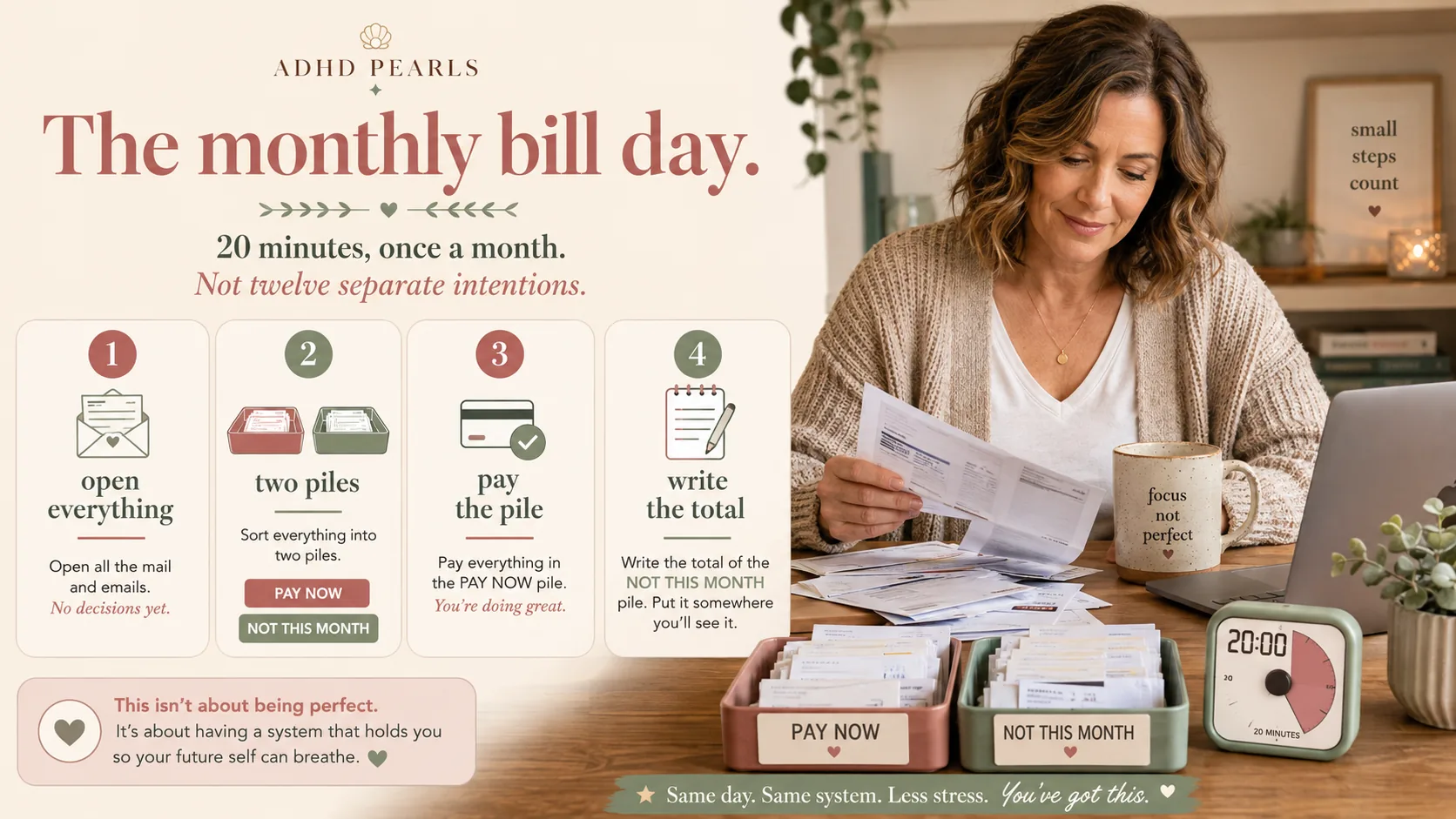
Autopay handles the predictable ones. Everything else needs a container, because "I will deal with it later" has no date attached and later is not a place.
Pick one day a month. The same day, not a floating one - the day after payday works for most people because the money is there and the date is already memorable.
Open everything. All post, all emails with the word invoice or statement. Do not act on anything yet. Opening is its own step because it is the one with the dread on it.
Two piles: pay now, and not this month. Two options only. Any third category is where this collapses.
Pay the pile. All of it, in one sitting. Batching is what makes this work - the hard part is starting, and you only pay that cost once.
Write the total somewhere. One number. Not a budget. Just so next month is not a surprise.
One fixed day turns twelve separate acts of remembering into a single repeatable system.
Twenty minutes, once. Compare that with twelve separate occasions of remembering at 11pm and feeling bad about it.
If even opening the laptop on bill day is the wall, that is a starting problem rather than a money one, and the fix is to make the first step smaller - one envelope, not the pile. That is the same move as any other tiny win.
When You Are Already Behind
Different situation, and it needs different rules. If there is a drawer of unopened envelopes and a genuine physical reluctance to look at it, none of the above applies yet.
Open them all in one sitting, without acting. No paying, no calling, no sorting. Just open and read. The dread is attached to not knowing, and not knowing gets worse every day you preserve it. Almost everyone reports the reality being smaller than the imagined version.
Opening the pile is its own step. You do not have to solve everything in the same breath.
Sort into three, once. Overdue, upcoming, and junk. Junk is usually most of it.
Deal with the oldest overdue first, not the scariest. Age causes the escalation, not size.
Ring them. This is the one nobody wants to hear. Companies deal with missed payments constantly and most have arrangements they simply do not advertise. Being three weeks late and calling puts you in a completely different category from being three months late and silent. The call is horrible and it is usually twelve minutes.
Freelance, shifts, commission, self-employed. Autopay gets recommended relentlessly and it can genuinely go wrong when the balance moves.
The usual adjustment is to change the date rather than abandon the method. Most providers will move a payment date if you ask, so cluster the automated ones just after money reliably lands. Keeping a small buffer in the paying account rather than the balance you actually plan around also absorbs the timing mismatch. And on a lean month, one call before the payment fails is far cheaper than the fee afterwards. If the deeper problem is that your pay does not arrive in months at all, the arithmetic of being paid fortnightly is its own subject.
What tends not to work is going fully manual as a matter of principle. That puts the whole load back on remembering, which is the thing that was not working in the first place.
One caveat on autopay, which belongs here and nowhere else: it is the right answer for the monthly bills and the wrong one for the annual renewals. Automating a yearly charge does not stop you paying it — it stops you ever checking the price.
FAQ: ADHD and Paying Bills
Why do I pay bills late when I have the money?
Because the difficulty is timing rather than funds. Paying requires noticing the bill arrived, holding that for weeks, and acting on a specific day. Research on financial competence in ADHD found adults with ADHD scored significantly lower on awareness that a bill had arrived, which is the step that fails long before money is involved.
Is forgetting to pay bills a symptom of ADHD?
It is a common consequence of ADHD traits rather than a diagnostic criterion. Working memory, time perception and task initiation all feed into it, and studies consistently find more financial difficulties in adults with ADHD than in matched controls. It is not evidence of not caring.
Should I put everything on autopay?
Not everything. Fixed, predictable bills are the strongest candidates. Free trials, anything you are disputing, and payments that could hit when your balance is low are worth handling manually. Whether it suits you depends on your bank's overdraft terms and how steady your income is.
What if autopay causes an overdraft?
That is the main risk and it is a real one. Moving payment dates to just after money reliably arrives helps, as does keeping a small buffer in the account the payments leave from. Most providers will change a payment date if you ask.
How do I stop losing paper bills?
Switch to paperless where you can, so the bill lands somewhere searchable rather than somewhere physical. For whatever still arrives on paper, one visible landing spot beats a tidy drawer, because an envelope you cannot see is functionally an envelope that does not exist.
What is a bill day and why does it help?
One fixed day a month when you open everything, pay what is due, and stop. It works because it converts twelve separate acts of remembering into one, and because starting is the expensive part - batching means you only pay that cost once.
What do I do about a pile of unopened post?
Open all of it in one sitting without acting on anything. The dread is attached to not knowing, and it grows for as long as the envelopes stay shut. Then sort into overdue, upcoming and junk, and start with the oldest overdue rather than the one that frightens you most.
Is it worth calling a company I have missed payments with?
Usually, yes, and sooner is considerably better. Missed payments are routine for them and many have arrangements they do not advertise. Being a few weeks late and in contact is treated very differently from being months late and unreachable.
Will this affect my credit?
It can, depending on the bill type and how late it is - rules differ by country and by provider. Setting the minimum payment to autopay on credit accounts is a common way to protect against the worst of it. For anything specific to your file, a free debt advice service can tell you more than an article can.
Save this for the next time ADHD makes a bill disappear until it is suddenly overdue.
Pin this ADHD bill-paying reset for the next overdue spiral.
My bills go out three days after payday now, and I open the post standing up in the hallway because sitting down with it was where it used to go to die. Neither of those is impressive. Both of them work, which turned out to be a different thing entirely.
Found this helpful? Share it with someone who gets stuck too.
One tap makes ADHD Pearls a preferred source in your Google account, so our articles surface higher when you search. No signup, and it brings you straight back to this page.
Before you go
All-in-One ADHD Planner
Eighteen tabs that fill each other in. Say a repeating chore once and the schedule builds itself, and one tab shows who in the house actually carries what.
For the woman who sets up the perfect system on Sunday and abandons it by Tuesday.
One short letter, every week. Real talk about ADHD, task paralysis, and the tiny wins that actually move the needle for a brain like yours. No shame. No hustle culture.