For about four years I thought I got a bonus twice a year.
It arrived in the months with three paydays. I would open the banking app, see a number that had never been there before, and feel briefly like a person whose life was going well. I bought a coat once. I have no regrets about the coat.
Then February would turn up and I would be short again, and I would put that down to February being February, or Christmas, or me. It took an actual spreadsheet — built in a temper, at midnight, which is when my best admin happens — to work out that the bonus was never a bonus. It was my own money coming back, after ten months of being quietly missing.
If you are paid every two weeks and you budget by the month, you are running a small arithmetic error all year. It is not a discipline problem. It is a division problem, and once you see it you cannot unsee it.
Quick answer
How do I budget when I am paid every two weeks?
Stop budgeting by the month. Fortnightly pay is 26 paycheques a year, not 24, so your true monthly income is higher than two paycheques — which is why most months feel tight and two feel generous. Budget by pay period instead: each paycheque covers the bills that land before the next one arrives.
Key takeaways
📌Paid fortnightly is 26 paycheques a year, not 24. Treating it as two a month is the arithmetic error underneath the tight months.
📌The three-paycheck month is not a bonus. It is the shortfall from all the other months arriving at once.
📌Pay runs on a 14-day cycle and bills run on a calendar month. The two never line up, and the gap drifts all year.
📌Budget by pay period: each paycheque covers the bills due before the next one, so nothing depends on which month it is.
📌A small float absorbs the drift, so the mismatch stops landing on you personally.
Here is the whole thing in one line, before the explanation.
If you are paid every two weeks, you get 26 paycheques a year. If you budget as though you get two a month, you are budgeting for 24. The other two exist — they just show up somewhere you were not looking.
Two a month sounds identical to every two weeks. It is not. Twelve months times two is 24. Fifty-two weeks divided by two is 26. Those are different numbers and one of them is your actual life.
Paid every two weeks is 26 paydays. Paid twice a month is 24. Budgeting one as though it were the other is where the tight months come from.
Put real money in it. Say you take home £1,000 every fortnight.
What you plan for
What actually happens
Paydays per year
24
26
Money per year
£24,000
£26,000
Per month
£2,000
£2,166.67
That £166.67 a month is not extra. It is yours, every month, and you have simply never counted it as monthly money. Over a year it is £2,000 — which is, exactly and unmysteriously, the two paycheques you did not plan for.
The bonus months are not a windfall. They are the shortfall, arriving late and all at once.
Different rhythm, same arithmetic. Paid weekly? That is 52 paydays, not 48 — so four months a year have five. Paid twice a month, on the 15th and the last day? Then you genuinely do get 24, and none of this applies to you; your problem is a different one and this article will be no use.
The rule underneath it: true monthly income = (pay per period × periods per year) ÷ 12. Not "what usually lands in a month."
I did that sum on the back of an envelope and then sat there feeling stupid for a while, which I would like to spare you. It is not stupidity. Every budgeting tool, every article, every bank app I had ever used organised money into calendar months, because that is how bills are billed. Nobody had ever mentioned that my money does not arrive in months.
So I went looking for something that would let me budget across the period my money actually lands in — the fortnight, the four weeks, whatever mine happened to be that year — rather than forcing it into a calendar box. Nearly everything I tried had "monthly" welded into it. A few let me rename the month. None let me change its length.
So we ended up building the thing we could not find: a planner where a budget has a start date and an end date you choose, so a pay period can be thirteen days or seventeen and the sums still work, and where what is left to allocate is kept separate from what is left to spend. I am not going to claim it made me good with money. It did stop me buying a coat in July with money that belonged to February.
From ADHD Pearls
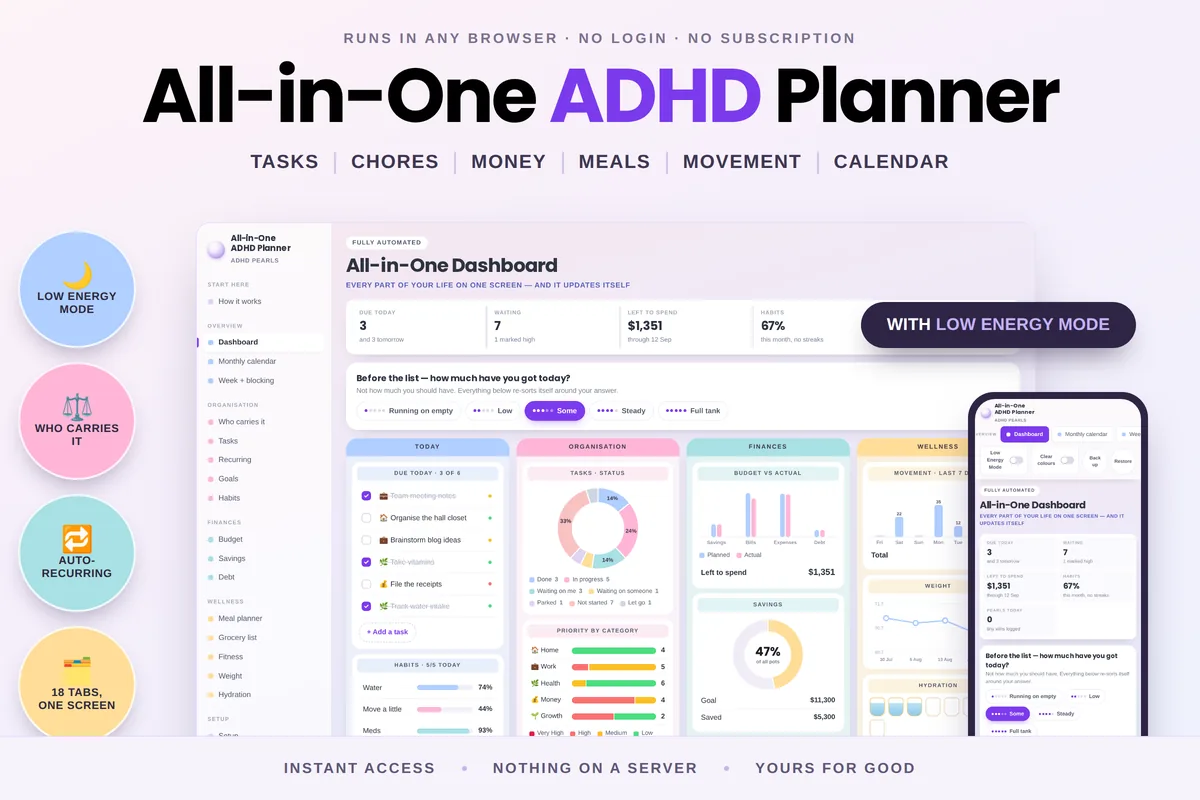
All-in-One ADHD Planner
Eighteen tabs that fill each other in. Say a repeating chore once and the schedule builds itself, and one tab shows who in the house actually carries what.
$27 once — private to your browser, no login, no subscription.
The three-paycheck month is not a bonus
Twice a year, the fortnightly rhythm and the calendar collide in your favour and three paydays land in one month. It feels like a windfall. It is treated like a windfall by roughly everyone, including me, including the coat.
But look at where it came from. In the ten ordinary months, two paycheques had to cover a month of bills that were priced against £2,166 of income. You were running £166 short, quietly, every one of those months. The third paycheque is that shortfall, handed back in a lump.
It feels like extra money. It is the ten months of quiet shortfall arriving late and all at once.
This matters more than it sounds, because of what a windfall does to a brain that is already inclined to act on the thing in front of it. Money that arrives labelled "extra" gets spent like extra. Money that arrives labelled "the ten months you were short" does not.
The relabelling is most of the fix. When the three-paycheque month comes round, that cheque already has a job: it is the year's float, or the annual bills, or the thing you have been putting on a credit card each January. Not because you must be austere. Because it was never spare.
Two rhythms that never line up
There is a second problem sitting underneath the first, and it is the one that makes fortnightly pay feel chaotic rather than merely inconvenient.
Your money arrives on a 14-day cycle. Your bills leave on a calendar cycle. Fourteen days is fixed. A month is 28, 30 or 31 days and moves. So the gap between "when the rent goes" and "when the money lands" is different every single month, and it drifts through the year like a slow tide.
One month the rent leaves three days after payday and you feel wealthy. Four months later it leaves two days before, and the identical income feels like a crisis. Nothing about your spending changed. The alignment did.
Pay runs on a fixed 14-day cycle. Bills run on a moving calendar month. Same income, same spending, different alignment every month.
Which is why "just be more careful in the tight months" does not work. There is no stable pattern to learn. The tight months move.
Budget by pay period, not by month
The fix is not more willpower applied to a monthly budget. It is to stop using the month as the container.
A pay period budget asks one question: this money, that just landed — what does it have to survive until the next lot arrives, and what has to come out of it? The period is however long it actually is. Thirteen days, fifteen days, whatever the calendar did this time.
Give each paycheque its jobs before it lands
Not after. The single most useful change I made was writing what a paycheque owed before it arrived, because after it arrives it stops being an abstraction and starts being a number I can feel, and a number I can feel is a number I will spend.
Bills due before the next payday. Groceries for that many days. The transfer to the annual-bills pot. Then what is left is genuinely left.
One paycheque, given its jobs before it lands. The float line is the timing buffer explained in the next section.
Split the monthly bills across periods
Rent is monthly. Your income is not. So halve it. If rent is £900, then £450 comes out of each fortnight and sits somewhere that is not your spending balance. When the rent leaves, it leaves from money you stopped counting a fortnight ago.
This is the step I resisted longest, because it felt like admin theatre — moving my own money around to trick myself. It is exactly that. It works anyway. My spending balance now tells me the truth, which it never did when it contained the rent.
Keep "left to allocate" and "left to spend" apart
These are two different numbers and conflating them is how a good week becomes a bad fortnight. Left to allocate is money that has not yet been given a job. Left to spend is what remains after every job is assigned. The first is almost always bigger, and it lies.
Handle the odd periods deliberately
Twice a year a period will contain an extra payday, and once or twice it will contain an extra bill. Decide in advance which one you are in. It takes ten seconds and it removes the specific panic of not knowing whether this fortnight is a good one.
If your income itself varies — shifts, commission, freelance — the same container works, but the amounts do not. Budget the period against your lowest recent pay rather than the average, and treat anything above that as unallocated. The timing of the automated payments themselves is a separate problem with its own fixes.
The float that absorbs the drift
Everything above still leaves you exposed on the months where the calendar puts a big bill just before a payday instead of just after. You cannot budget that away, because it is a timing gap, not a money gap.
What closes it is a float: a fixed amount that sits in the account bills come out of, and that you do not count as available. It is not savings. It has no goal. Its whole job is to be in the wrong place at the wrong time so that you are not.
How big? Enough to cover the largest bill that might land on the wrong side of a payday. For most people that is the rent or the mortgage. Building it is the obvious use for one of the two "bonus" paycheques, which is a much better story than the coat.
I got mine to about half a rent and then stalled for a year, and half a rent still absorbed most of it. This is not an all-or-nothing thing. Any float is better than none, and the first £100 does a surprising amount of work.
What the numbers say, including the awkward one
In 2022 Monzo and YouGov surveyed UK adults with ADHD about money. Among the women:
59% said sticking to a budget was a regular problem, against 39% of men with ADHD.
54% said they impulse spend frequently, against 40% of men.
72% thought their ADHD affected their personal finances, against 56% of men.
The estimated extra annual cost came out at £1,695 for women and £1,494 for men.
Two things about that. It is a survey commissioned by a bank, not a peer-reviewed study, and the published write-ups do not give a sample size — so treat it as a large, useful piece of self-report, not as a measurement. And it describes women with ADHD against men with ADHD, which is a comparison worth having when almost everything else compares ADHD against no ADHD.
Now the awkward one, which I would rather you heard here than found later.
In 2020 Bangma and colleagues studied financial decision-making in 1,292 community adults, grouped by ADHD symptoms. Unadjusted, the ADHD groups did show more impulsive buying and more avoidant financial decision styles. But when the analysis controlled for personality traits and symptoms of depression, ADHD symptoms were no longer significantly associated with any of the financial outcomes. What predicted impulsive buying instead was neuroticism, extraversion, low conscientiousness — and being female, and being younger.
I am not going to pretend that is comfortable reading for an article on an ADHD site. But it belongs here, for two reasons.
The first is that it does not make your difficulty imaginary. It says the route may run through traits and mood that travel with ADHD rather than through ADHD itself, which is a claim about mechanism, not about whether you are struggling.
The second is that none of it touches this article's actual argument. The 26-versus-24 arithmetic is not a psychological finding. It is division. It is wrong for everyone paid fortnightly who budgets monthly, ADHD or not — we just have less spare capacity to absorb being quietly wrong all year.
What this does not fix
It does not create money. If the numbers do not meet, budgeting by pay period will show you that faster and more clearly, which is genuinely useful and also horrible. Seeing it sooner is worth something. It is not the same as solving it.
It does not survive a month you stop looking. Nothing here runs itself. The relabelling only works while somebody is doing the labelling.
It will not stop the impulse spend. Different mechanism, and it has its own article. What it does is make the damage visible in the period it happened in, rather than four months later when the tight month arrives and you cannot work out why.
And if your income is genuinely unpredictable — no fixed periods at all, some weeks nothing — this framework helps less than I would like. Budgeting to your lowest recent pay is the honest version of the advice, and it is a harder life than any article makes it sound.
Save this for the next month that feels tight for no reason you can name.
FAQ
How many paychecks are in a year if I am paid every two weeks?
Twenty-six. Fifty-two weeks divided by two. Roughly every eleven years the calendar produces twenty-seven. If you are paid twice a month on set dates instead, it is twenty-four, which is a genuinely different situation.
What is a three-paycheck month?
A month where the fortnightly cycle happens to deliver three paydays instead of two. It happens twice a year. It feels like extra money, but it is the accumulated shortfall from the months where two paycheques had to cover bills priced against a higher true monthly income.
How do I work out my real monthly income?
Pay per period multiplied by periods per year, divided by twelve. Fortnightly is × 26 ÷ 12. Weekly is × 52 ÷ 12. Not "what usually lands in a month," which quietly undercounts.
Is budgeting harder with ADHD?
Self-report says yes and by a wide margin — in the Monzo/YouGov survey, 59% of women with ADHD called it a regular problem against 39% of men with ADHD. The research picture is more careful: at least one study found the link to financial outcomes disappeared once personality and depression were controlled. Both can be true, and neither means you are imagining it.
Should I just move to a monthly-paid job?
No. The fortnight is not the problem — budgeting the fortnight as if it were half a month is. Monthly pay brings its own version, which is a single large sum that has to last thirty-one days with no checkpoint in the middle.
Research notes
Monzo & YouGov (2022).Living with ADHD can cost an extra £1,600 a year because of difficulties managing your money. UK adults with ADHD, published 27 June 2022. Overall: 50% struggled to stick to a budget vs 15% without ADHD; 49% paid bills late vs 18%; 31% struggled with debt vs 11%. The women-versus-men breakdown (59% vs 39% on budgets; £1,695 vs £1,494) comes from press coverage of the same research. A bank-commissioned survey, not a peer-reviewed study, and no sample size is published.
Bangma, D. F., Tucha, L., Fuermaier, A. B. M., Tucha, O., & Koerts, J. (2020).Financial decision-making in a community sample of adults with and without current symptoms of ADHD. PLOS ONE, 15(10), e0239343. 1,292 community adults. Impulsive buying and financial decision styles were not significantly associated with ADHD symptoms once personality, depression symptoms and demographics were controlled; neuroticism, extraversion, low conscientiousness, female sex and younger age predicted impulsive buying instead.
Stickley, A., et al. (2026).ADHD symptoms and financial debt among adults. BMC Psychiatry, 26(1), 566. 3,717 Japanese adults. ADHD symptoms associated with debt at OR 1.04 per point (women 1.06), adjusted for sociodemographics, household finances, health, alcohol, smoking, depression and anxiety. Cross-sectional, self-report, single-item debt measure, and a Japanese sample — context rather than proof.
The arithmetic in this article is not a research finding. It is 52 ÷ 2 = 26, and you can check it against your own bank statements, which is what I eventually did.
I still have the coat. It is a good coat. I wear it in February now, which feels like a small joke I am having with myself.
What actually changed was not restraint. It was that I stopped asking a calendar month to describe money that does not arrive in months. When I went looking for something that would hold a budget across the period my money actually lands in, every tool I tried had the month built in at the foundations — you could rename it, but you could not resize it.
So we built one where the budget runs between two dates you pick, where bills, expenses and debt are counted separately instead of blurred into one pot, and where the money you have not yet allocated is never shown as money you can spend. It has not made me a person who enjoys looking at her bank balance. It did mean the July version of me stopped spending February's rent, which turns out to have been most of the problem.
Found this helpful? Share it with someone who gets stuck too.
One tap makes ADHD Pearls a preferred source in your Google account, so our articles surface higher when you search. No signup, and it brings you straight back to this page.
Before you go
All-in-One ADHD Planner
Eighteen tabs that fill each other in. Say a repeating chore once and the schedule builds itself, and one tab shows who in the house actually carries what.
For the woman who sets up the perfect system on Sunday and abandons it by Tuesday.
One short letter, every week. Real talk about ADHD, task paralysis, and the tiny wins that actually move the needle for a brain like yours. No shame. No hustle culture.