Last year I bought a bread maker at 11:47pm because a video convinced me I was about to become the kind of woman who bakes her own sourdough. It arrived, I used it twice, and it now lives in the cupboard of good intentions with the spiralizer and the calligraphy set.
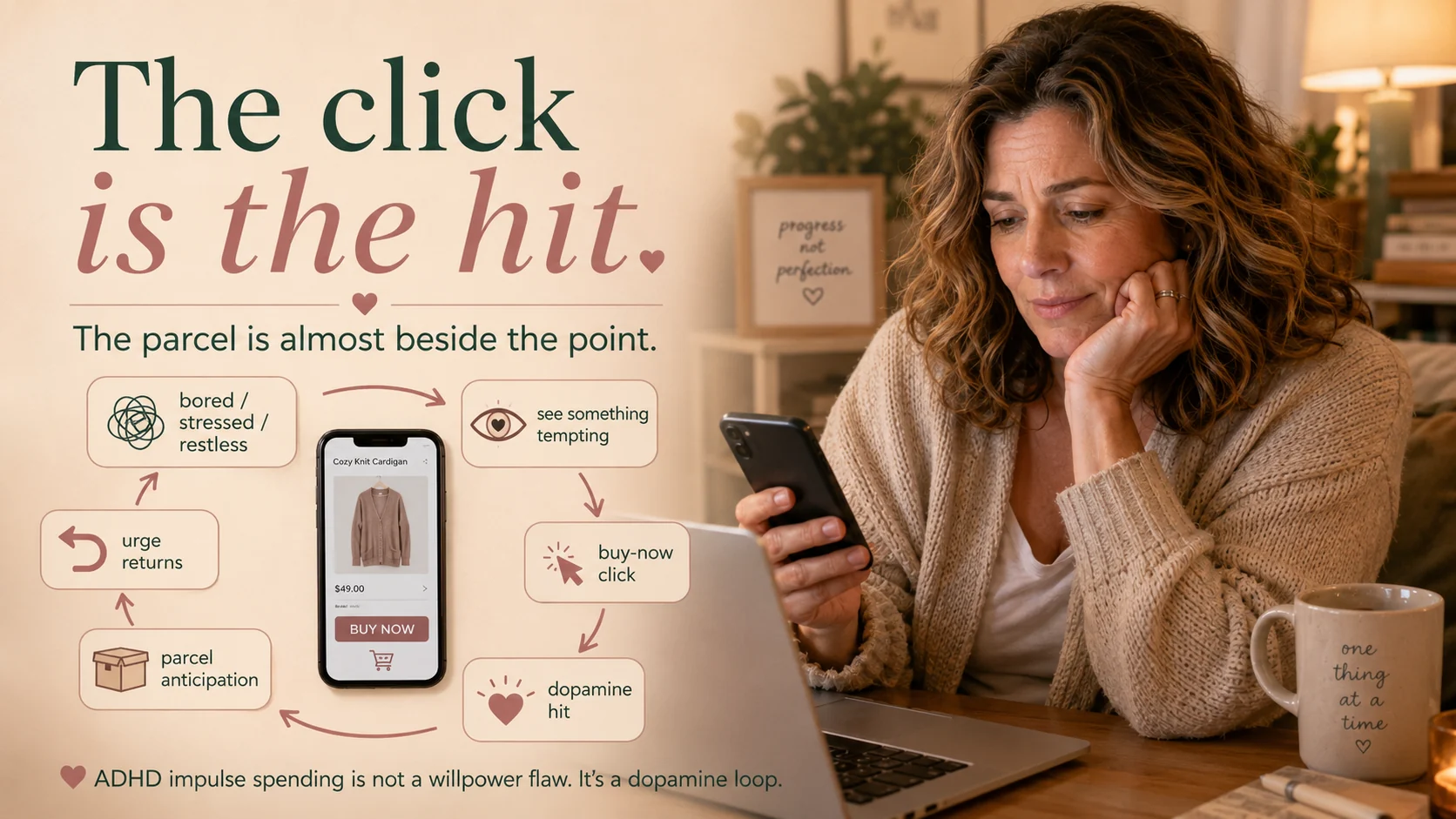
None of those purchases were about bread, or spiralized courgette, or beautiful handwriting. They were about the little hit of yes I got the second I clicked "buy now" - a hit my brain went looking for again the very next quiet, restless evening.
For a long time I thought this made me irresponsible, or bad with money. It doesn't. It makes me a dopamine-seeking brain meeting a checkout button designed to need zero willpower. So here are the 8 friction tricks that actually shrank my impulse spending - no shame, no budgeting spreadsheet from hell.
Quick answer
How do you stop ADHD impulse spending?
Add friction instead of relying on willpower. Delete saved cards and shopping apps so buying takes effort, unsubscribe from marketing emails, cap yourself with a fixed "fun money" amount, and park anything you want on a 24-hour wait list before buying. ADHD brains impulse-spend because a click is a fast dopamine hit and modern checkouts remove every speed bump - so the fix is to slow the moment between wanting and paying, and give your brain a cheaper hit instead.
Key takeaways
📌Add friction instead of willpower: delete saved cards, unsubscribe, cap fun money, wait 24 hours.
📌The purchase is dopamine, so removing it without a replacement rarely holds for long.
📌Catch the trigger rather than the item. Boredom, overwhelm and RSD each need a different answer.
📌Saved payment details are the biggest single leak, because they remove the pause entirely.
📌One fixed amount you are allowed to spend badly works better than a ban you will break.
Here's the mechanism, because it helped me stop taking it personally. ADHD brains tend to run lower on dopamine, the chemical behind reward and motivation - so they're constantly, quietly hunting for a hit. And buying something delivers one, fast and reliable: the anticipation, the click, the little "yes," the parcel to look forward to.
On top of that, ADHD comes with weaker impulse control and a strong pull toward immediate gratification. The part of the brain that's supposed to pause and ask "wait, do we need this?" is exactly the part that runs unreliably. So the gap between wanting and buying - which for other people is a thoughtful few seconds - can be basically zero.
Studies back this up: impulsive-buying scores tend to run higher in people with ADHD. My own evidence is a cupboard full of single-use appliances, but it's nice to know the research agrees.
I wasn't buying a bread maker. I was buying the feeling I got the moment before it shipped.
The parcel is almost beside the point. The fast reward often happens at the click.
From ADHD Pearls
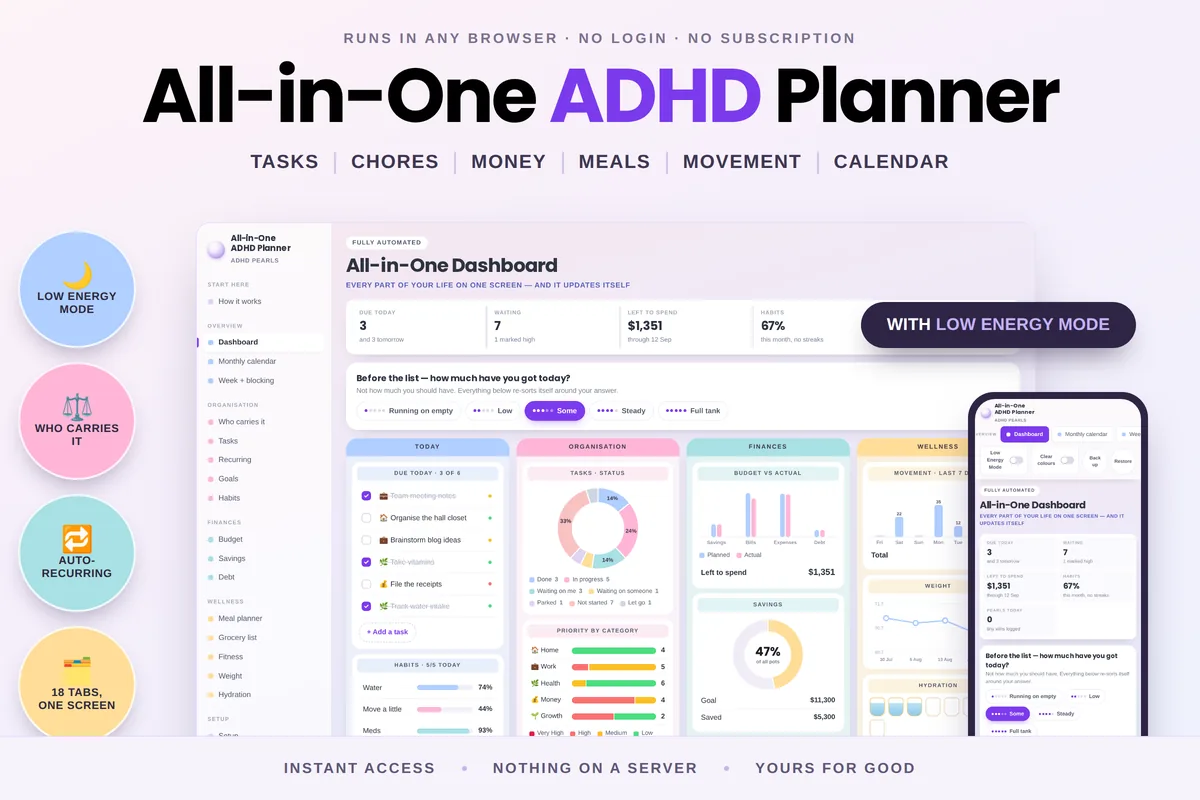
All-in-One ADHD Planner
Eighteen tabs that fill each other in. Say a repeating chore once and the schedule builds itself, and one tab shows who in the house actually carries what.
$27 once — private to your browser, no login, no subscription.
It's Not Weak Willpower - It's Missing Friction
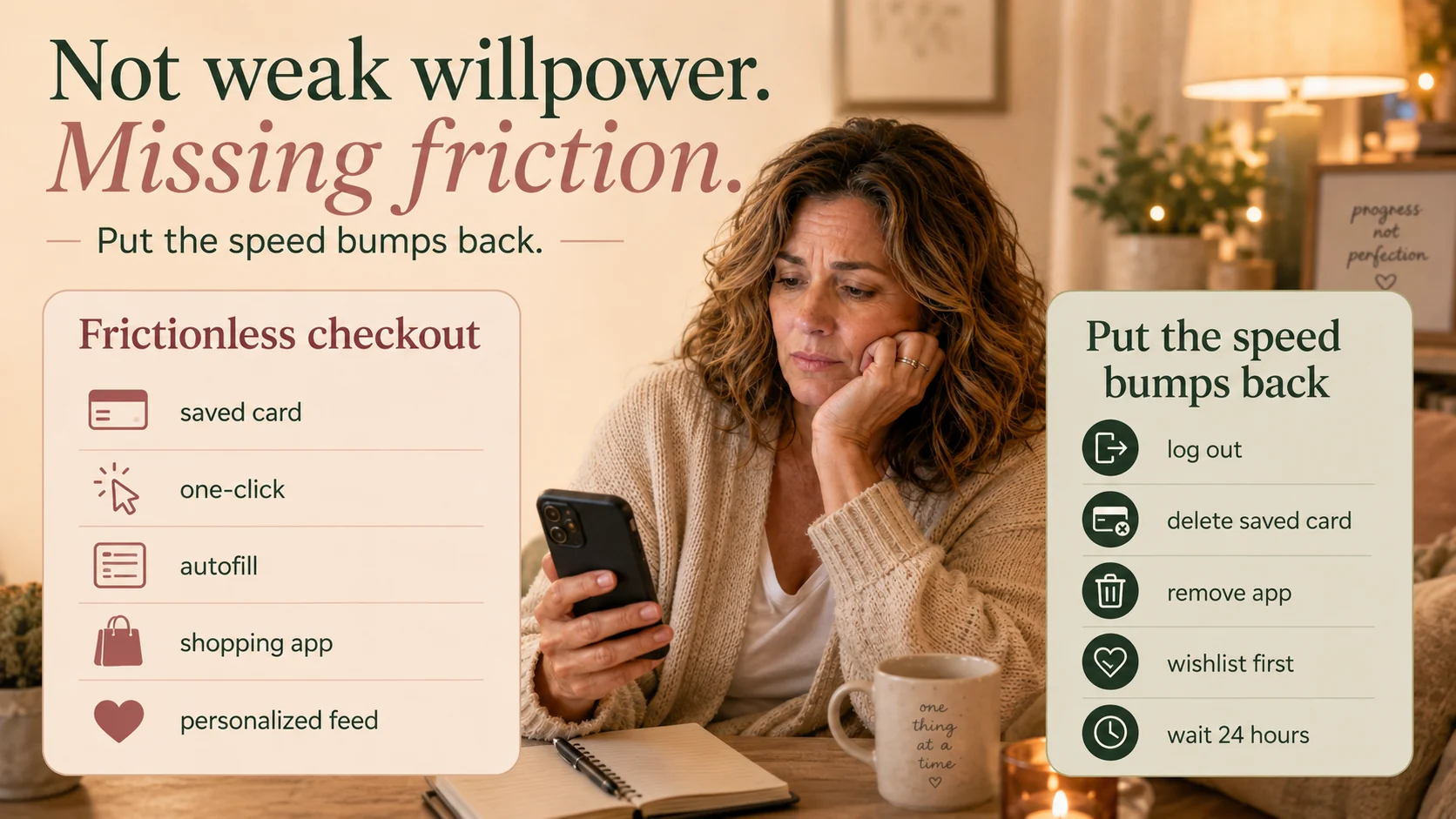
The reframe that changed how I handle this: you're not weak. You're up against a system engineered to remove every single speed bump between you and a purchase. Saved cards. One-click. "Buy now with one tap." Autofill. Apps that open to a personalized feed of things you'll probably want.
Every one of those exists to delete the pause - the exact pause an ADHD brain already struggles to hold. Asking yourself to out-willpower a checkout that took a team of designers years to make frictionless is a losing game, and losing it doesn't mean you're irresponsible. It means the machine is working as intended.
So the whole strategy below isn't "want it less." It's "put the speed bumps back." When willpower fights friction, friction wins - the same logic behind beating mindless scrolling, just with your bank account instead of your evening.
The goal is not perfect self-control. The goal is to put the pause back where the system removed it.
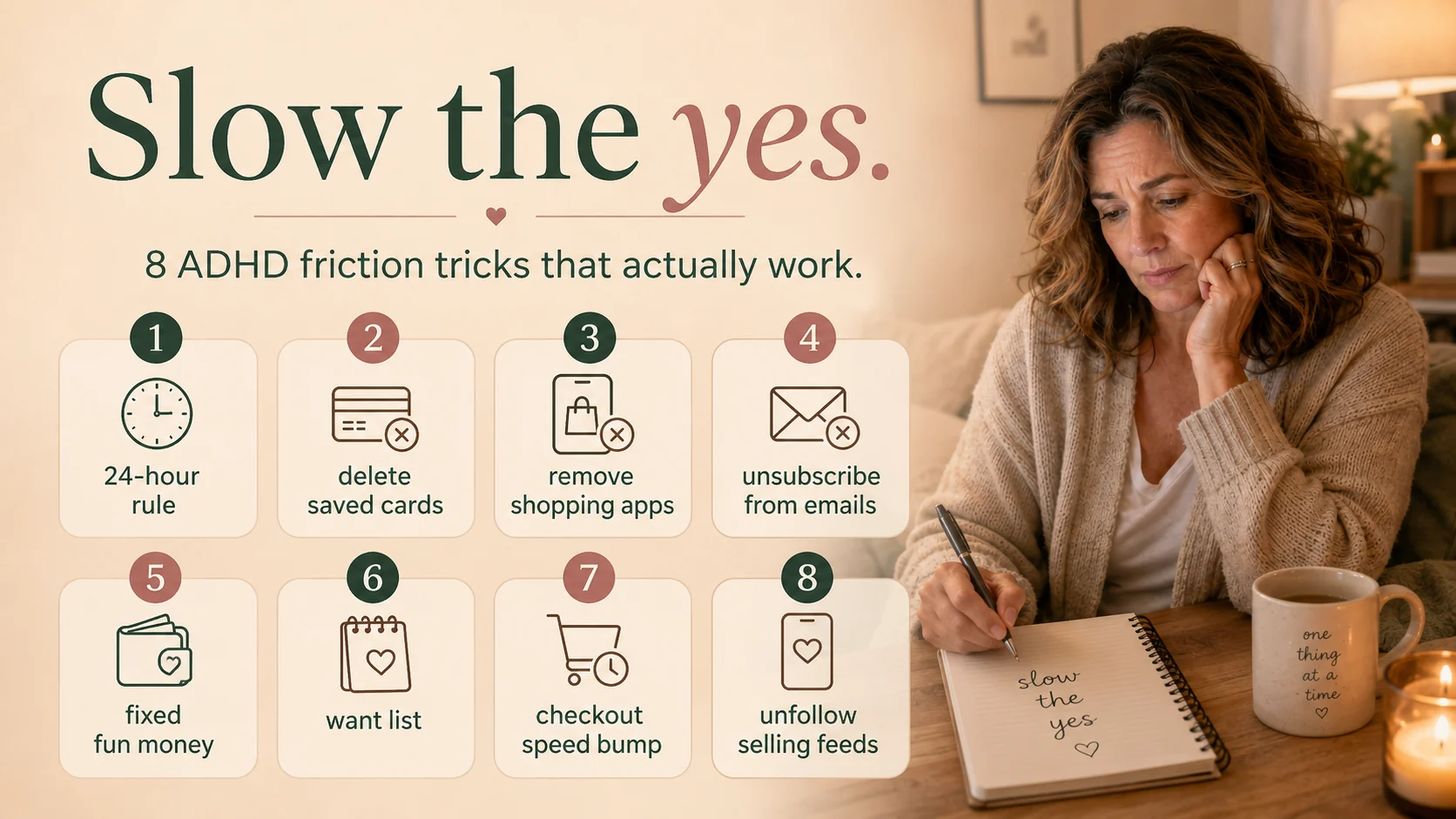
8 Friction Tricks That Actually Work
You don't need to cut up your cards or feel guilty about every latte. You just need to slow the moment between wanting and paying. These are the ones that genuinely stuck for me.
1. The 24-hour rule. Anything non-essential goes in the cart - and then I wait a day before buying. That's it. Most of the time the urge just evaporates once the dopamine spike passes. In one story that went viral, a person parked 83 wanted items over a year, ended up buying only 19, forgot 64 entirely, and saved over six thousand dollars. You're not saying no; you're saying "not right now," which an ADHD brain accepts far more easily.
2. Delete your saved card details. This is the big one for online buying. If I have to physically get up, find my wallet, and type sixteen digits every time, half my impulse purchases die in the friction. The tap-to-buy is the enemy; make yourself do the boring version.
3. Take the shopping apps off your phone. The app on the home screen is a slot machine in your pocket. I moved mine to a browser I have to log into each time, and the two extra steps break the autopilot reach. I still shop - I just have to mean it.
4. Unsubscribe from marketing emails. Those "24 hours only!" emails are basically dopamine grenades lobbed straight at the part of your brain that can't resist a deal. I spent one boring afternoon hitting unsubscribe, and my "oh I didn't even know I wanted that" purchases dropped noticeably. You can't be tempted by a sale you never see.
5. Use a fixed "fun money" amount. I keep a set amount each month on a separate card for guilt-free spending. When it's gone, it's gone - no maths, no willpower, no checking. The decision is made in advance by past-me, who was calmer and not looking at a limited-edition anything at midnight.
6. Keep a want list instead of a cart. When I want something, I write it on a running note instead of buying it. Weirdly, the act of capturing it gives my brain a smaller version of the same hit - like the want has been acknowledged. Then I revisit the list later, and most entries make me go "why did I want a light-up ice cube tray, exactly?"
7. Add one deliberate speed bump at checkout. Log out of stores so you have to sign in. Turn off one-click. Some people move the item to a wishlist and only buy from there. Each tiny barrier reinserts the pause your brain skips - and the pause is where the "actually, no" lives.
8. Unfollow the feeds that sell to you. Half my impulse buys started as a "get ready with me" video or a too-perfect flat-lay. Muting or unfollowing the accounts that reliably make me reach for my card removed the trigger before it fired. It's not about missing out; it's about not being advertised to during your own downtime.
You do not have to ban every purchase. You just need to slow the yes long enough to choose.
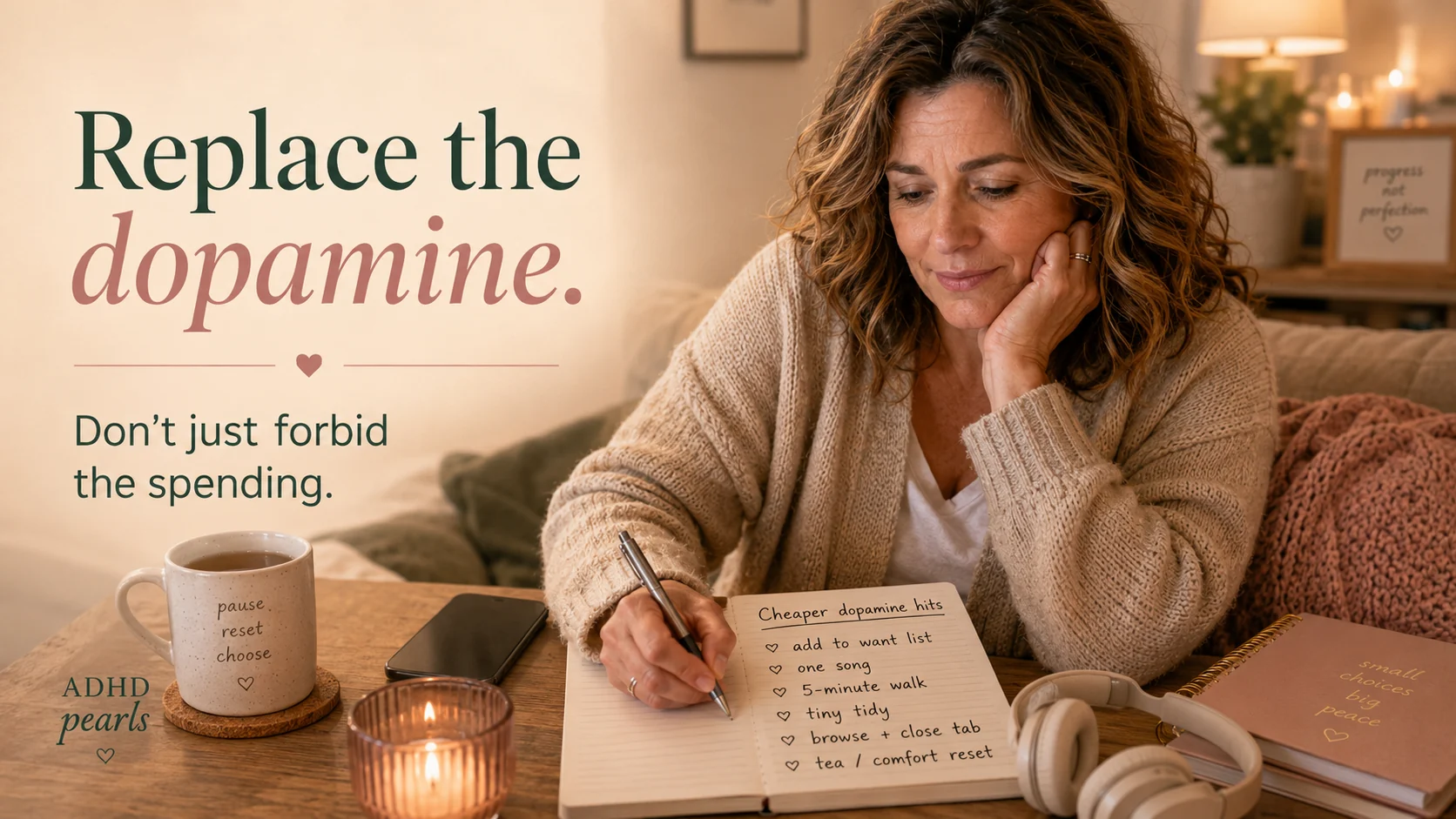
Replace the Dopamine, Don't Just Forbid It
Here's the mistake I made for years: I'd go on a strict no-spending ban, white-knuckle it for two weeks, and then blow it spectacularly on a haul that undid all my "progress." Because I'd removed the dopamine source without giving my brain anything to replace it with, and a dopamine-hungry brain does not accept a void.
What actually works is rerouting the hit, not deleting it. When I feel the itch to buy, I need something else easy and a little bit rewarding right there - browsing and closing the tab without buying (a genuinely satisfying tiny rebellion), adding to the want list, a five-minute walk, one song, a quick tidy that gives me a visible win. If shopping is how you change your state when you're bored or low, a pre-made list of cheaper hits works far better than a rule. That's the whole idea behind a dopamine menu.
Do not just forbid the spending. Give your brain another fast, gentle reward to move toward.
Catch the Trigger, Not the Item
Once I started paying attention, my impulse buys had almost nothing to do with the items and everything to do with my state. Bored on a Tuesday night. Stressed after a hard day. Sad and wanting a small good thing. Even happy - "I finished the project, I deserve this." The bread maker wasn't a baking decision; it was an "I'm restless and understimulated" decision wearing an apron.
So now I try to name the feeling before I name the thing: "I'm not actually shopping, I'm bored," or "this is a stress-buy." Catching the state is the real skill, because you can meet boredom or stress a hundred cheaper ways once you've noticed that's what's happening. It's the same money leak I chase from the other end in the ADHD subscription audit and the ADHD tax.
This is general, practical information, not financial advice. Everyone's situation is different, and if spending is seriously affecting your finances or wellbeing - or feels genuinely compulsive - a qualified financial advisor, therapist, or free debt-support service can help.
The tiny move: before you close this, do one thing - delete your saved card from the one shop you impulse-buy from most, or move its app off your home screen. Just one. You don't need a budget, a ban, or a new personality. You just need the "yes" to take thirty seconds longer than it does right now, so the real you gets a vote.
Pin this ADHD impulse spending reset for later.
FAQ: ADHD and Impulse Spending
Why do people with ADHD impulse spend?
Because an ADHD brain runs lower on dopamine and craves stimulation, and a "buy now" click delivers a fast, reliable hit of it. Add weaker impulse control, a pull toward immediate gratification, and a tendency to spend to change your mood, and one-click shopping becomes almost irresistible. It's a wiring-plus-design problem, not you being irresponsible or bad with money.
How do I stop impulse buying with ADHD?
Add friction instead of relying on willpower. Delete saved card details and shopping apps so buying takes effort, unsubscribe from marketing emails, use a fixed "fun money" amount, and put anything you want on a 24-hour wait list before buying. The goal is to slow the moment between wanting and paying - because that pause is exactly the part ADHD skips.
Does the 24-hour rule actually work?
For a lot of people, yes. You put the thing in your cart (or on a list) and wait a day before buying. Most impulse wants fade once the dopamine spike passes - in one widely shared example, a person parked 83 items over a year, still bought 19, but forgot 64 completely and saved thousands. Waiting beats forbidding, because you're not saying no, just not right now.
Why can't I just use willpower to stop?
Because willpower is the exact resource an ADHD brain has least of on demand, and shopping is engineered to need none of it - saved cards, one-click, and "buy now" remove every speed bump. Knowing you shouldn't doesn't override the impulse in the half-second it fires. Changing the environment works far better than trying to want it less.
What is dopamine or emotional spending?
It's buying to change how you feel rather than because you need the thing - a hit of novelty and reward when you're bored, stressed, sad, or even celebrating. ADHD brains are especially prone to it because spending reliably produces the dopamine they're low on. Naming it as state-changing (not shopping) is the first step to swapping it for a cheaper hit.
How do I stop online impulse buying specifically?
Remove the frictionless parts: delete saved payment details so you have to type your card every time, take shopping apps off your phone, log out of stores, and unsubscribe from marketing emails. Each small barrier reinserts the pause between wanting and paying. Online shopping is designed to be effortless, so your job is to make it slightly annoying again.
Should I use cash instead of cards for ADHD?
It helps a lot of people, because handing over physical cash feels more real than a tap, and a fixed amount can't be overspent. A prepaid or separate "fun money" card does the same job - once the balance is gone, the decision is made for you, with no willpower or mental maths required. It turns self-control into a system.
Can ADHD medication help with impulse spending?
For some people, treating ADHD improves impulse control, which can make it easier to pause before buying. It won't erase the pull of a well-designed checkout, though, so it works best alongside friction and replacement strategies rather than on its own. Any medication decision should be made with a qualified clinician.
One tap makes ADHD Pearls a preferred source in your Google account, so our articles surface higher when you search. No signup, and it brings you straight back to this page.
Before you go
All-in-One ADHD Planner
Eighteen tabs that fill each other in. Say a repeating chore once and the schedule builds itself, and one tab shows who in the house actually carries what.
For the woman who sets up the perfect system on Sunday and abandons it by Tuesday.
One short letter, every week. Real talk about ADHD, task paralysis, and the tiny wins that actually move the needle for a brain like yours. No shame. No hustle culture.