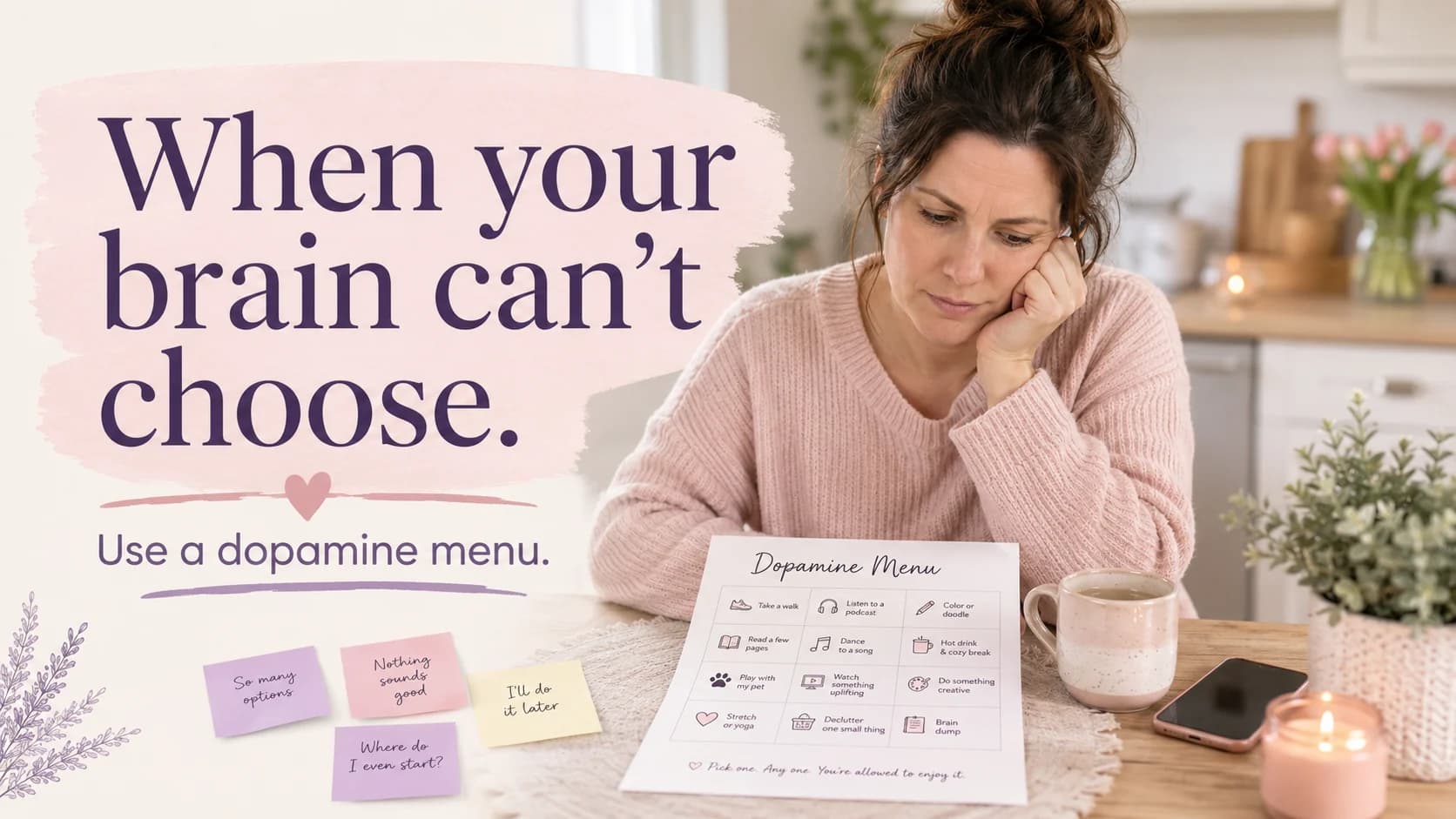
I used to lose entire days. Not depressed, not sick — just completely unable to land on anything. I’d open my phone, close it, walk to the kitchen, stand there, walk back. My brain was running but it wasn’t going anywhere. By 4pm I’d have that specific ADHD shame where you’ve done nothing, and you’re not even sure why.
The thing I was missing wasn’t discipline. It was a list. A very specific kind of list that I could reach for when my brain lost the ability to choose. I didn’t know it had a name until much later. It’s called a dopamine menu, and it changed how I handle my worst days.
This is what it is, why it works on the days when nothing else does, and how to get a free printable version you can actually use today.
One thing worth knowing before you build one: this menu is sorted by type of activity. If you find that the problem is picking something far too ambitious for the state you are actually in, the version sorted by level of overwhelm may suit you better.
Quick credit where it belongs: I didn’t invent this idea. The dopamine menu concept was popularized in the ADHD community by Jessica McCabe from How to ADHD and Eric Tivers from ADHD reWired. I built my own version after realizing how useful the idea was on the days when my brain couldn’t generate a single helpful next step on its own.
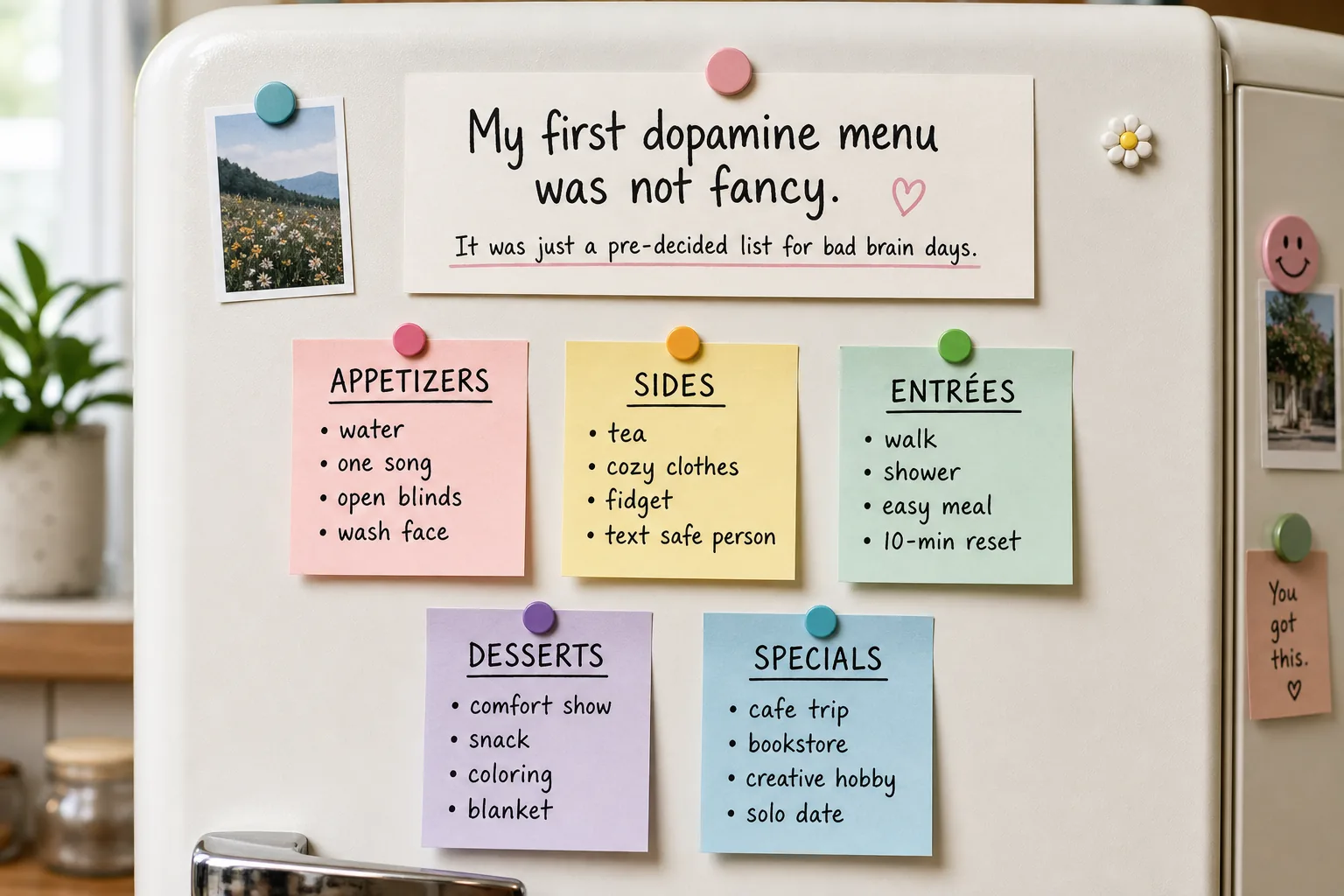
My first dopamine menu was a sticky note on the fridge. Ugly, functional, better than nothing.
Quick answer
What is an ADHD dopamine menu?
A pre-written list of small activities sorted by energy and effort, so that on a bad day you choose from a menu instead of inventing an idea you have no capacity to invent. It is not a self-care list of things that are good for you. It is one decision, made in advance, for the version of you who cannot decide.
Key takeaways
📌A dopamine menu is one decision made in advance, for the version of you who cannot decide.
📌It sorts activities by energy and effort, not by what is supposedly good for you.
📌Low-energy days are hard because choosing fails, not because doing fails.
📌It only works if it is visible. A menu in a drawer is not a menu.
📌Keep some options absurdly small. If nothing on it is possible at your worst, it will not get used.
A dopamine menu is a pre-made, curated list of activities organized by how much effort they take. That’s it. It’s not a productivity system or a self-improvement plan. It’s a cheat sheet for your brain on the days when choosing feels impossible.
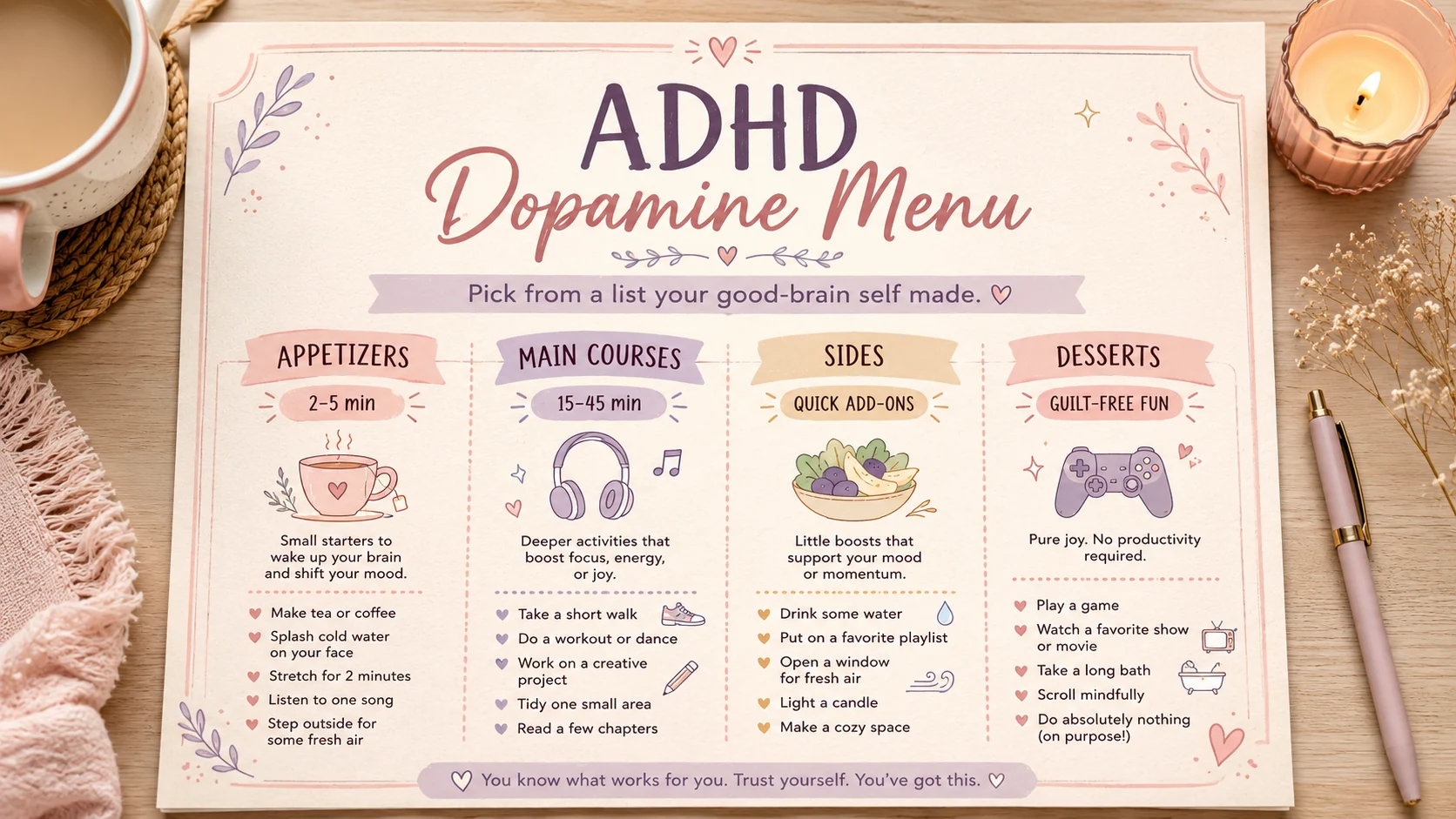
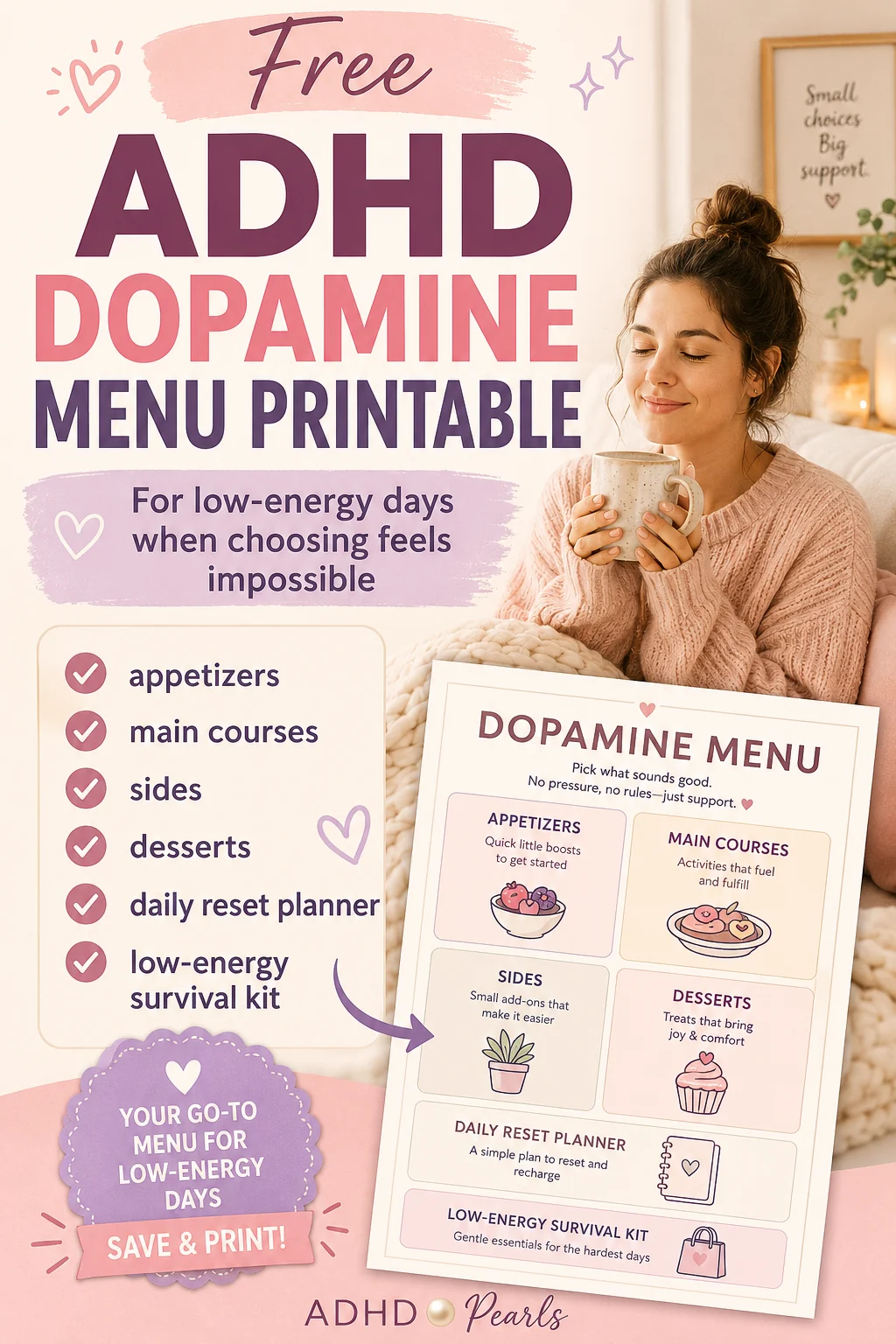
The name comes from the menu format — like a restaurant menu, it’s divided into sections. Typically: Appetizers (tiny, low-effort things), Main Courses (more engaging activities), Sides (quick add-ons), and Desserts (pure fun with no productivity attached). Some versions also include a Specials section for rare, high-reward activities you save for particularly hard days.
The format matters because ADHD brains struggle with open-ended choice. "What do you want to do?" is one of the hardest questions an ADHD brain faces when it’s already running low. The menu eliminates that question entirely. You don’t have to generate options. You just have to pick from the ones you already made when you felt okay. ADDitude has a detailed breakdown of how to build one, and this format was one of the first things that clicked for me when I discovered the concept.
The menu is written by your good-brain self. You use it when your good-brain self has left the building.
A dopamine menu is a list your good-brain self makes for the days when choosing feels too hard.
From ADHD Pearls
Free Dopamine Menu
24 tiny activities for low-energy, low-capacity days.
Everyone has low-energy days. But for ADHD brains, a low-energy day isn’t just tiredness — it’s a collapse in the systems that make choosing, starting, and switching between tasks possible.
Dopamine is at the center of this. It’s not just the "feel-good" chemical — it’s what makes things feel worth doing. It’s the signal that says this matters, start now. ADHD brains produce and regulate dopamine differently — research from The Conversation notes that ADHD brains tend to have lower baseline dopamine at rest, which may explain why the usual start signals just don’t fire the same way. On a normal day, that difference is managed with routines, stimulation, movement, and interest. On a low-energy day, all of that breaks down at once.
The result isn’t laziness. It’s something closer to a power outage — a collapse in what CHADD describes as executive function skills: the ability to start, prioritize, and shift between tasks. You’re not choosing to do nothing. You’re in a state where the mechanism that produces motivated action isn’t running. And without that signal, everything feels equally pointless and equally hard to start.
What makes it worse is that low-energy ADHD days often come with guilt. The day is slipping. You’re doing nothing. The doing-nothing feels bad, but the doing-something feels even more inaccessible. So you stay stuck, feeling bad about staying stuck, which depletes you further.
A dopamine menu doesn’t fix the underlying energy problem. But it removes one of the biggest barriers: the decision. When choosing is already hard, having pre-made options in front of you can be exactly enough to break the loop. If you want more on what actually helps during these days, I wrote about navigating low-energy days with ADHD — including what tends to make things worse without meaning to.
Low-energy ADHD days are not a character flaw. They usually need less pressure and fewer choices.
What Actually Goes on a Dopamine Menu
This is where most people get tripped up. A dopamine menu is not a to-do list in disguise — and if you’ve ever wondered why standard productivity tools never quite fit an ADHD brain, this is part of the answer. It’s not "productive things you could do when you’re not being productive." The whole point is that it includes things that are genuinely low-effort, genuinely fun, and genuinely restorative — without attaching shame to any of them.
Here’s what goes into each section:
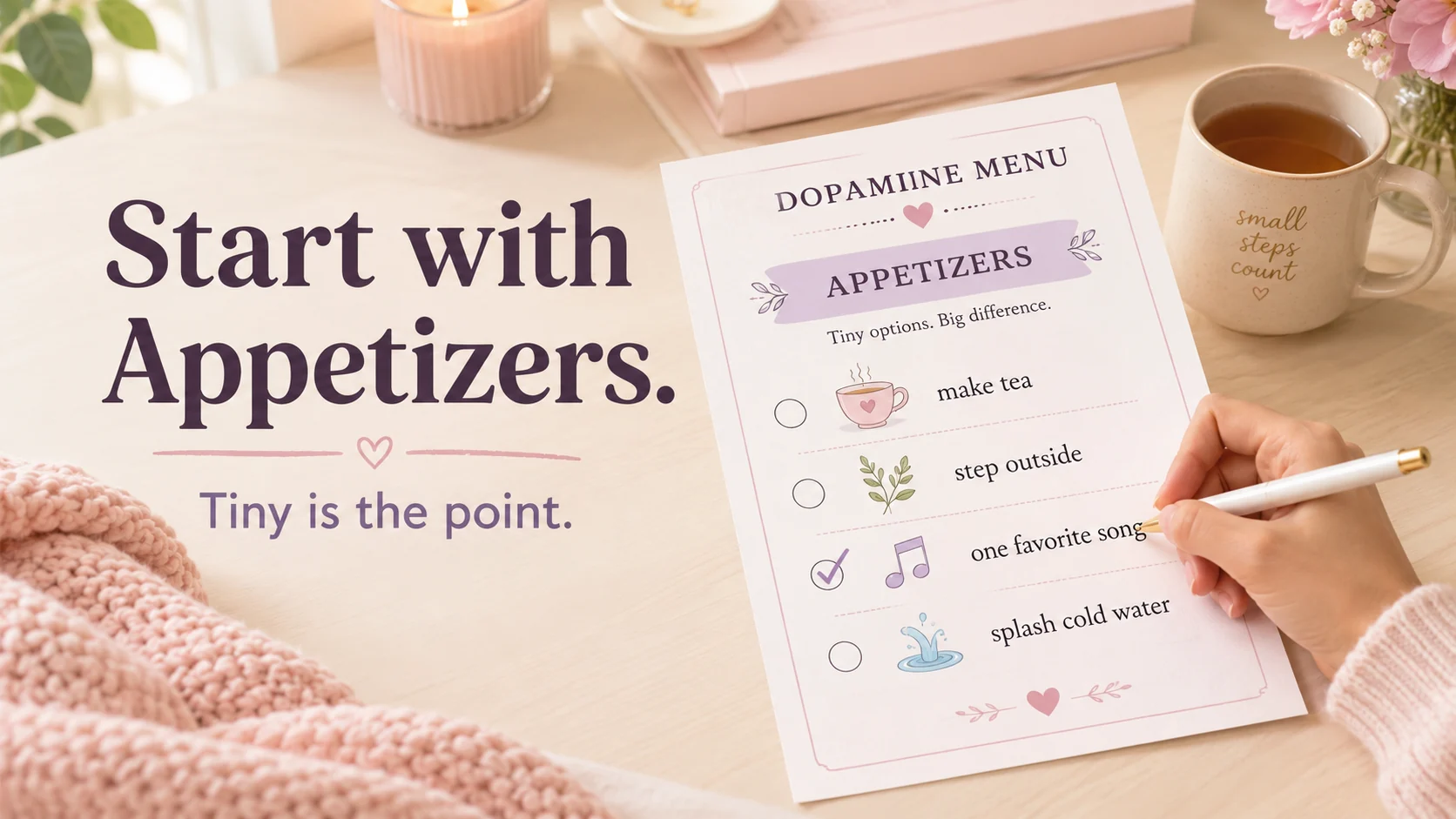
Appetizers (2–5 minutes, minimal effort): Make a cup of tea. Step outside for two minutes. Put on a favourite song. Splash cold water on your face. Stretch in whatever way feels good. These exist for the moments when even Mains feel too heavy. The rule for Appetizers is that they have to be genuinely accessible when you’re at your lowest.
Main Courses (15–45 minutes, moderate engagement): A walk with headphones. A show you love rewatching. A craft project. Cooking something simple. Drawing or journaling without any agenda. These are the activities that actually shift your state — not dramatically, but enough. They create forward motion from a stopped place.
Sides (quick, stackable add-ons): Things that pair with other activities. Music. A podcast. A scented candle. A snack. Sides are about adding sensory richness to what you’re already doing to increase engagement.
Desserts (high-reward, low-guilt fun): Your favourite video game. A comfort rewatch. A long bath. Desserts are not for every day — they’re for the worst days. They go on the menu to legitimize them. When you reach for a dessert on a really hard day, it’s not giving up. It’s choosing recovery. That’s different.
The goal isn’t to get productive. The goal is to stop the slide and give your brain something that feels like forward motion — even if that’s just a cup of tea and a song.
How to Actually Use It (Not Just Make It and Forget It)
Most people make a dopamine menu once, feel good about it, and never look at it again. The menu ends up in a notebook somewhere or as a note on your phone that you scroll past every day. Here’s how to make it actually work.
Make it physical if you can. A printed page on your fridge, desk, or nightstand is harder to ignore than a digital file. Your ADHD brain isn’t going to open a folder when it’s already running low. It will see a piece of paper in front of it.
Use it before you need it. The dopamine menu is most useful when you feel the start of a slide — not after you’ve been stuck for three hours. Learn to recognize your early signs: the restless scrolling, the walking in circles, the inability to choose what to eat. Those are the moments to pull the menu out. If you’re already deep in a freeze before you catch it, I’ve also written about the things ADHD brains do that look like laziness but aren’t — including the watching-yourself-not-do-the-thing feeling.
Start with Appetizers, always. Even if you think you can do a Main Course, start with an Appetizer. The goal is not to do the most impressive thing — it’s to do anything. Appetizers lower the barrier so far that your brain can say yes. And once your brain says yes to one thing, starting the next thing becomes easier.
Don’t use it to avoid real things permanently. This is worth saying directly: a dopamine menu is a recovery tool, not a way to never do hard things. If you find yourself reaching for it to avoid every difficult task on every day, that’s worth noticing. Used well, it’s a bridge back to function. Used as an escape hatch, it stops being useful.
Start small on purpose. Tiny is the point.
The Free 24-Page Printable Version
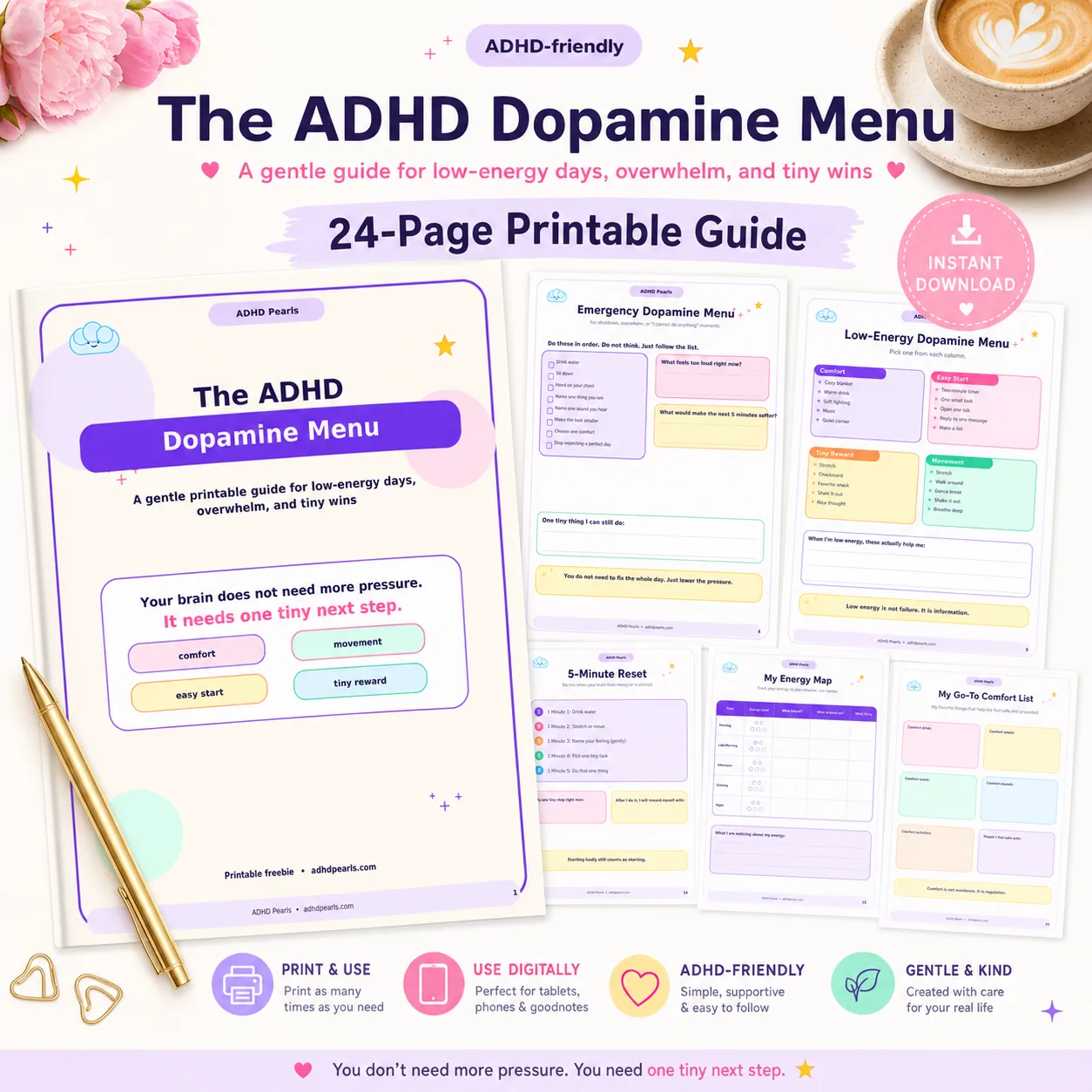
I made the ADHD Dopamine Menu printable because I couldn’t find one that covered every energy state without making me feel like I needed to become a better person to use it. No affirmations. No motivational quotes. Just practical categories, clear prompts, and enough room to fill in your own things.
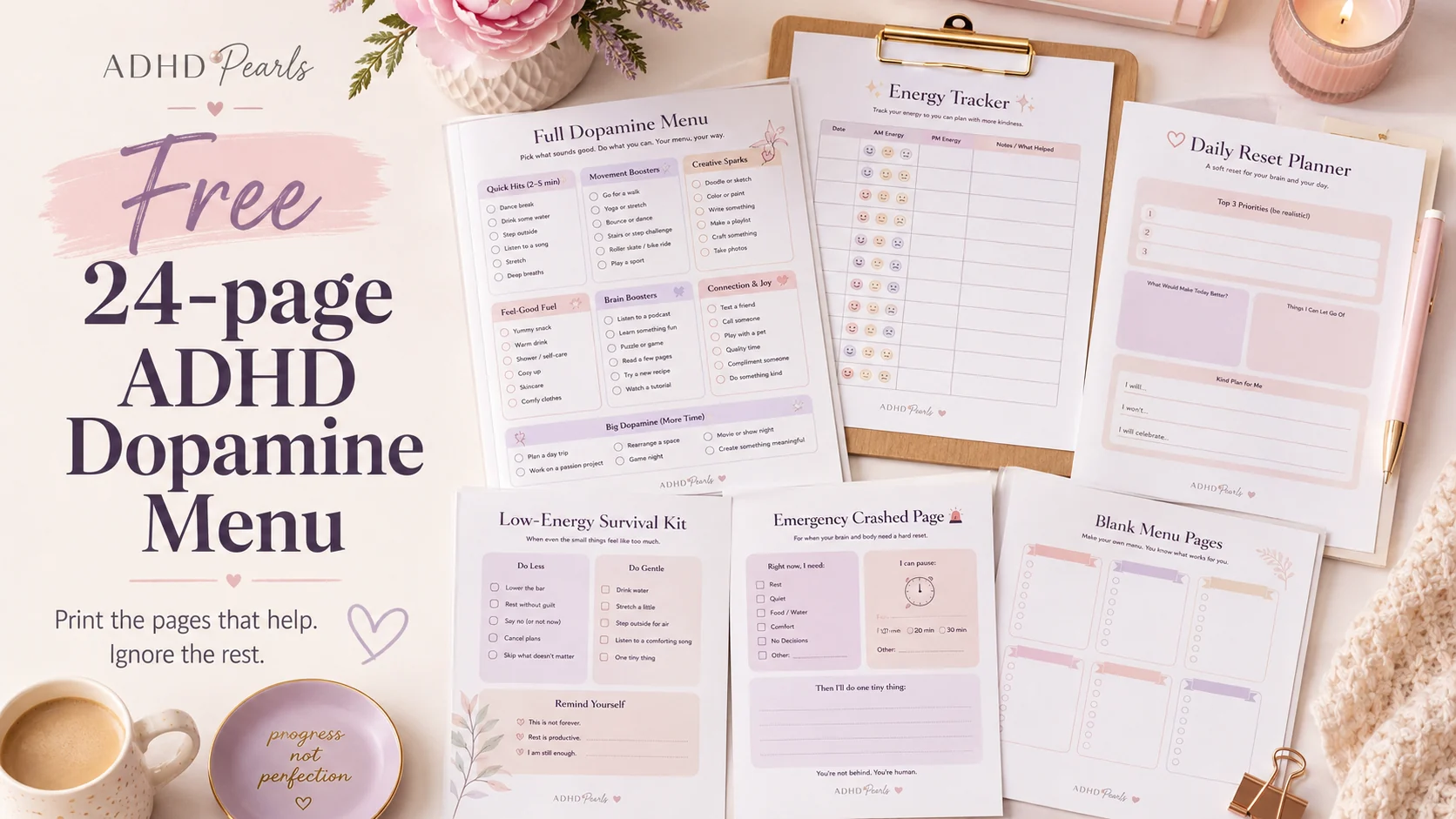
The 24 pages include a full menu template with all four categories, an energy tracker, a daily reset planner, a low-energy day survival kit page, a "when I’m crashed" emergency page, and blank versions so you can customize each section in whatever way fits your brain.
It’s free. You enter your email and you get the PDF. No paid upgrade. No trial. No subscription attached unless you want the weekly newsletter, which you can skip during sign-up.
You can print the whole thing or just the pages that are useful to you. If you only ever use the Appetizers page and the Daily Reset Planner, that’s fine. It’s yours to use however it helps.
Print the pages that help. Ignore the rest.Pin this free ADHD dopamine menu printable for later.
Frequently Asked Questions
Is a dopamine menu the same as a self-care list?
Somewhat, but not exactly. Self-care lists often include things that are good for you in a general sense — exercise, journaling, drinking water. A dopamine menu is more specifically organized around energy level and effort required. The goal is to match activity to your current state, not to aspire to a better one. It also explicitly includes things that are just fun, with no productivity or self-improvement attached.
What if I don’t feel like doing anything on the menu?
That happens. If none of the Appetizers feel accessible, it might be a signal that rest is actually what you need — not activity. Rest without guilt is legitimate. Lying down, doing nothing, not performing recovery — that’s allowed. The menu exists to help you when choosing is the barrier. If what you actually need is to do nothing, the menu gives you permission to do that too.
How often should I update my dopamine menu?
Whenever something stops working or you discover a new thing that helps. Some people update theirs seasonally. Some update after a hard period reveals what was missing. There’s no schedule. The menu should reflect your actual life, not an idealized version of it — so it needs to change as you change.
Can I use a dopamine menu if I don’t have an ADHD diagnosis?
Yes. The menu format is genuinely useful for anyone who struggles with choice paralysis, low-energy days, or the freeze that comes with anxiety or burnout. It was designed with ADHD in mind, but the underlying problem it solves — too many options, not enough activation energy to choose — isn’t exclusive to ADHD.
Is the printable really free?
Yes. You enter your email, get the PDF immediately. No card required. There’s an optional newsletter sign-up during the process but it’s genuinely optional. You can get it here.
Does a dopamine menu actually change my dopamine levels?
The name is a metaphor, not a neurochemical claim. Nobody is measuring your dopamine, and this is not a treatment. What the menu does is remove a decision at the exact moment your brain is least able to make one, which is the part that helps.
How many things should be on it?
Enough to have options, few enough to scan in a few seconds. Somewhere around five to eight per category tends to work. A long menu recreates the original problem, which was having too many choices and no ability to pick one.
What is the difference between an appetizer and a main?
An appetizer is something tiny that takes a minute or two and asks almost nothing of you. A main takes longer and gives more back. On a bad day you only ever reach for appetizers, and that is the menu working as intended.
What if using the menu makes me feel guilty?
That usually means it is being read as another list of things you are failing to do. It is not a schedule and nothing on it is required. If the guilt persists, cut the menu down to three items you genuinely like and ignore the rest.
The Short Version
An ADHD dopamine menu is a pre-made list of activities organized by effort level. You make it when your brain is working. You use it when it isn’t. The point isn’t productivity — it’s giving your brain a structure for days when open-ended choice is impossible.
Low-energy ADHD days aren’t about laziness. They’re about a dopamine system that has run low and lost access to the signals that make starting feel possible. The menu doesn’t fix that. But it removes one of the biggest barriers — the decision — and sometimes that’s enough.
If you want a ready-made version with 24 pages covering every energy state, the free printable is here. Print the pages that help. Ignore the rest. Start with an Appetizer.
Found this helpful? Share it with someone who gets stuck too.
One tap makes ADHD Pearls a preferred source in your Google account, so our articles surface higher when you search. No signup, and it brings you straight back to this page.
Before you go
Free Dopamine Menu
24 tiny activities for low-energy, low-capacity days.
For the woman who sets up the perfect system on Sunday and abandons it by Tuesday.
One short letter, every week. Real talk about ADHD, task paralysis, and the tiny wins that actually move the needle for a brain like yours. No shame. No hustle culture.