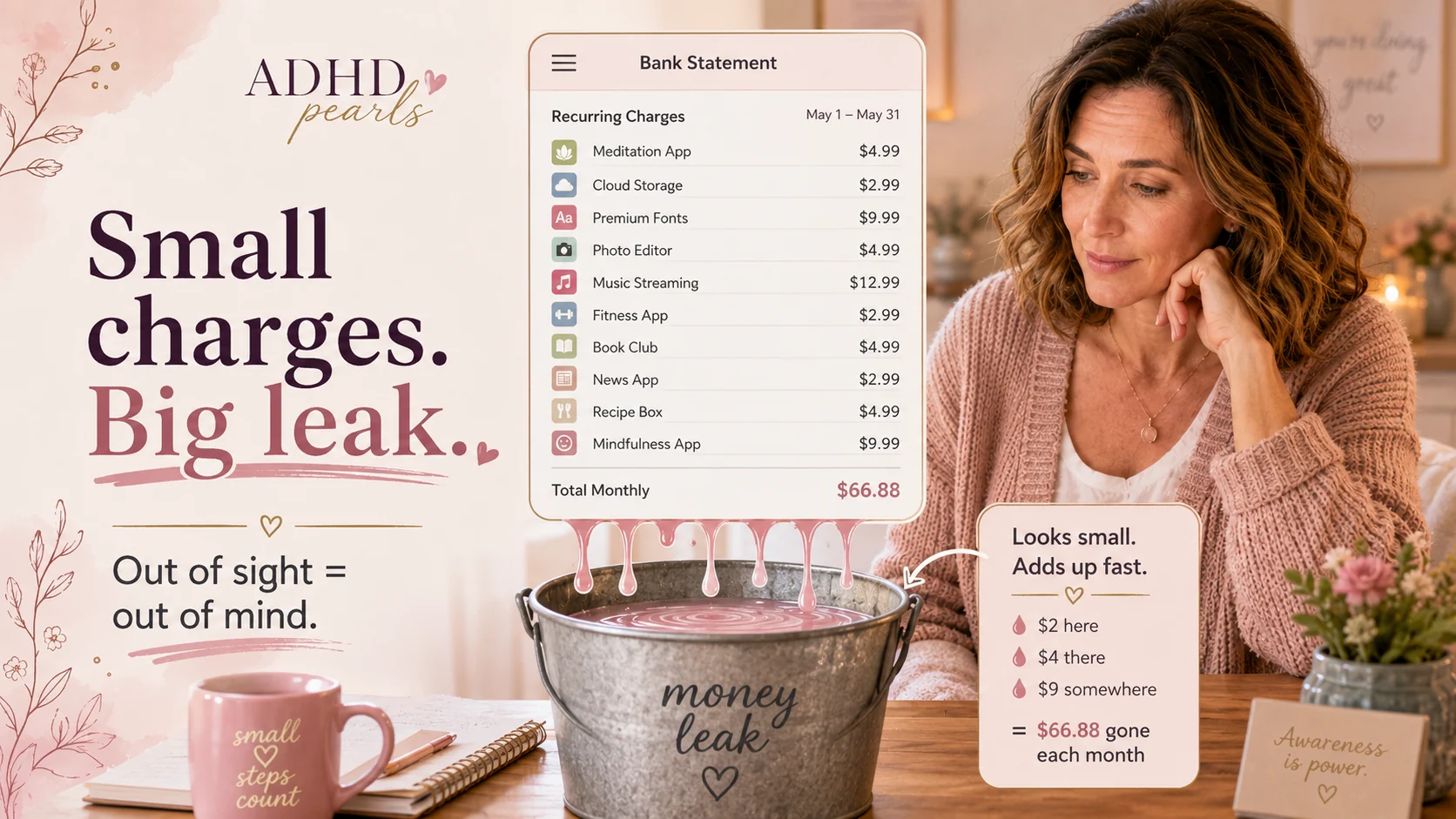
I once discovered I'd been paying for a meditation app for two and a half years. I had used it, generously, four times. That's roughly seventeen dollars per moment of calm, which is not the vibe meditation is going for.
It wasn't the only one. A cloud storage plan I'd forgotten, a "free trial" that quietly became a subscriber, a magazine I have never once read. None of it was huge on its own - which is exactly the trap.
Here's the thing: this isn't a you're-bad-with-money problem. It's an ADHD brain meeting a system designed to profit from forgetting. So here's a 15-minute, no-shame audit to find the leaks - and the goal is just to cancel one thing today.
Quick answer
What's an ADHD subscription audit?
Set a 15-minute timer, pull your last 2 to 3 months of bank and card statements, and highlight every recurring charge. Sort them into "use it", "forgot it existed", and "on the fence" - then cancel just one today as a win. ADHD brains leak money on subscriptions because a charge you can't see doesn't ping your memory, and cancelling is a boring, high-friction task your brain avoids. The fix isn't willpower; it's a short, timed, one-thing-at-a-time sweep.
Key takeaways
📌Fifteen minutes and two to three months of statements is enough to find the leak.
📌Sort into use it, forgot it existed, and on the fence. Cancel one today as the win.
📌ADHD leaks money on subscriptions because cancelling is admin, and admin is the hard part.
📌Free trials with a card on file are the most expensive item on the list.
📌Stop it recurring: no card stored, prepaid terms, and a reminder set before the renewal date.
Cancelling a subscription on time is secretly a stack of ADHD-hard tasks: you have to remember a future renewal date, initiate a boring admin job, and push through the friction of actually finding the cancel button. Miss any one link and the charge just... continues.
And the biggest reason it stays hidden is the same wiring behind so much of ADHD life: out of sight, out of mind. A charge you can't see doesn't exist to your brain, so a small monthly fee renews silently for years. It's the exact mechanism I unpack in ADHD object permanence - if it's not in front of you, it's gone.
Add impulsive sign-ups (that trial felt so worth it at 11pm) and the freeze around admin tasks, and you get a slow financial leak nobody chose. It's not carelessness. It's life-admin paralysis with a monthly price tag.
I wasn't spending money on things I love. I was spending money on things I forgot existed.
A few dollars here and there can stay invisible for months when the charges never demand your attention.
From ADHD Pearls
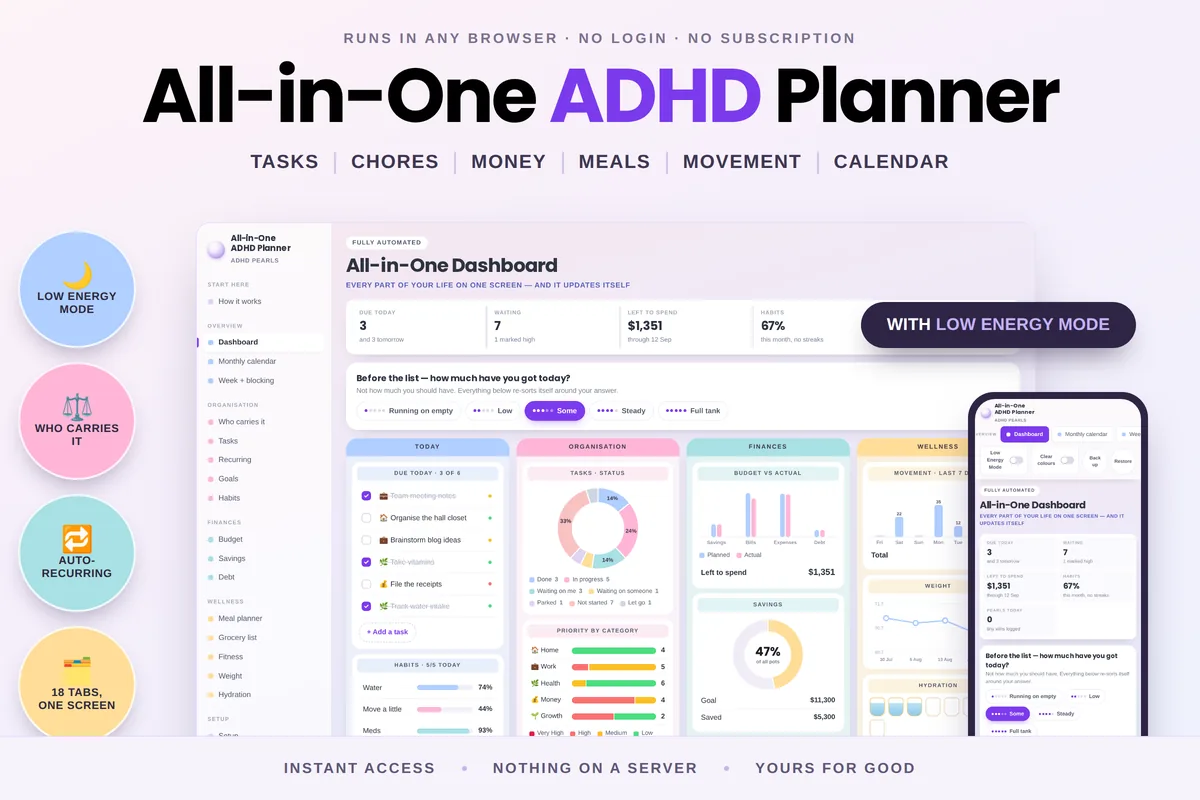
All-in-One ADHD Planner
Eighteen tabs that fill each other in. Say a repeating chore once and the schedule builds itself, and one tab shows who in the house actually carries what.
Opens in a new tab — this article stays where it is.
5 free days, counted only when you use it — just your email, no card. Then $27 once, private to your browser, no login, no subscription.
How Much It's Actually Costing You
Brace yourself, because the numbers are wild. Most people underestimate their monthly subscription spending by roughly three times - guessing around a hundred dollars while actually spending closer to two hundred and seventy. Ninety percent of us lowball it.
And the waste is real: about 60% of people have at least one unused subscription still quietly billing them, averaging somewhere around $25 to $30 a month. That's $300 or more a year, per person, for absolutely nothing. Because each one feels like "just $10," a dozen of them can top a thousand dollars a year without you ever feeling the hit.
This is a close cousin of the ADHD tax - all the extra money a brain that struggles with follow-through quietly pays. The good news: a subscription leak is one of the fastest ADHD taxes to plug. The other big one is the 11pm cart, which has its own set of friction tricks for impulse spending. The third is the bill you fully intended to pay - see why bills go late when you have the money.
The 15-Minute ADHD Subscription Audit
You do not need a spreadsheet, a finance app, or a personality transplant. You need a timer and fifteen minutes. Here's the version that actually works on a distractible brain.
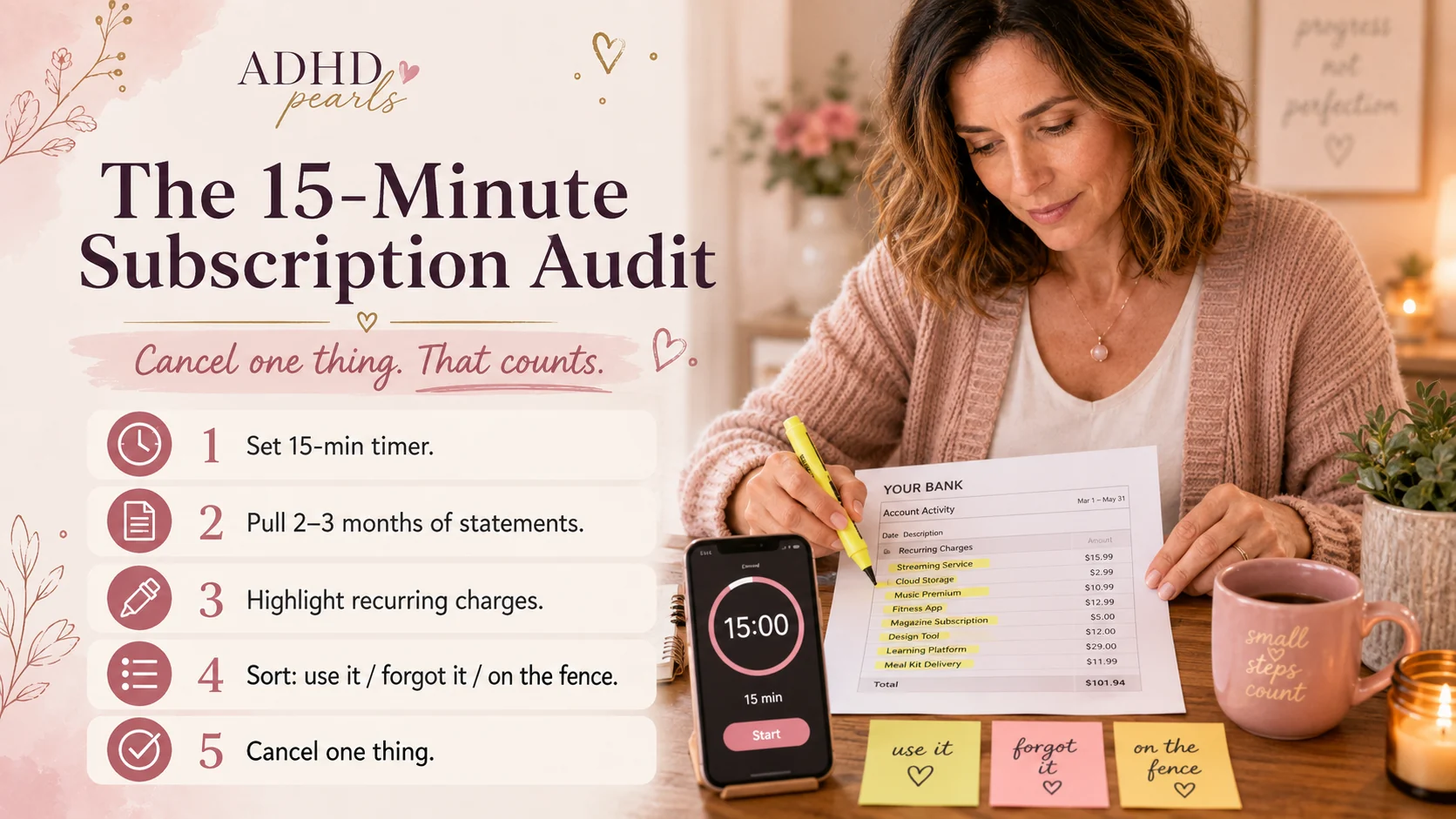
1. Set a 15-minute timer. This is the whole trick. A timer makes it a short, bounded sprint instead of an open-ended chore, and it gives your brain a finish line. When it rings, you're allowed to stop - even mid-list.
2. Pull 2 to 3 months of statements. Open your bank app and your card statements. Recurring charges hide in the boring middle of the list, so scan for anything that repeats month to month. Two or three months catches the monthly ones and the sneaky annual renewals.
3. Highlight every recurring charge. Don't judge yet, just list. Streaming, apps, storage, that gym, the box of artisanal something. Seeing them in one place is often the most shocking - and clarifying - part.
4. Sort into three piles. Use it. Forgot it existed. On the fence. The "forgot it existed" pile is your gold mine - those are pure leaks with zero emotional attachment.
5. Cancel ONE thing right now. Not all of them. One. The easiest, the most annoying, or the one you forgot you had. That single cancellation is the win - momentum matters more than completeness, and you can do more tomorrow.
The first time I did this, I cancelled the meditation app before the timer even hit five minutes, and I felt like I'd found money in a coat pocket. I didn't finish the whole list that day. I didn't need to - the leak was already smaller.
You do not need a spreadsheet marathon. You need 15 minutes and one cancellation.
When You Can't Find the Cancel Button
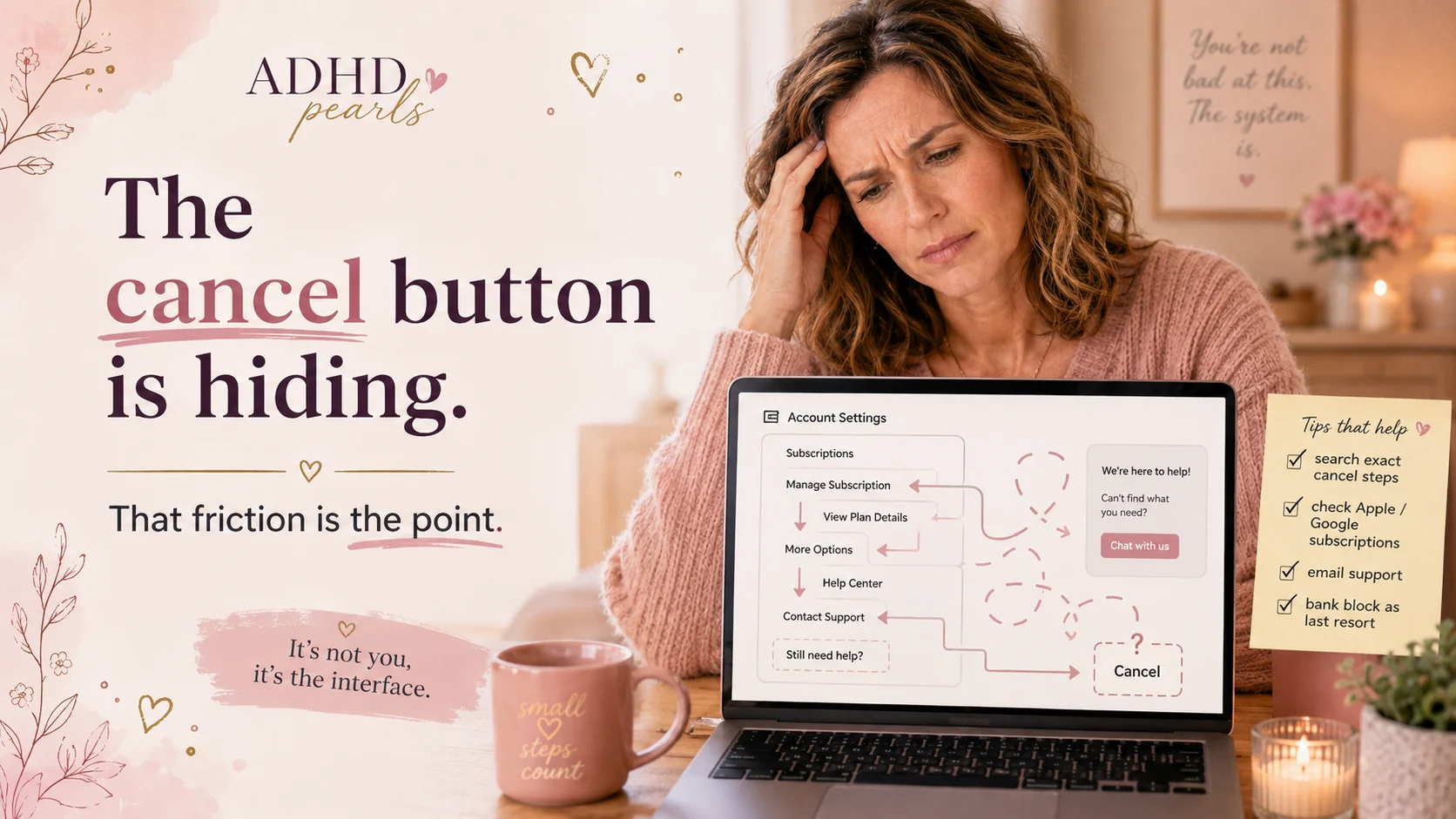
Sometimes you go to cancel and the button has simply vanished into a maze of menus. This is not you being bad at technology - companies bury the cancel flow on purpose, because friction makes them money.
Three moves that get past it: search the web for "cancel" plus the service name to get the exact click-path; check your phone's app store, because anything you subscribed to through Apple or Google is cancelled there, not in the app; or email their support and ask them to cancel any active subscription tied to your email. As a last resort, your bank can often block a merchant from charging your card again.
If the friction itself is the wall you keep hitting, that's the same freeze from ADHD life-admin paralysis - so shrink it: your only job is to find the cancel path for one service, not to enjoy it.
Sometimes the cancellation process is confusing on purpose. That friction is part of the business model.
How to Stop It Happening Again
Auditing is treating the symptom. A couple of tiny systems stop the leak refilling:
Calendar the trial end date. The second you start any free trial, put the end date in your calendar with an alert the day before. Deciding in advance is the whole game, because future-you will not remember.
Use a trial card with a limit. Some people keep a separate virtual card with a low spending cap for trials, so a forgotten one gets politely declined instead of silently charged.
Make it visible. Keep a short running note of what you subscribe to, or set a recurring reminder to re-run this 15-minute audit each season. Visible beats willpower every time for an ADHD brain.
And scroll back a full twelve months, not three. A three-month sweep catches every monthly charge and misses every annual one, which is why the bills that only come once a year are the ones that keep getting through.
Do not rely on memory. Make the next decision visible while you are thinking about it.
This is general, practical information, not financial advice. Everyone's budget and situation are different, and if money worries are seriously affecting your wellbeing, a qualified financial advisor or a free debt-support service can help.
The tiny move: right now, before you close this, open your bank app and cancel one subscription you'd forgotten about. Just one. You don't need the spreadsheet, the whole list, or a better relationship with money. You need fifteen minutes you don't even have to use all of - and one quiet leak, plugged.
Pin this for your next 15-minute money reset.
FAQ: ADHD and Subscriptions
Why do people with ADHD forget to cancel subscriptions?
Cancelling on time relies on remembering a future date, initiating a boring task, and overcoming friction - all things ADHD makes harder. On top of that, a charge you can't see doesn't ping your brain (out of sight, out of mind), so a small monthly fee quietly renews forever. It's an executive-function and design problem, not you being careless with money.
How do I do a subscription audit quickly?
Set a 15-minute timer, pull your last 2 to 3 months of bank and card statements, and highlight every recurring charge. Sort them into "use it", "forgot it existed", and "on the fence". Then cancel just one - the easiest or most annoying - as today's win. You don't have to fix everything in one sitting.
How much money do unused subscriptions cost?
A lot more than people think. Most people underestimate their monthly subscription spending by roughly threefold, and around 60% have at least one unused subscription still billing them - often about $25 to $30 a month, which is $300 or more a year. A dozen small "it's only $10" services quietly add up to over $1,000 annually.
Why can't I just cancel it if I know I should?
Because "should" isn't what starts tasks for an ADHD brain - and cancelling is genuinely high-friction, with buried buttons and guilt attached. Knowing it's wasteful doesn't override the inertia. Shrinking it to "cancel one thing, right now, timer on" is what gets you past the freeze.
What if I can't find the cancel button?
Companies hide it on purpose. Search the web for "cancel" plus the service name to find the exact steps, check the app store if you subscribed through it (Apple or Google manage those cancellations, not the app), or email support asking them to cancel any active subscription linked to your email. If it's charging a card, your bank can sometimes block the merchant too.
How do I decide whether to cancel or keep a subscription?
Ask one question: have I actually used this in the last month? If you can't remember using it, that's your answer. For on-the-fence ones, cancel anyway - most let you resubscribe instantly if you miss it, and you rarely do. Keeping something "just in case" is usually just paying to avoid a tiny decision.
How do I stop signing up for free trials I forget?
The moment you start a trial, put the end date in your calendar with an alert a day before - that's the single most effective habit. Some people use a separate virtual card with a spending limit for trials, so a forgotten one simply gets declined instead of charged. Deciding in advance beats trying to remember later.
How often should I check my subscriptions?
A quick 15-minute audit every few months catches most leaks, since new ones creep in constantly. Anchor it to something you already do - the start of a season, a birthday, tax time - so you don't have to remember out of nowhere. A recurring calendar reminder does the remembering for you.
Is it bad that I wasted money on subscriptions?
No - you're in enormous company, and the system is built to make forgetting profitable for them. Beating yourself up just adds shame to a problem that's really about invisible charges and executive function. Notice it, cancel what you can today, and move on - the win is what you save from here, not what already slipped.
One tap makes ADHD Pearls a preferred source in your Google account, so our articles surface higher when you search. No signup, and it brings you straight back to this page.
Before you go
All-in-One ADHD Planner
Eighteen tabs that fill each other in. Say a repeating chore once and the schedule builds itself, and one tab shows who in the house actually carries what.
For the woman who sets up the perfect system on Sunday and abandons it by Tuesday.
One short letter, every week. Real talk about ADHD, task paralysis, and the tiny wins that actually move the needle for a brain like yours. No shame. No hustle culture.