The email arrived on a Tuesday and said, in a tone I can only describe as pleased with itself: Good news — your policy has renewed automatically, so you are still covered.
Car insurance. £681. The year before it had been £437.
What made it worse was that I had not forgotten it, exactly. In February I had opened the renewal letter, thought I must shop around before this goes through, felt briefly competent for having thought it, and put the letter on the shelf above the kettle. That thought was the last piece of work my brain ever did on the subject. It had filed the task as handled because the thinking about it had happened.
I have since found out that this is not a personal defect. It is what a twelve-month gap does to a brain, it is what several industries quietly rely on, and there is a fix with an unglamorous name and a very large effect size.
Quick answer
Why do I keep forgetting bills that only come once a year?
Because twelve months is too long a gap to learn anything from. A monthly bill gives you twelve chances a year to build the association; an annual one gives you a single chance, across a gap longer than most reminder systems survive. It is a property of the interval, not of your memory or your character.
Key takeaways
📌A monthly bill gives you twelve rehearsals a year. An annual one gives you one, across a twelve-month gap.
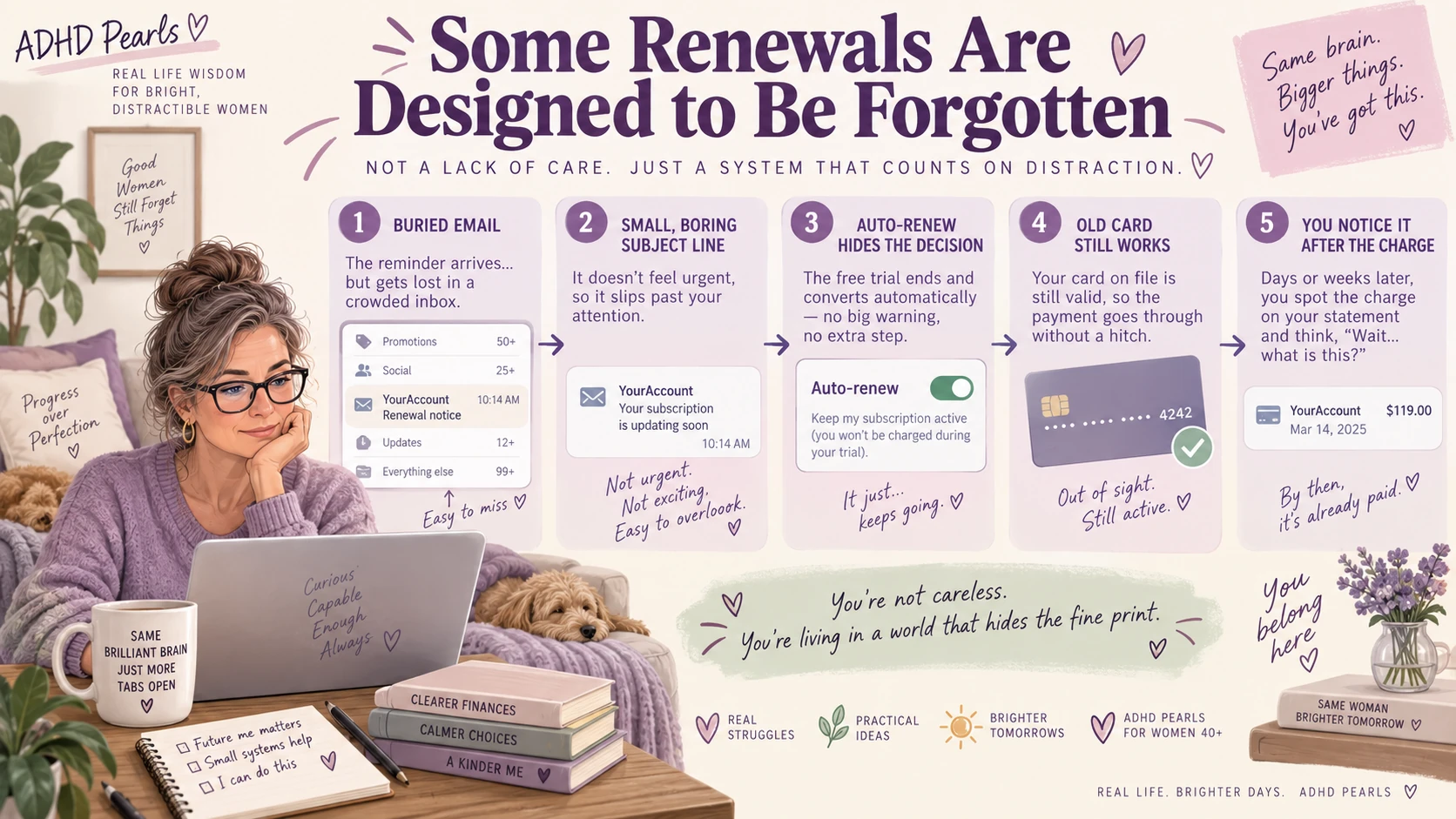
📌Some renewals are built to be forgotten — the promotional year quietly becoming full price is the business model, not an accident.
📌Notice rules exist in some places: California requires 15–45 days’ warning before an annual renewal, in force since 1 July 2025. There is currently no federal US equivalent.
📌Deciding in advance exactly when and where you will deal with it is one of the better-evidenced fixes for this kind of forgetting.
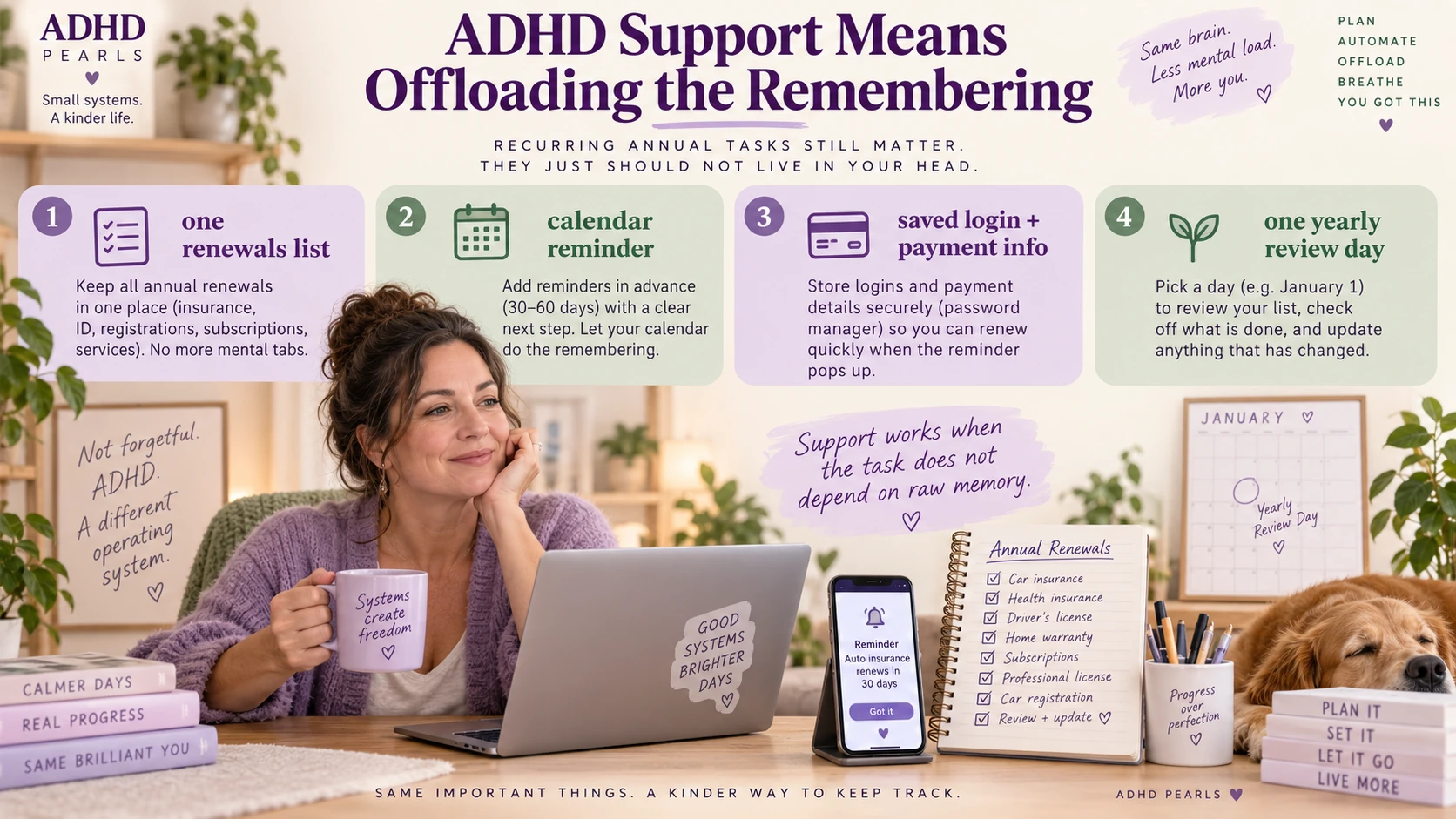
📌One twenty-minute list of everything that renews annually, with its date, replaces a whole year of trying to remember.
I wrote a while ago about why chore charts stop working, and the argument there was that a chart holds the list but not the timing. Every week you rebuild the plan from nothing — which day is today, what is in today's slot, where it fits — and that rebuild is the expensive part.
An annual bill is that same problem with the volume turned all the way up.
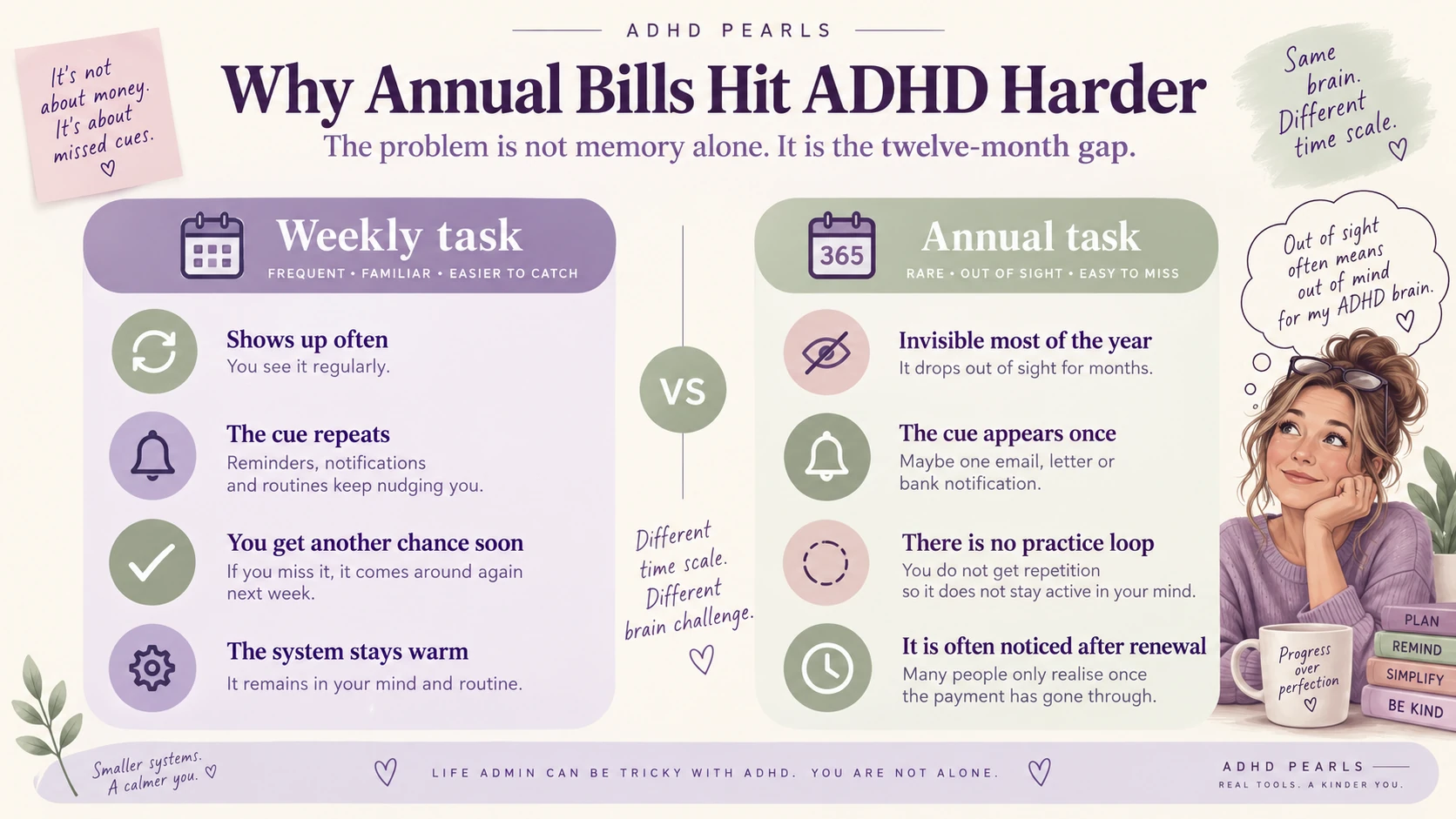
Do something weekly and you get fifty-two attempts a year to build an association. Miss it, notice, adjust, try again. By November you have run the loop enough times that something in the environment starts doing the remembering for you: the bins go out because the neighbour's bin is already at the kerb.
Do something once a year and you get one attempt. One. There is no second try in which to correct the first. Whatever you worked out last February about how to handle this has to survive twelve months of everything else, in a brain that struggles to hold a thought across twelve minutes.
You are not failing to remember a simple thing. You are being asked to remember across a gap longer than most of your systems survive.
Weekly tasks keep refreshing the cue. Annual tasks can disappear for eleven months and return into a completely different system.
And the environment does not help, because by the time it comes round the environment has changed. Last year I was using a different notes app. Last year the letter came by post and this year it came by email. Last year I had a paper diary that I abandoned in April. The cue that might have caught it does not exist any more, because I do not exist in the same setup any more.
There is also a specific trap in the annual ones that the weekly ones do not have. A weekly task announces itself — the laundry pile is visible, the bin is full. Annual admin is invisible right up until the moment it has already happened. Nothing about your kitchen tells you that the home insurance renews in nine days. It has no physical presence at all until it becomes a number on a statement, at which point remembering it is no longer useful. If you have read the piece on out of sight, out of mind, this is that, stretched across a year.
From ADHD Pearls
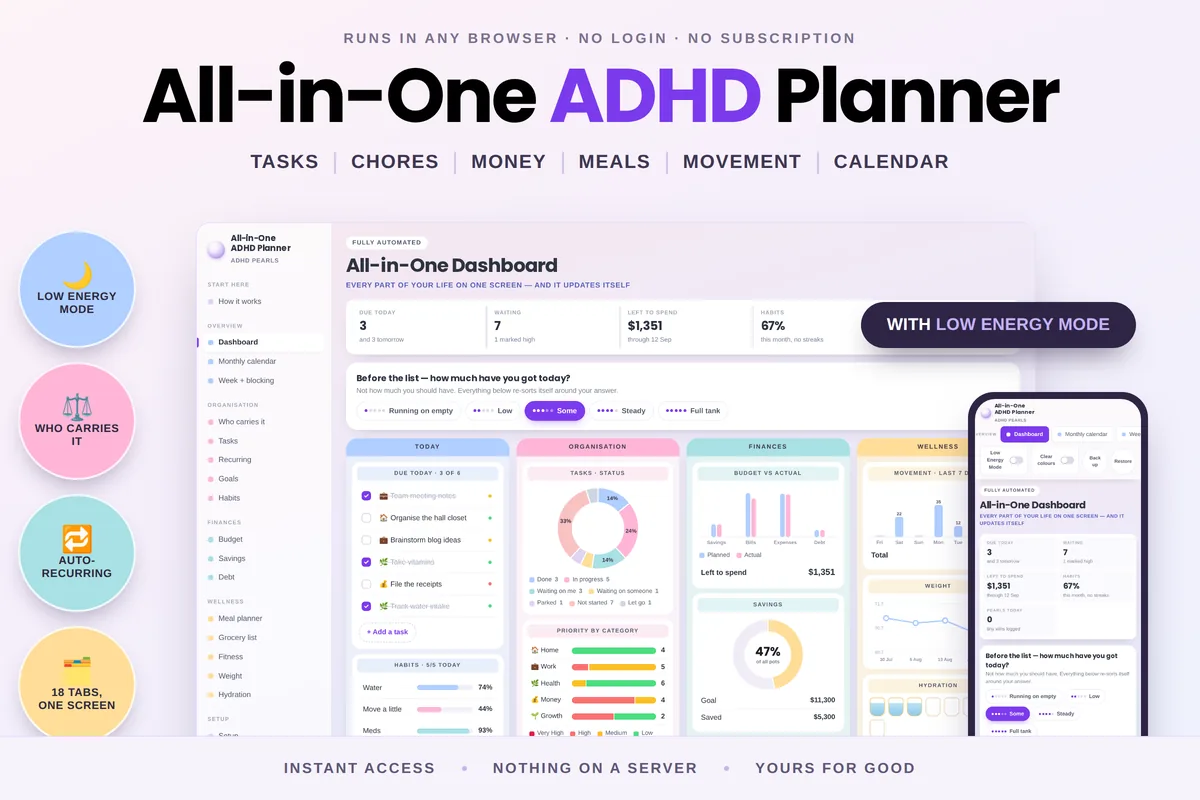
All-in-One ADHD Planner
Eighteen tabs that fill each other in. Say a repeating chore once and the schedule builds itself, and one tab shows who in the house actually carries what.
$27 once — private to your browser, no login, no subscription.
Some of them are built to be forgotten
Here is the part that changed how I felt about the £681.
Legislators have written actual laws about this. Not about insurance pricing in general — about the specific problem of a company charging you for another year while you were not looking. And you do not write a law like that unless there is a business model on the other side of it.
In the UK, since April 2017 the Financial Conduct Authority has required every general insurance renewal notice to show you last year's premium next to this year's, so the two can be compared without you having to dig. Firms also have to tell you to shop around. And if you have renewed with the same insurer four or more times in a row, they have to give you an additional prescribed message encouraging you to look elsewhere.
Read that last one again. The regulator identified long-term loyal customers as a group being quietly penalised, and made the companies say so out loud. That is not a rule you need unless the drift was real and profitable.
In California, the Automatic Renewal Law was amended with effect from 1 July 2025. If a subscription renews on a term of a year or more, the business must send you notice of that renewal at least 15 days and no more than 45 days before it happens. If you are on a free or discounted trial longer than 31 days, the notice window is three to twenty-one days before the trial ends. Cancellation has to be available by the same route you signed up through — if you subscribed online, you have to be able to cancel online, immediately, without being routed through a retention call.
A word of caution, because the internet is currently full of confident and wrong claims about this. The federal "click to cancel" rule — the FTC's amended Negative Option Rule — was vacated in full by the Eighth Circuit in July 2025, on the grounds that the Commission had skipped a required regulatory analysis step. It is not in force. The FTC reopened the rulemaking with an advance notice in March 2026 and continues to bring cases under an older statute in the meantime, including a $2.5 billion settlement with Amazon over Prime enrolment and cancellation. But if someone tells you that a federal law guarantees you a one-click cancel button, that is not currently true.
What all of this adds up to is not "the law will save you." It is something more useful on a bad day:
Whole regulatory frameworks exist because ordinary people, with ordinary memories, reliably fail to notice an annual charge. Your brain is not the outlier here. It is the assumption the pricing was built on.
If a system benefits when nobody notices, relying on memory alone is not a fair fight.
I find that genuinely steadying. Not because it gets my £244 back, but because it moves the problem out of the category of personal failing and into the category of known adversarial design. You prepare differently for those two things.
What actually renews once a year
Monthly subscriptions get all the attention, because they are the easy ones to write about and the easy ones to find — they show up on every statement, twelve times a year. If that is your problem, the fifteen-minute subscription audit is the piece you want, and it is a different piece from this one.
Annual items are harder to catch precisely because they appear once. Scroll back three months on your banking app and you will find every monthly leak. You will find almost none of these.
So here is the list I built after the insurance, in the order things actually caught me. Not all of it will apply to you. The point is the shape.
Insurance of every kind — car, home and contents, pet, travel, gadget, life. This is where the loyalty drift lives, and it is the category most worth a diary note rather than a shrug.
Vehicle admin — MOT, road tax, breakdown cover, the service interval. Three separate dates that all feel like one thing called "the car" and are not.
Household — TV licence, boiler cover, alarm monitoring, chimney or gutter jobs, the fixed-rate energy tariff that ends and drops you onto the standard rate.
Professional — union or professional body membership, registration fees, indemnity insurance, mandatory training that expires, a practising certificate.
Digital that is not a subscription — domain names, web hosting, an SSL certificate, cloud storage bought as a year. Domains are especially cruel: they fail silently and the recovery fee is worse than the renewal.
Documents with expiry dates — passport, driving licence, visas, a child's passport that expires faster than yours. Not bills, but the same interval problem and a far worse failure mode.
Health — dental check-up, eye test, smear test, the annual medication review, the repeat prescription that needs re-authorising.
The ones with no invoice at all — school shoes in September, the club membership that runs a season, the birthday that always arrives as a surprise despite being on the same date for the entirety of your life.
Write your own version of this and you will find, as I did, that it is longer than you expect and that four or five items on it have already gone wrong at least once. That is not evidence you are bad at admin. It is evidence there are roughly twenty of these a year, each one visible for about a week, scattered across twelve months with no relationship to each other.
The promo year that quietly became full price
This one deserves its own heading because it is the most expensive version and the hardest to see.
You sign up for something at £29 for the first year. It is genuinely good value at £29. Twelve months later it renews at £89, and it will renew at £89 every year after that, and there is no email that says this is now three times what you agreed to. There is only your subscription has renewed, which is technically true and practically useless.
The reason it is so hard to catch is that the decision you would need to revisit was made a year ago, by a version of you who had a reason, and the reason has long since evaporated. You do not remember that £29 was an introductory price. You remember that you decided this was worth it, once, and you trust that decision because it was yours.
The fix is small and slightly tedious: when you sign up at a promotional price, write down the standard price on the same day. Not the discounted one — the one it will become. Then the future notification arrives against a number you already agreed to, and "renewed at £89" reads as expected rather than as a surprise you have no framework for.
I do this in the notes field now, and it takes eight seconds, and it is the single highest-return habit in this entire article.
The fix has a name and an effect size
The thing you do when you set a reminder instead of trying to remember has a name in the research literature: intention offloading. Sam Gilbert and colleagues reviewed the field in Psychonomic Bulletin & Review in 2022, and two findings from that review are worth your time.
The first is the size of the effect. In one of the experiments the review draws on, participants relying on their own memory forgot the intention roughly 45% of the time. The same participants, given the option to set an external reminder, forgot around 5% of the time.
I want to be accurate about what that is. It is a laboratory task, not a year of household admin, and the exact numbers belong to that experiment rather than to life. Nobody has run this on annual insurance renewals. But the direction and the scale of it are consistent across the literature, and they match something you already know in your body: the note in the calendar works and the resolve does not.
The second finding is the one I actually needed, and it is stranger.
Across several studies, when researchers worked out the mathematically optimal balance between trusting memory and setting a reminder, people set reminders more often than was optimal. Not fewer. More. Given the choice, humans in general lean on external cues harder than a perfectly calibrated agent would.
Reaching for a reminder is not a workaround for a broken memory. It is what people do, including people whose memory is fine.
If you have spent years feeling that using alarms and lists for "simple things" is proof of something shameful, that finding is worth sitting with. The shame is not measuring a real gap between you and everyone else. Everyone else is also offloading. They are just not apologising for it.
A reminder is not cheating. Intention offloading is a normal human memory strategy.
There is a wider evidence picture on ADHD and money, and I will not overclaim it. A 2026 study of 3,717 Japanese adults found ADHD symptoms associated with financial debt — an odds ratio of 1.04 per point on a screening scale, 1.06 for women, holding after adjustment for income, education, health, alcohol, smoking, depression and anxiety. That is a real association and a small one, from a cross-sectional online survey with a single-item debt measure in one country. It is context, not proof, and it certainly does not explain any individual person's insurance renewal. I mention it because I would rather you had the honest version than a scary statistic with the caveats trimmed off.
Building the once-a-year list in twenty minutes
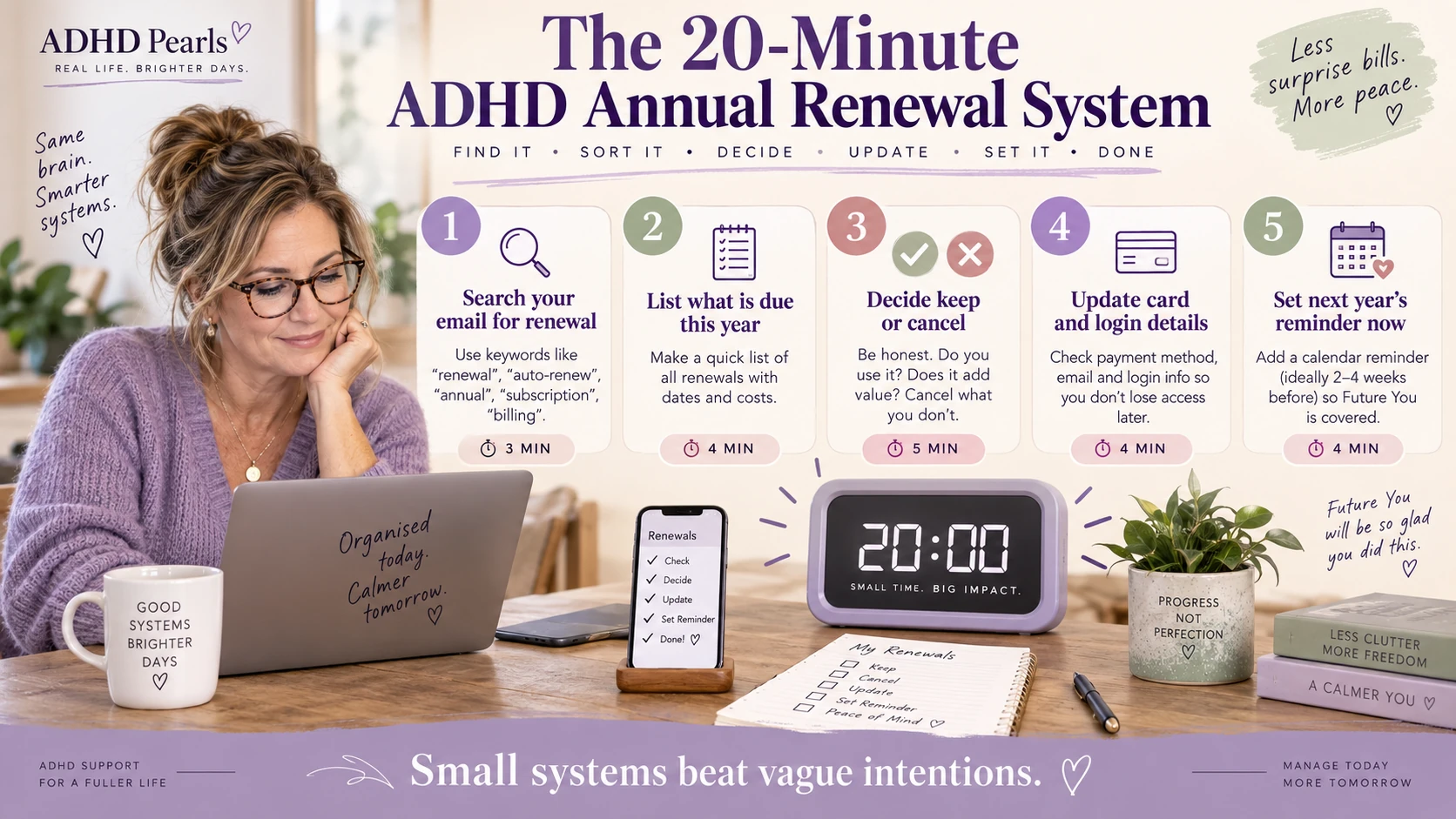
This is one sitting, once, and then it maintains itself in a few minutes a year. I would put a timer on and accept a scrappy version, because a scrappy version that exists beats the thorough one you plan for a Sunday that never comes.
1. Sweep twelve months of statements
Not three. Twelve. That is the whole point — a shorter window catches monthly charges and misses every annual one. Go month by month and write down anything that appears exactly once. Include the boring stuff. Include the things you are sure you remember.
Search your email for renew, renewal, your subscription and expires as a second pass. Between the two you will catch most of it.
2. Give every item a date and a real amount
Two columns: when it happens, and what it costs. Where the amount is about to change — the promo year — write the amount it is becoming, not the one you paid.
3. Set two reminders, not one
This is the part people get wrong, myself very much included. One reminder on the renewal date is not a system, it is a notification of a decision already made.
Six weeks before: the decide reminder. Do I still want this? Is it still the right price? This is where shopping around actually fits, because it needs days, not minutes. Six weeks also sits neatly outside California's 15-to-45-day notice window, so your own reminder lands before the company's does — which means you arrive at their email having already decided, instead of being asked to make a choice at the moment you are least able to.
One week before: the do reminder. Cancel it, switch it, or let it go through on purpose. "On purpose" is a legitimate outcome and the whole point of the exercise.
Make both recurring yearly, so next year's version arrives without you rebuilding anything.
4. Divide the total by twelve
Add up the annual list. Divide by twelve. That number is what these bills actually cost you per month, and setting it aside monthly is the difference between an expected transfer and a bad week.
This is the same move as the annual-bills pot in budgeting by pay period, and it is worth doing even roughly. A pot that is half funded still absorbs half the shock.
5. Put the list somewhere that is not your memory or your inbox
Your inbox is not storage. It is a river. Things you put there are gone in a fortnight, buried under everything that arrived since.
Where the list lives matters less than that it lives in exactly one place that you will still be using in eleven months. If your system changes every spring — mine did, for years — pick the most boring, least exciting option available, because the boring one is the one that survives.
The goal is not to remember better next year. It is to make next year show up before the renewal does.
When I went looking for somewhere to put this, I wanted three specific things: a recurring item that could be set to every year rather than daily or weekly, a place to hold small pots for costs that arrive all at once, and dates that come back on their own without being re-entered. Most tools gave me one of the three. So we built the All-in-One ADHD Planner with all three in the same file — recurring tasks that accept a yearly interval, sinking funds that show what you need per month and by when, and birthdays and holidays stored as day-and-month so they simply return. It did not make me a person who enjoys admin. It did mean February stopped being a month I dreaded for reasons I could not name.
What this does not fix
It does not stop the charge you have already agreed to. If it renewed last week, this system starts working next year. That is a genuinely annoying answer and it is the true one. The useful move now is to note the date and set the six-week reminder for the next cycle, which takes two minutes and converts a bad week into the last time it happens.
It does not survive a year you stop looking. Nothing here runs itself. A list nobody opens is a list that quietly goes out of date, and the annual cadence means it can rot for eleven months before you find out. The yearly reminders are what keep it alive, which is why they are step three and not an optional extra.
It does not help with the ones that never appear on a statement. Documents that expire, appointments that are due, the school thing in September — those need the same reminders and get no help at all from a bank feed. You have to remember they exist in order to add them, which is the exact problem we are trying to solve. This is why the list is worth rebuilding once a year rather than treating as finished.
And it does not address the reason the letter sat above the kettle. Opening the post, making the call, sitting through the retention script — that is admin paralysis, a different problem with a different fix. This article gets the thing in front of you at a moment when you can still act on it. Whether you can act on it that day is another question, and an honest one, and it has its own article.
FAQ
Why do I keep forgetting annual bills when I never forget the monthly ones?
Because a monthly bill gives you twelve chances a year to build an association and an annual one gives you a single chance, across a gap longer than most reminder systems survive. It is a property of the interval, not of your character.
Is there a law that stops companies auto-renewing without telling me?
It depends where you are. In California, businesses must give notice 15 to 45 days before an annual renewal, in force since 1 July 2025. In the UK, insurers have had to show last year's premium on renewal notices since April 2017. There is currently no federal US rule — the FTC's click-to-cancel rule was vacated by the Eighth Circuit in July 2025 and a new rulemaking only reopened in March 2026.
How far back should I check my bank statements?
Twelve months, every month. Three months is enough for monthly subscriptions and will miss every single annual one, which is the whole reason they go unnoticed.
Is it bad to rely on reminders for things I should just remember?
No, and the research is unusually clear about this. External reminders cut forgetting dramatically in experimental tasks, and when researchers calculated the optimal balance, people used reminders more than was strictly optimal. Offloading is the normal human strategy, not a concession.
What is the single thing to do if I only do one?
Set one recurring yearly reminder six weeks before your car or home insurance renews. It is the item with the largest silent price drift and the easiest one to switch.
Research notes
Gilbert, S. J., Boldt, A., Sachdeva, C., Scarampi, C., & Tsai, P.-C. (2022).Outsourcing memory to external tools: A review of "intention offloading". Psychonomic Bulletin & Review, 30(1), 60–76. The ~45% versus ~5% forgetting figures come from a single experiment discussed in the review (Gilbert et al., 2020), not from household admin. The finding that people set reminders more often than would be optimal recurs across several studies using the optimal-reminders paradigm.
California Department of Justice, Office of the Attorney General.Consumer alert on California's Automatic Renewal Law. Amendments effective 1 July 2025: notice at least 15 and no more than 45 days before an annual renewal; three to twenty-one days before a free or discounted trial of more than 31 days ends; cancellation by the same method used to enrol.
Financial Conduct Authority.Transparency in insurance renewals. In force since 1 April 2017: last year's premium must be shown alongside the new one, consumers must be encouraged to shop around, and those renewing for the fourth or subsequent consecutive time must receive an additional prescribed shop-around message.
Stickley, A., Shirama, A., Ruchkin, V., Isaksson, J., & Sumiyoshi, T. (2026).ADHD symptoms and financial debt among adults. BMC Psychiatry, 26(1), 566. 3,717 Japanese adults, ASRS screener; debt OR 1.04 per point overall (95% CI 1.01–1.07), 1.06 for women, adjusted for sociodemographics, household finances, health, alcohol, smoking, depression and anxiety. Cross-sectional, self-report, single-item debt measure — context, not proof.
Save this for the next renewal that somehow disappears for eleven months and then arrives all at once.
Not better memory. Earlier reminders.
The insurance is £398 now, which is less than the £437 I was paying before any of this started, which I mention only because it is the one time in my life that a piece of life admin has ended with a number going down.
The letter still goes on the shelf above the kettle. I have made peace with that. The difference is that six weeks earlier something on my phone has already said the word "insurance" out loud, and by the time the letter arrives the decision is behind me rather than in front of me. That is the whole of it. Not a better memory — an earlier one.
Found this helpful? Share it with someone who gets stuck too.
One tap makes ADHD Pearls a preferred source in your Google account, so our articles surface higher when you search. No signup, and it brings you straight back to this page.
Before you go
All-in-One ADHD Planner
Eighteen tabs that fill each other in. Say a repeating chore once and the schedule builds itself, and one tab shows who in the house actually carries what.
For the woman who sets up the perfect system on Sunday and abandons it by Tuesday.
One short letter, every week. Real talk about ADHD, task paralysis, and the tiny wins that actually move the needle for a brain like yours. No shame. No hustle culture.