The chart lasted nineteen days. I know it was nineteen because I found it months later behind the bin, and I had ticked it in three different pens, which is its own kind of archaeology.
It was a good chart. Colour-coded. Bathroom on Tuesdays, sheets on Sundays, the bins on whatever night the lorry came. For about two and a half weeks it worked so well that I told two separate people about it, in the tone of somebody who has finally sorted herself out.
Then it stopped. Not dramatically. Nothing fell over. I just… stopped seeing it, and a fortnight later the sheets situation had become a personality issue.
I assumed this was a discipline problem, because that is what I had always been told it was. It took me an embarrassingly long time — and one very specific research paper — to work out that the chart was asking me to do the single thing my brain is measurably worst at, and asking me to do it again every seven days, forever.
Quick answer
Why do chore charts stop working after a few weeks?
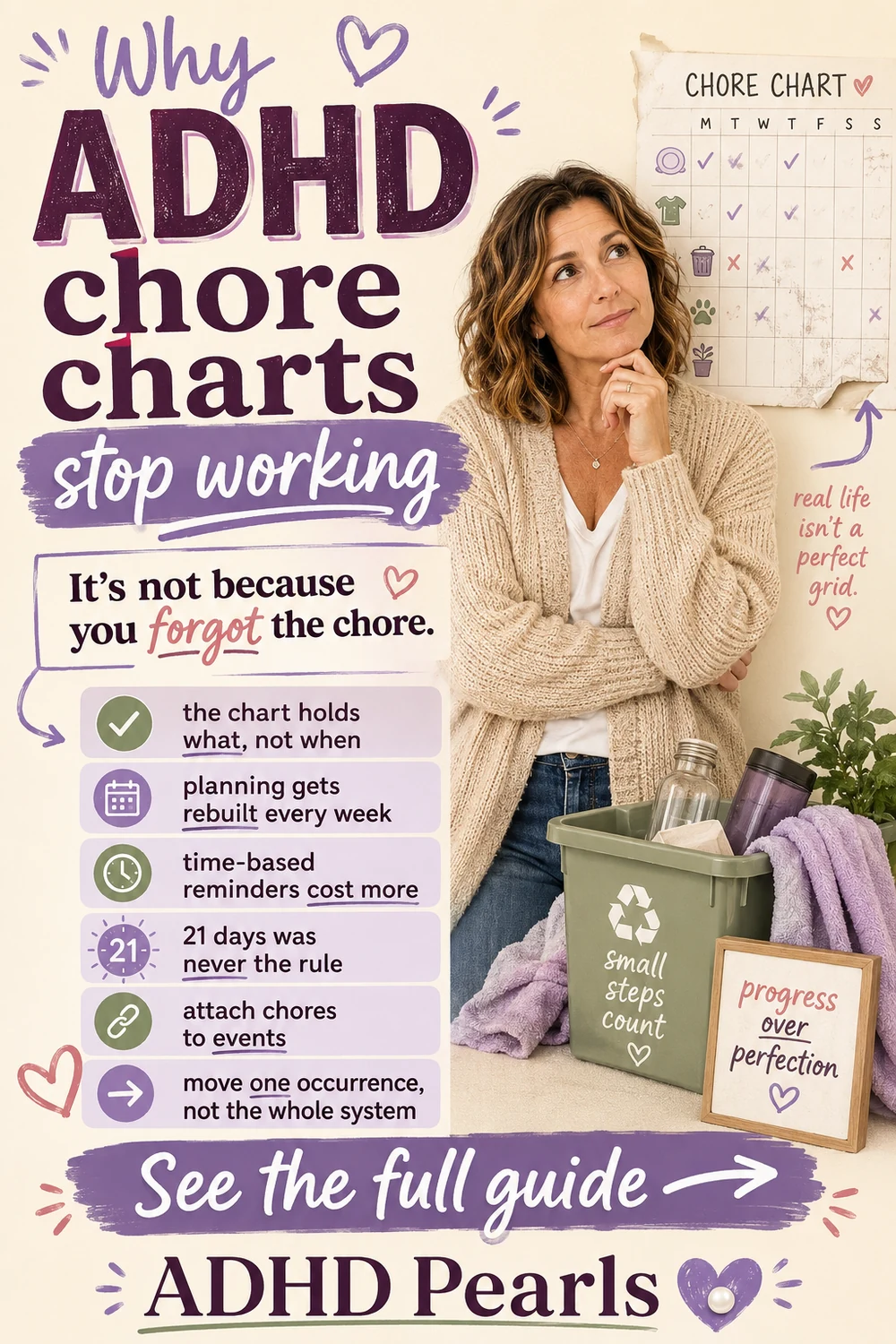
Because a chart holds the list but not the timing. Every week you still have to rebuild the plan — what today contains, where each job fits — and plan-building is the most impaired part of prospective memory in ADHD. Remembering a plan that already exists is far less affected. The chart asks for exactly the part that breaks.
Key takeaways
📌A chore chart stores the list. The expensive part is the timing, and a chart does not hold timing.
📌Prospective memory splits in two: building the plan, and retrieving it. ADHD hits the building far harder (Cohen’s d = 1.60 in Fuermaier et al., 2013).
📌Week three is not a motivation cliff. It is roughly when the chart stops being novel enough to actually see.
📌The 21-day habit rule was never a research finding, so missing it is not evidence of anything.
📌Attach repeating jobs to cues that already happen, instead of to intervals you have to compute each week.
A chore chart holds the what. It does not hold the when. Every week, you have to rebuild the when from scratch — look at today, work out which slot today is, work out what that slot contains, work out where that fits around everything else that is already happening, and then start.
That rebuild is called planning. And planning is not a mildly weaker skill in ADHD. It is the standout deficit.
In 2013 a team led by Anselm Fuermaier gave 45 adults with ADHD and 45 matched controls a complex errand task and pulled it apart into its separate stages. The result is the most useful thing I have read about my own broken charts.
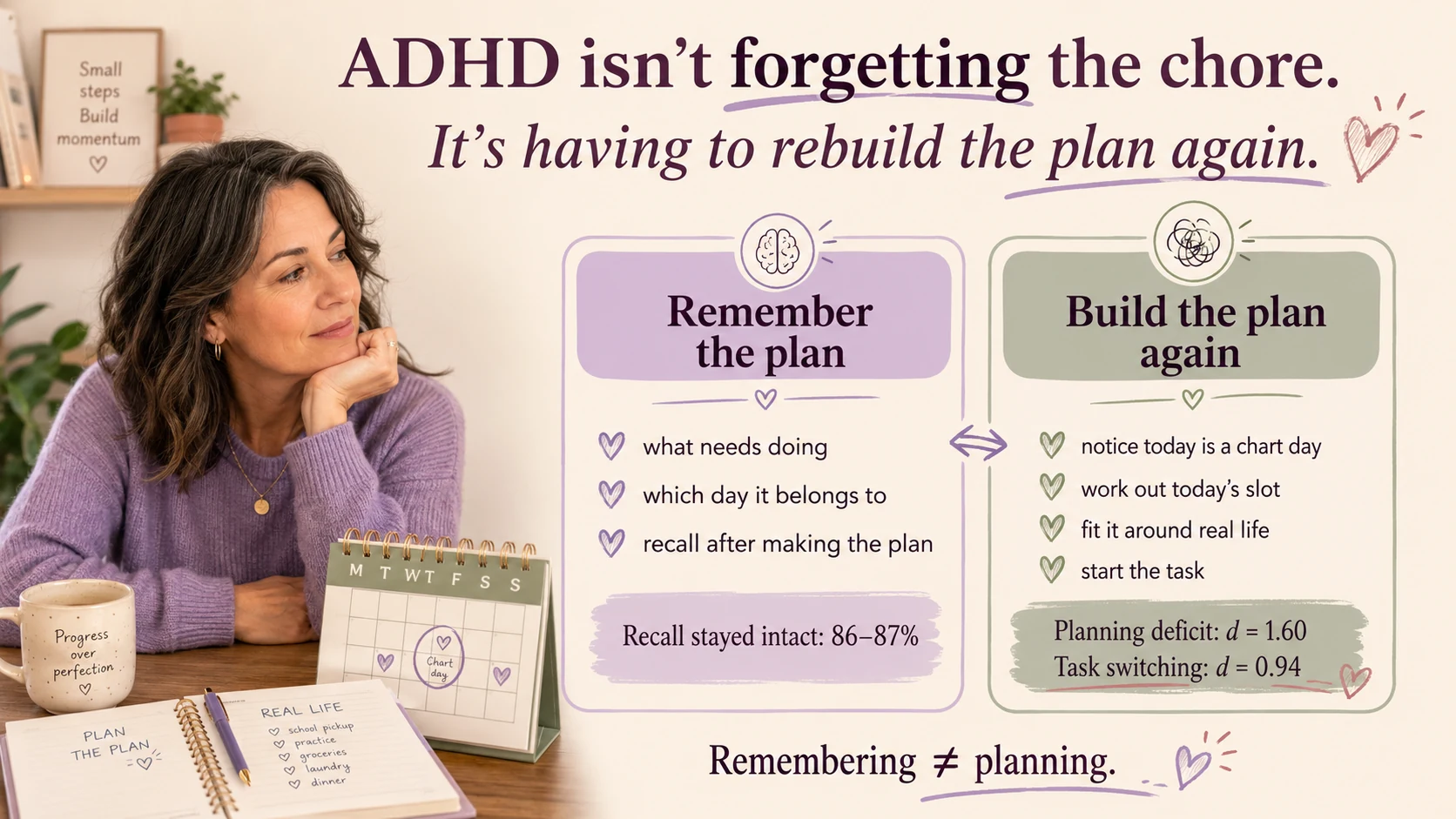
Remembering the plan was completely intact. Forty minutes after making it, both groups recalled it at around 86–87% accuracy. Statistically there was no difference at all.
Building the plan was where it fell apart — a large effect, Cohen's d = 1.60. Task switching was impaired too (d = 0.94), and inhibition alone explained about 13% of the variance in planning scores.
The recurring task is not disappearing from memory. The costly part is rebuilding when and how it fits into the week.
You are not forgetting the chore. You are being asked to re-plan your week, from nothing, every seven days — and plan-building is the exact thing that is impaired.
That reframe cost me about four years of thinking I was lazy, so I would like you to have it for free.
The chart is not a memory aid. A chart is a planning assignment with nice colours on it. It hands you the raw material and quietly expects you to do the expensive part yourself, on a Tuesday, at 7pm, after work.
Once that clicked I went looking for something that would hold the when and not just the what. (The wider question of why a new planner keeps not fixing this is a separate one.) What I found was a lot of apps that let me tick a box marked “repeat weekly” and then produced… a box that said “repeat weekly.” The repeating happened in the settings. It never happened on the screen I actually looked at. I still had to work out what today contained.
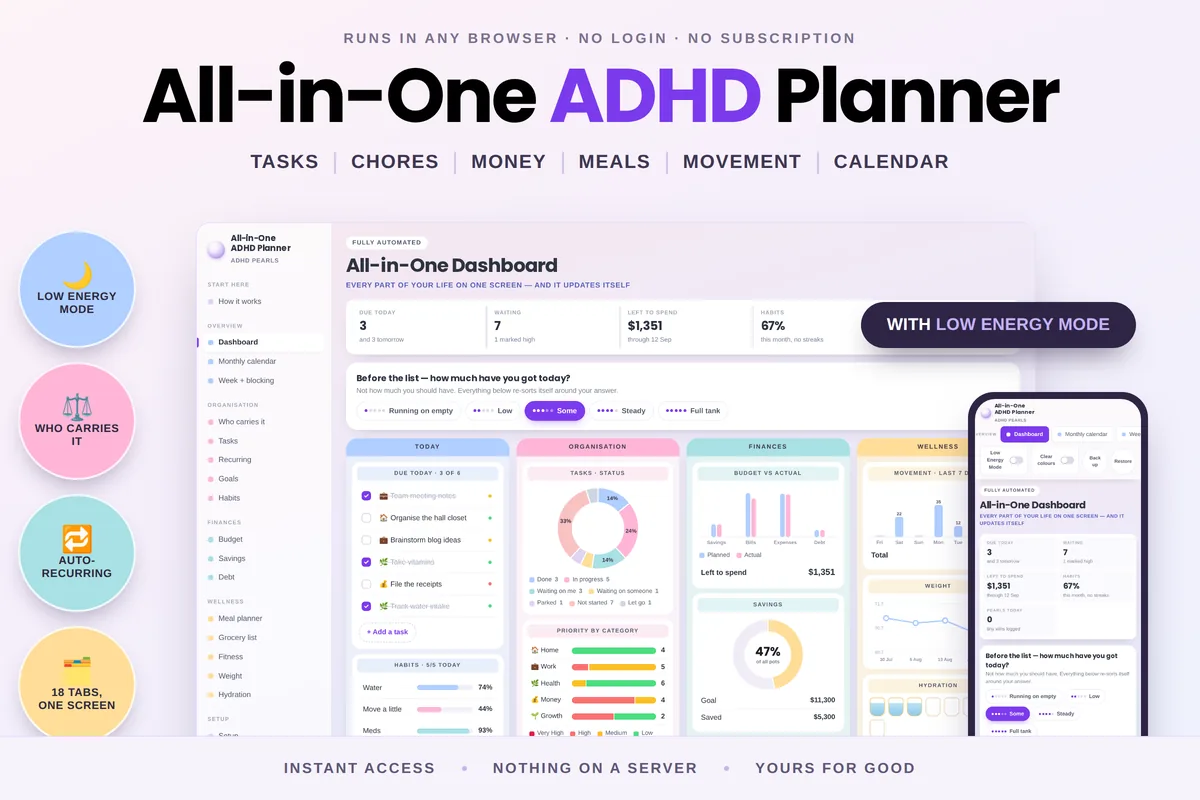
So we ended up building the thing we could not find: a planner where you describe a repeating job once — how often, who carries it, when it should stop — and it then draws every future occurrence onto the calendar and the day list by itself, so the when is already decided before you get there. I am not going to pretend it made me a person who enjoys cleaning the bathroom. It did mean I stopped re-deciding, fifty-two times a year, when the bathroom happens.
From ADHD Pearls
All-in-One ADHD Planner
Eighteen tabs that fill each other in. Say a repeating chore once and the schedule builds itself, and one tab shows who in the house actually carries what.
Opens in a new tab — this article stays where it is.
5 free days, counted only when you use it — just your email, no card. Then $27 once, private to your browser, no login, no subscription.
Two kinds of remembering — ADHD only breaks one
Remembering to do something later is its own cognitive skill, separate from remembering facts. Psychologists call it prospective memory, and it comes in two flavours.
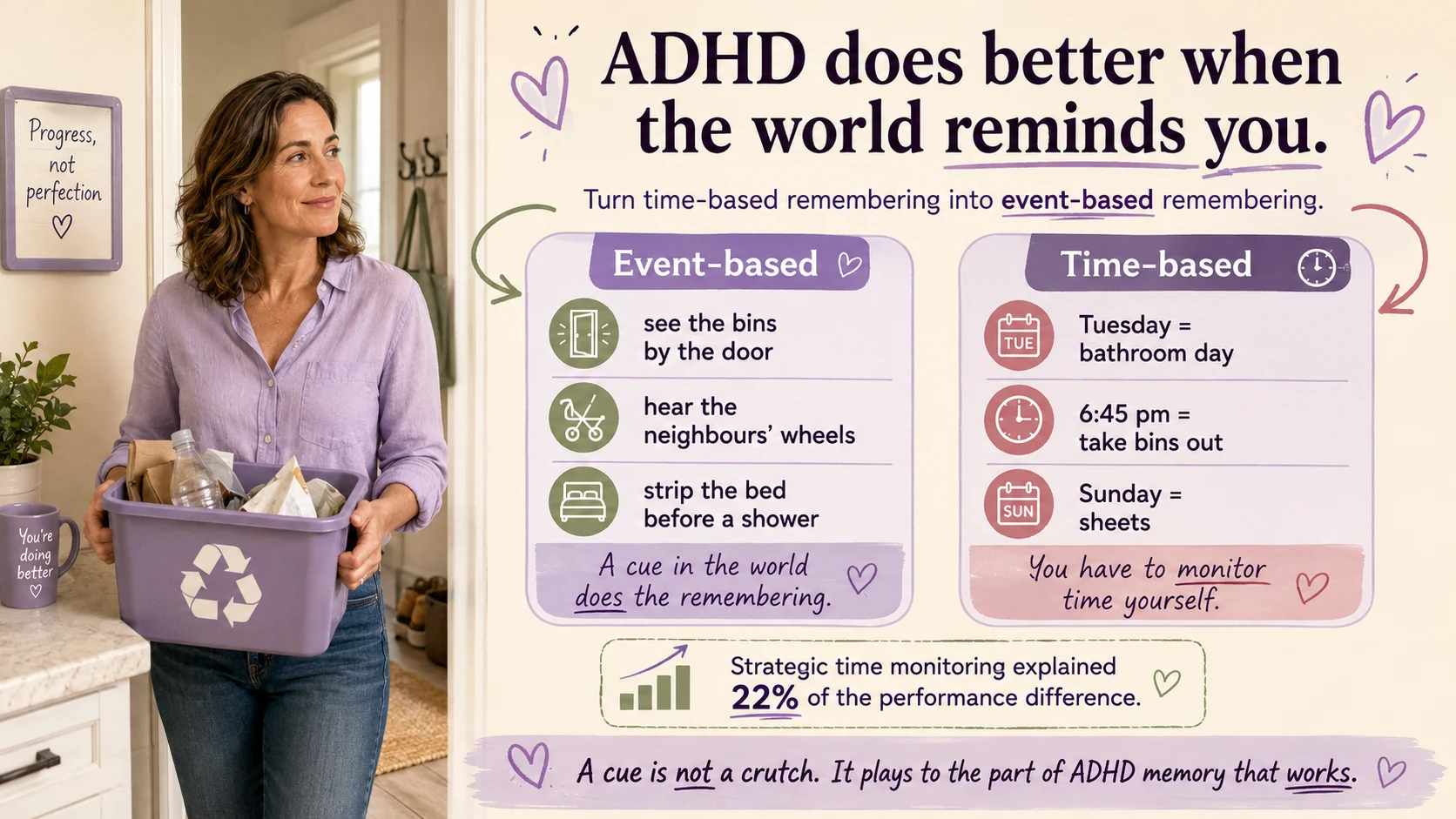
Event-based: something in the world triggers you. You see the bins by the door, you take the bins out. The cue does the remembering. This is the useful flip side of out of sight, out of mind: if being visible is what makes a thing real, visibility can be used on purpose.
Time-based: nothing triggers you. You have to keep an eye on the clock or the calendar yourself and act when it says so. “Tuesday is bathroom day” is time-based. So is every chore chart ever printed.
Time-based is the harder one for everybody. It is much harder with ADHD — the underlying reason you cannot feel time passing is its own subject — and the reason is more specific — and honestly more flattering — than “you don't pay attention.”
A 2025 study in Scientific Reports put 71 children with ADHD and 71 without into a virtual-reality task where they had to do things at particular times, with a clock they could check whenever they liked. The children with ADHD checked the clock just as often as everyone else. They simply checked it at less useful moments — evenly spread out, rather than clustering their checks as the deadline approached. How strategically they monitored explained 22% of the variance in performance, and fully accounted for the ADHD effect.
That is a children's study and I am not going to pretend it maps cleanly onto a 43-year-old woman with a laundry backlog. But it names something I recognise exactly: the effort is there. I check the time constantly. I am simply checking it at 2pm and 4pm and 6pm and then somehow not at 6.45pm, which was the only one that mattered.
A cue in the environment turns a recurring job into something you respond to. The 22% figure comes from the study in children described above.
The practical upshot: a system that turns time-based remembering into event-based remembering is not a crutch. It is playing to the half of prospective memory that works.
What a chore chart is really asking you to do
Put those two findings next to each other and the chart's design problem is almost funny.
What a chore chart provides
What it silently leaves to you
The list of jobs
Noticing that today is a chart day at all
Which day each job belongs to
Working out what today's slot contains
A place to tick
Fitting it around everything already in the day
—
Re-deciding all of the above next week, and the week after
The left column is the cheap part. The right column is the expensive part, and it is the part the research says is impaired.
There is a second, quieter cost. Everyday prospective memory failures do not just lose you the task — they change what you do next. Altgassen and colleagues, working with 29 adults with ADHD and 24 controls, found that everyday prospective memory partially mediated the link between ADHD symptoms and procrastination. The missed intentions were part of the path to putting things off, not a separate problem sitting beside it.
Which matches the thing nobody writes on the chart: the week you miss the bathroom, you do not calmly do it on Wednesday. You avoid the bathroom, because the bathroom is now evidence.
The 21-day thing was never true
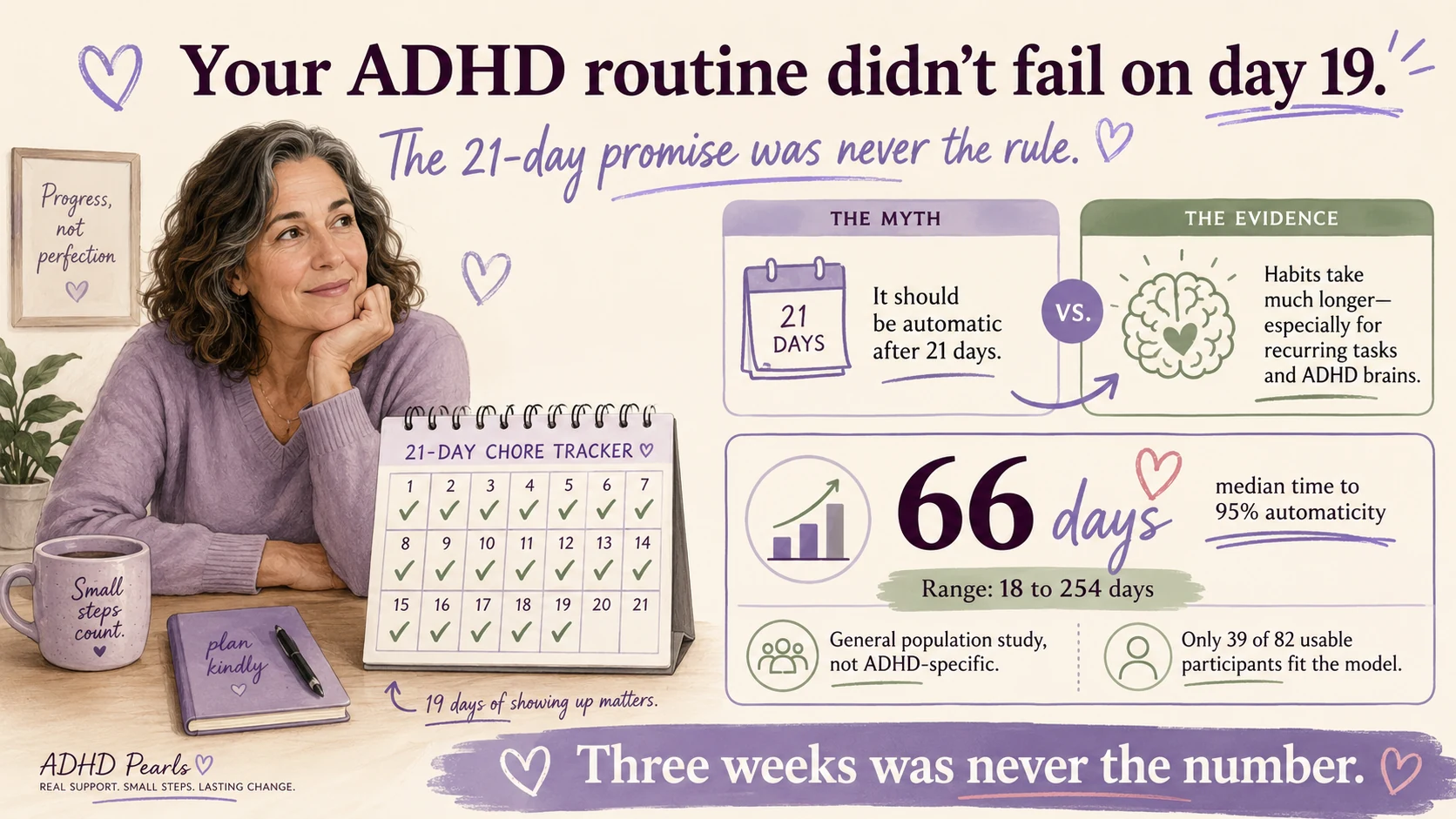
Most chore charts are quietly designed around a number that does not exist. Three weeks, and it becomes a habit. Stick it out, and it goes automatic.
I built at least two charts on that promise, and when they collapsed at nineteen days I read it as a personal failure delivered one day before the finish line.
The actual study everyone is half-remembering is Lally and colleagues, 2010. Ninety-six volunteers picked a daily behaviour and reported on it for twelve weeks. The median time to reach 95% of automaticity was 66 days — and the range ran from 18 to 254 days.
Two honest caveats, because they matter. The participants were mostly postgraduate students, not ADHD women running a household. And only 39 of the 82 usable participants produced a curve that fitted the model at all — less than half. This is a real finding but it is not a law of nature.
Three weeks was never a universal finish line — and the habit study behind the better-known number was not an ADHD study.
Still, the shape of it stands: three weeks was never the number, the spread between people is enormous, and a chart that quietly promises automation at day 21 is going to feel like a betrayal at day 22 for most people who ever try it.
Mine failed on day nineteen. It turns out I was not even late.
Turning intervals back into cues
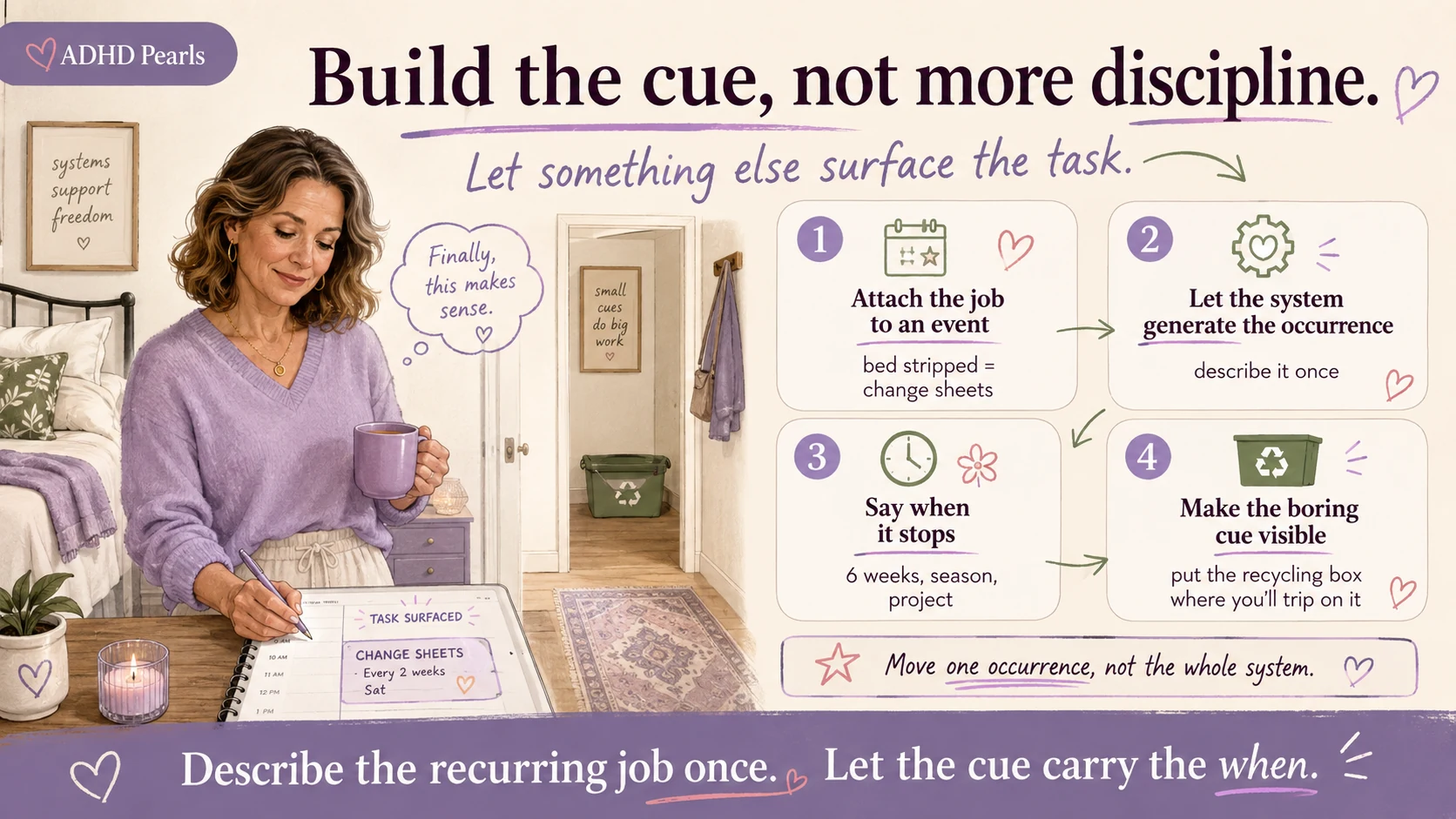
Everything that has actually held for me does the same underlying thing: it moves a job out of “I must remember this on a schedule” and into “something will put this in front of me.”
Attach the job to an event, not a day
“Sheets on Sunday” needs me to know it is Sunday and that Sunday means sheets. “Sheets go on when I strip the bed to shower” needs me to be in the bedroom holding a towel, which I already am.
The bins one that finally stuck for me: not “Thursday night,” but “when I hear the neighbours' wheels on the pavement.” Outsourced to a man I have never spoken to. Working beautifully for two years.
Let the interval be somebody else's job
This is the one that changed the most. If a system generates the occurrence and shows it to you on the day, the interval stops being something you hold. You are no longer remembering “every three weeks” — you are responding to a thing that appeared.
The test I use: can I describe this job once and never think about its schedule again? If the answer is no, the schedule is still living in my head, and my head is where schedules go to die.
Say when it stops
Not every repeating job repeats forever, and the ones with no end date are the ones that rot. The physio exercises were six weeks. The plant food was through the growing season. Charts have no concept of an end, so those items sat there accusing me until the whole chart became unreadable.
Give the boring ones a visible marker
Where a job genuinely has to happen on a date — the bin lorry does not care about my nervous system — I make it physical. The recycling box goes in the hallway on Wednesday evening, where I will trip on it. My hallway is not beautiful. My recycling goes out.
Imagine doing it, specifically, once
There is a technique with real evidence behind it and a real limitation attached. Episodic future thinking means picturing yourself actually carrying out the task — where you'll be, what you'll be holding — at the moment you set the intention.
In a 2026 study of 127 adults (63 with ADHD), that imagining increased how many intentions people actually carried out, compared with just noting them down. The honest footnote: the advantage disappeared once the researchers controlled for verbal ability, so we do not yet know who it works for and why.
I use it for the once-a-year things, where I have no cue at all and no chance of building one. Ten seconds of picturing myself at the desk with the boiler paperwork does more than another line on a chart. It is not magic. It is just better than nothing, and nothing was the alternative.
The goal is not stronger discipline. It is reducing how often you have to reconstruct the schedule from scratch.
The “just this once” problem
Here is the failure that killed more of my systems than forgetting ever did.
Something repeats every Monday. One Monday, you cannot. You are ill, or away, or it is simply not a Monday-shaped day. So you move it to Wednesday.
And now the series is broken. In a paper chart there is no way to say “this week only” — you either cross it out, which makes the chart wrong, or you move the whole line, which makes every future Monday a Wednesday for reasons nobody will remember by October.
Most apps are no better. Moving one occurrence either detaches it from the series entirely or drags the whole series with it.
This matters more with ADHD than it sounds, because of what a broken system does next. Once the chart is visibly wrong in one place, it stops being a reference and becomes a piece of evidence about me. And I do not consult evidence about me. I put it behind the bin.
What a repeating system has to be able to say, and almost none of them can: this one occurrence moved, and nothing else changed. The series stays on Monday. This week is Wednesday. No crossing out, no guilt, no archaeology.
What this does not fix
I would rather say this plainly than have you find out at week four.
It does not make you want to do the job. Nothing here touches motivation. A chore that appears in front of you on the right day is still a chore, and I still put off the oven.
It does not survive a genuinely bad week. When capacity goes, the system does not save you — it just means that when you come back, the schedule is still intact and you have not lost the map as well as the week. That is a smaller promise than most productivity writing makes, and it is the true one.
It does not replace the conversation. If you are the only person in the house who has ever noticed that sheets need changing, a better schedule will make you a more efficient sole carrier of the load. That is a different problem, and it has its own article — the first part of this series.
And the research has edges. The strongest finding here — planning impaired, recall intact — comes from one study of 90 adults doing a laboratory errand task. The time-monitoring work is in children. None of it was designed to evaluate chore charts, and I am the one drawing the line between them.
And it gets harder as the interval gets longer. Everything above assumes enough repetitions to build something. Stretch the gap to twelve months and you get a single attempt a year, which is why annual bills and renewals catch you out in a way weekly chores never quite do.
Save this for the next time a chore chart works beautifully for two weeks and then somehow disappears from your brain.
The chart held the what. Your brain was still carrying the when.
FAQ
Why do chore charts stop working after a few weeks?
Because a chart holds the list but not the timing. Every week you have to rebuild the plan — what today contains and where it fits — and plan-building is the most impaired part of prospective memory in ADHD (Cohen's d = 1.60 in Fuermaier et al., 2013), while remembering the plan is unaffected.
Is it ADHD if I keep forgetting recurring chores?
Forgetting repeating tasks is extremely common in ADHD, but on its own it is not diagnostic — tiredness, stress, perimenopause and having a lot of people to keep alive all do it too. If it runs across your whole life and always has, that is worth raising with a professional rather than settling from an article.
Are habit trackers better than chore charts?
Only if the tracker surfaces the task on the day rather than asking you to check in. A tracker you have to remember to open is another time-based task wearing a different outfit — and the streaks most of them add are their own problem.
How long does it actually take to build a habit with ADHD?
Nobody knows for ADHD specifically. In the general population the median was 66 days with a range of 18 to 254 (Lally et al., 2010), and fewer than half the participants fitted the model at all. The honest answer is that “21 days” has no evidence behind it and planning for automatic is planning for something that may not arrive.
What should I do when I miss a week?
Move the single occurrence, do not restart the system. The restart is the dangerous move: it turns one missed bathroom into a referendum on whether you are the sort of person who can keep anything going.
Research notes
Fuermaier, A. B. M., Tucha, L., Koerts, J., Aschenbrenner, S., Westermann, C., Weisbrod, M., Lange, K. W., & Tucha, O. (2013).Complex prospective memory in adults with ADHD.PLOS ONE, 8(3), e58338. 45 adults with ADHD, 45 matched controls. Plan recall did not differ between groups (~86–87% after a 40-minute delay). Task planning showed a large impairment (d = 1.60); task switching d = 0.94. Laboratory errand task, not a household study.
Lally, P., van Jaarsveld, C. H. M., Potts, H. W. W., & Wardle, J. (2010).How are habits formed: modelling habit formation in the real world.European Journal of Social Psychology, 40(6), 998–1009. 96 volunteers, 82 with usable data, mostly postgraduate students. Median 66 days to 95% of automaticity, range 18–254 days; only 39 participants fitted the model well. Not an ADHD sample.
I still have that chart. It is in a drawer with the pens, because throwing it away felt like admitting something and keeping it felt like admitting something else, so it lives in the drawer, unresolved, like most of my filing.
What changed was not that I got better at Tuesdays. It was that I stopped asking myself to invent the week from scratch every Sunday night. When I went looking for something that would do that part, everything I tried put the repeating in a settings menu and left the deciding with me — which is the expensive half.
So we built one where a repeating job is described once and then keeps appearing on its own, where you can move a single week without breaking the series, and where you can tell it when to stop. The sheets still do not change themselves. But I have not sat down on a Sunday and rebuilt my own week in about eight months, and the bathroom is on a schedule I could not tell you the details of — which, as far as I am concerned, is the whole point.
Found this helpful? Share it with someone who gets stuck too.
One tap makes ADHD Pearls a preferred source in your Google account, so our articles surface higher when you search. No signup, and it brings you straight back to this page.
Before you go
All-in-One ADHD Planner
Eighteen tabs that fill each other in. Say a repeating chore once and the schedule builds itself, and one tab shows who in the house actually carries what.
For the woman who sets up the perfect system on Sunday and abandons it by Tuesday.
One short letter, every week. Real talk about ADHD, task paralysis, and the tiny wins that actually move the needle for a brain like yours. No shame. No hustle culture.