My husband asked me where the spare key to the shed was. Kindly. No agenda at all. I said third drawer, under the fuse box instructions. He found it, fixed the gate, put the key back exactly where it came from.
Then I stood in the kitchen feeling unreasonably furious about a shed.
It took me an embarrassingly long time to work out why. He had done the entire job. Every part of it except the one where somebody has to know.
That last part — being the one who knows — is the mental load. And if you have ADHD, it is the expensive half, because it is the half that runs on remembering.
Quick answer
Why does the mental load feel heavier if you have ADHD?
Because the mental load is not the chores. It is noticing what needs doing before anyone asks, and checking later that it happened. Research finds women do most of exactly those two jobs, and both of them run on working memory and remembering-to-remember, which are the two things ADHD is measurably worst at.
Key takeaways
📌Household thinking has four stages: noticing, finding options, deciding, checking. Most couples only argue about deciding.
📌In one 2025 study, mothers reported doing 72.6% of the thinking and 63.6% of the physical work. The gap is bigger for the thinking.
📌In that same study, the thinking predicted burnout. The physical work did not.
📌ADHD is not worse at deciding. It is worse at noticing early and checking back, which are the two stages that land on women by default.
📌"Just tell me what to do" leaves the load exactly where it was. It hands over the doing and keeps the holding.
This article is personal and educational, not medical advice. Burnout, depression, anxiety, thyroid problems and perimenopause can all look like this from the inside. If it is affecting your daily life, please get proper medical guidance.
The Mental Load Has Four Parts. You Are Only Fighting About One.
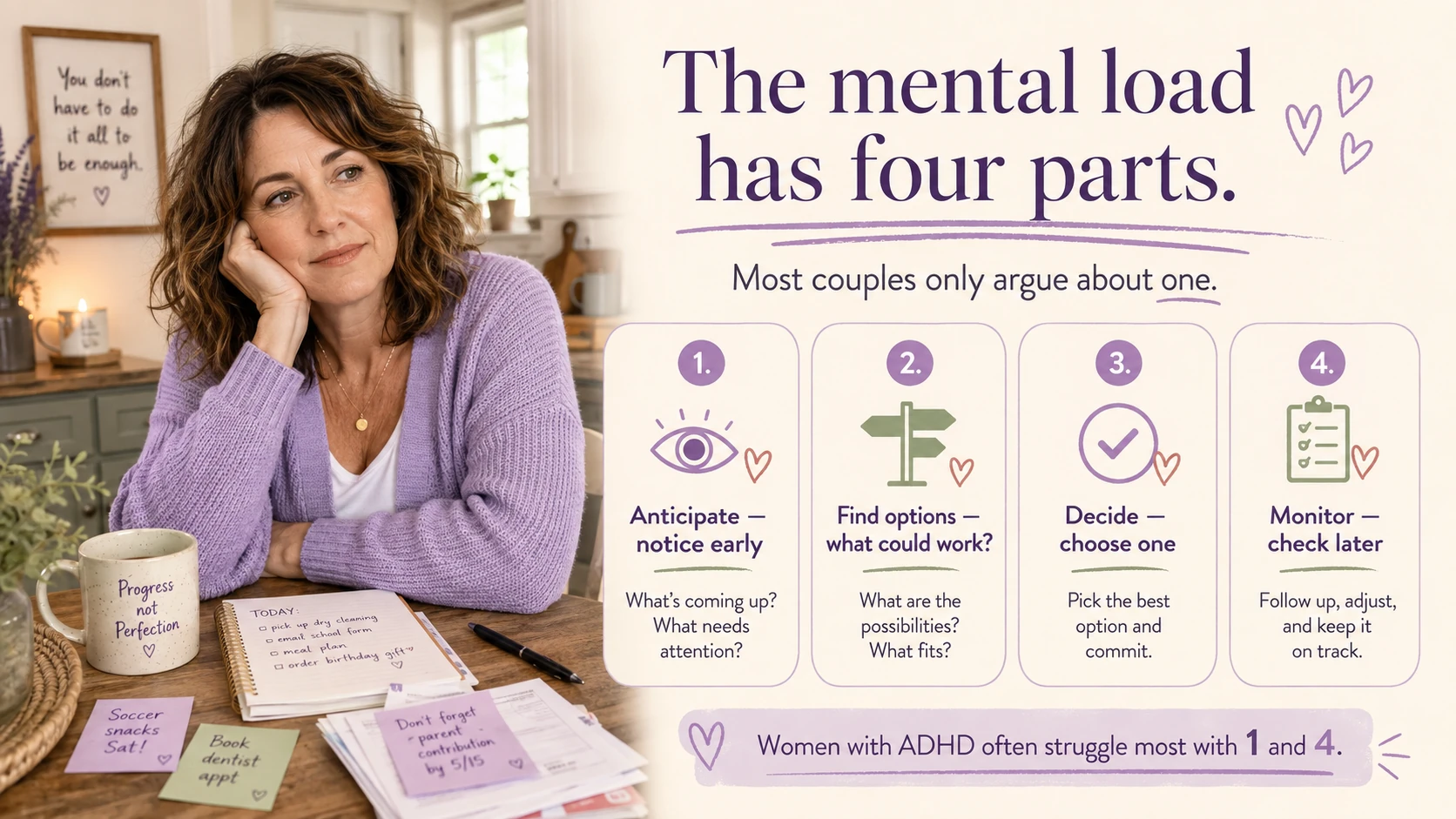
A sociologist called Allison Daminger sat down with 35 couples and asked them, in detail, who thought about what. What she found is that the thinking is not one thing. It breaks into four steps, and they are not equally shared.
Anticipate. Noticing that something is going to need doing, before anybody has said so. The shoes are getting tight. The passport expires in the spring.
Identify options. Working out what could be done about it. Which shoes, which shop, what it costs.
Decide. Choosing one.
Monitor. Checking, later, that the thing actually happened. Did the shoes arrive. Did anyone put them on the child.
Here is the part that reorganized my whole head. Daminger found that deciding is split fairly evenly between men and women. It is anticipating and monitoring that pile up on one person.
The argument is often about who decides. The invisible imbalance is usually in who notices first and who remembers to check later.
The argument in most houses is about who decides. The imbalance is in who notices, and who checks.
Which explains the shed. He decided, he acted, he executed beautifully. What he did not do was hold, on an ordinary Tuesday with nothing prompting him, the location of a key he had not needed for a year. That job was mine, permanently, and nobody had ever mentioned it out loud.
The stage
What it sounds like in a real house
What ADHD does to it
Anticipate
"Those school shoes are getting tight."
Hardest stage. It runs on a background list nobody has prompted you about, held in working memory.
Identify options
"Clarks, or the cheaper ones online?"
Usually fine. Often more than fine. This is research, and plenty of us over-research.
Decide
"Get the cheaper ones."
Usually fine, and already shared. Research finds couples split this one reasonably evenly.
Monitor
"Did the shoes come? Did anyone try them on him?"
Brutal. No cue, no deadline, no reminder. This is the exact kind of remembering ADHD is worst at.
The stage with no name
Monitoring is the one nobody has a word for, which is why it never gets divided. It has no start, no end and no visible output. When it goes right, nothing happens. When it goes wrong, a child goes to school in shoes that hurt and somebody feels like a failure, and it is never the person who did not notice.
Once I could see the four stages, I went looking for something that would hold stages one and four for me. Every list app I tried held tasks — the doing — and quietly left the noticing and the checking exactly where they had always been, which is to say in my head, at 11pm.
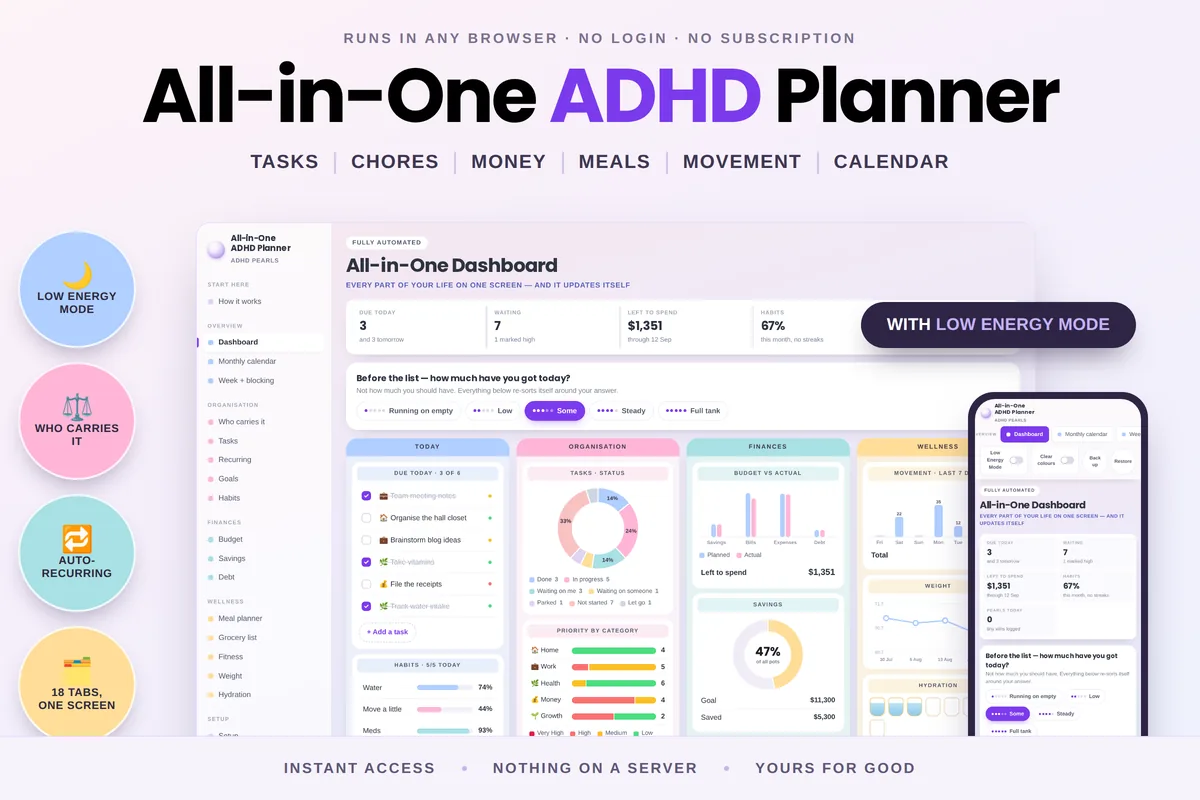
So we ended up building the thing we could not find: a planner where a repeating job gets described once and then keeps drawing itself, and where one tab does nothing but count who in the house is actually carrying what. I am not going to pretend that fixed anything about my marriage. It did get the shed key off my list. The next part of this series looks at what happens to the jobs that come back every week — why chore charts stop working after about three weeks.
From ADHD Pearls
All-in-One ADHD Planner
Eighteen tabs that fill each other in. Say a repeating chore once and the schedule builds itself, and one tab shows who in the house actually carries what.
Opens in a new tab — this article stays where it is.
5 free days, counted only when you use it — just your email, no card. Then $27 once, private to your browser, no login, no subscription.
ADHD and the Mental Load: the Two Parts That Break
Now put the ADHD research next to it, which as far as I can tell almost nobody does.
Noticing early is a working memory job
Anticipating means carrying a quiet background list of things that are not urgent yet and that nobody has mentioned. That is working memory, running unprompted, all day.
A meta-analysis of 38 studies found moderate working memory deficits in adults with ADHD across the board. And the ceiling was never high to begin with: the researcher Nelson Cowan's work suggests a typical adult holds roughly four items at once, not the famous seven.
So a household with twenty-odd live obligations in it is not something anyone holds in their head. Not you, not your partner, not the frighteningly organized woman at the school gate. She has a system. She may also have a spreadsheet she does not mention.
Checking back is the hardest kind of remembering there is
Monitoring is what psychologists call prospective memory: remembering to do something in the future. And it splits in two.
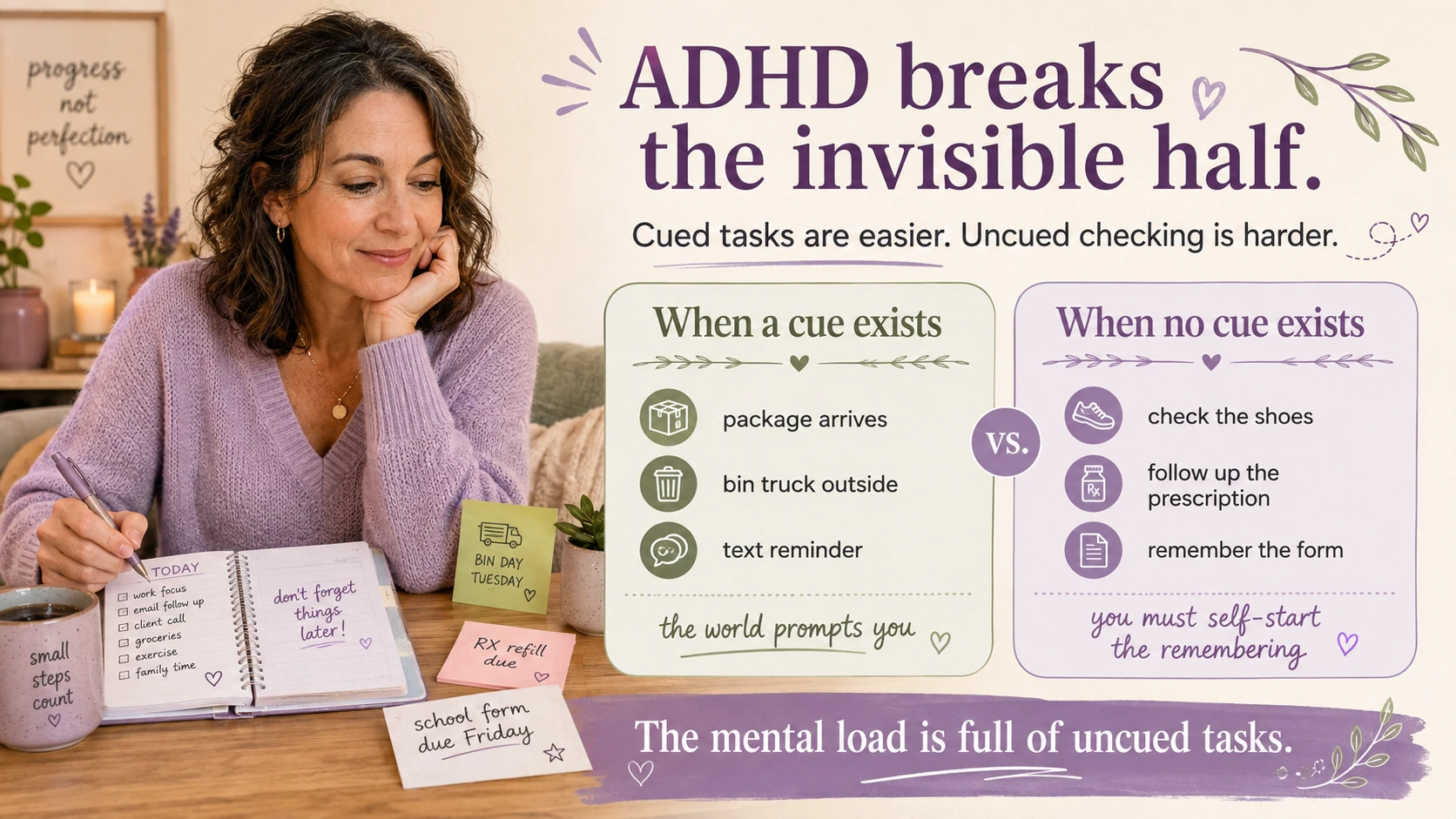
Event-based means something in the world fires the reminder. You see the bin lorry, you remember the bin. Time-based means nothing fires it. You have to self-start, off a clock or a calendar, with no cue at all.
A 2014 study compared adults with ADHD to matched controls on both. On event-based tasks there was no significant difference between the groups. On time-based tasks the ADHD group showed a large impairment.
Read that again, because it is the whole article. Cued, we are fine. Uncued, we are not. And monitoring is uncued by definition. There is no object in the world that reminds you to check whether the shoes arrived.
ADHD is not simply a problem with remembering everything. External cues change the equation. Mental-load monitoring often has no cue at all.
ADHD is not worse at deciding. It is worse at exactly the two stages that landed on you by default, and then you get blamed for the outcome.
I want to be careful here, because "my brain can't" is a sentence that can quietly become a cage. This is not an excuse and it is not a diagnosis. It is a reason to stop attributing a memory problem to a character problem. If you have spent years thinking you are a disorganized person who is bad at caring about her family, that is the wrong story, and it is costing you something.
The Numbers, Including the Awkward Ones
I went looking for data because I was tired of being told the mental load was real by people who could not tell me how big it was.
The clearest study I found is from 2025. Researchers used the Fair Play card deck to measure 30 household tasks across 322 mothers of young children. Mothers reported doing 72.6% of the cognitive labor and 63.6% of the physical labor. They reported more responsibility for the thinking in 29 of the 30 tasks.
Then the finding that made me put my phone down. Cognitive labor predicted depression, stress, burnout and worse relationship quality. Physical labor predicted only relationship quality. It was the thinking, not the chores, that tracked with burning out.
A separate 2025 study of over 2,000 partnered parents found something bleaker still: mothers earning six figures reported roughly 30% less childcare and 17% less housework than lower-earning mothers, and no reduction at all in the mental load. You can buy your way out of the doing. Nobody has found a way to buy their way out of the noticing.
The ADHD-specific numbers, and why I am flagging them
Here is where I have to be honest about evidence quality. There is very little research on ADHD and the mental load specifically. What exists is a reader survey ADDitude ran in 2025 with 2,263 responses. A reader survey is not a controlled study, and the people who answer one are not a random sample. Treat it as a large, useful show of hands.
•76% of women with ADHD reported parenting guilt, against 50% of men.
•60% of mothers with ADHD reported burnout.
•Fathers took 64% more time for themselves each week.
•8% of mothers said they felt fully supported. Eight.
And one more caveat that matters. Nearly all of this research is on mothers, in heterosexual couples, mostly in the US. When researchers asked same-gender couples how they divide it, the rigid pattern largely did not appear. Imbalance still built up when one person accumulated too much, and it still had to be renegotiated. So this is not a fact about women. It is a fact about defaults, and defaults can be changed, which is the only reason any of this is worth writing down.
Why "Just Tell Me What to Do" Changes Nothing
My partner has said this to me with total sincerity, more than once. It sounds generous. It is a trap made of good intentions.
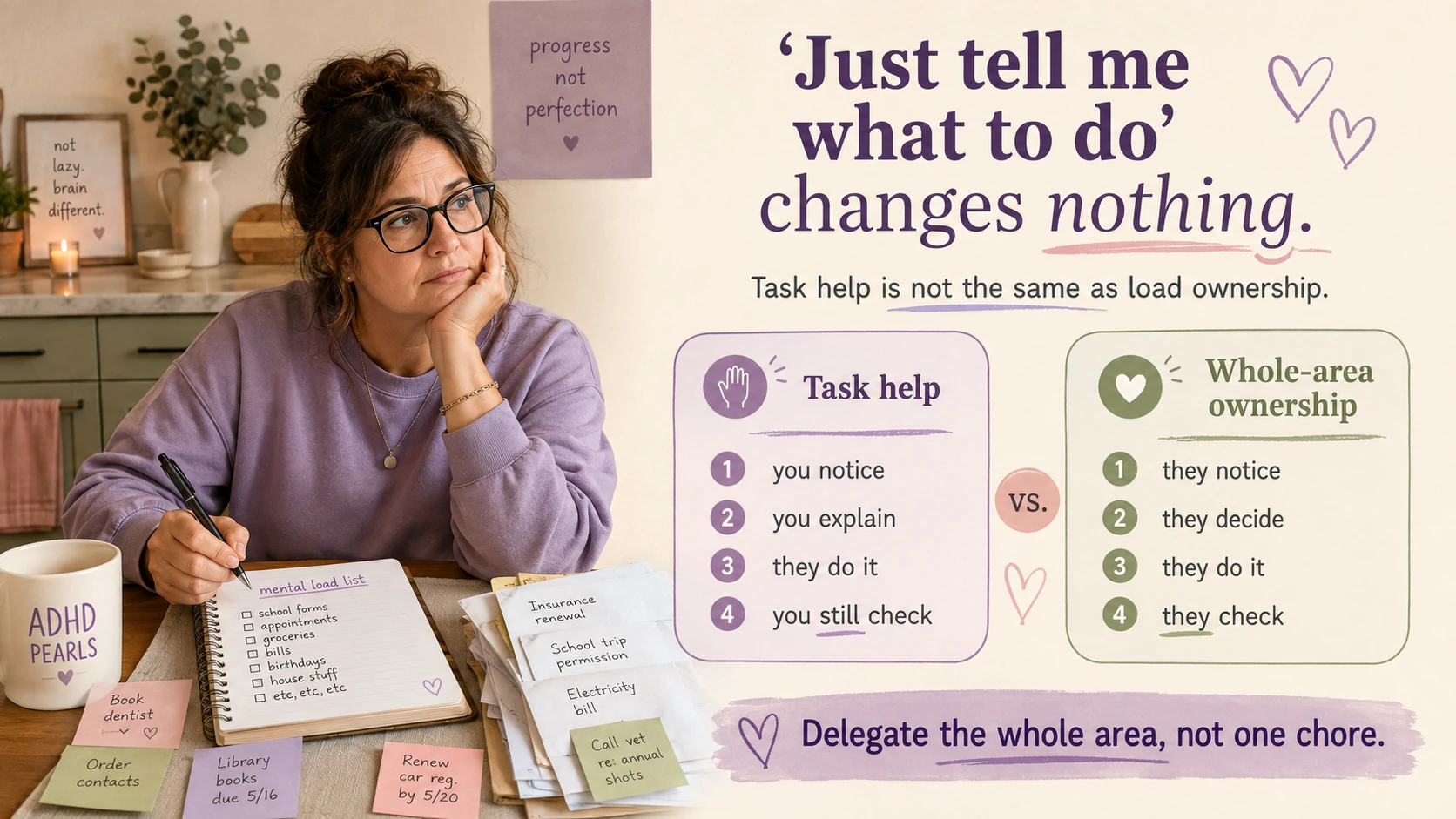
Look at it against the four stages. "Tell me what to do" is an offer to take stage three and stage three only, after I have already done the noticing, the researching and the deciding, and it quietly hands me the monitoring as well, because now I also have to remember to tell him and then remember to check.
Delegating a task is not delegating the load. It is adding an admin step to it.
I hit this hardest with a repeat prescription. I asked him to sort it out, he said yes, he genuinely meant it, and then for eleven days I thought about that prescription roughly twice a day. The asking cost me more than the doing would have. That is not his fault and it is not mine. It is the wrong unit of delegation.
If you still have to notice it, assign it and remember to check it, the task moved — but the mental load did not.
What to hand over instead
The unit that works is a whole area, including the noticing and the checking. Not "book the dentist" but "you own dental. All of it. I will not be asking when it is due, because I am not going to be the one who knows."
That last clause is the entire transfer, and it is the one that gets left off. If you keep the knowing, you have not handed anything over. You have hired an assistant and paid for them in worry.
What If You Are the One Carrying Less?
I want to stop and sit with this, because a lot of articles about the mental load will make some of you feel worse, and I would rather not be one of them.
Plenty of women with ADHD are not the one holding the household list. We are the one who forgot the parents' evening. Our partner is the one with the calendar, the renewals and the quiet, tight expression when something slips again. If you go looking for help with that, almost everything you find is written for the other person, about how exhausting it is to live with someone like you.
That literature is not made up. A 2024 study interviewed women partnered with men who have ADHD and described a real caregiving burden, real limit-setting, real cost. Those women deserve to be believed too. It is possible for both people in a house to be carrying something the other cannot see, and to be right about it.
Two things I would say if you are on this side of it. First, guilt is not evidence of the size of the problem, it is evidence that you care, and the two are not the same measurement. Second, carrying less than your partner is not carrying nothing, and the four stages still apply to you. Find one area, take all four stages of it, and let it be genuinely yours. One area held completely is worth more than help offered everywhere.
A word about "weaponized incompetence"
The phrase is everywhere and it is sometimes exactly right. Someone who does a job badly on purpose so they are not asked again is doing something real and it has a name.
But be careful using it inside an ADHD household, in either direction. Executive dysfunction produces the identical behavior from the outside: the forgetting, the half-finishing, the needing to be asked. There is a difference between a skill gap someone is willing to close and a refusal to hold responsibility, and only one of them is manipulation. Getting that wrong turns a solvable problem into a character verdict, and character verdicts are very hard to walk back.
Getting the List Out of Your Head
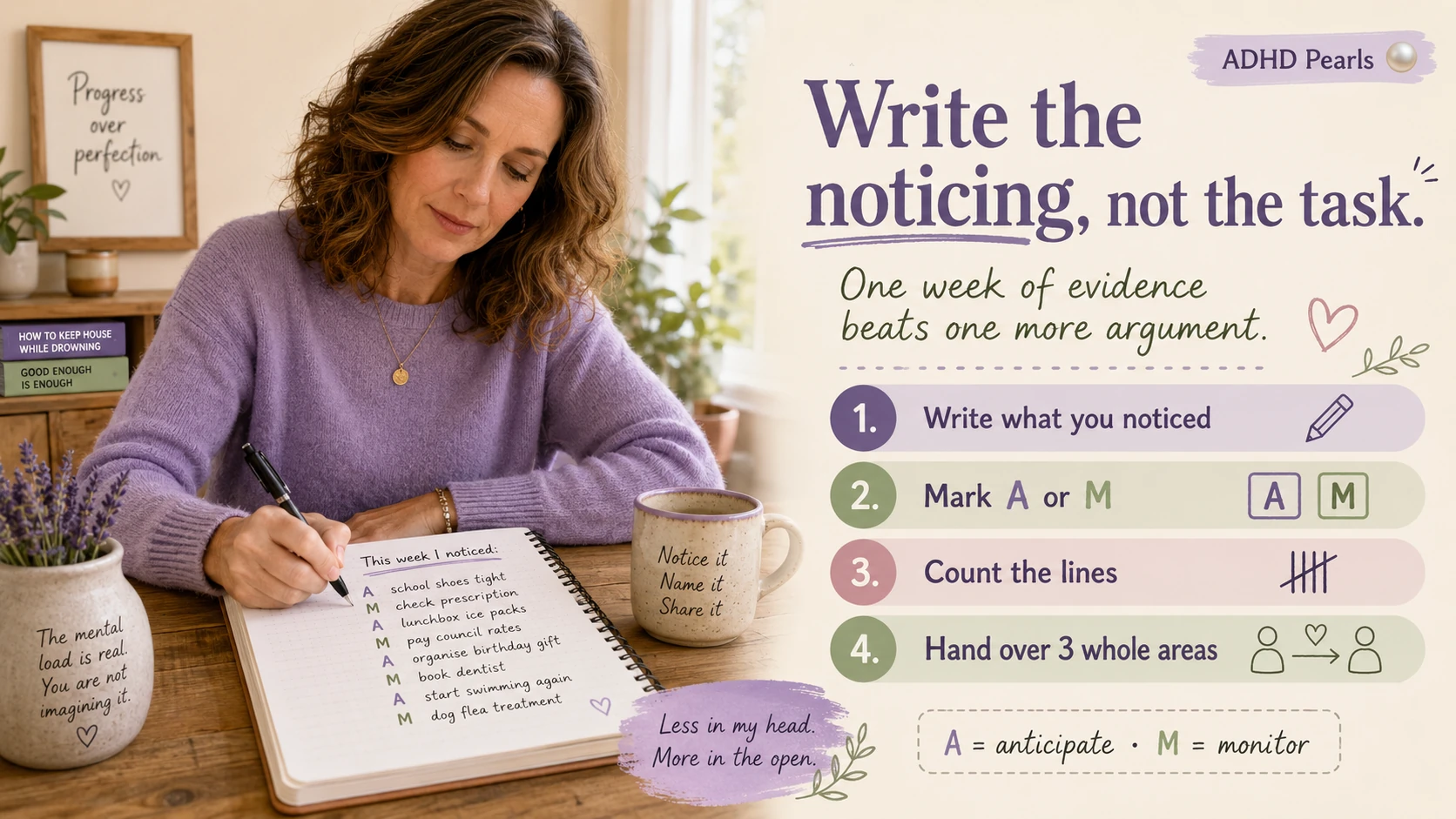
Here is the part that works with a pen and a page, and I would rather you did it that way first. It takes five days and it is not a productivity system. It is evidence gathering.
1. For one week, write the noticing, not the task. Every time you register something nobody asked you to register, write it down in the form it arrived in. "Sam's shoes are getting tight." Not "buy shoes." The noticing is the invisible thing, so the noticing is what you record.
2. Mark each line A or M. A for anticipating, M for monitoring. If the line is you remembering to check something you already delegated, that is an M and it counts fully. Do not record the doing. The doing is visible and nobody disputes it.
3. At the end of the week, count. Do not argue. Count. When I did this I had 41 lines in five days and 30 of them were M. I had been telling myself the problem was that I did too much housework. The problem was that I was the household's monitoring department.
4. Pick three lines to hand over whole. Not three tasks. Three areas, with the noticing and the checking attached. Three is enough to change the number and small enough that nobody panics.
5. Agree, out loud, what failure looks like. This is the step people skip and it is the one that decides whether any of it survives. If nobody notices the shoes for two weeks, the shoes are tight for two weeks. If you rescue it, the transfer is cancelled and you have taught both of you that you were always going to rescue it. Pick areas where you can genuinely tolerate the failure, which is why I would not start with medication or anything with a legal deadline.
Do not record the visible chore. Record the moment your brain noticed something nobody had asked you to notice.
If you do one thing from this article, do the first step for three days. Write the noticing, not the task. Most people are shocked by their own page, and a page is much harder to argue with than a feeling.
And then, honestly, get it out of your head permanently
The paper version proves the problem. It does not solve it, because a notebook is still something you have to remember to open, which is a time-based prospective memory task, which is the thing we established you are worst at. I have started and abandoned this exact notebook four times.
What actually holds is anything that fires without you and that shows who owns what. That can be a shared calendar with owners on the entries, a whiteboard by the kettle, a recurring reminder that repeats itself forever so you never re-enter it, or something built for it. The test is not whether it is clever. The test is whether it works on a day when you have forgotten it exists. If you have to remember to check it, it is another thing you are monitoring, and you have made the number worse.
How to Say It Without Starting a Fight
Some of the most-read threads on parenting forums are not asking how to cope. They are asking for the words. "Help me articulate the mental load." That is a translation problem, and translation problems have better solutions than resentment does.
Do not open with the total. "I do everything around here" is a sentence with a defense already built into it, and your partner will reach for it. It also is not quite true, and the deciding data says so.
Open with one example, all four stages. The shoes. Who noticed, who chose, who bought, who checked. One small story does the work that an accusation cannot, because there is nothing in it to deny.
Make the ask specific and strange enough to remember. Not "share the mental load." Try: notice it before I say it, and check that it got done. Those are the two stages. Naming them is the difference between a complaint and a request.
Aim for fair rest, not equal work. This reframe, which I first heard from KC Davis, is the only one I have found that survives every version of this: the ADHD version, the illness version, the one-of-us-works-nights version. Fifty-fifty collapses the moment two people are not identical. "Do we get a comparable amount of time when nobody needs anything from us" holds up.
If you want to go further into why the admin itself feels impossible before you even get to who owns it, ADHD life admin paralysis is the companion piece. If the guilt is the loudest part, this one on mom guilt is more useful than anything I can say here. And if the noticing problem is what you recognized most, out of sight, out of mind explains the mechanism underneath it.
The shed key, by the way, now lives on a hook by the back door with a label on it. Not because I got organized, but because I got tired of being the only person in the building who knew. It is a very small hook. It removed one line from my page. I will take it.
Save this for the next time "just tell me what to do" sounds helpful but somehow leaves you carrying the same list.
If you still have to remember it, you still own it.
FAQ: ADHD and the Mental Load
What is the mental load?
The mental load is the thinking work of running a household, as distinct from the physical work of doing it. Research breaks it into four stages: anticipating what will be needed, identifying the options, deciding, and monitoring that it actually happened. The tasks are visible. The thinking is not, which is why it rarely gets divided.
Is the mental load the same as emotional labor?
No, and the difference is worth knowing. Emotional labor was coined by the sociologist Arlie Hochschild in 1983 to describe managing your own feelings as part of a paid job, like a flight attendant staying pleasant. It got stretched to mean housework thinking, and Hochschild has objected to that. The mental load is the more accurate term for what happens at home.
Why does the mental load feel heavier with ADHD?
Because the two stages that fall most heavily on women, anticipating and monitoring, are the two that depend most on working memory and on remembering to do things in the future with no cue. Both are areas where research consistently finds ADHD-related difficulty. You may be doing the hardest half of the job with the weakest available tool.
Does ADHD make you worse at making decisions?
Not in this particular sense. Decision-making within couples appears to be split relatively evenly, and deciding is not the stage that piles up. What tends to break is noticing something before anyone mentions it, and checking later that it was handled.
Is the mental load always the woman's?
No. It is a default, not a rule. Research on same-gender couples found the rigid pattern largely did not appear, and division tracked strength and circumstance instead. Imbalance still developed when one partner accumulated too much, which suggests the real risk is accumulation rather than gender.
What if my partner carries more of it than I do?
That happens often when you are the one with ADHD, and it is worth naming rather than hiding. Research on partners of adults with ADHD describes a real burden that deserves to be taken seriously. The useful move is not guilt but ownership: take one whole area, including the noticing and the checking, and let it genuinely be yours.
Is what is happening in my house weaponized incompetence?
Sometimes, but be careful with the label in an ADHD household. Executive dysfunction produces behavior that looks identical from the outside. The distinction worth drawing is between a skill gap someone is willing to close and an unwillingness to hold responsibility for an area at all. Only the second one is what the phrase was meant to describe.
How do I explain the mental load to my partner without a fight?
Use one specific example rather than a total, and walk through all four stages of it: who noticed, who researched, who decided, who checked. Then make the ask in those terms, which is roughly "notice it before I say it, and check that it got done." A story is harder to argue with than an accusation, and a named stage is harder to dismiss than a feeling.
Can an app or a list actually fix this?
Only if it fires without you. A list you have to remember to open is one more thing you are monitoring, which makes the number worse rather than better. What tends to help is anything that surfaces on its own, shows who owns each thing, and repeats without being re-entered. The test is whether it still works on a day you have forgotten it exists.
Research notes
Daminger, A. "The Cognitive Dimension of Household Labor."American Sociological Review, 2019. The four-stage framework, and the finding that deciding is shared far more evenly than anticipating and monitoring.
Weeks, A. C., Kowalewska, H., & Ruppanner, L. "Take a Load Off? Not for Mothers."Socius, 2025. The study finding that higher earnings reduced physical work but not the mental load.
ADDitude: Division of Labor in ADHD Homes. additudemag.com, 2025. A reader survey of 2,263 people, not a controlled study, and the source of the guilt, burnout and support figures.
If you do the five-day page and nothing else changes, one thing still will: you will have a number. Mine was unbearable to look at and impossible to argue with, which is more or less what evidence is for.
What I could not do was keep the page going. It is a notebook, and remembering to open a notebook is the exact task we just spent two thousand words establishing I am worst at. So the version we built is the one that does not need me to remember it — the repeating jobs redraw themselves, and the load tab keeps counting whether I look or not. Not a personality transplant. Just the part that stopped living in my head.
Found this helpful? Share it with someone who gets stuck too.
One tap makes ADHD Pearls a preferred source in your Google account, so our articles surface higher when you search. No signup, and it brings you straight back to this page.
Before you go
All-in-One ADHD Planner
Eighteen tabs that fill each other in. Say a repeating chore once and the schedule builds itself, and one tab shows who in the house actually carries what.
For the woman who sets up the perfect system on Sunday and abandons it by Tuesday.
One short letter, every week. Real talk about ADHD, task paralysis, and the tiny wins that actually move the needle for a brain like yours. No shame. No hustle culture.