Last spring I forgot it was dress-up day at school. My kid went in as the only child not dressed as a book character, and when I found out that evening I cried in the pantry for a solid ten minutes, absolutely certain I was ruining her life one forgotten email at a time.
She, for the record, had a great day and does not remember it. I remember it in high definition, because that's what an ADHD brain does with guilt: files the failures in 4K and lets the good days blur.
Some of the guilt is not about the day at all. It is about being the only person who was holding the whole week in her head, which is a job with a name and a measurable cost.
If you've ever lain awake replaying the moment you snapped, or the forms you missed, or the "fun mom" you meant to be - certain it all adds up to bad mother - I need you to hear this: it doesn't. Let's talk about what's actually going on.
Quick answer
Am I a bad mom because of my ADHD?
No. ADHD makes the logistics of parenting - remembering, planning, staying calm when you're overstimulated - genuinely harder, but that's a brain difference, not a measure of how much you love your kids or how good a mother you are. The guilt you feel is a symptom of an ADHD brain (executive dysfunction, emotional intensity, rejection-sensitive shame) meeting a culture that blames mothers for everything. It is not evidence. In fact, worrying this much is proof of how deeply you care.
Key takeaways
📌ADHD makes the logistics of parenting harder. It does not measure how much you love your kids.
📌The guilt is a symptom of caring, not evidence of failing.
📌Guilt triggers usually point at a support gap rather than a character gap.
📌Children benefit more from repair than from a parent who never gets it wrong.
📌Outsource the logistics you can, and stop paying for the rest in shame.
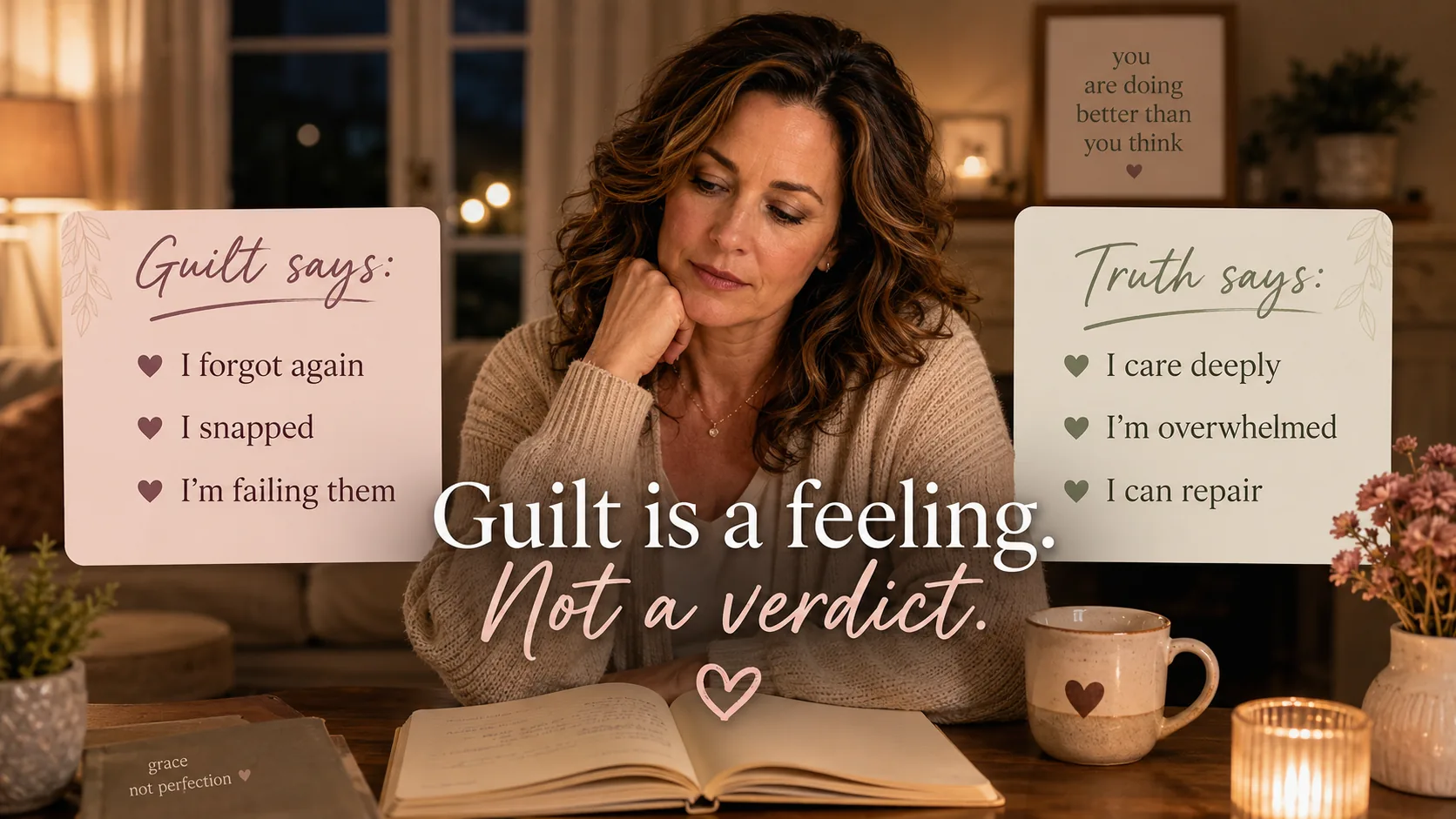
Let me say the thing I needed someone to say to me, plainly: a bad mom does not lie awake worrying she's a bad mom. She doesn't feel the guilt at all. The fact that this question keeps you up at night is, itself, the answer - it's the sound of someone who cares enormously running low on capacity.
ADHD makes the invisible machinery of parenting harder: the remembering, the planning, the endless small logistics, the staying-calm-while-three-people-need-you-at-once. But being good at logistics is not the same thing as being a good mother. Kids are not raised by spreadsheets. They're raised by whether they feel loved, safe, and seen - and none of that lives in a permission slip you forgot to sign.
I kept confusing "I'm struggling with the admin of motherhood" for "I'm failing at the love of it." They are not the same, and my kids have always known the difference even when I didn't.
Guilt can be loud, but it is not always accurate. Caring deeply and being overwhelmed can exist at the same time.
From ADHD Pearls
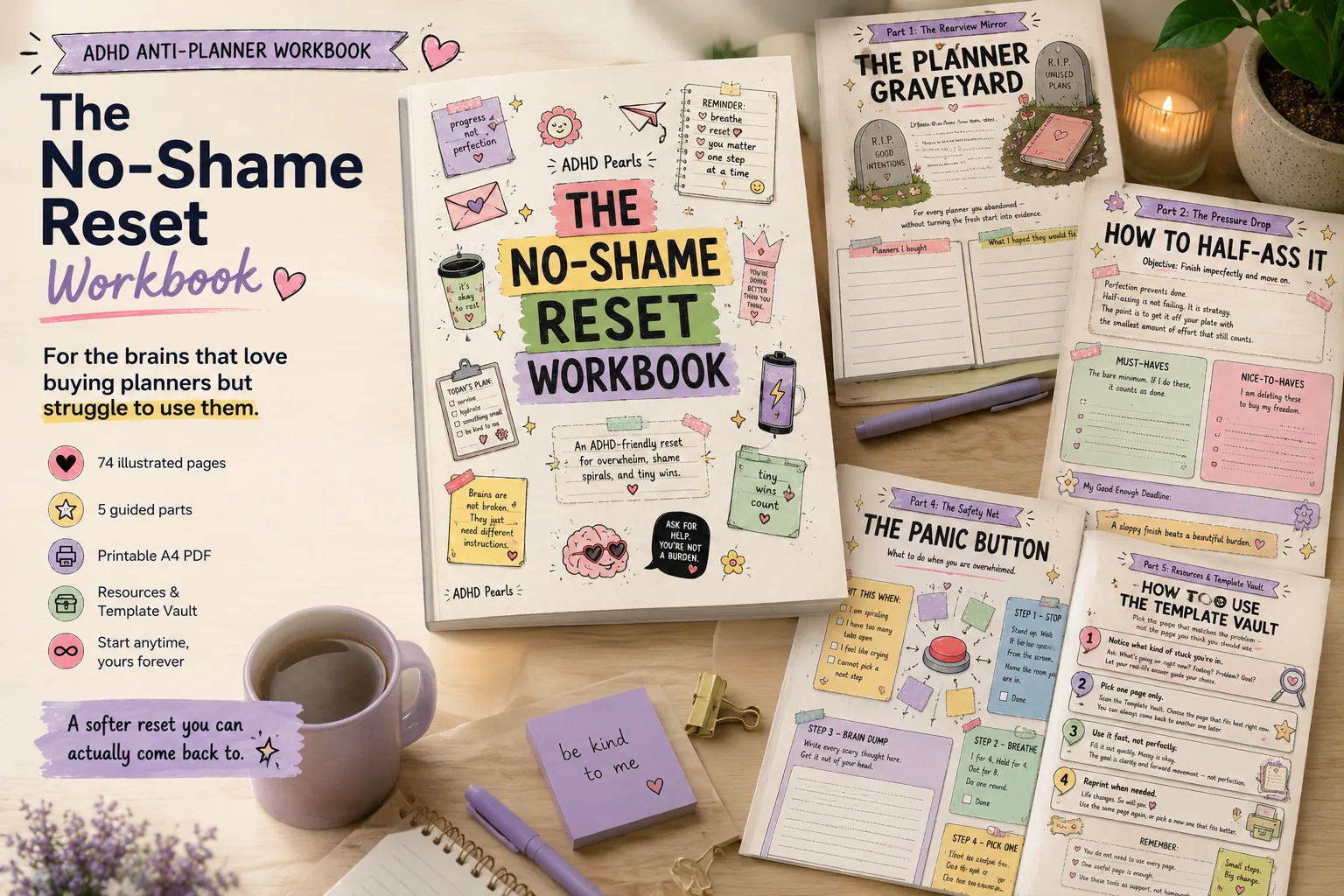
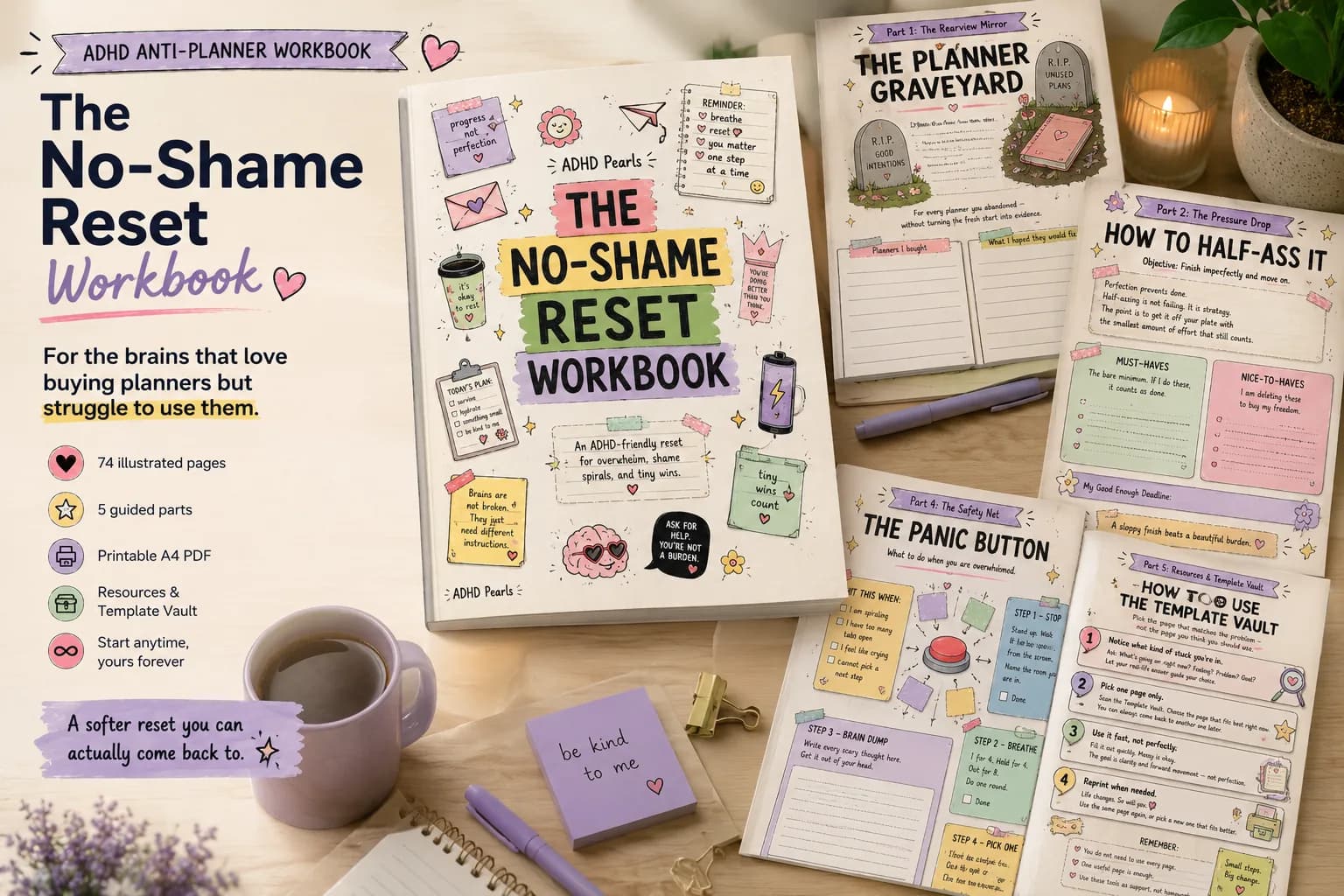
The No-Shame Reset Workbook
74 pages to reflect without shame, release what isn't working, and build a softer reset you can actually return to.
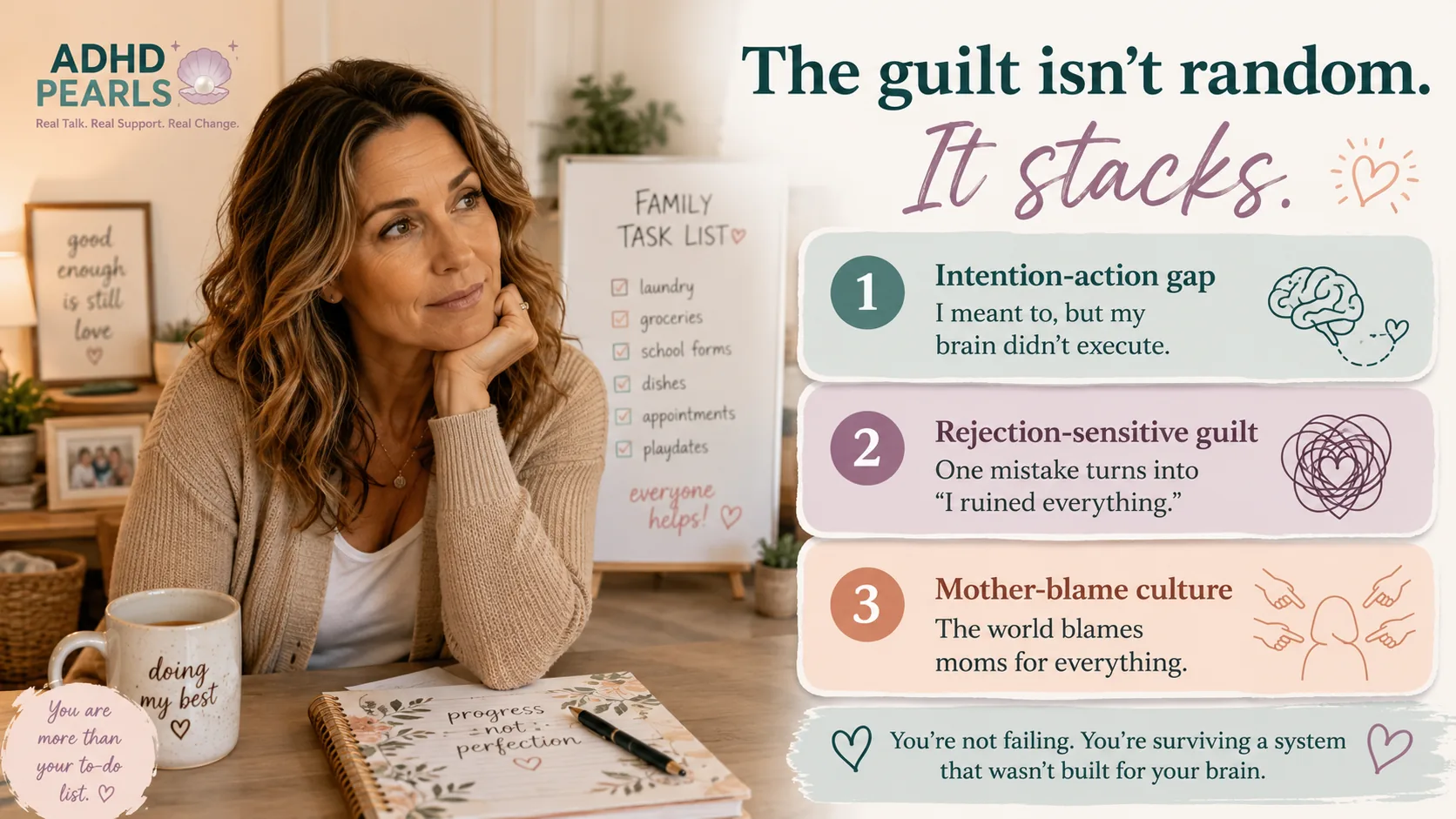
The guilt isn't random. It's manufactured by three things stacking on top of each other.
The intention-action gap. This is the cruel one. I can picture the calm, organized, crafts-on-a-Tuesday mother I mean to be with total clarity - and then my brain simply won't execute her. Knowing exactly what a good day should look like and being unable to make it happen feels like failure, even though it's really executive dysfunction doing what it does.
Rejection-sensitive guilt. ADHD often comes with emotions that hit fast and huge, so one sharp moment - a raised voice, a forgotten thing - doesn't stay a moment. It balloons into hours of "I've damaged them forever." That disproportionate self-attack is the same wiring behind ADHD emotional intensity, just pointed straight at your mothering.
A culture that blames mothers. On top of your own brain, there's a whole society primed to blame mothers - especially mothers of neurodivergent kids - for anything that goes sideways. You've absorbed decades of that. So when your ADHD brain hands you a small failure, the culture is right there to agree it's your fault. It isn't. ADHD is a neurodevelopmental condition, largely genetic. You didn't choose it, and you didn't cause it.
The guilt is not random. It often builds from brain-based struggles, emotional sensitivity, and impossible cultural expectations placed on mothers.
The Guilt Triggers (and What They Really Mean)
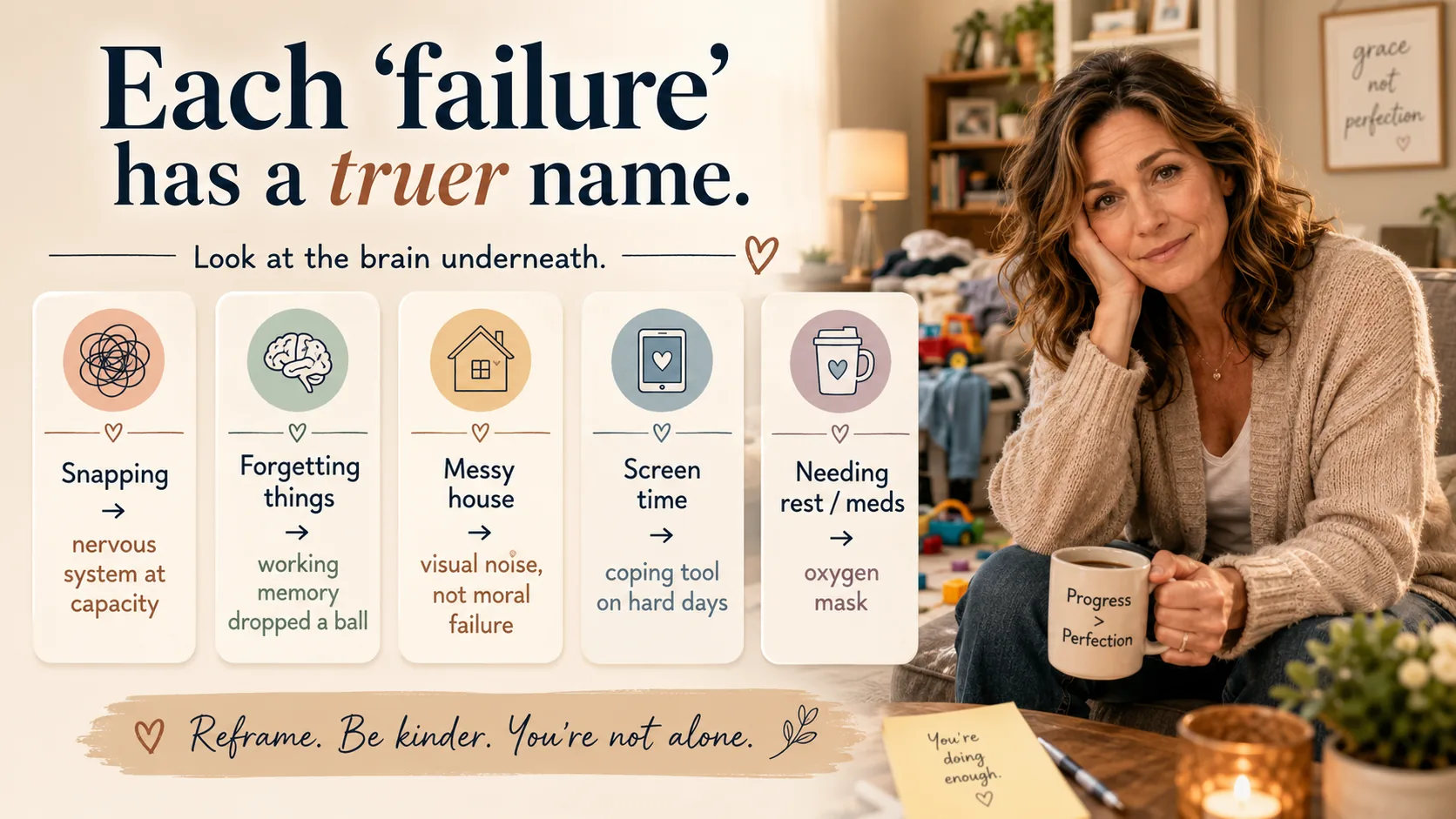
For years I treated each of these as proof of my badness. Reframing what they actually are took most of the sting out:
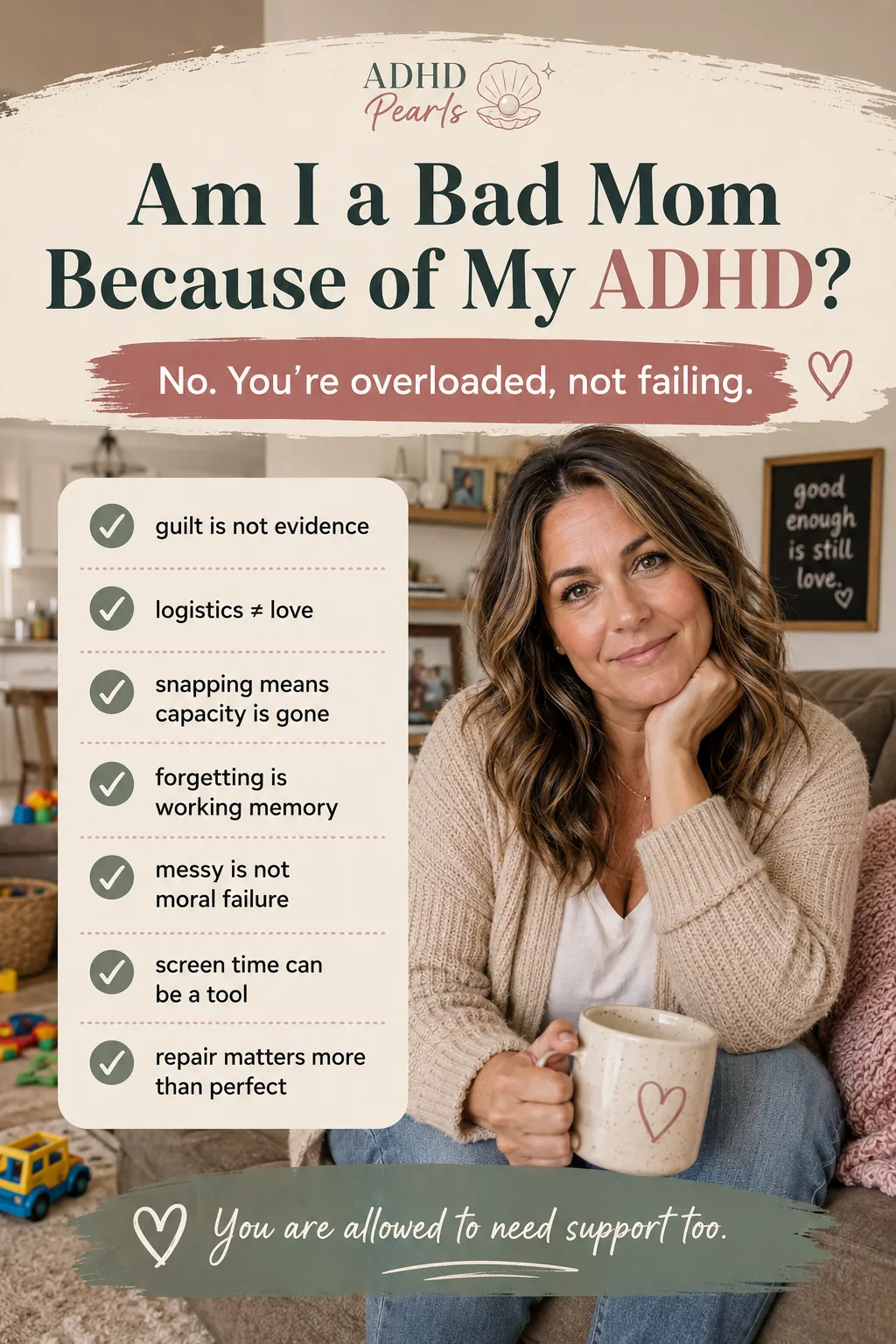
Snapping or yelling. Not a lack of love - a nervous system at capacity, overstimulated by noise and mess and everyone needing you at once. Every parent alive has done it.
Forgetting things. The dress-up day, the deadline, the snack you swore you'd pack. That's working memory dropping an invisible ball, not you not caring.
The messy house. Clutter is visual noise your brain struggles to process, not a moral report card. Your kids do not grade you on tidiness.
Screen time on hard days. Sometimes the telly is the tool that gets everyone fed and safe when you have nothing left. That's called coping, not neglect.
Needing time (or meds) for yourself. Wanting rest or treatment isn't selfish - it's the oxygen mask. You cannot pour from an empty cup, and modeling that you matter too is a gift, not a theft.
None of those make you a bad mom. They make you a human being with an ADHD brain doing one of the hardest jobs there is, usually with far too little support.
Each “failure” has a truer name when you look at the nervous system and the ADHD brain underneath.
What ADHD Actually Gives Your Kids
Here's the part the guilt never lets you see: ADHD doesn't only take from your parenting. It gives, too, and often the things kids remember most.
My focus problems come with a flip side - I can hyperfocus love and delight onto my kid like a spotlight, drop everything for the good stuff, and get gloriously silly in a way more organized parents sometimes can't. The impulsivity that loses my keys also says "yes, let's build the pillow fort at bedtime." The empathy that makes me feel everything too much means I understand my child's big feelings from the inside, especially the days her brain works like mine.
Kids do not grow up and miss the clean kitchen. They remember being laughed with, being met where they are, being genuinely seen. And every time you mess up and repair it, you're teaching them something priceless: that people who love you are allowed to be imperfect, and that mistakes can be mended. That's not despite your ADHD. A lot of it is because of it.
Your child does not need a perfect mother. They need love, repair, warmth, and a parent who keeps coming back.
December deserves its own mention here, because it concentrates every guilt trigger into four weeks — the presents, the traditions, the version of the season you meant to give them. Surviving Christmas with ADHD is the seasonal version of this, including permission to let some of it fall.
What Actually Helps the Guilt
You can't willpower your way out of guilt, but you can make it quieter and rarer. These are the ones that actually moved the needle for me.
Lower the bar to "good enough." Perfect parenting is a fantasy that only exists to make you feel bad. Aim for fed, safe, and loved, and let the Pinterest version go. Good-enough is not a consolation prize; it's the actual goal.
Offload the mental load onto systems, not memory. A shared family calendar, alarms for the things you always forget, a whiteboard by the door. Every task you hand to a system is one your brain doesn't have to hold and drop and feel guilty about.
Master the repair. You will snap. When you do, come back once you're calm: "I got overwhelmed and raised my voice - that wasn't your fault, I'm sorry." The repair matters more than the rupture, every single time.
Get support for your own brain. Treatment, therapy, an ADHD-informed clinician, or just other ADHD moms who get it - you deserve support as much as your kids do. Parenting on an untreated, unsupported ADHD brain is playing on the hardest difficulty for no reason.
Talk to yourself like you'd talk to a friend. You would never tell another struggling mom she's ruining her kids because she forgot a form. Extend yourself the same decency. If the self-attack is relentless, the daily reality of ADHD in women might help you feel less alone in it.
This is warm, educational content, not medical or mental-health advice. If guilt, low mood, or overwhelm are affecting your daily life or your relationship with your kids - or if you're having thoughts of harming yourself - please reach out to a qualified professional or a support line. Asking for help is one of the most loving things a parent can do.
The tiny move: tonight, instead of cataloguing everything you got wrong today, name one thing your kid felt from you - safe, or laughed with, or simply loved. Just one. You don't have to become a different mother. You just have to stop believing the guilt when it tells you you're a bad one, because it has always, always been lying.
Save this for the next time ADHD mom guilt tries to convince you that overload means failure.
Pin this reminder for the next shame spiral: you are allowed to need support too.
FAQ: ADHD and Mom Guilt
Am I a bad mom because I have ADHD?
No. ADHD makes the logistics of parenting - the remembering, the planning, the staying calm when you're overstimulated - genuinely harder, but that's a brain difference, not a measure of how good a mother you are. The very fact that you're worried about it is evidence of how much you care. A bad mom doesn't lie awake feeling guilty; she doesn't feel guilty at all.
Why do I feel so much guilt as an ADHD mom?
Because you can see exactly what a "good" day should look like and often can't make your brain execute it - and that gap between intention and action feels like failure. Add rejection-sensitive guilt that turns one snapped moment into hours of shame, and a culture that blames mothers for everything, and the guilt piles up fast. It's a symptom of an ADHD brain under pressure, not proof you're doing it wrong.
Does ADHD make you a worse parent?
It makes some parts harder - consistency, paperwork, managing your own overwhelm - but it also brings real strengths like empathy, creativity, playfulness, and the ability to understand a struggling child from the inside. ADHD is a neurodevelopmental condition, not a parenting flaw you caused. With support and lower expectations, many ADHD moms parent with enormous warmth.
Why do I lose my temper or yell more than I want to?
Emotional dysregulation is a core part of ADHD, so feelings arrive fast and big and the "brake" that helps you pause is weaker - especially when you're overstimulated by noise, mess, and demands. It's not a lack of love; it's a nervous system at capacity. What matters most isn't never snapping (no parent manages that) but repairing afterward, which teaches kids that ruptures can be mended.
How do I stop feeling guilty about forgetting things?
First, name it as working memory, not carelessness - the forgotten form or dress-up day is your brain dropping an invisible ball, not you not caring. Then offload the remembering onto external systems (shared calendars, alarms, a family whiteboard) so it doesn't rely on a brain that can't hold it all. You're not failing; you're using tools, which is exactly what a resourceful parent does.
Can ADHD be a strength in parenting?
Absolutely. ADHD often comes with deep empathy, spontaneity, humor, and the ability to hyperfocus love and attention on your kids. If your child is also neurodivergent, you understand their world from the inside in a way few parents can. Kids don't remember a spotless house; they remember the fun, the silliness, and being truly seen - things ADHD parents are often brilliant at.
How do I parent with ADHD without burning out?
Lower the bar to "good enough", offload as much mental load as you can onto systems and other people, and protect some recovery time without guilt - you can't pour from an empty cup, and rest isn't a reward you have to earn. Getting support or treatment for your own ADHD often makes the whole thing more manageable. Sustainable beats perfect, every time.
What should I do after I snap at my kids?
Repair. Once you're calm, name it simply: "I got overwhelmed and I raised my voice, and that wasn't your fault - I'm sorry." That repair matters more than never snapping, because it models accountability, emotional honesty, and that love survives hard moments. Kids raised with repair learn that mistakes are fixable, which is a genuinely valuable thing to grow up believing.
One tap makes ADHD Pearls a preferred source in your Google account, so our articles surface higher when you search. No signup, and it brings you straight back to this page.
ADHD anti-planner workbook
The No-Shame Reset Workbook
A 74-page printable reset for overwhelm, shame spirals, and the planners you couldn't keep using. Reflect without shame, release what isn't working, and build a softer reset you can actually return to.
For the woman who sets up the perfect system on Sunday and abandons it by Tuesday.
One short letter, every week. Real talk about ADHD, task paralysis, and the tiny wins that actually move the needle for a brain like yours. No shame. No hustle culture.