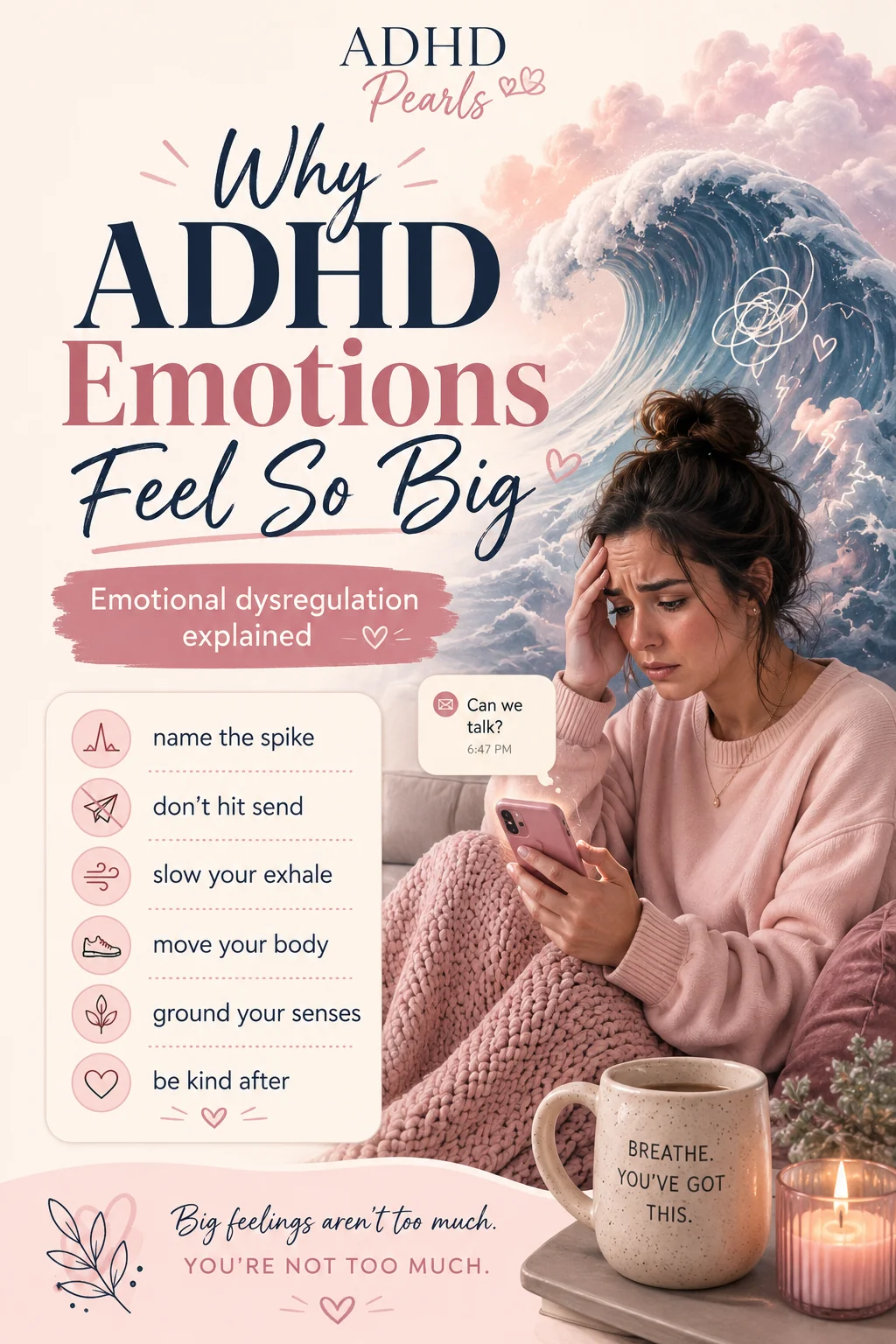
A friend once texted me "can we talk later?" and by the time she called, I had mentally ended the friendship, rehearsed my dignified goodbye, and grieved it. She wanted to tell me about a good haircut.
For most of my life I took that as proof I was too much - too sensitive, too dramatic, too intense. People told me to calm down so often it became background noise.
It turns out the volume knob wasn't a character flaw. Big, fast, hard-to-shake emotions are one of the most common - and least talked about - parts of ADHD. Once I understood the mechanism, I stopped fighting the feelings and started working with the wave.
Quick answer
Why am I so emotional with ADHD?
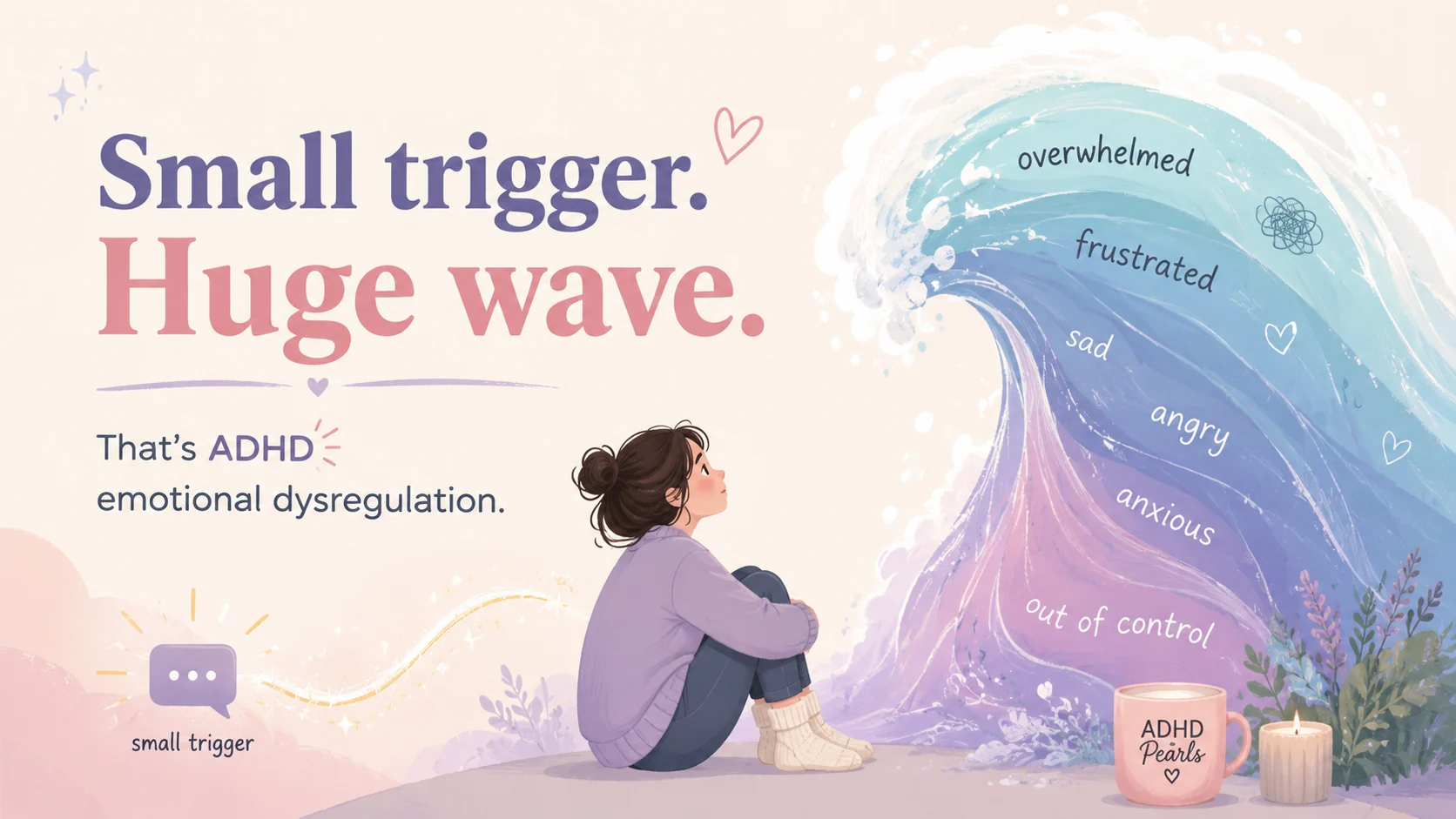
Emotional dysregulation is a core part of ADHD. Your brain tends to feel emotions faster and more intensely, and the mental "brake" that helps most people pause and settle works less reliably - so a small trigger becomes a big wave that hits in seconds and takes longer to pass. It's neurological, not you being dramatic. You can't stop the spike, but you can calm your body first, delay reacting at the peak, and let the wave move through.
Key takeaways
📌Emotional dysregulation is a core part of ADHD, not a personality trait sitting next to it.
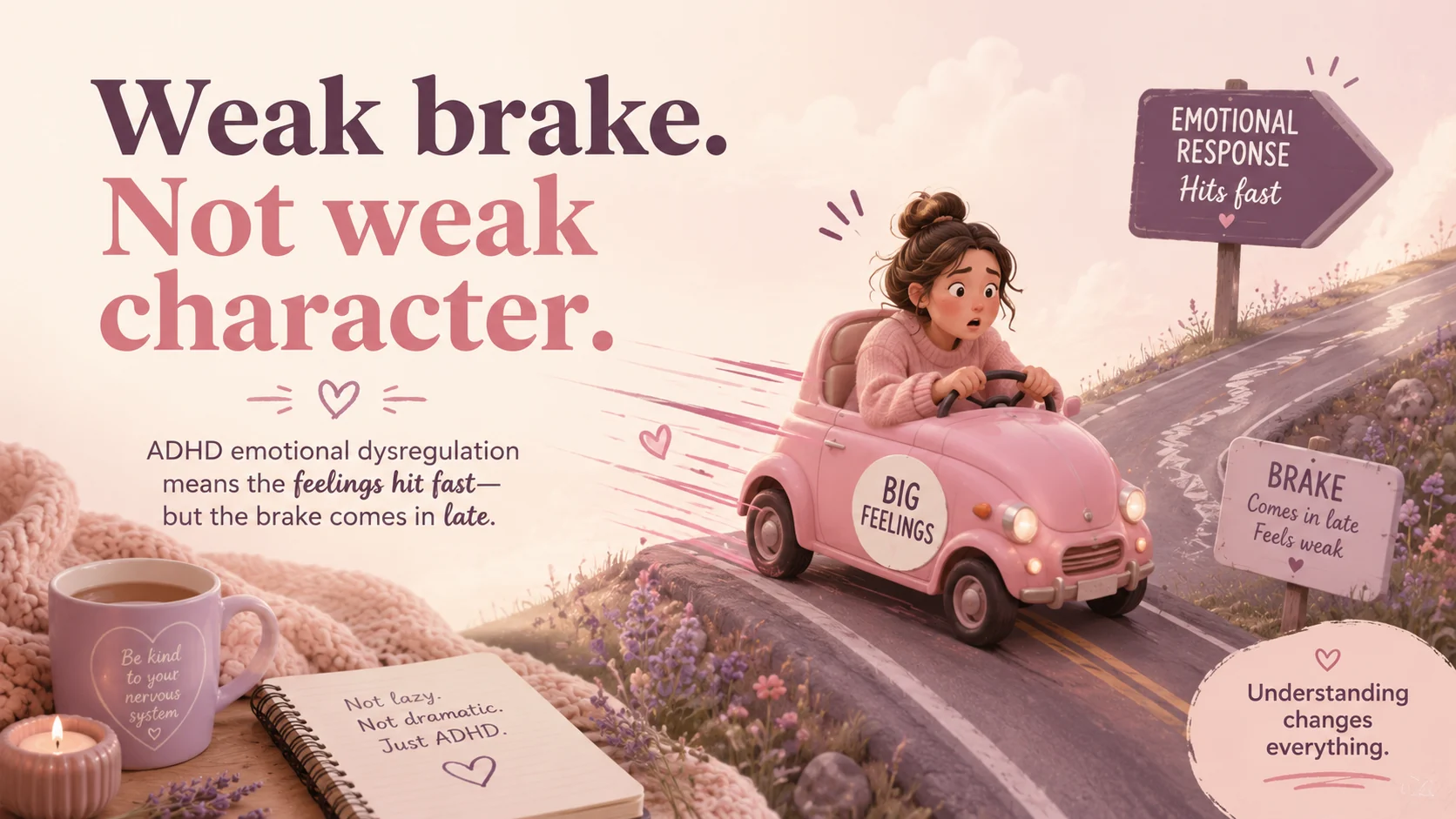
📌It is a weak brake, not a weak character. Feelings arrive fast and take longer to settle.
📌The spike often peaks within seconds, which is why the reaction outruns the reasoning.
📌Do not make decisions during the wave. Almost nothing needs answering inside those minutes.
📌If the intensity is constant rather than episodic, it is worth checking for more than ADHD.
Here's the part nobody told me for decades: emotional dysregulation is a central feature of ADHD, not a personality bonus round. It just didn't make it into the hyperactive-boy checklist most of us grew up picturing.
People with ADHD tend to feel emotions more intensely than people without it, and take longer to come back down. The same brain systems that manage attention also help manage emotion - so when those systems run differently, feelings run hotter.
That's why "just calm down" has never once worked on me. You cannot logic your way out of a wave that arrived before the logical part of your brain was even invited.
I'm not too sensitive. I have a brain that turns a small spark into a bonfire before I've noticed anyone lit a match.
With ADHD, the feeling can arrive before your logical brain has time to catch up.
From ADHD Pearls
Free RSD Reset
When one message or moment sends your nervous system sideways.
The mechanism helped me more than any pep talk. In most brains, when a feeling flares, the prefrontal cortex acts like a brake - it steps in, dampens the reaction, and buys a second to think before you speak. In ADHD, that brake is often weaker or slower, while the emotion-generating parts of the brain fire strongly.
So the feeling arrives at full volume almost instantly, and the "wait, let's think about this" part shows up late, if at all. It's not that I don't care about consequences in the moment. It's that the wave gets there first and I'm along for the ride.
Reframing it this way is genuinely calming: the size of my reaction isn't a measure of how weak or dramatic I am. It's a brake that doesn't grip well. You don't shame a car for that - you drive it knowing it needs a longer stopping distance.
The problem is not that you care too much. It is that the emotional brake can come in late.
What ADHD Emotional Dysregulation Looks Like
It wears a lot of outfits. For me it's rarely tidy "sadness" or "anger" - it's a whole-body flood. Some common shapes:
Zero to a hundred in seconds - a small trigger, an instant huge reaction.
Feelings that feel physical - hot, tight, overwhelming, not just "in your head."
A very long climb down - staying upset or replaying it for hours after everyone else moved on.
Rejection that lands like a slap - a short text or a flat tone triggering a disproportionate wave. That's often rejection sensitive dysphoria, ADHD's frequent companion.
Overwhelm tipping into tears or snapping - too many inputs, and the feelings spill.
The "friend got a haircut, I grieved the friendship" thing? Textbook. My brain wrote an entire tragedy from a four-word text, and I lived every scene of it before reality arrived. If any of this is landing hard, you might also recognize yourself in why RSD hits ADHD women so hard. The smallest version of it, and the one that catches most people, is a short text with no punctuation. If the intensity arrives on a schedule rather than at random, that is worth knowing about too - see why two weeks a month feel different.
How to Calm an ADHD Emotional Spike (6 Steps)
You usually can't stop the spike from arriving. But you can shorten it and keep it from making decisions for you. The order matters - body first, thoughts later.
1. Name it as a spike. The first thing I do now is label it: "this is an ADHD emotion wave, not the truth about my life." Naming it puts a sliver of space between me and the feeling, and that sliver is everything.
Naming the thought underneath it works the same way, and is a bit more specific: mind reading, catastrophizing, one mistake turning into an identity. The nine thought traps covers which is which.
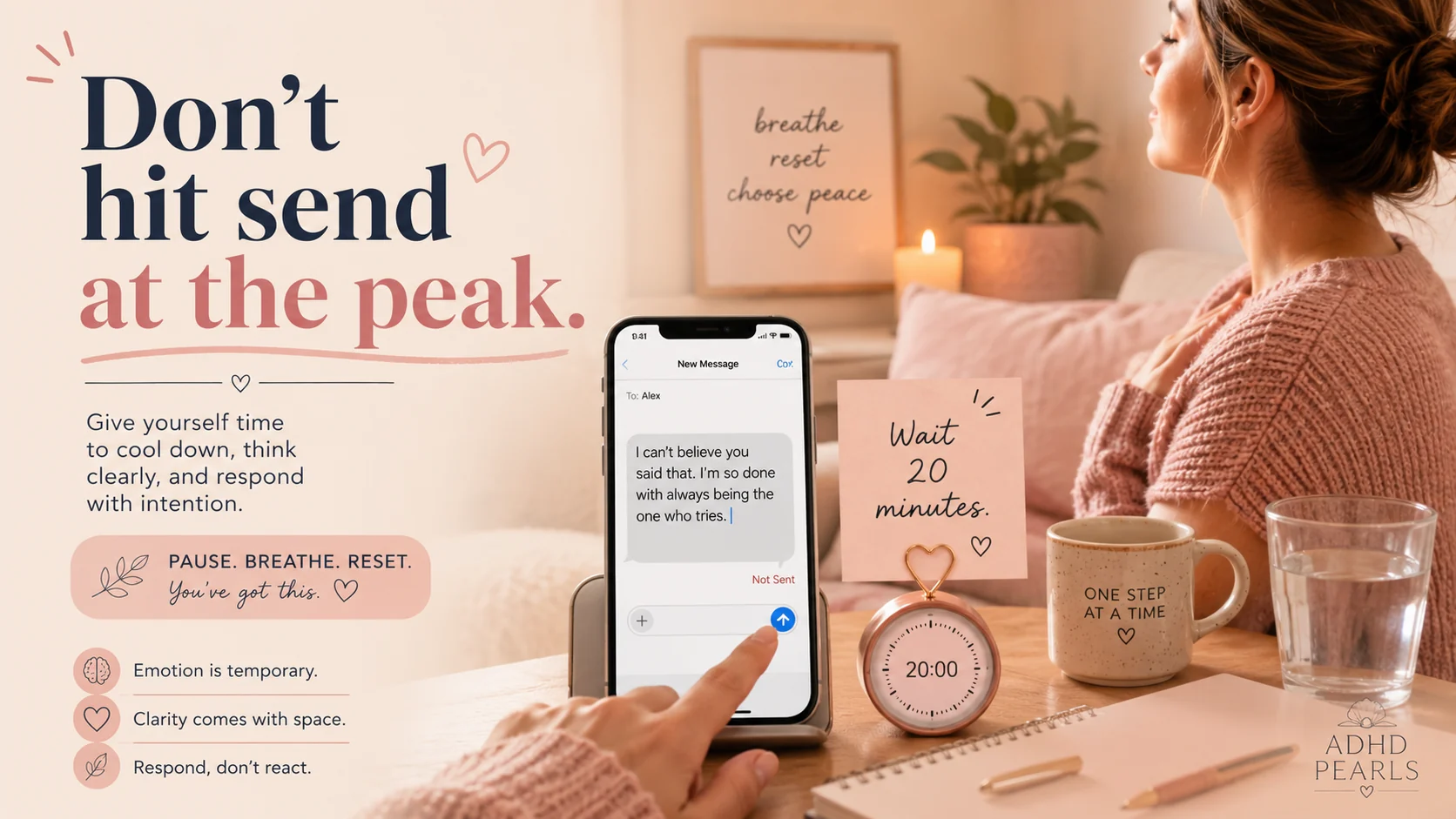
2. Delay the response - do not act at the peak. No sending, no confronting, no big decisions while the wave is cresting. My rule: I'm allowed to feel it fully, but I'm not allowed to hit send. The version of me at minute forty is much wiser than the one at second four.
The version of you at minute 40 usually writes a better message than the version of you at second 4.
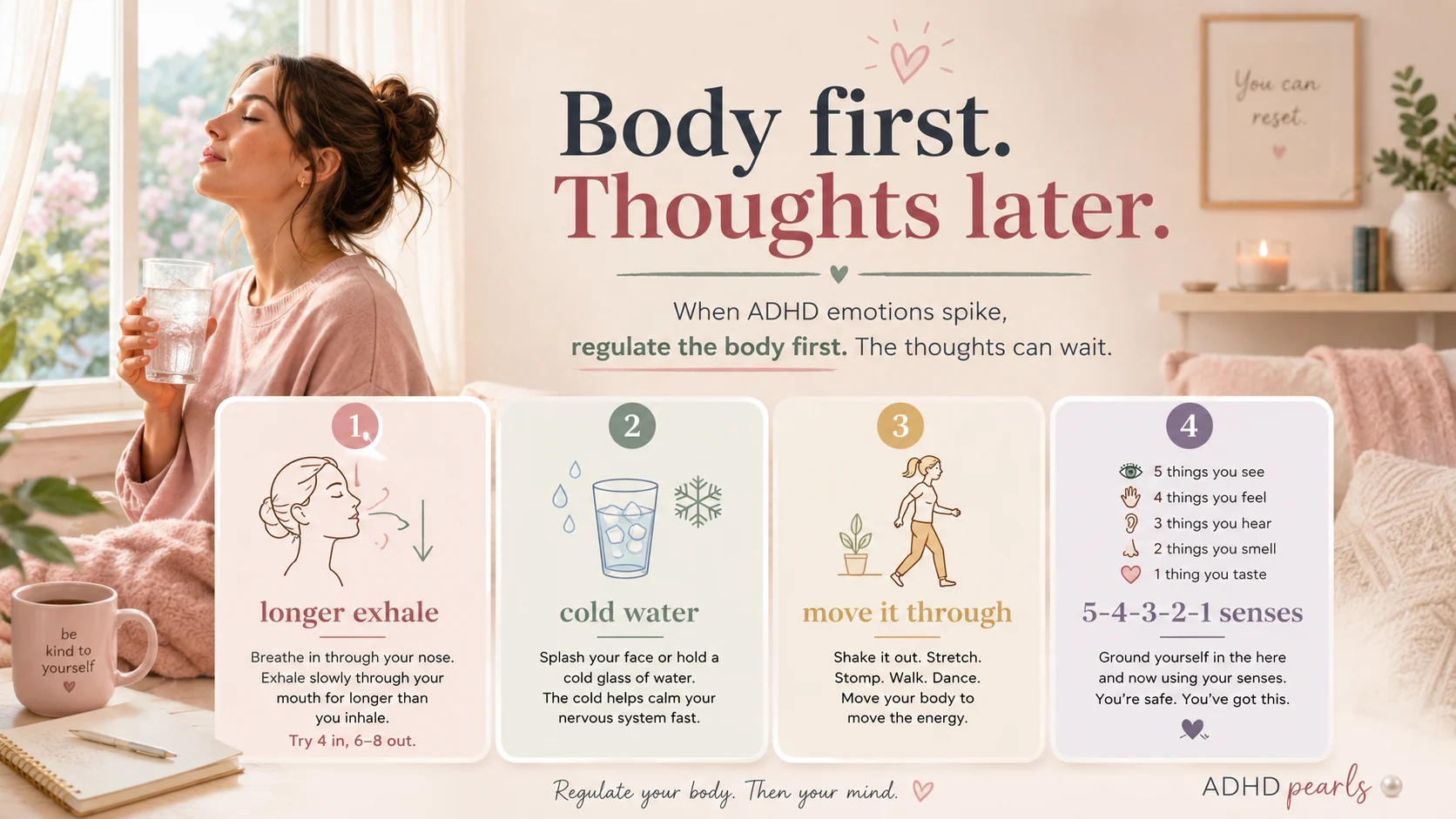
3. Calm your body, not your logic. The spike is physical, so treat it physically. Lengthen your exhale so it's longer than your inhale, splash cold water on your face, or hold something cold - it nudges your nervous system out of alarm. Trying to reason with the feeling first never works for me; soothing the body does.
4. Move it through. Emotions are energy, and mine need somewhere to go. A short walk, shaking out my hands, stairs, anything physical discharges the charge faster than sitting in it.
5. Ground with your senses. When my thoughts are spiraling, 5-4-3-2-1 (five things I see, four I hear, and so on) drags my brain back into the room and out of the imaginary argument I was winning.
6. Land somewhere kind. Once the wave drops, I skip the self-flogging. Beating myself up for having feelings just starts a second wave. "That was a big one, and I got through it without setting anything on fire" is a complete sentence.
When ADHD emotions spike, regulate the body first. The thoughts can wait.
When It Might Be More Than ADHD
Big emotions aren't ADHD's alone. Anxiety, depression, trauma, BPD, and hormonal shifts can all crank up emotional intensity, and several of them commonly coexist with ADHD - so it's rarely a tidy single answer.
One December note, because it is the month this peaks: the same maths applies to Christmas, where a whole season of extra decisions lands at once — surviving Christmas with ADHD is the seasonal version.
One more pattern worth separating out: putting things off is not always an emotional spike. If your version is mostly delay rather than intensity, see why you can only start at the last minute.
One more thing that gets mistaken for a mood: sensory overload. If your worst moments arrive after a day of noise, light and people rather than after a specific trigger, the ADHD first aid protocol for sensory overload may fit better than an emotional explanation.
What leans ADHD is the pattern: lifelong, fast, trigger-linked spikes that were there long before any one crisis. But I can't tell you which mix is yours, and honestly neither can a quiz. If your emotions are regularly hurting your relationships, work, or wellbeing, that's the signal to get a proper assessment - the same starting point I describe in how to know if you have ADHD.
This is educational and personal, not medical advice or a diagnosis. Emotional dysregulation appears in ADHD, anxiety, depression, PMDD/perimenopause, trauma, and BPD, which often overlap. If big emotions are affecting your daily life, relationships, or safety, please reach out to a qualified professional. If you're ever in crisis, contact your local emergency services or a crisis line.
The tiny move: next time a wave hits, do exactly one thing - breathe out slowly, longer than you breathed in, and don't hit send. That's it. You're not too much, and you didn't fail at being calm. You have a brain with a light brake and loud feelings, and now you know how to give the wave somewhere to go.
Pin this ADHD emotional regulation reset for later.
FAQ: ADHD and Big Emotions
Why am I so emotional with ADHD?
Because emotional dysregulation is a core part of ADHD, not a side quirk. ADHD brains tend to feel emotions faster and more intensely, and the mental "brake" that helps most people pause and settle down works less reliably. So a small trigger can produce a big wave that arrives in seconds and takes longer to pass. It's neurological, not you being dramatic or too sensitive.
Is emotional dysregulation part of ADHD?
Yes. Difficulty regulating emotion is increasingly recognized as a central feature of ADHD, even though it isn't in the checklist most people picture. The same brain systems that handle attention also help manage emotion, so when those run differently, feelings run hotter. Many late-diagnosed women only connect their "too emotional" years to ADHD after learning this.
Why do my emotions feel so big and intense?
In ADHD, the emotion-generating parts of the brain can react strongly while the prefrontal "brake" that dampens the reaction is weaker or slower. The result is a spike that feels enormous and physical - hot, fast, all-consuming - before logical thought can catch up. The size of the feeling is real; it just isn't proportional to the trigger.
Why do I go from 0 to 100 so fast?
Because the pause between feeling something and reacting is exactly the part ADHD makes harder. Most brains get a split-second brake; an ADHD brain often doesn't, so the emotion is at full volume almost instantly. Building in an external pause - walking away, delaying your response - gives you back the gap your brain skips.
Why does rejection or criticism hurt so much?
That sharp, sudden, almost physical response to perceived rejection or criticism is often rejection sensitive dysphoria (RSD), which commonly travels with ADHD. A tiny cue - a short text, a flat tone - can trigger a disproportionate wave of hurt or shame within seconds. It's a recognized ADHD experience, not oversensitivity you chose.
How do I calm down during an ADHD emotional spike?
Regulate your body before your thoughts, because the spike is physical. Slow your exhale (breathe out longer than you breathe in), use cold water or temperature change, move, or ground with your senses. Then delay any response - don't send, decide, or confront at the peak - and let the wave pass before you act. Name it as an ADHD spike to shrink it.
Why do I stay upset longer than everyone else?
ADHD brains not only spike higher, they often come down more slowly, and can get stuck replaying the trigger (rumination). So an argument that others shake off in ten minutes can color your whole afternoon. Movement, distraction with something absorbing, and self-compassion help you climb down faster than willpower does.
Is it ADHD or something else, like anxiety or BPD?
Emotional dysregulation shows up in several conditions - anxiety, depression, BPD, trauma, and hormonal shifts can all intensify it, and they often coexist with ADHD. The pattern matters: lifelong, fast, trigger-linked spikes lean ADHD, but only a qualified professional can sort it out. If your emotions are affecting your life or relationships, it's worth getting assessed.
Can ADHD medication help with emotional regulation?
For some people, yes - treating ADHD can reduce the intensity and frequency of emotional spikes by supporting the brain's regulation systems. It doesn't erase big feelings, and it works best alongside skills like pausing, body-based calming, and therapy (CBT or DBT). Any medication decision should be made with a qualified clinician.
One tap makes ADHD Pearls a preferred source in your Google account, so our articles surface higher when you search. No signup, and it brings you straight back to this page.
Before you go
Free RSD Reset
When one message or moment sends your nervous system sideways.
For the woman who sets up the perfect system on Sunday and abandons it by Tuesday.
One short letter, every week. Real talk about ADHD, task paralysis, and the tiny wins that actually move the needle for a brain like yours. No shame. No hustle culture.