Last December I bought my brother the same book twice, six weeks apart, and was genuinely pleased with myself both times.
I also forgot my sister's youngest entirely. Not because I do not love him — because the list lived in my head, and things that live in my head dissolve. I found out on Christmas Eve, in a shop, at 4:40pm, holding a scented candle I had already decided was not good enough.
For years I read Decembers like that as evidence about my character. Disorganised. Selfish, maybe. Bad at the one month everybody else seems to manage with fairy lights and a spreadsheet.
Here is what I understand now, and it changed how I do the whole month: Christmas is not a day. It is a month-long project that nobody officially assigned to you — and it is built almost entirely out of the things an ADHD brain finds hardest.
Quick answer
Why is Christmas so overwhelming with ADHD?
Because December is not a day, it is a six-week project nobody formally gave you — built from the things ADHD makes most expensive: holding a long list of people, tracking who gets what, meeting deadlines that are not urgent until they suddenly are, and shopping in the loudest month of the year. Plan for the crash on the 27th, not just the 25th.
Key takeaways
📌December is a six-week project nobody assigned you, built from the skills ADHD makes most expensive.
📌The remembering work is invisible until it fails, and it usually falls on one person in the household.
📌Fewer shops beats better willpower: every extra source is another decision and another thing to track.
📌Decide your exit before you arrive. The plan cannot be invented once you are in the room.
📌Plan for the 27th. The crash afterwards is recovery, not ingratitude.
Look at what the month actually asks of you, listed plainly:
Hold a list of fifteen to thirty people in your head for six weeks
Track what each one likes, what you got them last year, and what you have already bought
Meet a series of soft deadlines that are not urgent until they are catastrophically urgent
Do most of the buying in bright, loud, crowded places in the worst month to be in them
Attend more social events than usual, on less sleep, with your routines already broken
Be visibly delighted throughout
Read that list as a job description and it is obviously brutal. It is memory, sequencing, time estimation, sensory tolerance and emotional regulation, all at once, for a month, with an audience.
You are not bad at a lovely month. You are being asked to run a six-week project using every skill your brain finds most expensive.
The year I finally saw it that way was the year it stopped feeling like a personal failing. Nothing about my December got easier. It just stopped being about me.
December asks an ADHD brain to manage memory, sequencing, time estimation, sensory tolerance and emotional regulation all at once.
The Project Nobody Assigned You
There is a second layer, and it is worth naming because it is the part that produces the resentment nobody admits to.
The remembering work is almost always done by one person in a household, and it is almost always a woman. Who has what. Who is allergic. Which cousin got a book last year. Whether the school thing is Tuesday or Thursday. None of it appears on any list, nobody hands it over formally, and it is invisible until it fails — at which point it is extremely visible.
Put that on top of ADHD and you get a specific kind of misery: you are running the project in the medium your brain is worst at, which is memory, and getting judged on the one metric that shows, which is whether anything was forgotten.
My own tell is that I get snappy around the 12th. Not about Christmas — about the dishwasher, about someone asking what is for dinner. It took me three years to work out that the irritability was not a mood. It was the sound of a project running over capacity, which is the same signal I describe in the levels of ADHD overwhelm.
This is educational and personal, not medical advice. If December reliably tips you into something heavier than tiredness — if the flatness lasts into January, or the dread starts in October — that is worth taking to a professional rather than managing with a better gift list.
Everything below is on paper in the free ADHD Christmas Rescue Kit — eight pages including the gift tracker, the one-shop list and a page for the 27th. It exists because I got tired of rewriting the same four lists every November.
Strategies 1–5: The Gifts
1. Get the list out of your head today. Not organised — just out. Every name, on paper or in one note, the moment you first think about Christmas. Mine now lives on the fridge from November, and the year I started doing this was the first year I did not buy a duplicate.
2. Track four columns, not one. Who, what, bought, wrapped. That fourth column is the one that saves you. My "forgotten" presents were almost never unbought — they were bought in October, hidden somewhere sensible, and discovered in March. Bought is not done.
3. Buy from as few places as possible. One shop, one order, one afternoon. Not because it is elegant, but because every additional source is another decision, another delivery to track, another chance to lose the thread. I do about eighty percent of mine in a single sitting now and the quality has not dropped once.
4. Give the same thing to several people. Three of my friends get the same nice candle every year. They have never noticed, and if they had, the worst outcome is that they know I like it enough to buy it three times. The pressure to make every gift bespoke is self-imposed and it is what turns a two-hour job into a six-week one.
5. Stop wrapping. Genuinely. Wrapping is the step that quietly kills the whole system: it needs a clear surface, scissors you cannot find, tape that has vanished, and about four times longer than you estimated. Bags take nine seconds and nobody has ever once mentioned it. Reusable ones also come back out of the loft next December already done, which removes the job entirely rather than shrinking it.The reusable gift bags I use instead of wrapping →Affiliate link — as an Amazon Associate we may earn from qualifying purchases.
For an ADHD brain, bought is not done. It is done when it is tracked, bagged, and ready to hand over.
Strategies 6–10: Gatherings and Noise
6. Decide your exit before you arrive. Which room you will step into, roughly when, and the sentence you will use — mine is "just going to check on something", which nobody has ever questioned. Deciding this in the car takes forty seconds and is the difference between leaving a room and enduring it.
7. Take the edge off the noise rather than removing it. A Christmas gathering is close to a worst-case sensory environment: a lot of people, all talking, over music, in a warm room, for hours. Filtered earplugs lower the volume without cutting you out of the conversation, which is what makes them usable at a table rather than something you hide in the bathroom to escape.
8. Say no to one thing per week, on purpose. Not the thing you dread most — any thing. The point is to practise the sentence while the stakes are low, so that it is available in the third week when you need it and have no capacity left to invent it.
9. Do not stack two events in one day. I used to think of a lunch and an evening drinks as two separate manageable things. They are not two things. They are one very long thing with a costume change, and I am never fit for the second one.
10. Eat before you go. Unglamorous and it changes the whole evening. Buffet timings are unpredictable, you will not want to be the person hovering, and low blood sugar plus a loud room is how a nice gathering turns into me crying in a hallway about something my aunt said.
An exit plan is not antisocial. It is how you protect your energy before the noise makes deciding harder.
Strategies 11–13: The Day Itself
11. Write the day down the night before. Not a schedule — a rough order. When the food goes in, when people arrive, when you would like to be sitting down. Christmas Day has an unusual number of moving parts and no normal structure, which is exactly the combination that dissolves an ADHD day.
12. Book yourself twenty minutes. Actually put it somewhere. Mine is after lunch, upstairs, door shut, no phone. The first year I did it I felt selfish for about four minutes and then extremely, unmistakably better — and everyone downstairs got a nicer version of me for the rest of the afternoon.
13. Let the day be uneven. Something will be forgotten, someone will say the thing, one part will be genuinely lovely. The version where all of it goes well does not exist for anyone, and holding out for it is how you end up unable to enjoy the parts that did.
Strategies 14–15: The 27th
Here is the part almost nobody plans for, and it is the one I would keep if I could only keep one.
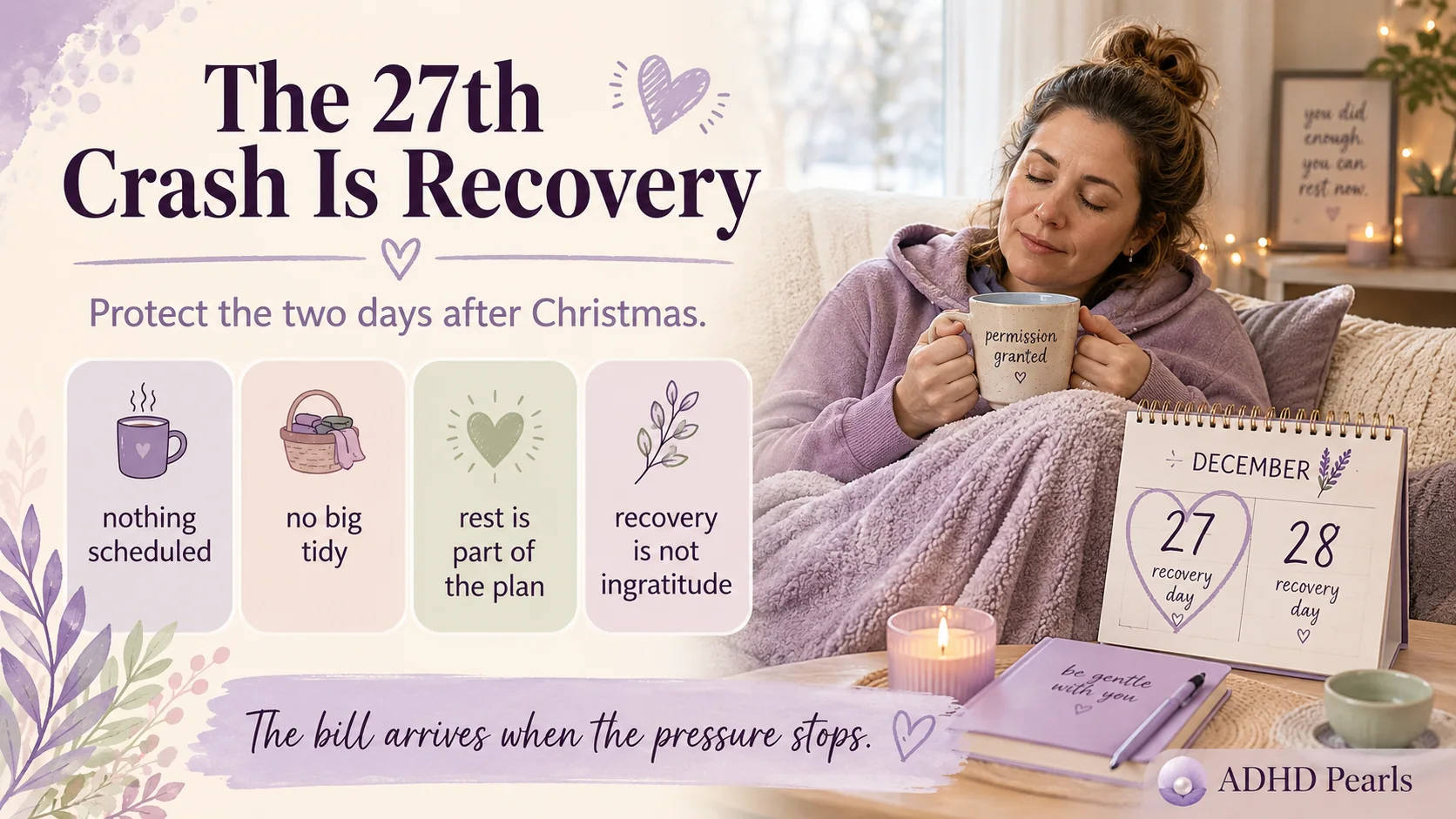
14. Expect the crash and put it in the calendar. The month runs on borrowed capacity: masking at gatherings, broken routines, extra decisions, less sleep. The bill arrives when the pressure stops, which for me is reliably the 27th — flat, tearful, faintly useless, for no reason I can point at. It is not ingratitude. It is recovery, and it is the same mechanism as any other crash after a long stretch of holding it together.
15. Protect the two days after, not the day itself. Nothing scheduled. No returns, no visits, no big tidy. I now treat the 27th and 28th as part of Christmas rather than as free days I have somehow wasted, and it has done more for how January feels than anything I do in December.
The 27th crash is not failure. It is the nervous system catching up after a month of borrowed capacity.
What to Let Fall
Choosing what to drop in advance is much kinder than dropping it by accident in the last week — and something is going to fall either way.
Things I have let go, and nothing bad happened:
Cards. All of them, for four years now. Two people have mentioned it. Both were fine.
Homemade anything. The bar for a bought dessert is much lower than the story in my head suggested.
Matching wrapping. See above; bags.
The second gathering. One per weekend is my ceiling and pretending otherwise costs me the following week.
Being the one who remembers everything. The list is now on the fridge where anyone can read it, which turns out to be a completely different thing from being asked to help.
If you host, the same logic applies: cut the number of separate tasks, not the quality of any of them. Fewer dishes, more shop-bought, one room prepared instead of the whole house. Hosting does not fail because the food is hard. It fails on the sheer count of things.
One Tiny Move
Right now, before you close this: write down every name you need a present for. Not what you will buy. Just the names.
It takes two minutes and it is the single highest-return thing in this entire article, because the list is the part that lives in your head and costs you attention every day until it is written down somewhere you can see it.
Then put it where you will trip over it. Mine is the fridge, at eye level, next to the takeaway menus.
If you would rather not draw the boxes yourself, the free Christmas Rescue Kit has the brain dump page ready to print, along with the tracker and the letting-go page.
Save this for the next time Christmas feels exciting and overwhelming at the same time.
Pin this ADHD Christmas survival guide before December turns into a project running only in your head.
FAQ: ADHD and Christmas
Why is Christmas so overwhelming with ADHD?
Because December quietly becomes a month-long project made almost entirely of the things ADHD makes hardest: holding a long list in your head, tracking who gets what, sticking to deadlines that are not urgent until suddenly they are, and doing it all in noisy, bright, crowded places. It is not that you cope badly with a nice month. It is that this particular month is stacked against your brain.
How do I stop forgetting Christmas presents?
Get the list out of your head the day you start thinking about it, and track four columns rather than one: who, what, bought, wrapped. Most forgotten presents are not forgotten — they are bought, put somewhere sensible, and never wrapped or handed over, which is a different failure with a different fix.
How do I survive Christmas shopping with ADHD?
Reduce the number of trips rather than the length of them. One shop, one order, one afternoon, with the list written before you go. Shopping centres in December are close to a worst-case sensory environment, and decision-making falls apart fast in them — so the win is fewer exposures, not better willpower.
How do I cope with sensory overload at Christmas gatherings?
Decide your exit before you arrive. Know which room you will step into, roughly when, and the one sentence you will use to leave. Filtered earplugs help a lot of people take the edge off noise without cutting themselves out of conversation. Planning the escape in advance is what makes it possible to use.
Why do I crash after Christmas?
Because the whole month runs on borrowed capacity — masking at gatherings, extra decisions, broken routines, less sleep — and the bill arrives once the pressure stops. The flat, tearful, useless feeling around the 27th is recovery, not ingratitude, and expecting it is far better than being ambushed by it.
How do I manage Christmas when I am the one hosting?
Cut the number of separate things rather than the quality of any of them. Fewer dishes, more shop-bought, one room prepared instead of the whole house, and jobs handed out on purpose rather than in a panic at 11am. Hosting fails on the count of tasks, not on their difficulty.
Is it okay to skip Christmas traditions?
Yes, and choosing which ones to drop in advance is much kinder than dropping them by accident in the last week. Traditions that make you cry in the car park are not obligations, they are habits — and you are allowed to keep the two that matter and let the rest go.
How do I explain Christmas overwhelm to my family?
Ask for something specific rather than explaining a diagnosis mid-December. I need twenty minutes upstairs after lunch works better than a description of executive function, because it gives people an action instead of a concept to be sceptical about.
When should I start planning Christmas with ADHD?
Earlier than feels necessary, and in one sitting rather than continuously. A single hour in November spent writing the list, the budget and the fixed dates removes most of December’s decisions — and the reason to do it early is not virtue, it is that December-you will have far less capacity to spend.
One tap makes ADHD Pearls a preferred source in your Google account, so our articles surface higher when you search. No signup, and it brings you straight back to this page.
For the woman who sets up the perfect system on Sunday and abandons it by Tuesday.
One short letter, every week. Real talk about ADHD, task paralysis, and the tiny wins that actually move the needle for a brain like yours. No shame. No hustle culture.