I stayed on the couch. I did not do the laundry, the emails, or the thing I'd promised myself I'd finally start. By every outside measure, I rested all day.
I stood up at 6pm feeling like I'd been hit by a small, quiet truck.
I had scrolled for roughly nine hours and recharged absolutely nothing. My to-do list was untouched and my battery was somehow lower than when I started. That was the day I realized there are two completely different things wearing the same word, and only one of them actually works.
This article is personal and educational. It is not medical advice. Ongoing exhaustion can also be linked to burnout, depression, thyroid issues, anemia, sleep disorders, and perimenopause. If tiredness is affecting your daily life, please get proper medical guidance.
Quick answer
What's the difference between ADHD fake rest and real rest?
Fake rest looks like a break but keeps the brain stimulated - scrolling, doom-watching, lying down with a racing mind - so you finish just as drained. Real rest lowers your actual stimulation and load, which for ADHD brains can mean stillness or gentle movement, a single absorbing activity, or finally discharging the mental loop. The test isn't whether you sat down. It's whether you feel more like yourself afterward.
Key takeaways
🔋Fake rest stops the hard thing without recharging you. Real rest lowers your stimulation and load.
🌀Scrolling is low-effort stimulation, not recovery - it quiets boredom but doesn't refill the battery.
📌There are four kinds of tired - mental, physical, emotional, sensory - and each needs a different break.
🧠For a racing ADHD brain, one quiet point of focus can be more restful than forced stillness.
📋Pick rest by your real energy, not by what you think you "should" find relaxing.
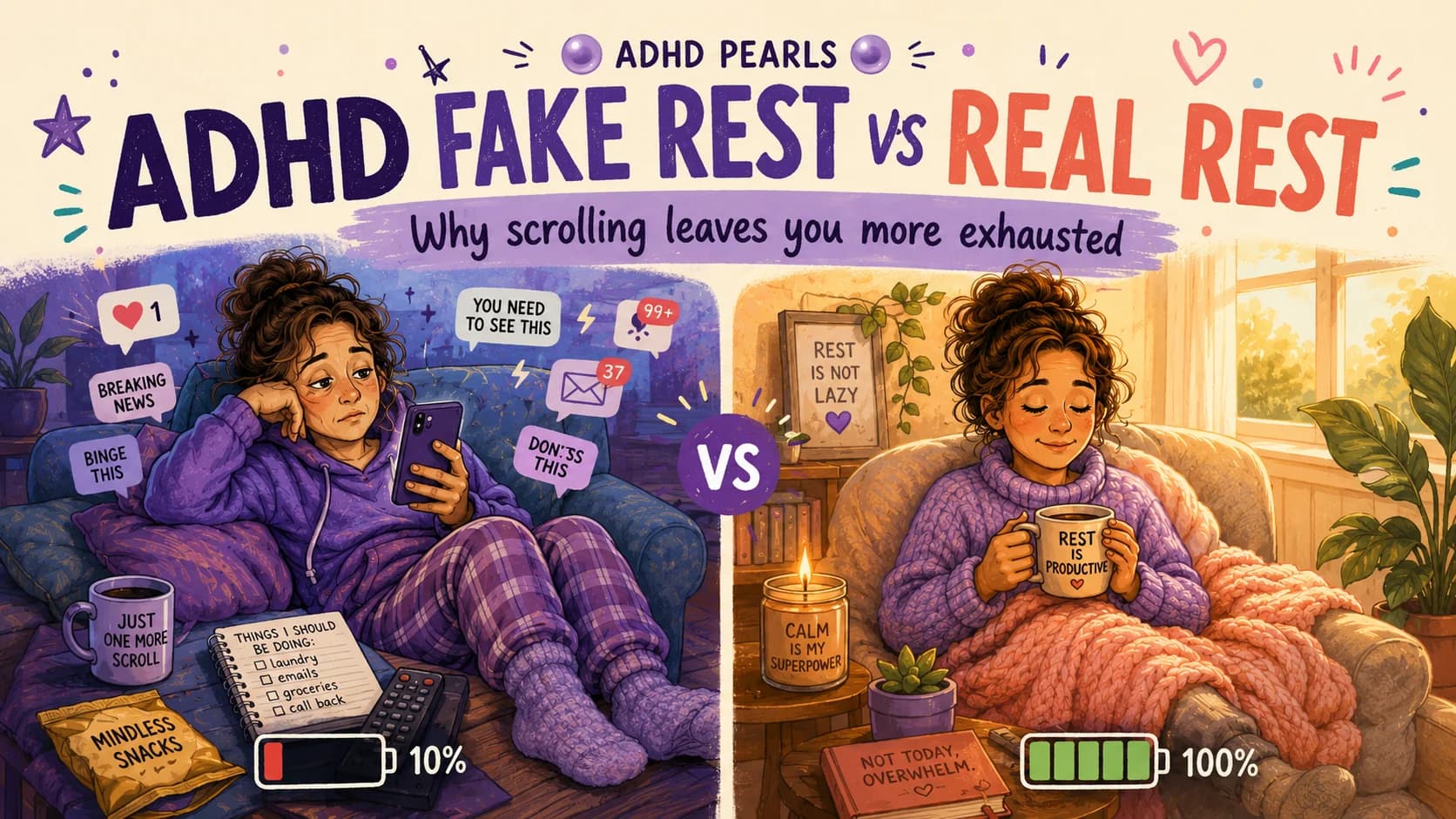
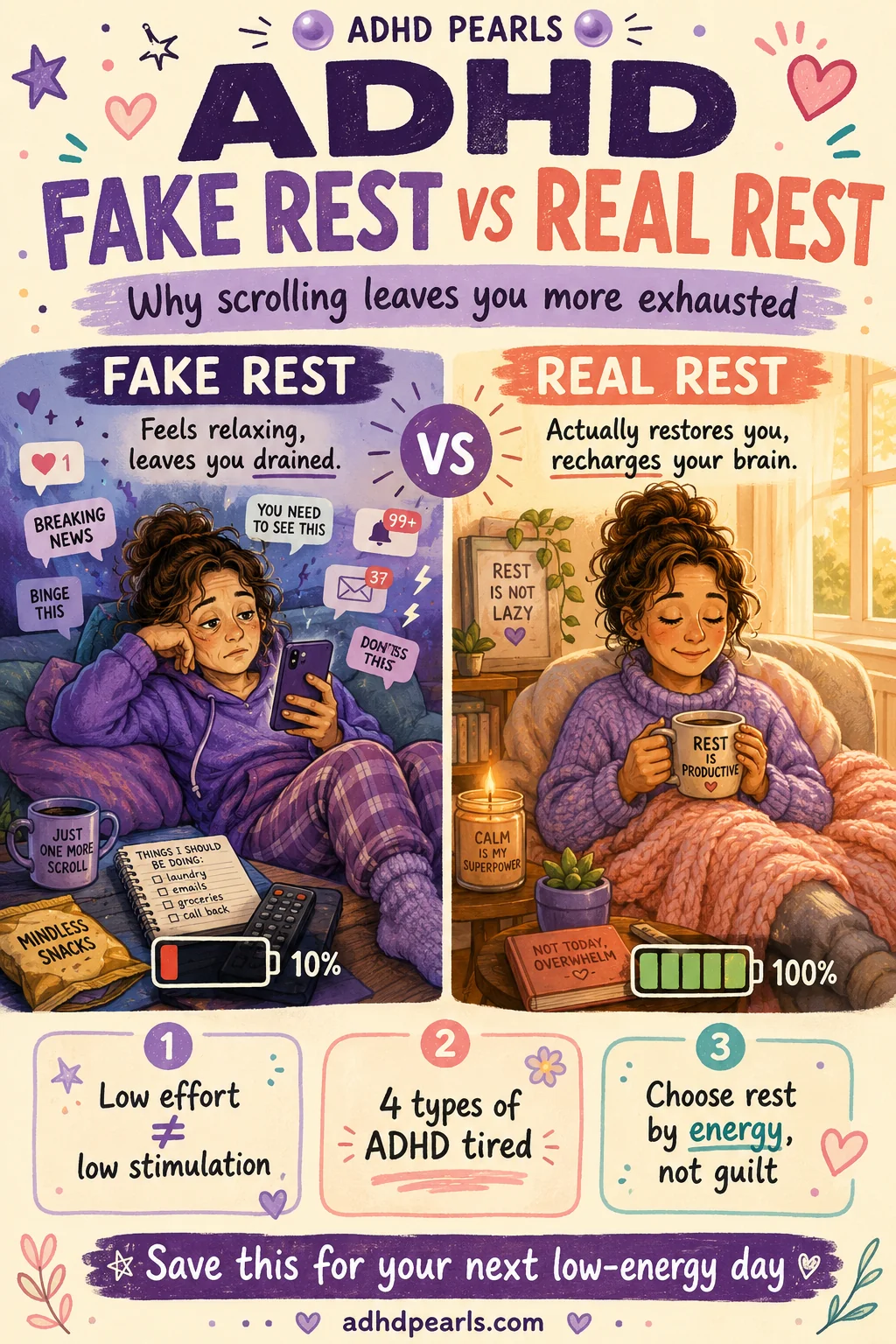
Fake rest is the thing you do instead of the hard thing, that also happens to do nothing for you.
It's not relaxing. It's avoiding. And the cruel part is that it wears the costume of self-care, so you don't even get to feel like you took a break - you just feel vaguely guilty while a stranger reorganizes their pantry on your screen.
The tell is how you feel at the end. Real rest leaves you a little more settled. Fake rest leaves you flat, foggy, and somehow more behind. You didn't recover. You just pressed pause on the discomfort while the battery kept draining in the background.
Fake rest doesn't refill the cup. It just hides the cup behind a screen so you can't see how empty it is.
None of this means you're doing rest "wrong" on purpose. When your brain is overloaded, it reaches for the fastest available off-ramp - and scrolling is always the closest exit. That's not a willpower failure. It's a brain choosing the path with the least friction, which is exactly what tired brains do.
From ADHD Pearls
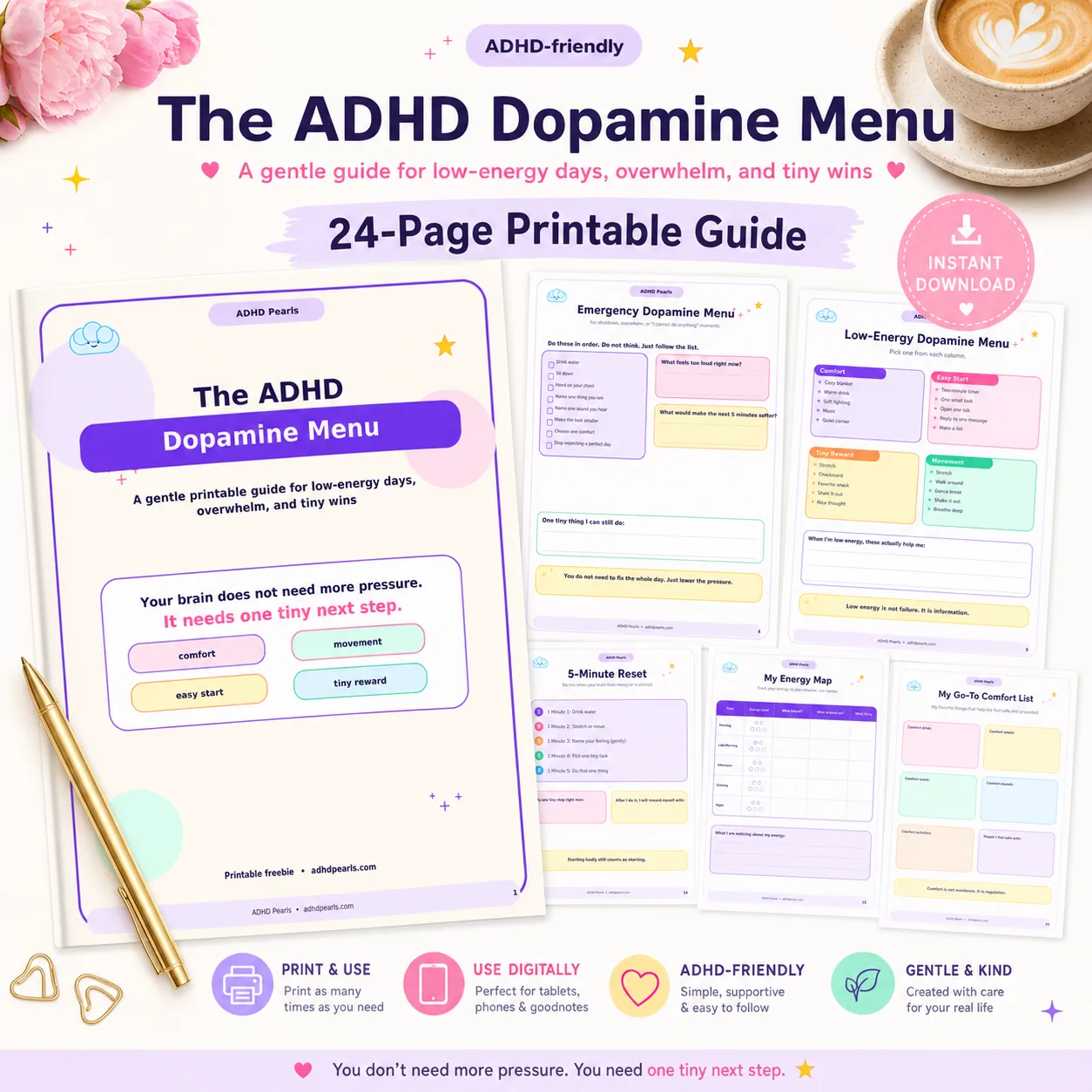
Free Dopamine Menu
24 tiny activities for low-energy, low-capacity days.
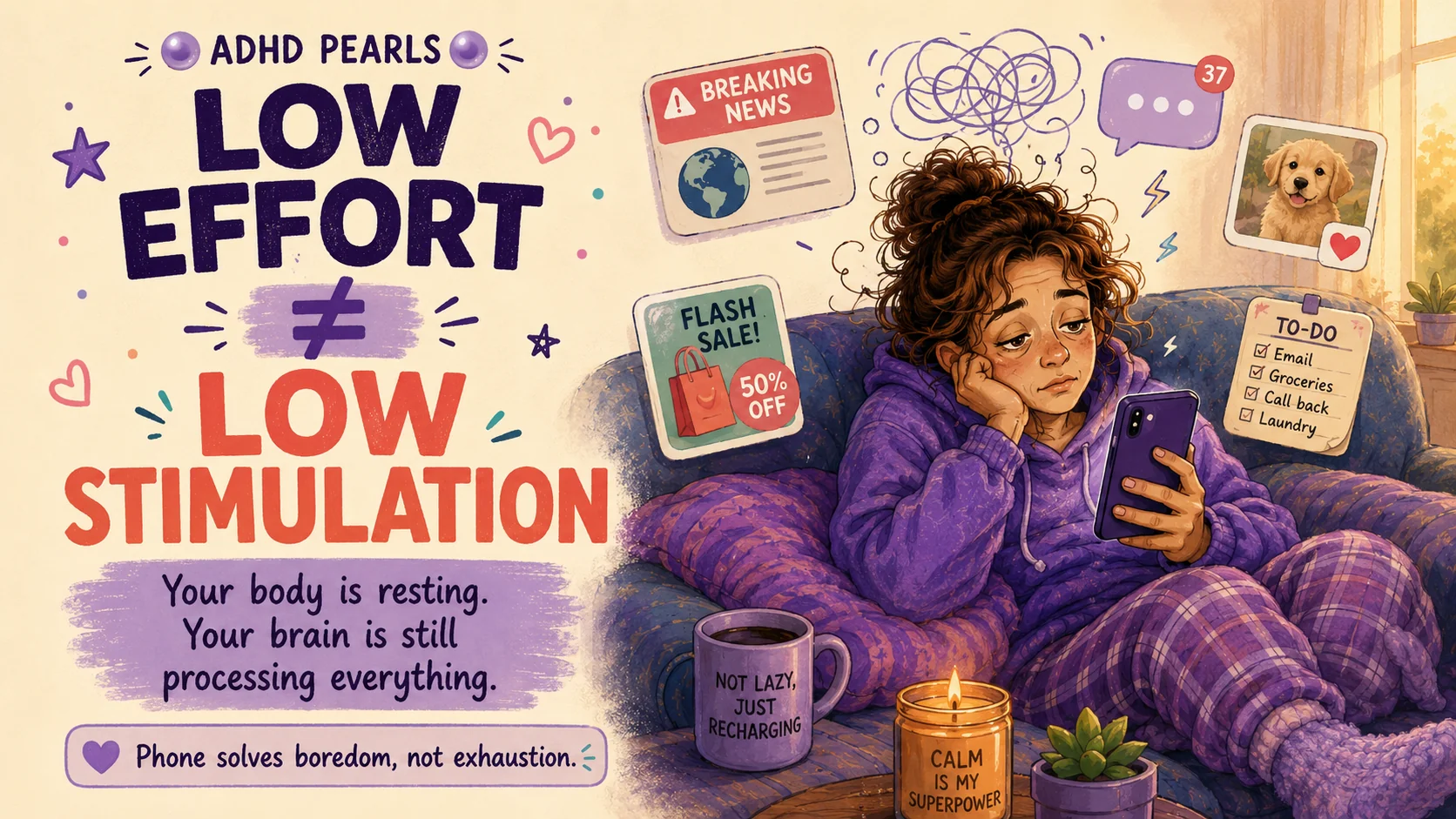
Here's the part nobody told me until I was deep in low-energy burnout: scrolling isn't rest because it isn't low stimulation. It's just low effort.
Your brain is still working the entire time. Every swipe is a tiny new thing to process - a face, a headline, an opinion, an ad, a dance, a tragedy, a puppy - delivered fast enough that you never have to sit with the discomfort of an unstimulated moment. Research on ADHD points to differences in dopamine-related signaling, which may be part of why understimulation feels so genuinely uncomfortable and why fast novelty is so hard to put down.
So the phone solves the wrong problem. It removes boredom. It does not restore energy. You end up over-stimulated and still depleted, which is the specific, awful flavor of tired where you're exhausted but also weirdly wired.
Scrolling is low effort, but your ADHD brain is still processing a constant stream of novelty.
I'm not anti-phone, to be clear. I gray-scaled mine, felt deeply virtuous for about a day, then a friend sent a photo of her new puppy and I switched the color straight back. The puppy won. But on ordinary days, knowing that the scroll is stimulation and not recovery changed what I reach for when I'm actually fried.
If the scroll has become the default off-switch, the ADHD Dopamine Menu is a gentle way to pre-decide better options before your tired brain has to choose in the moment.
Fake Rest vs Real Rest: The Comparison
I needed something less vague than "listen to your body" and less useless than "just relax." I needed a way to catch myself mid-scroll and ask: is this actually a break, or am I hiding?
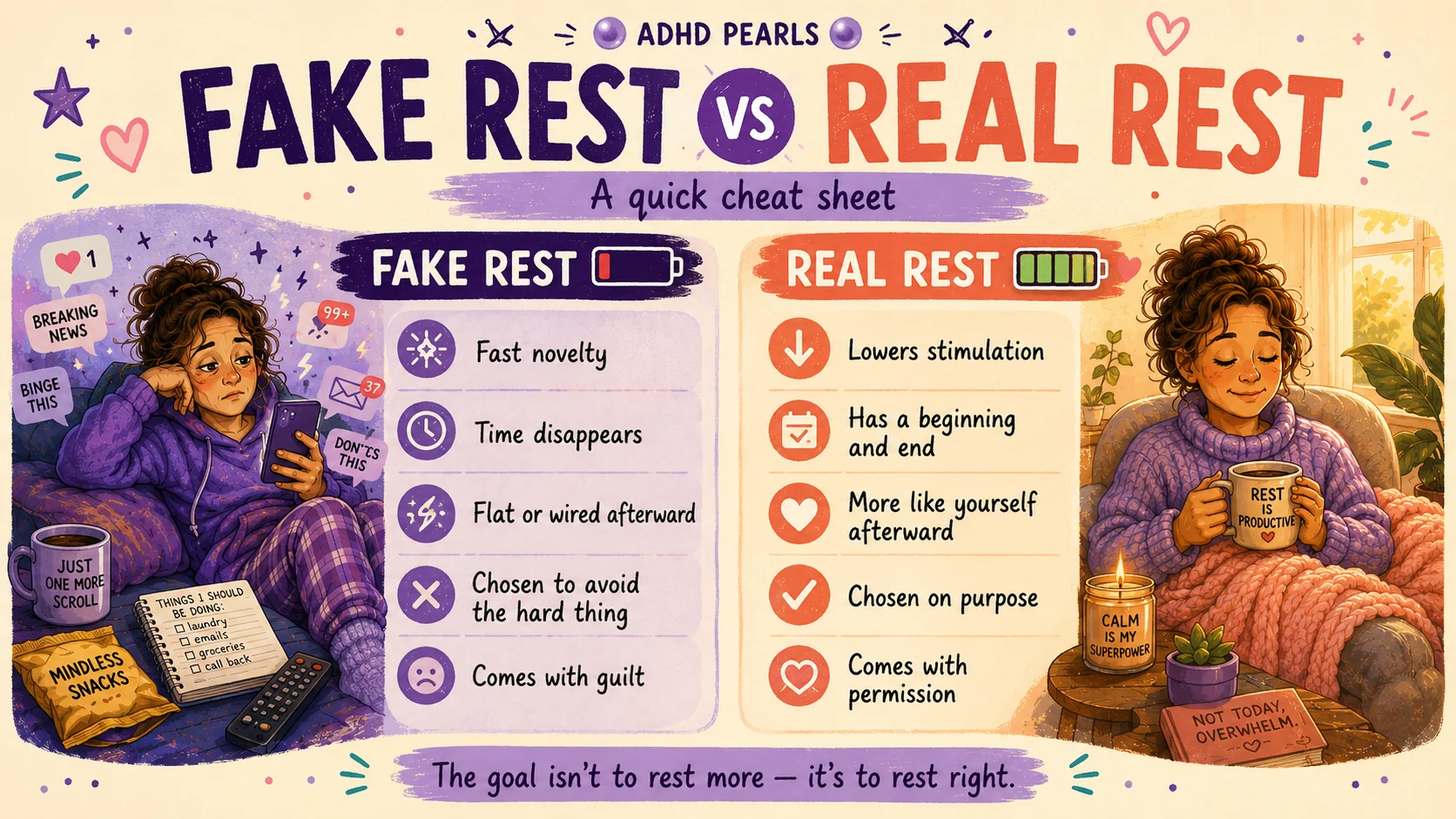
This table is the cheat sheet I wish I'd had.
Fake rest
Real rest
Keeps the brain stimulated (fast novelty)
Lowers stimulation or discharges the loop
You feel flat or wired afterward
You feel more like yourself afterward
Often chosen to avoid a hard task
Chosen on purpose, not as an escape hatch
Time disappears with no edges
Has a beginning and an end
Comes with guilt or a vague "behind" feeling
Comes with permission - nothing owed
Fake rest keeps the brain stimulated. Real rest lowers the load and leaves you feeling more like yourself.
This isn't a moral chart. Fake rest isn't a sin and a quiet scroll isn't a crime. It's just a way to notice, without shame, when the thing you're calling rest is quietly making you more tired.
Four Kinds of Tired - and What Each One Needs
The other reason rest fails: we treat every kind of tired with the same break. Usually the couch. Usually the phone. But you can't fix sensory overload with more input - that needs its own first aid protocol - and you can't fix physical exhaustion by lying down thinking about everything you haven't done.
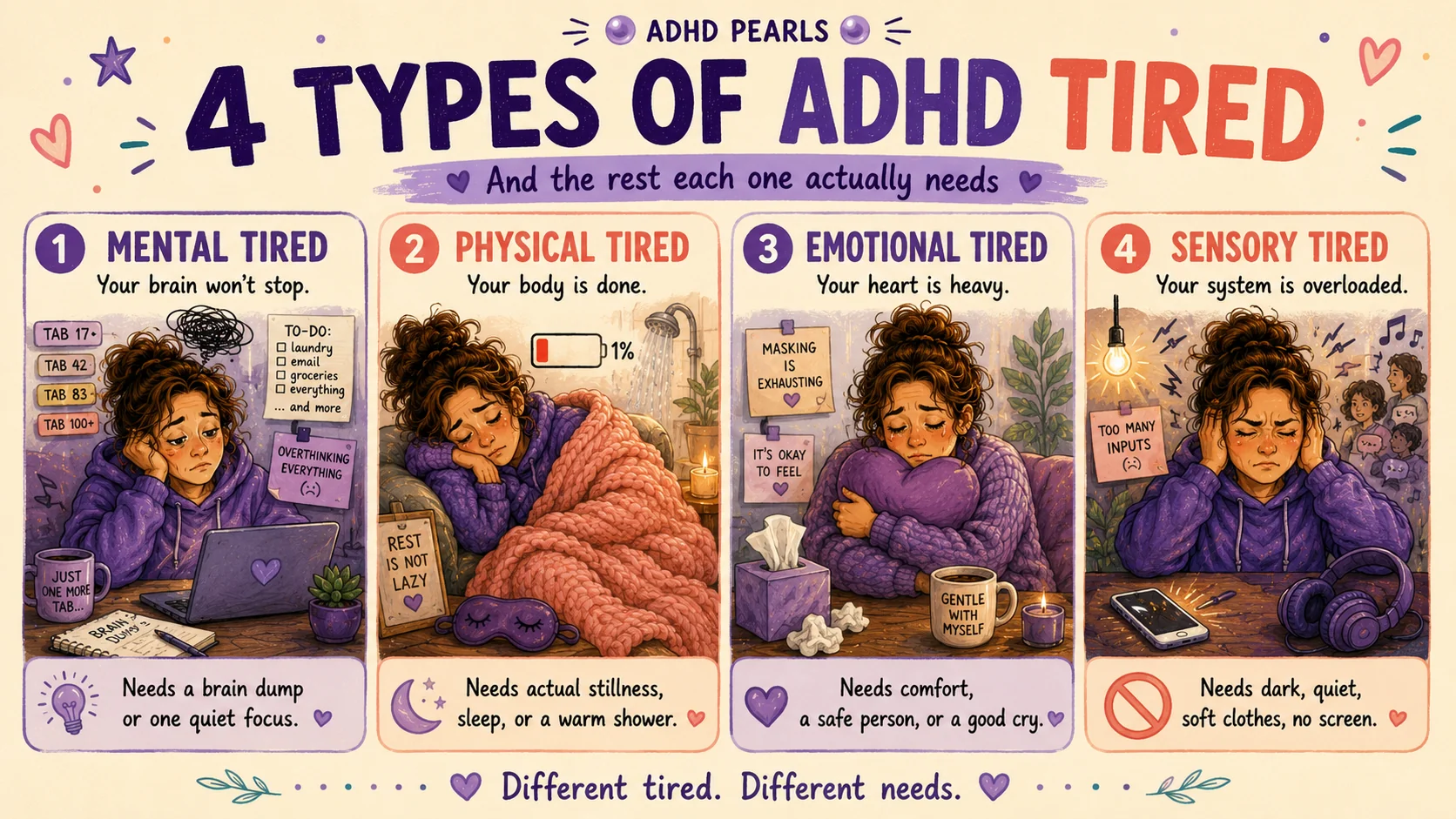
Roughly, the tiredness sorts into four kinds:
Mental tired - too many open tabs in your head. Needs a brain dump or one quiet point of focus, not more decisions.
Physical tired - the body is done. Needs actual stillness, sleep, or a warm shower - not a "quick" scroll that becomes two hours.
Emotional tired - masking, conflict, or low-grade shame drained you. Needs comfort, a safe person, or a good cry, not productivity.
Sensory tired - too much noise, light, and input. Needs less: dark, quiet, soft clothes, no screen.
Mental, physical, emotional and sensory tired each need a different kind of rest.
When I started naming which tired I actually was, my "rest" stopped backfiring. A sensory-fried evening doesn't need Netflix at full brightness. It needs the lamp off and the world turned down. Matching the break to the drain is most of the trick.
The bigger map: the 7 types of rest
If four kinds of tired resonate, it is worth knowing the fuller version. Dr. Saundra Dalton-Smith describes seven types of rest - physical, mental, sensory, creative, emotional, social, and spiritual - and the same principle holds: sleep only covers one of them, so you can be wrecked even after a full night if the kind you actually need is missing.
The one ADHD women miss most is often social rest. If masking all day leaves you fried, more sleep will not fix it; quiet, unmasked, low-demand time will. That overlaps with why dropping the mask matters so much.
A Real-Rest Menu for ADHD Brains
The mistake I made for years was waiting until I was empty to figure out what helps. By then, the only thing my brain could reach for was the phone.
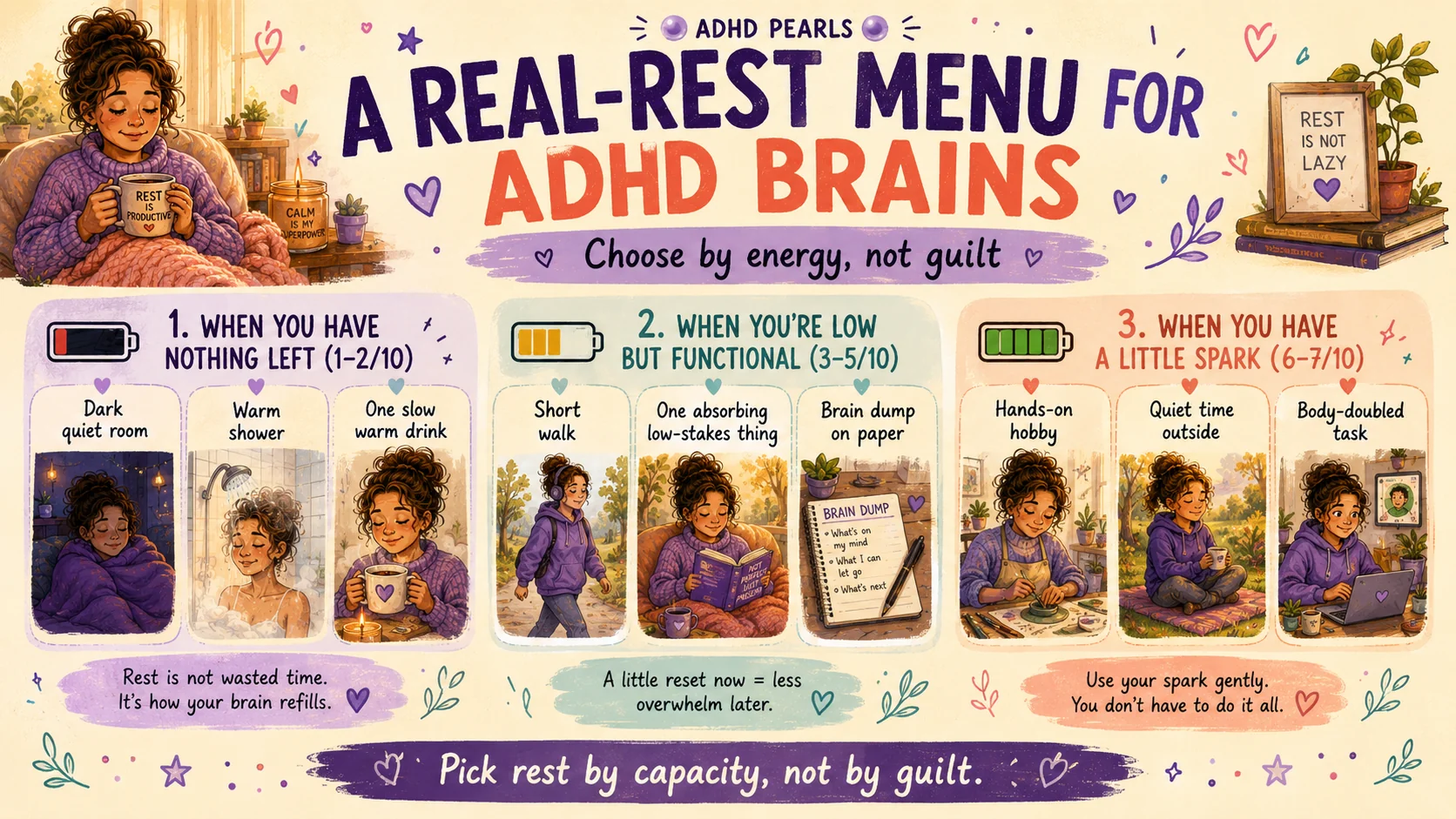
So pre-decide. Keep a short menu somewhere visible, sorted by how much energy you've got. The same logic behind energy-based planning works for rest too: pick by capacity, not by guilt. And if sensory tired is the one you recognise most, it often announces itself through what you are wearing - why clothes feel wrong some days.
When you have nothing left (1-2 out of 10):
Lie down somewhere dark and quiet for ten minutes - no phone, no goal.
Warm shower. The water counts as doing something while you do nothing.
One slow, warm drink, held in both hands, away from a screen.
When you're low but functional (3-5):
A short walk, even just to the corner and back - movement discharges the loop.
One absorbing, low-stakes thing: a puzzle, coloring, repotting a plant, folding warm laundry.
A brain dump on paper to close the open tabs before you try to settle.
When you have a little spark (6-7):
A real hobby that uses your hands and gives you one thing to focus on.
Time outside without a podcast - let it be quiet for once.
A body-doubled task, so the thing that's been looping finally gets done and stops draining you.
Choose rest by the energy you actually have—not by guilt or by what you think rest should look like.
Notice that almost none of these are "do nothing." For a lot of ADHD brains, the most restful thing isn't stillness - it's one gentle thing to land on, instead of nothing to land on and a phone to fill the gap.
And on the days you can't even start the rest? The free ADHD Stuck Reset is a soft place to begin.
And if real rest keeps failing to land no matter which kind of tired you aim it at, the problem may be further upstream: that is usually what ADHD burnout does, and it needs less load rather than better rest.
FAQ: ADHD and Rest
Why doesn't scrolling feel restful for ADHD brains?
Because it keeps the brain stimulated instead of letting it settle. The constant stream of novelty and small dopamine hits works more like low-effort stimulation than recovery, so an hour can pass with your energy unchanged or lower. It quiets boredom without refilling the battery.
What is fake rest?
Fake rest is any activity that looks like a break but does not recharge you: scrolling, half-watching a show while doom-reading the news, or lying down with a racing mind. It stops you doing the hard thing without giving your nervous system real recovery, so you finish still tired.
What are the 7 types of rest?
A framework from Dr. Saundra Dalton-Smith describing seven kinds of rest: physical, mental, sensory, creative, emotional, social, and spiritual. The idea is that sleep only covers one kind, so you can feel drained even after a full night if the type of rest you actually need is missing.
Why can't I relax even when I have free time?
For many ADHD brains, sitting still does not equal resting; the mind keeps cycling through tasks, worries, and self-criticism, and an under-stimulated moment can feel genuinely uncomfortable. Rest often has to be more intentional, giving the brain one calm thing to do rather than nothing at all.
What counts as real rest with ADHD?
Real rest is whatever genuinely lowers your stimulation and load, which is personal. For some it is stillness and quiet; for others it is gentle movement, a single absorbing activity, time outside, or finally discharging a looping task. The test: do you feel more like yourself afterward?
What should I do instead of scrolling when I'm exhausted?
Match the break to the kind of tired. Sensory overload needs less input, like dark and quiet; mental overload needs a brain dump or one point of focus; physical exhaustion needs real stillness or sleep. A pre-written rest menu helps your tired brain choose without deciding from scratch.
Why am I so tired even when I rest with ADHD?
Often because the thing you are calling rest is not restorative, or you are treating one kind of tired with the wrong kind of break. Mental, physical, emotional, and sensory tiredness each need different recovery, and an always-activated nervous system can leave you unrefreshed even after sleep.
Why do I feel guilty when I rest?
Many late-diagnosed ADHD women have spent years being told they are behind, so stillness can trigger a low-grade alarm. Reframing rest as maintenance rather than a reward you earn can help, though the guilt often eases slowly rather than all at once.
Can rest actually help ADHD symptoms?
For some people, yes; genuine recovery can make focus, mood, and emotional regulation a little easier, because a depleted brain manages everything less well. Rest is not a cure, but under-resting tends to make ADHD harder to live with. It is one input worth discussing with a professional.
You're Not Lazy. You're Running on Fake Rest.
The day I figured out the difference, I stopped feeling broken for ending "restful" weekends more tired than I started them. I wasn't bad at resting. I was doing a thing that was never going to work and calling it the same word.
Real rest is allowed to be small. It's allowed to be weird. It's allowed to be a dark room for ten minutes or one warm drink with no phone in your other hand.
You don't have to earn it. You just have to stop mistaking the off-ramp for the recharge.
Save this ADHD fake rest vs real rest guide for your next low-energy day.
Sources I leaned on while writing this
ADDitude: ADHD and exhaustion. additudemag.com. Background on why ADHD can be so draining and why rest often fails to recharge.
One tap makes ADHD Pearls a preferred source in your Google account, so our articles surface higher when you search. No signup, and it brings you straight back to this page.
Before you go
Free Dopamine Menu
24 tiny activities for low-energy, low-capacity days.
For the woman who sets up the perfect system on Sunday and abandons it by Tuesday.
One short letter, every week. Real talk about ADHD, task paralysis, and the tiny wins that actually move the needle for a brain like yours. No shame. No hustle culture.