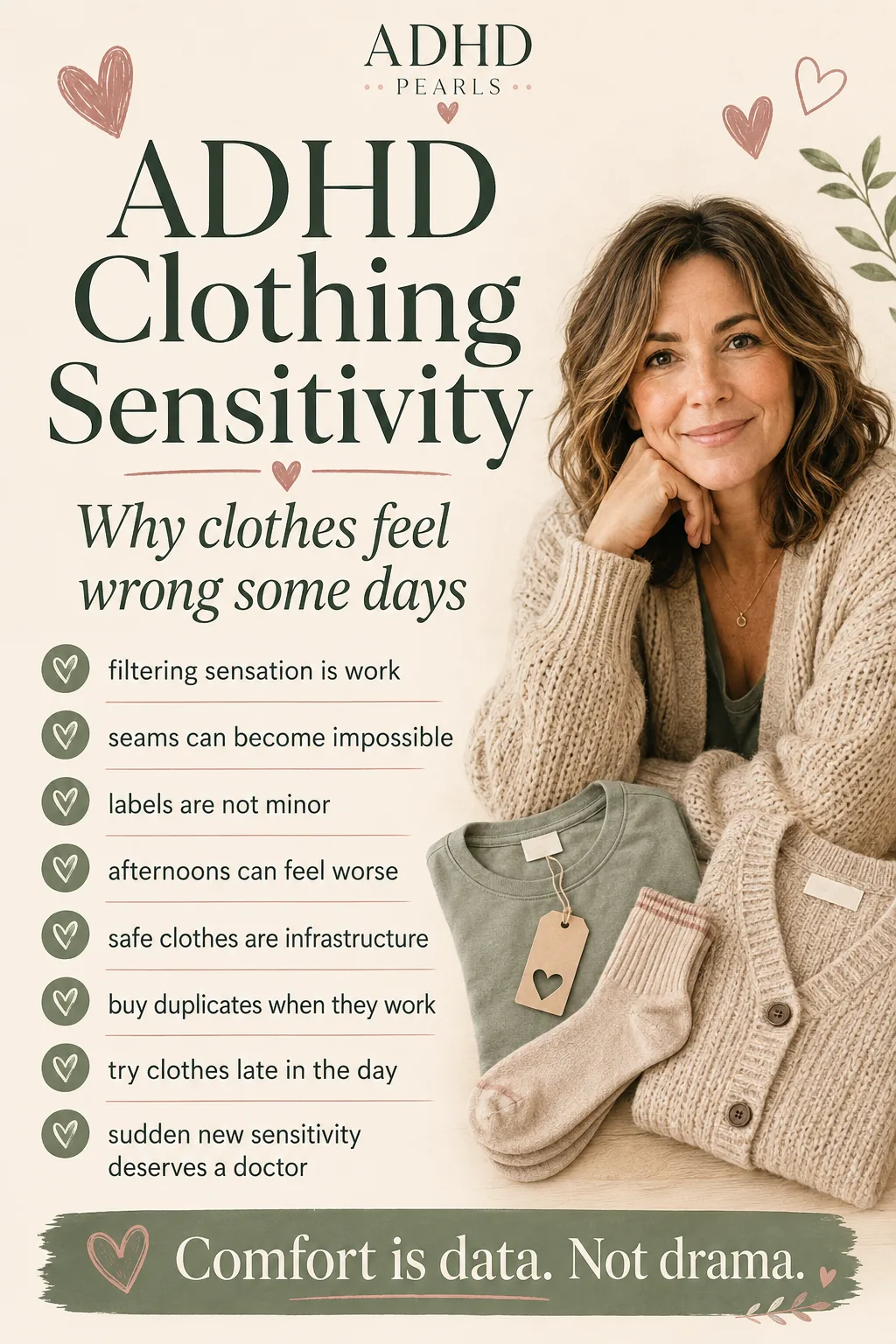
It is 7.40am and I am on my third shirt. Not because of how any of them look. Because the first one had a seam that sat wrong across my shoulder, the second one had a label I could feel through the fabric, and the third one is the one I wore on Monday, which I know is safe.
The strange part is that shirt one was fine last week. Same shirt, same body, same shoulder. Something else changed.
Quick answer
Why do clothes feel wrong with ADHD?
Because filtering out background sensation takes effort, and ADHD makes that filtering less reliable. A seam your brain usually ignores becomes impossible to ignore once your capacity is low. That is why the same shirt can be fine on Tuesday and unbearable on Thursday afternoon - the garment did not change, the amount of filtering you had available did.
Key takeaways
📌Filtering sensation is work. It runs down like anything else that takes effort.
📌Clothes that were fine this morning can become intolerable by late afternoon.
📌Your "safe clothes" are not a rut. They are infrastructure.
📌Buying differently helps more than tolerating better.
📌Women are often socialised to endure discomfort quietly, which is why this goes unnoticed for decades.
📌A sudden new sensitivity is worth mentioning to a doctor rather than assuming it is sensory.
Your skin is reporting constantly. The chair, the waistband, the sock seam, the collar. Most brains file all of that under nothing-to-see-here and never surface it.
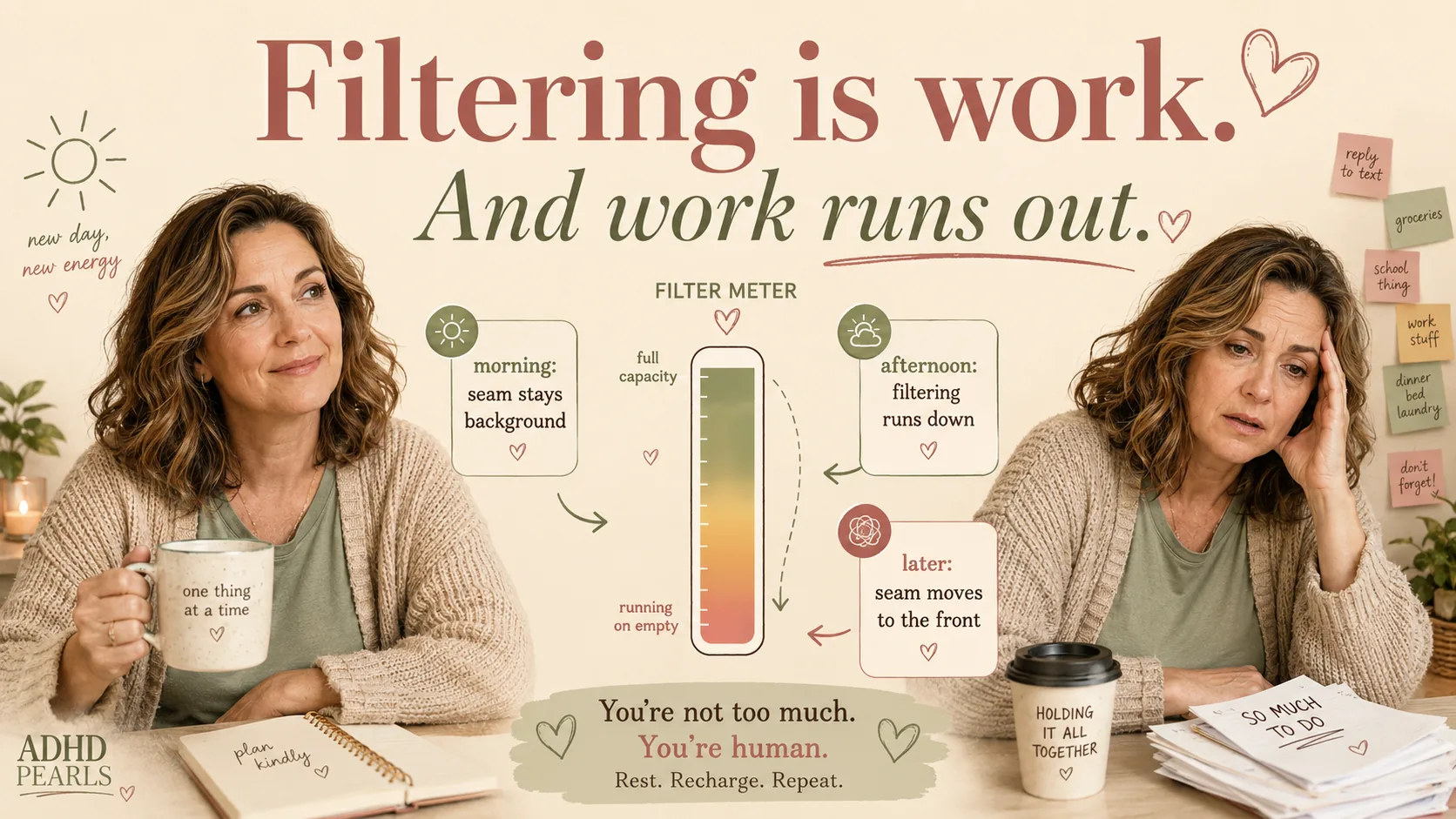
That filing is not free. It is an ongoing job, and ADHD makes it less dependable. When you are rested the seam stays filed. When you are depleted the filing fails, the seam gets promoted to the front of your attention, and then it will not leave.
It is not the shirt. It is what is left of your filtering.
Filtering sensation is not effortless. When the filter runs down, small irritations become impossible to ignore.
This is why the pattern is so confusing from the inside. There is nothing wrong with you on the good days and nothing wrong with the shirt on the bad ones. What varies is the resource in between.
Which is why afternoons are worse
A waistband that felt fine in the shop can consume an entire Thursday afternoon. Same garment, eight hours later, and by then you have spent the day filtering an open-plan office, three conversations and your own to-do list.
Clothes are usually the last thing to become unbearable, because they are the sensation you have been suppressing longest. They are also the one you can actually change, which is why the fix is worth having.
What the research says, and what it does not
Sensory over-responsivity is taken seriously in ADHD research. A 2019 paper in Frontiers in Integrative Neuroscience measured physiological responses to sensory challenge and argued that sensory responsivity differentiates meaningfully between children with ADHD - enough that the authors suggested it be considered as a dimension in the diagnostic process.
Two honest caveats. That study was in children, not adults. And "suggested as a dimension worth considering" is not the same as "in the diagnostic criteria", which is how it often gets repeated online. What it does tell you is that this is a documented pattern being investigated, not a preference you invented.
The reason nobody noticed
Here is the part that lands hardest for a lot of women. Girls are frequently taught, gently and without anyone meaning harm, to stop complaining about how things feel. The tights are fine. Everyone's uniform is scratchy. You will forget about it once you are outside.
So you stop reporting it, and eventually you stop registering it as a thing that could be reported. Decades later you own eleven jumpers you never wear and no explanation for why. It is the same quiet endurance that shows up across so much of how ADHD gets missed in women.
From ADHD Pearls
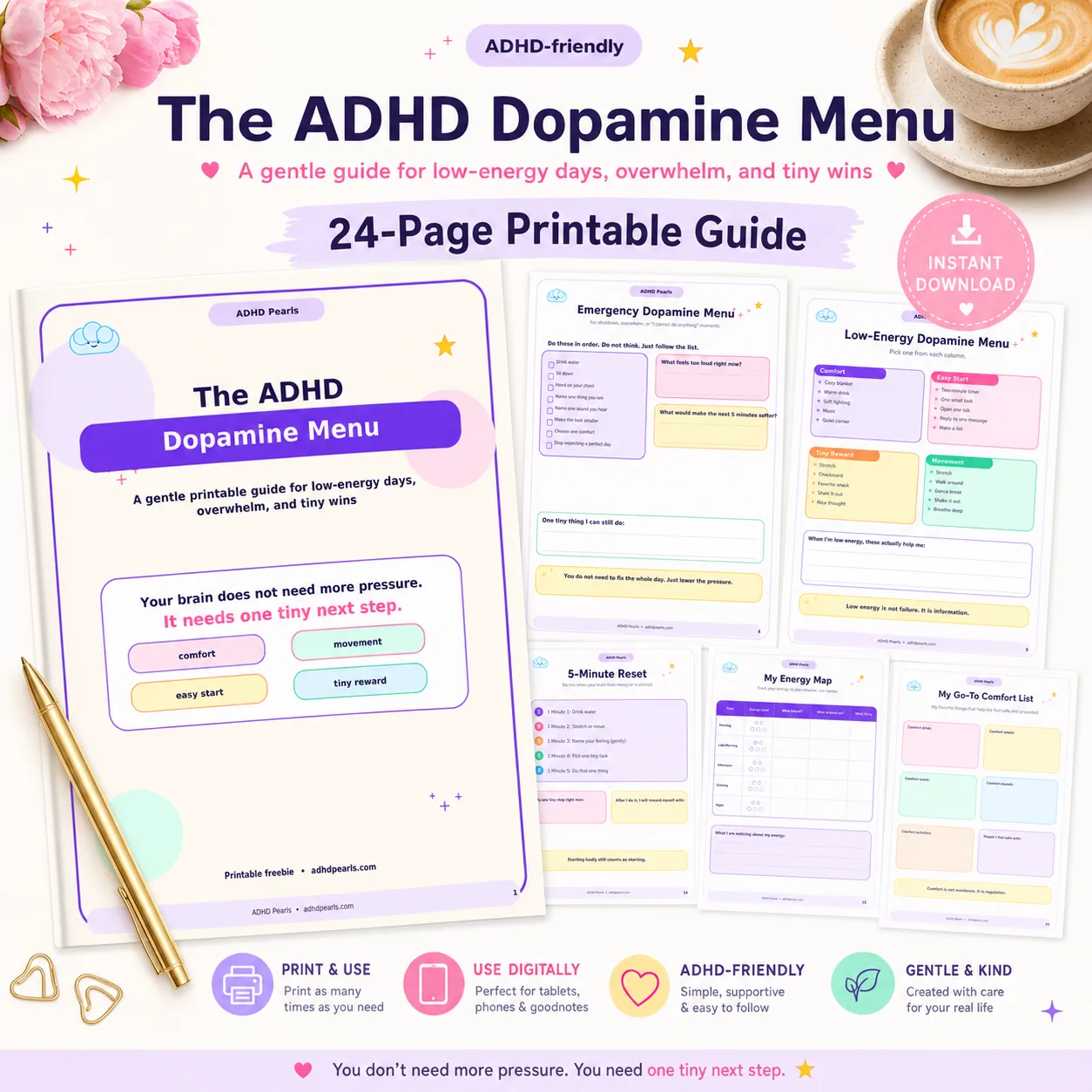
Free Dopamine Menu
24 tiny activities for low-energy, low-capacity days.
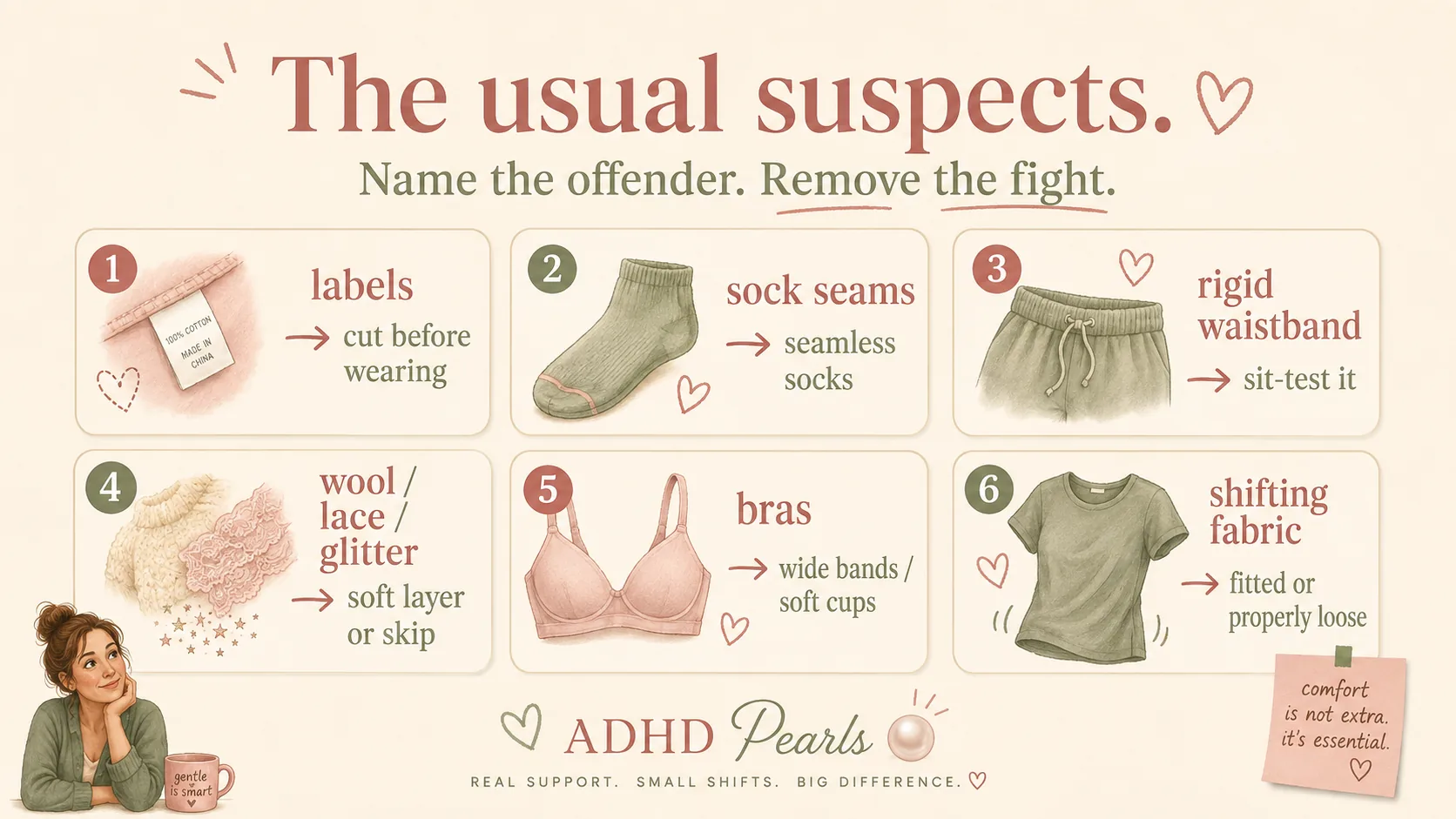
Most people have three or four repeat offenders rather than a general problem with clothing. Naming yours is most of the work.
The offender
What usually helps
Labels and printed neck tags
Cut them out on the day you buy it, not the day it starts bothering you. Printed-on labels exist and are worth seeking out.
Sock seams across the toes
Seamless socks. If you only change one thing, this is the highest return for the smallest cost.
Waistbands, especially rigid ones
Judge it sitting down, at the end of a day, not standing in a fitting room in the morning.
Wool, lace, stiff denim, anything with glitter
A soft layer underneath, or accept that the fabric is not for you. Toleration is not a skill worth building here.
Bras - underwires, tight bands, straps
Wide bands and soft cups. This is one of the most-discussed items in ADHD women's communities for a reason.
Anything that shifts as you move
Movement means the sensation keeps renewing, so your brain never gets to file it. Fitted or properly loose both work; in between does not.
The goal is not to tolerate the fight better. It is to name the offender and remove the friction.
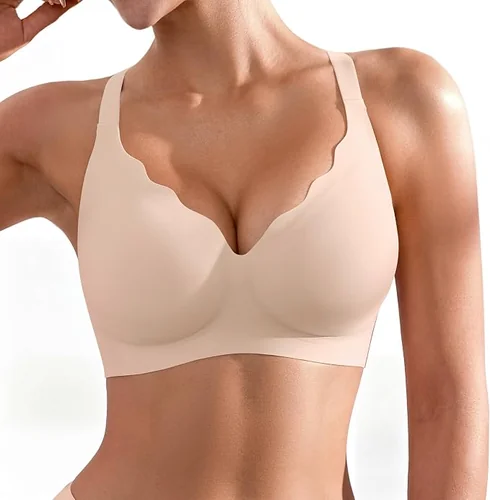
The bra row is the one that comes up most, and it is worth saying plainly: if getting through the day means counting the hours until you can take it off, the bra is wrong, not your tolerance. What tends to help is a wide band that spreads the pressure instead of digging in one line, soft cups with no rigid wire, and straps broad enough that they do not carve into your shoulders.The wireless one I wear →Affiliate link — as an Amazon Associate we may earn from qualifying purchases.
What Safe Clothes Actually Are
Almost everyone I have compared notes with has a small set of things they wear far more than anything else. The same three tops. The one pair of trousers. A cardigan that has genuinely seen better days.
It gets read as being in a rut, or not making an effort, and I spent years slightly ashamed of mine.
Look at what it is actually doing. It removes a decision from your morning. It guarantees no unpleasant surprises for the next fourteen hours. It protects the filtering capacity you are going to need for everything else in the day. That is not a rut. That is a load-bearing wall.
Researchers studying tactile hyper-sensitivity in autistic adults used the phrase safe clothes directly, from participants' own accounts - and noted the tension in it, since safe clothes can also feel limiting. That study was about autism rather than ADHD, and the two are distinct, but sensory profiles overlap enough that the description travels.
Both things are true. Your uniform is doing real work, and it is allowed to feel a bit boring. The answer is usually more safe options rather than fewer.
Safe clothes are not a failure of style. They are a support system for the rest of your day.
Building a Wardrobe That Does Not Fight You
The twenty-minute audit
Take everything you have not worn in a year and sort it into two piles: did not wear it because of how it looks, and did not wear it because of how it feels.
The second pile is the interesting one. It is usually bigger than expected and it is full of things you have been quietly failing to force yourself into. Those are not going to start working. Let them go, and stop treating the unworn pile as evidence of anything except a mismatch.
Buy differently, rather than tolerate better
Touch it before you look at the price. If your hand does not want it, your shoulder will not either.
When you find something that works, buy it more than once. Two or three of the same top is not a lack of imagination. It is a solved problem, purchased.
Check the seams and the label before the mirror. Thirty seconds now, versus an item that hangs in your wardrobe for two years.
Try it on late in the day. Morning-you has far more filtering available than the version of you who will actually be wearing it at 4pm.
Wash new things before wearing. Stiffness and finishing chemicals are often what your skin is reacting to, and one wash can change the answer entirely.
Give getting dressed less to decide
If mornings are where this costs you most, reduce the number of live options. A small rotation of known-good outfits removes the trial-and-error entirely, which matters more than variety on the days you are already starting low.
If you never wear it because of how it feels, that is not a willpower problem. It is data for the next purchase.
On the Days Nothing Works
Some days you will go through four things and none of them are tolerable. That day is not a wardrobe problem. It is a capacity problem wearing a wardrobe costume.
What helps on those days:
Go straight to the safe outfit. Do not audition anything. This is not the morning for the new trousers.
Reduce layers rather than adding them. Fewer contact points, fewer edges, fewer things shifting.
Treat it as information. If clothes have suddenly become intolerable, you are usually depleted, overstimulated or heading into something. It is a fairly reliable early signal, and it is the same underlying maths as any other low-energy day. If it tips over into everything being too much at once, there is a five-step first aid protocol for sensory overload to run before it becomes a shutdown.
Notice if it is cyclical. A lot of women find sensitivity climbs in the week before their period, alongside everything else, which is covered in why two weeks a month feel different.
And if the reason nothing is available is that everything clean is in a basket somewhere, that is a different circuit entirely - the ADHD laundry system covers that one.
If Your Child Does This Too
Short section, because it comes up every time.
A child who cannot bear socks, cuts labels out, or melts down over a school jumper is not being difficult on purpose. They are reporting something your generation was probably taught to stop reporting.
You do not need to diagnose anything to make it easier. Seamless socks, labels removed before first wear, soft layers under uniform, and letting them choose the clothes they can actually be in all help. If it is affecting school or daily life more broadly, that is worth raising with a professional rather than managing alone.
Sensory difficulty on its own does not mean ADHD, autism or anything else. Plenty of people have one without the others.
This article is educational and is not medical advice. Sensory sensitivity has several possible explanations and is not a diagnostic test for anything. A sudden or unexplained change - new skin pain, numbness, tingling or itching without an obvious cause - is worth raising with a doctor rather than assuming it is sensory.
FAQ: ADHD and Clothing Sensitivity
Why do clothes feel wrong with ADHD?
Because filtering out constant background sensation takes ongoing effort, and that filtering is less reliable with ADHD. When your capacity is low, sensations your brain normally suppresses - a seam, a label, a waistband - get pushed to the front of your attention and stay there.
Why is the same shirt fine one day and unbearable the next?
Because what changed is not the shirt. Filtering runs down as the day and the week go on, so a garment that was unnoticeable in the morning can become impossible to ignore by late afternoon. Being tired, overstimulated or unwell all make it more likely.
Is clothing sensitivity a symptom of ADHD?
It is not a formal diagnostic criterion, but sensory over-responsivity is well documented alongside ADHD. A 2019 study in children argued it differentiates meaningfully within ADHD and suggested it be considered as a dimension in diagnosis. Sensory difficulty on its own does not diagnose anything.
Why do afternoons feel worse?
Because you have been filtering all day - noise, light, people, your own tasks - and clothes tend to be the sensation you have been suppressing longest. They are usually the last thing to break through and the first thing you can actually change.
What are safe clothes?
The small set of things you wear far more often than anything else because you know exactly how they will feel. They remove a morning decision and protect your filtering capacity for the rest of the day. That is useful infrastructure, not a lack of effort.
What should I look for when buying clothes?
Touch the fabric before you check the price, look at seams and labels before the mirror, and try things on late in the day rather than first thing. When something works, buying a second one is a reasonable decision rather than a boring one.
Do seamless socks and tagless clothes really help?
For many people, considerably, and socks tend to give the biggest improvement for the smallest cost. Removing a recurring irritation is more effective than getting better at ignoring it, because ignoring it is exactly the thing that uses up capacity.
Is this the same as being autistic?
Not necessarily. Tactile sensitivity is very commonly discussed in autistic communities and is well studied there, and it also occurs with ADHD, and in people with neither. The experiences overlap, which is one reason the two are sometimes confused.
My child cannot tolerate certain clothes. What helps?
Seamless socks, labels removed before the first wear, soft layers under scratchy uniform, and involving them in choosing what they can actually wear. Treat the complaint as real information rather than fussiness. If it is affecting school or daily life, it is worth discussing with a professional.
Save this for the next time your clothes suddenly feel impossible and you need a reminder that comfort is data, not drama.
Pin this for the next sensory bad day.
Sources I leaned on while writing this
Lane & Reynolds. "Sensory Over-Responsivity as an Added Dimension in ADHD."Frontiers in Integrative Neuroscience, 2019. Physiological responses to sensory challenge in children with ADHD, and the argument for treating sensory responsivity as a diagnostic dimension.
I am wearing the Monday shirt again. It has a small mark near the hem that will not come out, and it is the single most reliable garment I own. I have since bought two more of it, which felt ridiculous at the till and has not felt ridiculous once since.
Found this helpful? Share it with someone who gets stuck too.
One tap makes ADHD Pearls a preferred source in your Google account, so our articles surface higher when you search. No signup, and it brings you straight back to this page.
Before you go
Free Dopamine Menu
24 tiny activities for low-energy, low-capacity days.
For the woman who sets up the perfect system on Sunday and abandons it by Tuesday.
One short letter, every week. Real talk about ADHD, task paralysis, and the tiny wins that actually move the needle for a brain like yours. No shame. No hustle culture.