For about two weeks a month I am a person who answers emails. Then, reliably, I become a person who looks at the same email eleven times, feels a small hot wave of dread each time, and closes the laptop.
For years I read that as inconsistency. Proof that the good weeks were the fluke and the bad ones were the real me finally showing through. It took embarrassingly long to notice that the bad weeks were not random. They had a schedule, and it was printed on a calendar I already owned.
Quick answer
Why does my ADHD get worse before my period?
Estrogen appears to support the dopamine systems involved in attention and motivation, and estrogen falls sharply in the week or so before your period. Research on the menstrual cycle in ADHD consistently finds attention, executive function and impulsivity are hardest in the mid-luteal and premenstrual phases. Your ADHD has not got worse. It has been temporarily amplified, and the amplification is predictable.
Key takeaways
📌The bad weeks are not a personality failure. They tend to track a hormonal pattern.
📌It is the drop in estrogen that seems to matter, not the level.
📌There is a clinical name for this: premenstrual exacerbation, or PME.
📌PME is an existing condition getting louder. PMDD is a separate disorder. They are not the same thing.
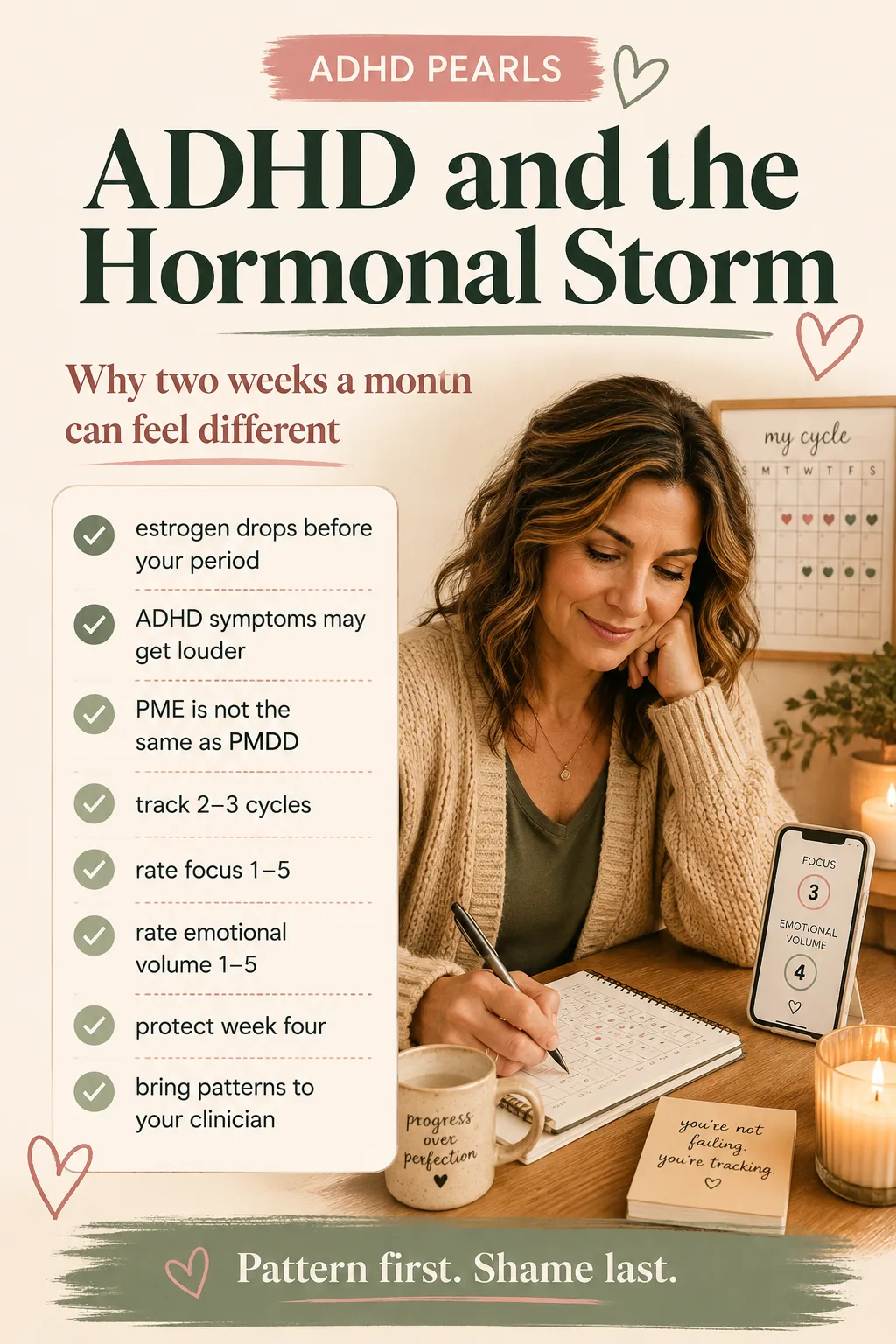
📌Two or three tracked cycles will show you your own pattern better than any article can.
📌Plan around the hard week instead of trying to be a different person during it.
First, a definition, because I am about to use a phrase that sounds more official than it is. Hormonal storm is my shorthand, not a diagnosis. No clinician will write it on a form. I use it because it describes the experience better than the clinical language does: something arrives, it is loud, it passes, and it comes back.
Underneath the metaphor there is a mechanism that researchers are taking seriously.
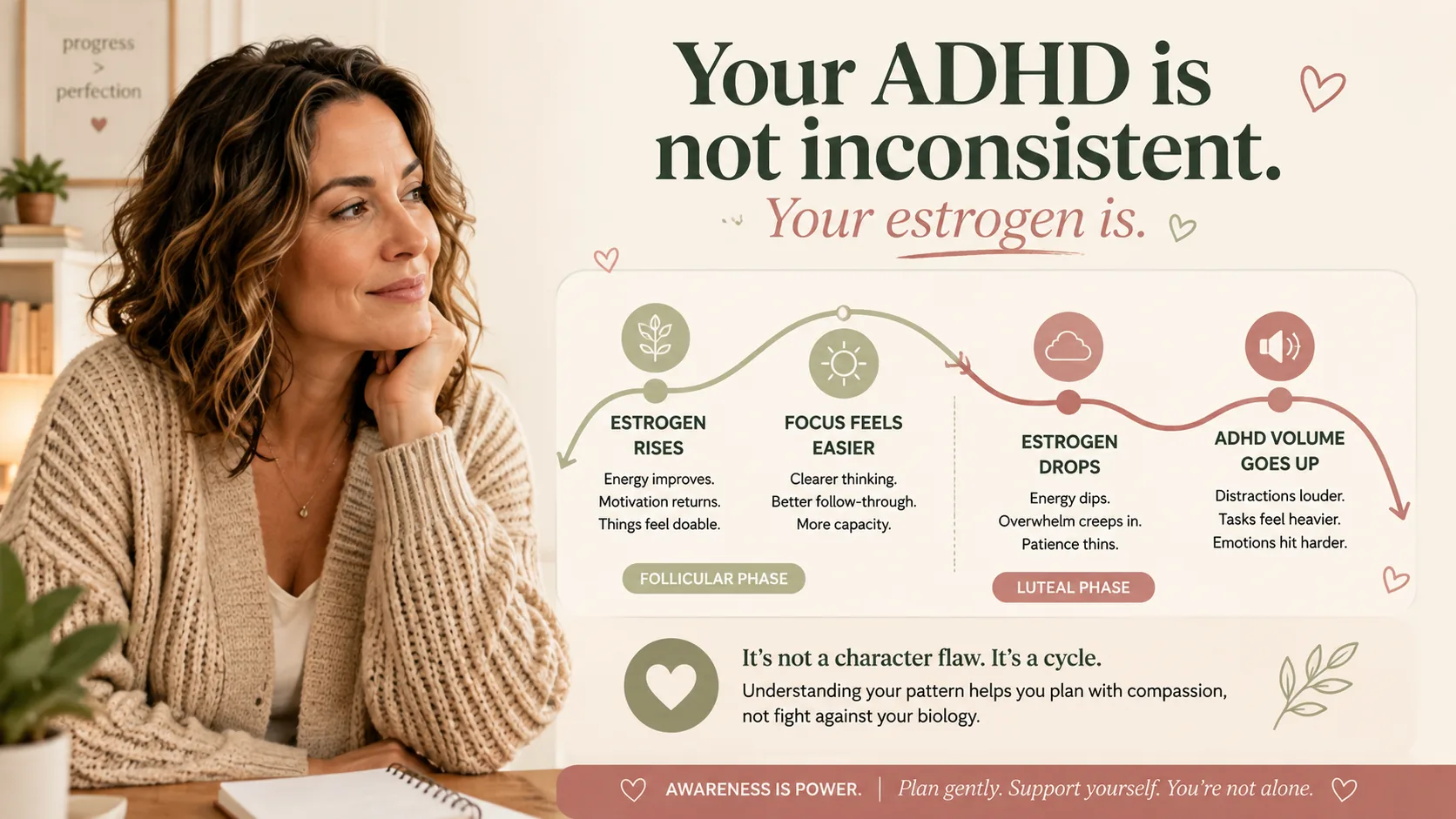
Estrogen and dopamine appear to travel together
ADHD involves dopamine systems that regulate attention, motivation and reward. Estrogen appears to support those same systems - when estrogen rises, dopamine activity tends to rise with it; when estrogen falls, it tends to fall too.
Your estrogen is not a flat line. It climbs through the first half of the cycle, peaks around ovulation, and then drops - sharply, in the days before your period. Whatever support it was lending, it withdraws it on a schedule.
Your ADHD is not inconsistent. Your estrogen is.
Your focus may not be randomly failing. For some people, hormone shifts change how much support the brain has available.
It is the drop that matters, not the level
This is the part that reframed it for me. Research points to the rate of decline in estradiol - the most active form of estrogen - as the thing associated with worsening symptoms, rather than simply how much you have.
Which explains something confusing. You can have a genuinely terrible week and then a fine one at a lower absolute hormone level. It is not the altitude. It is the falling.
How much of this is settled science?
Less than the internet implies, and I would rather say so. A 2025 narrative review of hormonal fluctuations and cognition in ADHD found the pattern showing up repeatedly - impairments in attention, executive function and impulsivity concentrated in the mid-luteal and premenstrual phases - while noting the studies are mostly small and the field is young.
So: a real and repeatedly observed pattern, not a precisely mapped one. Enough to take your own experience seriously. Not enough for anyone to tell you exactly what your cycle is doing to your brain.
From ADHD Pearls
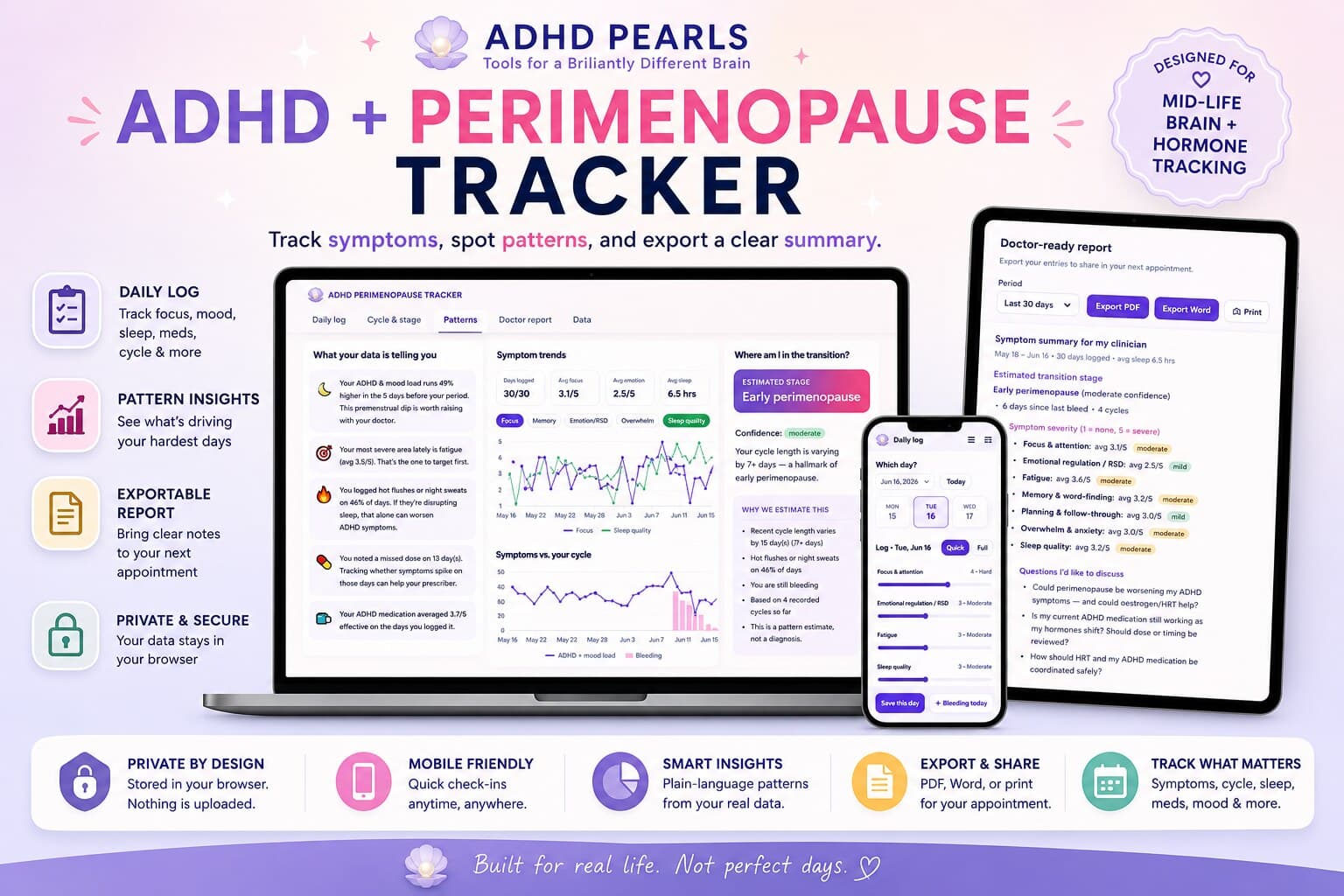
Is it ADHD, perimenopause, or both? See if there’s a pattern.
The ADHD Perimenopause Tracker logs your symptoms, sleep, meds and cycle together, estimates your transition stage, decodes your patterns, and builds a doctor-ready report — plus two printable workbooks.
Opens in a new tab — this article stays where it is.
7 free days, counted only on the days you log — just your email, no card. Then $27 once. Educational tracking tool, not a diagnosis.
It Has a Name: Premenstrual Exacerbation
When I finally found the term, something loosened. What happens to a lot of us in that week is called premenstrual exacerbation, usually shortened to PME.
It means an existing condition getting predictably louder in response to hormonal change. Not a new problem arriving every month. The same brain, turned up.
That distinction matters more than it sounds, because the alternative story - the one I was telling myself - was that I had a stable good self and a recurring broken self, and that the broken one was more honest. PME says no. You have one brain, and it is running with less support for about a week.
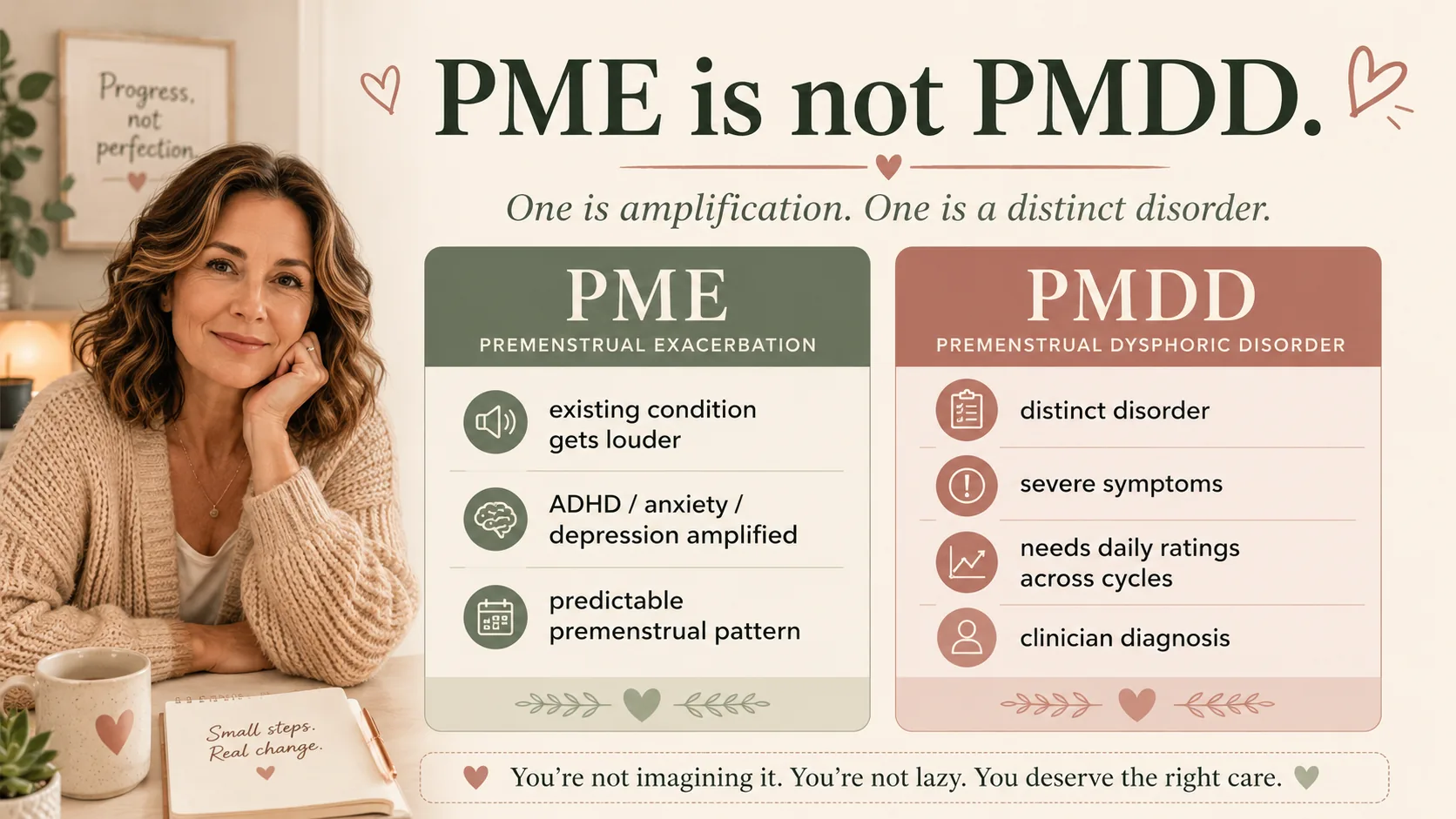
PME is not PMDD
These get used interchangeably online and they should not be.
PME is an existing condition - ADHD, anxiety, depression - amplified premenstrually.
PMDD, premenstrual dysphoric disorder, is a distinct condition in its own right, in the DSM-5, with specific criteria and a requirement for daily symptom ratings across at least two cycles before it can be diagnosed. It is severe, and it is not just bad PMS.
The reason to know both: PMDD appears to be considerably more common in women with ADHD than in the general population. A 2025 survey study in the British Journal of Psychiatry found provisional PMDD in around 31 percent of participants with a self-reported clinical ADHD diagnosis, compared with about 10 percent in the non-ADHD group. Other clinical samples have reported higher still.
PME and PMDD are not interchangeable. The distinction matters if you want the right kind of support.
Provisional means screened, not diagnosed - the daily-rating requirement was not met in a survey design. But a three-fold difference is not noise, and it is worth knowing if your premenstrual week involves more than difficulty concentrating.
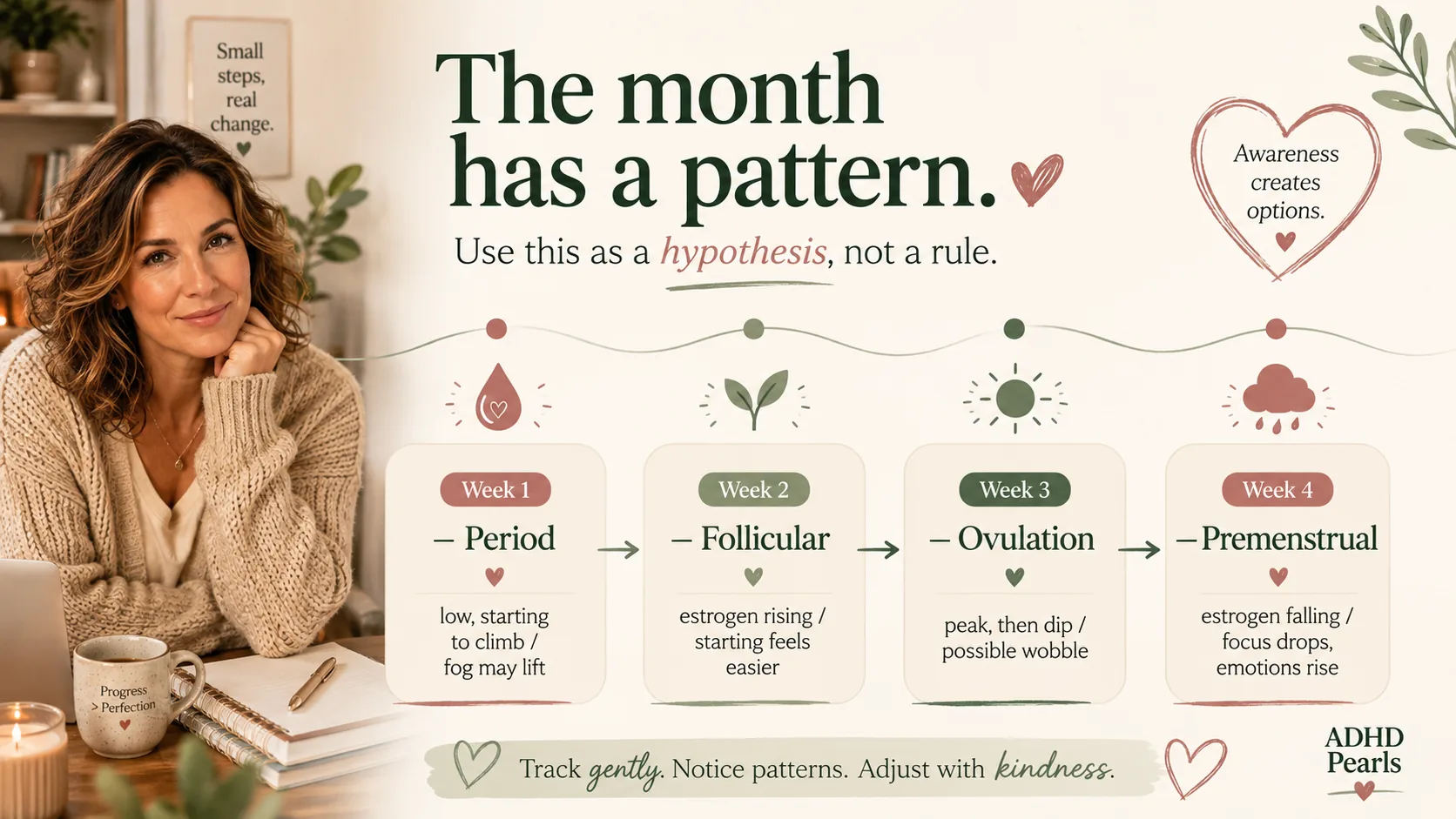
The Four Weeks, Mapped
Rough shape only. Cycle lengths vary, phases vary, and yours will not match a diagram exactly. Use it as a hypothesis to test against your own weeks, not a schedule to obey.
This is not a rigid rule. It is a starting hypothesis you can compare against your own cycle.
Roughly when
Hormones
What a lot of women notice
Week 1 - period
Low, starting to climb
Physically rough, mentally clearer than the week before. The fog often lifts before the bleeding stops.
Week 2 - follicular
Estrogen rising
The good week. Starting is easier, words arrive, plans feel plausible. This is when people commit to things.
Week 3 - around ovulation
Estrogen peaks, then dips
Often still good, sometimes a short wobble mid-week that makes no sense at the time.
Week 4 - luteal, premenstrual
Estrogen falling, progesterone up
The storm. Focus goes, emotions arrive faster and bigger, rejection sensitivity sharpens, everything feels like more.
If week four sounds like your whole personality collapsing on schedule, you are describing the thing this article is about. And if the emotional side is the loudest part, that has its own mechanism - I unpacked it in why ADHD emotions hit so hard, and the rejection-sensitivity version tends to spike in the same week, which is covered in why RSD hits ADHD women so hard.
Why Your Medication Feels Different Some Weeks
A very common experience: the same dose that works fine for three weeks seems to stop reaching in the fourth.
If estrogen supports the dopamine systems that stimulant medication acts on, it is plausible that a sharp drop in estrogen changes how well that medication seems to work. Some researchers and clinicians have discussed adjusting treatment across the cycle for exactly this reason.
Please read this part carefully. Nothing here is advice about your dose. Do not change how much medication you take, or when, on the basis of an article. What this section is for is giving you the language to raise it: my symptoms and my medication response seem to change in a consistent pattern across my cycle, and I would like to talk about whether that is relevant. That is a conversation for the person who prescribes for you.
Worth saying plainly: if a prescriber has never heard of this, that is not unusual, and it does not mean you are imagining it. Bringing written records rather than a description tends to help.
How to See Your Own Pattern
Everything above is a hypothesis until you check it against yourself. Two to three cycles is usually enough for a shape to appear.
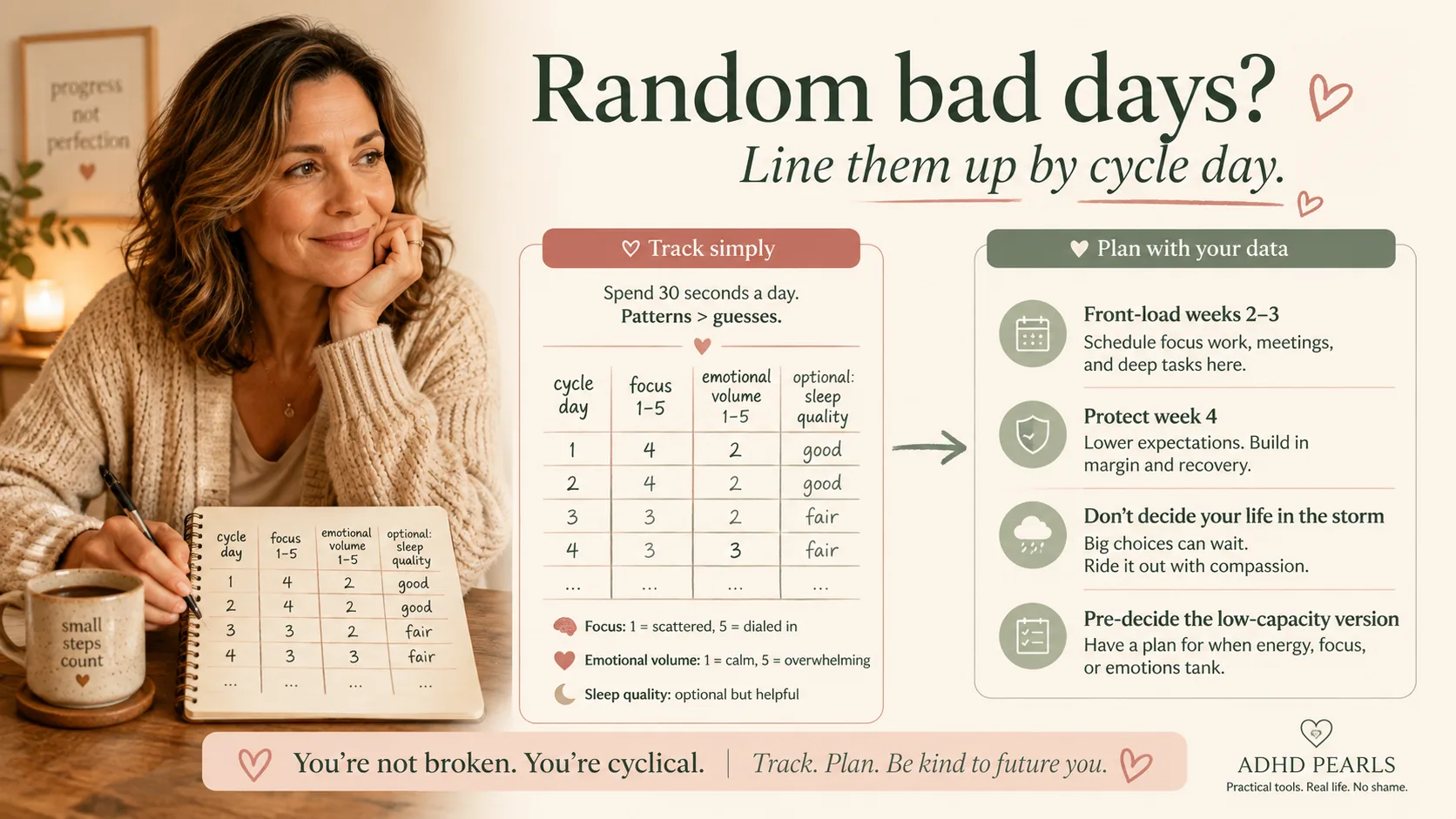
Keep it small enough that you will actually do it in week four, which is the week you will least want to. Three things, once a day:
Cycle day. Day one is the first day of proper bleeding. That is the anchor everything else hangs off.
Focus, one to five. Not a description. A number. Descriptions require energy you may not have.
Emotional volume, one to five. How big did today's feelings get relative to what caused them.
Optional fourth if you have capacity: sleep quality. It confounds everything and it is useful to be able to rule it in or out.
After two cycles, line up the numbers by cycle day rather than by date. That single change is what makes the pattern visible - by calendar date it looks like random bad days, by cycle day it usually looks like a wave.
A few seconds a day is enough to show whether the random bad days are landing in the same part of your cycle.
Planning Around the Storm Instead of Through It
The instinct is to fix week four. Try harder, sleep better, be more disciplined. I spent years on that project and it has a completion rate of zero.
What works better is treating it as weather you can forecast.
Front-load the month. Put the demanding, starting-from-scratch work in weeks two and three, on purpose. This is the single highest-value change and it costs nothing but scheduling.
Protect week four from new commitments. Maintaining is achievable. Beginning is expensive. Say yes to fewer new things in that window.
Do not make decisions about your life during it. Quitting, confronting, restructuring - all of it will still be available in ten days, and it will look different. Write it down and revisit.
Pre-decide the low-capacity version. Know in advance what the reduced week looks like, the same way you would on any low-energy day, so you are not designing it while depleted.
Tell one person. Not an announcement. Just someone who knows that a short reply in that week means less than it appears to.
When the Storm Stops Being Monthly
Everything above assumes a cycle with a shape. In perimenopause, that shape breaks down. Estrogen stops declining predictably and starts fluctuating - higher some months, lower others, without the rhythm you had learned to read.
Which is why women who had managed the monthly version for twenty years often describe midlife as the point where it stopped being manageable. The storm did not get stronger. It stopped keeping appointments.
This article is educational and is not medical advice or a diagnosis. Cyclical changes in mood and concentration can have several causes, including thyroid conditions, anaemia, depression and PMDD. If the pattern is affecting your work, relationships or safety, please speak to a qualified clinician rather than managing it alone.
FAQ: ADHD and Your Cycle
Why does my ADHD get worse before my period?
Because estrogen appears to support the dopamine systems involved in attention and motivation, and estrogen falls sharply in the days before your period. Studies of the menstrual cycle in ADHD repeatedly find attention, executive function and impulsivity are hardest in the mid-luteal and premenstrual phases. The ADHD has not changed; the support around it has.
What is premenstrual exacerbation?
PME is when an existing condition, such as ADHD, anxiety or depression, gets predictably worse in the premenstrual phase. It is not a separate disorder and it is not a new problem each month. It is the same condition amplified by hormonal change.
Is PME the same as PMDD?
No. PME is an existing condition getting louder. PMDD is a distinct disorder in the DSM-5 with its own criteria, and diagnosing it requires daily symptom ratings across at least two cycles. Some people have both, which is one reason the two get confused.
Is PMDD more common in women with ADHD?
The evidence suggests yes, considerably. A 2025 survey study found provisional PMDD in around 31 percent of participants with a clinical ADHD diagnosis compared with about 10 percent without ADHD, and clinical samples have reported higher figures. Provisional means screened rather than formally diagnosed, but the difference is large enough to take seriously.
Which week of my cycle is usually hardest?
For most women who notice a pattern, the week before their period - the late luteal phase. Some also report a short dip just after ovulation. Cycles vary a great deal, so tracking your own is more useful than assuming the average applies to you.
Why does my ADHD medication feel weaker some weeks?
Falling estrogen may change how well stimulant medication seems to work, since both act on overlapping dopamine systems. This is something to raise with your prescriber rather than adjust yourself, and taking written records to the appointment tends to make the conversation easier.
Does this happen to women who are not on medication?
Yes. The pattern is about hormonal fluctuation and its effect on attention, motivation and emotional regulation, not about medication. Medication response is one more thing that can vary across the cycle, but the underlying pattern does not depend on it.
How long should I track before I can see anything?
Two to three cycles. Record cycle day, a focus rating and an emotional-intensity rating each day, then line the numbers up by cycle day rather than calendar date. That single step is usually what turns apparently random bad days into a visible wave.
Does this get better or worse with age?
It varies. Many women find the monthly pattern becomes less predictable in their forties, as perimenopause makes hormone levels fluctuate rather than cycle. Some describe the premenstrual week as intensifying during that period. There is no single trajectory, which is another argument for tracking your own.
Save this if your ADHD feels noticeably worse before your period and you want to track the pattern without blaming yourself.
Pin this ADHD hormone pattern tracker for the next cycle.
I still have week four. It has not been cured by knowing what it is. What changed is that I no longer spend it building a case against myself, and I stopped scheduling anything that requires me to be a beginner.
The Tool I Wish Had Existed
Everything in the tracking section can be done with a notebook, and for a while that is exactly what I did. Cycle day, a number for focus, a number for emotional volume, written in the back of whatever was nearest.
What the notebook could not do was the part that actually matters: line the days up by cycle day instead of by date. That step is where the pattern appears, and doing it by hand across three cycles, in a month when your working memory is already the thing that is struggling, is a genuinely unfair ask.
So we built the thing we kept wishing for. The ADHD Perimenopause Tracker logs symptoms, sleep, medication and cycle day together, arranges them for you, and turns three months of scattered notes into something you can hand to a clinician without having to explain it from memory in a ten-minute appointment.
It was made for perimenopause, when the pattern stops being predictable and the case for having records gets urgent. The daily cycle logging underneath works from any age, which is why it belongs at the end of this article rather than only at the end of the midlife ones.
Found this helpful? Share it with someone who gets stuck too.
One tap makes ADHD Pearls a preferred source in your Google account, so our articles surface higher when you search. No signup, and it brings you straight back to this page.
Before you go
Stop trying to hold the pattern in your head.
Log symptoms, sleep, medication and cycle day in one place, then let it line the days up for you and build a report you can hand to a clinician. Made for perimenopause — the daily cycle logging works at any age.
For the woman who sets up the perfect system on Sunday and abandons it by Tuesday.
One short letter, every week. Real talk about ADHD, task paralysis, and the tiny wins that actually move the needle for a brain like yours. No shame. No hustle culture.