The first time I sat in a parking lot and could not remember why I had driven there, I told myself I was just tired.
Not in a scary, dramatic way. In a quiet, ordinary way. Engine off. Hands on the wheel. Brain completely blank.
It had been happening for months. Words sliding out of reach mid-sentence. Forgetting appointments I’d made that morning. Crying over emails. My ADHD medication felt like it had quietly stopped working, even though nothing about the dose had changed.
My doctor said it was stress. A friend said it was “just your age.” Nobody connected the dots between my ADHD and my hormones.
It turned out both things were true at once — and they were making each other worse.
Quick note: This is personal, lived-experience writing plus ADHD-informed research. It is not medical advice or a diagnosis. ADHD, perimenopause, thyroid issues, anemia, depression, and sleep problems can overlap. Please get proper medical guidance if your symptoms are affecting daily life.
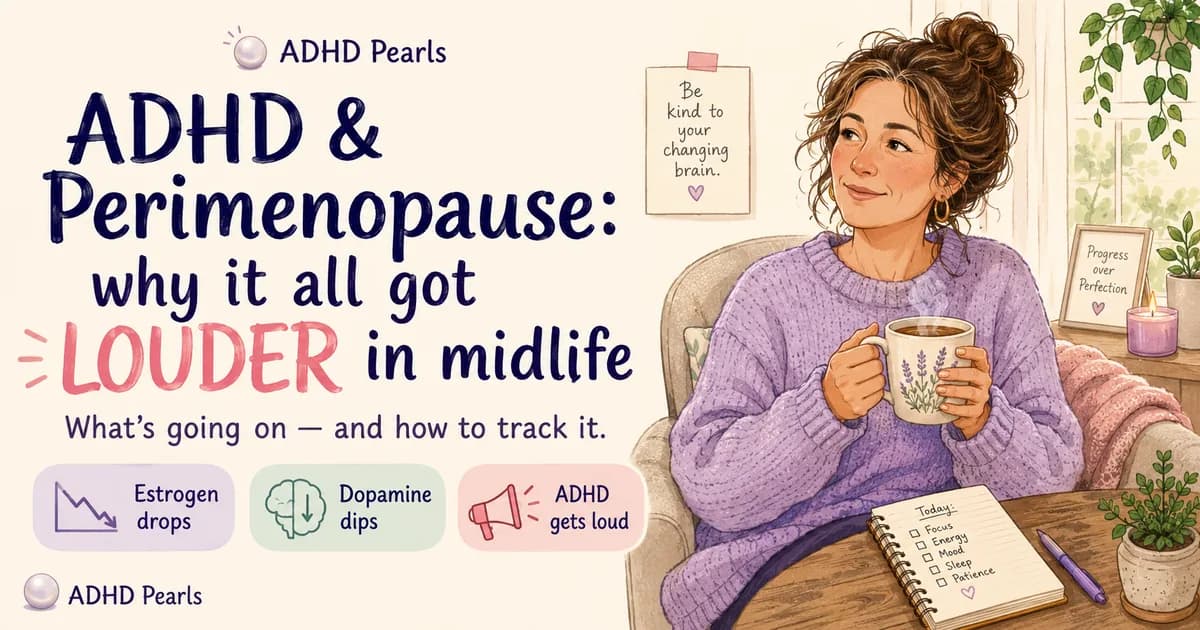
Yes — for a lot of women, it can. Estrogen helps regulate dopamine and other brain systems involved in focus, motivation and mood. Because those systems are also involved in ADHD, the hormone swings of perimenopause may make symptoms harder to manage. You are not imagining it, and you are not getting worse as a person — something real may have shifted.
Key takeaways
•Estrogen and dopamine are linked, so falling estrogen can make ADHD symptoms louder.
•Women with ADHD may hit perimenopause symptoms earlier and harder than women without it.
•It is often not ADHD or perimenopause — it is both, feeding each other.
•Your medication can feel different even at the same dose. That is worth raising with your prescriber.
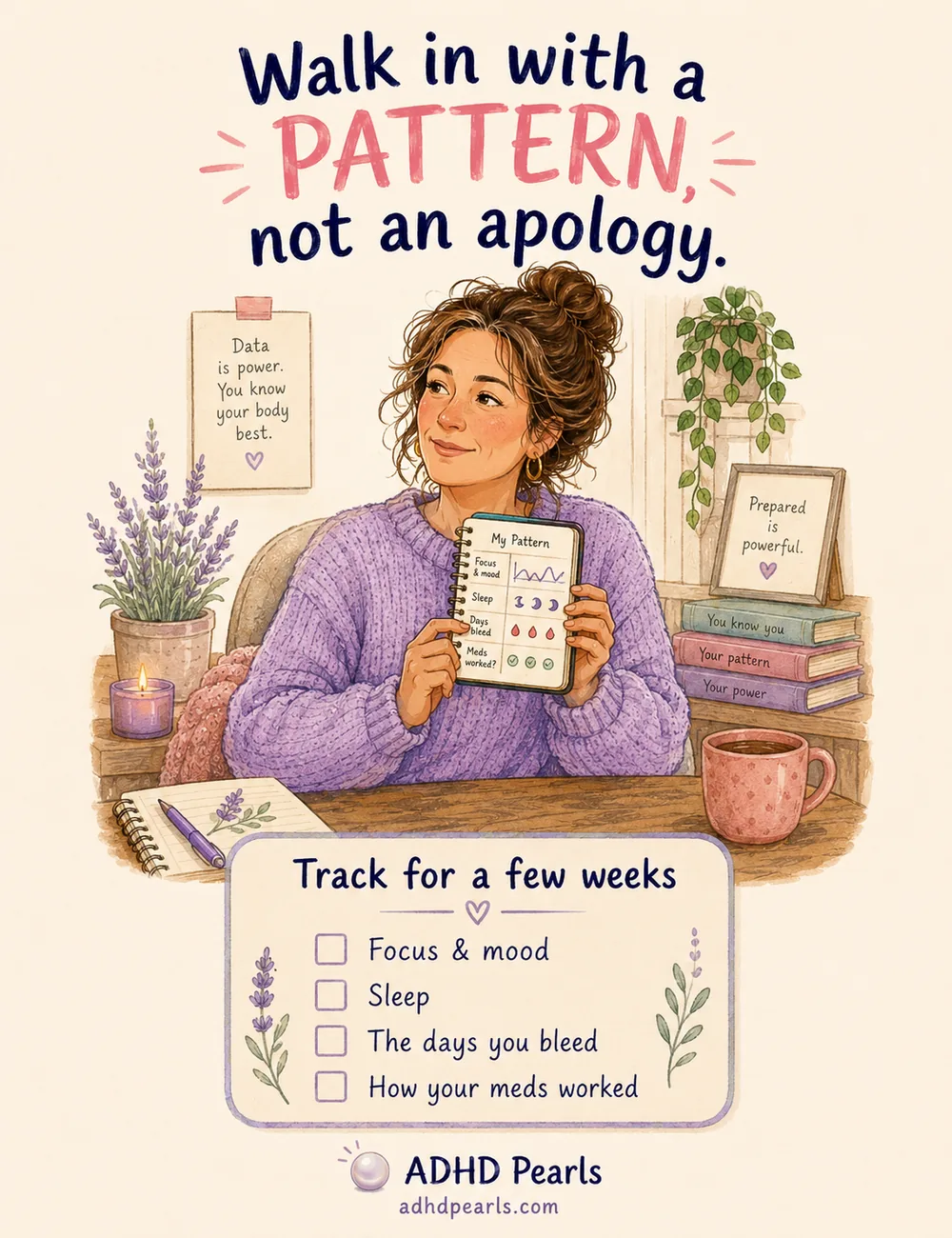
•Tracking your symptoms, sleep and cycle for a few weeks turns “I feel crazy” into a pattern a doctor can act on.
Quick definitions: Perimenopause is the hormonal transition leading up to menopause, and it can last several years. Menopause is the point when you have gone 12 months without a period, with no other cause. ADHD is a lifelong neurodevelopmental condition; perimenopause is a midlife hormonal shift. The two can overlap — but they are not the same thing.
Why ADHD and Perimenopause Collide in Midlife
Here is the part nobody explained to me.
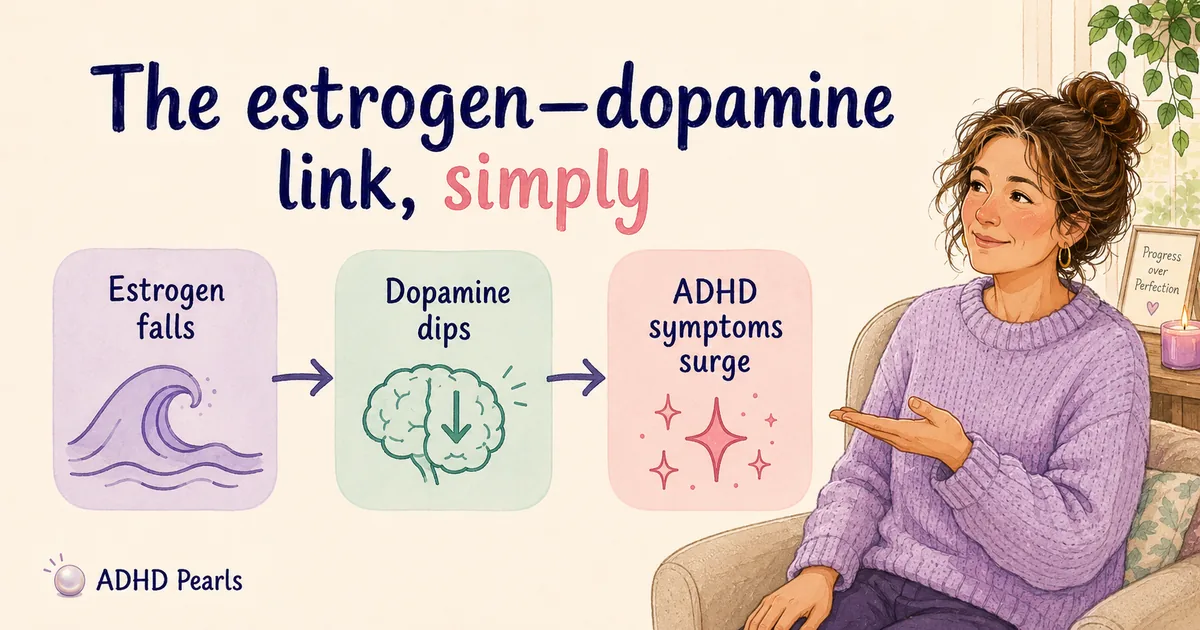
Estrogen is not just a reproductive hormone. It helps regulate dopamine — the brain chemical tied to focus, motivation and follow-through. If you have ADHD, your dopamine system already works differently. So when estrogen starts swinging and falling in perimenopause, the system that was already running lean gets less support.
Research suggests estrogen influences brain systems involved in attention, mood and dopamine-related signaling. That may be one reason so many women find their ADHD symptoms get louder during hormonal shifts. In an ADDitude survey of nearly 5,000 women, more than 90% said they noticed a change in the severity of ADHD symptoms during perimenopause or menopause.
Some research suggests women with ADHD may experience perimenopause symptoms earlier and more severely — a population-based study found differences most pronounced between ages 35 and 39. Findings are still mixed, though, so treat this as an emerging pattern rather than a settled fact.
And there is a second thing happening underneath all of it.
Sometimes perimenopause does not create the chaos. It removes the coping system that was hiding the chaos.
If you spent decades masking — over-preparing, double-checking, white-knuckling your way through — that took enormous energy. Perimenopause can drain the exact reserves you were running on. The ADHD did not appear out of nowhere. The camouflage just stopped working.
Estrogen helps your brain use dopamine. When it drops, ADHD gets louder.
From ADHD Pearls
Is it ADHD, perimenopause, or both? See if there’s a pattern.
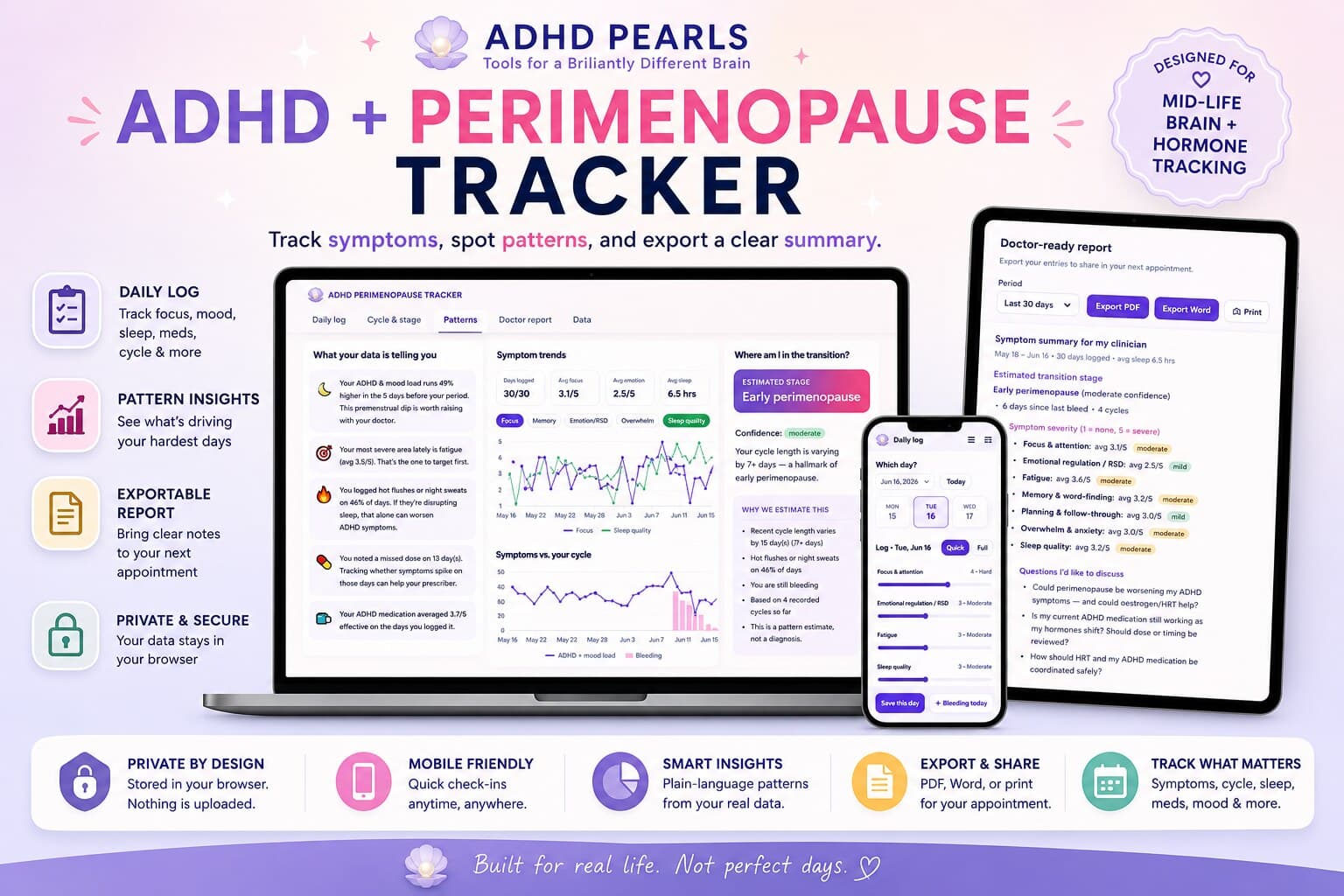
The ADHD Perimenopause Tracker logs your symptoms, sleep, meds and cycle together, estimates your transition stage, decodes your patterns, and builds a doctor-ready report — plus two printable workbooks.
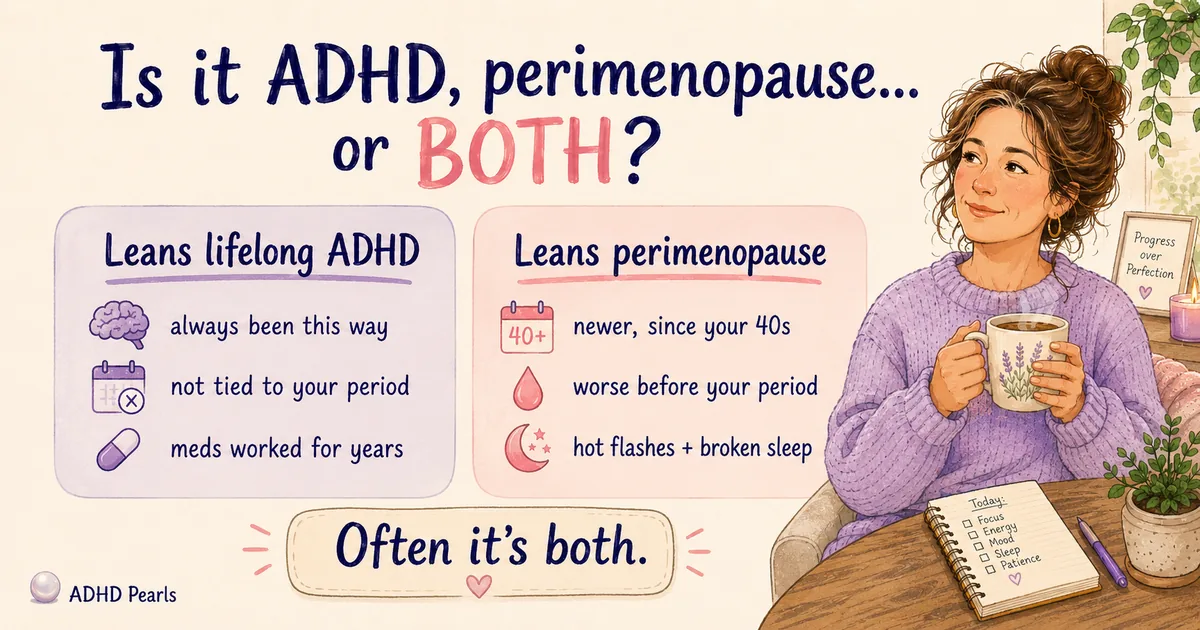
This is the question that keeps women up at 2am. And the honest answer is: it can be hard to separate, because the symptoms genuinely overlap. Brain fog, forgetfulness, overwhelm, mood swings — those show up in both.
This is not a diagnostic tool. It will not tell you what you have. But it can help you notice which way things lean, so you can ask better questions.
Signal
Points more to lifelong ADHD
Points more to perimenopause
When it started
You can trace it back to childhood or your teens, even if it was mild.
It clearly showed up or worsened in your late 30s or 40s.
Pattern over time
Fairly steady your whole life, with better and worse seasons.
A newer, faster decline that feels unlike your usual self.
Cycle link
Not strongly tied to your period.
Worst days cluster before your period, or your cycle is changing.
Physical signs
Mostly attention, organization and emotional regulation.
Hot flashes, night sweats, broken sleep, new joint aches.
Medication
Has worked consistently for you over the years.
Feels less reliable lately, even at the same dose.
Not a diagnosis — just a way to notice which way yours leans.
If you read that and thought “both columns are me” — that is incredibly common. For a lot of late-diagnosed women, midlife is when ADHD that was always there finally gets unmasked by the hormonal shift. You can read more about that experience in is it ADHD or perimenopause and why ADHD can get dramatically worse at 45.
What It Actually Looks Like Day to Day
Not the clinical list. The real one. The stuff that makes you wonder if something is wrong with you.
•Losing words mid-sentence, then covering for it so no one notices.
•Walking into a room and forgetting why — constantly, not occasionally.
•Crying or snapping over things that would not have touched you a year ago.
•Lying awake at 3am, then running on empty all day.
•Systems that used to hold you together — suddenly falling apart.
•Quietly wondering if this is early dementia. (Brain fog is very common in perimenopause and dementia in midlife is rare — but new or rapidly worsening changes are worth checking with a doctor.)
Get urgent medical care for sudden confusion, new trouble speaking, weakness on one side, or a severe, unusual headache. Those are not typical perimenopause symptoms.
Why Your ADHD Meds Might Feel Like They Stopped Working
This one blindsided me, so I want to name it clearly.
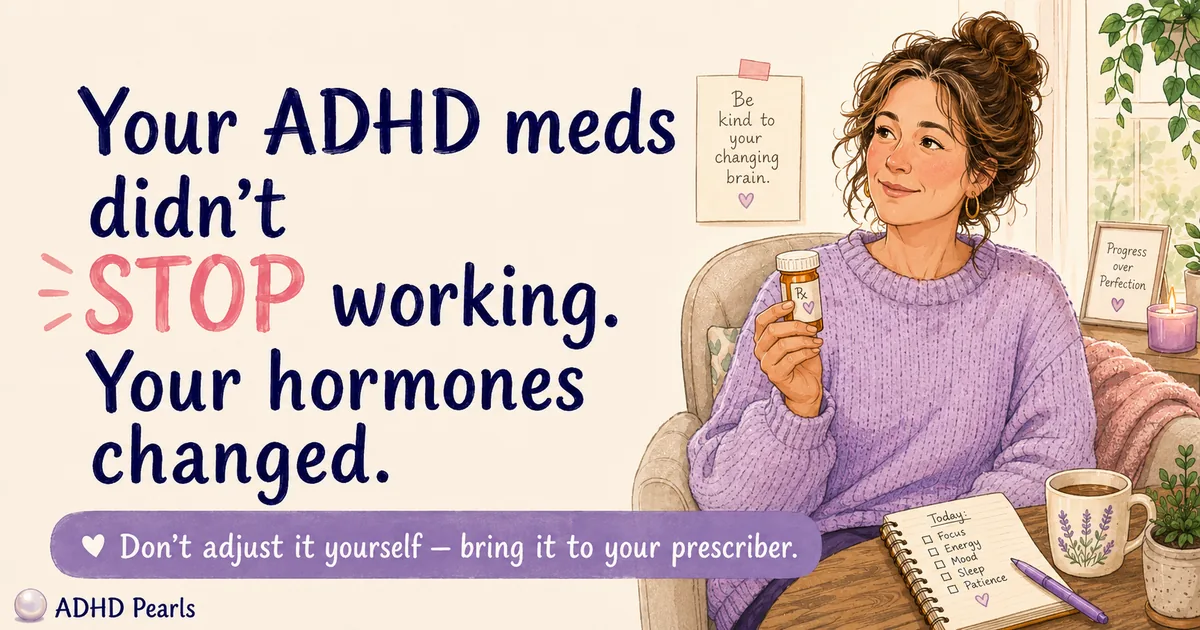
You can take the exact same dose you have taken for years and feel like it barely touches anything. That does not mean you are broken or building tolerance in some shameful way.
Because estrogen supports dopamine signaling, falling and fluctuating estrogen may change how well stimulant medication seems to work for some women. There are no randomized trials in perimenopausal women yet, so the direct evidence is still limited — but it is a real, widely reported experience, and a legitimate thing to raise.
Same dose, different effect — and you’re not imagining it.
What I want you to hear: do not quietly adjust your own medication. Do not double up, skip days to “reset,” or decide it is your fault. Bring it to the person who prescribes it, and bring data (more on that next).
How to Track the Pattern
Here is the single most useful thing I did. I stopped trying to explain the chaos from memory and started writing it down.
Not a full journal. I do not have the capacity for that, and neither do you on a hard day. Just a few quick things, most days, for a few weeks:
•Focus and memory, rough 1–5.
•Mood, irritability, rejection sensitivity.
•Sleep — how many hours, and why it broke.
•The days you bleed, so your cycle becomes visible.
•Hot flashes or night sweats.
•Your medication — whether you took it, and how well it worked.
After a few weeks, something shifts. Your worst days stop looking random. They start clustering — before your period, after bad sleep, in the same week each month. That is not chaos. It is a pattern, and a pattern is something you can actually talk about clearly.
A few weeks of quick notes turns “I feel crazy” into a pattern a doctor can act on.
If you want this done for you instead of wrangling a notebook, that is exactly what the ADHD Perimenopause Tracker is for — it logs all of this, estimates where you are in the transition, and builds the summary for you. But a paper notebook works too. The tool is the easy button, not the requirement.
What to Say to Your Doctor
Current NICE guidance says that for women 45 and over, perimenopause can usually be identified from symptoms — recent changes to your cycle plus symptoms like hot flashes — without blood tests. So you do not need a lab result to start the conversation. You need to be heard.
Walk in with your tracked data and lead with your top concerns. A few things worth asking:
•Could perimenopause be making my ADHD symptoms worse?
•Could hormone therapy help my menopausal symptoms — and might better sleep, fewer hot flashes or steadier mood make focus easier?
•How would HRT and my ADHD medication work together?
•Should the dose or timing of my ADHD medication be reviewed as my hormones change?
One important caveat on HRT: it is not an ADHD treatment, and it is not generally prescribed just to improve memory or focus. But by easing menopausal symptoms like hot flashes and broken sleep, it may indirectly make concentration easier for some women. There are no studies looking specifically at HRT in women with ADHD yet, and it is not right for everyone — it is a genuine conversation to have with a qualified clinician who knows your history, not a fix to assume. Menopause specialist Dr. Louise Newson has written usefully about the hormone–ADHD overlap if you want to read more before you go.
If you have spent years being dismissed, that history is real, and it is exhausting. You are allowed to take up the appointment. You are allowed to bring notes. And if one door closes, you are allowed to ask for a referral to a menopause or ADHD service. None of this is you being difficult. This is you advocating for a brain that deserves support.
What we still don’t know
It is worth being honest about the limits here. There are currently no randomized controlled trials testing ADHD medication strategies specifically in perimenopausal women, and the effect of hormone therapy on ADHD outcomes has not been formally established. A lot of what we have is women’s reported experience plus a still-growing body of research. That is exactly why tracking your own pattern helps — it gives you and your doctor real data to work from while the science catches up.
FAQ
Can perimenopause cause ADHD? No. Perimenopause does not cause ADHD — ADHD is a neurodevelopmental condition whose symptoms begin in childhood, even if no one recognized it until adulthood. But hormonal changes can unmask ADHD that was always there but masked or mild, which is why some women are diagnosed for the first time in midlife.
Why did my ADHD get so much worse in my 40s? For many women, falling estrogen reduces support for the dopamine system, and years of masking finally run out of fuel. The combination can make long-managed symptoms feel suddenly unmanageable.
Can HRT help ADHD symptoms? For some women it may help with focus, memory and mood by stabilizing estrogen, but the evidence specific to ADHD is still limited. Whether HRT is right for you is a decision to make with a qualified clinician.
Why do my ADHD meds feel like they stopped working? Because estrogen supports dopamine signaling, fluctuating or declining estrogen may change how well stimulant medication seems to work for some women. Do not adjust your dose yourself — raise it with your prescriber.
How long should I track my symptoms before seeing a doctor? A few weeks to two or three months is usually enough to reveal a pattern, especially the link between your symptoms and your cycle.
Do I need a blood test to confirm perimenopause? If you are 45 or over, current NICE guidance says perimenopause can usually be identified from your symptoms and cycle changes, without blood tests.
What should I actually write down each day? Keep it small enough that you will keep doing it: a rough symptom rating, sleep quality, where you are in your cycle if it is still trackable, and anything unusual. Two lines a day beats a detailed log you abandon after a week.
What if my doctor dismisses the ADHD part? Bring written records rather than descriptions, and ask specifically what would need to be documented for them to take it further. If you keep hitting a wall, seeking a second opinion or a clinician with experience in both ADHD and menopause is reasonable rather than difficult.
Is it too late to get assessed for ADHD in my late 40s? No. Assessments happen at every age, and many women are diagnosed in their 40s and 50s. An assessment does look for evidence that traits were present in childhood, which is why old school reports or a family member's recollection can be useful to bring.
If you have been quietly grading yourself as “getting worse” — please put the red pen down.
You did not get lazier or less capable. Something real shifted, and nobody handed you the map. The fact that you held it together this long, with this little support, is not evidence that you are failing. It is evidence of how hard you have been working.
Start writing it down. Find your pattern. Walk into that appointment with proof instead of apologies.
This article is personal and educational. It is not medical advice. ADHD, perimenopause, depression, anxiety, thyroid issues, sleep disorders, anemia, medication side effects, and other health conditions can overlap. Please get proper medical guidance if your symptoms are affecting daily life.
Found this helpful? Share it with someone who gets stuck too.
One tap makes ADHD Pearls a preferred source in your Google account, so our articles surface higher when you search. No signup, and it brings you straight back to this page.
Before you go
Stop trying to hold the pattern in your head.
Log symptoms, sleep, medication and cycle day in one place, then let it line the days up for you and build a report you can hand to a clinician. Made for perimenopause — the daily cycle logging works at any age.
For the woman who sets up the perfect system on Sunday and abandons it by Tuesday.
One short letter, every week. Real talk about ADHD, task paralysis, and the tiny wins that actually move the needle for a brain like yours. No shame. No hustle culture.