This article is personal and educational. It is not medical advice. ADHD, perimenopause, depression, anxiety, thyroid disorders, sleep disorders, anemia, and other health conditions can overlap and interact. If your symptoms are affecting daily life, please speak with a qualified clinician who takes your experience seriously.
You got eight hours of sleep. You are technically rested. And still, you are sitting in the car in the driveway because going inside — into the noise, the dishes, the three people who will immediately need things — requires something you do not currently have.
It is not that you are sad. It is not that you are sick. You just need … a minute. Maybe five. Maybe twenty. Long enough to gather something back before you have to start being a person again.
If you recognize that, you are in the right place.
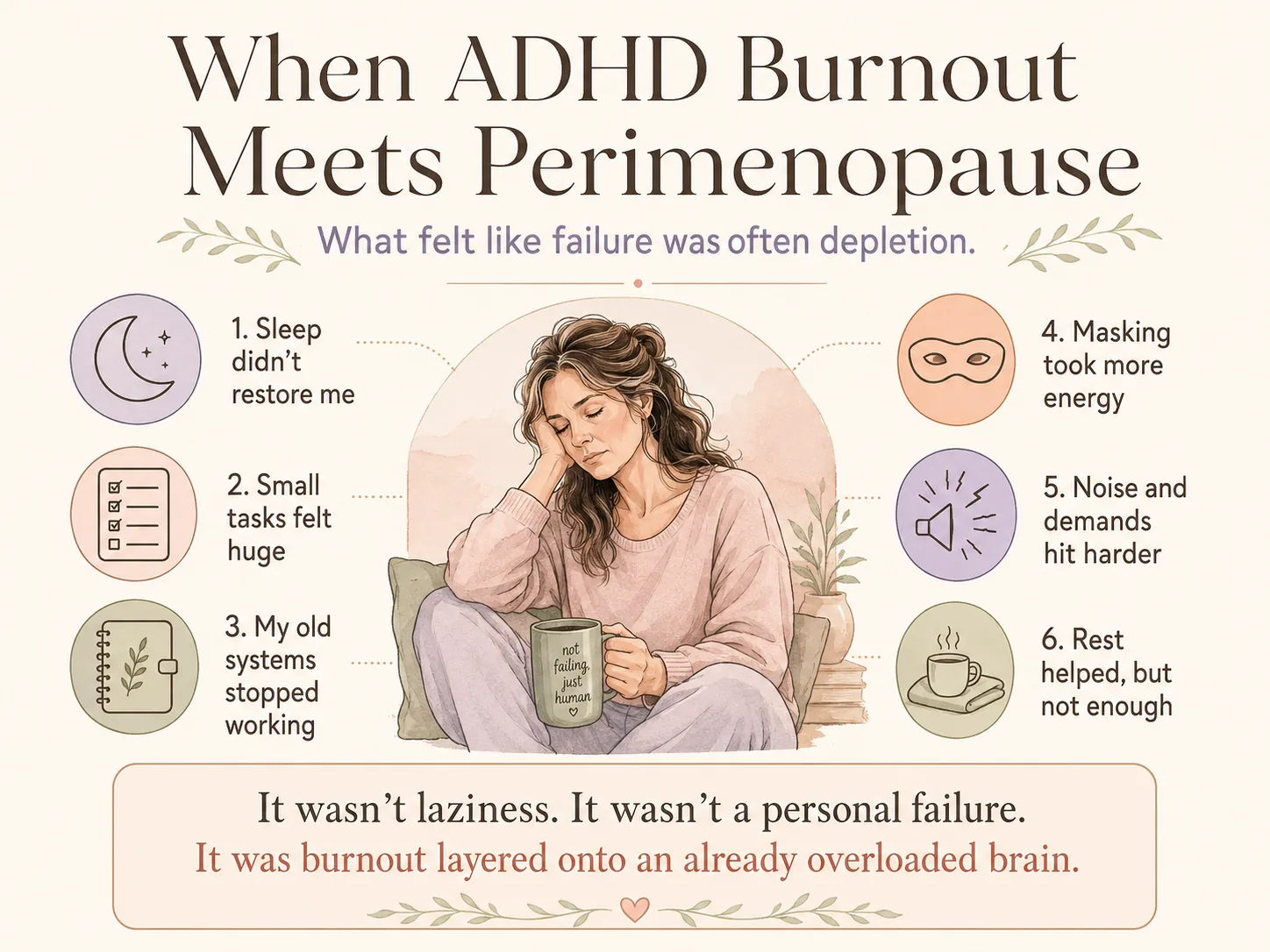
What many women describe as “I just burned out” or “I suddenly got so much worse” in perimenopause is often a combination of things arriving at once: ADHD overload that has been building for years, hormonal shifts that reduce the buffer, a life that is objectively heavier, and a nervous system that has been running a compensation engine that nobody could see — including you.
This is not weakness. This is what happens when the margin finally runs out.
Quick answer
Can perimenopause make ADHD burnout worse?
Yes — for many women, it can. Perimenopause may affect sleep, mood regulation, attention, and stress tolerance. When these hormonal shifts arrive alongside years of accumulated ADHD masking, compensation fatigue, and midlife life-load, the result can feel like a sudden crash. It usually is not sudden. It is a long-running deficit that finally ran out of margin. Understanding the combination — ADHD overload plus hormonal disruption plus reduced recovery capacity — is key to finding what actually helps.
Key takeaways
📌ADHD burnout in perimenopause is often a combination of ADHD overload, hormonal shifts, and accumulated masking fatigue — not just stress.
📌Sleep may not fix the exhaustion when the nervous system itself is depleted.
📌Old coping strategies can stop working when the buffer they depended on gets smaller.
📌Masking — performing competence and composure — becomes harder and more expensive in midlife.
📌Low-stimulation recovery is different from doing nothing. It is a real, active form of recovery.
📌New or worsening symptoms deserve medical attention — not dismissal.
I want to be specific here, because vague descriptions of burnout are everywhere and most of them did not help me recognize what I was experiencing.
It felt like this: I would wake up from what should have been a full night of sleep, and there would be nothing there. Not groggy-nothing. Just … flat. Like the morning had already asked too much before I had gotten out of bed.
Tiny things felt loud. The sound of someone loading the dishwasher in the next room. Notifications. A question I had to answer. The visual clutter of a counter with too many things on it. None of it was objectively loud. But my nervous system was receiving it all at full volume, all at once, with no filter left.
I started sitting in the car.
Not because anything bad had happened. Not because I was avoiding a fight or a hard conversation. Just because the inside of my car was quiet, and quiet had become something I was rationing. I would sit there for five minutes, sometimes ten, doing the quiet math: how much do I have, how much will this cost, can I actually do this today.
I got snappy over things that should not have mattered. The wrong tone of voice. A plan that changed. Socks left on the floor for the fourth time. I knew in real time that I was overreacting. I could not stop it. There was no gap between the irritant and the response — the emotional regulation I used to have access to was just gone.
I stopped making plans. Not because I didn’t want to. Because picturing a future commitment — even something I used to enjoy — produced a kind of dread I could not explain. The anticipation of having to be a person, competently, at a specific time, felt like too much.
Burnout does not always look dramatic. Sometimes it looks like sitting in the driveway. Sometimes it looks like not texting people back. Sometimes it looks like being perfectly fine on the outside while running completely empty on the inside. All of those count.
The house didn’t get harder. My capacity to absorb it did.
From ADHD Pearls
Is it ADHD, perimenopause, or both? See if there’s a pattern.
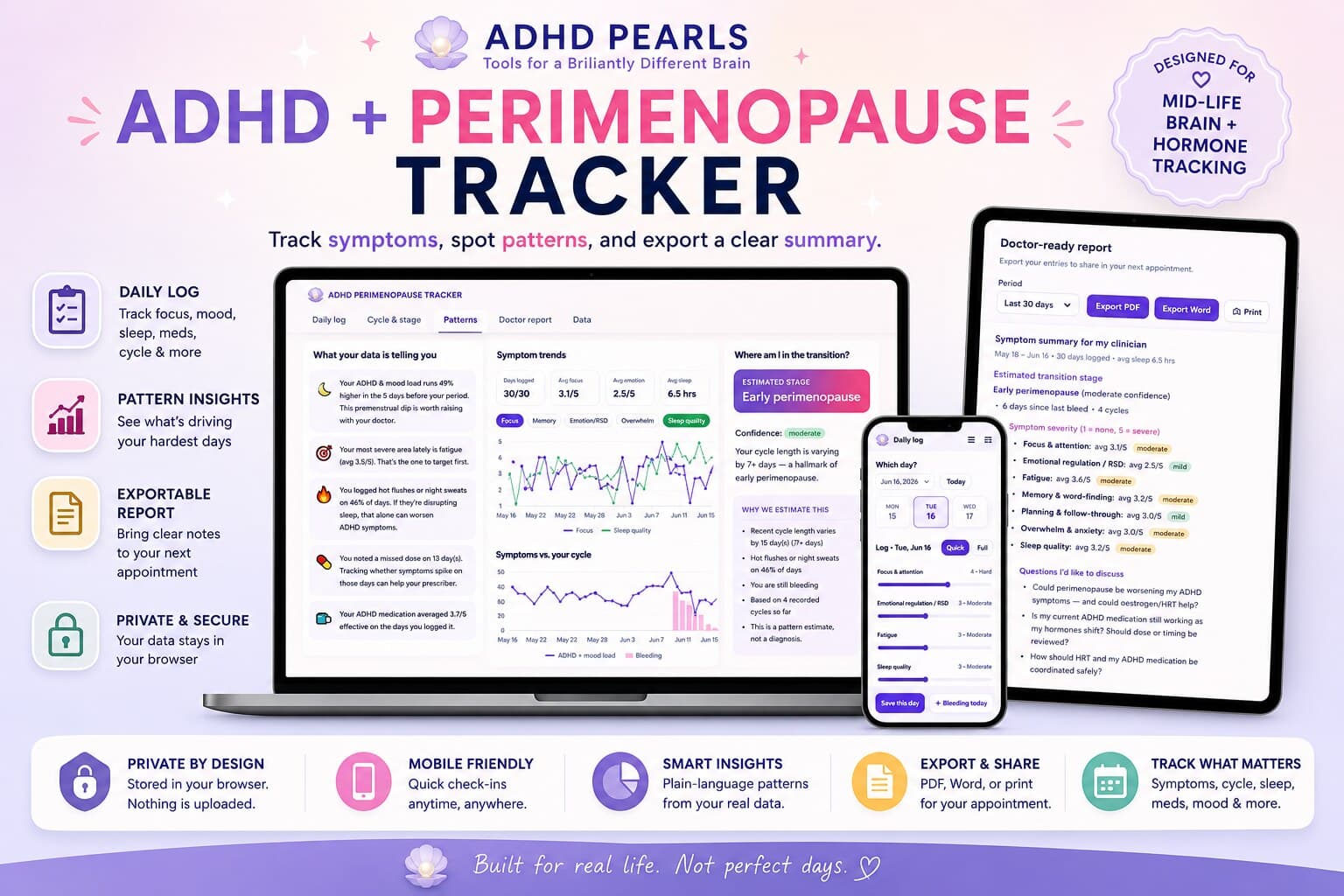
The ADHD Perimenopause Tracker logs your symptoms, sleep, meds and cycle together, estimates your transition stage, decodes your patterns, and builds a doctor-ready report — plus two printable workbooks.
Opens in a new tab — this article stays where it is.
7 free days, counted only on the days you log — just your email, no card. Then $27 once. Educational tracking tool, not a diagnosis.
Why perimenopause can intensify ADHD burnout
Perimenopause is not a single event. It is a years-long hormonal transition — estrogen and progesterone fluctuating, then declining — and both of those hormones interact with neurotransmitters that ADHD brains already have complicated relationships with.
Estrogen, in particular, may support dopamine function and serotonin regulation. Research suggests that as estrogen fluctuates and declines, some women notice that ADHD symptoms — attention, emotional regulation, impulse control, working memory — become harder to manage. This is not imaginary. For many women, there may be a real biological and neurological layer to what they are experiencing — and that is worth taking seriously.
But the hormones are only one part of what is happening. There are several layers:
Sleep disruption. Perimenopausal sleep changes — night sweats, lighter sleep, early waking — can mean that even adequate hours of sleep do not produce adequate recovery. ADHD already affects sleep architecture for many people. Add hormonal disruption and the baseline gets lower.
Midlife life-load. Women in their 40s and 50s are often carrying more than they ever have: careers at a demanding stage, teenagers or young adults, aging parents, the administration of an entire household, the invisible mental load that has no clock-out time.
Accumulated compensation fatigue. Many women with ADHD spent two or three decades developing elaborate workarounds — systems, masks, scripts, strategies. Those workarounds were never free. They were borrowed energy. By midlife, the interest rate on that borrowing can arrive all at once.
Reduced recovery capacity. When sleep is disrupted, stimulation load is high, and hormonal fluctuations are affecting emotional regulation, the ability to recover between demands shrinks. What used to take a weekend to reset from might now take a week.
If you have been wondering whether you just “got worse” — whether something broke — this is usually what happened. You did not break. The conditions changed, and the margin you had been depending on quietly ran out.
The cycle: each element makes the others harder. None of it is your fault.
The kind of tired sleep doesn’t fix
There is ordinary tiredness — the kind that responds to sleep, a quiet weekend, a long nap. And then there is this other thing. The kind where you have technically rested, technically had enough hours, technically done everything right — and still wake up already used up.
I slept. I slept well by the numbers. And I would come downstairs in the morning and the smallest question — “what do you want for breakfast?” — would feel like it was coming from too far away. Like there was a pane of glass between me and the rest of the day.
This is nervous system depletion. It is different from muscle fatigue. It is the result of sustained overstimulation, emotional regulation labor, decision-making, masking, and the chronic low-grade effort of managing an ADHD brain in a world that was not built for it — amplified by hormonal disruption that affects sleep quality and stress response.
Sleep helps. But sleep cannot fully restore a system that is still being overdrawn during all the waking hours. The depletion fills back in at night, and empties out again by mid-morning.
Some things that can contribute to sleep not restoring:
Perimenopausal sleep disruption (night sweats, light sleep, early waking)
Chronic sensory overload that does not fully unwind overnight
Executive function strain that runs even in the background
Emotional regulation labor — the effort of managing RSD, anxiety, and hypervigilance
The anticipatory load of tomorrow arriving before today is over
If you are consistently waking up tired despite adequate sleep, please talk to a doctor. Unrefreshing sleep can have treatable medical causes — sleep apnea, thyroid dysfunction, anemia, hormonal factors — that deserve proper evaluation, not just acceptance.
Sleep was there. Rest was not.
When masking gets more expensive
Masking is the effort of performing neurotypicality — appearing organized, attentive, and composed while privately tracking five things, running social scripts, and spending four times the energy most people use to follow a conversation.
Most women with ADHD have been doing this for so long it does not feel like effort anymore. It just feels like Tuesday.
The problem is that it was always effort. The bill was always being charged. And in perimenopause, when sleep is disrupted and hormonal regulation is unstable and the emotional buffer is already thin, the same masking that used to cost one unit now costs three. And the recovery time doubles.
I remember leaving a two-hour meeting where I had, by any external measure, done fine. Contributed. Tracked the conversation. Made the right face at the right moments. And I came home and lay down on the floor — not the sofa, the floor — for twenty minutes before I could form a coherent thought.
The people in that meeting saw a competent woman. They did not see the four hours of recovery time. They did not see the snappiness afterward, the inability to make a simple dinner decision, the strange emotional flatness that sometimes follows sustained masking.
This is not weakness. This is a resource management problem. Masking hides distress from the outside world while making it louder inside. And in perimenopause, the inside is already louder.
If you have been feeling like your social reserves are smaller — if you need more alone time, more quiet time, more time between obligations — that is probably not a personality change. It is your system telling you that the overhead costs went up and the budget did not.
The car was the only place nobody needed me to be okay.
Low-stimulation recovery vs productivity recovery
When you are burned out, the standard advice is usually about productivity: better systems, better habits, more discipline, more structure. Get back on track. Use your time better. Make a plan.
I tried all of that. More than once. And every attempt to push through with better systems made me feel worse, not better, because a nervous system in deficit does not need more demands. It needs less stimulation.
This distinction matters: there is productivity recovery (doing less, organizing more efficiently, taking a day off and then getting back to output) and there is low-stimulation recovery (actually reducing the input load, the sensory noise, the decision count, the social obligations, the emotional labor — until the system can rebuild its own baseline).
Productivity recovery works when you are tired. Low-stimulation recovery is what is needed when you are depleted.
The difference between tired and depleted is not drama. It is direction. Tired moves toward rest and wakes up better. Depleted can rest for days and still wake up at a deficit if the stimulation load is still high.
Low-stimulation recovery might look like:
🎧 Reducing background noise and screen time, not just sitting quietly
📵 Smaller social obligations, not larger ones to “feel better”
🌿 Doing things that produce calm without requiring production — a walk, a shower, sitting outside, something with hands
⏸️ Letting recovery happen without earning it first
That last one is the hardest. The instinct when you are behind and depleted is to earn the rest. To get enough done to justify the quiet. But depletion does not respond to earning logic. The system cannot restore itself while it is still spending.
Recovery is not the same as doing nothing. It is doing less of everything that costs.
What actually helped more
Not what I hoped would help. Not the perfect system, the new planner, the morning routine overhaul. What actually moved the needle.
Lowering stimulation before requiring discipline
I stopped trying to force output when the stimulation load was still high. Instead: fewer things on before the thing I needed to do. Less noise, fewer notifications, fewer micro-decisions before the important one. The task became more accessible when I stopped arriving at it already drained.
Fewer decisions per day
Decision fatigue is real for ADHD brains at baseline. In burnout, it hits faster and harder. Pre-deciding anything I could pre-decide — meals, what to wear, what the next step on a project was — reduced the daily drain considerably. Not because decisions are hard. Because there is a finite supply of good decisions per day and I was wasting them on things that did not need to be decided in real time.
Smaller re-entry points
Instead of “I need to catch up on everything,” one tiny action. One email, not the inbox. One task on one project, not the project review. The entry point being small enough that it did not require motivation — just a willingness to be in the vicinity of the thing.
Honest capacity check-ins
Not “how productive have I been?” but “what do I actually have today?” Starting with an honest read of my actual capacity rather than my planned capacity. Then matching demands to that, rather than to what I thought I should be able to handle.
This felt like accepting defeat at first. It was actually the only thing that produced sustainable output over weeks rather than over days.
Reducing sensory load
The kitchen that looked overwhelming often became manageable once I cleared the counter. The project that felt impossible was sometimes easier once I closed all the tabs. Environmental clutter translates directly to cognitive load for ADHD brains. Addressing the sensory environment was sometimes the most effective productivity strategy available.
Gentle routines instead of perfect systems
Routines that survived a bad day. Routines that required the minimum, not the ideal. Not a beautiful morning ritual but a five-minute anchor. Not a full evening routine but one thing that signaled transition. Perfection systems collapse. Minimum viable routines persist.
Permission to recover without earning it
This was the hardest and also the most important. The depletion is not a punishment for bad habits. It is information. Rest is not a reward for output. It is a biological requirement. The recovery period is not wasted time — it is the period during which the system rebuilds enough capacity to eventually produce again.
You do not need to earn it. You just need to take it.
When ADHD burnout in perimenopause shows up like this…
What it looked like
What it was really signaling
What helped more
Sleeping 8 hours but waking up wrecked
Nervous system depletion, not just physical tiredness; possibly disrupted sleep architecture from hormonal changes
Reduce stimulation load during the day; get evaluated for sleep and hormonal factors
Sitting in the car before going inside
Transition exhaustion; needing a buffer between roles and environments when capacity is low
Protect transition time; reduce the demands waiting inside where possible
Getting snappy over tiny things
Emotional regulation running on empty; hormonal fluctuations may shorten the window between trigger and response
Name it as capacity, not character; lower stimulation before re-entering high-demand environments
Needing silence more than motivation
Sensory overload and input saturation; the system is full, not unmotivated
Low-stimulation recovery before performance; quiet is not laziness — it is recalibration
Household tasks feeling weirdly impossible
Executive function depletion; task initiation requires activation energy that is not currently available
Reduce the visible clutter first; use a single-step entry point rather than the full task
Feeling like even planning takes too much
Working memory and decision fatigue at capacity; planning is a high-cost cognitive task when reserves are depleted
Pre-decide as much as possible; use a single visible next step rather than a full plan
If your old system only works when you are already running on fumes, you do not need a louder planner. You need a lighter way back in. Perlova starts with how you feel right now — not how you were supposed to feel.
A note on getting support
If what you are experiencing feels new, or significantly worse than before, please do not dismiss it as just stress or just getting older. New and worsening symptoms deserve medical evaluation.
ADHD, perimenopause, thyroid dysfunction, depression, anxiety, sleep apnea, and anemia can all produce overlapping symptoms and can all be treated. A clinician who is knowledgeable about both ADHD and perimenopause is worth seeking out. You should not have to choose between getting your hormones evaluated and getting your ADHD taken seriously.
You are not too much. You are not broken. You are a person whose nervous system has been working very hard for a very long time, and whose conditions changed in ways that made the old strategies stop working. That is a capacity problem, not a character problem. It means you need different support, not more willpower.
FAQ: ADHD burnout in perimenopause
Can perimenopause make ADHD burnout worse?
Yes — for many women, it can. Perimenopause may affect sleep, mood regulation, attention, and stress tolerance. When these shifts arrive alongside accumulated ADHD masking and compensation fatigue, the result can feel like a dramatic crash. It is usually not sudden. It is a long-running deficit that ran out of margin.
Why am I still tired even after sleeping?
Sleep restores the body but not always the nervous system — especially when sleep itself is disrupted by hormonal changes, or when the exhaustion comes from sustained overstimulation, emotional labor, and masking. This is a different kind of tired. If unrefreshing sleep is ongoing, talk to a doctor to rule out sleep apnea, thyroid issues, anemia, and hormonal factors.
Is this burnout, perimenopause, or both?
Often both — and they can feed each other. Perimenopause can reduce sleep quality and stress tolerance, making ADHD harder to manage. ADHD burnout can make perimenopausal symptoms feel more severe. You do not need to fully untangle them before getting support. What matters is that you are struggling, and that is worth taking seriously.
Why do old ADHD coping strategies stop working?
Many ADHD coping strategies were built on urgency, shame, masking, and adrenaline. They worked because the body had enough buffer to absorb the cost. In perimenopause, that buffer may shrink. Sleep disruption, hormonal fluctuations, and increased life load reduce recovery capacity, making expensive strategies harder to sustain. See: Why ADHD Strategies Stop Working After 45.
What helps when I feel overstimulated and depleted?
Less input before more output. Reducing sensory load, decision demands, and social obligations before trying to produce or perform. Smaller re-entry points, genuine rest without earning it first, and reducing friction rather than adding motivation. The ADHD Dopamine Menu can help on low-capacity days.
When should I talk to a doctor about new or worsening symptoms?
If you are experiencing new or significantly worsening symptoms — extreme fatigue, mood changes, cognitive difficulties, or a feeling that your capacity has substantially dropped — do not brush it off as stress. These symptoms can have treatable hormonal, neurological, and metabolic causes. Please get evaluated. You deserve to be taken seriously.
What is low-stimulation recovery?
Low-stimulation recovery means reducing input — noise, screens, decisions, social demands, visual clutter, and emotional labor — so the nervous system has a chance to rebuild capacity. It is different from doing nothing. It is active recovery for a system that has been overloaded. The goal is not productivity. It is restoration.
Can ADHD burnout look like laziness?
Yes. From the outside, ADHD burnout can look like avoidance, low motivation, or laziness. Inside, it often feels like depletion, overstimulation, emotional flatness, and an inability to access the first step on even simple tasks. That does not mean every struggle is burnout, but it does mean shame is not a useful diagnosis — and it is definitely not a solution.
Sources I leaned on while writing this
These sources informed the thinking behind this article. They are not endorsements, and this article is not a substitute for medical advice.
CHADD — Children and Adults with ADHD.ADHD in Women and Girls. Overview of how ADHD presents differently in women across the lifespan, including hormonal influences.
The Menopause Society (NAMS).Menopause and Mental Health. On mood, cognition, and sleep during perimenopause and menopause.
Cleveland Clinic.Perimenopause. Plain-language overview of symptoms, hormonal changes, and treatment options.
Kessler R.C. et al. “The prevalence and correlates of adult ADHD in the United States.” American Journal of Psychiatry, 2006. Foundational data on ADHD prevalence and underdiagnosis in women.
One tap makes ADHD Pearls a preferred source in your Google account, so our articles surface higher when you search. No signup, and it brings you straight back to this page.
Before you go
Stop trying to hold the pattern in your head.
Log symptoms, sleep, medication and cycle day in one place, then let it line the days up for you and build a report you can hand to a clinician. Made for perimenopause — the daily cycle logging works at any age.
For the woman who sets up the perfect system on Sunday and abandons it by Tuesday.
One short letter, every week. Real talk about ADHD, task paralysis, and the tiny wins that actually move the needle for a brain like yours. No shame. No hustle culture.