I once washed the same load of towels three times. Not three different loads - the same towels, rewashed on Tuesday, rewashed on Wednesday, and finally dried on Thursday, by which point I had spent more hours on those towels than on anything I was actually paid to do that week.
Nothing about that was a washing problem. I know how to work a washing machine. What I could not do was remember, four hours later and with nothing prompting me, that a wet load existed behind a closed door.
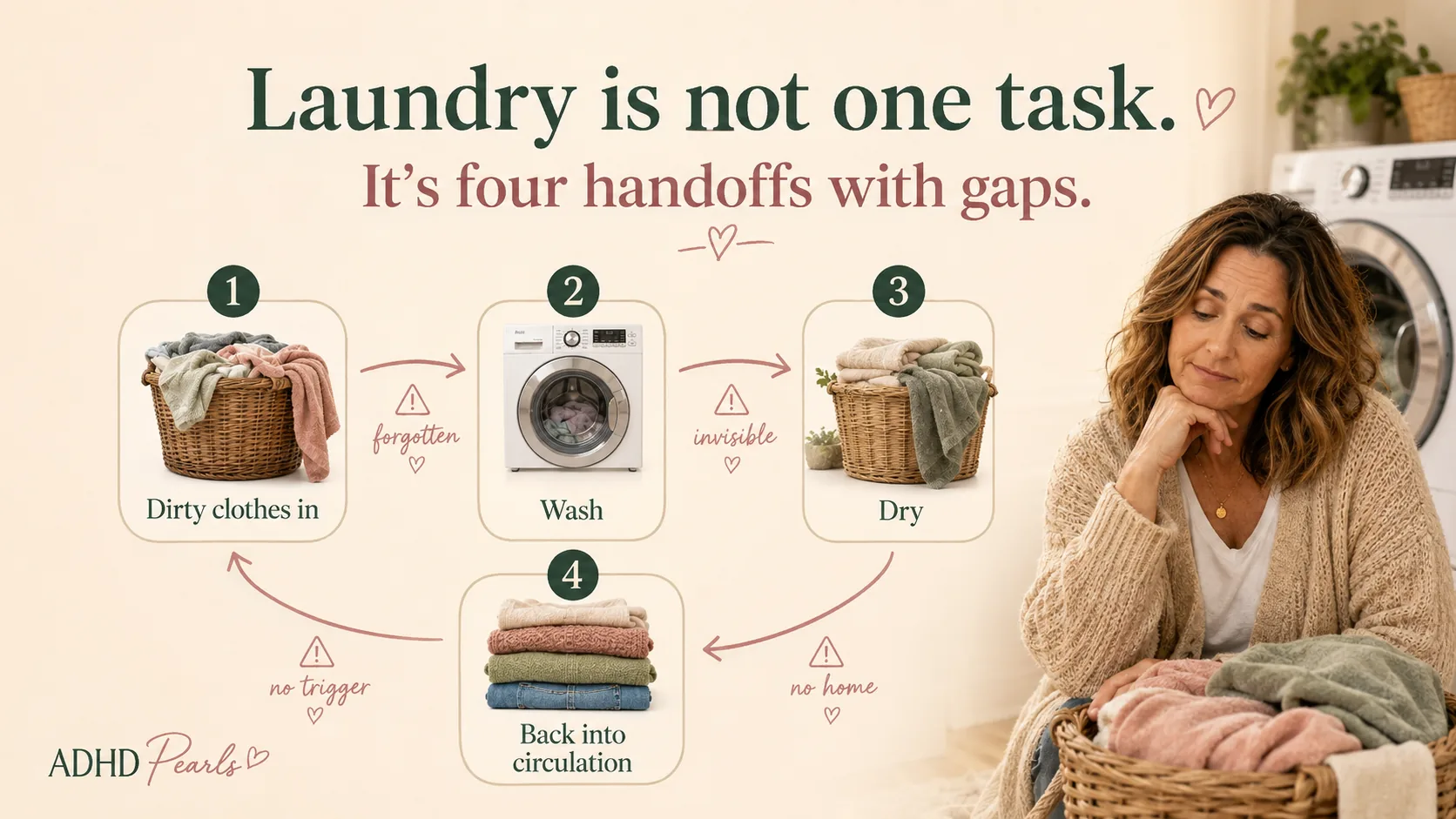
Laundry is not one task. That is the whole problem. It is four tasks with gaps between them, and ADHD brains lose things in gaps.
Quick answer
How do you keep on top of laundry with ADHD?
Stop treating laundry as one chore and treat it as a circuit with four stops: dirty clothes in, wash, dry, and clean clothes back into circulation. Each stop needs its own container and its own trigger, because the failures happen in the gaps, not during the work. Most people can fix the whole system by giving clean clothes a permanent home that does not require folding.
Key takeaways
📌Laundry is four tasks, not one. Every handoff between them is a place to lose it.
📌The washer is where most loads die, because wet clothes are invisible and have a deadline.
📌The chair is not laziness. Clothes left in view are often there so you do not forget they exist.
📌Folding is optional. Having something clean to wear is the actual goal.
📌Sorting is the step to delete first. It doubles the decisions and rarely earns its cost.
📌On a bad day, one load moved one stop is a complete success.
Nobody fails at laundry because they cannot operate a washing machine. The machine is the easy part. What breaks is everything around it.
It is four tasks pretending to be one
Put like that, "do the laundry" sounds like a single item. In practice it is: gather, wash, transfer to dry, and return clean clothes to where you get dressed. Four separate acts, separated by hours, each requiring you to remember something invisible at a moment when nothing is prompting you.
Laundry feels simple only if you ignore the handoffs. ADHD usually loses the load in the gaps.
Research on adult ADHD keeps landing on the same thing: what predicts real-life difficulty is not how you perform on a lab test of attention, but how you manage the ordinary sequenced tasks of daily life. Barkley's work on executive functioning found that everyday ratings of these skills predicted real-world impairment better than the formal tests did. Laundry is that finding wearing a laundry basket on its head.
The washing machine did not defeat you. The four-hour gap between the washing machine and the dryer did.
Wet clothes are invisible and on a timer
This is the stop where most loads die. Once the door closes, the clothes cease to exist - the same out-of-sight-out-of-mind problem I unpacked in why you forget everything you cannot see. Unlike most forgotten things, though, this one has a deadline. Miss it by a day and the entire load has to be rewashed, which converts a finished task into an unfinished one and adds a small tax of shame on top.
The chair is doing a job
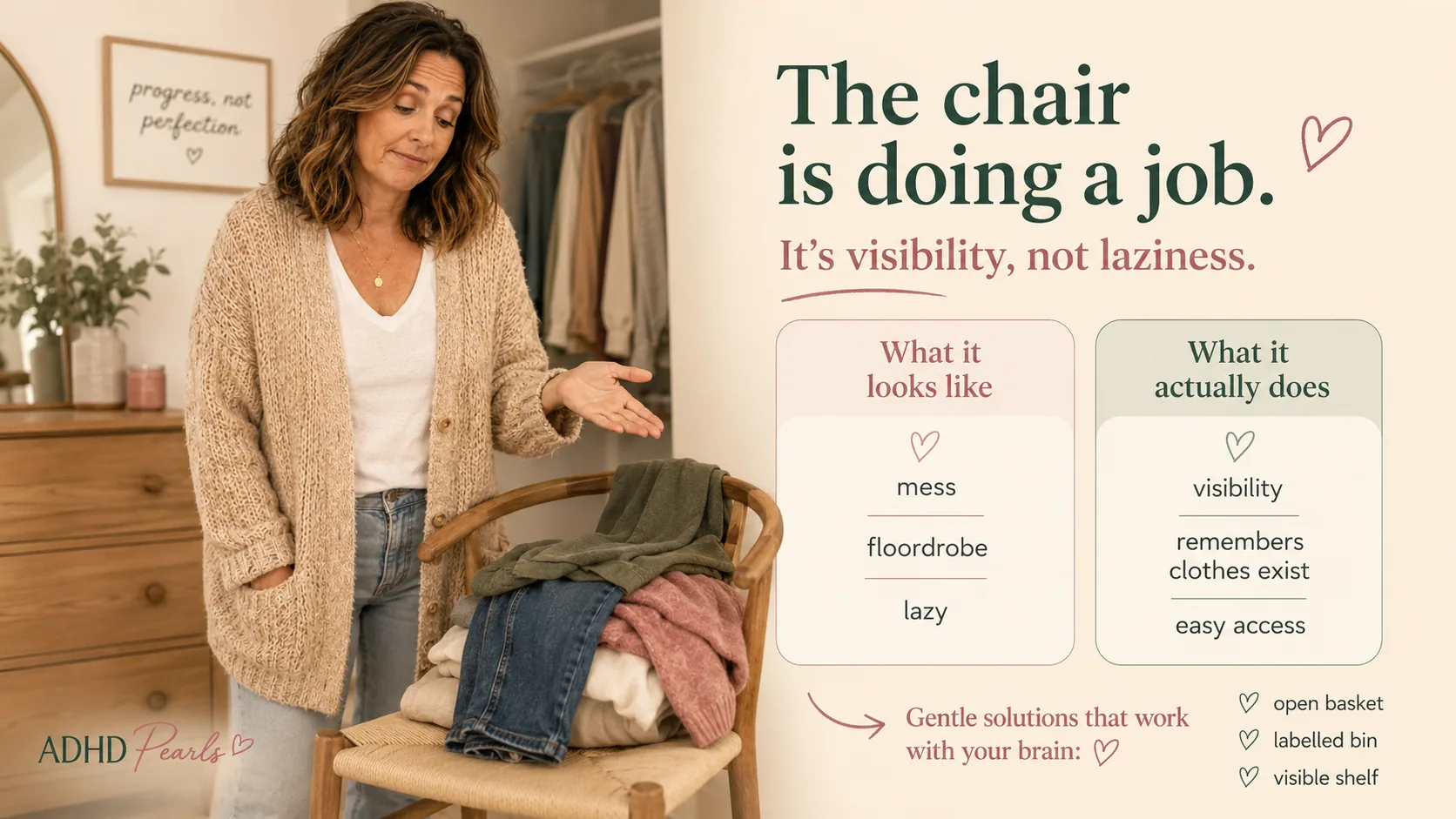
Here is the part that reframed the whole thing for me. The clothes on the chair are not there because you are lazy. They are frequently there on purpose - visible, so you remember they exist and can actually wear them. The moment they go into a drawer, for a lot of ADHD brains, they stop being real.
Which means the chair is a broken solution to a genuine problem, not evidence of a character defect. Any system that ignores that will be abandoned, because it removes the visibility you were relying on without replacing it.
If the chair is doing memory work, the answer is not shame. The answer is a better visible home.
Time blindness makes it feel enormous
Putting away a basket of clothes takes about seven minutes. Ask an ADHD brain to estimate it and you will get something closer to forty, because time blindness distorts the size of any task you are avoiding. The estimate is what you are reacting to, and the estimate is wrong.
From ADHD Pearls
ADHD Laundry Rescue Cards
Laundry is not one task. 24 visual cards to find the exact stuck point — forgotten wet load, dryer full, clean basket, chair pile — and do one useful step.
Before fixing anything, work out where yours actually breaks. Most people have one bad stop, not four, and fixing that one changes everything.
The first two stops are about starting - getting clothes into a basket and a load into the machine. The third is about keeping it moving, which is a completely different skill. The fourth is where it ends, and it is the one almost every laundry system quietly skips.
Stop
What it looks like when it fails
The fix
1. Dirty clothes in
Clothes on the floor, never reaching a basket
Move the basket to where you undress, not where it looks tidy
2. Wash
Full basket, machine empty for days
Attach starting a load to something you already do daily
3. Dry
Rewashing the same load two or three times
One alarm, labelled, set the moment you press start
4. Back into circulation
The chair, the floordrobe, the basket you dress out of for a fortnight
Give clean clothes a permanent home that needs no folding
Mine was stop 3 for years, and then stop 4 forever. Once I stopped pretending I would ever fold, stop 4 quietly solved itself.
The ADHD Laundry System
Stop 1: put the basket where your clothes actually land
Most people put the laundry basket where it looks least offensive - a corner, a cupboard, the bathroom. Then they undress somewhere else entirely, and the floor wins.
Watch yourself for two days and notice where clothes actually come off. That is where the basket goes, even if it is an ugly spot. You are not fighting the habit; you are moving the container to meet it.
And use one basket. Not a sorting station with three compartments, which is a decision engine disguised as furniture. Sorting is the first step to delete.
One clarification, because these two get confused. Sorting a pile before you can wash any of it is the step to delete - it adds decisions in front of the start. Choosing a single category, like towels or underwear and socks, and making that the entire load is a different move, and a good one when the backlog is too big to look at. The first blocks you. The second gives you a load you can actually name.
Stop 2: attach the wash to something that already happens
"Do a load when it gets full" fails because "full" is a judgment call and you are not monitoring it. Attach it to an existing anchor instead: the kettle in the morning, the school run, closing the laptop. Same cue every time.
Two loads a week that actually happen beat a perfect weekly laundry day that happens twice a month and then requires a whole Sunday.
Stop 3: the alarm is not optional
This is the single highest-value change in the entire system, and it takes four seconds. The moment you press start, set an alarm for when the cycle ends. Label it - not "alarm", but "move the washing".
An unlabelled alarm gets dismissed by a brain that is genuinely trying to work out what it wanted. A labelled one gives you the instruction at the exact moment you need it, which is the whole point of an if-then plan rather than an intention.
A generic alarm is easy to ignore. A specific instruction works better.
If you miss it anyway: most machines have a rinse-and-spin cycle that takes fifteen minutes and rescues a load that has only been sitting a day. It is not a full rewash and it costs almost nothing.
Stop 4: clean clothes need a home, not a holding pattern
The chair exists because clean clothes have nowhere to go that is easier than the chair. So make somewhere easier.
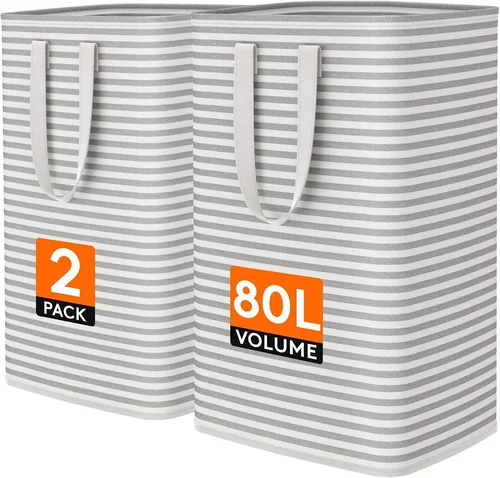
The most reliable version I have found is a basket - one per person - that is not temporary. It lives where you get dressed, it holds clean clothes, and you dress out of it. That is the system. Not a stage before the real system. The basket is the wardrobe for everything that does not need hanging. This is also why the circuit wants two baskets rather than one: a dirty one where you undress, and a clean one where you get dressed.The two-pack I use →Affiliate link — as an Amazon Associate we may earn from qualifying purchases.
It sounds like giving up. It is not. Nobody has ever been harmed by socks living in a basket, and the alternative - a folded drawer system you maintain for nine days a year - is the thing that was actually failing.
The No-Fold Endgame
Folding is the step people assume is compulsory and it is the one with the worst return on effort. Some things genuinely need it. Most do not.
Hang everything that hangs. Straight from dryer to hanger, no intermediate flat surface. Flat surfaces are where laundry goes to become a pile.
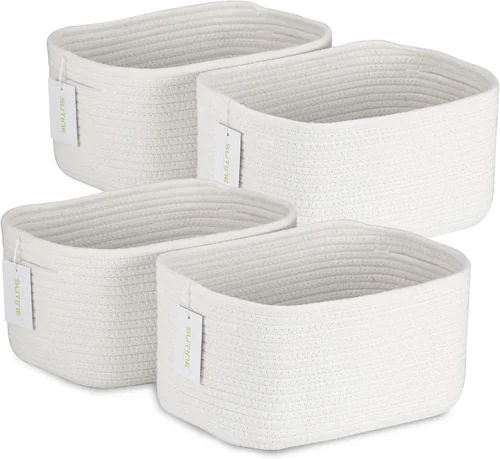
Bins by category, not by outfit. One for socks, one for underwear, one for pyjamas, one for t-shirts. No folding, no matching. Sock pairing is a hobby, not a requirement.The open bins I use →Affiliate link — as an Amazon Associate we may earn from qualifying purchases.
Own fewer clothes than your storage holds. If the drawer only closes when everything is folded perfectly, the system will break the first bad week. Leave slack in it on purpose.
Keep visibility where you need it. If seeing a thing is how you remember to wear it, open shelving or a labelled bin gives you that without the chair.
The goal is not a beautiful wardrobe. It is opening something in the morning and finding clean clothes in it. Whether you can bear to wear what you find is a separate question, with its own answer in why clothes feel wrong some days.
The goal is not a picture-perfect closet. It is being able to find clean clothes tomorrow morning.
When It Has Already Piled Up
Everything above assumes a working circuit. Sometimes there are six loads, three of them clean but unidentifiable, and the bedroom is a topographical map of the last month.
Do not start by sorting. Sorting a mountain is how the mountain wins.
Clean clothes first, one basket. Anything you know is clean goes into one basket. Do not fold it. You now have something to wear, which is the only urgent part.
Everything else is dirty. If you cannot tell, it is dirty. This decision costs you one extra wash and saves you forty decisions.
One category at a time. If even that feels like too much, pick one category - towels, or underwear and socks - and let that be the whole load. A load you can name is easier to start than a load you have to assemble.
Two loads a day until it clears. Not six. Two, run on the alarm system above.
Do not reorganize the wardrobe now. The urge to build a whole new system mid-crisis is avoidance in a productive costume, and I have lost entire afternoons to it.
If the room around the laundry is also a problem, that is a different job with its own approach - how to clean your room with ADHD covers the wider version, and this article stays in its lane.
The One-Load Version for Bad Days
On a day when you are running at about 40 percent, the full system is too much and pretending otherwise just adds another failure to the pile.
So the bad-day version is: move one load one stop.
That is the whole instruction. Basket to machine counts. Machine to dryer counts. Dryer to basket counts. You are not doing laundry today; you are keeping the circuit moving so it does not seize up entirely. Matching the job to your actual capacity is the same principle behind being productive on low-energy days, and it applies here more than anywhere, because laundry punishes abandonment more than most chores.
This article is educational and is not medical advice. If household tasks have become impossible across the board, or if that change is recent and persistent, it is worth raising with a clinician rather than treating it as an organizing problem.
FAQ: Laundry With ADHD
Why is laundry so hard with ADHD?
Because it is four separate tasks with long gaps between them - gather, wash, dry, put away - and each gap requires you to remember something invisible with nothing prompting you. The washing itself is easy. The handoffs are where it fails, particularly the wet clothes sitting in a machine you can no longer see.
Why can I wash clothes but never put them away?
Putting away is the only stop with no external prompt and no deadline. Nothing goes mouldy if you leave a clean basket for a week, so it never becomes urgent, and ADHD motivation responds to urgency far more than to importance. Removing the folding step is usually what fixes it.
What is a floordrobe and why do I have one?
It is the pile of clothes on the floor or the chair that functions as your actual wardrobe. It is often serving a purpose: clothes you can see are clothes you remember owning. It is a broken solution to a real visibility problem, which is why replacing it with a closed drawer system tends not to stick.
Do I really have to sort laundry?
Far less than you were taught. Modern detergents and cold washes handle mixed loads for everyday clothes, and sorting adds decisions at the exact point where decisions are the barrier. Keep separate handling for genuinely delicate items and anything new that might run, and stop there.
How do I stop forgetting clothes in the washing machine?
Set a labelled alarm the moment you press start - "move the washing", not just an alarm tone. If a load has only been sitting a day, a rinse-and-spin cycle usually rescues it in about fifteen minutes without a full rewash.
Is it bad to live out of a laundry basket?
No. If the clothes are clean and you can find them, the basket is doing the job a drawer would do, with fewer steps. The system that actually fails is the one that requires folding you will not do, because it leaves you with clean clothes you cannot reach.
How often should I do laundry with ADHD?
Little and often works better than one big laundry day. Two smaller loads a week that reliably happen beat a perfect weekly session that gets skipped and then needs a whole Sunday to recover from.
What do I do when there are six loads backed up?
Pull out anything you know is clean into one basket first so you have something to wear, treat everything ambiguous as dirty, and run two loads a day until it clears. Do not sort, and do not redesign your wardrobe in the middle of it.
Would a laundry routine or a chart help?
Only if it is very short. Detailed schedules tend to collapse the first time a week goes badly and then get abandoned entirely. One cue for starting a load and one labelled alarm for moving it will outlast almost any chart.
Save this if laundry keeps getting stuck halfway and you need a system that works with your brain.
Pin this ADHD laundry reset for the next week your clean clothes never make it home.
The chair is still in my bedroom. It holds one cardigan now instead of a season's worth of clothing, which I am choosing to count as a functioning system rather than a partial failure.
Found this helpful? Share it with someone who gets stuck too.
One tap makes ADHD Pearls a preferred source in your Google account, so our articles surface higher when you search. No signup, and it brings you straight back to this page.
Before you go
ADHD Laundry Rescue Cards
Laundry is not one task. 24 visual cards to find the exact stuck point — forgotten wet load, dryer full, clean basket, chair pile — and do one useful step.
For the woman who sets up the perfect system on Sunday and abandons it by Tuesday.
One short letter, every week. Real talk about ADHD, task paralysis, and the tiny wins that actually move the needle for a brain like yours. No shame. No hustle culture.