There is a chair in my room that has not been visible since March. It is not a chair anymore. It is a geological formation made of laundry, and I have started routing around it like it's furniture on purpose.
Every time I open the door, my brain does the same thing: it takes one look at the pile, the desk, the mystery cups, and quietly closes for the day. Not "I don't want to clean." More like a breaker flipping. Nothing personal. Just off.
If you're reading this standing in a doorway, staring at a room that has quietly become a nightmare, I want to tell you the thing nobody told me for twenty years: the size of the mess is not the size of your character. It's the size of how many decisions got skipped, one tired night at a time.
This article is personal and educational. It is not medical advice. Overwhelm, low motivation and trouble starting tasks can also be linked to depression, anxiety, chronic fatigue and other conditions. If this is seriously affecting your life, please talk to a qualified clinician.
Quick answer
How do you clean your room with ADHD when it's a total nightmare?
Don't aim for "clean." Aim for one small function restored. Do a trash-only sweep first, sort into three baskets instead of a hundred decisions, clear exactly one surface, give the doom pile a 10-minute cap, and stop at a pre-decided line instead of "when it's done." A messy room is usually a decision-fatigue problem, not a discipline problem - so the fix is fewer decisions, not more willpower.
Key takeaways
🧠A nightmare room is usually decision fatigue and executive dysfunction, not laziness or a lack of caring.
📌Trash-only sweeps skip decisions entirely, which is why they're the easiest possible first move.
🔋Three baskets (laundry, dishes, elsewhere) beat sorting everything into its "real" home on day one.
📋A pre-decided stop line protects you from the all-or-nothing crash that ends most cleaning attempts.
🩺Research links cluttered spaces to higher stress hormones - your discomfort in that room is a real, measurable thing.
Why the Room Turned Into a Nightmare (Not a Character Flaw)
Nobody's bedroom becomes a nightmare in one day. It happens in a thousand tiny "I'll deal with that later" moments, and ADHD makes almost every one of those moments harder than it looks.
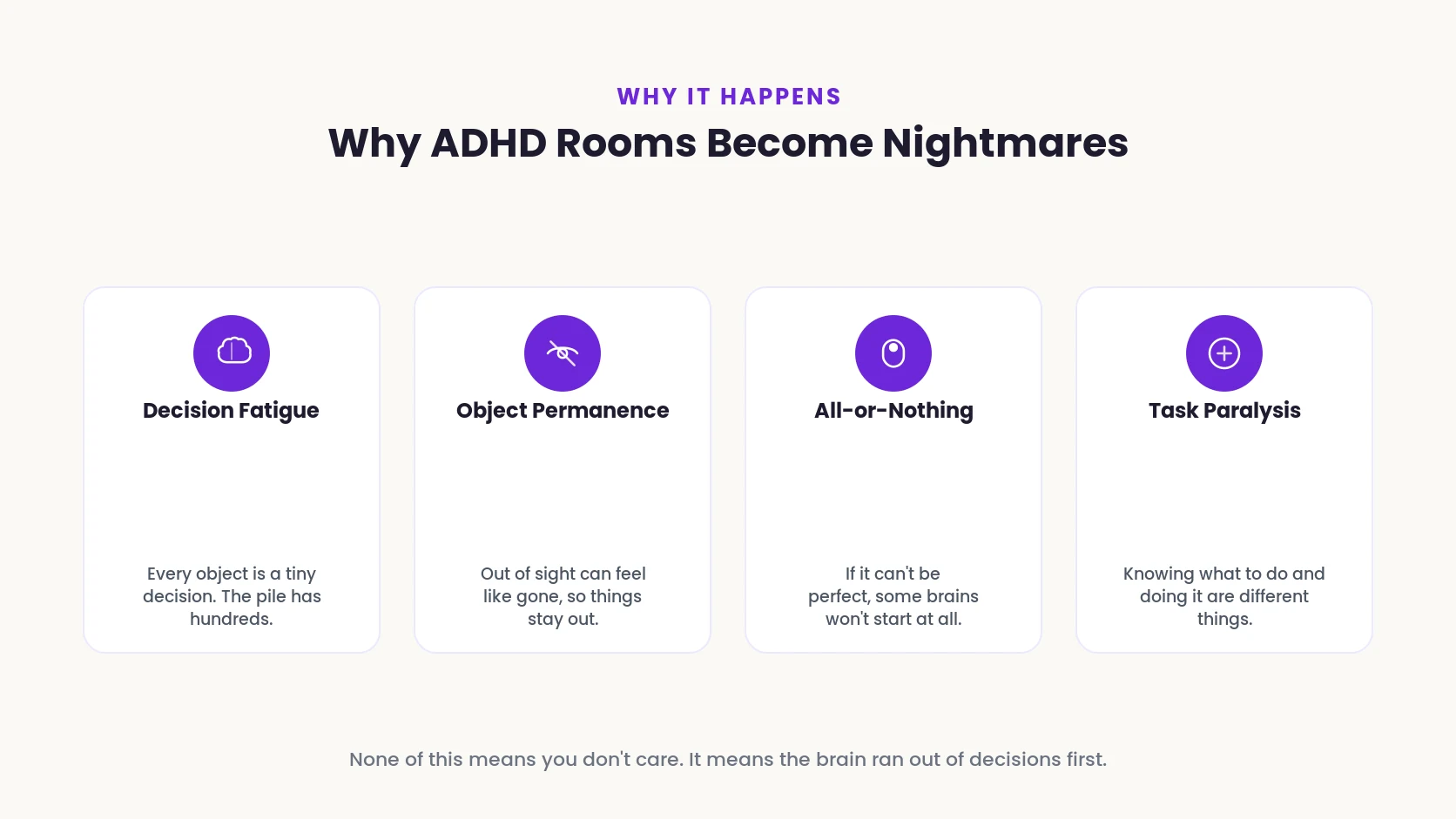
Decision fatigue. Every object on the floor is actually a tiny decision - keep, wash, donate, put away, deal with later. A messy room can hold hundreds of those decisions, and an ADHD brain runs out of decision fuel fast.
Object permanence. If it's in a drawer, it doesn't exist. So things stay out, visible, "so I don't forget" - and the visible pile grows because putting things away can genuinely feel like losing them.
All-or-nothing thinking. If you can't do the whole room properly, some ADHD brains would rather do none of it. There's no "good enough" setting, just off and all the way on.
Task paralysis. You can see exactly what needs doing and still not be able to make your body start. That gap between knowing and doing is executive dysfunction, not a lack of caring.
None of this means you don't care. It means the brain ran out of decisions first.
Here's the part that actually helped me stop hating myself about it: researchers who study clutter and stress found that women living in homes they described as messy or "unfinished" had measurably higher stress hormone levels in the evening, meaning their bodies weren't recovering from the day. That room isn't just an eyesore. It's a low hum of stress your nervous system has been absorbing quietly, every single day.
The room didn't get like this because I don't care. It got like this because I ran out of decisions before I ran out of laundry.
If laundry is the part that always breaks first, there is a whole deck for it — the printable ADHD laundry cards work on the washer-dryer-basket-chair loop specifically.
So the goal isn't to become a tidier person. It's to build a way back in that doesn't require the version of you who has fifty spare decisions lying around - because on the day the room got bad, she wasn't home.
From ADHD Pearls
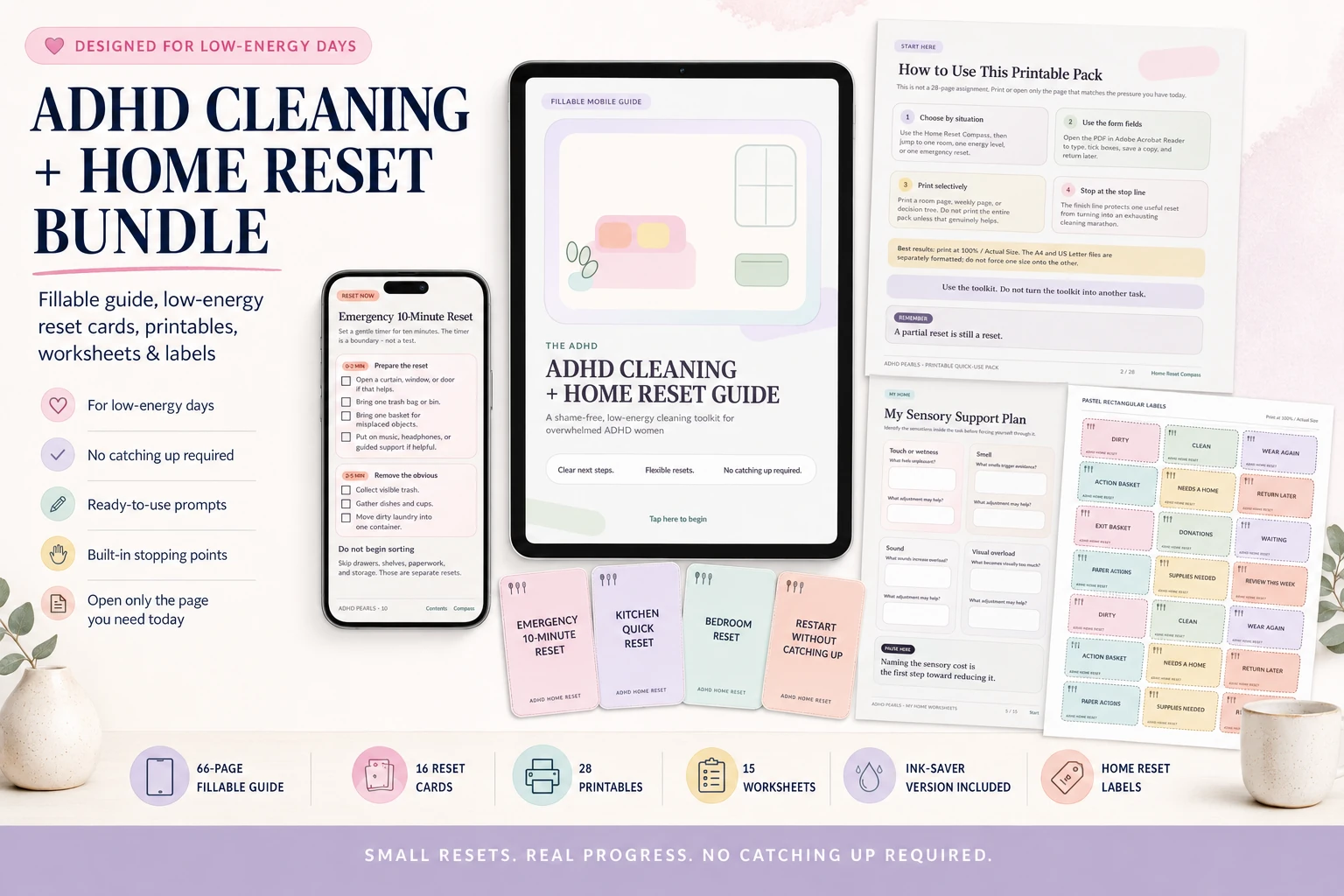
ADHD Cleaning + Home Reset Bundle
Pre-written resets, printables and labels for the days your room is winning.
This isn't a deep clean. A deep clean is a wonderful idea for a person who is not currently afraid of their own bedroom. This is the reset I actually use on the rooms I've been avoiding for weeks.
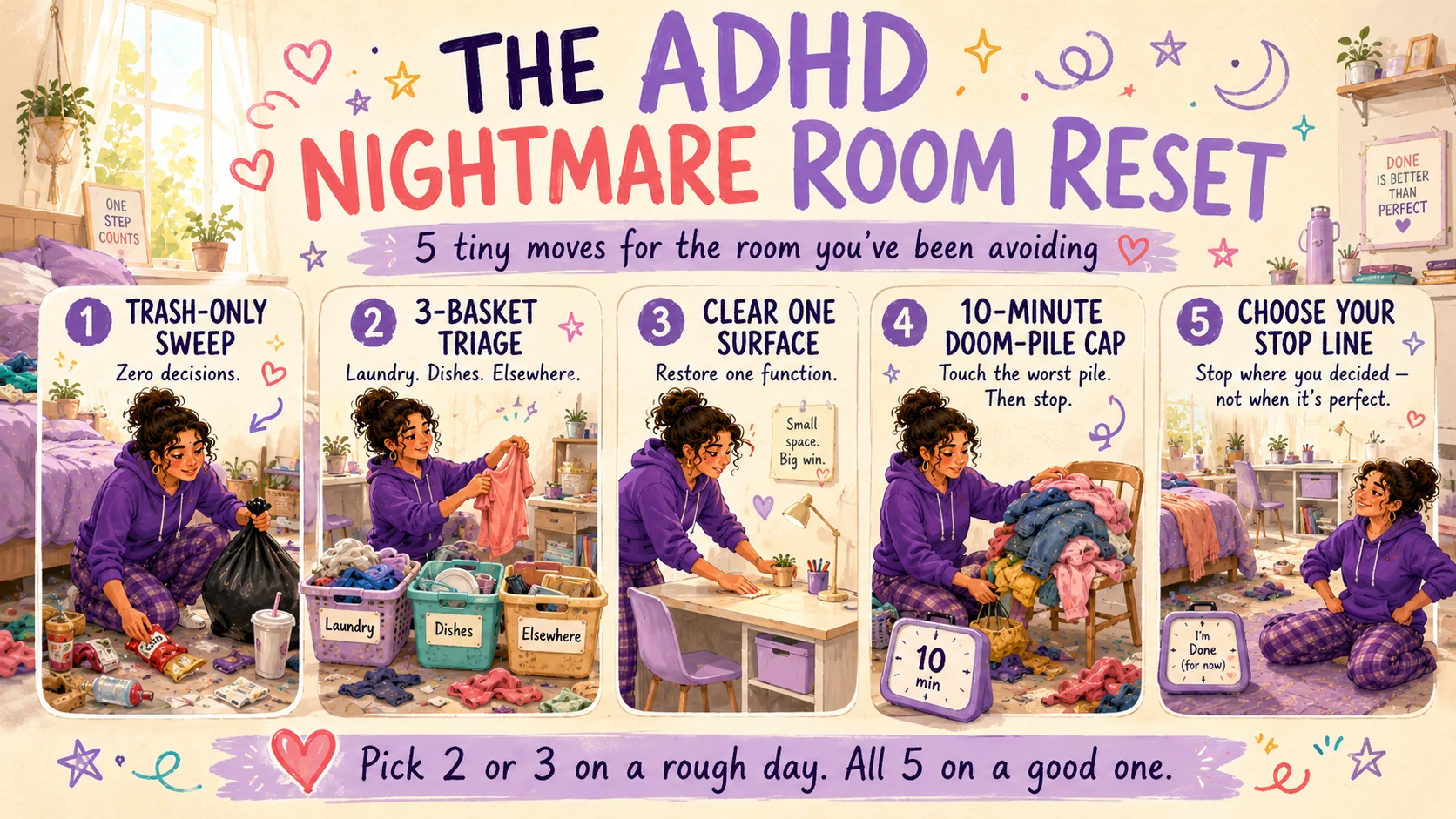
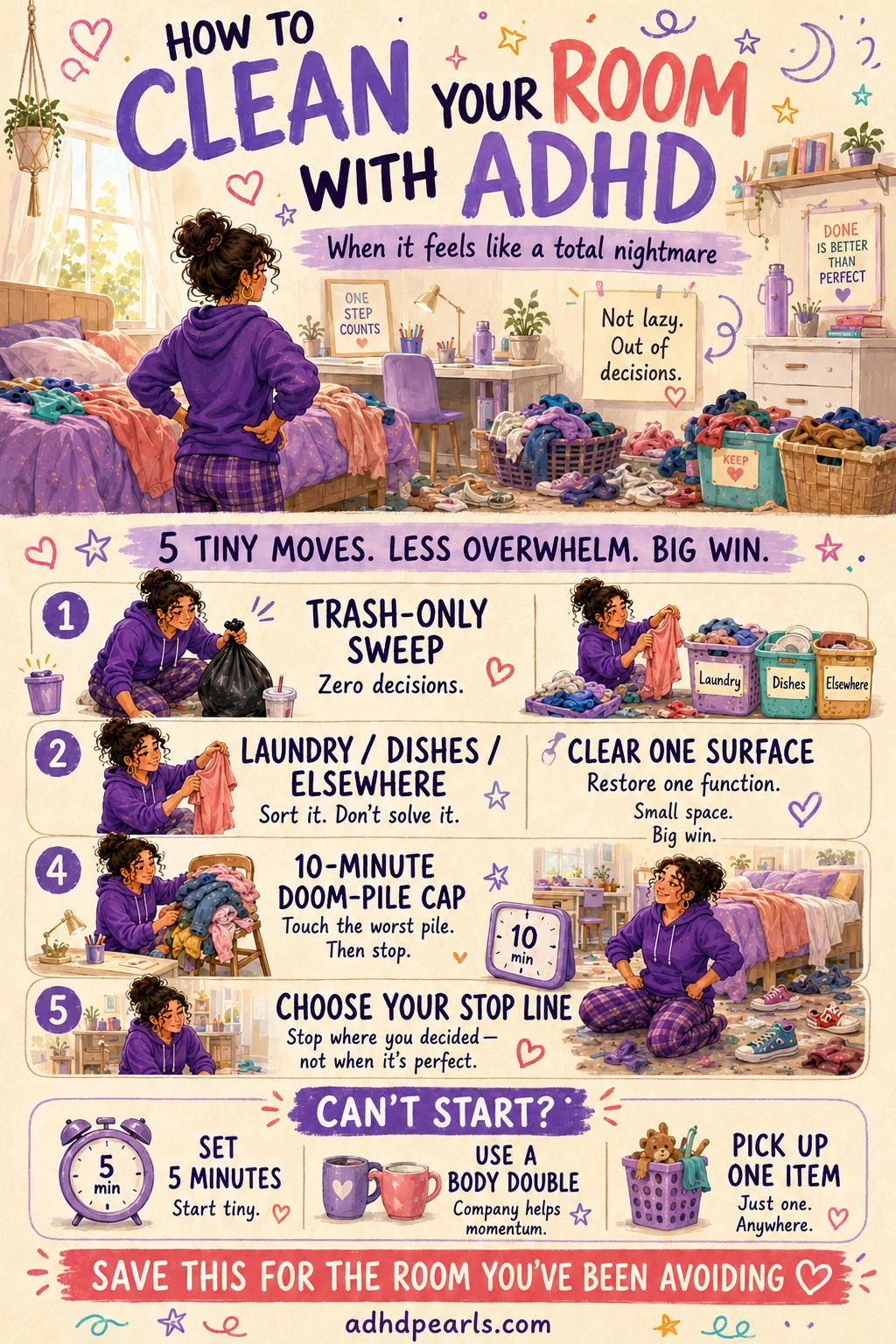
1. Trash-only sweep
Walk the room once, holding a bag, and pick up only obvious trash - wrappers, cups, receipts, the mystery paper. No sorting, no "is this actually still good," no decisions. Trash is the one category your brain never has to debate, which makes it the easiest possible way to get moving.
2. Basket triage, not "everything in its place"
Grab three containers: one for laundry, one for dishes and cups, one for "belongs in a different room." Everything that isn't trash goes into one of exactly three buckets. You are not organizing today. You are sorting a nightmare into three smaller, much less scary nightmares.
3. Clear exactly one surface
Pick one - the bed, the desk, one square of floor - and clear only that. Having one visibly usable surface changes how the whole room feels, even if the chair is still a geological event. One clear surface is a win. It counts.
4. Give the doom pile a 10-minute cap
Set a timer for ten minutes and touch only the doom pile - that one chair, corner, or floor drift that's been growing the longest. When the timer ends, you stop, even mid-pile. You're not required to finish it. You're required to have started, which is the part that was actually stuck.
5. Stop at a line you picked in advance, not "when it's done"
Before you start, decide your stop line out loud: fifteen minutes, one basket, one surface, whatever feels honest for today. When you hit it, you stop - even if the room isn't magazine-ready. A reset with a real ending is one you'll actually repeat. An open-ended "clean until it's perfect" is one you'll dread starting next time.
Pick two or three moves on a rough day and all five only when your energy allows.
Pick two or three of these on a rough day. All five on a good one. The order barely matters - what matters is that none of them ask you to make a hundred decisions before you've made any progress at all. If your mess extends beyond one room, the 17 ADHD cleaning hacks tackle the whole-house version of this same problem.
What To Do With the Doom Pile in the Corner
Every ADHD bedroom has one. Mine lives on the chair. Yours might be the floor by the closet, or the top of the dresser that stopped being a dresser sometime in February.
The doom pile grows because it's easier to add one more thing to an existing pile than to make a decision about where that thing actually goes. Each addition takes half a second. Reversing six weeks of half-seconds takes considerably longer, which is exactly why it feels so disproportionately awful to face.
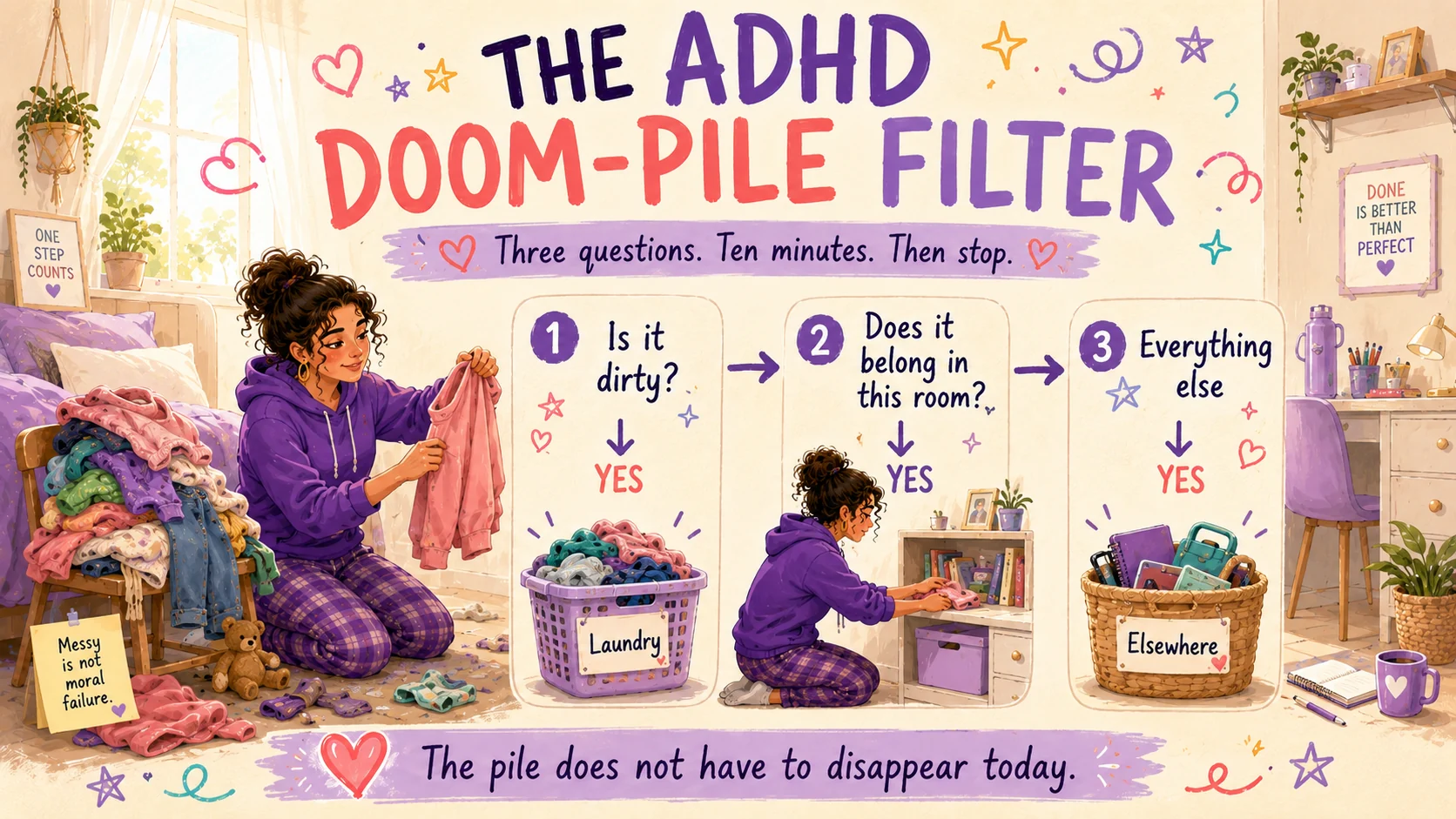
Here's the filter I use so I'm not standing there interrogating every single item:
Is it dirty? Laundry basket. Don't smell it to check. Just go.
Does it belong somewhere in this room? Put it there now, in the two seconds that takes.
Everything else goes in the "elsewhere" basket from step two, to be dealt with later, in a different room, by a slightly less exhausted version of you.
Use three automatic destinations so every object does not become a new organizing decision.
Set the ten-minute timer, run the three questions on autopilot, and stop when it beeps. A doom pile doesn't have to disappear today. It just has to stop being the reason the whole room feels unrecoverable.
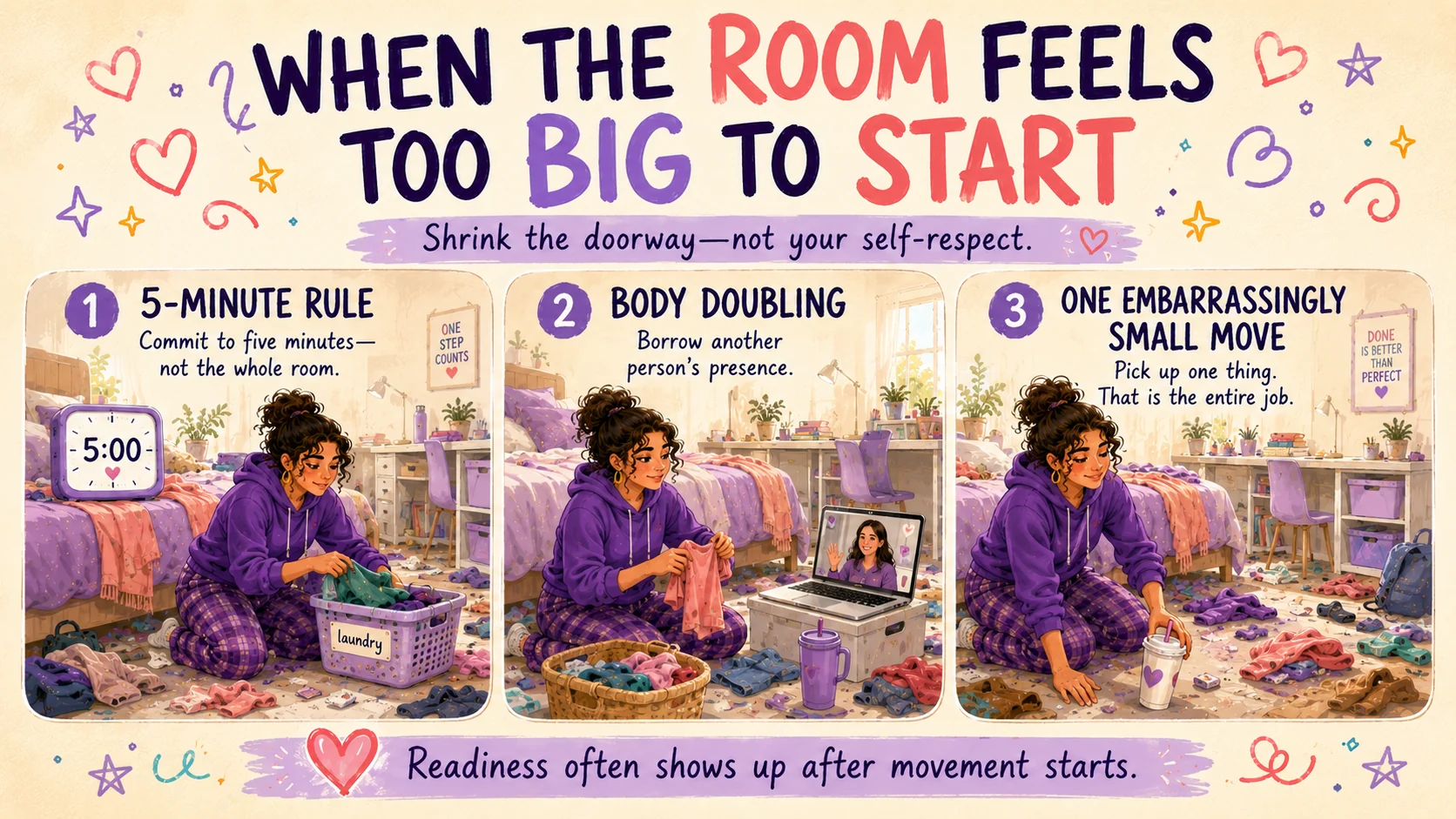
When the Room Feels Too Big to Start
Sometimes the problem isn't knowing what to do. It's that the doorway itself feels like a wall. Here's what actually gets me moving on those days.
The five-minute rule
Commit to five minutes, not the whole room. Set a timer, do one small thing, and give yourself full permission to stop when it rings. Most of the time momentum carries you past it - but even if it doesn't, five honest minutes is still five minutes more than the room had this morning.
Body doubling
Clean while a friend is on a video call, or with a cleaning video playing, or even just with someone else quietly existing in the house. You don't need their help. Their presence alone can act as an anchor that makes starting - and staying - noticeably easier for a lot of ADHD brains.
Make the first move embarrassingly small
Not "clean the room." Not even "do the trash sweep." Just: pick up one item, walk it to the bag. That's it. That's the whole ask. The size of the first move is often the entire difference between starting and staring.
I stopped waiting to feel ready. I started picking up one cup instead, and the readiness showed up somewhere around cup four.
When the whole room feels impossible, shrink the starting move until your brain can cross the doorway.
Here's the difference between the version of cleaning that keeps failing and the version that actually gets repeated:
The "deep clean" plan
The Nightmare Room Reset
Goal
A fully organized, magazine-ready room
One small function restored today
Decisions required
Hundreds, all at once
Almost none - trash, three baskets, a timer
Ending
Open-ended - "when it's finally done"
A stop line you picked before you started
If starting is the part that keeps beating you, the free ADHD Cleaning Reset Checklist lays this same reset out as a one-page, no-thinking-required printable.
Keeping It From Becoming a Nightmare Again
I will not pretend I keep a spotless room. I keep a room that never gets bad enough to make me want to disappear when I open the door, which turned out to be a much more honest goal.
One landing zone. A single basket or chair-that's-allowed-to-be-messy where stray things land, so the mess has one address instead of twelve.
A two-minute closer. Before bed, do just the trash-and-cups sweep from step one. Two minutes, not a routine, not a ritual - just enough to stop today's mess from becoming next week's nightmare.
Let go of "maintained." A room that gets reset once a week when it tips over is still a massive win over a room you've been avoiding since spring. Progress here is not linear, and it doesn't need to be.
Small and often beats big and occasional, especially for a brain that treats "later" as a foreign concept. If low motivation shows up in more places than just this room, why your whole house feels too loud digs into the bigger pattern.
FAQ: Cleaning Your Room With ADHD
How do I start cleaning my room when it's a huge mess with ADHD?
Skip sorting and start with a trash-only sweep - it requires zero decisions, which is usually the actual barrier. From there, sort into just three baskets (laundry, dishes, elsewhere) instead of putting everything in its exact place right away. What happens to that laundry basket afterwards is its own circuit, and it has its own fixes - the ADHD laundry system.
Why does my room get this messy in the first place with ADHD?
Usually decision fatigue, not carelessness. Every object on the floor represents a small decision, and ADHD brains can run out of decision-making capacity long before the room is clean. Object permanence also plays a role - things left out feel safer than things put away, which can feel like losing them.
What's the fastest way to clean a messy room with ADHD?
Trash sweep, three-basket triage, one cleared surface, a timed doom-pile cap, then stop at a line you picked in advance. Most of that can happen in fifteen to twenty minutes and still count as a real reset.
How do I deal with the pile of clothes that's taken over my chair?
Set a timer for ten minutes and run three questions on autopilot: is it dirty (laundry basket), does it belong in this room (put it there), everything else (the "elsewhere" basket). Stop when the timer ends, even if the pile isn't gone.
Why can I see exactly what needs doing and still not do it?
That gap between knowing and doing is task paralysis, a form of executive dysfunction - not a lack of caring or effort. Shrinking the first move to something almost too small to count, like picking up one item, is often what breaks the freeze.
How long should an ADHD room reset take?
Whatever your real energy allows that day - five, ten or twenty minutes, chosen on purpose rather than left open-ended. A short reset you actually finish beats an ambitious one that stalls out halfway.
What if I get distracted halfway through cleaning my room?
Stay in the room and keep your three baskets within reach so you're not tempted to wander off delivering items one at a time. If you do drift, that's not failure - just come back to the timer and pick up where you left off.
How do I keep my room from turning back into a nightmare?
Give stray items one landing zone instead of letting them scatter, and do a two-minute trash-and-cups sweep before bed. A room that gets reset weekly when it tips over is still a huge win over one you've been avoiding for months.
Is my messy room ADHD, or am I just messy and lazy?
Laziness is not caring and feeling fine about it. If you feel guilty, overwhelmed, or ashamed every time you look at the room - and you genuinely want it clean - that gap between wanting to and being able to is executive dysfunction, which is a brain-based difference, not a character flaw.
You're Not Failing at Cleaning. You're Out of Decisions, Not Out of Effort.
That chair is still not fully visible as I write this, if I'm honest with you. But it's smaller than it was, because I stopped waiting to want to clean the whole room and started doing the trash sweep instead.
You don't need a spotless room. You need a reset small enough to actually finish, and permission to stop before it's perfect. That's enough to keep the nightmare from coming back.
Save this ADHD room reset for the room you have been avoiding
Save this ADHD room reset for the room you have been avoiding.
Sources I leaned on while writing this
Cleveland Clinic: Executive function. my.clevelandclinic.org. On working memory, planning and why executive dysfunction makes starting tasks harder.
One tap makes ADHD Pearls a preferred source in your Google account, so our articles surface higher when you search. No signup, and it brings you straight back to this page.
Before you go
ADHD Cleaning + Home Reset Bundle
Pre-written resets, printables and labels for the days your room is winning.
For the woman who sets up the perfect system on Sunday and abandons it by Tuesday.
One short letter, every week. Real talk about ADHD, task paralysis, and the tiny wins that actually move the needle for a brain like yours. No shame. No hustle culture.