I once stood in my own living room holding a single sock, completely unable to move.
Not because I did not know where it went. Because to put it away, I would have to walk past the mail I had not opened, the basket of laundry that was clean three days ago, the mug situation on the side table, and a small voice that said, why is this so hard for you?
So I put the sock back down. And the room got 1% louder.
If you have ever felt like your house is yelling at you while also being completely unable to start tidying it, you are not lazy and you are not broken. You are dealing with ADHD home overwhelm, and there are real reasons it happens.
Quick answer
Why does a messy house feel so overwhelming when you have ADHD?
Because clutter is not just clutter — it is visual noise and a pile of unmade decisions your brain has to process all at once. ADHD makes task initiation, working memory, and transitions harder, so a full room reads as one giant impossible task instead of many small ones. The fix is not more discipline. It is less friction and a smaller starting point.
Key takeaways
📌A messy ADHD home is usually a sign of an overloaded brain, not a lazy person.
📌Clutter builds because putting things away is a chain of small decisions, and any link can stall.
📌"Out of sight, out of mind" means tidy-away systems quietly fail ADHD brains.
📌Cleaning paralysis happens because your brain tries to load the whole job at once and freezes.
📌A short, low-pressure reset works better than a big overhaul that you abandon by Tuesday.
Why Your House Feels "Too Loud"
Most cleaning advice treats a messy room as a tidiness problem. For ADHD brains, it is closer to a sensory and attention problem.
Every visible object is a small open loop. The unopened envelope is a decision. The pile of clothes is a decision. The thing you set down "just for now" three weeks ago is a decision you keep re-making every time you see it.
A neurotypical brain can filter a lot of that out. An ADHD brain often cannot. So a cluttered room is not background — it is a hundred quiet notifications going off at the same time. That is the "too loud" feeling. It is real, and it is exhausting.
It is not that you do not care about your home. It is that your home is making your brain do a hundred tiny jobs at once, and you are tired before you have picked anything up.
From ADHD Pearls
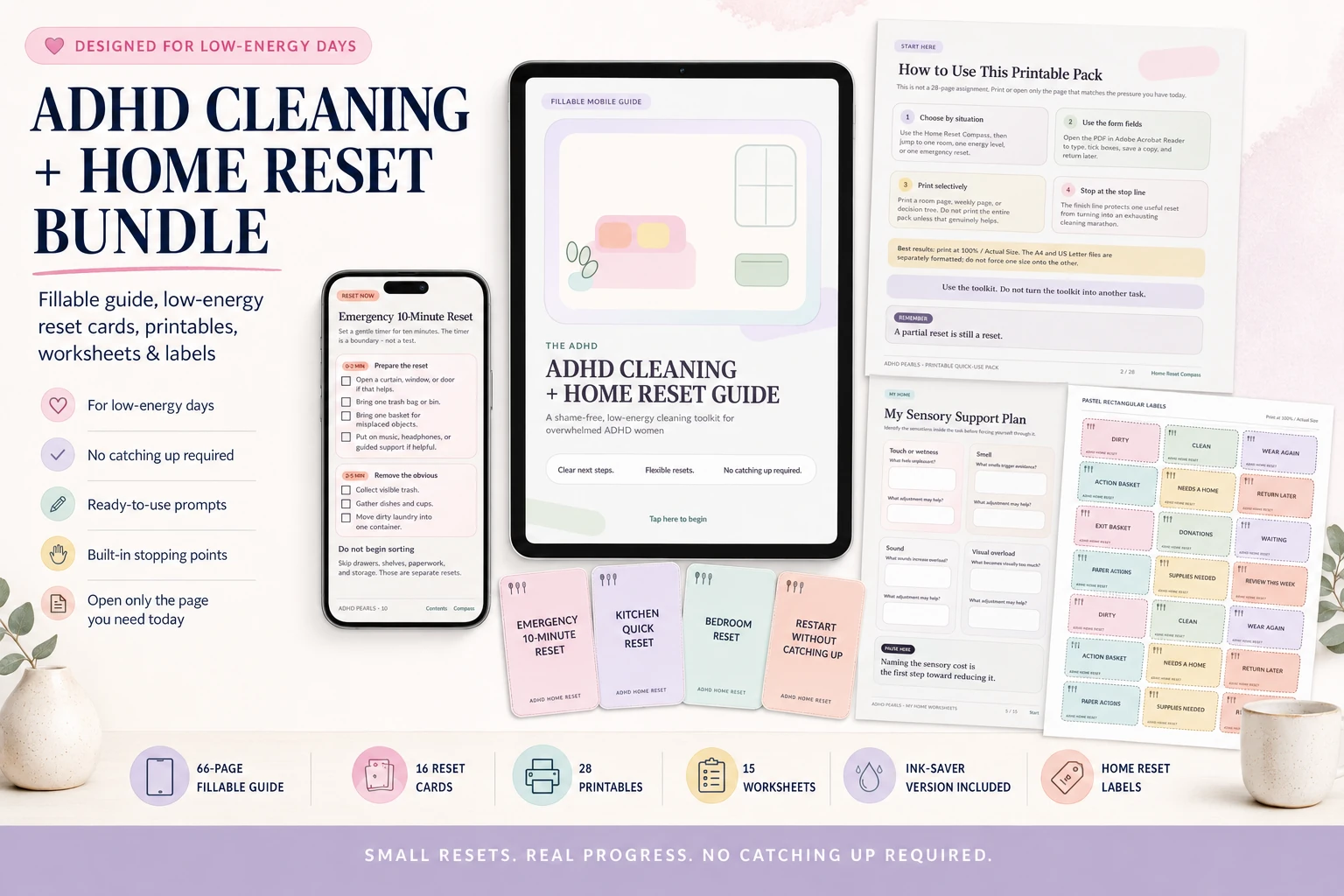
ADHD Cleaning + Home Reset Bundle
Pre-written resets, printables and labels for the days your room is winning.
Putting one item away sounds like one action. It is not. It is a chain.
•Notice the item exists and decide it needs to move.
•Decide where it belongs (and remember if it even has a home).
•Interrupt what you are doing to walk it there.
•Resist the four other things you notice on the way.
•Come back without losing the thread of what you were doing.
For ADHD brains, executive function — the set of skills behind planning, starting, and follow-through — makes every one of those links wobbly. Miss any link and the item stays out. Multiply that across a week and you do not have a character flaw. You have a pile.
There is also the "out of sight, out of mind" problem. Many ADHD brains rely on seeing things to remember them. So you leave items out on purpose, as memory cues — and then the cues multiply until the whole surface is a cue and none of it works anymore.
Doom Piles, Floordrobes, and "I'll Deal With It Later"
If you have a chair that is 80% clean clothes (a "floordrobe" that made it to furniture), or a corner of mail and chargers and random objects you swept together to "sort later," congratulations: those are doom piles, and they are deeply ADHD.
A doom pile forms when deciding where each item goes feels harder than just setting it down. It is not mess for the sake of mess. It is what happens when decision-making is the expensive part and you are running low.
The cruel twist is that "later" rarely comes, because later you will be just as low on decision fuel — and now the pile is bigger and scarier. That avoidance loop is closely related to ADHD task paralysis: the more it builds, the harder it is to face.
Doom piles are often deferred decisions, not laziness.
Cleaning Paralysis: When You Can't Start
Here is the part that confuses everyone, including us: you can desperately want a clean home and still be physically unable to start cleaning it.
That is because wanting and starting run on two different systems. Wanting is easy. Starting needs task initiation — and ADHD makes that one unreliable, especially when the task is vague and huge.
When you look at a messy room and think "clean the living room," your brain tries to load the entire job at once: every surface, every decision, every transition. It is too much to hold, so it freezes. The freeze is not a willpower failure. It is an overload response.
This is the same wall that shows up on low energy days, when even small tasks feel enormous. The task did not get bigger. Your available capacity got smaller.
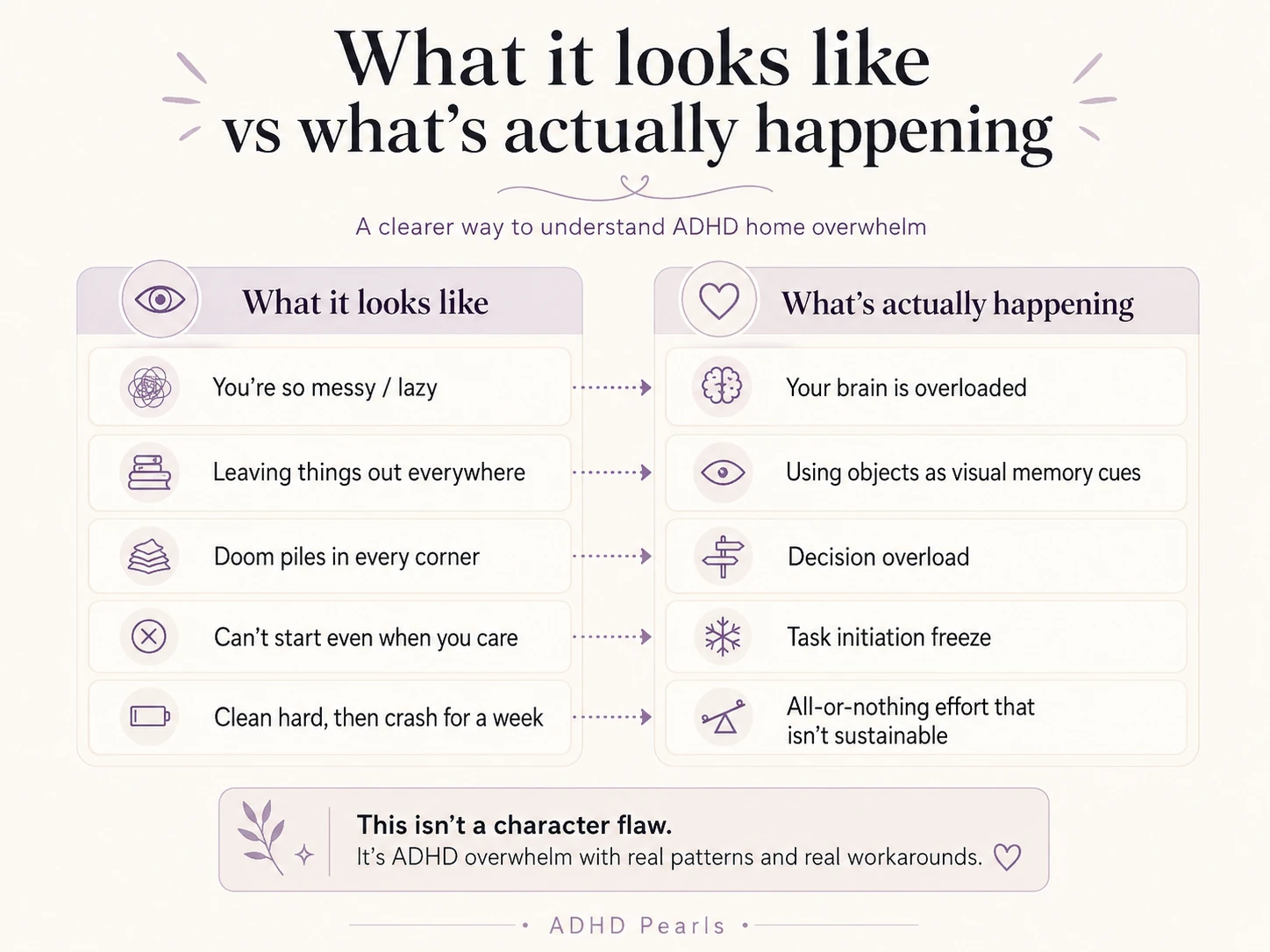
What It Looks Like vs What's Actually Happening
So much ADHD home shame comes from misreading the behavior. Here is the translation I wish someone had handed me years ago.
What looks like mess, avoidance, or inconsistency is often overload, visual memory cues, decision fatigue, and task initiation freeze.
What it looks like
What's actually happening
"You're so messy / lazy"
Your brain is overloaded and starting tasks is the part that is hard, not caring.
Leaving things out everywhere
Using objects as visual memory cues because out of sight means out of mind.
Doom piles in every corner
Decision overload — setting it down was cheaper than deciding where it lives.
Can't start even when you care
Task initiation freeze — the brain loaded the whole job at once and stalled.
Clean hard, then crash for a week
All-or-nothing effort with no bad-day version, so the system is not sustainable.
None of the left column is a moral failing. All of the right column has a workaround.
The Shame Tax on a Messy Home
For women especially, a messy house gets read as a verdict on your whole character. So on top of the actual mess, you carry a second, invisible load: the shame about the mess.
There is a third load underneath both of those, and it is the one nobody names: being the person who notices what needs doing and checks it got done. That job is invisible even to the people living in the house with you.
That shame is not just painful — it is functional sabotage. It makes the starting line heavier, it keeps you from asking for help, and it turns "the kitchen is messy" into "I am a mess." Research on home environments has even linked higher clutter to higher stress hormone patterns, so that drained feeling in a chaotic room is not in your head.
If your inner voice gets cruel the moment the house slips, that is worth its own work. I wrote more about untangling that in the ADHD shame detox. The short version: the mess is information, not proof of who you are.
The reason "deep clean the whole house this weekend" keeps failing is that it is built for a brain with steady energy and easy task-switching. That is not the brain you are working with on a hard day, and pretending otherwise is how the planner graveyard gets bigger.
A reset is different. A reset does not try to fix the whole house. It gives your brain one safe way back in.
One surface. Not the whole kitchen. That is a real reset.
•One surface, not one room. Pick the counter or table you walk past most. Visible relief tells your brain it is safe to keep going.
•One timer. Five or ten minutes. Stop when it rings, even mid-pile. Stopping on purpose is part of the system, not quitting.
•One "for now" basket. Skip the where-does-this-live decision. Everything homeless goes in the basket; you sort it later, or you do not, and the room still got quieter.
•A bad-day version of everything. If the routine cannot survive a 10% day, it is not your routine — it is a fantasy of someone else's.
What Actually Helps
Beyond the reset itself, these are the changes that quietly lowered the volume in my home — not by adding discipline, but by removing friction.
An obvious drop zone reduces friction and gives high-traffic items an easy home.
•Give high-traffic items an obvious, lazy home — a bowl by the door, a hook within reach. If putting it away takes more than one move, it will not happen.
•Make "out of sight" work for you, not against you: open shelving and clear containers for things you must remember; closed storage for things that just create noise.
•Body-double it. Clean while on a call, on video with a friend, or alongside a "clean with me" video. Company borrows you the focus you do not have alone.
•Lower the bar for "done." A made-enough bed, a cleared-enough counter, a good-enough room. Good enough is the standard that survives real life.
•Treat resets as recurring, not as failures you keep needing. The home will get loud again. That is not relapse. That is just living in it.
If you want the same gentle, no-streak approach for the rest of your life admin and planning — not just the house — that is exactly what I built The No-Shame Reset Workbook for. It is the paper version of resetting without turning a hard week into evidence against yourself.
This article is personal and educational, not medical advice. Chronic home overwhelm can overlap with ADHD, depression, anxiety, burnout, and other conditions. If it is affecting your daily life, please get proper guidance from a qualified clinician.
FAQ: ADHD and Home Overwhelm
Why does my house feel so overwhelming with ADHD?
An ADHD home often feels overwhelming because clutter is not just clutter — it is visual noise your brain has to process all at once. Every unfinished pile is a reminder of a decision you have not made yet. For a brain that already struggles with task initiation and working memory, a full room can read as one giant, impossible task instead of many small ones.
Why do people with ADHD have so much clutter?
Clutter builds up faster for ADHD brains because of how executive function works. Things left out of sight are easily forgotten, so items get left in view on purpose. Putting something away involves a chain of small decisions and transitions, and any of them can stall. Over time, deferred decisions pile up into physical mess — not because you do not care, but because the system has too much friction.
What are ADHD doom piles?
A doom pile is a collection of random items you gathered to deal with later — mail, chargers, clothes, paperwork — that never got sorted. They tend to form because deciding where each item belongs feels harder than just setting it down. Doom piles are extremely common with ADHD and are a sign of decision overload, not laziness.
Why can't I start cleaning even when I want to?
This is cleaning paralysis, and it is real. Cleaning is not one task — it is a stack of hidden decisions, transitions, and sensory input. When your brain looks at a messy room, it tries to load the whole job at once and freezes. Wanting a clean home and being able to start cleaning use two different systems, and ADHD makes the starting one unreliable.
How do I declutter when I have ADHD and feel overwhelmed?
Shrink the task until it feels almost too small. Pick one surface, not one room. Set a short timer and stop when it rings, even mid-pile. Use a single "everything goes here for now" basket instead of deciding where each item lives. The goal is not a finished house — it is one starting point your brain can actually enter without freezing.
Is a messy house a sign of ADHD?
A messy home on its own is not a diagnosis — plenty of people are messy. But chronic, distressing clutter that builds despite genuinely caring, paired with difficulty starting and finishing household tasks, is a common ADHD experience. If home overwhelm is affecting your daily life, it is worth discussing with a qualified clinician.
How do I stop feeling ashamed of my messy home?
Start by separating the mess from your character. A cluttered home usually means your brain is overloaded and your system has too many steps — not that you are lazy or failing. Shame makes the starting line heavier, so naming it as data rather than proof of who you are is often the first step that makes cleaning possible again.
Where do I start when every room is bad?
Pick the room that costs you the most each morning, usually the kitchen or wherever you get dressed. Fixing the room with the highest daily friction gives back more than starting with the worst-looking one.
Should I hire a cleaner or a professional organizer?
If it is affordable, it is a reasonable use of money rather than an admission of defeat. A cleaner handles maintenance; an organizer helps with the decisions, which is usually the harder part for ADHD. Many people find one deep reset makes the ongoing upkeep possible.
CHADD. Executive Function Skills. chadd.org. Overview of how planning, initiation, and working memory are affected in ADHD.
ADDA. ADHD Paralysis. add.org. Explains the freeze response behind tasks like cleaning feeling impossible to start.
One last thing
Your home is not loud because you failed at being a tidy person. It is loud because a hundred small decisions stacked up while you were busy surviving everything else.
You do not have to silence all of it today. Clear one surface. Set one timer. Let the room get 5% quieter. That counts. That is a reset.
— The ADHD Pearls team
Found this helpful? Share it with someone who gets stuck too.
One tap makes ADHD Pearls a preferred source in your Google account, so our articles surface higher when you search. No signup, and it brings you straight back to this page.
Before you go
ADHD Cleaning + Home Reset Bundle
Pre-written resets, printables and labels for the days your room is winning.
For the woman who sets up the perfect system on Sunday and abandons it by Tuesday.
One short letter, every week. Real talk about ADHD, task paralysis, and the tiny wins that actually move the needle for a brain like yours. No shame. No hustle culture.