The dishwasher needed unloading. The sink was full. A laundry basket had somehow migrated beside the table. There were unopened envelopes under a bag of recycling. I knew how to clean every single thing in that room. I still could not work out what to touch first.
That's the part most ADHD cleaning advice skips. It tells you how to maintain a clean home — set a timer, play music, use a basket — and assumes the floor is already visible. But the moment you actually need help is the one where the house is already too much and your brain quietly chooses "not now."
So these aren't generic tips. They're 17 slightly weird, friction-cutting hacks for the days you can see the mess and still can't start — organised around the real reason starting is so hard.
This article is personal and educational. It is not medical advice. If overwhelm at home is affecting your daily life, it's worth talking with a qualified clinician. Care tasks are morally neutral — being behind on cleaning says nothing about your worth.
Quick answer
How do you clean with ADHD when you don't know where to start?
The best ADHD cleaning hacks reduce the number of decisions required before and during the task. Start with one visible category, stay in one space, use a short pre-written sequence, and decide what "done" means before you begin. The goal isn't to finish the whole house — it's to restore one useful function without triggering another cleaning marathon.
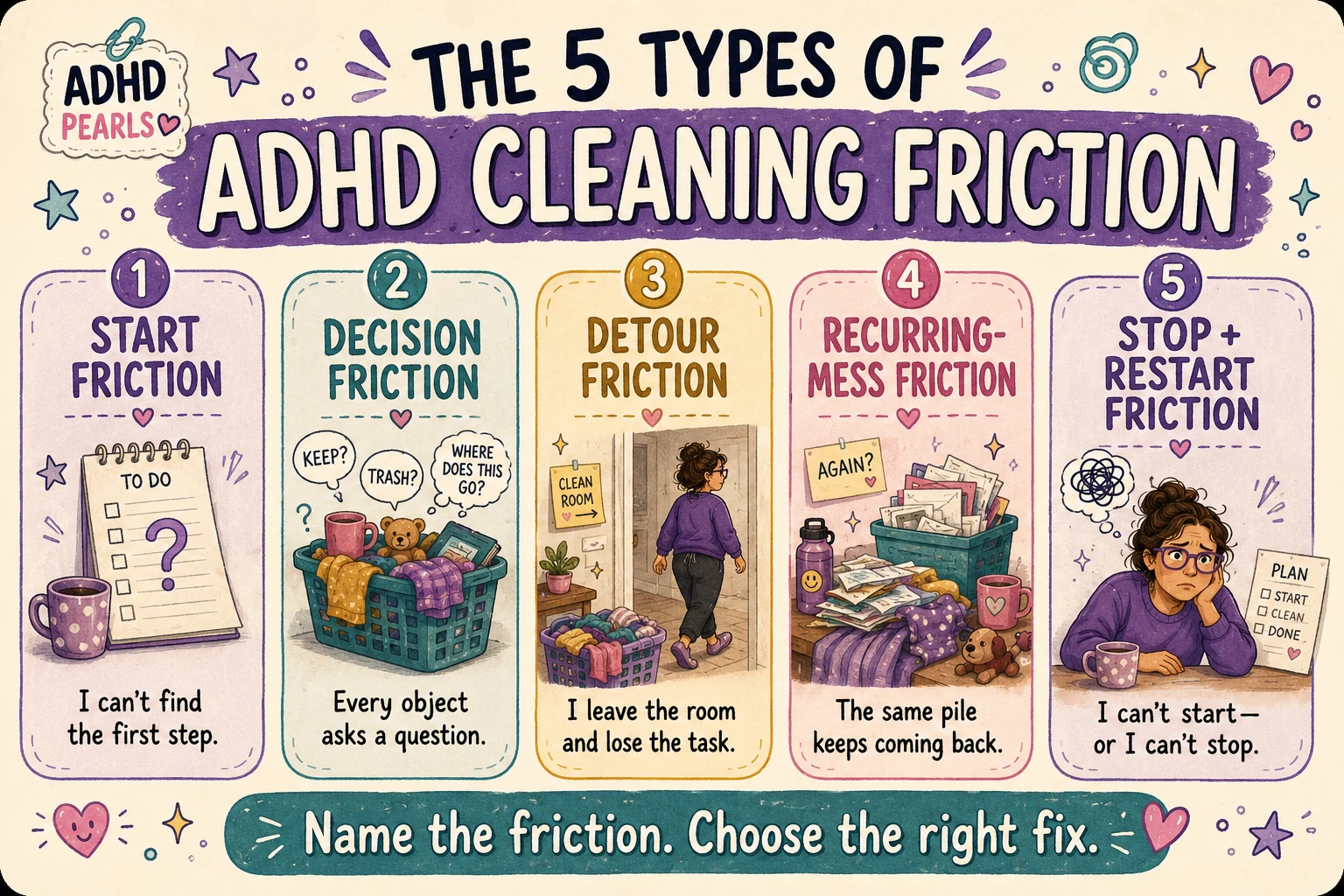
Most ADHD cleaning stalls happen at one of five friction points. Naming the friction helps you choose the right fix.
Key takeaways
📌Cleaning paralysis is a decision-load problem, not a laziness problem.
📌Most ADHD cleaning friction falls into five types — name it and you can target it.
📌Start with the no-decision category (trash) and restore one function, not a whole room.
📌Stay in one room, keep supplies where the mess is, and design storage around real behaviour.
📌Decide your stop line before you begin. Never catch up — restart from today.
Here's the reframe that changed everything for me: cleaning with ADHD rarely fails for one reason. It fails at specific friction points — and once you can name which one is stopping you, you stop reaching for the wrong fix. Executive function is the brain system that handles starting, sequencing, holding steps in mind and finishing; ADHD makes each of those harder, in its own way.
So before the hacks, the framework. Almost every "I can't clean" moment is one of these five:
Start friction — you can't identify the first action, so nothing happens.
Decision friction — every object asks a question (keep? toss? where?), and the questions pile up faster than the cleaning.
Detour friction — you carry something to another room, see something else, and lose the original task entirely.
Recurring-mess friction — the same pile keeps coming back because the storage doesn't match how you actually behave.
Stop-and-restart friction — you don't know when you're finished, so you either never start or clean for four hours and burn out for two days.
The 17 hacks below are sorted by which friction they remove. Skip to the one that's actually stopping you today.
From ADHD Pearls
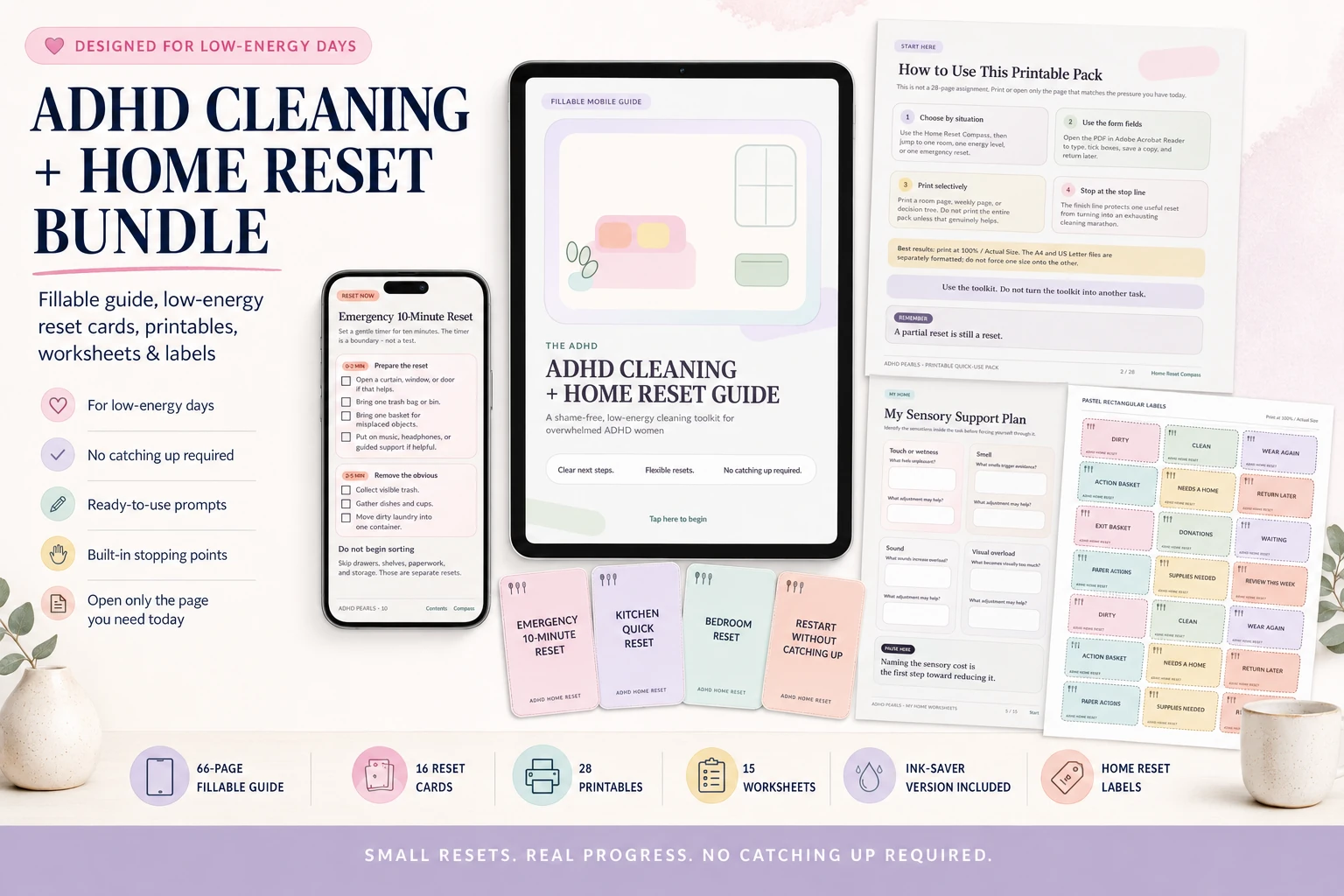
ADHD Cleaning + Home Reset Bundle
Pre-written resets, printables and labels for the days your room is winning.
This is the "holding one mug, no idea what to touch" zone. The fix is never "try harder to start." It's removing the decisions that come before starting.
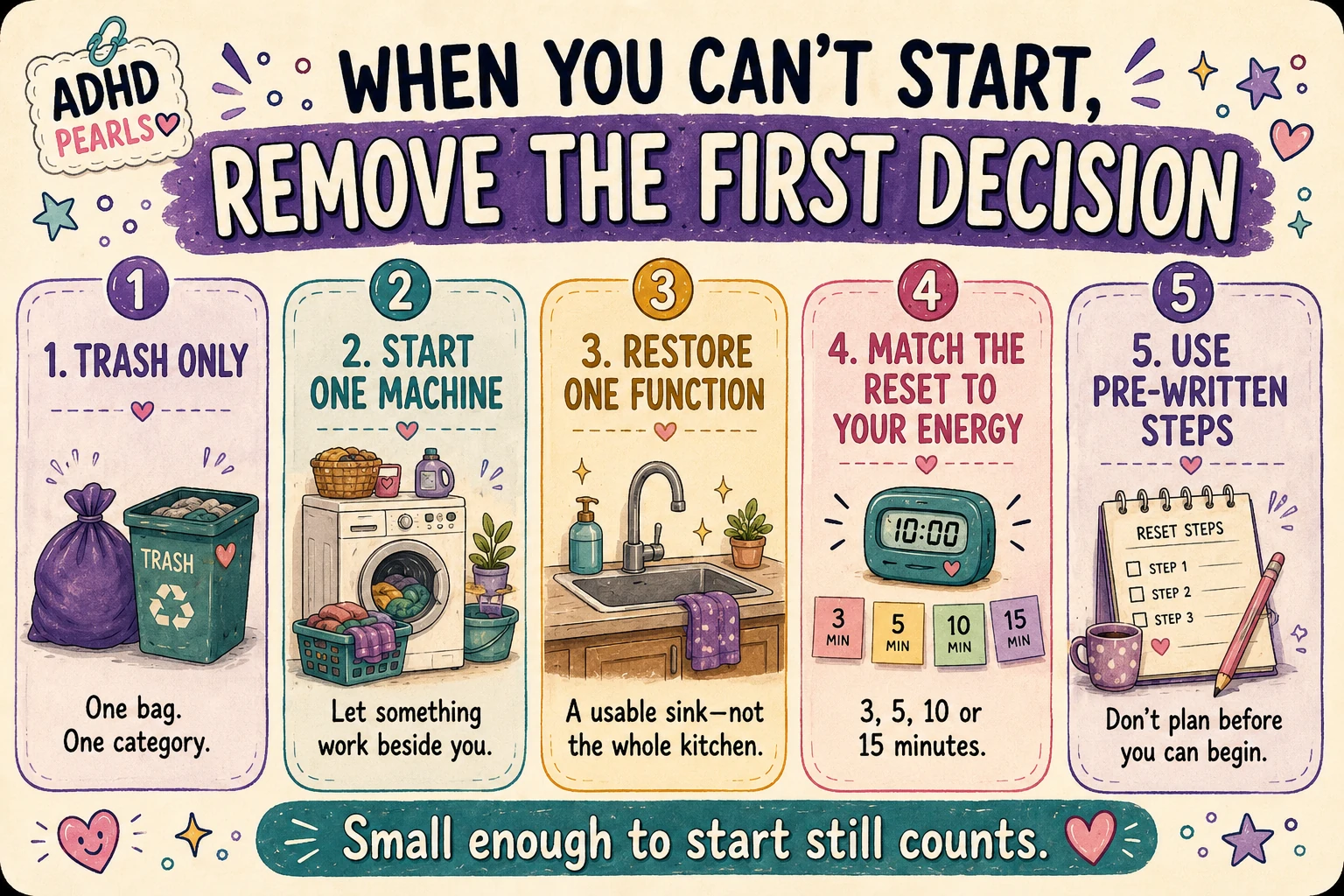
When starting is the problem, remove the decisions that have to happen before the first action.
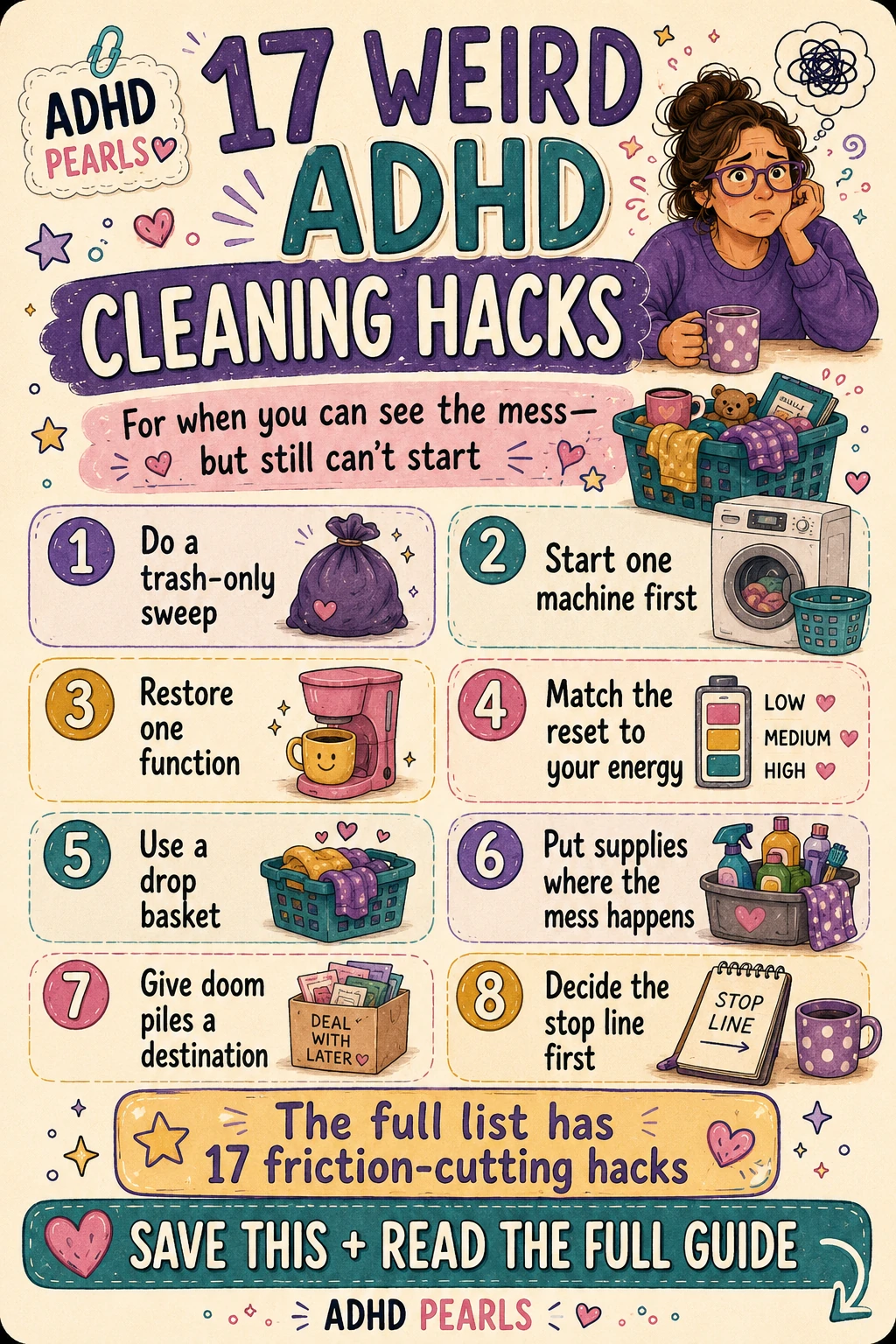
1. Do a trash-only sweep
What to do: Walk the room with one bag and collect only obvious rubbish. Nothing else. Don't tidy, don't sort, don't get sidetracked by the thing that belongs upstairs.
Why it helps: Trash is the only category that requires zero decisions — there's no "keep, donate or where does this live?" So it slips straight past decision friction and gets your body moving, which is most of the battle.
Try it today: Grab one bag, set a 3-minute timer, and collect only trash in the room you're standing in.
2. Put one machine to work before you clean
What to do: Before you touch anything else, start the dishwasher or the washing machine.
Why it helps: Now something is making progress in parallel with you, for free. You get an instant "this is happening" win, and a quiet bit of momentum, without spending any of your own attention.
Try it today: Load and start one machine first. That counts as beginning.
What to do: Don't "clean the bedroom." Make the bed usable, or clear a single path to the door. Pick a function, not a room.
Why it helps: "Clean the room" is a huge, fuzzy project with no edges. "Make this one surface usable" is a single task with a visible finish line your brain can actually hold.
Try it today: Choose one function — a usable sink, a clear path — and restore only that.
4. Choose the reset by energy, not by guilt
What to do: Pick a 3, 5, 10 or 15-minute reset based on the energy you actually have, not the energy you think you should have.
Why it helps: A guilt-sized task ("the whole kitchen") makes you freeze. A capacity-sized task ("three minutes") makes starting possible. On a hard day, small is the entire point — the same logic behind being productive on low-energy days.
Try it today: Name your energy out of ten, then choose the reset that honestly fits it.
5. Use a pre-written sequence instead of making another list
What to do: Follow steps someone has already written, rather than building a checklist first.
Why it helps: A blank list is itself a task — it stacks decision friction on top of start friction. If task initiation is the hard part, the last thing you need is to plan before you can do. Pre-written steps let your energy go into cleaning, not into designing the cleaning.
Try it today: For your next reset, use a ready-made sequence — even a saved note — instead of writing one from scratch.
Part 2: Hacks for Decision & Detour Friction
You started — and then a stray sock sent you upstairs, where you found three new tasks and forgot the kitchen existed. These hacks keep you in one place and cut the decisions per object.
Reduce room-hopping, extra decisions and the small detours that make the original task disappear.
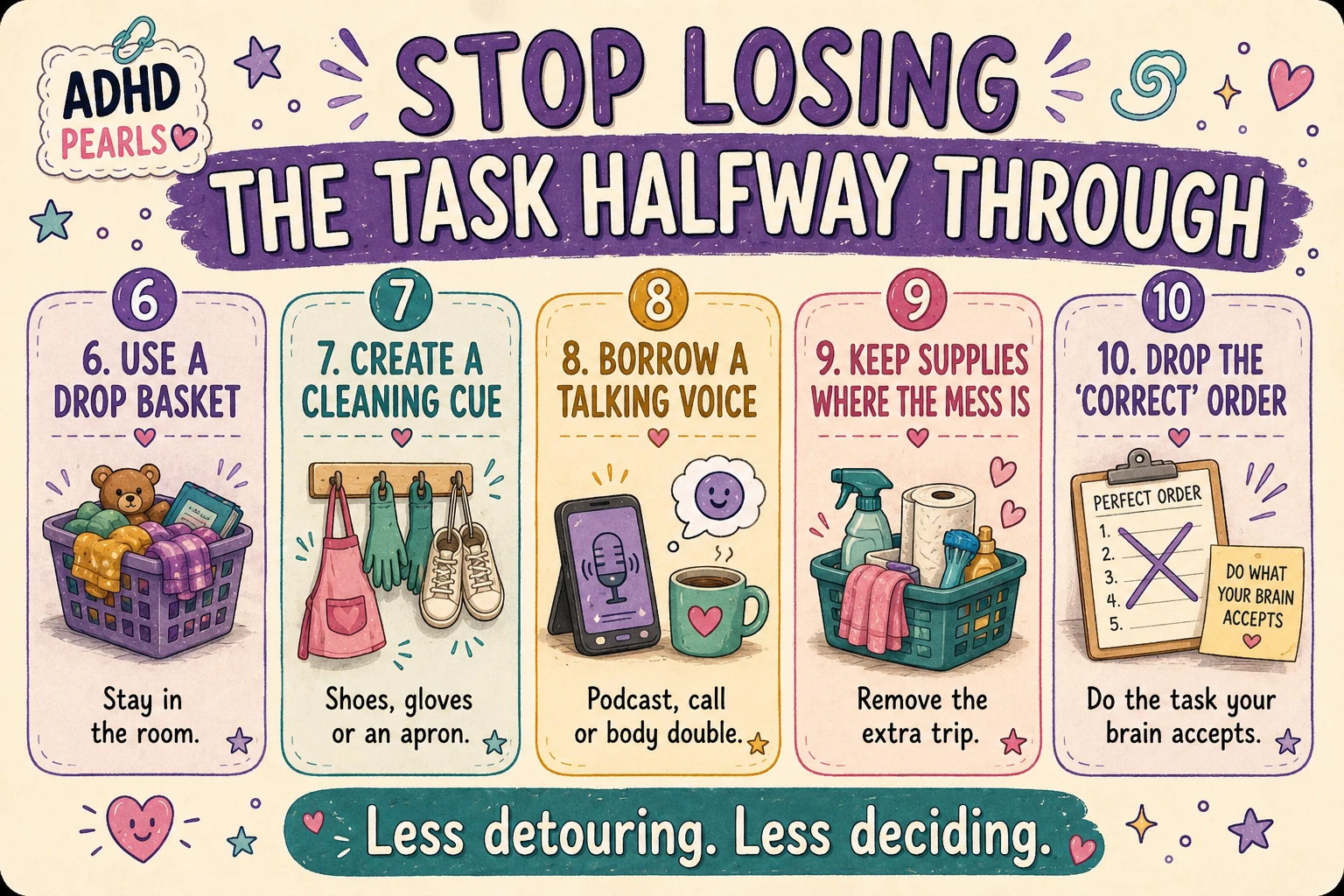
6. Keep a “belongs elsewhere” basket beside you
What to do: Keep one empty basket in the room and drop in everything that belongs somewhere else. Do not leave the room until the reset is finished — the basket gets carried out at the end, once.
Why it helps: Every trip into another room is a fresh chance to get distracted and lose the original task. One basket replaces twenty derailing little journeys with a single trip.
Try it today: Put a laundry basket by the kitchen door and use it only for things that need to leave the kitchen.
7. Wear cleaning-only shoes or gloves
What to do: Keep a pair of shoes, slippers or rubber gloves used only for cleaning, and put them on to begin.
Why it helps: A physical cue can flip your brain into "cleaning mode" — an external trigger that doesn't wait for motivation to show up first. Yes, it's a little silly. It also works.
Try it today: Pick one item — gloves, an apron, ugly slippers — to be your cleaning signal, and put it on before anything else.
8. Use a talking voice as a body double
What to do: Put on a chatty podcast, a "clean with me" video, or call a friend who'll potter about while you work — a voice in the room.
Why it helps: Body doubling borrows someone else's presence to anchor your attention, and many ADHD brains find it genuinely easier to start with someone "there." A talking voice is the lowest-effort version — no scheduling required. If it works on you, the full body doubling guide covers the stronger versions and how to pick one per task.
Try it today: Start a conversational podcast or a clean-with-me video, then begin during it.
9. Keep supplies where the mess happens
What to do: Stash wipes in the bathroom, bin bags right inside the bin, spray and a cloth in the kitchen.
Why it helps: If your supplies live in one cupboard across the house, fetching them is a detour — and the task often dies in the hallway. Supplies at the point of mess remove the trip entirely.
Try it today: Move one cleaning supply to the room where you actually use it.
10. Stop trying to clean in the “correct” order
What to do: If your brain will accept the mirror right now, clean the mirror. Drop the "right" sequence.
Why it helps: Insisting on the proper order is just more decision friction. Any task you actually start beats a perfectly-planned one you never begin. Movement matters more than method.
Try it today: Do the first thing your brain says yes to — even if it's "out of order."
Part 3: Hacks for Recurring-Mess Friction
Some messes aren't a discipline problem. They form in the same spot every time because your storage is fighting your actual behaviour. Stop fighting yourself and redesign around how you really move.
A recurring mess often reveals a system that does not match how the household actually functions.
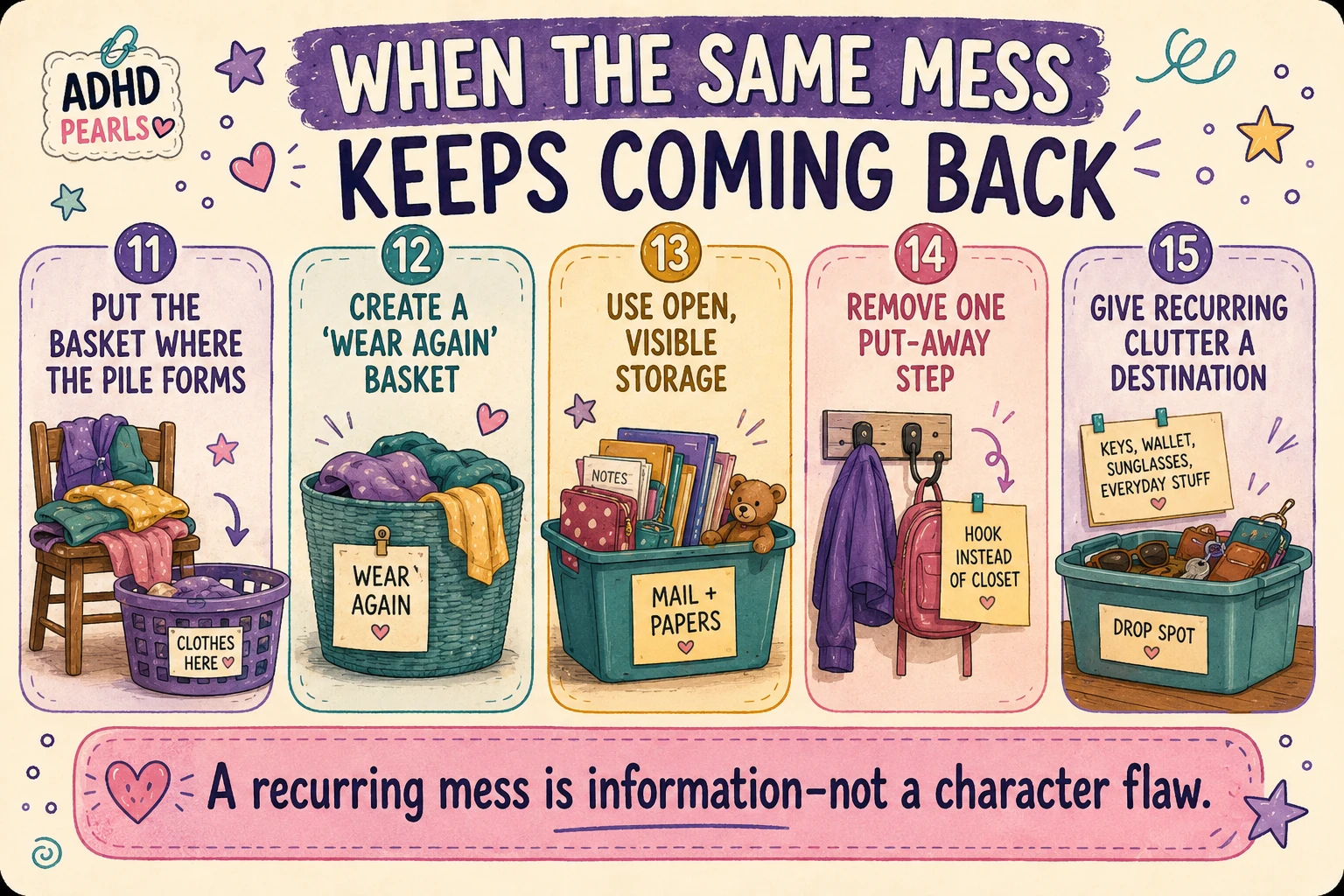
11. Put the basket where the pile already forms
What to do: Place storage where the mess actually lands — the chair, the end of the counter, the spot by the door — not where it would look neatest in a photo.
Why it helps: You can't out-discipline your own traffic patterns. If a pile always forms there, that's where the basket belongs, so the pile has somewhere to go by default.
Try it today: Find one spot where a pile always appears and put a basket or hook right there.
12. Create a “wear again” basket
What to do: Keep one basket for clothes that are worn but not dirty — the jeans that aren't ready for the wash but aren't going back in the drawer.
Why it helps: The chair-pile exists because there's no category between "clean, put away" and "dirty, laundry." The in-between basket gives those clothes a real home instead of the floor.
Try it today: Put one basket where you actually undress and call it "wear again."
13. Use open storage for things you need to remember
What to do: Use open bins, hooks and clear containers for important things — not closed, opaque drawers.
Why it helps: For ADHD brains, out of sight is genuinely out of mind. Tucking something important into a tidy closed system is how it quietly ceases to exist. Visible storage keeps it real.
Try it today: Move one important-but-forgettable item to open, visible storage.
14. Remove one step from putting things away
What to do: Take a step out of "away." Lose the lid, swap the hanger for a hook, skip the trip across the house, drop the fine sorting.
Why it helps: If putting something away is a five-step process, it won't happen. Make "away" a single motion and your brain will actually do it.
Try it today: Pick one thing that never gets put away and delete a step — an open bin instead of a lidded one, a hook instead of a hanger.
15. Give recurring clutter a visible destination
What to do: Mail, donations, cables, "needs to go to another room" — give each one clear, labelled home.
Why it helps: Clutter with no destination becomes a doom pile by default. A labelled spot turns "where does this even go?" into a one-second decision. When the whole home feels too loud, fewer open questions is the relief. If you would rather follow a list than pick a hack, the ADHD cleaning reset checklist sequences it for you. And if the pile that never clears is specifically laundry, that has its own broken circuit - see the ADHD laundry system.
Try it today: Pick the clutter that returns most and give it one labelled destination.
Part 4: Hacks for Stop-and-Restart Friction
Two opposite problems live here: the brain that can't begin because there's no end in sight, and the brain that begins and then reorganises the entire bathroom for four hours. Both are fixed by defining the edges.
16. Separate a reset from a deep clean
What to do: Decide up front which one today is. A reset makes a space usable again. A deep clean is a different, bigger project.
Why it helps: Resets quietly mutate into marathons when "make it usable" secretly becomes "empty every cupboard." Naming it a reset keeps it contained — and keeps tomorrow's energy intact.
Try it today: Before you start, say it out loud: this is a reset, not a deep clean.
17. Decide the stop line before you begin
What to do: Write your finish line first, in one sentence — the sink is usable, the main counter is clear, there's a path, a machine is running, the trash is by the door. When it's reached, you're done.
Why it helps: Without a defined end, an ADHD brain either won't start (no edge to aim at) or won't stop (no permission to). A stop line gives you both. And it carries the most important rule of all: never catch up — restart from today. Rigid "make up the missed days" systems collapse after one bad week; a reset you simply choose for today never builds a backlog to dread.
Try it today: Write your one-sentence stop line before you touch anything. Reach it, stop, and tomorrow start fresh from today — not from the backlog.
I don't need the house finished. I need to know, before I start, what "enough for today" looks like — and that I'm allowed to stop there.
When 17 Hacks Become 17 More Things to Remember
Here's the honest catch. Hacks are useful when you can remember which one fits the moment. But on the days the house feels loudest, recalling seventeen strategies and picking the right one becomes its own planning task — exactly the kind your brain is already refusing to do.
That's the gap the ADHD Cleaning + Home Reset Bundle closes. It removes the choosing. You pick the room, pressure point or energy level; you open one pre-written reset; you follow the visible sequence; you stop at the defined result. Less deciding, faster starting.
Because it leans on the exact skills ADHD makes harder: starting, holding steps in working memory, deciding what to do with each object, and knowing when you're done. "Clean the house" loads as one enormous project, so the brain stalls before the first action. It's an executive-function difference, not laziness.
How do I start cleaning when my house is already a mess?
Restore one function, not a room. Do a trash-only sweep, start one machine so something works in parallel, and clear one usable surface or path. When the house already feels too much, the goal is to make one thing usable — not to finish everything.
What should I clean first with ADHD?
The category that needs zero decisions: trash. Collecting only obvious rubbish bypasses decision paralysis and gets you moving. Then restore one function — a usable sink, a clear counter, a path to the door — rather than a whole room.
How do I stop getting distracted while cleaning?
Stay in one room and keep a "belongs elsewhere" basket beside you, so you stop leaving (and getting derailed) every time you find a stray object. Keep supplies where the mess happens, and use a talking podcast or clean-with-me video as a body double to anchor your attention.
Is an ADHD cleaning checklist or schedule better?
A rigid weekly schedule often collapses after one missed day and becomes a backlog. For most ADHD brains a flexible, pre-written reset chosen by today's energy works better — there's nothing to catch up on, so a hard week doesn't end the whole system.
How long should an ADHD cleaning reset take?
As long as your real energy allows — a 3, 5, 10 or 15-minute reset chosen by capacity, not guilt. A short, defined reset is far more likely to happen than an open-ended "clean until it's done," which tends to either never start or balloon into a marathon.
What is cleaning paralysis?
When you can see the mess, know exactly what to do, and still can't make yourself begin. It's a form of task paralysis driven by executive-function differences — too many decisions and no clear first step — not a lack of care.
How do I deal with ADHD doom piles?
Treat the pile as separate decisions, not one project — one object at a time (trash, has-a-home, needs-an-action). Then change what creates it: put a basket where the pile forms, give recurring clutter a labelled home, and use open storage so important things don't vanish.
What if I stop cleaning for a week?
Nothing is owed. The most sustainable ADHD approach assumes there will be missed days, so there's no backlog and no catch-up. You choose the reset that fits today and start from where you are.
How is the free checklist different from the Home Reset Bundle?
The free checklist is a gentle one-download starting point. The bundle is the bigger system — pre-written resets chosen by room and energy, a Doom Pile Decision Card, a Recurring Mess Audit, a Body Double session and Home Reset Labels — built so you don't have to remember or choose the right hack when you're already overwhelmed.
Sources I leaned on while writing this
KC Davis. What is Struggle Care? strugglecare.com. The principle that care tasks are morally neutral and your home exists to serve you — not the other way around.
LA Concierge Psychologist. ADHD and the Pillars of Struggle Care. laconciergepsychologist.com. How executive-function challenges (task initiation, sequencing, working memory) make care tasks hard.
You're not lazy and you don't lack discipline. You're running a brain that finds the deciding, the sequencing and the stopping genuinely hard — in a home that offers infinite freedom and zero external structure. The hacks above aren't about motivation. They're about removing friction so the first step is small enough to actually take.
Pick one from the friction type that's stopping you most, and try it in the next ten minutes. Restore one function. Then stop. That's the whole job today.
Save these ADHD cleaning hacks for later
Save this infographic to Pinterest so the hacks are easier to find on a stuck day.
One tap makes ADHD Pearls a preferred source in your Google account, so our articles surface higher when you search. No signup, and it brings you straight back to this page.
Before you go
ADHD Cleaning + Home Reset Bundle
Pre-written resets, printables and labels for the days your room is winning.
For the woman who sets up the perfect system on Sunday and abandons it by Tuesday.
One short letter, every week. Real talk about ADHD, task paralysis, and the tiny wins that actually move the needle for a brain like yours. No shame. No hustle culture.