There is a laundry pile in my bedroom that has been there since Tuesday.
I see it every time I walk past. I think about it. I plan to deal with it. I promise myself I will start after lunch, after this email, after this cup of tea.
And then I don’t.
Not because I don’t care. Not because I am lazy. But because something between my brain and that pile keeps breaking down, and no amount of knowing what to do fixes the gap between knowing and starting.
If you have ever stood in the middle of your own home feeling like a stranger to it — like the mess is speaking a language you understand but cannot respond to — this article is for you.
This article shares personal insight and educational information about ADHD and cleaning overwhelm. It is not medical advice. If your home environment, mood, or daily functioning feel unmanageable, please reach out to a qualified professional for support.
Quick answer
How do I clean when I am too overwhelmed to start?
Stop treating it as one task. Cleaning is a stack of hidden decisions: notice the mess, choose a starting point, find supplies, manage the shame, decide when it is finished. Remove the deciding instead of finding motivation — do a rubbish-only sweep first, clear one surface, set a timer, and stop when it rings whether or not you are done.
Key takeaways
📌Cleaning is not one task. It is a stack of hidden decisions, and the deciding is what fails.
📌Remove the choosing rather than the mess: rubbish-only sweep first, then one surface.
📌Set a timer and stop when it rings, finished or not. Stopping is part of the method.
📌A reset works better than a routine, because a routine needs a good week to survive.
📌When shame turns up mid-clean, that is a signal to shrink the job, not to push harder.
Quick Answer
Why is cleaning so hard with ADHD?
Cleaning feels hard with ADHD because it is not one task. It is a stack of invisible steps: noticing the mess, choosing where to start, finding supplies, managing shame, staying focused, and stopping before burnout. When your brain is overwhelmed, a full cleaning routine can feel impossible. A small reset checklist works better because it gives your brain one safe starting point.
Key Takeaways
✓ Cleaning with ADHD often feels impossible because the task has too many hidden steps.
✓ Shame makes cleaning paralysis worse, not better.
✓ A full-house cleaning plan is usually too heavy for an overwhelmed ADHD brain.
✓ A reset works better than a routine when energy is low.
✓ The goal is not a perfect home. The goal is one small starting point.
✓ A printable ADHD cleaning checklist can reduce decisions and help you begin.
It is not laziness. It is not that you do not care. It is that cleaning is one of the highest-demand tasks there is for an ADHD brain.
Here is why:
Executive dysfunction. The part of the brain that helps you start, sequence, and shift between tasks does not work the same way in ADHD. Cleaning requires all three, constantly, at the same time.
Task initiation. Even when you want to clean, you may not be able to begin. Task initiation is not about wanting. It is a neurological function. ADHD makes starting harder, especially when a task is unpleasant, invisible in its consequences, or does not offer immediate reward.
Decision fatigue. Where do you start? The kitchen? The laundry? The thing on the floor you have been stepping over? Every option requires a decision. When you are already depleted, that stack of decisions feels like a wall.
Sensory overwhelm. Clutter is visual noise. A messy space can feel genuinely loud to an ADHD brain, making it harder to think clearly enough to clean it.
Clutter blindness. Some ADHD brains swing the other way and stop registering the mess entirely. You are not ignoring it. You genuinely stopped seeing it. Until suddenly you see all of it at once and freeze.
Shame spiral. The longer the mess builds, the heavier the shame. And shame burns energy before the task even starts. By the time you are standing at the starting line, you are already exhausted from feeling bad about standing there.
The pile that keeps waiting. One of the hardest things about ADHD cleaning overwhelm is that you can see it, feel it, and still not be able to start.
From ADHD Pearls
Free Cleaning Reset
A gentle checklist for when the mess piles up and your brain won't start.
When someone says “just clean the kitchen,” what they are actually asking for is this:
Notice what is out of place
Decide what matters first
Gather supplies
Throw things away
Put things back in their places
Deal with the dishes
Wipe the surfaces
Handle any interruptions that come up
Decide when “clean enough” is
Put the cleaning supplies away
That is not one task. That is ten tasks, each requiring its own decision, its own transition, its own sustained attention.
For an ADHD brain, “clean the kitchen” is not a task. It is a project.
Real Talk
A messy home is not proof that you failed adulthood. It usually means your brain is overloaded, your system has too many steps, and shame has made the starting line feel heavier. That is a systems problem. Not a character problem.
Why Most Cleaning Advice Fails ADHD Brains
Most cleaning advice was written for neurotypical brains. It assumes consistent follow-through, habit formation that works linearly, and the ability to do the same thing every week without needing external structure to re-enter.
Here is the advice we are given, and why it tends to fall apart:
Common advice
Sounds helpful because
Fails ADHD brains because
Gentler reset instead
Clean the whole room
Feels complete when done
Too many decisions at once
Pick one visible surface
Make a weekly schedule
Creates structure
Breaks after one missed day
Use a reset checklist
Declutter first
Reduces mess permanently
Creates emotional overload
Remove 5 obvious items
Just do 15 minutes
Sounds manageable
Still requires task initiation
Start with 2–5 minutes
Clean as you go
Prevents build-up
Requires constant awareness
Use visible reset points
None of this advice is wrong. It just was not designed for brains that struggle with task initiation, habit formation, and returning to abandoned routines without external structure.
If you have tried all of this and felt like a failure when it did not stick, the advice was failing you. Not the other way around.
Why a Reset Works Better Than a Routine
A routine assumes you will show up the same way every day. An ADHD brain does not work that way.
A reset does not ask that. A reset is a low-pressure re-entry point. It assumes you have been away. It assumes you are overwhelmed. It meets you where you actually are, not where a routine expects you to be.
A reset does not ask your brain to fix the whole house. It asks your brain to choose one tiny next step.
One surface. Five minutes. That is a complete reset.
A routine says: you should have done this yesterday.
A reset says: here is a place to begin right now.
That is a different relationship with the task entirely. And for ADHD brains that have been failing routines for years, that shift matters.
Try This
Pick one surface. Set a five-minute timer. Stop when it rings. Stopping counts. The timer is not a challenge. It is permission to begin and permission to stop.
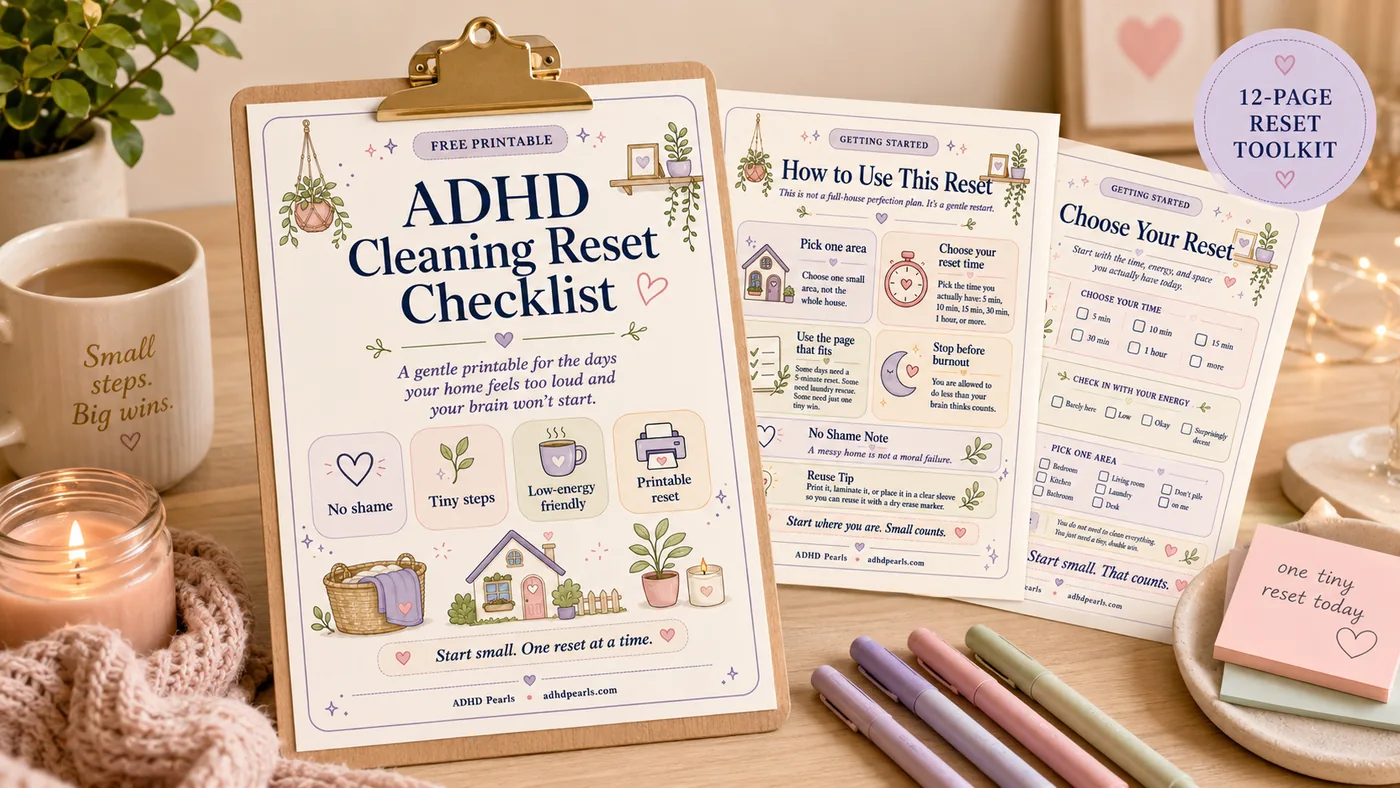
The ADHD Cleaning Reset Checklist is a free 12-page printable designed for messy, overwhelming, low-energy days. It does not ask you to clean your whole home. It asks you to choose one tiny reset and begin there.
Here is how to use it:
Choose your reset time. How much time do you actually have? Two minutes? Fifteen? The checklist has a page for both.
Check your energy. Are you at 20%? 50%? The page you choose should match where you actually are, not where you wish you were.
Pick one area. Not a room. One area. One counter. One pile. One basket.
Choose one tiny goal. Clear it? Sort it? Move it somewhere better? One goal.
Set a timer. Even a two-minute timer changes the relationship with the task.
Stop when the timer rings. Not after one more thing. When it rings.
Track the win. Write it on the Tiny Cleaning Wins Tracker. Because it counts.
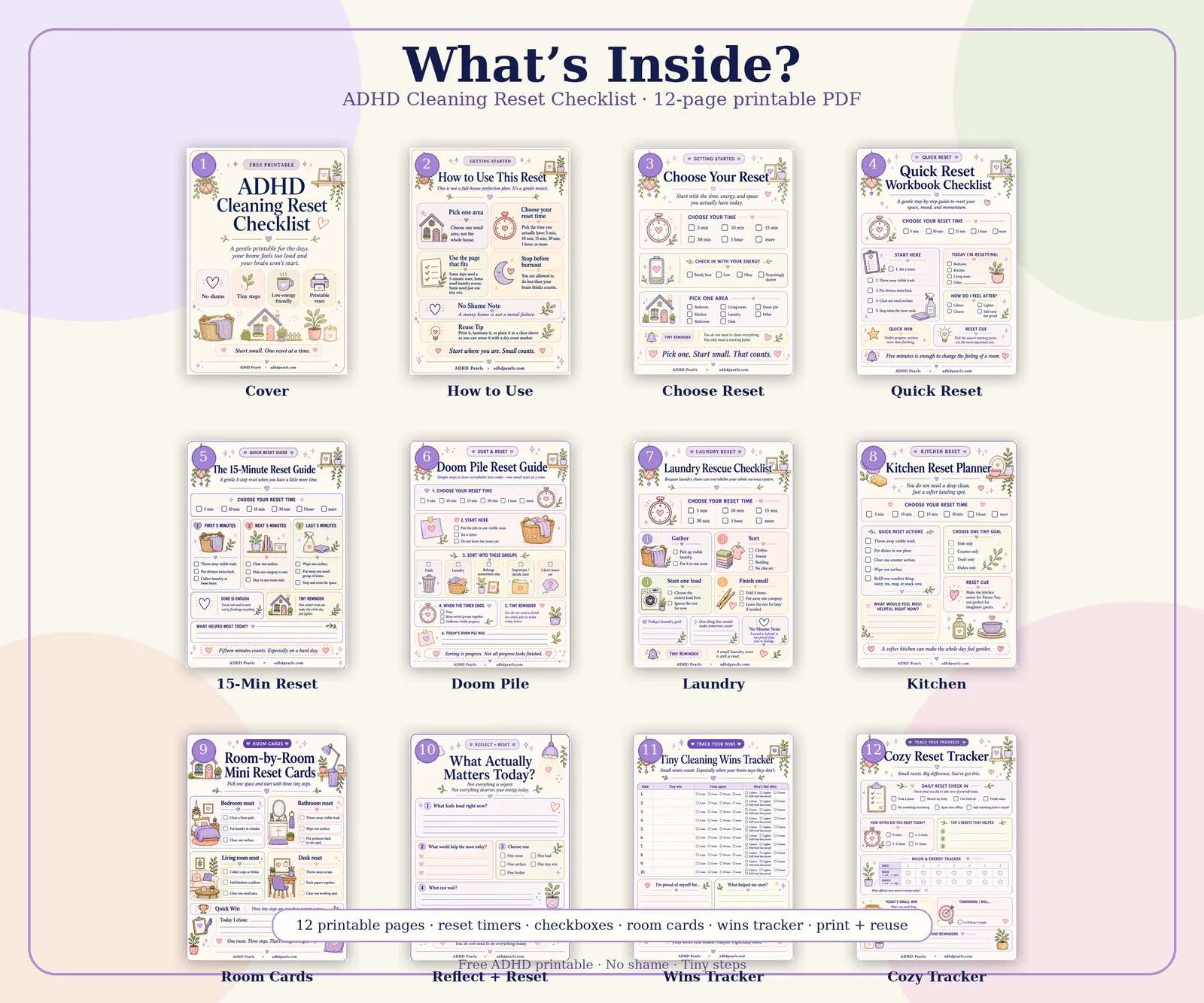
What’s Inside the Free ADHD Cleaning Reset Checklist
The printable has 12 pages. You do not have to use every page. Pick the one that matches your energy today.
All 12 pages inside the ADHD Cleaning Reset Checklist printable.
Cover page — Because starting something with a cover page feels better than starting a blank form.
How to Use This Reset — A simple guide to using the checklist without turning it into another pressure system.
Choose Your Reset — Pick your entry point based on time, energy, and what your brain can actually handle today.
Quick Reset Workbook Checklist — For the fastest possible reset. Tick what you did. That is the whole thing.
15-Minute Reset Guide — A timed reset for when you have a window and need structure to use it.
Doom Pile Reset Guide — A gentle step-by-step page for the pile that has been there for weeks.
Laundry Rescue Checklist — Break the laundry loop into steps your brain can actually follow.
Kitchen Reset Planner — One page for the kitchen that keeps making you look away.
Room-by-Room Mini Reset Cards — Small, targeted resets for individual spaces.
What Actually Matters Today? — A decision page for days when everything feels equally urgent and nothing gets started.
Tiny Cleaning Wins Tracker — Count every small thing. Because small things count.
Cozy Reset Tracker — A gentle tracker for the days when cozy is enough.
You can print all pages, laminate them, or keep them in a clear sleeve and reuse with a dry-erase marker.
What To Do When Shame Shows Up
It will.
You will stand in the middle of the mess and feel a wave of something that is not just tiredness. It is shame. Heavy, personal, history-soaked shame.
The shame says you should have dealt with this days ago. It says this is what your life looks like. It says people with their lives together do not live like this.
And shame burns energy before the task even starts. By the time you have finished the shame spiral, you have nothing left for the actual cleaning.
Here is what I have learned to say back:
“I am not lazy. I am overloaded.”
“One reset counts. The whole house does not have to be clean.”
“I can stop before burnout. Stopping is not failure.”
“My home does not have to be perfect to feel lighter.”
Shame is not a motivator. It never was. It is a weight. And you are allowed to put it down before you start.
You are allowed to make the room 5% easier to breathe in. That still counts. Five percent is not nothing. Five percent is a beginning.
If you find that shame, overwhelm, or avoidance are showing up in most areas of your life, that is worth bringing to a professional. ADHD task paralysis and shame are connected, and support helps.
A Small Reset Is Still a Reset
You do not need a perfect cleaning system.
You do not need to become a different woman before breakfast.
You do not need to fix all of it today.
You need one gentle place to begin.
If today that means clearing one counter, throwing away five things, running one load of laundry, or wiping one surface — that counts. That is a real thing that happened in your real home. It does not stop counting because the rest of the room is still messy.
You are not behind. You are beginning. And beginning is the whole thing.
The ADHD Cleaning Reset Checklist is there for the days when beginning feels like too much. It is designed to make beginning small enough to actually do.
FAQ: Cleaning with ADHD
Why is cleaning so hard with ADHD?
Cleaning is hard with ADHD because it is not one task. It is a stack of hidden decisions, transitions, sensory input, shame, and executive function demands. Your brain has to notice the mess, choose where to start, find supplies, manage emotions, stay focused, and decide when to stop. That is exhausting before you even pick up a sponge.
How do I start cleaning when I feel overwhelmed?
Start smaller than feels reasonable. Instead of cleaning a room, clean one surface. Instead of 30 minutes, set a 5-minute timer. The goal is not a clean house. The goal is one starting point your brain can actually enter. A printable reset checklist helps by removing the decision about where to begin.
What is an ADHD cleaning reset?
An ADHD cleaning reset is a short, low-pressure re-entry into cleaning. It is not a full routine. It does not ask you to fix the whole house. It gives your brain one safe starting point — one area, one timer, one tiny goal — and lets you stop when it rings.
Is a cleaning checklist helpful for ADHD?
Yes, especially one designed for low-energy days. A checklist removes decision fatigue by telling your brain exactly what to do next. It also gives you a sense of completion that helps with task initiation. The key is keeping the list short and low-pressure — not a full house cleaning plan.
How do I clean with ADHD when I have no energy?
Use the lowest possible version. Clear one surface. Throw away five obvious items. Move the laundry to the machine even if you do not start it. A two-minute reset counts. Stopping before burnout counts. The goal is not a perfect home. The goal is one small thing that makes the room 5% easier to breathe in.
Why do I feel ashamed of my messy house?
Because society tells us a clean home reflects personal character. For women especially, a messy space is read as laziness or failure. But a messy home usually means your brain is overloaded, your system has too many steps, and shame has made the starting line heavier. You are not failing adulthood. You are managing a brain that needs a different system.
What room should I clean first with ADHD?
The one that gives you the most relief or the most visible result. For many ADHD brains, the kitchen counter or the area you walk past most often works well. Visible progress helps the brain feel safe enough to continue. If you cannot decide, start where you are standing right now.
Is a messy house a sign of laziness?
No. A messy house is often a sign of executive dysfunction, overwhelm, sensory sensitivity, decision fatigue, or a task management system that was not built for your brain. Laziness implies you could start but chose not to. Most people with ADHD want to clean and genuinely cannot get the task started. Those are very different things.
Sources & further reading
These sources informed the thinking behind this article. They are not endorsements, and this article is not medical advice.
CHADD — Children and Adults with ADHD.ADHD and Daily Life. Practical overview of how executive dysfunction affects everyday tasks including home management.
ADDitude Magazine.ADHD and Clutter. Real-life accounts and practical strategies for managing clutter and home overwhelm with ADHD.
National Institute of Mental Health (NIMH).Attention-Deficit/Hyperactivity Disorder. Evidence-based overview of ADHD, executive function, and how ADHD affects daily functioning.
Brown, T. E. (2013).A New Understanding of ADHD in Children and Adults: Executive Function Impairments. Routledge. Foundational work on executive function and how ADHD affects task initiation, planning, and follow-through.
Cleaning is hard with ADHD because it is not one task. It is a stack of hidden decisions, transitions, sensory input, shame, and executive function demands. Your brain has to notice the mess, choose where to start, find supplies, manage emotions, stay focused, and decide when to stop. That is exhausting before you even pick up a sponge.
How do I start cleaning when I feel overwhelmed?
Start smaller than feels reasonable. Instead of cleaning a room, clean one surface. Instead of 30 minutes, set a 5-minute timer. The goal is not a clean house. The goal is one starting point your brain can actually enter. A printable reset checklist helps by removing the decision about where to begin.
What is an ADHD cleaning reset?
An ADHD cleaning reset is a short, low-pressure re-entry into cleaning. It is not a full routine. It does not ask you to fix the whole house. It gives your brain one safe starting point — one area, one timer, one tiny goal — and lets you stop when it rings.
Is a cleaning checklist helpful for ADHD?
Yes, especially one designed for low-energy days. A checklist removes decision fatigue by telling your brain exactly what to do next. It also gives you a sense of completion that helps with task initiation. The key is keeping the list short and low-pressure, not a full house cleaning plan.
How do I clean with ADHD when I have no energy?
Use the lowest possible version. Clear one surface. Throw away five obvious items. Move the laundry to the machine even if you do not start it. A two-minute reset counts. Stopping before burnout counts. The goal is not a perfect home. The goal is one small thing that makes the room 5% easier to breathe in.
Why do I feel ashamed of my messy house?
Because society tells us that a clean home reflects personal character. For women especially, a messy space is read as laziness or failure. But a messy home usually means your brain is overloaded, your system has too many steps, and shame has made the starting line heavier. You are not failing adulthood. You are managing a brain that needs a different system.
What room should I clean first with ADHD?
The one that gives you the most relief or the most visible result. For many ADHD brains, the kitchen counter or the area you walk past most often works well. Visible progress helps the brain feel safe enough to continue. If you cannot decide, start where you are standing right now.
Is a messy house a sign of laziness?
No. A messy house is often a sign of executive dysfunction, overwhelm, sensory sensitivity, decision fatigue, or a task management system that was not built for your brain. Laziness implies you could start but chose not to. Most people with ADHD want to clean and genuinely cannot get the task started. Those are very different things.
Found this helpful? Share it with someone who gets stuck too.
One tap makes ADHD Pearls a preferred source in your Google account, so our articles surface higher when you search. No signup, and it brings you straight back to this page.
Before you go
Free Cleaning Reset
A gentle checklist for when the mess piles up and your brain won't start.
For the woman who sets up the perfect system on Sunday and abandons it by Tuesday.
One short letter, every week. Real talk about ADHD, task paralysis, and the tiny wins that actually move the needle for a brain like yours. No shame. No hustle culture.